Every Slovak Commercial Airport Inspected by Drone
TarmacView has flown drone lighting inspections at all seven Slovak commercial airports. How the method works, what the data changed and what comes next.
 PAPI · TRENČÍN · DUSK
The short answer
In recent months TarmacView has done a drone lighting inspection at every commercial airport in Slovakia: Bratislava, Košice, Poprad, Piešťany, Žilina, Trenčín and Nitra. Piešťany was the last of the seven.
We used one standard commercial drone and the same automated method at all seven. Several airports have already used the data to adjust their lights. This post explains how the method works, what we saw and what comes next.
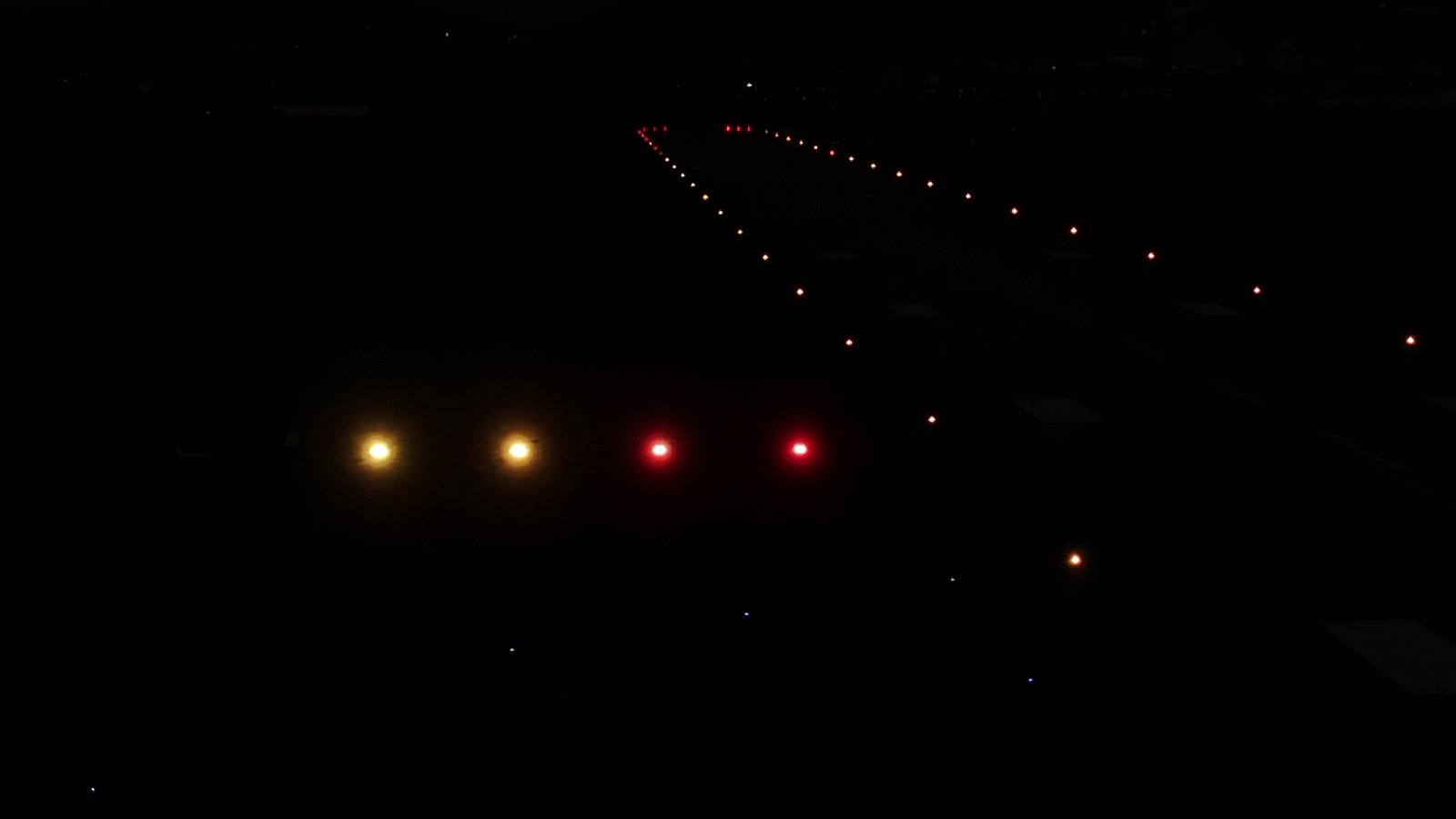
A PAPI at Trenčín at dusk, two lights white and two red. This is a frame from our drone’s video.
The seven airports
We started with Žilina and Trenčín and flew the other five over the following months. Each airport gave us access to its airside , and each flight ran while the airport stayed in operation.
| Airport | Place in the programme |
|---|---|
| Žilina | One of the first two airports we flew |
| Trenčín | One of the first two airports we flew. First airport to re-adjust its lights on our data |
| Bratislava | Flown in recent months |
| Košice | Flown in recent months |
| Poprad | Flown in recent months |
| Nitra | Flown in recent months |
| Piešťany | Flown in recent months, the last of the seven |
Our scope was the approach, runway and taxiway lights. The PAPI is the clearest example, so we use it in this post.
How airports check their lights today
A visual approach slope indicator such as the PAPI shows a pilot whether the aircraft is above, on or below the glide path . The colour change of each unit must happen at a set angle. If a unit drifts, the pilot sees a wrong picture.
Annex 14 to the Chicago Convention sets the requirements for these visual aids in Chapter 5. Chapter 10 requires the aerodrome to maintain them. The EASA acceptable means of compliance for ADR.OPS.C.015 asks for a flight check of the approach, runway and taxiway lights and the PAPI. It asks for the check at least once a year. It is one accepted way to comply and not the only way.
The usual tool is a flight inspection aircraft, often called a calibration aircraft. It flies the approach, and the crew judges the lights by eye and with instruments. A visit costs €5k to 7k, based on about €3,000 per flight hour. Because of this cost, airports order it 2 to 3 times a year.
That cadence leaves a gap. If a light fails or drifts just after a visit, it waits for the next one. The report from the visit also arrives weeks later. Between flight checks, the airport has little evidence of the state of its lights.
How the drone inspection works
The method has five steps.
- Survey once. We survey the airport one time and record the position of every light.
- Generate the missions. From the survey we generate centimetre-precise flight missions. We validate each mission against the airport model before it flies.
- Fly. A standard commercial drone flies the mission on its own. The airport stays in operation, and the drone gives way to aircraft.
- Read the lights. Our software tracks each light in the video. It reads the colour and the angle frame by frame.
- Evaluate and report. The evaluation is deterministic. The same video gives the same result. The protocol is ready the same day.
For one runway side the time from take-off to results is about 15 minutes. For both PAPI systems of an airport it is about 30 minutes. Repeat flights agree within 2 arcminutes, which is 1/30 of a degree or 0.03°. An arcminute is 1/60 of a degree. At a distance of 100 m, 1 arcminute is about 2.9 cm of arc.
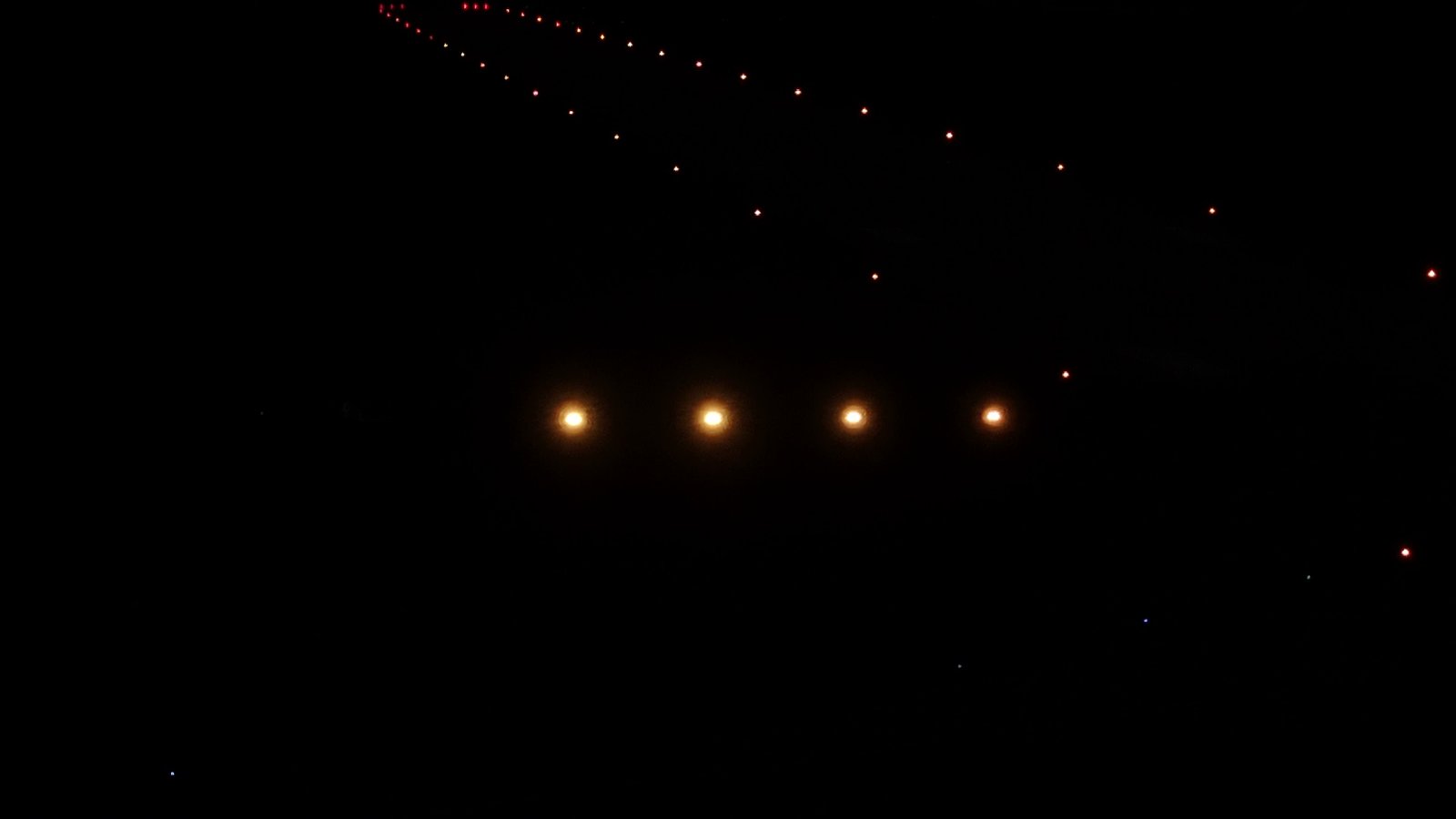
The same PAPI with all four lights white. The drone is above the glide path.
The drone flies up through the colour change of each unit, so the video shows where each unit switches from red to white. The software turns that into an angle. The repeatability of this angle is what the 2 arcminute figure describes. It is not a claim that every unit meets a tolerance. The tolerance comes from the standard and from the aerodrome’s own manual.
Calibration aircraft and drone inspection compared
| Question | Calibration aircraft | Drone inspection |
|---|---|---|
| Who judges the lights | A crew, by eye and with instruments | Software, from the video, frame by frame |
| How often | 2 to 3 times a year | Whenever the airport wants a measurement |
| Time to results | A report weeks later | The protocol the same day |
| Cost per check | €5k to 7k per visit | Not shown here |
| Accepted for | Flight checks under the aerodrome rules | Recognition is in talks, no acceptance is claimed |
We do not show a drone price in this post. Airports pay yearly, and we scope each airport on its own.
We do not replace the calibration aircraft. We complement it. Between flight checks, the airport knows whether its lights are right. Our guide on drone versus flight inspection compares the two in more detail.
What the data changed
Trenčín was the first airport to re-adjust its lights based on our data. We did the field check there together with the external PAPI contractor that adjusts the lights. The measurement told the team which units to look at. The team did the adjustment.
Several more airports have done the same since. We name only Trenčín, because the others have not agreed to be named.
Here the old and the new method differ most. With a calibration aircraft, the lights are judged a few times a year. With a drone, a unit that drifts shows up in the next measurement. For a lighting team that is a revolution in precision, speed and cost. Repeat flights agree within 2 arcminutes. The results arrive about 15 minutes after take-off. A calibration aircraft visit costs €5k to 7k.
The data answers a practical question for a maintenance team. Which unit, which direction and by how much? The team can fix the unit and the drone can measure it again.
Why airports took the leap
Airports are conservative, and they have good reason to be. Their lights guide aircraft in the dark and in poor weather. Trusting a new method with those lights is a big leap of faith.
In the beginning the first measurements were free. We wanted references, and we wanted airports to see their own data before they decided anything. Every airport team gave us access to the airside, and every team took that leap with us. Thank you.
The airports are satisfied with the results. We are now in talks to sign a memorandum of understanding with each of them. An MOU is a statement of intent and not a contract. It sets the next steps.
What comes next
First, recognition. We are in talks with the Slovak Transport Authority about recognition of drone inspection. We do not claim regulatory acceptance. Whether a method satisfies the rules is the decision of the authority. Our post on what a regulator accepts as evidence explains how that decision works.
Second, scale. Our software is certified by the Slovak Armed Forces after an extensive audit. TarmacView also holds the EIC Seal of Excellence for lighting and runway inspection. Military airfields are a natural next step, because a base also needs a consistent method across its sites. Operators of several airports have the same need. Our page on lighting inspection for a network of airports describes it.
Third, more systems. The PAPI inspection is the service most airports start with. The same flights also cover approach lighting and the other aeronautical ground lights .
Questions people ask
Is a drone inspection accepted instead of a flight inspection aircraft?
Not as a replacement, and we do not claim it. We complement the aircraft between flight checks. Recognition is in talks with the Slovak Transport Authority. Other authorities decide for themselves.
How accurate is a drone PAPI measurement compared to an aircraft?
Repeat flights agree within 2 arcminutes. An aircraft crew judges the colour change by eye, from one path at approach speed. The drone flies several descent paths and eye heights, and the software reads every frame. Our post on how precise a PAPI flight check is explains the difference.
How often should airfield lights be checked?
The EASA means of compliance asks for a flight check at least yearly. Airports order a calibration aircraft 2 to 3 times a year. A drone measurement can fill the time between those visits.
How long does a drone lighting inspection take?
About 15 minutes from take-off to results for one runway side, and about 30 minutes for both PAPI systems of an airport. The protocol follows the same day.
What does the airport need to provide?
Access to the airside and a flight slot that fits its operation. The drone flies on its own and gives way to aircraft. The airport does not need to close the runway for the flight.
Which Slovak airports have been inspected?
All seven commercial airports: Bratislava, Košice, Poprad, Piešťany, Žilina, Trenčín and Nitra. Piešťany was the last of the seven.
What is an MOU between an airport and a supplier?
A statement of intent between the two sides that records the next steps. It is usually not a contract. Read the definition of a memorandum of understanding for the details.
Does the drone measure the intensity of the lights?
No. Our measurement is pixel-based from the video, and it reads colour and angle. We publish no photometric values.
References
- icao-annex-14-vol-i
- Annex 14 to the Convention on International Civil Aviation, Aerodromes, Volume I: Aerodrome Design and Operations, 9th edition International Civil Aviation Organization
- easa-ear-aerodromes
- Easy Access Rules for Aerodromes (Regulation (EU) No 139/2014), including CS-ADR-DSN Issue 7 European Union Aviation Safety Agency
Founded by flight-inspection veterans who spent decades measuring PAPI lights for aviation authorities across Europe.