What are Air Voids in Asphalt Pavement Mixtures?
Definition and Volumetric Role of Air Voids
Air voids (Va), also referred to as voids in the total mix (VTM), percent air voids, or simply void content, are the small pockets of air that exist between the coated aggregate particles throughout a compacted hot-mix asphalt (HMA) paving mixture. They are expressed as a percentage of the total bulk volume of the compacted mixture and represent one of the three fundamental volumetric constituents of asphalt concrete: aggregate, asphalt binder, and air. The standard engineering definition from AASHTO and ASTM is: “The total volume of the small pockets of air between the coated aggregate particles throughout a compacted paving mixture, expressed as a percent of the bulk volume of the compacted paving mixture.”
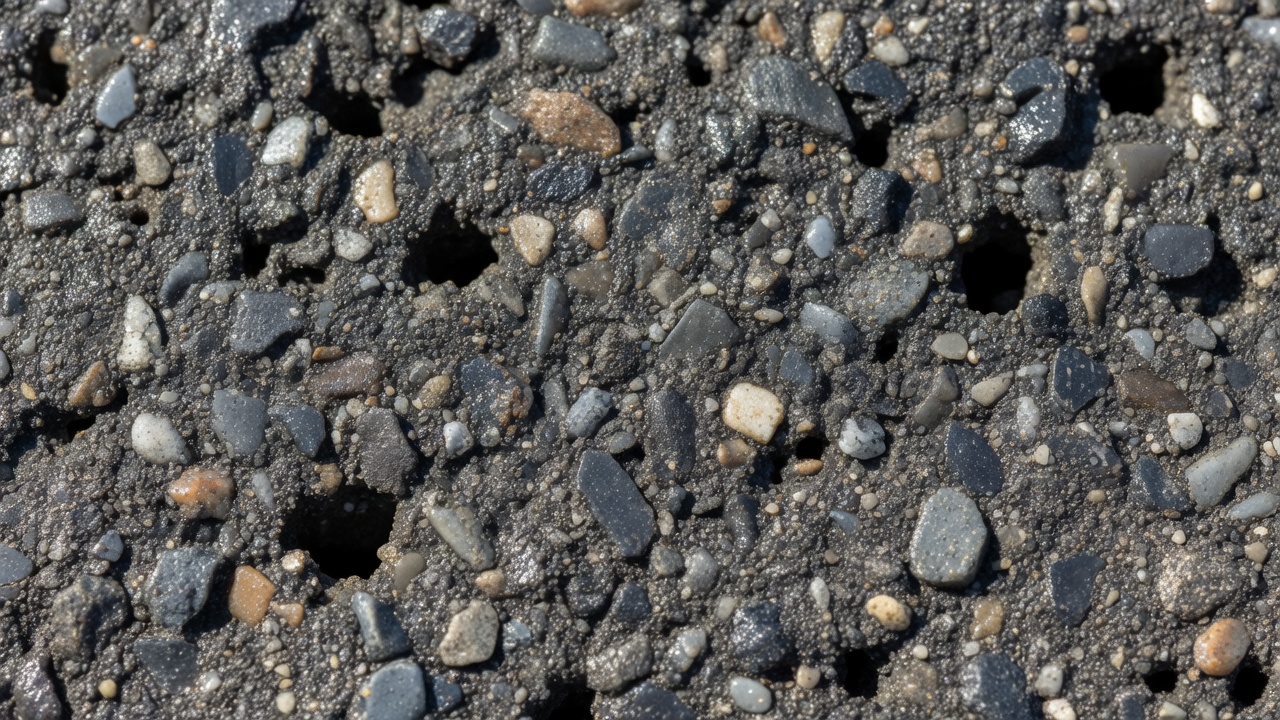
Air voids are not an incidental byproduct of compaction, they are a deliberately engineered volumetric parameter that governs the balance between two competing performance requirements: stability (resistance to permanent deformation) and durability (resistance to aging, moisture damage, and cracking). The volumetric analysis of HMA treats the mixture as a three-phase material. The total volume of a compacted specimen (Vt) is the sum of the volume of air (Va), the volume of asphalt binder (Vb), and the volume of aggregate (Vagg). The air void content is the only volumetric parameter that can be controlled independently through compaction effort during construction and through densification under traffic loading.
The significance of air voids lies in their relationship to pavement performance over the entire service life. In a newly constructed HMA pavement, in-place air voids are typically 6% to 8% immediately after compaction. Over the first 2 to 5 years of service, traffic loading further densifies the pavement, reducing air voids toward the design level of 4%. This initial higher void content is intentional, it provides a compaction allowance for additional densification under traffic without the pavement becoming unstable. Once air voids stabilize between 3% and 5%, the pavement achieves its optimal balance of stability and durability. If air voids fall below 3%, the mixture becomes over-compacted and prone to instability. If air voids rise above 8%, the pavement becomes excessively permeable and susceptible to environmental deterioration.
Roberts et al. (1996) in the National Asphalt Pavement Association’s reference text Hot Mix Asphalt Materials, Mixture Design, and Construction state: “Air voids are the most important parameter affecting the performance of HMA pavements. The amount of air voids in a mixture is extremely important and closely related to stability and durability.” The Asphalt Institute’s MS-2 manual (Mix Design Methods for Asphalt Concrete) dedicates an entire chapter to the calculation and interpretation of air voids and their relationship to VMA and VFA.
The volumetric equation that defines air voids is:
Va = 100 × (Gmm − Gmb) / Gmm
Where:
- Gmm = Theoretical Maximum Specific Gravity of the loose mixture (voidless condition, ASTM D2041 / AASHTO T 209)
- Gmb = Bulk Specific Gravity of the compacted specimen (ASTM D2726 / AASHTO T 166)
This equation expresses air voids as the percentage difference between the density of the mixture with no air (Gmm) and the actual density of the compacted mixture (Gmb). A Gmm of 2.500 and a Gmb of 2.400 yields air voids of 4.0%, calculated as 100 × (2.500 − 2.400) / 2.500 = 4.0%. The precision of air void determination depends directly on the accuracy of both specific gravity measurements. A 0.01 error in Gmm produces approximately a 0.4% change in calculated air voids. This sensitivity places stringent requirements on laboratory testing procedures, including temperature control (25°C ± 0.5°C), de-airing of the Rice test specimen, and proper drying of bulk specific gravity specimens.
Design Air Voids, The 4% Target
The design air void content is the target air void percentage established during laboratory mix design at which the mixture is expected to perform optimally over its service life. For the vast majority of dense-graded HMA mixtures worldwide, the design air void content is 4.0%. This value is not arbitrary, it represents the consensus of decades of research correlating laboratory air voids with field performance.
Superpave Design Air Voids
The Superpave mix design method, developed under the Strategic Highway Research Program (SHRP) and standardized by AASHTO, specifies a design air void content of exactly 4.0% at the design number of gyrations (Ndesign). Superpave does not specify a range, the target is a single value of 4.0%. The compaction effort in Superpave is tied to the expected 20-year traffic level, with Ndesign ranging from 50 gyrations (low traffic, <0.3 million ESALs) to 125 gyrations (high traffic, ≥30 million ESALs). At each traffic level, the mixture must achieve 4.0% air voids at Ndesign.
The Superpave gyratory compactor establishes three critical gyration numbers:
- Ninitial: The number of gyrations used to evaluate compactability. At Ninitial, air voids must be ≥ 11% for mixtures designed for ≥ 3 million ESALs. This prevents tender mixes that compact too quickly during construction.
- Ndesign: The design number of gyrations at which the mixture must achieve 4.0% air voids. This is the compaction level expected after years of traffic.
- Nmax: The maximum number of gyrations, representing the densest condition the pavement should ever experience. Air voids at Nmax must be ≥ 2.0%. If air voids fall below 2% at Nmax, the mixture is considered over-compactable and prone to rutting under traffic.
The Superpave system ties the design air voids directly to the gradation control points, the VMA requirements, and the dust-to-binder ratio. For a 12.5 mm Nominal Maximum Aggregate Size (NMAS) mixture designed for 3 to 30 million ESALs, the minimum VMA is 14.0%. With 4.0% air voids, this leaves 10.0% by volume for the effective asphalt binder, the available space for the binder film to coat the aggregate particles. If VMA is too low, there is insufficient space to accommodate both the 4.0% air voids and an adequate binder film thickness, resulting in a dry, brittle, and poorly durable mixture.
Marshall Design Air Voids
The Marshall mix design method, still widely used for airport pavements and in many international specifications, specifies design air voids in the range of 3% to 5% , with 4.0% as the target for most traffic levels. The Marshall method uses a drop hammer compactor (50 or 75 blows per face) and measures stability and flow in addition to volumetric properties. The FAA specifies 4.0% design air voids for airport HMA mixtures using the Marshall method with 75-blow compaction effort, consistent with the high traffic levels and heavy aircraft loads on airfield pavements.
The Marshall method has historically used 4% design air voids as the standard. The Asphalt Institute’s MS-2 manual presents the Marshall design procedure with 4% air voids as the basis for selecting the optimum asphalt binder content. The optimum binder content is determined by plotting air voids, stability, flow, VMA, and density against asphalt content and selecting the asphalt content that produces 4% air voids while meeting all other criteria.
Why 4%?
The selection of 4% design air voids is based on the fundamental understanding that this level provides the optimal balance between:
- Stability: At 4% air voids, the aggregate particles are sufficiently interlocked to resist permanent deformation under traffic loading. The binder fills the intergranular spaces without reducing aggregate-to-aggregate contact.
- Durability: At 4% air voids, the mixture is dense enough to prevent excessive oxygen and water infiltration but open enough to accommodate binder thermal expansion and additional traffic densification.
- Fatigue resistance: Research by Finn et al. (1973) and Scherocman (1984) demonstrated that mixtures with 4% air voids achieve maximum fatigue life. A reduction from 8% to 3% air voids can more than double pavement fatigue life.
- Permeability control: Below approximately 7% to 8% air voids, the air voids in dense-graded HMA are generally disconnected (not interconnected), preventing continuous water and air flow through the pavement structure.
The ICAO Aerodrome Design Manual Part 3 (Doc 9157, Third Edition, 2022) specifies design air voids in the range of 3% to 5% for airport asphalt mixtures, with minimum VMA of 17% and minimum asphalt content of 5.5% for surface courses. This range is consistent with the FAA specifications in AC 150/5370-10H for Item P-401 HMA pavement.
| Mix Design Method | Design Air Voids | Compaction | Traffic Application |
|---|---|---|---|
| Superpave (AASHTO M 323) | 4.0% (exact) | Gyratory (Ndesign gyrations) | Roads - all traffic levels |
| Marshall (Asphalt Institute MS-2) | 3%–5% (target 4%) | Drop hammer (50/75 blows) | Roads and airfields |
| FAA P-401 (Marshall) | 4.0% (3%–5% range) | 75-blow Marshall | Airport pavements |
| FAA P-401 (Superpave) | 4.0% at Ndesign | Gyratory (Ndesign gyrations) | Airport pavements |
| ICAO Doc 9157 | 3%–5% | As specified by State | Airport pavements |
Air Void Measurement Methods
Accurate determination of air voids is essential for both mix design verification and construction quality control. The measurement process involves determining two fundamental specific gravity values: the theoretical maximum specific gravity (Gmm) of the loose mixture and the bulk specific gravity (Gmb) of the compacted mixture. The air void content is then calculated from the difference between these two values.
Gmm, Theoretical Maximum Specific Gravity (Rice Test)
The theoretical maximum specific gravity (Gmm), also called the Rice specific gravity after James Rice who developed the test, represents the density of the mixture with all air voids eliminated. It is determined by testing the loose (uncompacted) HMA mixture according to ASTM D2041 or AASHTO T 209.
The procedure involves placing a sample of loose HMA (typically 1500 to 2000 grams) in a vacuum pycnometer, applying a partial vacuum (residual pressure of 30 mm Hg or less) for 15 minutes while agitating the sample to remove entrapped air, then filling the container with water and determining the mass. The Gmm is calculated as:
Gmm = Mass of Dry Mix / (Mass of Dry Mix − Mass of Sample in Water)
The Gmm test is highly sensitive to procedural details. Incomplete de-airing produces falsely low Gmm values, which in turn produce falsely low calculated air voids (since the denominator in the air void equation is smaller). Overly aggressive vacuum application can cause particle degradation, altering the gradation and producing falsely high Gmm values. The test requires strict temperature control at 25°C ± 0.5°C. Multiple replicates (typically 2 tests per sample) with a precision of 0.011 (within-lab, single-operator) are specified.
The accuracy of Gmm directly affects all volumetric calculations. A 0.01 error in Gmm changes the calculated air voids by approximately 0.4%. This means that a mixture with true air voids of 4.0% could be reported as anywhere from 3.6% to 4.4% due to Gmm measurement error alone. This sensitivity underscores the importance of rigorous laboratory quality control for Gmm testing.
Gmb, Bulk Specific Gravity of Compacted Mixture
The bulk specific gravity (Gmb) of compacted HMA is determined on either laboratory-compacted specimens (for mix design) or field-extracted cores (for quality control). The standard test methods are ASTM D2726 / AASHTO T 166 for laboratory specimens and ASTM D3203 / AASHTO T 269 for field cores.
For laboratory-compacted specimens (Superpave gyratory pills or Marshall briquettes), the specimen is weighed in air (dry mass), then submerged in water at 25°C for 3 to 5 minutes and weighed submerged (submerged mass), and finally blotted to a saturated surface-dry (SSD) condition and weighed in air (SSD mass). The Gmb is calculated as:
Gmb = Dry Mass / (SSD Mass − Submerged Mass)
For field cores, the procedure is similar but accounts for the core’s geometry and the potential for water absorption into open surface voids. Cores with high air voids (>8%) may absorb significant water during the SSD measurement, requiring a vacuum sealing method (paraffin coating or CoreLok) to prevent water infiltration into the specimen.
The bulk specific gravity of field cores is influenced by: the in-place density achieved by compaction, the lift thickness relative to the nominal maximum aggregate size, the temperature of the mixture during compaction, the rolling pattern and roller passes, and the presence of segregation or temperature differentials in the mat.
Field Density Measurement, Nuclear Gauges
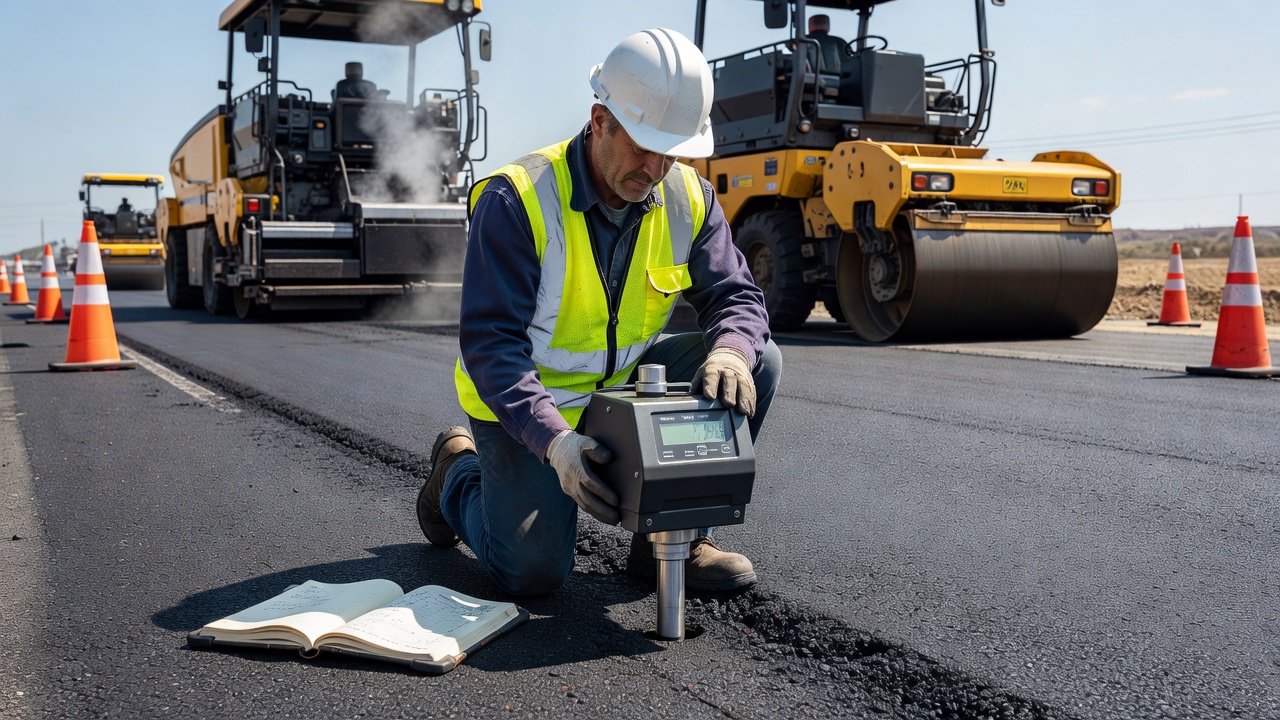
Since extracting pavement cores is time-consuming, expensive, and destructive, field density is routinely measured using portable density gauges. The most widely used instrument is the nuclear density gauge (NDG) , standardized under ASTM D2950 (Standard Test Method for Density of Bituminous Concrete In-Place by Nuclear Methods).
The nuclear density gauge operates on two principles. The direct transmission mode uses a Cesium-137 (Cs-137) radioactive source that extends through a hole in the pavement into the underlying layer. Gamma radiation emitted from the source interacts with the pavement material and is detected by Geiger-Müller tubes in the gauge body. The density is computed from the attenuation of the gamma radiation between the source and the detectors, denser materials attenuate more radiation, producing a lower count rate. The backscatter mode keeps the source within the gauge body, measuring radiation that is backscattered from the pavement surface. The backscatter mode is less accurate but does not require a hole in the pavement.
All nuclear density gauges also incorporate an Americium-241/Beryllium (Am-241/Be) source for moisture measurement via neutron thermalization. While moisture measurement is primarily used for soil compaction, the moisture reading on HMA can indicate residual moisture in the mixture or moisture trapped beneath the pavement.
The accuracy of nuclear gauge readings depends critically on calibration against cores extracted from the same mixture and pavement. Nuclear gauges measure the total density of the pavement, including aggregate, binder, and air. The gauge does not directly measure air voids, rather, it measures wet density, which is then converted to dry density using the measured or assumed moisture content, and the percent air voids is calculated using the known Gmm of the mixture:
Va = 100 × (1 − Dry Density / (Gmm × γw))
Where γw is the unit weight of water (1000 kg/m³ or 62.4 lb/ft³).
A nuclear gauge that has not been properly correlated with core data for the specific mixture being tested can produce errors of 1% to 3% in air void determination. The FHWA and FAA require correlation between nuclear gauge readings and core densities for each project. The correlation involves extracting a minimum of 5 to 10 cores at locations where nuclear gauge readings have been taken, determining the laboratory Gmb of each core, and developing a linear regression relationship between gauge density and core density.
Field Density Measurement, Non-Nuclear Gauges
Non-nuclear density gauges, also called electrical density gauges or PQI gauges (Pavement Quality Indicator), operate on the principle that the dielectric constant of HMA varies with density. As the pavement density increases, the volume of air (which has a dielectric constant of approximately 1.0) decreases relative to the volume of aggregate and binder (which have dielectric constants of 5 to 7 and 2.5 to 3.0, respectively). The gauge transmits a low-frequency electromagnetic field into the pavement and measures the impedance, which is related to the dielectric permittivity and, consequently, the density.
The primary advantages of non-nuclear gauges are: no radioactive materials (eliminating regulatory, training, transport, and liability issues associated with nuclear gauges), instantaneous readings (2 to 5 seconds versus 1 to 4 minutes for nuclear gauges), and reduced variability in some applications. The primary disadvantage is that they are more sensitive to moisture content in the pavement (water has a dielectric constant of approximately 80, overwhelming the density signal from the HMA) and to surface texture variations. Non-nuclear gauges require calibration to each specific mixture and are not universally accepted for acceptance testing. The AASHTO has not yet adopted a standard test method for non-nuclear gauges equivalent to ASTM D2950 for nuclear gauges.
Core Density Testing
Despite the convenience of portable gauges, laboratory testing of extracted cores remains the reference method, the standard against which all other methods are calibrated. Core testing per ASTM D3203 / AASHTO T 269 involves:
- Extracting a core of 100 mm (4 inch) or 150 mm (6 inch) diameter using a diamond-tipped core drill
- Drying the core to constant mass at 40°C
- Determining the dry mass, SSD mass, and submerged mass
- Calculating Gmb
- Comparing with Gmm (from the same production mixture) to calculate percent air voids
Core testing provides the most accurate determination of in-place air voids because it directly measures the bulk specific gravity of the actual pavement material. The precision of core testing (within-lab standard deviation of approximately 0.3% air voids) is superior to nuclear gauge precision (0.5% to 1.0% air voids) and non-nuclear gauge precision (0.7% to 1.5% air voids).
The limitation of core testing is that it is destructive, slow (cores must be extracted, transported, dried, and tested, requiring 24 to 48 hours for results), and spatially limited (typically 1 to 4 cores per lot of 500 to 1000 tons of HMA). Core locations also require patching after extraction.
Reporting Methods
Although percent air voids is the fundamental parameter of interest, field compaction measurements are typically reported as density in relation to a reference value. Three reporting methods are used:
- Percent of Theoretical Maximum Density (% TMD): The field density is divided by the theoretical maximum density (Gmm × γw) and expressed as a percentage. Specified values are typically 92% to 97% of TMD. For example, 93% of TMD corresponds to 7% air voids.
- Percent of Laboratory Density: The field density is divided by the density of laboratory-compacted specimens (typically Marshall or Superpave specimens compacted to Ndesign). This is common in Marshall-based specifications.
- Percent of Control Strip Density: A test strip of pavement is compacted to the desired density under close supervision, and the density achieved on the control strip becomes the target for the remainder of the project. This method is common in airport pavement specifications.
The relationship between density reporting methods can be confusing. A specification of “96% of laboratory density” is not equivalent to “96% of TMD”, the laboratory density is typically 96% of TMD (corresponding to 4% air voids at design), so 96% of laboratory density would be 0.96 × 0.96 = 0.922 or 92.2% of TMD, corresponding to 7.8% air voids. This discrepancy has been a source of specification confusion and variability among agencies.
In-Place Air Voids and Compaction
In-place air voids are the actual air void content of the compacted pavement in the field immediately after construction, in contrast to the design air voids established in the laboratory. The relationship between in-place air voids and design air voids is controlled by compaction, the process of mechanically reducing the volume of air in the HMA by applying pressure through rollers.
The Compaction Process
Compaction reduces the volume of air in the HMA by rearranging aggregate particles into a denser configuration and forcing the asphalt binder to fill the intergranular spaces. The compaction process involves three roller types in sequence:
- Breakdown rolling: A steel-wheel vibratory roller (typically 10 to 12 tons) operates immediately behind the paver at 130°C to 150°C. The vibratory action achieves initial densification of 85% to 92% of TMD.
- Intermediate rolling: A pneumatic-tire roller (typically 20 to 30 tons, with 7 to 11 tires) kneads the mixture to increase density to 92% to 96% of TMD. The rubber tires seal the surface and produce a tight mat texture.
- Finish rolling: A static steel-wheel roller removes roller marks and produces a smooth final surface.
The target in-place air voids for newly constructed HMA is typically 6% to 8% (92% to 94% of TMD). This is intentionally higher than the 4% design air voids because traffic loading over the first 2 to 5 years will further densify the pavement by 2% to 4% air voids. If the in-place air voids were 4% immediately after construction, traffic densification would quickly reduce voids below 3%, causing instability.
Compaction Measurement Specifications
Each contracting agency specifies minimum compaction requirements. Based on a survey of state DOT practices by Tran et al. (2016), the majority of states specify compaction to a minimum of 92% to 93% of TMD, corresponding to maximum in-place air voids of 7% to 8%. The FAA specifies in-place density of 96% of laboratory density for airport HMA pavements (P-401), which corresponds to approximately 92% to 93% of TMD and in-place air voids of 7% to 8%.
The European standard (EN 13108-1) specifies in-place air voids for asphalt concrete surface courses of 3% to 6% by volume for roads with heavy traffic, with acceptance testing performed on cores extracted at specified intervals. European practice generally targets lower in-place air voids than North American practice, reflecting different binder grades, aggregate characteristics, and traffic loading patterns.
Factors Affecting In-Place Air Voids
The in-place air void content achieved during construction is influenced by:
- Mixture temperature: HMA must be compacted within the temperature range specified in the job mix formula. Compaction at temperatures below 100°C is ineffective because the binder is too viscous to allow aggregate rearrangement.
- Lift thickness: The compacted lift thickness should be 3 to 4 times the nominal maximum aggregate size (NMAS). A 12.5 mm NMAS mixture requires a compacted lift thickness of 38 to 50 mm. Thinner lifts cool too quickly for effective compaction.
- Rolling pattern: The number of roller passes, roller speed (typically 3 to 5 km/h), vibration amplitude and frequency, and roller type all affect achieved density.
- Weather conditions: Wind, ambient temperature, solar radiation, and pavement surface temperature affect the cooling rate of the HMA mat and the available time for compaction.
- Mixture properties: The aggregate gradation, binder grade, binder content, and presence of recycled materials (RAP, RAS) affect compactability.
Long-Term Changes in Air Voids
After construction, in-place air voids change over time due to two mechanisms:
- Traffic densification: Each passing wheel load applies a small additional compactive effort, gradually reducing air voids. The rate of densification depends on the traffic volume, load magnitude, tire pressure, and the stiffness of the mixture. Highway pavements typically experience 1% to 3% reduction in air voids over the first 5 years.
- Binder oxidation: As the asphalt binder oxidizes, it becomes stiffer and more brittle. The oxidized binder occupies slightly more volume than the unoxidized binder, partially offsetting the reduction in air voids from traffic densification. However, this effect is minor compared to traffic densification.
The long-term equilibrium air void content for a properly designed and constructed pavement should stabilize between 3% and 5% . If air voids remain above 8% after 5 years of service, the pavement was under-compacted during construction and will experience accelerated deterioration. If air voids fall below 2% within 5 years, the mixture was over-compacted or the design binder content was too high.
Effects of Too-Low Air Voids, Rutting, Bleeding, and Flushing
When in-place air voids fall below 3% , the mixture becomes over-compacted and enters a condition of instability that produces three primary distress mechanisms.
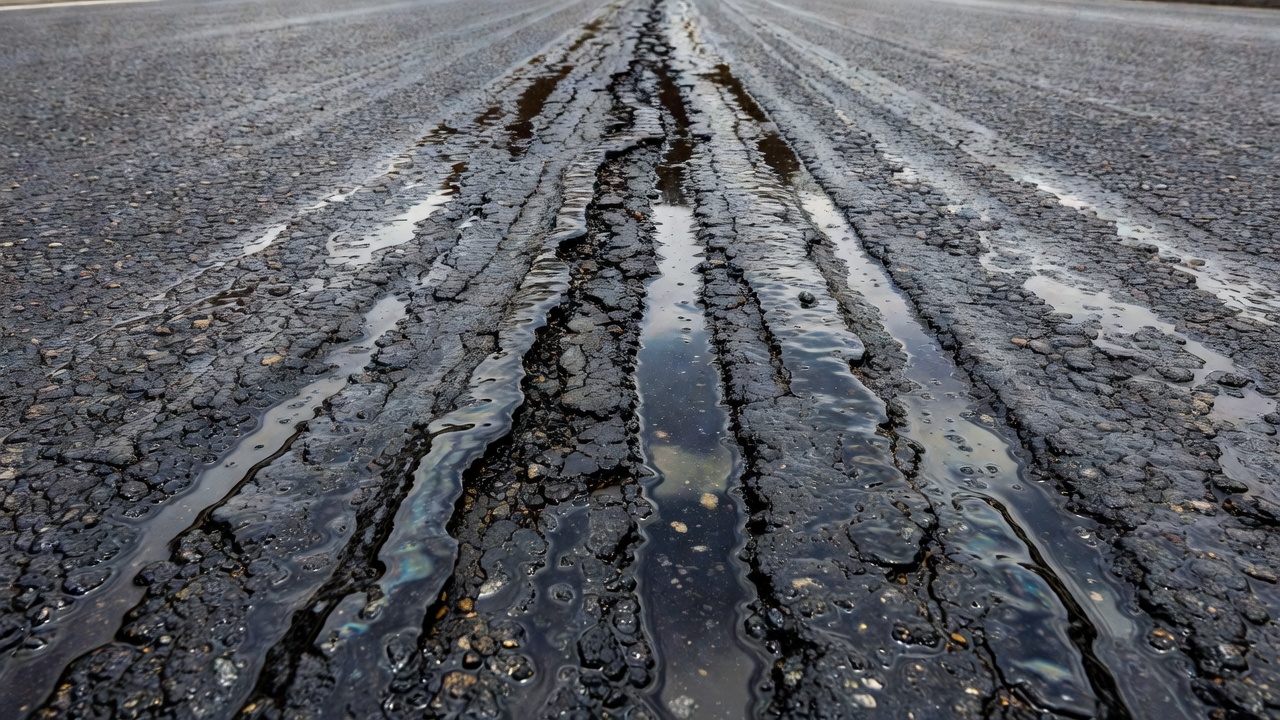
Bleeding and Flushing
Bleeding (also called flushing or fat spots) is the migration of asphalt binder to the pavement surface, creating a shiny, reflective, and sticky surface. The mechanism is straightforward: when the air void content is too low, there is insufficient space within the mixture to accommodate the thermal expansion of the asphalt binder during hot weather. On a hot day, the binder expands by approximately 0.05% to 0.10% per °C temperature increase. If the pavement temperature reaches 60°C (common in summer), the binder expands by 2% to 4% by volume. With only 2% to 3% air voids remaining, the expanding binder has nowhere to go except to the pavement surface.
The bleeding distress progresses as follows: initial binder rise on the surface during the first hot day after construction, progressive accumulation of binder on the surface with each subsequent hot day, the surface becomes dark, shiny, and sticky, aggregate particles become embedded in the binder film, reducing macrotexture and skid resistance, in severe cases, the binder forms a continuous film that creates a hydroplaning hazard during wet weather. The Ohio Department of Transportation’s Distress Identification Manual identifies low air void content as a direct cause of bleeding: “Bleeding is caused by an excess amount of bituminous binder in the mixture and/or low air void content.”
The FAA’s Airport Pavement Distress Identification Manual classifies bleeding as a surface distress in flexible pavements. Bleeding in wheel paths is rated based on the percentage of affected area and the thickness of the binder film. Bleeding is most common in: mixtures with excessively high binder content, mixtures compacted to less than 3% air voids, wheel paths where traffic has further densified the pavement, and mixtures with coarse aggregate gradations that provide insufficient VMA.
Rutting
Rutting is permanent deformation in the pavement wheel paths. Low air voids contribute to rutting through two mechanisms:
Vertical consolidation rutting occurs when the pavement continues to densify under traffic. If the mixture begins with 4% air voids and traffic densification reduces voids to 2%, the 2% volume reduction manifests as a vertical depression in the wheel path. Each 1% reduction in air voids corresponds to approximately 1 mm of vertical surface depression per 100 mm of HMA thickness.
Lateral displacement rutting (shear rutting) occurs when the mixture is unstable and the aggregate structure cannot resist the shear stresses imposed by traffic loading. Low air voids indicate that the aggregate particles are “floating” in the binder rather than being in direct contact with each other (stone-on-stone contact). The binder acts as a lubricant rather than a binder, allowing the aggregate particles to slide past each other under load. Lateral displacement produces humps (upheaval) at the edges of the rut, which is the distinguishing characteristic of shear rutting versus consolidation rutting.
Scherocman (1984) concluded that “the amount of rutting which occurs in an asphalt pavement is inversely proportional to the air void content.” The risk Management of Low Air Void Asphalt Concrete Mixtures study (ROSAP, 2007) documented that “Low in-place air voids have been historically associated with distress types such as flushing/bleeding and rutting/shoving.”
Other Distresses from Low Air Voids
Additional problems associated with low air voids include:
- Shoving: Horizontal displacement of the pavement surface at intersections, curves, and braking zones, producing waves and corrugations
- Tender mixes: Mixtures that compact too quickly during construction, making them unstable under the paver and roller and difficult to finish to a smooth surface
- Reduced skid resistance: The binder film on the surface eliminates macrotexture, significantly reducing the friction coefficient, particularly hazardous for aircraft operations on wet runways
Causes of Low Air Voids
Low in-place air voids can result from: excessive asphalt binder content (more binder than the air voids and VMA can accommodate), inadequate VMA in the mix design (the aggregate gradation is too dense, leaving insufficient intergranular space), over-compaction during construction (excessive roller passes or roller weight), construction on a hot day with thin lifts that cool slowly, allowing extended compaction, over-compaction from heavy traffic loads (undersized pavement structure or overweight vehicles), binder migration (in service, the binder can migrate into air voids, reducing void content without additional compaction), and lack of quality control during production (erratic binder content, temperature variations).
Effects of Too-High Air Voids, Raveling, Oxidation, and Moisture Damage
When in-place air voids exceed 8% , the pavement enters a condition of under-compaction that produces a fundamentally different set of distress mechanisms, all related to the permeability of the mixture to water and air.
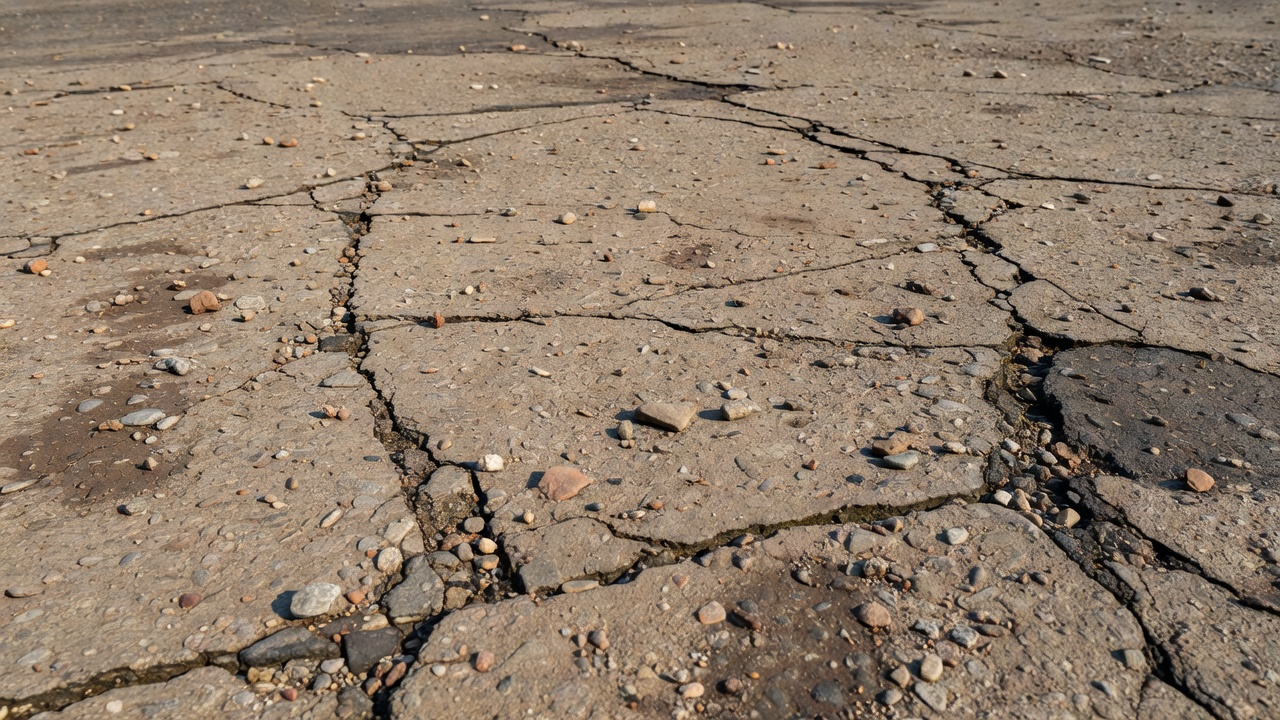
Raveling
Raveling is the progressive dislodgement of aggregate particles from the pavement surface, beginning with the finer particles and progressing to the coarser particles as the distress worsens. The mechanism is: oxygen penetrates through the interconnected air voids into the binder film surrounding each aggregate particle, the binder oxidizes, becoming brittle and losing adhesion to the aggregate surface, under traffic loading, the oxidized binder fractures at the binder-aggregate interface, the aggregate particle is loosened and dislodged by traffic, the loss of aggregate creates surface roughness, which accelerates further raveling.
Kandhal and Koehler (1984) conducted a comprehensive study on the relationship between air voids and raveling. They found that raveling becomes a significant problem above approximately 8% air voids and becomes a severe problem above approximately 15% air voids. The threshold of 8% corresponds to the air void level at which the voids become interconnected, creating continuous pathways through the pavement that allow air and water to move freely.
Raveling severity is classified as: Low severity, loss of fines only, surface appears slightly rough, Medium severity, loss of fine and some coarse aggregate, surface texture is clearly open, High severity, loss of coarse aggregate, surface is pitted and rough, loose aggregate on the pavement. In extreme cases, raveling can proceed through the entire lift thickness, creating a structurally weakened pavement that requires full-depth patching or overlay.
Oxidation and Aging
Oxidative aging of the asphalt binder is accelerated exponentially by high air voids. The mechanism is: oxygen in the air diffuses through the binder film and reacts with the chemical components of the binder (particularly the aromatics and saturates), the oxidation reaction creates carbonyl and sulfoxide functional groups that increase the binder’s molecular weight and stiffness, the stiffened binder loses its ability to relax thermal stresses, becoming brittle and prone to cracking, the stiffening is measured as an increase in the binder’s viscosity or a shift in the Performance Grade (PG).
The rate of oxidation depends on the oxygen concentration at the binder surface, which in turn depends on the air void content and the degree of void interconnection. A pavement with 10% air voids oxidizes approximately 4 times faster than a pavement with 4% air voids. The Asphalt Institute states: “Air voids between 7% and 3% provide an acceptable balance between stability and durability. At 8% or higher, interconnected voids allow air and moisture to permeate the pavement, reducing its durability.”
The oxidation gradient through the pavement thickness is significant. The top 10 to 20 mm of the surface course is exposed to higher oxygen concentrations and higher temperatures, resulting in the most severe aging. This zone develops a “crust” of aged, brittle binder that cracks under thermal contraction and traffic loading. The aged binder at the surface has a viscosity 5 to 10 times higher than the binder in the middle of the lift.
Moisture Damage and Stripping
Moisture damage, also called stripping, is the loss of bond between the asphalt binder and the aggregate surface due to the presence of water. High air voids facilitate moisture damage through two mechanisms: water infiltrates through interconnected voids and accumulates at the binder-aggregate interface, water pressure from traffic loading (pore pressure) mechanically separates the binder from the aggregate.
The critical air void threshold for moisture damage is 8% . Below 8%, the voids in dense-graded HMA are generally disconnected, water cannot flow freely through the pavement. Above 8%, the voids become interconnected, creating continuous pathways for water movement. Cooley et al. (2002) demonstrated that permeability increases exponentially once air voids exceed 8%.
The moisture damage mechanism is: water penetrates to the binder-aggregate interface, the water displaces the binder from the aggregate surface because water has a higher surface tension and stronger polar attraction to many aggregate types (particularly siliceous aggregates like quartz and granite), the stripped aggregate loses its bond to the pavement, the mixture loses strength, and the pavement systematically fails from the bottom up and the outside in.
The Tensile Strength Ratio (TSR) test (AASHTO T 283) is the standard method for evaluating moisture susceptibility. The TSR compares the indirect tensile strength of conditioned specimens (vacuum saturated to 70% to 80% saturation, freeze-thaw cycled) to unconditioned specimens. A TSR of 0.80 (80%) is the minimum acceptable value for most specifications.
Reduced Fatigue Life and Stiffness
High air voids reduce the structural capacity of the pavement. Kennedy et al. (1984) concluded that tensile strength, static modulus, resilient modulus, and stability are all reduced at high air void content. The reduction in modulus means that the pavement deflects more under load, increasing tensile strain at the bottom of the HMA layer and compressive strain at the top of the subgrade, both of which accelerate structural failure.
Finn et al. (1973) in the NCHRP Project 9-4 study concluded that “fatigue properties can be reduced by 30 to 40 percent for each one percent increase in air void content.” Pell and Taylor (1969) and Epps and Monismith (1969) independently confirmed this relationship through laboratory fatigue testing. Scherocman (1984) demonstrated that a reduction in air voids from 8% to 3% could more than double pavement fatigue life.
The practical implication is that a pavement constructed with 8% in-place air voids (rather than the target of 6% to 7%) will have approximately 30% to 40% less fatigue life. If the design life is 20 years, the pavement may fail at 12 to 14 years due to fatigue cracking, a loss of 6 to 8 years of service life directly attributable to inadequate compaction.
Causes of High Air Voids
High in-place air voids result from: inadequate compaction during construction (insufficient roller passes, low mixture temperature, rapid cooling, thin lift thickness relative to NMAS), low asphalt binder content (insufficient binder to fill the VMA), high VMA (aggregate gradation produces excessive intergranular void space), aggregate absorption (porous aggregates absorb binder, reducing the effective binder content), mixture segregation (coarse and fine aggregate separate during placement, creating areas of high voids), and temperature segregation (the mat cools unevenly, with colder areas achieving lower density).
Air Voids in Airport HMA Specifications
Airport asphalt pavements are subject to more stringent air void specifications than highway pavements due to the higher loads, higher tire pressures, and the critical safety requirements of aircraft operations.
FAA P-401 Specification
The Federal Aviation Administration (FAA) specifies HMA pavement construction through Item P-401 (Hot Mix Asphalt Pavement) in AC 150/5370-10H (Standard Specifications for Construction of Airports). The air void requirements are:
- Design air voids: 4.0% for Marshall (75-blow compaction) or Superpave gyratory compaction
- Acceptable range: 3.0% to 5.0% for design air voids
- In-place density: 96.0% of laboratory density (Marshall) or specified as percent of TMD
- Maximum in-place air voids: 8.0% after construction
- Minimum VMA: 17.0% for 12.5 mm NMAS surface course mixtures
The FAA specifies acceptance testing based on the Percent Within Limits (PWL) method. For density acceptance, a PWL of 90% is typically specified, meaning at least 90% of the test results must be within the specification limits. The density test results are obtained from nuclear gauge readings correlated to cored specimens at a minimum frequency of one test per 500 linear meters per lane.
The FAA’s P-401 specification also includes requirements for: smoothness (maximum 6 mm deviation under a 3-meter straightedge), binder content tolerance (±0.4% from JMF), aggregate gradation tolerance, and temperature control. The air void content is verified by extracting cores from the completed pavement at a frequency of 1 core per 750 tons of HMA placed, with a minimum of 3 cores per lot.
FAA P-403 Specification
Item P-403 (Plant Mix Pavement) is an alternative specification for asphalt pavements on airports, typically used at smaller airports or for non-critical pavements. The air void requirements are similar to P-401: design air voids of 3.0% to 5.0%, and maximum in-place air voids of 8.0%. The P-403 specification allows the use of state highway specifications as an alternative, subject to FAA approval.
FAA P-404 Fuel-Resistant Pavement
Item P-404 (Fuel-Resistant Asphalt Mix Pavement) specifies a dense-graded HMA that is resistant to jet fuel and aviation gasoline. The air void specification for P-404 is maximum 3.0%, substantially lower than for standard HMA. The low air voids are necessary because high air voids would allow fuel to penetrate the pavement, softening the binder and causing rapid deterioration. P-404 is typically used for apron areas, fueling positions, and other locations where fuel spills are expected.
ICAO Specifications
The International Civil Aviation Organization (ICAO) addresses airport pavement air voids through the Aerodrome Design Manual Part 3, Pavements (Doc 9157), Third Edition, 2022. ICAO specifies:
- Design air voids: 3% to 5% for airport HMA mixtures
- Minimum VMA: 17% for surface course mixtures
- Minimum asphalt content: 5.5% by weight of mix
- Minimum dynamic stability: 3000 passes/mm (for modified binders in high-temperature climates)
ICAO Doc 9157 does not prescribe specific compaction or acceptance testing methods, deferring to the practices of individual States. However, the ICAO guidance states that: “The air void content of the compacted asphalt mixture should be between 3% and 5% to ensure adequate durability and resistance to permanent deformation.”
The ICAO ACR-PCR method (Aircraft Classification Rating, Pavement Classification Rating), adopted in 2020 for reporting pavement bearing strength, uses layered elastic analysis that accounts for the structural contribution of each pavement layer. The PCR value reported for a pavement is affected by the condition of the pavement, including the in-place air voids and the degree of binder aging. Pavements with air voids above 8% are considered to have reduced structural capacity and receive a correspondingly lower PCR.
Military Specifications
The Unified Facilities Criteria (UFC) 3-270-01 provides standards for military airfield pavements. The air void specifications for military airfields are consistent with FAA P-401: design air voids of 4.0%, minimum in-place density of 96% of laboratory density, and maximum in-place air voids of 8.0%. For expeditionary airfields (temporary pavements), the air void requirements are relaxed to allow rapid construction with available materials and equipment.
Air Void Inspection Indicators
During pavement condition inspection, the air void content of the existing pavement cannot be measured directly from the surface. However, experienced inspectors use visual distress indicators and performance observations to infer whether the air void content is likely to be within the acceptable range.
Visual Indicators of High Air Voids
The following distress patterns and surface characteristics suggest that in-place air voids are above 8%:
- Raveling: Loss of aggregate from the surface, particularly in the wheel paths. The surface appears rough, open-textured, and “scabby.”
- Surface oxidation: The pavement surface appears gray or light brown (bleached) rather than black, indicating advanced binder aging from oxygen penetration.
- Cracking: Fine to medium-severity longitudinal and transverse cracks, particularly in the wheel paths, indicating reduced fatigue resistance.
- Stripping: Visible distress in core samples showing binder loss from aggregate surfaces, particularly in the lower portion of the lift.
- Water staining: Discoloration on the pavement surface in areas where water ponds, indicating water infiltration into the pavement.
- Edge raveling: Significant aggregate loss at pavement edges and longitudinal construction joints, where compaction is typically lowest.
- Permeability testing: A field permeability test (ASTM E1911 or LCS permeameter) showing infiltration rates above 100 mL/min indicates interconnected voids consistent with air voids above 8%.
Visual Indicators of Low Air Voids
The following distress patterns suggest that in-place air voids are below 3%:
- Bleeding/flushing: Shiny, reflective surface in wheel paths, particularly during hot weather. The surface may feel sticky to the touch.
- Rutting: Surface depression in wheel paths, often with humps at the edges of the ruts (lateral displacement).
- Shoving: Waves or corrugations in the pavement surface at intersections, curves, or braking zones.
- Fat spots: Localized areas of excess binder on the surface, particularly at the bottom of grades or in areas where the mixture segregated during placement.
- Reduced macrotexture: The surface appears smooth and “tight,” with aggregate particles embedded in a binder film rather than protruding from it. Sand patch testing (ASTM E965) will show mean texture depth (MTD) below 0.4 mm.
- Skid resistance reduction: Friction testing (ASTM E274, locked wheel trailer) will show friction numbers (FN) below the minimum specified for the facility type and speed.
Core Inspection
The most definitive inspection method for air voids is core extraction and laboratory testing. A 100 mm or 150 mm diameter core is extracted from the pavement, and the bulk specific gravity (Gmb) is determined per AASHTO T 166 or ASTM D2726. The air voids are calculated using the Gmm from the original mix design or from Rice testing of material sampled from the pavement.
Core inspection also reveals:
- Vertical air void distribution: Air voids typically increase from the top of the lift to the bottom, with the highest voids at the bottom of the lift (the zone of lowest compaction). A density gradient of 2% to 4% air voids through a 50 mm lift is common.
- Delamination: If the air voids at the interface between lifts are significantly higher than the mid-lift voids, the lifts may not be properly bonded, leading to delamination.
- Stripping: Cross-section examination of the core reveals whether moisture damage has occurred, the stripped areas appear lighter in color and the aggregate surfaces are not fully coated with binder.
Non-Destructive Testing Indicators
Ground Penetrating Radar (GPR) and Infrared Thermography can provide indirect indicators of air void variation. Areas of higher air voids (lower density) appear as different dielectric properties on GPR scans or as thermal differentials on infrared images. These methods are used for macro-scale assessment of density uniformity rather than for precise air void measurement. Temperature differentials of more than 15°C across the mat (thermal segregation) correlate with density differentials of 1% to 3% air voids.
Air Voids and Pavement Life
The relationship between air voids and pavement life is one of the most well-established relationships in asphalt pavement engineering. The Asphalt Institute and numerous researchers have documented that air void content is the single most important volumetric parameter affecting pavement longevity.
The 1% Rule
The widely cited “1% rule” states that for every 1% increase in air voids above a base level of 7%, approximately 10% of pavement life is lost. Linden, Mahoney, and Jackson (1989) first documented this rule in their study on the effect of compaction on asphalt concrete performance: “The rule-of-thumb that emerges is that each 1 percent increase in air voids (over a base air void level of 7 percent) results in about a 10 percent loss in pavement life (or about 1 year less).”
The 1% rule has been confirmed by subsequent research. Howell et al. (2021) in a study of Washington State DOT asphalt pavements using large linked field data sets confirmed that air voids are strongly correlated with pavement life, with the relationship being approximately linear between 3% and 8% air voids. The study found that the relationship may not be strictly linear across the entire range, there appears to be a “sweet spot” between 3% and 7% where pavement life is maximized, but the deterioration accelerates rapidly outside this range.
The practical implications of the 1% rule are significant:
| In-Place Air Voids | Expected Pavement Life | Life Loss vs. Optimal |
|---|---|---|
| 4% (design target) | 20 years (design life) | 0% |
| 7% (typical new construction) | 20 years (with traffic densification to 4%) | 0% |
| 8% | 18 years | 10% |
| 9% | 16 years | 20% |
| 10% | 14 years | 30% |
| 11% | 12 years | 40% |
| 12% | 10 years | 50% |
A pavement constructed with 10% in-place air voids (only 2% to 3% above the typical 7% to 8% target) will have only 70% of its design life, losing 6 years of service from a 20-year design.
Economic Impact
The economic impact of air void variations is substantial. For a typical highway pavement project of 1 million square meters with a construction cost of $40/m² ($40 million), a reduction of 1% in in-place air voids (improving compaction from 93% to 94% of TMD) would extend pavement life by approximately 1 year. If the pavement is designed for 20 years, the 1-year extension represents a 5% increase in service life, equivalent to a construction cost savings of $2 million over the pavement life cycle.
Conversely, pavements constructed with high air voids require earlier intervention. A pavement with 10% air voids requiring an overlay at year 14 instead of year 20 generates an additional overlay cost of $20 to $40/m² (for a 75 to 100 mm overlay) 6 years earlier than planned, representing a significant increase in life cycle cost.
Air Voids and Maintenance Timing
The air void content of in-service pavements influences the timing and effectiveness of maintenance treatments. Pavements with air voids below 5% respond well to preventive maintenance treatments (crack sealing, seal coats, thin overlays) because the dense structure prevents water infiltration and binder aging. Pavements with air voids above 8% require more intensive rehabilitation (milling and overlay, full-depth patching) because the existing mixture is already compromised by oxidation and moisture damage.
The FHWA Long-Term Pavement Performance (LTPP) program has documented that preventive maintenance applied to pavements with air voids below 5% extends service life by 30% to 50%, while the same treatments applied to pavements with air voids above 8% provide only 10% to 20% extension. The principle of “treating at the right time” in pavement management is fundamentally linked to the air void condition of the pavement.
Design for Pavement Life Extension
The recognition of air voids as a life-determining parameter has led to several specification innovations aimed at improving pavement longevity:
- Density pay factors: Many state DOTs now use pay adjustment factors for density, paying a bonus for density exceeding the specification minimum (lower air voids) and assessing a penalty for density below the minimum (higher air voids). The pay adjustment is typically 2% to 5% above or below the contract unit price for each 1% deviation in density.
- End-result specifications: These specifications specify the desired end result (air void content or density) rather than specifying the compaction process. The contractor is free to select any compaction method that achieves the specified air void target.
- Performance-related specifications (PRS): PRS directly link acceptance test results (including air voids) to predicted pavement performance through mechanistic-empirical models. A pavement with 7% air voids is predicted to have a different life than one with 9% air voids, and the pay adjustment reflects the difference in predicted life.
- Enhanced compaction initiatives: Several state DOTs and the National Center for Asphalt Technology (NCAT) have promoted enhanced compaction standards, specifying minimum density of 93% to 94% of TMD (maximum 6% to 7% air voids) rather than the traditional 92% of TMD (8% air voids). The NCAT Enhanced Compaction to Improve Durability study (2016) recommended targeting 93% of TMD for heavy-traffic pavements.
- Intelligent compaction (IC): IC technology uses roller-mounted accelerometers and GPS to measure the stiffness of the pavement in real time during compaction. The IC system provides the roller operator with a real-time display of compaction coverage and the number of passes at each location, ensuring uniform density and avoiding under- or over-compaction. IC has been shown to reduce the variability of in-place air voids by 30% to 50% compared to conventional compaction control.
The ICAO Aerodrome Design Manual Part 3 and the FAA AC 150/5370-10H continue to evolve toward more stringent air void specifications for airport pavements, recognizing that the high costs of airfield pavement failure, including flight delays, aircraft damage from FOD, and runway closures, justify higher quality standards. The FAA’s emphasis on PWL acceptance and density pay factors reflects the understanding that air void control during construction is the most cost-effective strategy for ensuring pavement longevity.
Summary of Air Void Performance Relationships
| Air Void Range | Performance Condition | Primary Distresses |
|---|---|---|
| 0% to 2% | Severely over-compacted | Severe bleeding, rutting, shoving |
| 2% to 3% | Over-compacted | Bleeding, rutting, flushing |
| 3% to 5% | Optimal (design range) | Minimal distress, optimal performance |
| 5% to 7% | Acceptable (new construction) | Low raveling potential, adequate durability |
| 7% to 8% | Marginal | Initial interconnected voids, oxidation acceleration |
| 8% to 10% | Under-compacted | Raveling, oxidation, moisture damage |
| 10% to 15% | Severely under-compacted | Severe raveling, stripping, fatigue cracking |
| >15% | Structural failure | Complete disintegration, potholes, structural collapse |
The management of air voids throughout the pavement life cycle, from mix design through construction compaction to in-service monitoring, is the single most effective strategy for maximizing pavement durability and minimizing life cycle cost. The 4% design air void target, the 3% to 8% in-service range, and the rigorous measurement and acceptance protocols established by AASHTO, ASTM, FAA, and ICAO collectively represent the state of the practice in air void engineering for asphalt pavements.
Frequently Asked Questions
- What are air voids in asphalt pavement and why are they important?
- Air voids (Va) are the small air pockets that exist between the aggregate particles in a compacted hot-mix asphalt (HMA) mixture. They are expressed as a percentage of the total volume of the compacted pavement. Air voids are critically important because they directly control the balance between pavement stability and durability. Design air voids (typically 4.0%) provide space for the asphalt binder to expand during hot weather without flushing to the surface, accommodate additional densification under traffic loading, and create pathways for water drainage. If air voids are too low (below 3%), the mixture becomes unstable, the binder has no room to expand, causing bleeding, flushing, and rutting. If air voids are too high (above 8%), the pavement becomes permeable to water and oxygen, accelerating raveling, oxidation embrittlement, moisture damage, and fatigue cracking. The Asphalt Institute states that for every 1% increase in air voids above 7%, approximately 10% of pavement life is lost.
- What is the typical design air void content for HMA mixtures?
- The standard design air void content for dense-graded hot-mix asphalt is 4.0% for both the Superpave and Marshall mix design methods. Superpave specifies a target of exactly 4.0% air voids at the design number of gyrations (Ndesign). Marshall designs typically specify 3% to 5% air voids, with 4% as the target for most traffic levels. For airport pavements, the FAA specifies design air voids of 4.0% for P-401 HMA pavements using the Marshall method (75-blow compaction) and 4.0% using the Superpave gyratory compactor. The ICAO Aerodrome Design Manual Part 3 specifies design air voids in the range of 3% to 5% for airport asphalt mixtures. The in-place air voids after construction should be maintained between 3% and 8% over the pavement service life for dense-graded mixtures.
- How are air voids measured in asphalt pavement?
- Air voids are measured by comparing the bulk specific gravity (Gmb) of a compacted specimen with the theoretical maximum specific gravity (Gmm) of the loose mixture. The standard formula is: Va = 100 × (Gmm − Gmb) / Gmm. Measurement methods include: (1) Laboratory core testing, pavement cores (typically 100–150 mm diameter) are extracted and tested per ASTM D3203 or AASHTO T 269 for bulk specific gravity, and the loose mix is tested per ASTM D2041 or AASHTO T 209 for theoretical maximum specific gravity. This is the most accurate method. (2) Nuclear density gauge, a portable device that uses radioactive sources (Cesium-137 and Americium-241) to measure in-place density per ASTM D2950. Results require correlation with core data. (3) Non-nuclear electrical density gauges, devices that measure dielectric properties of the HMA to compute density. These require calibration to the specific mix and are not yet universally accepted for acceptance testing. Field density is typically reported as a percentage of theoretical maximum density (% TMD), laboratory density, or control strip density.
- What is the difference between design air voids and in-place air voids?
- Design air voids are the target air void content established during laboratory mix design, typically 4.0% for Superpave mixtures at Ndesign gyrations. These represent the voids in laboratory-compacted specimens that simulate field conditions after years of traffic densification. In-place air voids are the actual voids in the pavement immediately after construction, typically ranging from 6% to 8% for newly placed HMA. Over time, traffic loading densifies the pavement, reducing in-place air voids toward the design level. The difference between in-place and design air voids represents the compaction allowance, the additional densification expected under traffic. The FAA specifies that in-place air voids after construction should not exceed 8% for airport pavements. The long-term air voids in a properly performing pavement should stabilize between 3% and 5% after several years of traffic.
- What pavement distresses are caused by air voids that are too low?
- When in-place air voids fall below 3%, the mixture becomes over-compacted and unstable. The primary distresses include: (1) Bleeding and flushing, excess binder is forced to the pavement surface during hot weather, creating a shiny, slick surface with reduced skid resistance. The binder fills the aggregate voids and expands onto the surface. (2) Rutting, permanent deformation in the wheel paths caused by lateral shoving and distortion of the unstable mix. The reduced air voids provide no space for the binder to expand, and the aggregate structure loses interlock. (3) Shoving and corrugation, horizontal displacement of the pavement surface, particularly at intersections and braking zones. The Ohio Department of Transportation identifies low air void content as a direct cause of bleeding distress. Low air voids are typically caused by excessive asphalt binder content, inadequate VMA, over-compaction during construction, or additional densification under heavy traffic loads.
- What pavement distresses are caused by air voids that are too high?
- When in-place air voids exceed 8%, the pavement becomes permeable and structurally deficient. The primary distresses include: (1) Raveling, the progressive loss of aggregate particles from the pavement surface downward as the binder ages and loses adhesion. Kandhal and Koehler (1984) found that raveling becomes a significant problem above 8% air voids and severe above 15%. (2) Oxidation and aging, high air voids allow oxygen to penetrate the pavement, accelerating binder hardening and embrittlement. The pavement becomes stiff, Crack-prone, and loses flexibility. (3) Moisture damage and stripping, interconnected air voids (typically above 8%) create continuous pathways for water to infiltrate the pavement, leading to binder-aggregate bond failure (stripping). (4) Fatigue cracking, the tensile strength, static modulus, resilient modulus, and fatigue life are all reduced at high air void contents. Finn et al. (1973) concluded that fatigue properties can be reduced by 30% to 40% for each 1% increase in air voids. (5) Reduced stiffness and structural capacity, the pavement cannot distribute loads effectively, leading to subgrade overstressing.
- What are the FAA and ICAO specifications for air voids in airport asphalt pavements?
- The FAA specifies air void requirements in AC 150/5370-10H, Item P-401 (Hot Mix Asphalt Pavement) and P-403 (Plant Mix Pavement). The design air voids for airport HMA mixtures using the Marshall method (75-blow compaction) are 4.0% with a range of 3.0% to 5.0%. Using the Superpave gyratory compactor, the target is 4.0% at Ndesign. In-place air voids for airport pavements must not exceed 8.0% after construction. The voids in mineral aggregate (VMA) minimum is 17% for 12.5 mm NMAS mixtures. The ICAO Aerodrome Design Manual Part 3 (Doc 9157) specifies design air voids in the range of 3% to 5% for airport asphalt mixtures, with minimum VMA of 17% and minimum asphalt content of 5.5%. Both FAA and ICAO require that air voids be maintained between 3% and 8% over the pavement service life. For fuel-resistant HMA (P-404), the air void specification is 3.0% maximum to minimize fuel penetration.
- What is the relationship between air voids and VMA?
- Voids in the Mineral Aggregate (VMA) is the intergranular void space between aggregate particles that includes both the air voids and the effective asphalt content. The relationship is: VMA = Va + Vbe, where Va is air voids and Vbe is the volume of effective asphalt binder. For a properly designed mixture with 4.0% air voids and a minimum VMA of 14% (for 12.5 mm NMAS Superpave mixtures), the effective binder content occupies approximately 10% by volume. If air voids are too low but VMA is adequate, the issue is excess binder. If both air voids and VMA are too low, the issue is insufficient aggregate intergranular space, the gradation is too dense. Minimum VMA requirements ensure there is sufficient space for both the binder film thickness and the design air voids. The FAA specifies minimum VMA of 17% for airport mixtures, while Superpave specifies VMA minimums ranging from 15% to 13% depending on the nominal maximum aggregate size.