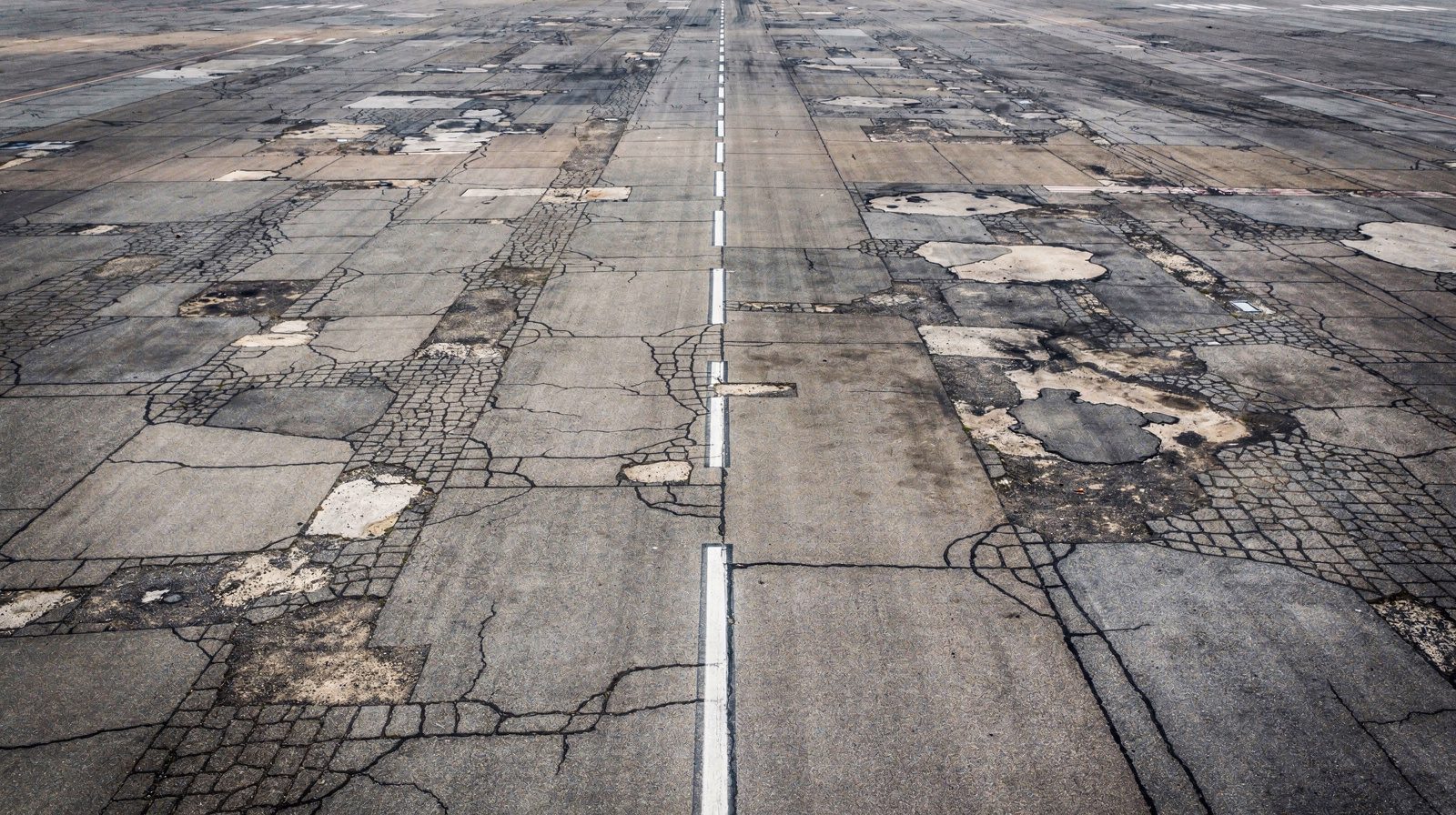
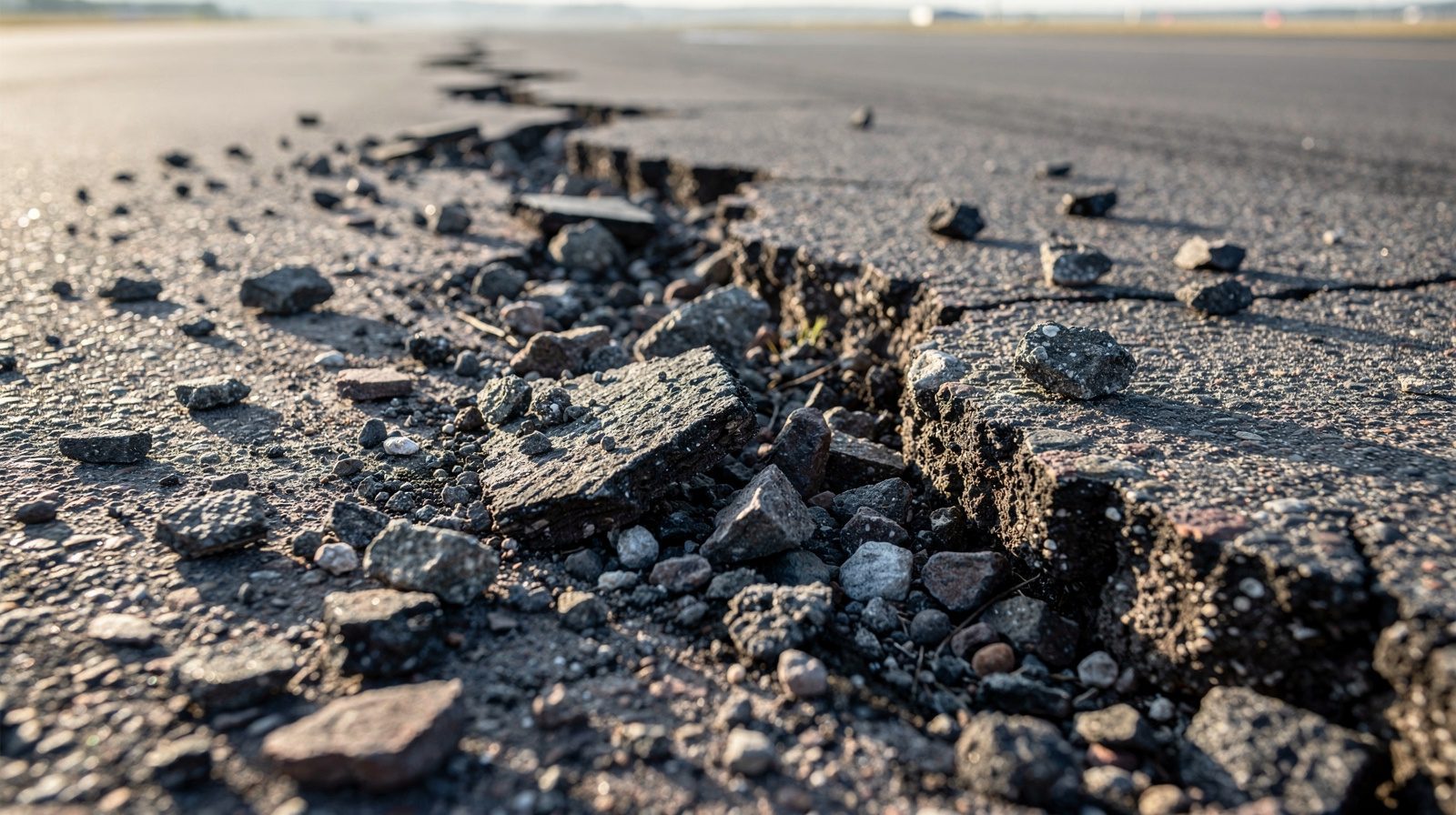
What is Alligator (Fatigue) Cracking?
Alligator (Fatigue) Cracking in Asphalt Pavements
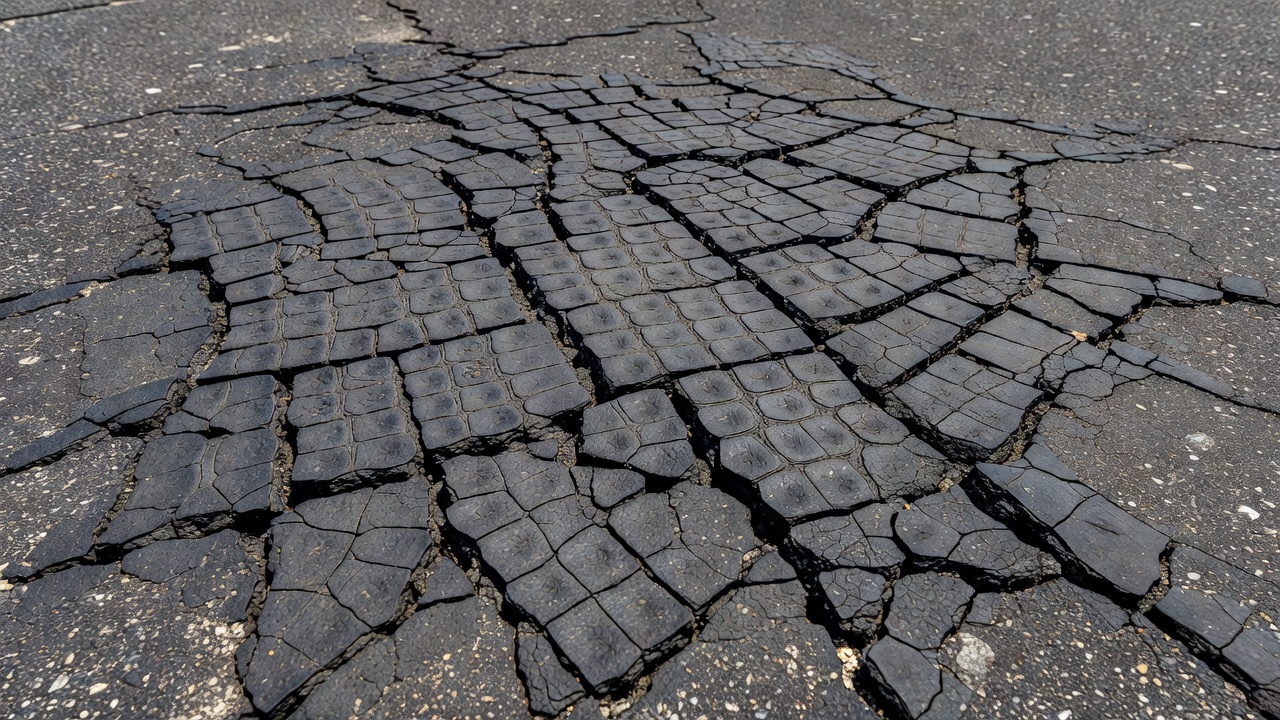
Definition and Visual Characteristics
Alligator cracking, also referred to as fatigue cracking or crocodile cracking, is a load-associated pavement distress classified as Distress Type ACP 1 in the FHWA Long-Term Pavement Performance (LTPP) Distress Identification Manual (DIM), 5th Edition (FHWA-HRT-13-092, Revised May 2014). It is characterized by a series of interconnecting cracks in the asphalt concrete (AC) surface that form a pattern resembling alligator skin, chicken wire, or reptile scales. The individual pieces formed by the crack network are typically less than 2 ft (0.6 m) on the longest side, and the pattern consists of many-sided, sharp-angled polygons that are distinctly irregular in shape and size.
The visual appearance of alligator cracking progresses through three recognizable stages as the distress develops. In the initial stage, the surface shows fine, longitudinal hairline cracks running parallel to one another in the wheel path with few or no interconnecting cracks. This stage is often overlooked during cursory inspections because the cracks are narrow and may be mistaken for normal longitudinal cracking or surface crazing. In the intermediate stage, these parallel longitudinal cracks develop transverse interconnections that begin to form a recognizable network pattern. The pieces between cracks remain securely held in place with good aggregate interlock, meaning there is no vertical displacement or loose material. In the advanced stage, the pattern is fully developed with well-defined pieces, and spalling (fragmentation of crack edges) becomes evident. At this stage, some pieces may rock under traffic or become completely detached, creating loose pavement fragments that constitute a safety hazard.
Alligator cracking is fundamentally a structural distress. Its presence indicates that the pavement has experienced tensile stresses and strains that exceeded the fatigue endurance limit of the asphalt concrete layer. This is not a surface-level cosmetic defect, it is a manifestation of structural failure in the pavement system. The distress is load-associated, meaning it is caused by repeated traffic loading and occurs only in areas subjected to traffic. Specifically, alligator cracking is always located in wheel paths, the traffic lanes where vehicle or aircraft tires repeatedly pass. If interconnected cracking covers an entire pavement area including non-traffic zones, it is classified as block cracking (ACP 2), which is a non-load-associated thermal distress.
The term fatigue cracking is the technically preferred nomenclature in engineering practice because it describes the mechanism of formation, the material has undergone fatigue failure from repetitive stress cycles at stress levels below the material’s static strength. Each wheel pass creates a tensile stress cycle at the bottom of the AC layer. After thousands to millions of repetitions, micro-cracks develop, coalesce, and propagate to form the visible surface pattern. The term alligator cracking is the descriptive name based on the visual pattern, and the term crocodile cracking is used interchangeably in some regions.
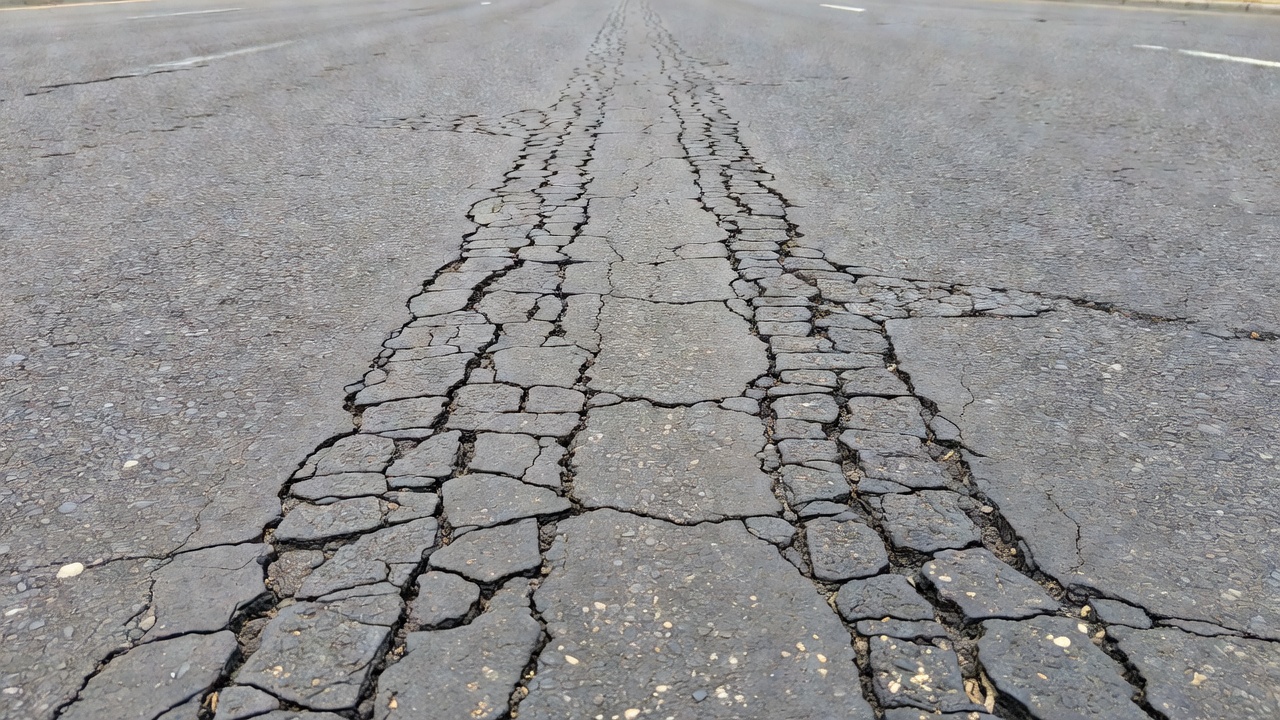
Formation Mechanism, Bottom-Up vs Top-Down Fatigue
The formation mechanism of alligator cracking is the fatigue failure of the asphalt concrete layer under repeated traffic loading. The classic understanding, bottom-up cracking, describes crack initiation at the bottom of the AC layer where tensile bending stresses are highest under a wheel load. However, research in the late 1990s and continuing through the present has identified a second mechanism, top-down cracking, that produces a visually similar surface pattern but initiates at the pavement surface.
Bottom-Up Fatigue Cracking (Classic Mechanism)
In bottom-up fatigue cracking, the distress mechanism follows a well-defined sequence. When a wheel load passes over a pavement section, it creates a tensile bending stress at the bottom of the asphalt concrete layer directly beneath the load center. This tensile stress is the highest in the pavement structural section because the AC layer acts as a structural beam spanning over the underlying base and subgrade layers. Each load application produces a tensile strain cycle at the bottom of the AC. The relationship between tensile strain and fatigue life is described by the classical fatigue transfer function:
Nf = k1 × (1/εt)^k2 × (1/E)^k3
where Nf is the number of load repetitions to failure, εt is the tensile strain at the bottom of the AC layer, E is the AC modulus, and k1, k2, k3 are experimentally determined coefficients. This relationship, fundamental to mechanistic-empirical pavement design, predicts that higher tensile strains produce exponentially shorter fatigue lives.
Under continued loading, micro-cracks develop at the bottom of the AC layer where the tensile stress is maximum. These micro-cracks coalesce into a macro-crack that propagates upward through the AC layer thickness. The crack reaches the surface as one or more longitudinal hairline cracks in the wheel path. With continued traffic loading, adjacent longitudinal cracks propagate and interconnect through transverse cracking, forming the characteristic alligator skin pattern. The cracks widen and spall (fragment) at edges as pieces become loose, eventually leading to pothole formation if the material is completely dislodged.
Bottom-up cracking is the predominant failure mode in thin AC pavements (less than approximately 6 inches or 150 mm of total AC thickness). In these thinner sections, the bending stress at the bottom of the AC layer dominates the stress state, making bottom-up initiation the controlling mechanism. This mechanism is the basis for the fatigue transfer functions in the AASHTO Mechanistic-Empirical Pavement Design Guide (MEPDG) and forms the core of pavement structural design for most highway applications.
Top-Down Fatigue Cracking
Top-down cracking was first systematically documented in the late 1990s when pavement cores from several states showed cracks that originated at the pavement surface and propagated downward, rather than the reverse. This mechanism is now recognized as a significant, and in some pavements, dominant, mode of fatigue cracking. Research by the Washington Asphalt Pavement Association and studies from multiple state DOTs have identified three primary mechanisms for top-down cracking initiation.
The first mechanism is high surface tensile stresses from truck tire-pavement interaction. Modern truck tires, particularly wide-base single tires and tires with high inflation pressures (100-120 psi, and up to 130+ psi for some heavy-load configurations), create high horizontal tensile stresses at the pavement surface near the tire edges. These surface tensile stresses can exceed the tensile strength of the aged AC surface, initiating cracks that propagate downward. The second mechanism is age hardening and thermal stresses. The pavement surface undergoes the most rapid oxidative aging from exposure to UV radiation, air, and temperature extremes. This creates a stiffness gradient where the surface is significantly more brittle than the underlying material. Combined with thermal cycling stresses from daily and seasonal temperature changes, the embrittled surface develops cracks that propagate downward under traffic. The third mechanism is low-stiffness upper layer caused by high surface temperatures during summer months. When the AC surface temperature exceeds 50-60°C (122-140°F), the binder softens dramatically, reducing the surface stiffness and causing high shear stresses from tire contact that initiate surface cracking.
Top-down cracking is the predominant failure mode in thick AC pavements (greater than 6-8 inches or 150-200 mm). In these thicker sections, the bending stress at the bottom of the AC layer is significantly reduced by the structural thickness, making bottom-up initiation less likely. However, the surface tensile and shear stresses from tire contact remain substantial regardless of AC thickness. Therefore, any pavement with thick AC sections should be assumed susceptible to top-down cracking. The Washington Asphalt Pavement Association recommends taking pavement cores on suspect cracks to distinguish between bottom-up and top-down mechanisms, a core will clearly show whether the crack originates at the top, bottom, or both surfaces.
The practical significance of distinguishing bottom-up from top-down cracking lies in repair strategy selection. Bottom-up cracking typically indicates a structural deficiency requiring full-depth repair or structural overlay. Top-down cracking, particularly when confined to the upper AC layer, can often be addressed by milling the top 1.5-3 inches (the depth of crack penetration) followed by an overlay, a less expensive and more targeted repair.
FHWA LTPP Severity Classification (Low/Moderate/High)
The FHWA Long-Term Pavement Performance (LTPP) Program established the definitive standard for classifying alligator (fatigue) cracking severity in the Distress Identification Manual (DIM) , 5th Edition (FHWA-HRT-13-092, Revised May 2014). This classification system is the foundation for pavement condition data collection by highway agencies across the United States and is referenced by AASHTO, ASTM, and international pavement management standards.
Low Severity (L)
Low-severity alligator cracking is characterized by fine, longitudinal hairline cracks running parallel to one another with none or only a few interconnecting cracks. The cracks are not spalled, the crack edges are intact with no evidence of material loss or fragmentation. There is no pumping evidence (no fine material deposited on the surface from water being forced upward through the cracks under traffic). The individual crack widths are typically less than approximately 1/4 inch (6 mm) and the pieces between cracks remain fully intact with no evidence of movement or rocking. At low severity, the pavement surface remains essentially intact, the structural capacity has been reduced but significant load transfer still occurs across the cracks through aggregate interlock. The distress is primarily detectable by close visual inspection. A low-severity rating indicates the initial stages of fatigue damage, the micro-cracks have reached the surface but have not yet developed into a fully interconnected pattern.
Moderate Severity (M)
Moderate-severity alligator cracking represents the further development of light alligator cracking into a pattern or network of cracks. The key defining characteristics are: (1) a well-defined pattern of interconnecting cracks is clearly visible, forming the characteristic alligator-skin or chicken-wire appearance, (2) the cracks may be lightly spalled, some minor fragmentation of crack edges is evident, but the pieces remain securely in place with good aggregate interlock, (3) all pieces are securely held in place under traffic, there is no rocking of individual pieces, (4) crack widths may range up to approximately 1/2 inch (13 mm), and (5) there is no significant pumping evidence. At moderate severity, the structural integrity of the pavement is substantially compromised. The interconnected crack pattern has significantly reduced the effective load transfer capacity of the AC layer, and the pavement has entered a phase of accelerated deterioration where continued traffic loading will cause rapid progression.
High Severity (H)
High-severity alligator cracking represents the most advanced stage of fatigue failure. The defining characteristics are: (1) network or pattern cracking has progressed so that the pieces are well defined, the alligator pattern is fully developed and clearly visible, (2) pieces are spalled at the edges, the crack edges show significant fragmentation and material loss, (3) some pieces rock under traffic, the aggregate interlock has been destroyed, and individual pieces move independently under wheel loads, (4) there is evidence of pumping, fine, gray silt-like material is deposited on the pavement surface adjacent to cracks, indicating that water is being forced upward through the full pavement section under traffic loading, (5) there is definite foreign object debris (FOD) potential, loose fragments may break away and become debris on the pavement surface. At high severity, the pavement has lost most or all of its structural capacity in the affected area. The AC layer is broken into individual pieces that cannot effectively transfer load to the underlying base. Immediate repair is typically required to prevent rapid progression to pothole formation and to eliminate safety hazards from loose pavement fragments.
The severity classification table from FHWA LTPP DIM is summarized below:
| Severity Level | Crack Pattern | Spalling | Piece Stability | Pumping | Crack Width |
|---|---|---|---|---|---|
| LOW | Fine parallel longitudinal, few interconnections | None | Securely held | None | < 1/4 in (6 mm) |
| MODERATE | Well-defined interconnected network | Light spalling | Securely held (good aggregate interlock) | None typical | Variable |
| HIGH | Fully developed network pattern | Significant spalling | Pieces rock under traffic | Evidence present | Variable with loose pieces |
TxDOT and ASTM D6433 Classification
Texas Department of Transportation (TxDOT) Classification
The Texas Department of Transportation (TxDOT) Pavement Management Information System (PMIS) Rater’s Manual provides a detailed classification system for alligator cracking that aligns with FHWA LTPP but incorporates Texas-specific adaptations. TxDOT classifies alligator cracking severity using the same three-level system (Low/Moderate/High) but with more quantitative thresholds for crack width and pattern development.
TxDOT Low Severity, cracks with mean width up to 1/4 inch (6 mm), fine hairline cracks that are mainly parallel with few interconnections, no spalling, and no loose material. TxDOT Moderate Severity, cracks with mean width between 1/4 and 3/4 inch (6-19 mm), well-defined interconnected pattern, light spalling, all pieces securely in place. TxDOT High Severity, cracks with mean width greater than 3/4 inch (19 mm), fully developed pattern with heavy spalling, loose pieces, and pumping evidence present.
TxDOT also provides percentage-of-wheel-path-area thresholds for network-level condition assessment. The wheel path area is defined as two strips approximately 3 ft (0.9 m) wide centered on each wheel track. The percentage of wheel path area affected by alligator cracking is used as a condition indicator separate from severity, recognizing that a pavement with 5% of its wheel path area in low-severity alligator cracking has a different condition and maintenance priority than one with 80% area affected. TxDOT combines severity and extent into a single distress rating that feeds into the overall PMIS score.
ASTM D6433 Classification
ASTM D6433, Standard Practice for Roads and Parking Lots Pavement Condition Index Surveys, defines alligator cracking as Distress Code AC-01 with the formal description: “Alligator Cracking (Fatigue), a series of interconnecting cracks caused by fatigue failure of the AC surface under repeated traffic loading.” The ASTM D6433 classification uses the same three severity levels as FHWA LTPP but with slightly different wording and interpretive guidance.
Under ASTM D6433, alligator cracking is measured in square feet of affected surface area. The critical measurement protocol states: “The entire area should be rated at the highest severity present.” This means that if a 50 sq ft area of alligator cracking contains 5 sq ft of high-severity cracking and 45 sq ft of low-severity cracking, the entire 50 sq ft area is recorded as high severity. This conservative approach ensures that PCI calculations conservatively capture the structural significance of even small areas of advanced failure within a larger distressed zone.
For Pavement Condition Index (PCI) calculation per ASTM D6433, the deduct value for alligator cracking is determined by:
- Measuring the total affected area in square feet
- Calculating distress density = (affected area / sample unit area) × 100%
- Locating the appropriate deduct value curve for alligator cracking at the recorded severity level
- Reading the deduct value from the curve at the calculated density
The deduct value curves for alligator cracking are nonlinear, a low-severity density of 5% might yield a deduct value of approximately 12, while the same density at high severity might yield a deduct value of 35 or higher. The steepness of the high-severity curve reflects the severe impact of advanced fatigue cracking on pavement serviceability.
| Distress Code | Distress Name | Unit of Measure | Severity Levels |
|---|---|---|---|
| AC-01 | Alligator Cracking (Fatigue) | Square Feet (Sq Ft) | Low (L) / Medium (M) / High (H) |
Measurement Methods
Accurate measurement of alligator cracking is essential for pavement condition assessment, PCI calculation, repair quantity estimation, and deterioration modeling. The measurement protocols differ between manual (walking) surveys, semi-automated surveys, and fully automated surveys using computer vision.
Manual Measurement (ASTM D6433 / FHWA LTPP Protocol)
In manual surveys, the inspector identifies each distinct area of alligator cracking within the sample unit and measures the total contiguous area in square feet (or square meters). The area is measured as a single polygon that encompasses the entire interconnected crack pattern. The key measurement rules are:
Alligator cracking is measured as a two-dimensional area in the plane of the pavement surface. The area is defined by the smallest rectangle or polygon that encloses the interconnected crack network. For irregularly shaped crack zones, the area is estimated by multiplying the maximum length by the maximum width of the affected zone. If multiple separate areas of alligator cracking exist within the same sample unit, each area is measured separately and the areas are summed for the total. The entire area is rated at the highest severity level present within that area. If any portion of the area exhibits high-severity characteristics, the entire measured area is recorded as high severity. The precision of manual area measurement is typically ±5 sq ft for most inspectors, which is adequate for PCI calculation where density values are grouped into categories.
Semi-Automated and Automated Measurement
Modern pavement condition surveys increasingly use automated data collection vehicles equipped with high-resolution line-scan cameras, 3D laser profiling systems, and GPS/IMU positioning. These systems capture continuous pavement surface images at highway speeds (up to 60-70 mph) and process the data using computer vision algorithms to detect, classify, and measure alligator cracking.
In automated surveys, alligator cracking is measured as:
Affected area in square meters (m²), the total surface area of alligator cracking polygons detected by the algorithm within each analysis segment. For network-level reporting, this is typically summarized as alligator cracking density = (total affected area / total lane area) × 100%.
Severity distribution, the breakdown of total affected area into low, moderate, and high severity categories based on crack width, connectivity, spalling, and pattern development metrics extracted from the imagery.
Wheel-path concentration, the percentage of alligator cracking that falls within the defined wheel path zones (typically two 0.75-1.0 m strips centered on each wheel track), which is critical for distinguishing load-associated alligator cracking from non-load-associated block cracking.
The output of automated surveys for alligator cracking is typically reported in 10 m, 20 m, or 100 m analysis segments with: Segment ID (location reference), Total Area Affected (m²), Low Severity Area (m²), Moderate Severity Area (m²), High Severity Area (m²), Weighted Severity Index, and Crack Density (% of segment area).
FAA Airport Pavement Measurement
For airport pavements per FAA AC 150/5380-6B and ASTM D5340, the measurement of alligator cracking follows the same general approach as roads but with critical differences: the measurement is in square feet, the area is recorded at the highest severity present, additional emphasis is placed on FOD (foreign object debris) potential, and areas with loose pieces are flagged for immediate repair regardless of total area, and the deduct values for airport PCI per ASTM D5340 are specific to airfield pavements and differ from ASTM D6433 road values.
| Measurement Parameter | Manual (FHWA/PCI) | Automated (TarmacView) |
|---|---|---|
| Unit | sq ft (or m²) | m² |
| Minimum Detectable | ~1 sq ft | ~0.01 m² per pixel |
| Severity | L / M / H per LTPP | L / M / H per LTPP |
| Area Precision | ±5 sq ft | ±2% of measured area |
| Reporting Unit | Sample unit (2500 sq ft) | Segment (10-100 m) |
Differentiation from Block Cracking and Map Cracking
Correctly differentiating alligator cracking from block cracking and map cracking is essential for accurate pavement condition assessment because these three distress types have fundamentally different causes, implications, and repair strategies. Confusing them can lead to incorrect PCI calculations and inappropriate maintenance decisions.
Alligator Cracking vs Block Cracking
Alligator cracking (ACP 1) and block cracking (ACP 2) are the two most commonly confused interconnected crack patterns in asphalt pavements. The FHWA LTPP DIM provides specific criteria for differentiation:
| Differentiating Factor | Alligator Cracking (ACP 1) | Block Cracking (ACP 2) |
|---|---|---|
| Primary cause | Repeated traffic loading (fatigue) | Thermal shrinkage, age hardening |
| Piece size | Typically < 2 ft (0.6 m) on longest side | 1 ft × 1 ft to 10 ft × 10 ft (0.3 × 0.3 to 3 × 3 m) |
| Piece shape | Many-sided, sharp-angled, irregular | Approximately rectangular, right-angle corners |
| Location | Wheel paths only | Large areas, including non-traffic zones |
| Structural significance | Major structural distress | Not a structural distress |
| Surface condition | May show pumping, rocking pieces | Cracks may be spalled but pieces stable |
| Progression rate | Rapid under continued loading | Slow, progressive over years |
The key distinguishing feature is location relative to traffic. Alligator cracking occurs only in areas subjected to repeated traffic loading, such as wheel paths. If interconnected cracking covers an entire pavement lane including the area between wheel paths and near shoulders, it is almost certainly block cracking. The piece size is also diagnostic, alligator cracking produces small, sharp-angled pieces with a very irregular geometry, while block cracking produces larger, more regular rectangular blocks defined by cracks that intersect at approximately 90-degree angles.
Block cracking is caused by volumetric shrinkage of the asphalt concrete due to age hardening of the binder and daily thermal cycling that creates tensile stresses at the pavement surface. The cracks form at right angles because that is the lowest energy configuration for stress relief in a restrained slab. Block cracking indicates that the asphalt binder has hardened significantly, the pavement is becoming brittle and losing flexibility, but it does not indicate structural failure of the pavement section. Block cracking can be addressed with surface treatments (crack sealing, slurry seal, overlay) without requiring structural repair, whereas alligator cracking typically requires structural remediation.
Alligator Cracking vs Map Cracking
Map cracking (JCP 8a in the FHWA LTPP DIM) is a distress type that occurs only in Portland cement concrete (PCC) pavements, not in asphalt concrete. Map cracking appears as a network of shallow, fine cracks on the PCC surface, creating a pattern that resembles a road map or crazing. The critical differences from alligator cracking are:
Map cracking is a surface defect, the cracks penetrate only the top 1/8 to 1/4 inch (3-6 mm) of the PCC slab surface. It does not extend through the full slab depth and does not indicate structural failure of the pavement. Map cracking in PCC is caused by alkali-silica reaction (ASR), freeze-thaw damage (D-cracking), or improper curing, mechanisms that are entirely different from the traffic-induced fatigue that causes alligator cracking in AC. Map cracking is classified as a surface defect in the FHWA LTPP taxonomy, not as a structural distress. It affects ride quality and may progress to scaling but does not compromise the structural capacity of the slab.
The visual similarity between map cracking and alligator cracking is only superficial, both appear as networks of interconnected lines on the pavement surface. However, map cracking in PCC is distinguished by: cracks that are very shallow (not full-depth), a crazed, spiderweb-like pattern with very small pieces (often < 1 inch), the surface layer may peel or scale in thin sheets, and the distress has no relationship to wheel path loading.
Practical Field Identification
For rapid field identification, inspectors should ask three questions:
Is the cracking in the wheel path only? If yes, it is likely alligator cracking. If it covers the entire lane including non-traffic areas, it is likely block cracking.
What is the piece size? If pieces are smaller than 2 ft on the longest side with irregular, sharp-angled geometry, it is likely alligator cracking. If pieces are larger rectangular blocks, it is likely block cracking.
Is the pavement surface type AC or PCC? If AC, the distress cannot be map cracking. If PCC, the distress cannot be alligator cracking.
Alligator Cracking in Airport Pavements
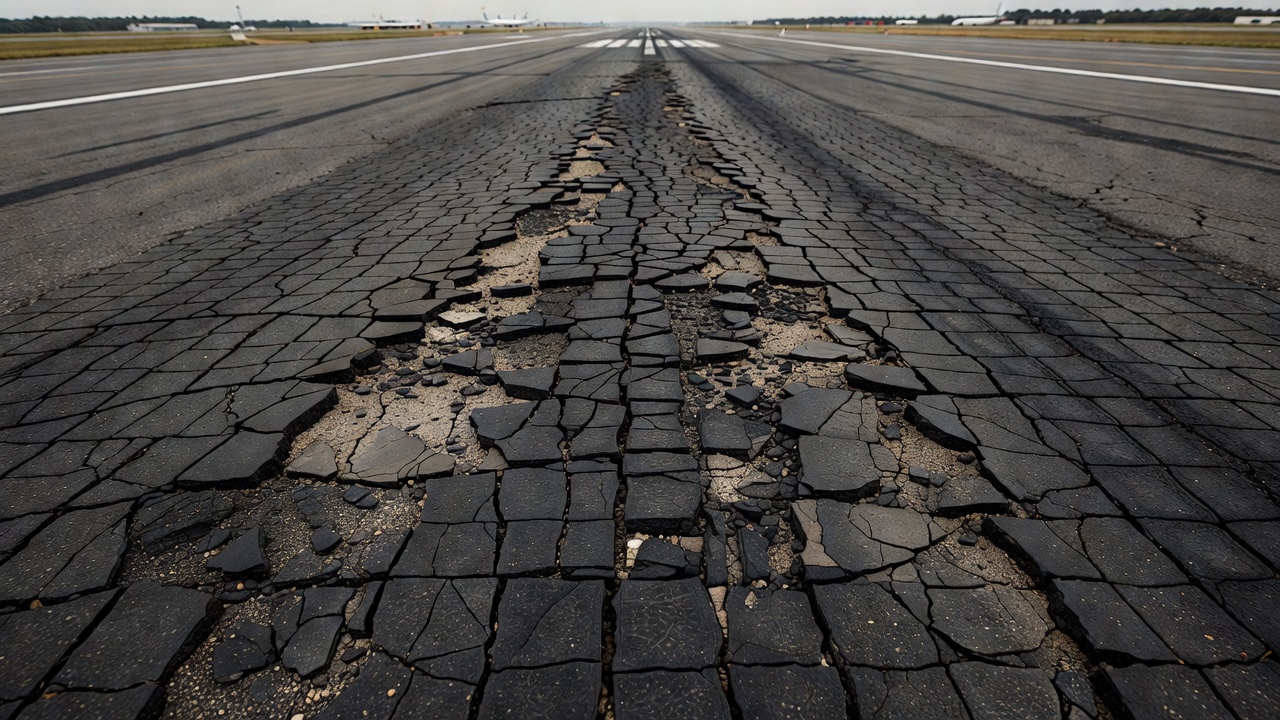
Alligator cracking in airport pavements follows the same fundamental fatigue mechanism as highway pavements but operates under significantly different loading conditions and carries elevated safety implications. Airport pavement distress is governed by FAA Advisory Circular 150/5380-6B (Guidelines and Procedures for Maintenance of Airport Pavements), FAA AC 150/5380-7B (Airport Pavement Management Program), and ASTM D5340 (Standard Test Method for Airport Pavement Condition Index Surveys).
Aircraft Loading Characteristics
Aircraft loads differ fundamentally from highway truck loads in several critical aspects affecting alligator cracking formation. Tire contact pressures for aircraft are substantially higher than highway trucks, commercial aircraft main gear tires operate at pressures from 140 psi (Boeing 737) to over 220 psi (Boeing 777, Airbus A380), compared to typical highway truck tire pressures of 100-120 psi. These higher contact pressures create greater surface shear stresses and higher tensile strains at the bottom of the AC layer, accelerating fatigue damage accumulation.
Aircraft load magnitudes are also dramatically higher. The Boeing 777-300ER has a maximum takeoff weight of approximately 775,000 lb (351,500 kg), distributed over 12 main gear wheels. While the loads are distributed over multiple wheels, the total structural demand on the pavement is far beyond highway loading. Aircraft load repetition frequency is lower than highways, a major commercial runway may experience 50,000 to 200,000 aircraft operations per year, compared to millions of vehicle passes on a highway lane, but each aircraft operation imposes significantly higher stress. Aircraft traffic distribution is more concentrated than highway traffic. Aircraft follow specific departure paths (first third of runway for takeoff roll, touchdown zone for landings), creating highly localized fatigue zones where alligator cracking concentrates, rather than the distributed wheel-path pattern on highways.
FAA Severity Classification
The FAA AC 150/5380-6B and ASTM D5340 define alligator cracking severity for airport pavements with specific attention to FOD (foreign object debris) potential, which is a critical safety consideration for aircraft operations. FOD on runways can be ingested into jet engines, cause tire damage, or strike aircraft structures. The FAA severity levels are:
Low Severity (Airport), Fine, longitudinal hairline cracks running parallel to one another with none or only a few interconnecting cracks. The cracks are not spalled. There is little or no FOD potential. The surface remains essentially intact.
Medium Severity (Airport), Further development of light alligator cracking into a pattern or network of cracks that may be lightly spalled. A well-defined pattern of interconnecting cracks exists, where all pieces are securely held in place. Some FOD potential may exist from light spalling.
High Severity (Airport), Network or pattern cracking has progressed so that the pieces are well defined and spalled at the edges, some pieces rock under traffic and may cause FOD potential. There is definite FOD risk from loose or missing pieces.
The FAA emphasizes that high-severity alligator cracking on runways and high-speed taxiways requires immediate attention because loose pavement fragments can be ingested into aircraft engines, a catastrophic safety hazard. FAA AC 150/5380-6B specifies that corrective action for high-severity alligator cracking should be scheduled immediately upon detection.
ICAO Standards
The International Civil Aviation Organization (ICAO), through Annex 14, Aerodromes, Volume I (Aerodrome Design and Operations), establishes Standards and Recommended Practices (SARPs) for airport pavement condition. ICAO Annex 14, Section 9.4 (Pavement Condition) requires that: “The surface of a runway shall be maintained in a condition such that the surface characteristics are adequate for the safe operation of aircraft.” ICAO further specifies that runways must be regularly inspected for defects and that any defect that could impair safety must be promptly repaired.
The ICAO Aerodrome Design Manual (Doc 9157, Part 3, Pavements) provides guidance on pavement structural design and distress evaluation. It references ASTM and FAA standards for distress identification and PCI methodology. ICAO recognizes alligator cracking as a major structural distress in airport pavements requiring engineering evaluation. The ICAO World Airport Pavement Condition Survey methodology includes alligator cracking as one of the primary distress types recorded in airport pavement management systems worldwide.
Airport PCI per ASTM D5340
The Airport Pavement Condition Index (APCI) per ASTM D5340 uses a modified distress catalog compared to ASTM D6433 for roads. For alligator cracking, the deduct value curves in ASTM D5340 are calibrated to reflect the higher safety standards and structural demands of airfield pavements. The threshold for structural intervention is lower than for roads, an airport pavement with alligator cracking density exceeding 10% at moderate severity in the wheel path area is typically classified as requiring structural evaluation, whereas a highway pavement might tolerate 20-30% at the same severity before triggering structural rehabilitation.
AI-Based Detection and Classification
The automated detection and classification of alligator cracking using computer vision and deep learning has emerged as one of the most impactful applications of AI in pavement management. Traditional manual surveys are labor-intensive, subjective, and limited in spatial coverage. AI-based systems can provide objective, repeatable, and comprehensive alligator cracking detection at network scale.
Computer Vision Approaches
The state-of-the-art in automated alligator cracking detection employs deep convolutional neural networks (CNNs) and vision transformer architectures that learn to recognize the distinctive pattern geometry of alligator cracking from large training datasets. The key technical approaches are:
Semantic Segmentation, Pixel-level classification where each pixel in a pavement image is labeled with its distress class (alligator cracking, block cracking, longitudinal cracking, intact pavement). The leading architectures include U-Net (encoder-decoder with skip connections), DeepLabV3+ (atrous spatial pyramid pooling for multi-scale context), and SegFormer (hierarchical transformer encoder with lightweight MLP decoder). These models produce dense, pixel-level maps of alligator cracking extent and spatial distribution. The output is a binary or multi-class mask that directly enables area measurement in square meters.
Instance Segmentation, Object-level detection where each individual alligator cracking zone is identified with a bounding box and a pixel-precise boundary mask. Mask R-CNN (Region-based Convolutional Neural Network) is the most widely used architecture, providing separate detection of each distinct alligator cracking area, enabling per-zone severity classification and area measurement. This approach is particularly valuable for distinguishing multiple separate alligator cracking zones within the same image.
Object Detection, Faster inference approach using bounding-box detection to locate and classify alligator cracking zones. The YOLO (You Only Look Once) family of models (YOLOv5, YOLOv8, YOLOv9) provides real-time detection capable of processing pavement images at highway speeds. DETR (Detection Transformer) uses transformer-based end-to-end detection that eliminates the need for anchor boxes and non-maximum suppression.
Severity Classification
Beyond detection, AI models can classify alligator cracking severity using the FHWA LTPP three-level system. Research by Wang et al. (Virginia Tech, arXiv 2407.16021) demonstrated a CNN-based approach achieving 96.74% severity classification accuracy across low, moderate, and high severity categories. The severity classification models use: crack width estimation from pixel-level measurements, connectivity analysis quantifying the degree of crack interconnection, pattern regularity metrics measuring how developed the alligator pattern is (e.g., number of closed polygons per unit area), and spalling detection assessing edge deterioration and material loss.
TarmacView Crack-Type Specific Detection
TarmacView implements a crack-type-specific detection head architecture that targets the distinctive geometric signature of alligator cracking. Unlike generic crack detection models that treat all cracks as a single class, TarmacView’s approach uses:
A dedicated alligator cracking detection head trained on thousands of annotated pavement images spanning all severity levels and pavement types. A pattern geometry classifier that explicitly measures crack interconnection density, polygon closure rate, and piece-size distribution, features that mathematically distinguish alligator cracking from other crack types. A multi-head architecture where separate detection heads for alligator cracking, block cracking, longitudinal cracking, and transverse cracking run in parallel, each optimized for its specific pattern geometry. The system outputs per-segment statistics: total alligator cracking area (m²), severity-weighted equivalent area, FOD risk index (high-severity area / total lane area), deterioration rate derived from sequential surveys.
National Academies Research
The National Academies of Sciences, Engineering, and Medicine through the Airport Cooperative Research Program (ACRP) and the National Cooperative Highway Research Program (NCHRP) have published extensive research on automated pavement distress detection. The 2024 report on AI applications in pavement management cites AASHTO R 85-18 and AASHTO R 86-18 standards for automated crack detection and classification. These standards are being updated to incorporate deep learning methods for distress identification including alligator cracking.
Repair Strategies
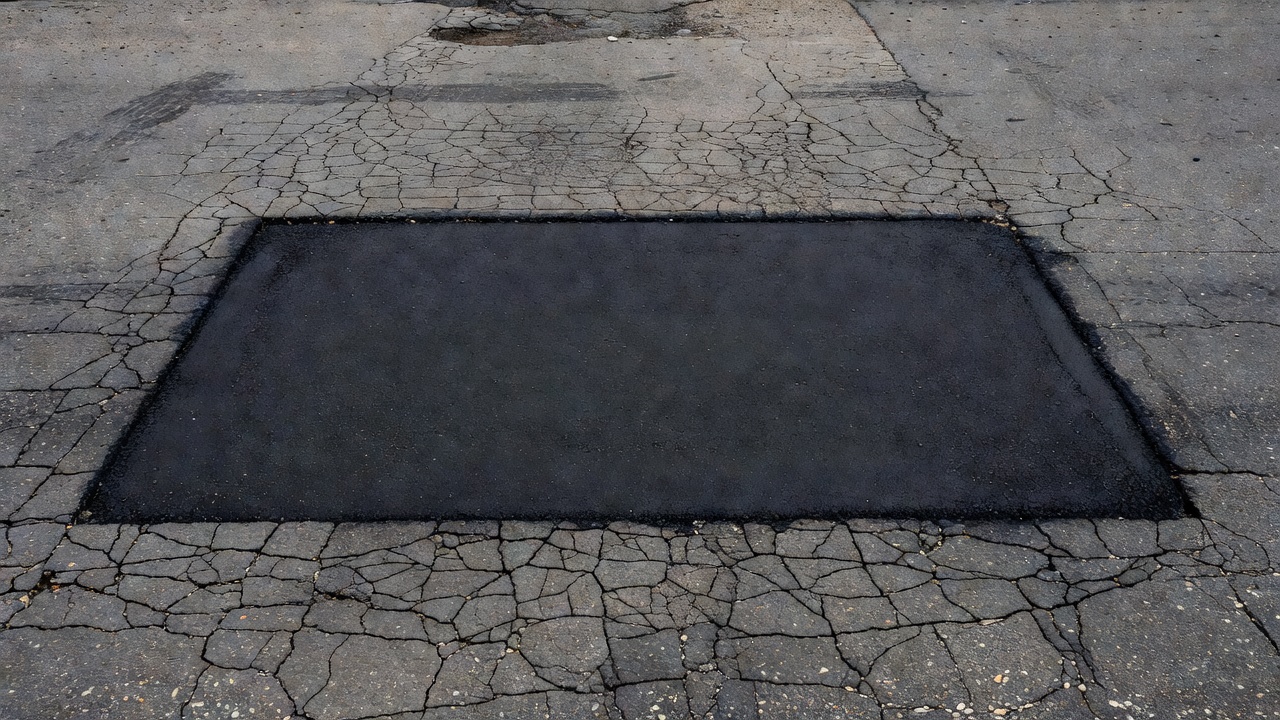
The repair strategy for alligator cracking is determined by severity level, extent of affected area, base condition, traffic loading, and pavement remaining life objectives. Surface treatments that address only the visible cracks will fail if the underlying structural deficiency is not addressed, alligator cracking repair requires addressing the root cause of the fatigue failure.
Low-Severity Repair Strategies
For low-severity alligator cracking (fine parallel cracks, few interconnections, no spalling, no base failure), the objective is to prevent water intrusion that would accelerate deterioration and to monitor progression. The recommended approaches are:
Crack sealing, Apply hot-applied, polymer-modified crack sealant (ASTM D6690 or D5078) to individual cracks to prevent water infiltration. Sealing is effective when cracks are clean and dry. The cost is $0.50-$1.50 per linear foot. Crack sealing does not restore structural capacity but slows the deterioration rate by eliminating moisture access to the base.
Surface treatment, For low-severity alligator cracking covering large areas, a slurry seal (1/8-3/8 inch thick) or microsurfacing (polymer-modified emulsion) can seal the surface, prevent water intrusion, and provide a new wearing surface. Cost: $1.50-$4.00 per square foot. Surface treatments are effective only when the base is sound and the cracking is light.
Structural overlay, A hot-mix asphalt (HMA) overlay of 1.5-3 inches (40-75 mm) over the cracked area provides structural reinforcement and prevents further fatigue progression. The overlay thickness is designed per AASHTO or FAA procedures to provide adequate structural capacity for the design traffic. Cost: $3.00-$8.00 per square foot. An overlay over low-severity cracking with a sound base can extend pavement life by 8-12 years.
Moderate-Severity Repair Strategies
For moderate-severity alligator cracking (well-defined interconnected pattern, light spalling, all pieces held in place), structural repairs are required. The base condition must be evaluated through cores or falling weight deflectometer (FWD) testing before selecting the repair strategy.
Mill and overlay, Mill the top 1.5-3 inches of distressed AC, evaluate the exposed base, and place a new HMA overlay. Milling removes the cracked surface layer and creates a clean bonding surface for the overlay. This is the most common moderate-severity repair when the base is sound. Minimum mill depth should extend below the deepest crack penetration as verified by cores. Cost: $3.00-$7.00 per square foot.
Full-depth patching (localized), For moderate-severity areas that are localized (less than 10% of lane area), saw-cut and full-depth removal is recommended. The patch boundaries should extend at least 12 inches (300 mm) beyond the visible crack limits to ensure the patch terminates in sound pavement. The excavation is made to the full AC depth, the base is evaluated and repaired if needed, and new HMA is placed in lifts (typically 2-3 inch compacted thickness per lift). Cost: $7.00-$15.00 per square foot depending on depth and base work.
High-Severity Repair Strategies
High-severity alligator cracking (fully developed pattern, spalling, rocking pieces, pumping evidence) indicates complete structural failure of the pavement section. Immediate repair is required to prevent pothole formation and eliminate safety hazards.
Full-depth pavement removal and replacement, Saw-cut the repair boundaries at least 12-24 inches (300-600 mm) beyond visible cracks. Remove all failed AC and base material. The base and subgrade are evaluated and repaired, common base repairs include adding 6-12 inches (150-300 mm) of new granular base, cement-treated base, or asphalt-treated base. Place new HMA in lifts of 2-3 inches (50-75 mm) compacted thickness per lift. Tack coat is applied between lifts and on vertical saw-cut faces. The total AC thickness should be designed for the current and projected traffic. Cost: $10.00-$25.00 per square foot depending on depth and base conditions.
Reconstruction (widespread failure), When alligator cracking covers more than 25-30% of a lane or section area, full reconstruction is typically the most cost-effective long-term solution. This involves: removal of all existing pavement and base material, subgrade improvement (compaction, stabilization, or undercut and replacement of unsuitable soils), drainage improvement (underdrains, edge drains, subgrade drainage layer), placement of new base (designed thickness), and placement of new AC surface (designed structural section). Reconstruction provides a 20+ year design life and the lowest lifecycle cost when failure is widespread. Cost: $15.00-$40.00+ per square foot.
Repair Strategy Selection Decision Matrix
| Severity | Extent | Base Condition | Recommended Repair |
|---|---|---|---|
| Low | < 10% | Sound | Crack seal + surface treatment |
| Low | 10-30% | Sound | Structural overlay (1.5-3 in) |
| Low | > 30% | Sound | Structural overlay (2-4 in) |
| Moderate | < 5% | Sound | Full-depth patch (localized) |
| Moderate | 5-20% | Sound | Mill and overlay |
| Moderate | > 20% | Marginal | Full-depth R&R + base repair |
| Moderate | Any | Failed | Full-depth R&R + base reconstruction |
| High | Any | Any | Full-depth R&R or full reconstruction |
| High | > 30% | Any | Reconstruction |
Critical Principles for Alligator Cracking Repair
Regardless of the specific repair method selected, several engineering principles apply to all alligator cracking repairs:
Water is the primary accelerator, alligator cracking allows water to enter the pavement structure, softening the base and subgrade. All repairs must include drainage evaluation and correction. Edge drains, underdrains, or base drainage layers should be installed when the existing drainage is inadequate.
Crack boundaries must be cut back to sound material, saw-cut repair boundaries must extend beyond visible cracks to ensure the repair terminates in structurally sound pavement. A minimum offset of 12 inches (300 mm) beyond visible crack limits is standard practice.
Overlay over structural failure will fail, placing an overlay over high-severity alligator cracking without addressing the base failure will result in reflective cracking through the overlay within 1-3 years. The base condition must be evaluated and repaired before any overlay.
Load transfer restoration is essential, for full-depth repairs, the patch must be properly compacted and bonded to ensure effective load transfer to the adjacent pavement. Tack coat on vertical faces provides shear load transfer, and compaction to target density (typically 92-96% of maximum density per AASHTO T 180) ensures the patch can carry traffic loads.
Timing matters, alligator cracking progresses exponentially. A low-severity area can progress to high severity within 6-12 months under heavy traffic and wet conditions. Prompt repair at low-to-moderate severity can reduce repair costs by 50-70% compared to waiting until high-severity failure.
| Repair Method | Typical Life | Cost Range (per sq ft) | Applicable Severity |
|---|---|---|---|
| Crack sealing | 2-4 years | $0.50-$1.50 | Low only |
| Surface treatment (slurry/micro) | 3-6 years | $1.50-$4.00 | Low only |
| Structural overlay (2-4 in) | 8-12 years | $3.00-$8.00 | Low to Moderate |
| Full-depth patch | 8-15 years | $7.00-$15.00 | Moderate to High |
| Full-depth R&R + base | 10-20 years | $10.00-$25.00 | High |
| Full reconstruction | 20+ years | $15.00-$40.00+ | High (widespread) |
Frequently Asked Questions
- What is alligator cracking in asphalt pavements?
- Alligator cracking, also called fatigue cracking or crocodile cracking, is a series of interconnected cracks forming a pattern that resembles alligator skin or chicken wire. It is caused by fatigue failure of the asphalt concrete (AC) surface under repeated traffic loading. The cracks initiate at the bottom of the AC layer where tensile stresses are highest, then propagate upward as parallel longitudinal cracks that eventually interconnect to form many-sided, sharp-angled pieces. Pieces are typically less than 2 ft (0.6 m) on the longest side. In FHWA LTPP terminology, alligator cracking is classified as Distress Type ACP 1 (Fatigue Cracking) and is considered a major structural distress. It occurs only in areas subjected to repeated traffic loading, primarily wheel paths, and differs from block cracking which covers entire pavement areas and is caused by thermal shrinkage rather than traffic loading.
- What is the difference between alligator cracking and block cracking?
- Alligator cracking and block cracking differ fundamentally in their cause and pattern. Alligator cracking is load-associated, caused by fatigue from repeated traffic loading, and forms small (typically < 2 ft or 0.6 m), many-sided, sharp-angled interconnected pieces only in wheel path areas. Block cracking is non-load-associated, caused by thermal shrinkage and age hardening of asphalt, forming larger rectangular blocks (1 ft × 1 ft to 10 ft × 10 ft, 0.3 m × 0.3 m to 3 m × 3 m) over large areas including non-traffic zones. Alligator cracking indicates structural failure requiring structural repair, block cracking signals surface aging requiring preventive maintenance. Per FHWA LTPP, alligator cracking is considered a major structural distress, while block cracking (ACP 2) is not explicitly designated as structural.
- What are the severity levels of alligator cracking per FHWA LTPP?
- Per the FHWA LTPP Distress Identification Manual, alligator (fatigue) cracking has three severity levels: LOW, fine longitudinal hairline cracks running parallel to each other with none or only a few interconnecting cracks, cracks are not spalled and show no pumping. Pieces are not broken out and the surface is essentially intact. MODERATE, further development of light alligator cracking into a pattern or network of cracks that may be lightly spalled. A well-defined pattern of interconnecting cracks exists, where all pieces are securely held in place (good aggregate interlock between pieces). HIGH, network or pattern cracking has progressed so that the pieces are well defined and spalled at the edges, some pieces rock under traffic and may cause FOD (foreign object debris) potential. Evidence of pumping, fine material washed to the surface, may be present at high severity.
- How is alligator cracking measured and quantified?
- Alligator cracking is measured in square feet (or square meters) of affected surface area. Per ASTM D6433 and FHWA LTPP protocols, the entire area of interconnected cracking is measured as one contiguous zone. The area is recorded at the highest severity level present within that zone, if any portion of the area exhibits high-severity cracking, the entire measured area is rated as high severity. For PCI (Pavement Condition Index) calculations per ASTM D6433, the distress density is computed as: Distress Density (%) = (Alligator Cracking Area in sq ft / Total Sample Unit Area in sq ft) × 100. This density is then mapped to a Deduct Value using standardized curves. For network-level surveys using automated data collection (e.g., TarmacView), alligator cracking is typically measured as: total affected area in m², percentage of lane area affected, and severity distribution across low/moderate/high categories.
- What causes alligator cracking in asphalt pavements?
- Alligator cracking is caused by fatigue failure of the asphalt concrete layer under repeated traffic loading exceeding the material's endurance limit. The primary causes include: (1) inadequate pavement structural design, insufficient AC thickness or base strength for the applied traffic loads, (2) weakened or saturated subgrade, poor drainage causes water accumulation that softens the subgrade, substantially reducing structural support, (3) overloading, traffic loads exceeding design values, particularly from overweight trucks or aircraft, (4) aging and embrittlement, oxidative hardening of asphalt binder over time reduces fatigue life, (5) construction deficiencies, poor compaction, segregation, or inadequate bond between lifts, (6) base deterioration, loss of base support from water intrusion, freeze-thaw damage, or repeated load failure. Alligator cracking can initiate from the bottom of the AC layer (bottom-up, classic fatigue) or from the surface (top-down), particularly in thick AC pavements over 6 inches (150 mm).
- How do you repair alligator cracking?
- Alligator cracking repair strategies depend on severity and extent. For LOW severity with sound base: crack sealing to prevent water intrusion combined with a surface treatment (slurry seal, microsurfacing) for area-wide protection, structural overlay (2-4 inches of new HMA) if the cracked area is widespread. For MODERATE severity: mill and overlay, mill the top 1.5-3 inches of distressed AC, evaluate base condition, and place new HMA overlay, full-depth patch for localized moderate areas. For HIGH severity or any severity with base failure: full-depth pavement removal and replacement, saw-cut at least 12 inches beyond visible cracks, remove failed AC and base material, rebuild base if required (typically 6-12 inches of granular base or treated base), place new HMA in lifts (typically 2-3 inch compacted thickness per lift). For widespread structural failure: full reconstruction including base and subgrade improvement, underdrains to correct drainage, and thicker structural section designed for current traffic.
- What is the difference between alligator cracking in roads vs airport pavements?
- Alligator cracking in airport pavements follows the same formation mechanism as highway pavements but has critical differences: (1) severity is assessed with additional emphasis on FOD (foreign object debris) potential, loose pieces of pavement on runways pose immediate safety hazards to aircraft engines and tires, (2) FAA Advisory Circular 150/5380-6B categorizes alligator cracking under the same three severity levels but with stricter repair thresholds, (3) airport load distribution differs, aircraft gear configurations concentrate loads in specific traffic patterns, while single-wheel loads produce higher contact pressures than truck tires, (4) repair urgency is higher for airports, high-severity alligator cracking on runways or high-speed taxiways requires immediate attention per FAA guidance, (5) Airport PCI uses ASTM D5340 (instead of D6433) which has subtle differences in distress catalog and deduct values. ICAO Annex 14 requires that runway surfaces be maintained free of any defect that might impair safety, including significant alligator cracking.
- Can AI detect and classify alligator cracking automatically?
- Yes. Modern computer vision systems using deep learning (convolutional neural networks, CNNs, and vision transformers) can detect, segment, and classify alligator cracking from pavement images with high accuracy. State-of-the-art approaches: (1) semantic segmentation (U-Net, DeepLab, SegFormer), pixel-level classification where each pixel is labeled as alligator cracking, other crack types, or intact pavement, (2) instance segmentation (Mask R-CNN), detects individual alligator cracking zones with boundary masks, (3) object detection (YOLO, DETR), bounding-box detection of alligator cracking areas, (4) crack-type classification, CNNs that classify patches as containing alligator cracking, block cracking, longitudinal cracking, etc. Leading research (Wang et al., Virginia Tech, arXiv 2407.16021) demonstrated CNN-based severity classification achieving 96.74% accuracy across three severity levels. TarmacView implements crack-type-specific detection heads that target alligator cracking pattern geometry for network-level pavement condition assessment.
- How is alligator cracking different from map cracking?
- Alligator cracking and map cracking are fundamentally different distress types. Alligator cracking (ACP 1) is load-associated fatigue cracking in asphalt pavements only, forming interconnected cracks in wheel paths from repeated traffic loading. Map cracking (JCP 8a / CRCP 4a) occurs in Portland cement concrete (PCC) pavements, it is a surface-related defect characterized by a network of shallow, fine cracks that penetrate only the surface of the PCC slab (typically 1/8 to 1/4 inch deep). Map cracking in PCC is caused by alkali-silica reaction (ASR), freeze-thaw damage, or improper curing. Map cracking does not extend through the full slab depth and does not indicate structural failure, it is classified as a surface defect, not a structural distress. Alligator cracking in AC pavements extends through the full AC layer thickness (propagating from bottom to top or top to bottom) and is a definitive structural failure indicator requiring structural evaluation and repair.