What is an Approach Procedure?
Approach Procedure (AP) / Instrument Approach Procedure (IAP)
An Approach Procedure (AP), also known as an Instrument Approach Procedure (IAP), is a published, regulatory-compliant sequence of maneuvers that guides aircraft operating under Instrument Flight Rules (IFR) from the en-route environment to a position where a landing can be made, or, if landing is not possible, to a missed approach. These procedures define specific waypoints, altitudes, headings, and speed constraints to ensure safe separation from obstacles and efficient sequencing into an airport’s airspace.
Regulatory Context
Approach procedures are established and published by national aviation authorities, such as the FAA (United States), EASA (Europe), and internationally under ICAO standards (notably Doc 8168, PANS-OPS). These authorities ensure procedures meet strict criteria for obstacle clearance, navigation reliability, airspace compatibility, and operational minima. Any deviation from these procedures is permitted only in emergencies or when directed by air traffic control (ATC).
The availability of approach procedures is fundamental for an airport’s operational capability under IFR, especially in regions with adverse weather, complex terrain, or high traffic volumes. Procedures are subject to regular reviews, amendments, and operational audits to maintain the highest safety standards.
Purpose and Scope of Approach Procedures
Instrument approach procedures are crucial for:
- Safe Transition: They provide a protected, repeatable path from en-route or terminal airspace to a landing position, even in low visibility or at night.
- Obstacle Clearance: Each segment is precisely designed for minimum obstacle clearance, following surfaces and gradients set by ICAO PANS-OPS.
- Traffic Management: They facilitate orderly sequencing and separation of arriving aircraft, integrating with Standard Terminal Arrival Routes (STARs).
- All-Weather Operations: Instrument approaches allow airports to remain open in poor weather, reducing delays and diversions.
- Standardization: Published procedures standardize expectations for pilots and ATC, reducing errors and miscommunication.
Approach procedures are used by all IFR operators, from commercial airlines to general aviation, and are a key aspect of airport and airspace design.
Categories of Instrument Approach Procedures
Instrument approaches are classified by the accuracy and type of guidance provided:
Precision Approach (PA)
Delivers lateral and vertical guidance to the runway, using systems like the Instrument Landing System (ILS) or Ground-Based Augmentation System (GBAS). Precision approaches are divided into categories based on Decision Height (DH) and Runway Visual Range (RVR):
| Category | Decision Height (DH) | RVR (m) | Example Use |
|---|---|---|---|
| CAT I | ≥ 200 ft (60 m) | ≥ 550 | Standard ILS operations |
| CAT II | 100–199 ft (30–60 m) | ≥ 300 | Lower visibility ILS |
| CAT IIIA | < 100 ft (30 m) | ≥ 175 | Autoland, very low vis |
| CAT IIIB | < 50 ft (15 m) | 50–175 | Autoland, minimum cues |
| CAT IIIC | None | None | Full autoland (not in use) |
Approach with Vertical Guidance (APV)
Provides both lateral and vertical guidance but to less stringent standards than a precision approach. These are typically satellite-based (e.g., LPV via SBAS) or use Barometric VNAV. APV approaches enhance safety and are increasingly available at airports where ILS is not feasible.
Non-Precision Approach (NPA)
Provides lateral guidance only (no published vertical path). Examples include VOR, NDB, and Localizer (LOC) approaches. NPAs terminate at a Minimum Descent Altitude/Height (MDA/H). The pilot controls the descent rate, ideally using a Continuous Descent Final Approach (CDFA) for safety.
Structure of an Instrument Approach Procedure
Approach procedures are broken into segments, each with specific purposes and protections:
| Segment | Purpose |
|---|---|
| Feeder Route | Connects en-route or STAR to the Initial Approach Fix (IAF), specifying safe course/altitude |
| Initial Approach | Begins at IAF, aligns the aircraft for intermediate/final segment, may include turns/arcs |
| Intermediate | Starts at Intermediate Fix (IF), positions and configures aircraft for final approach |
| Final Approach | From Final Approach Fix/Point (FAF/FAP) to runway or missed approach point |
| Missed Approach | Specifies routing if a landing cannot be made, ensuring obstacle clearance |
Straight-In vs. Circling Approaches
- Straight-In Approach: Final approach course is aligned within 30° of the runway centerline, minimizing maneuvering.
- Circling Approach: Used when alignment is not possible due to terrain, obstacles, or airspace. Pilots transition visually from the instrument procedure to maneuver for landing, requiring higher minimums and increased vigilance.
Instrument Approach Charts (“Approach Plates”)
Published approach charts provide all details needed for safe procedure execution, including:
| Section | Description |
|---|---|
| Pilot Briefing | Title, runway, navigation requirements, chart date, notes |
| Plan View | Overhead map of approach, waypoints, NAVAIDs, obstacles, terrain, minimum altitudes |
| Profile View | Side view of altitudes, fixes, descent paths, missed approach point |
| Minimums | Lists DA, DH, MDA, RVR/visibility, by aircraft category and equipment |
| Airport Diagram | Runway/taxiway layout, relevant for ground operations |
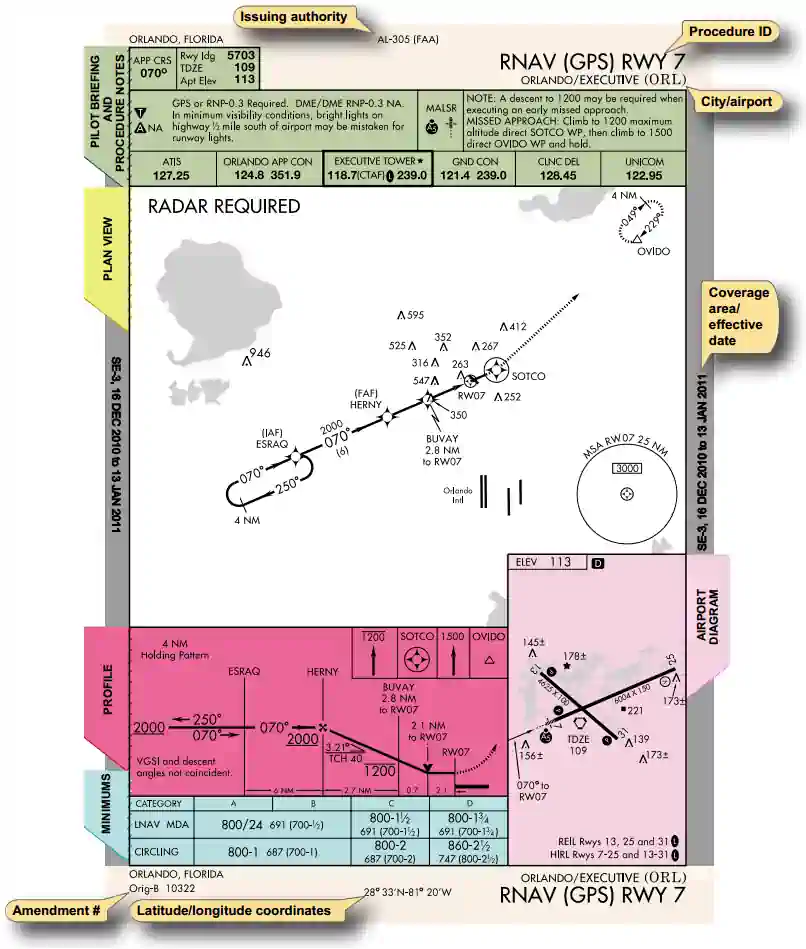
Charts also include frequencies, required equipment notes, special instructions, and are updated regularly. Pilots must always use current charts.
Stepwise Planning and Execution
Preflight Planning
- Review all available approaches for destination/alternate.
- Select procedures authorized for aircraft/equipment.
- Verify up-to-date charts and check NOTAMs for changes.
- Calculate approach speeds, landing distances, and missed approach performance.
- Prepare contingencies for alternates or diversions.
Weather Considerations
- Compare METAR/TAF data against published minima.
- Assess winds, RVR, altimeter settings, and field conditions.
- Monitor ATIS/AWOS/ASOS for rapid changes.
Approach Briefing
- Confirm procedure, navigation/communication setup, and minimums.
- Review procedural notes, missed approach, and automation mode changes.
- Discuss runway environment and taxi plan.
Execution and Monitoring
- Strictly comply with ATC and published profiles.
- Use CDFA for NPAs where possible.
- Maintain instrument cross-check and situational awareness.
- Be prepared for go-around if visual references are not established.
Missed Approach and Go-Around
- Initiate climb and published routing if landing is not possible.
- Notify ATC, reconfigure, and prepare for holding or alternate approach.
Regulatory Requirements and Best Practices
- Pilots must be familiar with all aspects of the approach and comply with regulatory minima.
- Commercial operators may have stricter company requirements.
- Approach minima must not be below those set by national/state authorities.
- Special approvals are required for advanced or non-standard approaches.
- Best practices include regular training, checklist use, and data-driven reviews of procedures.
Common Use Cases and Examples
Example: Selecting an Approach Based on Weather and Equipment
Suppose you’re arriving at an airport with both an ILS (CAT I) and an RNAV (GPS) LPV approach. If the weather is reported as 400 ft ceiling and 1600 m visibility, both approaches are legal. However, if the ILS is out of service (per NOTAM), and your aircraft is certified for LPV approaches, you can safely use the RNAV (GPS) approach, provided your onboard equipment and crew qualifications meet requirements.
Example: Executing a Missed Approach
During final approach, if you reach the Decision Altitude and cannot see the required runway environment, you must execute the published missed approach immediately. This involves applying go-around power, following the published climb and routing, and communicating your intentions to ATC.
Conclusion
Approach procedures are the backbone of safe, efficient IFR operations worldwide. They ensure aircraft can land safely in all weather conditions, maintain obstacle clearance, and provide standardization for pilots and controllers alike. With the advancement of navigation technology and regulatory oversight, approach procedures continue to evolve, enhancing aviation safety and operational reliability.
For further information, consult ICAO Doc 8168, national AIP publications, or your local aviation authority.
This glossary entry is intended as an educational overview. For operational use, always refer to current, official publications and charts.
Frequently Asked Questions
- What is an Approach Procedure in aviation?
- An Approach Procedure (AP) or Instrument Approach Procedure (IAP) is a published set of flight maneuvers for aircraft operating under IFR. It transitions the aircraft from the en-route or terminal phase to a position for landing, or to a missed approach if a landing is not possible, ensuring obstacle clearance and standardized airspace integration.
- What are the main categories of instrument approach procedures?
- Instrument approach procedures are categorized as Precision Approaches (providing lateral and vertical guidance, e.g., ILS), Approaches with Vertical Guidance (APV, e.g., LPV/Baro-VNAV), and Non-Precision Approaches (NPA, providing only lateral guidance, e.g., VOR, NDB, LNAV).
- Why are approach procedures critical for IFR operations?
- Approach procedures enable safe, repeatable landings in poor visibility, adverse weather, or complex terrain. They ensure obstacle clearance, standardize pilot and ATC expectations, and allow airports to operate reliably under instrument meteorological conditions.
- What are the typical segments of an instrument approach?
- A standard instrument approach has five segments: Feeder Route, Initial Approach, Intermediate, Final Approach, and Missed Approach. Each segment has defined waypoints, altitudes, and navigation requirements to ensure safety and predictability.
- How are approach procedures regulated and updated?
- Approach procedures are designed and authorized by national and international aviation authorities (such as ICAO, FAA, EASA). They are regulated for obstacle clearance, airspace compatibility, and operational minima, and are updated regularly to reflect changes in infrastructure, airspace, and best practices.
This is a reference entry. TarmacView provides drone inspection services and doesn't sell the equipment or materials described in this glossary.