What Is ASTM D5340?
Scope of ASTM D5340: Airport Pavement Condition Index Surveys
ASTM D5340, formally designated as Standard Test Method for Airport Pavement Condition Index Surveys, establishes the methodology for quantifying the surface condition of airfield pavements through systematic visual inspection. The standard applies to two pavement types: asphalt-surfaced pavements including porous friction courses (PFC), and plain or reinforced jointed Portland cement concrete (PCC) pavements. The standard explicitly excludes continuously reinforced concrete pavements (CRCP) and non-pavement surfaces such as shoulders or graded areas.

The standard was developed by the U.S. Army Corps of Engineers (USACE) under funding from the U.S. Air Force, with subsequent verification and adoption by the Federal Aviation Administration (FAA) and the U.S. Naval Facilities Engineering Command (NAVFAC). The current active version is ASTM D5340-24, maintained by ASTM Committee E17.42 on Pavement Management and Data Needs, published in BOS Volume 04.03 with an ICS code of 93.120. The standard implements NATO Standardization Agreement (STANAG) 7181 for airfield pavement condition assessment across allied forces.
The scope of D5340 is distinct from its road-pavement counterpart ASTM D6433 in several critical ways. D5340 accounts for the operational realities of airfields, high tire pressures, concentrated wheel loads, jet exhaust temperatures, fuel and oil spillage, and the catastrophic consequences of Foreign Object Debris (FOD). The standard defines the airport Pavement Condition Index (PCI) as a numerical rating from 0 (failed) to 100 (excellent) derived from the type, severity, and density of distresses observed on the pavement surface. The PCI is not a measure of structural capacity, skid resistance, or roughness, it is a surface condition index that quantifies the visible deterioration of the pavement material.
FAA Advisory Circular AC 150/5380-7B (Airport Pavement Management Program, dated October 10, 2014) mandates ASTM D5340 compliance for all federally obligated airports receiving Airport Improvement Program (AIP) funding under Grant Assurance No. 11 and Passenger Facility Charge (PFC) funding under PFC Assurance No. 9. The AC requires detailed pavement inspections at least once per year, but airports using PCI surveys per D5340 may extend this interval to every 3 years. This regulatory framework makes D5340 the de facto standard for airport pavement condition assessment across the United States and in many international airports that follow FAA guidance.
Inspection Unit Sizes for Airport Pavements
ASTM D5340 defines specific sample unit sizes that differ from road pavement standards and are tailored to the geometry and operational requirements of airfield pavements. The pavement hierarchy in D5340 follows a three-tier structure: Network (entire airport), Branch (individual runway, taxiway, or apron), Section (contiguous area with uniform construction, traffic, and condition history), and Sample Unit (the subdivision of a section that is physically inspected).
Asphalt Concrete Pavement Sample Units
For asphalt concrete (AC) airfield pavements, the standard sample unit size is 5,000 contiguous square feet ± 2,000 ft² (450 m² ± 180 m²). This means the acceptable range for an AC sample unit is 3,000 ft² to 7,000 ft² (279 m² to 650 m²). If a pavement section is not evenly divisible by 5,000 ft², the sample unit size may be adjusted within the tolerance range to accommodate field conditions such as pavement geometry, lighting bays, or apron gate areas.
For porous friction courses (PFC), the same sample unit size of 5,000 ± 2,000 ft² applies. PFC surfaces are tested with specific consideration for clogging of the pore structure, which reduces the surface’s drainage and noise-reduction functionality.
The D5340 AC sample unit size is twice the size specified for roads and parking lots in ASTM D6433 (2,500 ± 1,000 ft²). This difference exists because airport pavements typically have wider lanes, longer continuous pavement segments, and fewer transverse joints, a larger sample unit captures representative distress patterns while reducing the total number of units to inspect on large airfields.
Portland Cement Concrete Pavement Sample Units
For PCC airfield pavements, the standard sample unit is 20 contiguous slabs ± 8 slabs. This means a PCC sample unit may contain between 12 and 28 slabs, depending on the total number of slabs in the section and field conditions. The slab count approach is used because PCC distresses are recorded on a per-slab basis, corner breaks, spalling, cracking, and patching are counted by the number of slabs exhibiting each distress at each severity level.
A critical requirement in D5340 applies to PCC slabs with joint spacings greater than 25 ft (8 m). When slab dimensions exceed this threshold, the inspector must subdivide each slab into imaginary slabs of 25 ft (8 m) maximum length for distress recording purposes. This is necessary because the deduct values for concrete slab distress were developed for slabs with joint spacings of 25 ft or less. The imaginary joints dividing the oversized slab are assumed to be in perfect condition, no distress deduct is applied at these imaginary joint locations.
Sample Unit Marking and Identification
Each sample unit must be physically marked on the pavement to ensure consistent identification across multiple survey cycles. The standard recommends marking the boundaries with paint, chalk, or temporary markings that are visible during the inspection but do not conflict with pavement markings required for aircraft operations.
The sample unit boundaries are defined by station numbers and offsets referenced to the runway or taxiway centerline. Each sample unit receives a unique identifier that links it to its parent pavement section and branch. This identification system is critical for trend analysis, when the same sample unit is inspected repeatedly over time, the change in PCI provides a direct measure of deterioration rate.
Airport-Specific Distress Types
ASTM D5340 defines a total of 16 distress types for asphalt concrete airfield pavements and 16 distress types for Portland cement concrete airfield pavements. Several of these distresses are unique to airport operations and have no equivalent in road pavement PCI standards.
Asphalt Concrete Airfield Distresses (PAVER Codes 41-57)
The 16 AC distress types in D5340 are organized in the PAVER Distress Identification Manual with codes 41 through 57. Each distress has specific measurement units, severity level definitions (Low, Medium, High for most distresses), and measurement rules.
| PAVER Code | Distress Type | Measurement Unit | Primary Cause |
|---|---|---|---|
| 41 | Alligator (Fatigue) Cracking | ft² (m²) | Repeated traffic loading, structural failure |
| 42 | Bleeding | ft² (m²) | Excess asphalt binder in mix |
| 43 | Block Cracking | ft² (m²) | Thermal shrinkage of AC surface |
| 44 | Corrugation | ft² (m²) | Traffic action + unstable pavement layer |
| 45 | Depression | ft² (m²) | Foundation settlement or construction |
| 46 | Jet Blast Erosion | ft² (m²) | Jet exhaust burning/carbonizing binder |
| 47 | Joint Reflection Cracking | linear ft (m) | PCC slab movement beneath AC overlay |
| 48 | Longitudinal & Transverse (L&T) Cracking | linear ft (m) | Poor joints, shrinkage, reflective |
| 49 | Oil Spillage | ft² (m²) | Fuel, oil, or solvent damage to binder |
| 50 | Patching & Utility Cut Patch | ft² (m²) | Repairs to pavement or utilities |
| 51 | Polished Aggregate | ft² (m²) | Repeated tire polishing |
| 52 | Raveling | ft² (m²) | Binder hardening, aggregate loss |
| 53 | Rutting | ft² (m²) | Consolidation under traffic loads |
| 54 | Shoving | ft² (m²) | Lateral pavement displacement |
| 55 | Slippage Cracking | ft² (m²) | Poor bond between pavement layers |
| 56 | Swell | ft² (m²) | Frost action or swelling soils |
| 57 | Weathering | ft² (m²) | Binder aging, fine aggregate loss |
Jet Blast Erosion (PAVER Code 46) is one of the most important airport-specific distresses. It is caused by the high-temperature exhaust from aircraft jet engines that carbonizes and burns the asphalt binder, leaving a darkened, brittle surface layer. This distress typically occurs in areas where aircraft hold short of runways, at runway thresholds where aircraft apply takeoff power, and at the beginning of departure rolls. The severity of jet blast erosion is determined by the depth of binder carbonization and whether the aggregate has become loose, creating a FOD hazard. Jet blast erosion has no severity degrees defined, it is noted when extensive enough to cause skid resistance reduction or carbonization visible on the surface.
Oil Spillage (PAVER Code 49) records areas where fuel, hydraulic fluid, or engine oil has dissolved or softened the asphalt binder. This distress is common at aircraft parking positions (gates), fueling stations, and maintenance areas. The solvent action of jet fuel (Jet A, Jet A-1) on asphalt binder is well documented, hydrocarbon fuels can dissolve the maltene fraction of the asphalt, leaving a weakened, softened binder that leads to raveling and aggregate loss.
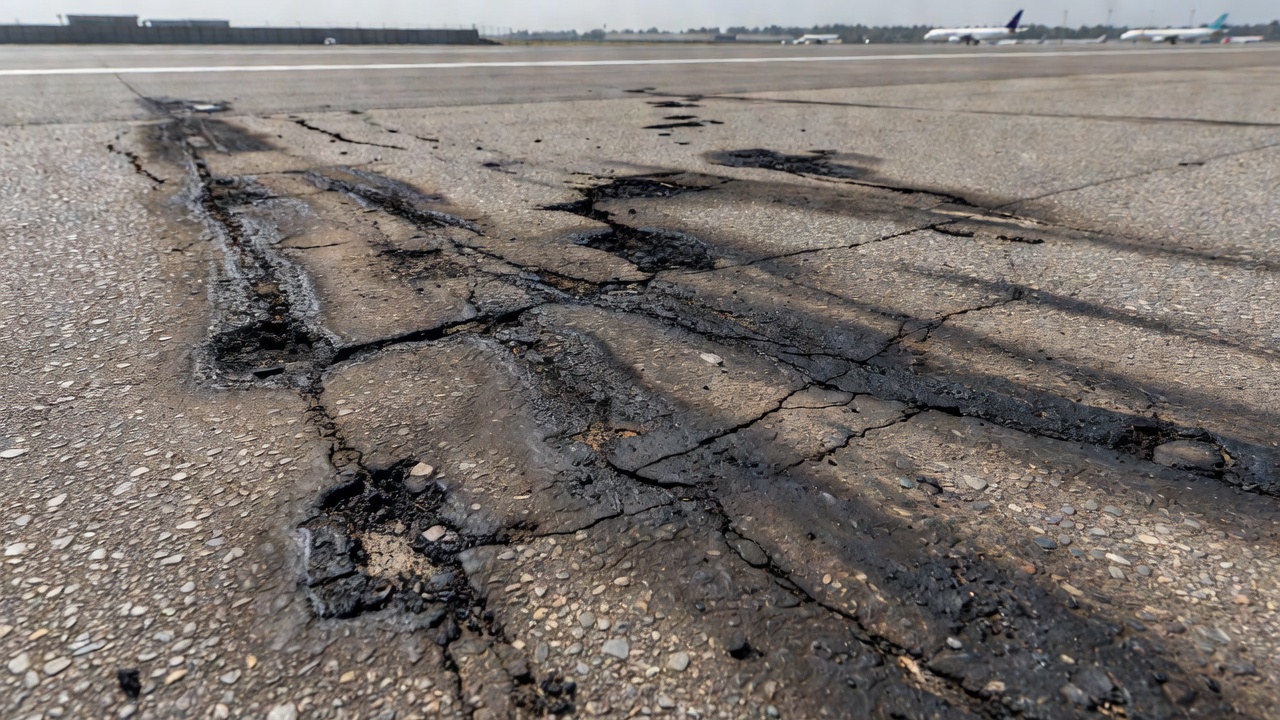
Joint Reflection Cracking (PAVER Code 47) is tracked as a separate distress in D5340 specifically for AC overlays over existing PCC pavements. The crack pattern mirrors the underlying PCC slab joints. This distinction is important because reflective cracking in airport pavements has specific structural implications, the cracking indicates that the PCC layer beneath the AC overlay is still moving thermally, and the overlay is not effectively bonded or thick enough to resist the movement.
Portland Cement Concrete Airfield Distresses (PAVER Codes 61-76)
The 16 PCC distress types in D5340 include slab-based distresses with severity criteria that account for FOD potential, joint condition, and slab structural integrity.
| PAVER Code | Distress Type | Measurement Unit | Primary Cause |
|---|---|---|---|
| 61 | Blowup | # of slabs | Joint expansion with incompressible materials |
| 62 | Corner Break | # of slabs | Load + loss of support + curling stress |
| 63 | LTD Cracking | # of slabs | Load + curling + shrinkage stress |
| 64 | Durability “D” Cracking | # of slabs | Freeze-thaw deterioration |
| 65 | Joint Seal Damage | # of slabs | Sealant aging, extrusion, bond loss |
| 66 | Patching, Small (≤ 5 ft²) | # of slabs | Minor repairs |
| 67 | Patching, Large (> 5 ft²) | # of slabs | Major repairs, utility cuts |
| 68 | Popouts | # of slabs | Freeze-thaw with reactive aggregates |
| 69 | Pumping | # of slabs | Poor drainage, joint seal failure |
| 70 | Scaling | # of slabs | Deicing salts, freeze-thaw, construction |
| 71 | Settlement or Faulting | # of slabs | Subgrade consolidation |
| 72 | Shattered Slab | # of slabs | Severe load repetition |
| 73 | Shrinkage Cracks | # of slabs | Concrete curing |
| 74 | Spalling (Joint) | # of slabs | Joint stress, weak concrete |
| 75 | Spalling (Corner) | # of slabs | Corner stress, traffic loads |
| 76 | Alkali-Silica Reaction (ASR) | # of slabs | Chemical reaction in concrete |
Alkali-Silica Reaction (ASR) (PAVER Code 76) was added to D5340 in recent editions to address the growing problem of ASR in airfield concrete pavements. ASR causes internal expansion that leads to map cracking, joint closure, and eventual slab disintegration. If ASR is rated at High severity, no other distress is counted on that slab, ASR dominates the slab condition to the extent that recording other distresses is redundant.
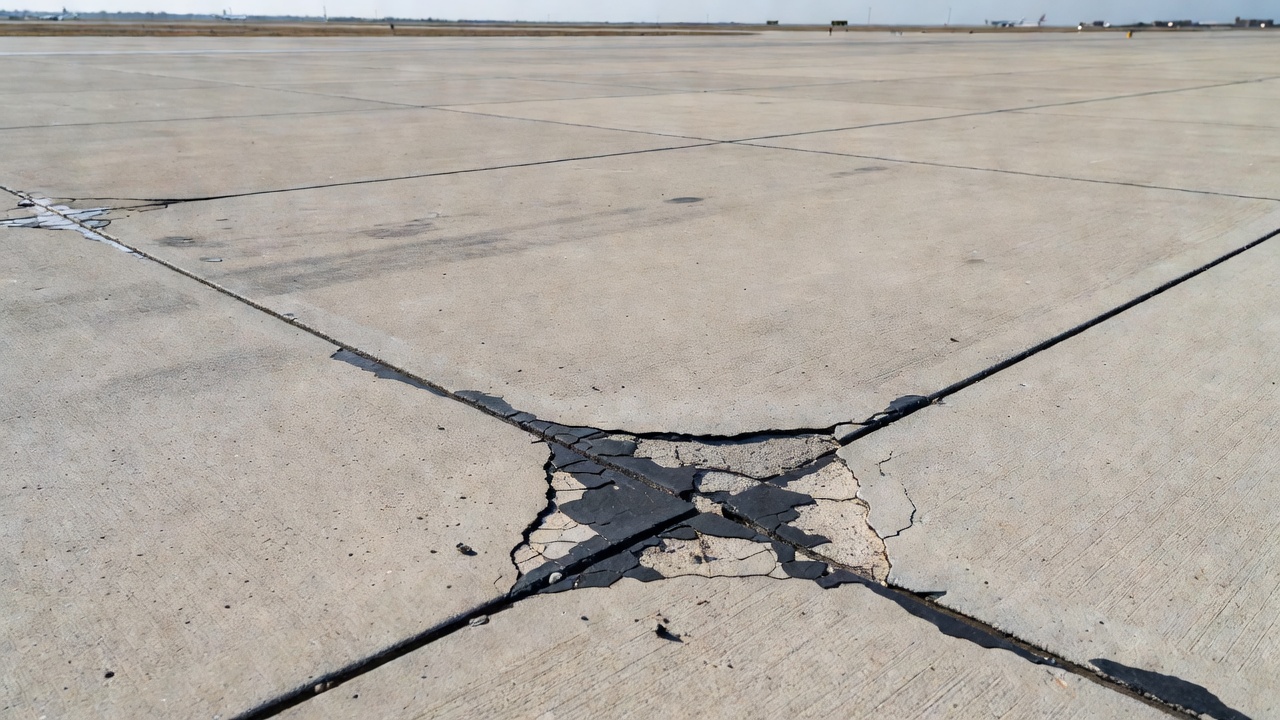
Joint Spalling and Corner Spalling (Codes 74 and 75) are distinguished by the distance from the joint intersection where the spall occurs. If the spalled area extends more than 2 ft (0.6 m) from the corner along both joints, it is classified as a corner break rather than a corner spall, provided the crack can be verified as vertical. Corner breaks have more severe structural implications than spalling and carry higher deduct values.
PCI Calculation per ASTM D5340
The PCI calculation in ASTM D5340 follows a five-step process that converts field distress observations into a numerical condition index. The methodology is mathematically identical to the PCI calculation in D6433, but the deduct value curves are specific to airport pavements.
Step 1, Distress Density Calculation
For each distress type at each severity level (Low, Medium, High), the inspector calculates the distress density as a percentage of the sample unit area:
Density (%) = (Total Quantity of Distress / Total Area of Sample Unit) × 100
For AC pavements, quantities are measured in square feet (area distresses) or linear feet (linear distresses). For linear distresses such as cracking, the measured length is converted to an equivalent area by multiplying by an assumed crack width (typically 1 ft per ASTM convention). For PCC pavements, distress is measured by counting the number of slabs exhibiting each distress at each severity level, and density is calculated as:
Density (%) = (Number of Affected Slabs / Total Slabs in Sample Unit) × 100
Step 2, Deduct Value Determination
Each distress type at each severity level has a corresponding deduct value curve, a graph plotting distress density against a deduct value ranging from 0 to 100. Deduct value curves for airport pavements are provided in Appendix X3 (for AC) and Appendix X4 (for PCC) of ASTM D5340. These curves were developed empirically from field surveys correlating observed distress with overall pavement condition.
Deduct values increase with both density and severity. For example, a 10% density of Low-severity alligator cracking in AC yields a different deduct value than 10% of High-severity alligator cracking. The curves are distress-specific, each distress type has a unique relationship between density and deduct value.
Step 3, Maximum Corrected Deduct Value (CDV)
The most complex step in the PCI calculation is determining the Maximum Corrected Deduct Value (CDV). The procedure is:
- List all individual deduct values (DV) in descending order, including only DVs greater than 5 (DVs of 5 or less are considered negligible).
- Determine q = the number of deduct values greater than 5.
- For each iteration, enter the correction curve with Total DV and q, and read the Corrected Deduct Value (CDV).
- For the next iteration, copy the DV list but change the smallest DV greater than 5 to 5.0.
- Repeat steps 2-4 until q = 1.
- The Maximum CDV is the largest CDV obtained from all iterations.
If there are zero or one individual DVs greater than 5, the total DV is used directly as the CDV, no iteration is required.
The correction curve accounts for the fact that multiple distresses do not have an additive effect on pavement condition. A pavement with 10 distresses at Low severity is typically in better relative condition than a pavement with 2 distresses at High severity, even if the total deduct value is the same. The correction factor reduces the total DV based on the number of distresses present (q).
Step 4, PCI Calculation
The sample unit PCI is calculated as:
PCI = 100, Maximum CDV
A PCI of 100 represents a pavement with no visible distress. A PCI of 0 represents a pavement that has completely failed.
Step 5, Section PCI
The section PCI is the average of all sample unit PCIs within the pavement section. If random sampling was used (as opposed to inspecting 100% of sample units), the section PCI is a weighted average where each sample unit PCI is weighted equally. If additional (non-random) sample units were inspected, they are included in the section average but noted separately in the report.
The standard includes a verification procedure for the section PCI. After the initial survey, the actual standard deviation of the PCIs is calculated and compared to the assumed standard deviation used in the sampling plan. If the actual standard deviation is higher, additional sample units may need to be inspected to maintain the 95% confidence level.
D5340 vs D6433, Key Differences
While ASTM D5340 (airports) and ASTM D6433 (roads and parking lots) share the same PCI calculation methodology, they differ in several critical aspects that reflect the different operational environments.
| Parameter | ASTM D5340 (Airports) | ASTM D6433 (Roads & Parking Lots) |
|---|---|---|
| Sample Unit Size (AC) | 5,000 ± 2,000 ft² | 2,500 ± 1,000 ft² |
| Sample Unit Size (PCC) | 20 ± 8 slabs | 20 ± 8 slabs (same) |
| AC Distress Types | 16 | 19 |
| PCC Distress Types | 16 | 15 |
| Unique Distresses | Jet blast erosion, oil spillage, rubber deposits, ASR | Railroad crossing, potholes, lane-to-shoulder drop-off |
| FOD Severity Criterion | Critical factor in severity definition | Not applicable |
| Severity Thresholds | Different for runways vs. taxiways vs. aprons | Uniform for all road types |
| Deduct Curves | Airport-specific curves | Road-specific curves |
| Rating Scale | PCI values mapped to 7 categories | Different PCI-to-rating mapping |
| Developed By | USACE for USAF, adopted by FAA | USACE |
| Regulatory Basis | FAA AC 150/5380-7B | Not mandated by regulation |
The most significant operational difference is the FOD criterion. In D5340, the potential for a distress to create Foreign Object Debris is explicitly considered in severity definitions. A joint spall on an airfield pavement that produces loose concrete fragments is rated at Medium or High severity because of the FOD hazard, even if the spall dimensions alone would be Low severity. No such criterion exists in D6433 because loose debris on a road poses minimal risk compared to loose debris on a runway where FOD can cause catastrophic engine damage.
The severity thresholds for depressions and corrugations also differ between the two standards for airport applications. D5340 recognizes that depression depths of 0.5 inches on a runway create a more significant operational impact than the same depth on a highway shoulder. The standard provides different depth thresholds for runways, taxiways, and aprons to reflect the different operational tolerances of each pavement type.
Integration with FAA PAVEAIR
The FAA PAVEAIR platform (faapaveair.faa.gov) is a web-based pavement management system that implements ASTM D5340 PCI calculations. PAVEAIR is free to use by airport operators, consultants, and researchers and is designed to fulfill the pavement management system (PMS) requirements of FAA AC 150/5380-7B. The current version is 3.7.4 (build 2024.06.10), managed by PCI program manager Qingge Jia.
PAVEAIR supports the complete D5340 PCI workflow:
- Data Hierarchy, Network → Branch (runway, taxiway, apron) → Section (uniform construction) → Sample Unit (inspection area)
- Inventory Management, Storing pavement structure, construction history, traffic data, and maintenance records
- Distress Data Entry, Field distress observations are entered directly into the platform with drop-down selection of D5340 distress types, severity levels, and quantities
- PCI Calculation, Automatic calculation of sample unit PCI and section PCI per D5340 methodology
- Condition Reporting, Color-coded pavement condition maps, network summary reports, and deterioration trend analysis
- Maintenance & Rehabilitation Planning, M&R needs identification, budget projection, and life-cycle cost analysis
PAVEAIR supports both ASTM D5340 (airports) and ASTM D6433 (roads/parking lots) PCI calculations. The platform automatically applies the correct distress taxonomy and deduct curves based on the pavement type and branch classification selected by the user.
The platform supports both user databases (private, managed by the airport) and public read-only databases that allow sharing of pavement condition data across agencies. Numerous public databases are available on the platform for reference and benchmarking.
PAVEAIR has been implemented by the FAA to standardize airport pavement management across the 3,300+ federally obligated airports in the United States. The platform’s integration with ASTM D5340 ensures that all airports using PAVEAIR generate PCI data that is consistent, comparable, and compliant with FAA requirements.
Airport PCI Reporting
ASTM D5340 specifies field data sheets and reporting formats that translate distressed survey data into actionable pavement management information. The standard defines two primary data collection sheets:
AC Pavement Survey Data Sheet
The AC data sheet records for each sample unit: date of survey, location (airport, branch, section, sample unit number), sample unit dimensions and area, and a distress table listing each distress type, severity level, and measured quantity. The sheet includes calculation sections for % density, deduct value lookup, the CDV iteration table, and the final PCI.
PCC Pavement Survey Data Sheet
The PCC data sheet adds a per-slab distress matrix, each slab in the sample unit is individually assessed, and the inspector records the distress type and severity for each slab. The slab-by-slab data is then summarized into counts of slabs affected by each distress type at each severity level, from which % density, deduct values, and PCI are computed.
Pavement Management Reports
Typical PCI reports used in airport pavement management include:
Network Summary Report, A tabular listing of all pavement branches and sections with their current PCI, area, last inspection date, and recommended maintenance action. This report provides the airport engineer with an at-a-glance condition overview of the entire airfield.
Color-Coded Condition Map, A GIS-based or CAD-based map of the airfield with each pavement section color-coded by PCI category (green = Excellent/Very Good, yellow = Good/Fair, red = Poor/Very Poor/Failed). This visual representation enables rapid identification of the most deteriorated areas requiring urgent attention.
Deterioration Trend Report, A graph showing PCI vs. time for each pavement section, with trend lines projecting future condition. This report is essential for budget planning, it shows when each section will reach the PCI threshold requiring rehabilitation, allowing the airport to schedule work and allocate funding proactively.
M&R Needs Report, A prioritized list of pavement sections requiring maintenance or rehabilitation, with estimated costs and recommended treatment types (crack sealing, overlay, reconstruction). The prioritization is typically based on PCI, traffic criticality, and cost-effectiveness.
Life-Cycle Cost Analysis Report, A comparison of alternative M&R strategies showing total costs over the pavement analysis period (typically 20-50 years). This report supports the FAA requirement that federally obligated airports use life-cycle cost analysis for pavement investment decisions.
D5340 and TarmacView Drone Surveys
Modern drone technology enables significant improvements in the speed, safety, and data quality of ASTM D5340 PCI surveys while maintaining standard compliance. TarmacView combines high-resolution drone imagery with automated computer vision analysis to deliver D5340-compliant PCI surveys for airport clients.
Drone Survey Workflow
The drone survey workflow for D5340 PCI assessment follows a defined sequence:
Flight Planning, High-resolution aerial imagery is collected at a ground sampling distance (GSD) of 1-2 mm/pixel, sufficient to resolve crack widths, spall dimensions, and surface texture details required for D5340 distress identification. Flight plans cover all pavement branches with the required overlap (typically 80% forward, 70% side for photogrammetric reconstruction).
Orthomosaic Generation, The individual images are stitched into a georeferenced orthomosaic of the entire airfield pavement surface. A digital surface model (DSM) is also generated to support the measurement of depression depth, rutting, and faulting.
AI-Based Distress Detection, Computer vision models trained on thousands of annotated airport pavement images identify and classify D5340 distress types. The models detect alligator cracking, block cracking, longitudinal/transverse cracking, joint spalling, corner breaks, patching, jet blast erosion, raveling, and other distresses.
Severity Classification, For each detected distress, the AI system assigns a severity level (Low, Medium, High) based on measured dimensions (crack width, spall area, depression depth) extracted from the orthomosaic and DSM.
PCI Calculation, The distress data is aggregated by sample unit (as defined in D5340), and the PCI is calculated using the standard D5340 methodology. The results are delivered as sample unit PCIs, section PCIs, and color-coded condition maps.
Ground Validation, A subset of sample units is inspected manually to validate the drone-based PCI. The ground validation data is used to calibrate the AI models and provide the ground truth required for FAA compliance.
Advantages of Drone-Based D5340 Surveys
Drone-based PCI surveys offer several advantages over traditional manual surveys for D5340 compliance:
Safety, Inspectors do not need to walk on active runways and taxiways. Drone surveys can be conducted during normal airport operations with minimal disruption. The FOD hazard to aircraft from inspectors on the pavement (tools, markers, loose equipment) is eliminated.
Speed, A medium-sized commercial airport (one runway, parallel taxiway, apron area of 50+ acres) can be surveyed by drone in 2-4 hours of flight time, compared to 5-10 days for manual inspection. Data processing and AI analysis take an additional 2-5 days.
Repeatability, Drone surveys produce digital records that can be compared precisely across survey cycles. The exact same flight path and image resolution ensure that year-over-year PCI comparisons reflect actual pavement changes, not inspector variability.
Comprehensive Coverage, Drone surveys capture 100% of the pavement surface, not just the statistically sampled sample units. This enables sub-sample-unit analysis of distress patterns and provides a complete digital record of the pavement condition.
Compliance Considerations
Drone-based PCI surveys must address several compliance considerations for full ASTM D5340 adherence. The standard requires physical measurement of certain distress characteristics, crack width measured between vertical walls (not in spalled areas), faulting measured with a straightedge, and depression depth measured with a string line. Drone imagery alone, without ground validation of these physical measurements, cannot fully satisfy all D5340 requirements. TarmacView addresses this by combining drone data with targeted ground truth collection at a subset of sample units to calibrate severity assignments and validate the AI classification.
Correlation with ICAO Doc 9157 Pavement Evaluation
ICAO Doc 9157, Aerodrome Design Manual, Part 3: Pavements provides international guidance on the design, evaluation, and reporting of aerodrome pavement bearing strength. The document describes two complementary evaluation methods: the Aircraft Classification Rating, Pavement Classification Rating (ACR-PCR) method for reporting pavement strength, and pavement evaluation procedures including layer thickness determination, material testing, and structural assessment.
ASTM D5340 and ICAO Doc 9157 address different but complementary aspects of airport pavement evaluation:
| Aspect | ASTM D5340 | ICAO Doc 9157 |
|---|---|---|
| Focus | Surface condition (distress) | Structural capacity (strength) |
| Metric | PCI (0-100) | PCR (Pavement Classification Rating) |
| Method | Visual distress survey | Layer thickness, material testing, FWD |
| Output | Condition rating, M&R needs | Bearing strength rating (PCR) |
| Complementary Use | When to repair | What loads can be carried |
A comprehensive airfield pavement evaluation requires both D5340 PCI data and ICAO Doc 9157 structural data. A pavement with a high PCI may have inadequate structural capacity for the aircraft using it, the surface condition is good, but the pavement may fail under load. Conversely, a pavement with a low PCI may have adequate structural capacity, the surface is deteriorated, but the remaining structural layers are strong enough to support traffic with an overlay.
The correlation between PCI and structural capacity is not direct. The PCI measures surface distress, which can have causes unrelated to structural capacity (environmental aging, material durability problems, construction deficiencies). The PCR measures load-carrying capacity, which depends on layer thicknesses, material stiffness, and subgrade support. A pavement with low PCI may have high PCR if the distress is limited to the surface layer. A pavement with high PCI may have low PCR if the structural layers are thin or the subgrade is weak.
ICAO Annex 14, Aerodromes, Volume 1: Aerodrome Design and Operations requires that aerodrome pavements be evaluated periodically to determine their condition and bearing strength. The Annex references the use of PCI surveys (ASTM D5340) as an acceptable method for assessing pavement surface condition, while referring to ACR-PCR methodology (ICAO Doc 9157) for bearing strength reporting.
ASTM D5340 Limitations
ASTM D5340 is a powerful and widely used standard, but it has specific limitations that pavement engineers must understand when interpreting PCI data and making pavement management decisions.
Surface Condition Only, No Structural Assessment
The PCI is a surface condition index that quantifies only what is visible on the pavement surface. It does not measure or indicate structural capacity, layer thickness, subgrade strength, or remaining structural life. A pavement with PCI 90 may have thin structural layers that will fail under the first heavy aircraft operation. A pavement with PCI 30 may have adequate structural capacity and require only a surface restoration (mill-and-overlay) rather than full reconstruction. The PCI must be complemented by structural evaluation (FWD testing, core analysis, layer thickness determination) for complete pavement assessment.
No Skid Resistance or Friction Measurement
The PCI does not evaluate surface friction or skid resistance. A pavement can have a high PCI (few cracks, no raveling) but dangerously low friction (polished aggregate, rubber-contaminated surface). FAA AC 150/5320-12C (Measurement, Construction, and Maintenance of Skid-Resistant Airport Pavement Surfaces) requires separate friction testing using continuous friction measuring equipment (CFME), this is outside the scope of D5340.
No Roughness Measurement
The PCI does not quantify ride quality or surface roughness. A pavement with extensive faulting (differential settlement at joints) may have a moderate PCI but produce unacceptable ride quality for aircraft operations, potentially causing damage to aircraft landing gear or passenger discomfort. Roughness is measured separately using inertial profilers per FAA AC 150/5380-9 and reported using the International Roughness Index (IRI).
Subjective Elements in Distress Identification
Despite standardized distress definitions and severity criteria, the PCI involves inherent subjectivity. Different inspectors may classify the same distress area differently, one inspector may rate a crack as Medium severity while another rates it High. This variability is most pronounced for distresses where severity boundaries depend on judgment (e.g., the boundary between Medium and High raveling depends on whether the inspector judges that significant aggregate loss has occurred).
The standard attempts to minimize variability through training and certification programs (FAA PCI training, ASTM inspector certification), but inter-inspector variability of 3-7 PCI points on the same sample unit is documented in the literature. This variability must be considered when comparing PCI values between survey cycles, a change of less than 5 PCI points may not be statistically significant.
Visual Inspection of Top Layer Only
The PCI is based on visual inspection of only the top pavement layer. Subsurface deterioration, debonding between lifts, stripping in the lower asphalt layer, alkali-silica reaction at depth in concrete, subgrade weakening, is invisible to the PCI survey. These subsurface conditions can cause rapid pavement failure even when the surface PCI is high.
Does Not Replace Direct Testing Methods
The standard explicitly states that it is not intended to replace direct measurement methods for roughness, structural capacity, texture, or friction. The PCI provides condition data that supports pavement management decisions, but the specific rehabilitation treatment design requires direct testing data (FWD deflections, core strengths, layer thicknesses, subgrade classification).
Operational Constraints and Hazards
Manual PCI surveys require inspectors to walk on active airfield pavements, creating operational hazards. The standard requires coordination with Air Traffic Control (ATC), issuance of NOTAMs, and implementation of safety protocols including high-visibility clothing, hearing protection (noise from aircraft operations), and escort by airport operations vehicles. These operational constraints make manual surveys costly and disruptive.
Drone-based PCI surveys mitigate many of these operational constraints by removing inspectors from the pavement surface, but the technology has its own limitations, reduced ability to measure crack width directly, dependence on clear weather for image collection, and regulatory constraints on drone operations in controlled airspace.
Specified Limitations in the Standard
The standard itself identifies several limitations in its scope section: the PCI does not provide a direct measurement of structural capacity, does not measure skid resistance, does not quantify roughness, and is intended as a measurement of the collective judgment of experienced pavement maintenance engineers. The PCI is a condition index, a useful management tool, but not a substitute for engineering analysis and testing in the design of rehabilitation treatments.
Frequently Asked Questions
- What is the difference between ASTM D5340 and ASTM D6433?
- ASTM D5340 is the airport-specific version of the PCI methodology, while ASTM D6433 covers roads and parking lots. The key differences are: D5340 uses larger inspection units (5,000 ± 2,000 ft² for AC vs. 2,500 ± 1,000 ft² in D6433), D5340 includes airport-specific distress types such as jet blast erosion, oil spillage, and rubber deposits that do not appear in D6433, D5340 severity criteria account for Foreign Object Debris (FOD) potential which is critical for aircraft safety, and D5340 has different deduct curves and rating scales. D6433 includes distresses like railroad crossing and potholes that are not relevant to airfields. Both standards share the same PCI calculation methodology (100 minus maximum corrected deduct value) but with different distress taxonomies and deduct value curves.
- What distress types are unique to ASTM D5340 and not found in road PCI surveys?
- ASTM D5340 includes several distress types that are specific to airport operations. For asphalt pavements, the airport-unique distresses are: Jet Blast Erosion (carbonization and burning of binder from aircraft jet exhaust), Oil Spillage (fuel, oil, and solvent damage to the asphalt binder), and joint reflection cracking evaluated with airport-specific criteria. For concrete pavements, D5340 includes Alkali-Silica Reaction (ASR) as a recorded distress and has slab-based severity criteria with FOD as a key consideration. The rubber deposit (rubber contamination) distress tracks the accumulation of rubber from aircraft tire landings on runways. These distresses are directly tied to aircraft operations and have no equivalent in road pavement surveys.
- What is the correct sample unit size for an airport asphalt pavement PCI survey?
- Per ASTM D5340, the standard sample unit size for asphalt concrete (AC) airfield pavements is 5,000 contiguous square feet ± 2,000 ft² (450 m² ± 180 m²). If the pavement section is not evenly divisible by 5,000 ft², the sample unit size may be adjusted to accommodate field conditions within the tolerance range of 3,000 ft² to 7,000 ft². For porous friction courses (PFC), the same size applies. For PCC pavements, the standard sample unit is 20 contiguous slabs ± 8 slabs. When PCC joints exceed 25 ft (8 m), each slab must be subdivided into imaginary slabs of 25 ft maximum length for distress recording purposes. For AC pavements on roads and parking lots, ASTM D6433 uses a smaller sample unit of 2,500 ± 1,000 ft², roughly half the airport size.
- How does the FAA require airports to use ASTM D5340?
- FAA Advisory Circular AC 150/5380-7B (Airport Pavement Management Program) requires all federally obligated airports to perform detailed pavement inspections at least once per year. However, if the PCI survey is conducted per ASTM D5340, the inspection frequency may be extended to every 3 years. This is mandatory for all projects funded by the Airport Improvement Program (AIP) under Grant Assurance No. 11 and the Passenger Facility Charge (PFC) Program under PFC Assurance No. 9. The FAA PAVEAIR platform (faapaveair.faa.gov) implements ASTM D5340-20 PCI calculations and is free for use by airport operators. The FAA considers ASTM D5340 PCI data as the standard condition metric for all federally obligated airports.
- Can ASTM D5340 PCI surveys be performed using drone technology?
- Yes. While ASTM D5340 was originally developed for manual visual surveys by inspectors walking the pavement, modern drone technology enables faster, safer, and more repeatable PCI surveys. High-resolution aerial imagery (typically 1-2 mm/pixel ground sampling distance) combined with automated distress detection using computer vision algorithms can identify and classify D5340 distress types. However, drone-based surveys require ground validation (core samples, manual severity verification) to achieve full ASTM compliance because the standard requires physical measurement of certain severity criteria (e.g., crack width measured between vertical walls, faulting depth measured with a straightedge). TarmacView combines drone orthomosaics with AI-based distress classification and selected ground truth data collection to deliver D5340-compliant PCI data for airport clients.
- What are the PCI rating categories in ASTM D5340?
- ASTM D5340 defines seven PCI rating categories for airport pavements: 100-86 Excellent (no visible distress or very minor), 85-71 Very Good (few minor cracks), 70-56 Good (some cracking, minor surface defects), 55-41 Fair (moderate distress evident), 40-26 Poor (significant cracking, some structural distress), 25-11 Very Poor (extensive deterioration), and 10-0 Failed (severe distress, needs reconstruction). These rating thresholds differ from road pavement PCI categories in ASTM D6433. The FAA provides rehabilitation guidance based on PCI: PCI above 85 warrants routine maintenance, PCI 56-85 (AC) or 65-85 (PCC) warrants pavement preservation, PCI 55 or below warrants major rehabilitation or reconstruction.
- What sampling methodology does ASTM D5340 specify?
- ASTM D5340 provides a statistical sampling methodology for selecting which sample units within a pavement section to inspect. The minimum number of sample units (n) is calculated as n = (N × s²) / ((e²/4)(N-1) + s²), where N = total sample units in section, s = estimated standard deviation (10 for AC, 15 for PCC for initial surveys), and e = acceptable error (typically 5 PCI points). For non-project analysis (network-level surveys), a simplified table is used: 1-5 sample units, inspect all, 6-10, inspect 2, 11-15, inspect 3, 16-40, inspect 4, over 40, inspect 10%. The sampling interval i = N/n ensures even distribution. Additional samples may be included for non-representative areas (very poor or very good samples, utility cuts).
- How does ASTM D5340 address Foreign Object Debris (FOD) potential?
- FOD potential is a key severity criterion in ASTM D5340 that has no equivalent in road pavement PCI standards (ASTM D6433). For airport pavements, any distress that creates loose aggregate, slab fragments, or raised edges that could be ingested into aircraft engines or damage aircraft tires is rated at higher severity. For example, spalling severity in PCC is partially determined by whether the spalled fragments could become FOD. Raveling severity in AC considers whether loose aggregate particles are present on the surface. Joint spalling severity considers whether the spalled material has formed loose debris. The FOD criterion is applied throughout the severity definitions because even small debris on an airfield pavement can cause catastrophic engine damage or tire failure.
- What are the limitations of ASTM D5340?
- ASTM D5340 has several important limitations. First, the PCI is a surface condition index only, it does not measure structural capacity, skid resistance, or surface roughness. A pavement can have a high PCI but inadequate structural strength, or a low PCI but adequate strength. Second, the PCI is based on visual inspection of the top layer only, subsurface distresses and material degradation (stripping, ASR at depth) are not visible. Third, the PCI is a measurement of collective engineering judgment, it requires trained, experienced inspectors, and there is inherent variability between inspectors in distress identification and severity rating. Fourth, the standard does not replace direct measurement methods (FWD for structural capacity, friction testing for skid resistance, profilometer for roughness). Fifth, traffic and noise hazards require careful coordination with airport operations during manual surveys.
- How does ASTM D5340 correlate with ICAO Aerodrome Design Manual Doc 9157?
- ICAO Doc 9157, Aerodrome Design Manual, Part 3: Pavements provides guidance on the design, evaluation, and reporting of aerodrome pavement bearing strength. While Doc 9157 focuses primarily on structural evaluation (layer thickness, material properties, bearing capacity using the ACR-PCR method), ASTM D5340 focuses on surface condition. The two standards complement each other in a comprehensive pavement evaluation program: ASTM D5340 PCI surveys assess surface distress and functional condition, while ICAO Doc 9157 evaluation methods assess structural capacity. For a complete airfield pavement assessment, both functional condition (D5340 PCI) and structural capacity (FWD, core analysis, PCR determination per Doc 9157) are needed. ICAO Annex 14 requires periodic pavement evaluation, and D5340 is the internationally recognized method for assessing the surface condition component.