What is Bidirectional Reflectance Distribution Function (BRDF)?
Bidirectional Reflectance Distribution Function (BRDF)
The Bidirectional Reflectance Distribution Function (BRDF) is a mathematical function that describes how light is reflected at an opaque surface. It quantifies the relationship between the direction of incoming light and the direction of reflected light, often including dependence on wavelength. The BRDF is central to understanding and modeling how real-world surfaces interact with light in fields such as physics, remote sensing, optical engineering, and computer graphics.
The BRDF is formally defined as the ratio of reflected radiance in a given direction to the incident irradiance from a specific direction, both expressed per unit solid angle. Its precise definition and measurement are crucial for accurate radiative transfer calculations, realistic rendering, and the interpretation of remote sensing data.
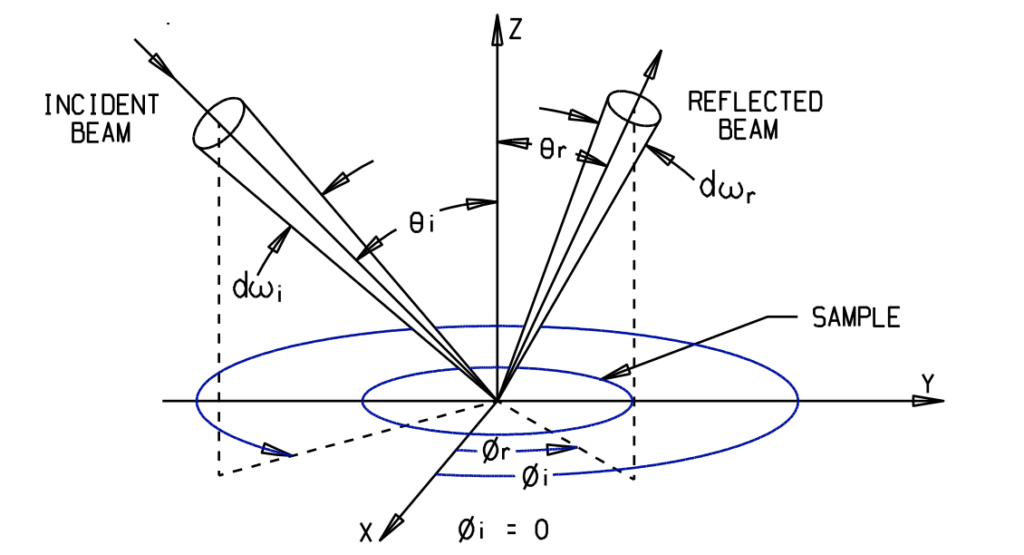
Geometrical Definition and Physical Meaning
A BRDF is parameterized by two pairs of angles:
- Incident direction: zenith angle (θ_i), azimuthal angle (φ_i)
- Reflected direction: zenith angle (θ_r), azimuthal angle (φ_r)
The BRDF, written as f_r(θ_i, φ_i, θ_r, φ_r, λ), gives the efficiency with which incident light from (θ_i, φ_i) is scattered into (θ_r, φ_r) at wavelength λ. In essence, it acts as a probability density function for the angular redistribution of light by a surface, encoding the effects of surface roughness, material composition, and microstructure.
- Lambertian (diffuse) surfaces have a constant BRDF, reflecting light equally in all directions.
- Specular (mirror-like) surfaces have BRDFs that are sharply peaked in the specular direction.
- Real surfaces exhibit both diffuse and specular components, with possible anisotropy or spectral dependence.
Mathematical Formulation and Units
The BRDF is mathematically defined as:
[ f_r(θ_i, φ_i, θ_r, φ_r, λ) = \frac{dL_r(θ_r, φ_r, λ)}{dE_i(θ_i, φ_i, λ)} ]
where:
- ( dL_r ): differential reflected radiance in direction (θ_r, φ_r) [W·m⁻²·sr⁻¹]
- ( dE_i ): differential incident irradiance from (θ_i, φ_i) [W·m⁻²]
For a narrow incident beam (solid angle dω_i):
[ f_r(θ_i, φ_i, θ_r, φ_r, λ) = \frac{dL_r(θ_r, φ_r, λ)}{L_i(θ_i, φ_i, λ) \cosθ_i, dω_i} ]
Units:
BRDF is measured in inverse steradians (sr⁻¹), reflecting its role as an angular density function. For spectral applications, it may also depend on wavelength (λ).
Key Properties: Reciprocity, Energy Conservation, and Spectral Dependence
Reciprocity
The reciprocity principle states that the BRDF is unchanged if the directions of incidence and reflection are swapped (assuming a passive, linear surface):
[ f_r(θ_i, φ_i, θ_r, φ_r, λ) = f_r(θ_r, φ_r, θ_i, φ_i, λ) ]
Energy Conservation
A physical BRDF must obey energy conservation, the total reflected power for any incident direction cannot exceed the incident power:
[ \int_{2\pi} f_r(θ_i, φ_i, θ_r, φ_r, λ) \cosθ_r, dω_r \leq 1 ]
Spectral Dependence
Many surfaces’ BRDFs vary with wavelength, reflecting their color or material absorption features. Accurate spectral BRDF data is essential in remote sensing, color science, and optical engineering.
Special Cases: Lambertian, Specular, Isotropic, Anisotropic
- Lambertian Surface:
BRDF is constant: ( f_r = \rho / \pi ), where ρ is albedo. - Specular Surface:
BRDF is a Dirac delta function peaked at the specular direction. - Isotropic BRDF:
Invariant under rotation about the surface normal. - Anisotropic BRDF:
Varies with absolute direction, typical of brushed metals or fabrics.
BRDF Measurement Approaches
Goniometric Measurement
Traditional goniometric reflectometers rotate a collimated light source and detector around a sample to systematically measure the BRDF across many angle pairs. These systems offer high accuracy and angular resolution but are time and data intensive.
Imaging-Based BRDF Measurement
Imaging systems employ cameras or mirrored optics to capture the angular distribution of reflected light simultaneously. They are faster and can capture spatially-varying BRDFs, though with typically lower radiometric accuracy.
Laboratory and Field Techniques
Laboratory setups use calibrated sources and detectors with reference standards for precise BRDF measurement. Field measurements use portable goniometers or spectroradiometers to characterize natural surfaces under real-world conditions, aiding remote sensing and ecological modeling.
Practical Applications of BRDF
Remote Sensing and Earth Observation
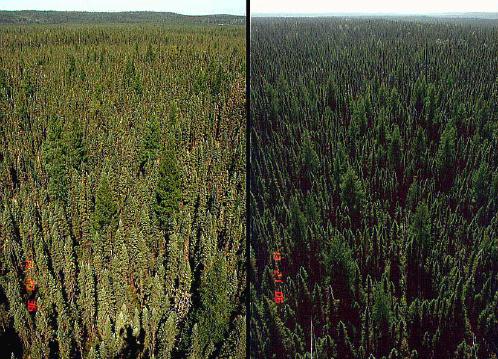
BRDF is pivotal in interpreting satellite imagery, correcting for angular effects, and deriving surface albedo, crucial for climate and energy balance studies.
Computer Graphics and Physically-Based Rendering
BRDF underpins physically-based rendering, enabling the simulation of realistic surface appearances in virtual environments. Common models include Lambertian, Phong, and Cook-Torrance BRDFs.
Optical Engineering and Photometry
BRDF data is essential for designing coatings, mirrors, and reducing stray light in optical systems. It’s also used to evaluate paints, films, and materials where directional reflectance matters.
Laboratory Photometry and Debris Analysis
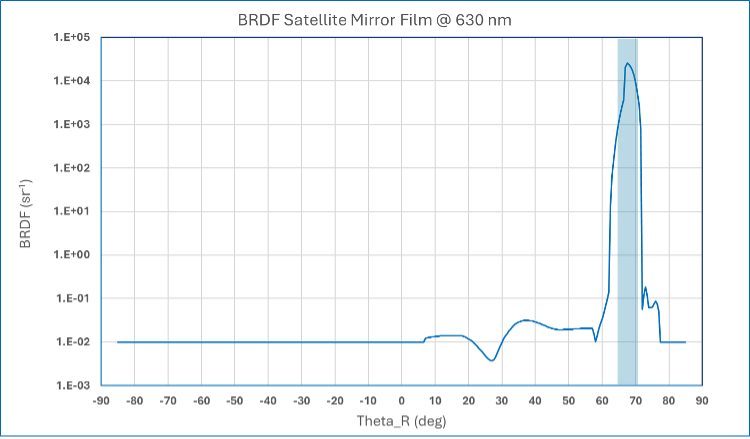
BRDF measurements support the analysis of orbital debris, helping infer object properties and improving space situational awareness.
BRDF Terminology and Notation
| Quantity | Symbol | Units | Description |
|---|---|---|---|
| Radiance | L | W·m⁻²·sr⁻¹ | Reflected or emitted power per area, angle |
| Irradiance | E | W·m⁻² | Incident power per unit area |
| Incident polar angle | θ_i | radians | Zenith angle of incoming light |
| Reflected polar angle | θ_r | radians | Zenith angle of reflected light |
| Incident azimuth | φ_i | radians | Azimuth angle of incoming light |
| Reflected azimuth | φ_r | radians | Azimuth angle of reflected light |
| Solid angle | dω | sr | Subtended angle in 3D |
| BRDF | f_r | sr⁻¹ | Bidirectional reflectance function |
| Hemispherical reflectance | ρ | dimensionless | Total reflected fraction (albedo) |
Related Reflectance and Scattering Functions
- BSDF (Bidirectional Scattering Distribution Function): General term encompassing both reflection (BRDF) and transmission (BTDF).
- BTDF (Bidirectional Transmittance Distribution Function): Describes angular distribution of transmitted light.
- BSSRDF (Bidirectional Surface Scattering Reflectance Distribution Function): Extends BRDF to account for light entering at one point and exiting at another, capturing subsurface scattering effects.
References
- Nicodemus, F.E., Richmond, J.C., Hsia, J.J., Ginsberg, I.W., Limperis, T., 1977. Geometrical Considerations and Nomenclature for Reflectance. NBS Monograph 160.
- ISO 15099:2003. Thermal performance of windows, doors, and shading devices – Detailed calculations.
- CIE International Lighting Vocabulary.
- Surface Optics Corporation – BRDF Overview
- Ocean Optics Web Book
- UMass Boston – MODIS BRDF Explained
For more details or applications, contact our team or request a demo to see how BRDF modeling can benefit your projects.
Frequently Asked Questions
- How is the BRDF mathematically defined?
- The BRDF is defined as the ratio of reflected radiance in a given direction to the incident irradiance from a specific direction, both per unit solid angle. In formula: f_r(θ_i, φ_i, θ_r, φ_r, λ) = dL_r(θ_r, φ_r, λ) / dE_i(θ_i, φ_i, λ), where θ and φ represent zenith and azimuth angles for incidence (i) and reflection (r), and λ is wavelength.
- What are common applications of BRDF?
- BRDF is widely used in remote sensing for correcting satellite imagery, in computer graphics for realistic rendering, in optical engineering for designing coatings and minimizing stray light, and in laboratory photometry for surface material characterization.
- What is the difference between BRDF, BSDF, and BTDF?
- BRDF describes only reflection at a surface, BTDF describes only transmission (light passing through). BSDF is the general term covering both BRDF and BTDF, describing all bidirectional scattering (reflection and transmission) from a surface.
- What are the units of BRDF?
- BRDF is measured in inverse steradians (sr⁻¹), reflecting its role as a density function over solid angles: radiance reflected per unit incident irradiance per unit solid angle.
- How is BRDF measured in practice?
- BRDF is measured using goniometric reflectometers (which sample incidence and reflection angles systematically) or imaging-based systems (which capture many angles at once with a detector array). Laboratory and field techniques are used depending on application.
- Why is reciprocity important in BRDF?
- Reciprocity means the BRDF is unchanged if the directions of incidence and reflection are swapped, assuming the surface is passive and linear. This property simplifies measurements and is fundamental to theoretical modeling.
- What is a Lambertian surface?
- A Lambertian (or ideal diffuse) surface is one that reflects incident light equally in all directions, resulting in a constant BRDF (f_r = ρ/π), where ρ is surface reflectance.
This is a reference entry. TarmacView provides drone inspection services and doesn't sell the equipment or materials described in this glossary.