What is Camera Calibration?
Camera Calibration
What is Camera Calibration?
Camera calibration is the process of determining the geometric parameters that define how a camera maps 3D world coordinates to 2D image coordinates. It answers a deceptively simple question: given a point in the real world (x, y, z), which pixel (u, v) in the image does it map to, and with what mathematical precision?
At its core, calibration exists because cameras are imperfect implementations of the ideal pinhole model. Every real camera-lens system deviates from perfection in ways that must be characterized and corrected before the camera can be used as a measurement instrument. Without calibration, every distance, area, and volume derived from images carries unquantified systematic error, the very thing that distinguishes photogrammetry from casual photography.
The Pinhole Camera Model
The pinhole camera model is the mathematical foundation upon which all camera calibration is built. It describes the ideal projective transformation from 3D world coordinates to 2D image coordinates through a single point, the center of projection (camera center). The model assumes that light travels in straight lines through an infinitesimally small aperture, that there is no lens, and that the image plane is perfectly planar and orthogonal to the optical axis.
Under the pinhole model, a 3D point X = [X, Y, Z, 1]ᵀ in world coordinates maps to image point x = [u, v, 1]ᵀ through the projection equation λx = K[R|t]X, where λ is a scale factor (the projective depth), K is the 3×3 intrinsic camera matrix, and [R|t] is the 3×4 extrinsic matrix representing rotation and translation from world to camera coordinates. Real lenses introduce systematic deviations from this ideal model, deviations that calibration quantifies and corrects.
Why Calibration Matters
An uncalibrated camera is not a measurement device. Consider what happens when a pavement inspection camera with a wide-angle lens captures an image of a road surface. Barrel distortion pulls pixels near the image edges inward by tens of pixels. Without a distortion model, a 0.3 mm crack at the image edge might appear as a 0.2 mm or 0.4 mm feature, or be invisible entirely. The principal point may be offset from the image center by 5-15 pixels due to manufacturing tolerances. Focal length, often assumed from the lens specification, can differ by 2-5% from the nominal value.
These seemingly small errors compound catastrophically in measurement. A 1% error in focal length translates to a 1% error in all derived distances. A 10-pixel principal point offset at a ground sample distance (GSD) of 1 mm/pixel introduces a 10 mm systematic shift in all measurements. Distortion of 5 pixels at the image edge translates to 5 mm of error at the corresponding ground location.
The Intrinsic Matrix K
The intrinsic matrix K encodes the internal geometric properties of a camera. It is a 3×3 upper-triangular matrix that maps 3D camera-centered coordinates to 2D pixel coordinates:
    [ fx   s   cx ]
K = [  0   fy  cy ]
    [  0    0   1 ]
Focal Length (fx, fy)
The focal length parameters fx and fy represent the distance from the camera center to the image plane, expressed in pixels. In an ideal camera, fx = fy. Differences arise from non-square pixels, sensor manufacturing tolerances, and anamorphic lens elements.
Conversion between pixel and physical units: The focal length in millimeters F can be computed from the pixel focal length as Fx = fx × (W/w), where W is the sensor width in mm and w is the image width in pixels. For a 24 MP camera with a 24 mm lens, 6 μm pixel pitch (6000 × 4000 pixels on a 36 × 24 mm sensor), the focal length in pixels is approximately 4000 pixels.
| Parameter | Formula | Typical Value (24 MP, 24 mm lens) |
|---|---|---|
| fx (pixels) | F × w / W | 6000 × 24 / 36 = 4000 px |
| fy (pixels) | F × h / H | 4000 × 24 / 24 = 4000 px |
| Fx (mm) | fx × W / w | 4000 × 36 / 6000 = 24 mm |
| Aspect ratio | fy/fx | ~1.000 (square pixels) |
Principal Point (cx, cy)
The principal point is the intersection of the optical axis with the image sensor, the point in the image where the camera’s optical axis pierces the image plane. In an ideal camera, it sits at the geometric center of the sensor: cx = w/2, cy = h/2. In real cameras, manufacturing tolerances shift it by 1-15 pixels from center. For the 24 MP example, cx ≈ 3000 pixels, cy ≈ 2000 pixels.
The principal point serves as the origin for lens distortion calculations, distortion displacements are measured radially from this point. A misidentified principal point causes distortion correction to be applied around the wrong center, introducing systematic errors that increase with distance from the true principal point.
Skew Coefficient (s)
The skew coefficient s accounts for non-rectangular pixels, a shear distortion in the image plane. In modern digital cameras with orthogonal sensor grids and rectangular pixels, the skew is effectively zero (s = 0). Historical analog cameras and certain scanning systems could exhibit non-zero skew, but for virtually all digital inspection cameras, skew can be assumed zero.
Lens Distortion Models
Lens distortion is the systematic deviation of real lens geometry from the ideal pinhole projection. The International Society for Photogrammetry and Remote Sensing (ISPRS) and the computer vision community have standardized on the Brown-Conrady model as the primary mathematical framework for describing lens distortion.
Radial Distortion (k1, k2, k3)
Radial distortion displaces image points along radial lines extending from the principal point. It is caused by the spherical shape of lens elements, light rays passing through the periphery of a spherical lens are refracted differently than rays through the center. The distortion is modeled as a polynomial function of the radial distance r from the principal point:
x_undistorted = x × (1 + k₁r² + k₂r⁴ + k₃r⁶) y_undistorted = y × (1 + k₁r² + k₂r⁴ + k₃r⁶)
Where (x, y) are normalized image coordinates relative to the principal point and r² = x² + y². The coefficient k1 dominates the distortion magnitude, with k2 and k3 providing increasingly subtle higher-order corrections. A negative k1 produces barrel distortion (points displaced inward, image appears bulging), while a positive k1 produces pincushion distortion (points displaced outward, image appears pinched).
| Coefficient | Typical Range | Effect |
|---|---|---|
| k1 | -0.32 to +0.15 | Primary distortion (100× stronger than k2) |
| k2 | -0.05 to +0.05 | Second-order correction |
| k3 | -0.005 to +0.005 | Third-order correction (often insignificant) |
| Maximum radial displacement | 1-100+ pixels | Depends on lens type and field of view |
For a typical wide-angle lens used in drone inspection (k1 ≈ -0.1), radial displacement at the image corner reaches 40-100 pixels, corresponding to 4-10 cm of measurement error at 1 mm GSD.
Tangential Distortion (p1, p2)
Tangential (decentering) distortion arises from imperfect alignment of individual lens elements in compound lenses, the optical centers of successive elements are not perfectly collinear. The Brown-Conrady model corrects tangential distortion using two parameters:
x_undistorted = x + [2p₁xy + p₂(r² + 2x²)] y_undistorted = y + [p₁(r² + 2y²) + 2p₂xy]
Tangential distortion is typically one to two orders of magnitude smaller than radial distortion for quality lenses. For most infrastructure inspection cameras, p1 and p2 are on the order of 10⁻⁴ to 10⁻⁵, producing displacements of 0.1-0.5 pixels at image corners. However, for lenses that have been physically damaged or poorly assembled, tangential distortion can exceed 5-10 pixels, significantly degrading measurement accuracy.
The Brown-Conrady Full Model
Duane C. Brown (1966, 1971) and A. E. Conrady (1919) developed the complete distortion model that is the standard in both photogrammetry and computer vision. The full model combines radial and tangential components into a single correction applied to each image point. The photogrammetric formulation differs slightly from the computer vision formulation: photogrammetry corrects from distorted to ideal coordinates as a function of distorted coordinates, while computer vision compensates from ideal to distorted as a function of ideal coordinates. This distinction is critical when transferring calibration parameters between photogrammetric (e.g., Agisoft Metashape) and computer vision (e.g., OpenCV) software.
Fisheye Model
For wide field-of-view lenses (≥ 90° field of view), the standard Brown-Conrady model becomes inadequate because the polynomial expansion diverges at large radial distances. The fisheye model uses a different projection function based on the angle θ of the incoming ray:
θ_d = θ(1 + k₁θ² + k₂θ⁴ + k₃θ⁶ + k₄θ⁸)
Where r = tan(θ) for the standard pinhole model, but r = θ (equidistant projection) for the fisheye model. Fisheye calibration typically requires 4 radial parameters (k1-k4) and no tangential parameters. Many consumer drone cameras with wide-angle lenses benefit from fisheye calibration, though the Brown-Conrady model is sufficient for normal and moderate wide-angle lenses (< 90° field of view).
Calibration Methods
Three primary methods dominate camera calibration practice, each with distinct accuracy characteristics, equipment requirements, and workflow implications.
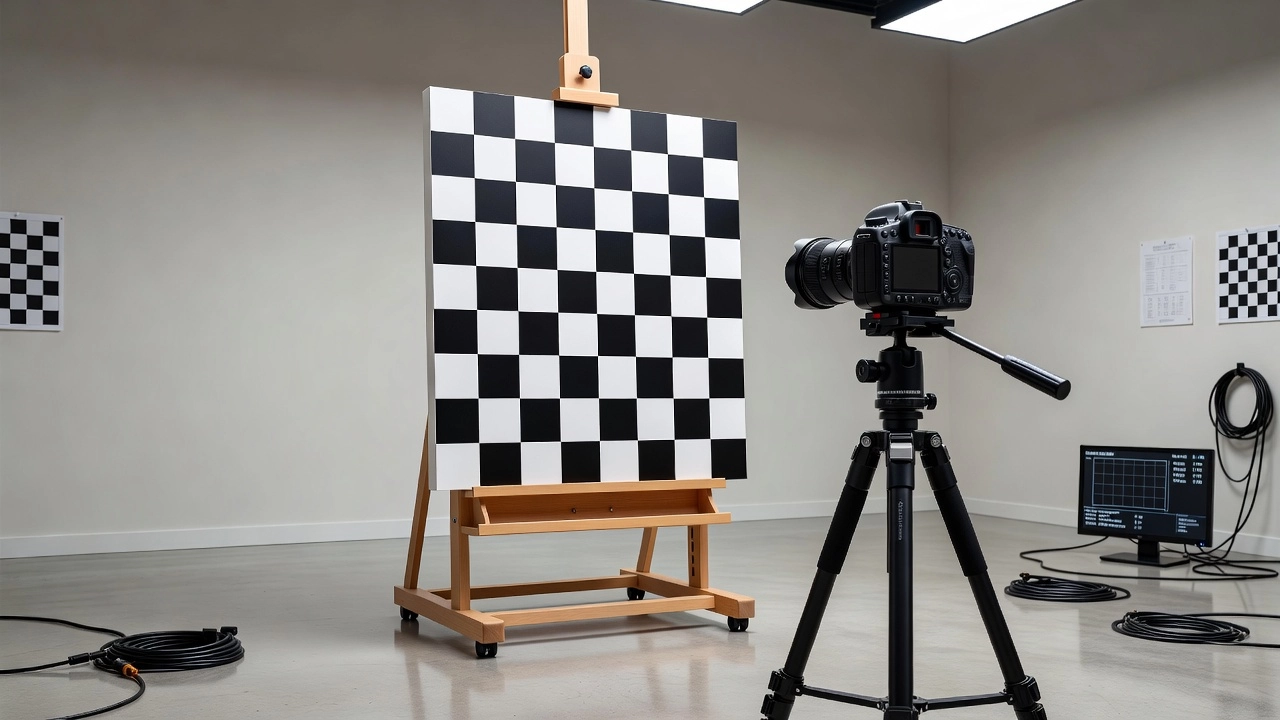
Zhang’s Checkerboard Method
Zhengyou Zhang’s 2000 paper “A Flexible New Technique for Camera Calibration” (IEEE Transactions on PAMI, cited 23,000+ times) introduced the method that has become the de facto standard for camera calibration. Zhang’s method requires only a planar checkerboard pattern printed on a flat surface, no expensive 3D test field or precision optical bench.
Mathematical framework: The method exploits the homography H between a planar calibration pattern (Z=0 in world coordinates) and its image projection. For each image of the checkerboard, the homography is computed from the known corner positions and their detected image coordinates. The homography provides two constraints on the intrinsic parameters via the absolute conic:
h₁ᵀ(A⁻ᵀA⁻¹)h₂ = 0 h₁ᵀ(A⁻ᵀA⁻¹)h₁ = h₂ᵀ(A⁻ᵀA⁻¹)h₂
These constraints follow from the fact that the rotation matrix columns r1 and r2 are orthonormal. With n images, 2n equations are available, and the intrinsic matrix A (equivalent to K) has 5 unknown parameters (fx, fy, cx, cy, s). A minimum of 3 images provides 6 equations for a closed-form solution.
Solution process: The closed-form solution is computed analytically, then refined via maximum likelihood estimation using the Levenberg-Marquardt algorithm. The refinement minimizes the total reprojection error:
min Σᵢⱼ ||pᵢⱼ - p̂(K, Rᵢ, tᵢ, Pⱼ)||²
where pᵢⱼ is the detected corner j in image i, and p̂ is the projected corner from the model. Radial distortion parameters (k1, k2) are typically added to the optimization in a second stage.
Pattern requirements: For reliable results, the checkerboard must satisfy flatness < 0.1 mm, a pattern size of 7×10 to 9×12 corners, square size of 10-30 mm, and 10-20 images at varied orientations. Images must cover all sensor quadrants including corners and edges, as the distortion model is poorly constrained without corner data.
Degenerate configurations: The method fails if the pattern undergoes pure translation (no rotation between images) or if all images are captured with the pattern parallel to the image plane. This is why calibration requires tilting and rotating the checkerboard between captures.
3D Test Field Calibration
Before Zhang’s method, calibration was performed using precisely surveyed 3D test fields, arrays of targets with known coordinates occupying a defined volume. The camera photographs the test field from multiple positions, and the known 3D-to-2D correspondences directly constrain all calibration parameters. This method achieves the highest accuracy (< 0.1 pixels RMS) but requires expensive surveying equipment, physical space, and maintenance. It remains the gold standard for metrology applications where maximum accuracy is required and budget permits.
Self-Calibration in Bundle Adjustment
Self-calibration (on-the-job calibration) estimates camera parameters simultaneously with 3D reconstruction during bundle adjustment. This approach is central to modern Structure from Motion (SfM) pipelines including Agisoft Metashape, Pix4Dmapper, COLMAP, and RealityCapture.
How it works: The pipeline detects thousands of tie points across overlapping images using feature detectors (SIFT, AKAZE, SuperPoint). A rough camera model is initialized from EXIF metadata. Bundle adjustment then simultaneously refines camera intrinsics (K, distortion coefficients), camera extrinsics (R, t for each image), and 3D point coordinates (Xⱼ) by minimizing the total reprojection error across all observations.
Critical requirements: Self-calibration requires convergent images (non-parallel optical axes), orthogonal roll angles, full image coverage (especially edges and corners), and for flat terrain, oblique images at 20-45° off-nadir. Without these conditions, the estimation problem is ill-posed, radial distortion parameters become strongly correlated with elevation, producing the dome effect.
| Platform | Self-Calibration | Distortion Model | Additional Parameters |
|---|---|---|---|
| Agisoft Metashape | Yes (default) | Brown-Conrady (k1-k4, p1-p2) | Affinity (B1, B2) |
| Pix4Dmapper | Yes (default) | Brown-Conrady (k1-k3, p1-p2) | – |
| COLMAP | Yes (default) | Brown-Conrady (k1-k3, p1-p2) | Fisheye, Orthographic |
| RealityCapture | Yes | Multiple models | Per-camera calibration |
| MATLAB Camera Calibrator | Yes (checkerboard) | Brown-Conrady | – |
Pre-Calibrated vs On-the-Job Calibration
A fundamental decision in photogrammetric workflow design is whether to pre-calibrate the camera in a controlled environment or to rely on on-the-job self-calibration.
| Aspect | Pre-Calibration | On-the-Job Self-Calibration |
|---|---|---|
| Accuracy | Higher for simple blocks (nadir-only) | Higher with strong network geometry |
| Convenience | Requires lab setup and time | No additional field work |
| Network geometry requirements | None for field block | Cross strips, oblique images required |
| Ground control points | Fewer required | More required |
| Correlation issues | None (parameters fixed) | fx-k1 correlation in nadir blocks |
| Dome effect | Eliminated | Requires mitigation strategies |
| Thermal variability | Fixed calibration temperature | Parameters adapt to flight conditions |
| Recalibration trigger | After shocks, periodic | Every block (implicitly) |
| Metrological traceability | Direct to calibration lab | Indirect, block-dependent |
For rectangular nadir-only blocks typical of infrastructure inspection, pre-calibration provides more accurate results because the block geometry is insufficient to decorrelate distortion parameters from elevation. The accuracy gap narrows significantly when adequate ground control points (GCPs) are distributed at block boundaries and centers. The optimal approach combines both methods: pre-calibrate the camera in a laboratory setting using Zhang’s method, then allow self-calibration refinement in the SfM pipeline only when the block includes oblique images (≥10% of images at 20-45° tilt).
Calibration Stability Over Time
Camera calibration parameters are not permanent. Thermal effects, mechanical shocks, and aging cause them to drift.
Thermal Effects
Temperature changes cause measurable geometric drift in consumer cameras. Research published in MDPI Sensors (2017) demonstrated focal length drift of 0.01-0.05% per °C. For a 4000-pixel focal length, this translates to 0.4-2.0 pixels per 10°C change. Principal point shifts of 0.1-0.5 pixels per °C are typical, and the dominant radial distortion coefficient k₁ can vary by 1-5% over a 30°C range. A drone taking off at 25°C and climbing to operating altitude where the temperature is 10°C experiences a 15°C change, causing focal length drift equivalent to 6-30 pixels or 1.5-7.5 mm of measurement error at 1 mm GSD. Photogrammetric accuracy improves by 2-4× when thermal effects are modeled and compensated.
Mechanical Shocks
Consumer-grade cameras are geometrically fragile. Dropping a camera can shift the principal point by 1-10 pixels. Removing and reattaching interchangeable lenses can alter the flange focal distance, shifting the principal point by 2-5 pixels. Auto-focus mechanisms change principal distance with every focus operation. Sensor-shift or lens-shift image stabilization introduces variable geometric offsets and must be disabled for photogrammetric use.
Recalibration Frequency
| Scenario | Recommended Frequency | Rationale |
|---|---|---|
| Regular use, fixed lens | Every 6 months | Gradual parameter drift from thermal cycling |
| Regular use, interchangeable lens | Every 3 months | Flange focal distance varies with each lens mount |
| After hard landing/drop | Immediately | Mechanical shock shifts sensor-lens alignment |
| After lens change | Immediately | Principal point and distortion change |
| Before major project | Immediately preceding | Ensure parameters match project conditions |
| Temperature delta > 15°C from calibration | Recalibrate at operating temperature | Thermal drift introduces measurable error |
| Not in use | Before next use | Verify calibration, don’t assume stability |
Effects of Uncalibrated Cameras on Measurements
An uncalibrated camera introduces systematic errors into every derived measurement. Understanding the propagation of these errors is essential for designing inspection workflows that meet accuracy requirements.
| Error Source | Typical Magnitude | Effect on 1 mm GSD Pavement Measurement |
|---|---|---|
| Focal length error (2%) | 80 pixels in fx | 2 cm error in 1 m length, 2% scaling error |
| Principal point offset | 10 pixels | 10 mm systematic lateral shift |
| Uncorrected barrel distortion (k₁ = -0.1) | 40 pixels at corner | 4 cm error near image edges |
| Uncorrected tangential distortion (p₁ = 1e-4) | 3 pixels at corner | 3 mm asymmetric error |
| Combined (all parameters incorrect) | – | 2-5 cm errors at 1 mm GSD |
| Dome effect (nadir-only, no calibration) | 0.1-0.5% of flight height | 10-50 cm at 100 m altitude |
The Dome Effect
The dome effect is the most insidious consequence of inadequate calibration in aerial photogrammetry. It manifests as a systematic elevation error where the center of the reconstructed surface is elevated relative to the edges (doming) or depressed relative to the edges (bowling). The causal mechanism is the strong correlation between radial distortion (especially k₁) and elevation in nadir-only imagery, bundle adjustment incorrectly absorbs radial distortion into elevation variations, producing a smooth, systematic error surface that looks realistic but is geometrically wrong. Magnitude: 0.1-0.5% of flight height (10-50 cm at 100 m altitude, 1-5 cm at 20 m altitude). Mitigation strategies include including oblique images at 20-45° off-nadir (at least 10% of block images), distributing GCPs at block boundaries and centers, flying cross strips (double-grid pattern), and using GNSS-assisted camera stations.
Calibration for Close-Range Photogrammetry
Close-range photogrammetry (camera-to-object distances < 300 m) benefits from strongly convergent camera networks where the camera is pointed at the same scene region from multiple directions. The ideal calibration network uses convergent images with 60-120° angle differences, cameras rolled to all four quadrants (0°, 90°, 180°, 270°), and images filling all sensor corners and edges.
Coded targets, circular retroreflective markers with unique identification patterns, provide automatic identification, sub-pixel measurement accuracy (0.01-0.05 pixels centroid), and automated correspondence. Close-range calibration with coded targets consistently achieves RMS reprojection errors below 0.1 pixels and object-space accuracy ratios of 1:50,000 to 1:200,000 (ratio of object size to measurement accuracy).
Calibration for Drone/UAV Cameras
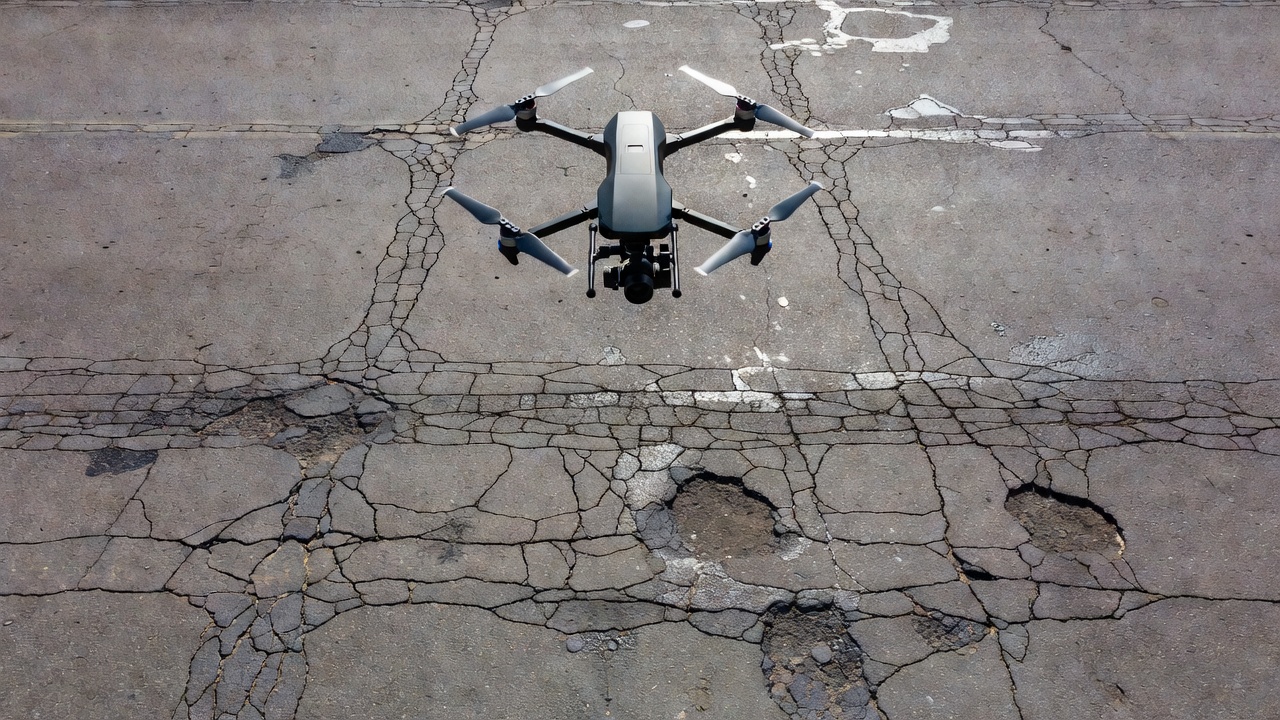
Drone-based photogrammetry occupies a challenging middle ground where consumer-grade cameras (borrowing challenges from close-range calibration) meet aerial block geometry (borrowing constraints from aerial photogrammetry). Unique challenges include mechanical instability from hard landings and gimbal shocks, auto-focus that changes principal distance in flight, temperature gradients of 10-40°C between ground and altitude, and CMOS rolling shutter that introduces geometric distortion.
Recommended Flight Configurations
| Configuration | Description | Benefit |
|---|---|---|
| Double grid | N-S and E-W flight lines at 80% overlap | Cross-strip geometry decorrelates parameters |
| Oblique images | 20-45° off-nadir, at every 4th-5th strip image | Breaks fx-k1 correlation, mitigates dome effect |
| GNSS-assisted stations | RTK/PPK camera positions | Constrains positions, improves parameter estimation |
| Variable altitude | ±10% altitude variation across block | Provides scale diversity |
| 80-90% forward overlap | Dense image coverage | More tie points per feature |
Research by Roncella and Forlani (Sensors, 2021) demonstrated that the accuracy gap between optimal and poor calibration configurations can be close to an order of magnitude for UAV blocks. Self-calibration with oblique images (≥10% of block images at 20-45° tilt) combined with a double-grid flight pattern reduces the dome effect from 0.1-0.5% of flight height to < 0.01%.
Calibration Quality Assessment
A calibration is only as good as its quality assessment. Multiple complementary metrics must be evaluated to determine whether a calibration is fit for purpose.
Reprojection Error
RMS reprojection error (RPE) is the most widely reported calibration quality metric. It measures the 2D pixel difference between detected image features and their positions computed from the camera model and 3D coordinates: RPE = √(1/n × Σ||xᵢ - x̂ᵢ||²).
| Application Domain | RPE Threshold | Notes |
|---|---|---|
| High-precision metrology | < 0.1 pixels | Aerospace, manufacturing QC |
| Industrial close-range | 0.1-0.3 pixels | Parts inspection, assembly verification |
| Standard quality | 0.3-0.5 pixels | General photogrammetry |
| UAV photogrammetry | 0.3-1.0 pixels | Drone-based inspection, mapping |
| Acceptable upper limit | < 2.0 pixels | Beyond this, calibration is unreliable |
Critical caveat: RPE is a training error. It measures how well the model fits the data used to estimate it. A low RPE does not guarantee good calibration because of overfitting risk (too many parameters for the available constraints). Always validate with independent check points measured in the calibration images but not used in parameter estimation.
Variance-Covariance Analysis
The variance-covariance matrix Cx = σ₀² × (JᵀJ)⁻¹ provides essential uncertainty information, where σ₀² is the a posteriori variance factor and J is the Jacobian matrix. The standard deviation of each parameter is the square root of the corresponding diagonal element. Parameter significance is assessed using the t-statistic t = |pᵢ| / σ(pᵢ): t > 2.0 indicates significance at 95% confidence.
Correlation Monitoring
The most critical correlation to monitor is between focal length (fx) and radial distortion (k₁):
| Correlation ρ(fx, k₁) | Implication |
|---|---|
| < 0.7 | Good network geometry, reliable parameter separation |
| 0.7-0.9 | Moderate correlation, acceptable with GCPs |
| 0.9-0.95 | Strong correlation, risk of systematic error |
| > 0.95 | Severe, parameters cannot be reliably separated |
Correlations above 0.9 between fx and k₁ indicate that the image block lacks oblique views, and self-calibration will produce unreliable results. Pre-calibration or additional oblique images are required.
USGS Guidelines
USGS Open-File Report 2023-1033 requires that all calibration parameters and their uncertainties be reported as metadata, the calibration method and date be documented, the calibration environment (temperature, humidity) be recorded, validation metrics (RPE, check point residuals) be provided, and recalibration history be maintained.
Calibration in Infrastructure Inspection and Crack Measurement
Infrastructure inspection, particularly pavement crack measurement, places stringent demands on camera calibration. Cracks as narrow as 0.1 mm must be reliably detected and measured, requiring sub-millimeter measurement accuracy across large surface areas.
Pavement Inspection Camera Parameters (ISPRS 2025 Study)
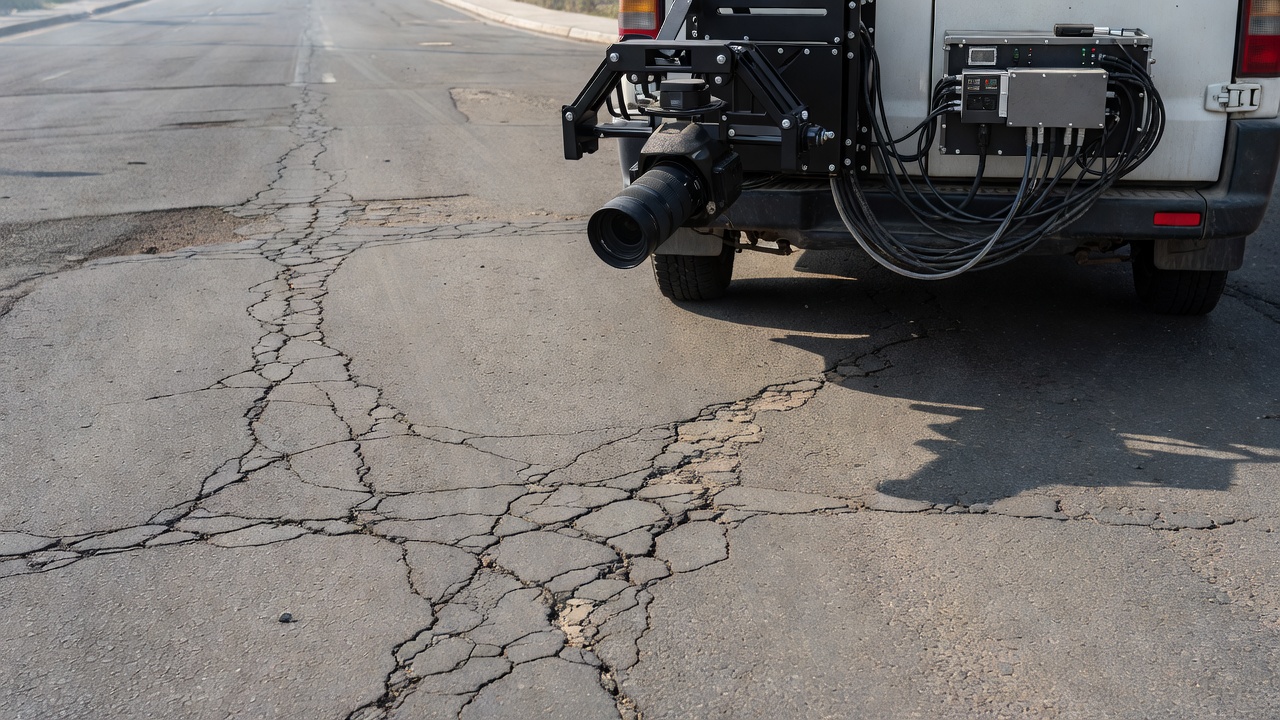
A recent ISPRS pavement inspection study (Darwish & Ahmed, 2025) using a vehicle-mounted camera system at 2.237 m height reported the following calibration parameters:
| Parameter | Value | Notes |
|---|---|---|
| fx | 1787.75 pixels | Horizontal focal length |
| fy | 1786.58 pixels | Vertical focal length (near-unity aspect ratio) |
| cx | 1640.34 pixels | Principal point column |
| cy | 1092.44 pixels | Principal point row |
| k₁ | -0.0186 | Slight barrel distortion |
| k₂ | -0.0372 | Second-order radial |
| p₁ | 0.0157 | Small tangential |
| p₂ | -0.0014 | Small tangential |
| Mounting height | 2.237 m | Fixed mount on vehicle |
| Achieved accuracy | σ = ±1.0 mm | Compared to laser reference (LCMS) |
| GSD | ~1.0 mm/pixel | At 2.237 m mounting height |
Impact on Crack Measurement
Uncalibrated cameras introduce systematic errors that directly affect crack measurement. A 5-pixel uncorrected barrel distortion at image edges translates to 5 mm error at 1 mm GSD, sufficient to entirely mask sub-millimeter cracks or falsely widen hairline cracks by 200-500%. Principal point errors of 10 pixels introduce 10 mm lateral offsets in crack location. Focal length errors of 2% produce 2% scaling errors in crack width measurements.
Calibration enables three critical transformations for pavement inspection: lens distortion correction (removing barrel/pincushion distortion that would otherwise warp crack geometry at image edges), orthogonal projection (converting perspective images to bird’s-eye orthographic views where true metric measurements are possible), and metric scaling (establishing the precise relationship between pixels and millimeters on the road surface).
Summary and Best Practices
Camera calibration is the foundation of all photogrammetric measurement. Without it, images are qualitative records, not quantitative data. With proper calibration, sub-millimeter measurement accuracy is achievable even with consumer-grade cameras.
Key Takeaways
- Every camera-lens combination has unique calibration parameters, never assume parameters from the same model or another unit.
- Calibration parameters drift over time, thermal effects (~0.01-0.05% per °C), mechanical shocks, and aging all degrade calibration validity.
- Self-calibration is not a silver bullet, without oblique images (20-45°), the correlation between fx and k₁ produces dome effect errors of 0.1-0.5% of flight height.
- Pre-calibration + self-calibration refinement is the optimal approach, lab calibration provides robust initial values, on-the-job refinement adapts to field conditions.
- Quality assessment requires multiple metrics, RMS reprojection error alone is insufficient, variance-covariance analysis, parameter significance testing, and independent check point validation are essential.
- For pavement inspection, calibration enables σ = ±1.0 mm accuracy as demonstrated by the ISPRS 2025 study.
- Document everything, calibration parameters, uncertainties, method, date, and environmental conditions should be preserved as metadata for every inspection dataset.
Best Practices Checklist
- Calibrate every camera-lens combination individually
- Use 15-20 checkerboard images covering all sensor quadrants
- Verify board flatness < 0.1 mm
- Fix zoom and focus rings, disable auto-focus and image stabilization
- Pre-calibrate before field deployment
- Allow self-calibration refinement in SfM only with oblique images (≥10% at 20-45°)
- Include cross strips (double grid) for UAV blocks
- Distribute GCPs at block boundaries and center
- Monitor fx-k₁ correlation, abort self-calibration if ρ > 0.95
- Recalibrate after hard landings, lens changes, and every 6 months
- Acclimate camera to operating temperature before calibration
- Validate calibration with independent check points
- Report all calibration parameters with uncertainties as metadata
- For pavement inspection: verify calibration against surveyed test strip
References
- Zhang, Z. (2000). A flexible new technique for camera calibration. IEEE Transactions on Pattern Analysis and Machine Intelligence, 22(11), 1330-1334.
- Brown, D. C. (1971). Close-range camera calibration. Photogrammetric Engineering, 37(8), 855-866.
- Conrady, A. E. (1919). Decentered lens systems. Monthly Notices of the Royal Astronomical Society, 79, 384-390.
- Roncella, R. & Forlani, G. (2021). UAV block geometry design and camera calibration: A simulation study. Sensors, 21(18), 6090.
- Lin, K. Y. et al. (2022). Interpretation and transformation of intrinsic camera parameters used in photogrammetry and computer vision. Sensors, 22(24), 9602.
- Darwish, W. & Ahmed, W. (2025). A simplified Gaussian approach for asphalt crack detection based on deep learning and RGB images. ISPRS Archives, XLVIII-G-2025, 345-352.
- USGS (2023). Guidelines for calibration of uncrewed aircraft systems imagery. Open-File Report 2023-1033.
- Hartley, R. & Zisserman, A. (2004). Multiple View Geometry in Computer Vision. Cambridge University Press, 2nd ed.
- Habib, A. et al. (2014). Stability analysis for a multi-camera photogrammetric system. Sensors, 14(8), 15084-15112.
Frequently Asked Questions
- What are intrinsic camera parameters?
- Intrinsic parameters define the internal geometry of a camera. The intrinsic matrix K contains focal length (fx, fy in pixels), principal point coordinates (cx, cy), and the skew coefficient (s, typically zero for modern sensors). The intrinsic matrix is K = [[fx, s, cx], [0, fy, cy], [0, 0, 1]]. Focal length converts between angular and pixel coordinates. Principal point is the intersection of the optical axis with the image sensor. For a 24 MP camera with 24 mm lens and 6 µm pixel pitch, focal length is approximately 4000 pixels.
- What is lens distortion and why does it matter?
- Lens distortion causes image points to be displaced from their ideal positions. Radial distortion (modeled by coefficients k1, k2, k3) displaces points along radial lines from the principal point, barrel distortion (negative k1) pulls points inward, pincushion distortion (positive k1) pushes them outward. Tangential distortion (p1, p2) arises from lens element misalignment. For wide-angle lenses, radial distortion at image corners often exceeds 100 pixels. Uncorrected distortion in photogrammetry causes the dome effect, systematic vertical errors of 0.1-0.5% of flight height, translating to 10-50 cm at 100 m altitude.
- What is Zhang's calibration method?
- Zhang's method (2000, cited 23,000+ times) calibrates a camera using 10-20 images of a planar checkerboard pattern at different orientations. The method computes a closed-form solution from homography constraints between the known pattern and observed images, then refines parameters via maximum likelihood estimation minimizing reprojection error. Typical checkerboard patterns use 7×10 to 9×12 corners with 10-30 mm square size. The board must be flat to < 0.1 mm. Minimum of 2 images is theoretically required, but 10-20 gives robust results.
- How does self-calibration work in SfM?
- Self-calibration (or on-the-job calibration) estimates camera parameters simultaneously with 3D reconstruction during bundle adjustment. Structure from Motion pipelines like Agisoft Metashape and Pix4D perform self-calibration by: (1) detecting thousands of tie points via feature matching, (2) estimating camera parameters as part of bundle adjustment, (3) refining intrinsics simultaneously with extrinsics and 3D points. Self-calibration requires convergent images, orthogonal roll angles, full image format coverage by tie points, and oblique images (20-45°) for flat terrain. Without oblique images, the dome effect causes systematic elevation errors.
- How often should a camera be recalibrated?
- Recalibration is required after any mechanical shock (hard landing, lens removal or change), at minimum annually for cameras in regular use, before and after major projects, and when ambient temperature differs significantly from calibration conditions (>15°C difference). Consumer-grade cameras are geometrically unstable, mechanical shock can shift principal point by 1-10 pixels, and temperature changes cause focal length drift of 0.01-0.05% per °C. PhotoModeler recommends calibration every 3-6 months for active cameras. Fix zoom/focus rings, disable auto-focus, image stabilization, and sensor vibration features for stable calibration.
- How does camera calibration affect crack measurement accuracy?
- For pavement crack measurement, camera calibration enables orthogonal (bird's eye) image projection and metric conversion from pixels to millimeters. In the ISPRS 2025 pavement inspection study, calibration achieved σ = ±1.0 mm accuracy compared to laser reference systems. Typical parameters for a vehicle-mounted pavement camera at 2.237 m height: fx = 1787.75 pixels, fy = 1786.58 pixels, k1 = -0.0186. Uncalibrated cameras introduce 1-5 pixels of barrel distortion at image edges, corresponding to 1-5 mm error at 1 mm GSD, enough to mask sub-millimeter cracks entirely.
- What is reprojection error and what values are acceptable?
- Reprojection error is the 2D pixel difference between a detected image feature and its projected position computed from the camera model and 3D coordinates. RMS reprojection error (RPE) quantifies overall calibration quality. Acceptable RPE ranges: high-precision metrology < 0.1 pixels, industrial close-range 0.1-0.3 pixels, standard quality 0.3-0.5 pixels, UAV photogrammetry 0.3-1.0 pixels, acceptable upper limit < 2.0 pixels. RPE is a training error, low values don't guarantee good calibration. Cross-validation with independent check points is essential.
- What is the difference between pre-calibration and on-the-job calibration?
- Pre-calibration uses a laboratory test field with optimal camera network geometry (convergent images, cross strips) to determine camera parameters before field deployment. On-the-job self-calibration estimates parameters during block adjustment of actual survey images. Pre-calibration is more accurate for rectangular nadir-only blocks, but the accuracy gap narrows significantly with adequate ground control points (GCPs). Optimal practice combines both: pre-calibrate the camera in a lab, then refine parameters through self-calibration in the field block. Oblique images (20-45°) at ≥10% of block images are strongly recommended for on-the-job calibration.
- What is the Brown-Conrady distortion model?
- The Brown-Conrady model decomposes lens distortion into radial and decentering (tangential) components. Radial distortion: Δr = K₁r³ + K₂r⁵ + K₃r⁷ where r is the radial distance from the principal point. Tangential distortion: Δx = P₁(r² + 2x²) + 2P₂xy and Δy = P₂(r² + 2y²) + 2P₁xy. Brown (1966, 1971) and Conrady (1919) developed the model. Radial coefficients k1 (dominant), k2, k3 correct increasing orders of radial displacement. Tangential coefficients p1, p2 correct lens decentering. Typical k1 values: -0.32 to +0.15 depending on lens type. The model is the standard in both photogrammetry and computer vision.
- How does drone camera calibration differ from close-range calibration?
- Drone (UAV) cameras combine consumer-grade optics from close-range photogrammetry with block geometry from aerial photogrammetry, creating unique challenges. Consumer cameras lack mechanical stability of metric cameras. Auto-focus in flight changes principal distance. Mechanical shocks from landing shift sensor/lens alignment. Temperature changes during flight (10-40°C) cause focal length drift equivalent to 0.3-1.5 pixels. Recommended self-calibration flight configurations: double grid with cross strips (N-S + E-W), oblique images at 20-45° tilt, and GNSS-assisted camera stations. Pre-calibration is recommended when cameras are mechanically stable and field conditions match calibration conditions.
- What calibration parameters are used in TarmacView?
- TarmacView uses the full intrinsic camera model including focal length (fx, fy), principal point (cx, cy), radial distortion coefficients (k1, k2, k3), and tangential distortion coefficients (p1, p2). Calibration follows Zhang's checkerboard method for pre-calibration and supports self-calibration refinement during photogrammetric block adjustment. For pavement inspection applications, calibration parameters enable orthogonal projection (bird's eye view) with verified sub-millimeter accuracy, metric conversion from pixels to physical units, and automated crack width measurement per ASTM D5340 standards.
- What is the dome effect in photogrammetry?
- The dome effect (also called bowl effect) is a systematic elevation error in photogrammetric models where the center is elevated relative to edges (or vice versa). It is caused by strong correlation between radial distortion parameters (especially k1) and elevation in nadir-only imagery. Magnitude: 0.1-0.5% of flight height, 10-50 cm at 100 m altitude. Mitigation strategies: include oblique images (20-45° off-nadir), use GCPs at block boundaries and center, fly cross strips (double-grid pattern), use GNSS-assisted camera stations. With proper mitigation, dome effect reduces to < 0.01% of flight height.
- How is calibration quality assessed?
- Calibration quality is assessed through: (1) RMS reprojection error, typical acceptable values 0.1-1.0 pixels depending on application, (2) parameter standard deviations from the variance-covariance matrix Cx = σ₀² × (JᵀJ)⁻¹, (3) correlation analysis, strong correlations between fx and k1 (~0.9 for nadir blocks) indicate poor network geometry for self-calibration, (4) significance testing via t-statistic = |parameter|/σ(parameter), values > 2.0 are significant at 95% confidence, (5) independent check point residuals in object space. USGS OFR 2023-1033 requires calibration parameters and their uncertainties be included as metadata.
- What is the difference between photogrammetric and computer vision calibration conventions?
- Photogrammetry (PH) and computer vision (CV) model intrinsic parameters differently per Lin et al. (Sensors, 2022): PH uses principal distance (f) in mm with image origin at bottom-left, CV uses fx, fy in pixels with image origin at top-left. PH distortion functions use distorted coordinates as input, CV uses undistorted coordinates. PH applies correction (distorted → undistorted), CV applies compensation (undistorted → distorted). PH models include affinity (b1, non-orthogonality) and shear (b2, differential scaling) terms beyond the CV model. These differences require careful parameter transformation when switching between PH and CV software.
- How does temperature affect camera calibration?
- Temperature changes cause measurable geometric drift in consumer cameras. Research (MDPI Sensors, 2017) shows: image sensor temperature variations of 10-40°C cause focal length drift equivalent to 0.3-1.5 pixels, photogrammetric accuracy improves by 2-4× when thermal effects are modeled and compensated. Mechanical effects include expansion/contraction of the lens mount, changes in refractive index of glass elements, and thermo-mechanical stress on the sensor assembly. For precision inspection, cameras should be acclimated to operating temperature before calibration, or thermal calibration models should be developed for temperature ranges expected during field operations.