What is a color transition in airport lighting?
Color Transition – Change from One Color to Another in PAPI or VASI Systems (Airport Lighting)
Definition
A color transition in airport lighting is the engineered, abrupt change from one color (typically white) to another (typically red) within the light beam of approach slope indicator systems such as the Precision Approach Path Indicator (PAPI) and Visual Approach Slope Indicator (VASI). This sharp boundary is precisely aligned with the standard glide slope for an approaching aircraft, providing pilots with immediate visual feedback about their vertical position relative to the ideal approach angle.
Background: Importance of Color Transition in Airport Lighting
Color transition is the central principle that makes PAPI and VASI systems effective. In poor visibility, at night, or above featureless terrain, traditional visual cues fade. The human eye, however, is acutely sensitive to abrupt color changes, especially between white and red. By using a sharp color transition, these systems provide pilots with an unmistakable, binary cue they can trust for safe, standardized approaches at any airport.
International standards (such as ICAO Annex 14) require that runways used for instrument approaches be equipped with visual glide path indicators using color transitions. This universal design ensures all pilots receive consistent, easy-to-interpret feedback, reducing cognitive load and minimizing risk during critical phases of flight.
Technical Mechanism: How Color Transition Works
Optical Engineering in PAPI and VASI
Each PAPI or VASI light unit projects a beam with a precisely engineered horizontal boundary. Above the set angle, the beam is white, below, it is red. This is achieved using:
- Optical filters (e.g., red glass or dichroic coatings)
- Precision lenses and reflectors
- High-intensity lamps or LEDs
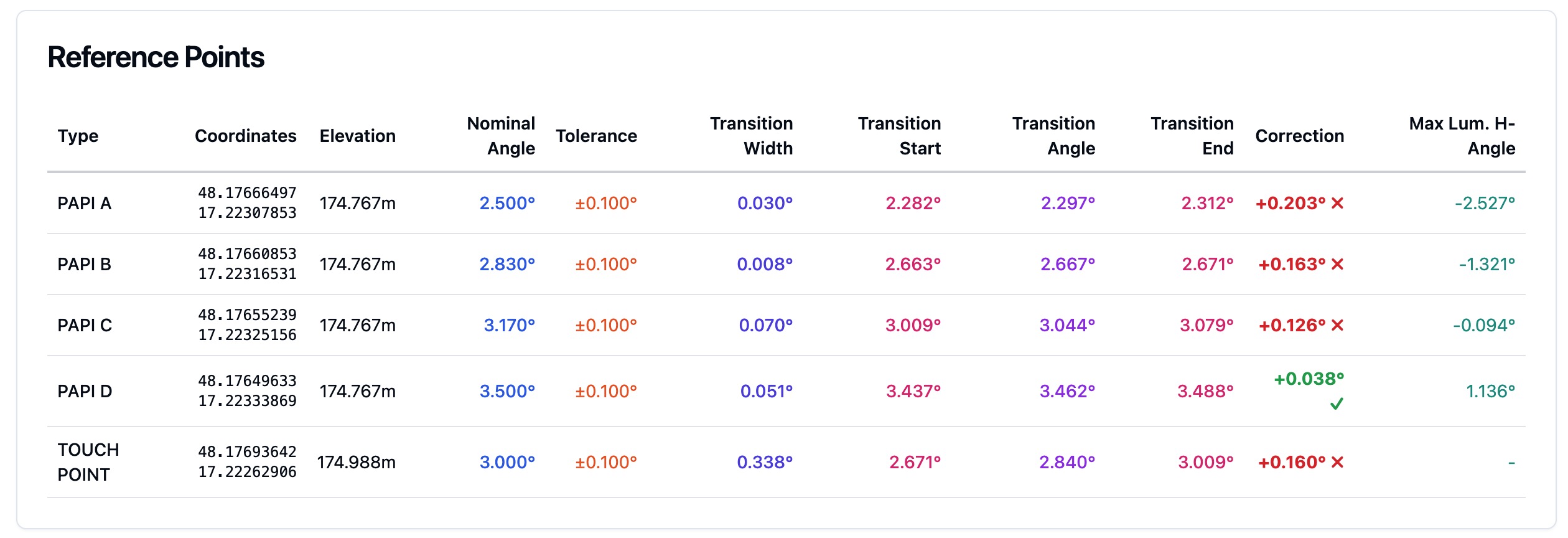
The transition between colors is designed to be extremely sharp, less than three minutes of arc. In PAPI, four units are aligned with staggered color transition angles to create a series of distinct, interpretable patterns. In VASI, two or three bars create a simpler, but still effective, color-coded system.
Angular Color Segmentation
The effectiveness of color transition relies on precise angular segmentation. Each light unit’s transition is adjusted so that its color change occurs at a specific vertical angle, matching the runway’s glide slope (usually 3 degrees). Pilots see more white lights if above the glide path, more red if below, and a balanced mix when on target.
This segmentation is maintained across a lateral coverage of ±10° from the runway centerline and up to 5 nautical miles out (for PAPI). Outside this sector, the pattern may become ambiguous, so pilots use the system only when properly aligned with the runway.
Modern Components: LEDs and Calibration
Modern systems increasingly use LEDs for both white and red segments, offering greater reliability and sharper transitions than incandescent bulbs. Each light unit is mounted on an adjustable base for precise alignment during installation and regular calibration.
Interpretation: What Color Combinations Mean
PAPI System
In a four-unit PAPI, the colors (left to right) mean:
| Lights Seen | Glide Path Position | Pilot Action |
|---|---|---|
| 4 White | Significantly Too High | Increase descent |
| 3 White, 1 Red | Slightly High | Descend gently |
| 2 White, 2 Red | On Glide Path (Ideal) | Maintain approach |
| 1 White, 3 Red | Slightly Low | Climb gently |
| 4 Red | Significantly Too Low | Initiate go-around |
VASI System
| Near Bar | Far Bar | Glide Path Position | Pilot Action |
|---|---|---|---|
| White | White | Too High | Increase descent |
| White | Red | On Glide Path (Ideal) | Maintain approach |
| Red | Red | Too Low | Climb or go-around |
Mnemonics:
- “White over white, you’re high as a kite.”
- “Red over red, you’re dead.”
- “Red over white, you’re alright.”
Operational Use: How Pilots Use Color Transition
During approach, pilots continuously monitor the color pattern:
- Too High: More white lights, descend.
- On Path: Equal red and white, hold approach.
- Too Low: More red lights, climb or go around.
These cues are integrated with other instruments, especially useful at night or in poor visibility. Color transitions are also vital during training, allowing for standardized, objective evaluation of approach technique.
Comparison: PAPI vs. VASI Color Transition
| Feature | PAPI (Precision Approach Path Indicator) | VASI (Visual Approach Slope Indicator) |
|---|---|---|
| Configuration | 4 (or 2) lights in a row | 2 or 3 bars of lights |
| Feedback | Five-step (granular) | Three-step (simple) |
| Visual Range | Up to 5 miles (day), 20+ (night) | Similar |
| Placement | One side of runway, 300m from threshold | One/both sides, 200–300m from threshold |
| Maintenance | Higher (individual alignment) | Moderate |
PAPI offers finer feedback, while VASI is simpler and easier for new pilots. Both depend on sharp color transitions for effectiveness.
Limitations and Safety Considerations
- Coverage: Accurate only within ±10° of centerline and up to 5 miles.
- Weather: Visibility may degrade in heavy rain, fog, or snow.
- Aircraft Type: Cockpit height affects perceived transition, large jets may require dual-angle systems.
- Maintenance: Regular calibration and cleaning are essential for reliable transitions.
Glossary of Key Terms
- PAPI (Precision Approach Path Indicator): Four (sometimes two) light units providing precise glide path via color transitions.
- VASI (Visual Approach Slope Indicator): Two or three bars of lights indicating glide path with simple color patterns.
- Glide Path: The ideal descent angle (usually 3°) that brings an aircraft safely to the runway.
- Color Transition: The sharp, engineered boundary between white and red light in approach aids.
- Angular Segmentation: The division of the light beam at a specific angle to create a color transition.
- Dichroic Filter: An optical filter that precisely transmits one color (like red) while blocking others.
Summary
Color transition is the foundational optical effect in PAPI and VASI approach aids, providing pilots with instant, unambiguous feedback on their vertical position relative to the ideal glide path by means of a sharp change from white to red light. This mechanism is vital for safe, standardized approaches in all conditions, making it an essential concept in airport lighting and visual guidance systems.
Frequently Asked Questions
- How does a color transition work in PAPI and VASI systems?
- Color transition is created by optical elements within each light unit, dividing the output into sharply separated zones, white above a certain angle and red below. As a pilot descends, their viewpoint passes through this boundary, causing an immediate color shift. This provides clear feedback about whether the aircraft is above, below, or on the correct glide path.
- Why is the color transition designed to be sharp rather than gradual?
- A sharp transition (usually less than three minutes of arc) ensures that even small deviations from the glide path are immediately visible to the pilot. This reduces ambiguity and enables prompt, accurate corrections, which is critical for safe landings, especially in low visibility or high-workload situations.
- What do the different color patterns mean in a PAPI system?
- In a PAPI system, four light units produce five possible red/white combinations: All white indicates too high, three white/one red is slightly high, two white/two red is on the glide path, one white/three red is slightly low, and all red means dangerously low. Pilots adjust their approach based on these cues.
- Can pilots rely on color transitions in all weather conditions?
- While PAPI and VASI are designed for visibility in day, night, and various weather conditions, severe weather like fog, snow, or heavy rain can reduce effectiveness. Pilots should use these systems in conjunction with instrument guidance in such cases.
- Are PAPI and VASI color transitions the same for all aircraft?
- The visual transition is affected by cockpit eye height, which varies between aircraft. Some airports offer dual-angle systems to accommodate different aircraft types, but pilots should always be aware of system calibration and adjust their interpretation as needed.
This is a reference entry. TarmacView provides drone inspection services and doesn't sell the equipment or materials described in this glossary.