What is Common Traffic Advisory Frequency (CTAF)?
Common Traffic Advisory Frequency (CTAF) – Radio Frequency for Traffic Information in Aviation
What Is CTAF?
Common Traffic Advisory Frequency (CTAF) is a specifically allocated VHF radio frequency enabling pilots at non-towered airports, or at airports where the control tower is inactive, to broadcast their positions, intentions, and coordinate activities. CTAF replaces, as much as possible, the situational awareness and traffic advisories provided by air traffic controllers at towered airports. By self-announcing on CTAF, pilots keep others informed of their location, movement, and intentions, vital for collision avoidance and maintaining orderly traffic flow.
Aviation authorities publish CTAF frequencies for each airport, in the US, the FAA designates and lists these in the Chart Supplements, sectional charts, and flight planning tools. Typical CTAF frequencies include 122.7, 122.8, 122.9, 123.0, and 123.05 MHz. Sometimes, the CTAF is the same as the UNICOM or even the tower frequency (when the tower is closed).
CTAF is strictly for operational use: position reporting, intention announcements, and safety-related coordination. Non-operational use, such as casual conversation, is discouraged to prevent clutter and ensure critical communications are heard. Standardized phraseology is required, and pilots state the airport name at the beginning and end of each transmission, especially important when multiple airports share a frequency.
CTAF is central to the airport traffic pattern (circuit), the path aircraft follow for arrivals and departures. At non-towered airports, all separation depends on timely, accurate self-announcements and vigilant listening. Without a controller to sequence or resolve conflicts, effective CTAF use is essential for safety.
Operational Context: Where and When Is CTAF Used?
CTAF is used:
- At non-towered (uncontrolled) airports for all arrivals, departures, and traffic pattern operations.
- At towered airports when the tower is closed, typically during night or off-hours. The former tower frequency usually becomes CTAF.
- At remote/private airstrips, gliderports, and ultralight fields, often using MULTICOM (122.9 MHz in the US) if no designated frequency exists.
- By all airspace users (fixed wing, gliders, helicopters, ultralights, skydiving aircraft) to ensure safe integration into the airport environment.
Pilots must check local regulations and published frequencies in their national AIP or chart supplements, as allocations may differ internationally.
How CTAF Is Used: Procedures and Best Practices
Self-Announcing Procedures
Pilots broadcast their identification, location, and intentions on CTAF, beginning about 10 nautical miles out. Calls are made at:
- 10 miles out (initial call)
- Entering downwind
- Turning base
- Turning final
- After clearing the runway
- Before taxi, entering the runway, and taking off
Standard format:
[Airport name] traffic, [aircraft type and registration], [position/direction], [intention], [runway if applicable], [Airport name].
Example:
“Midland traffic, Cessna 172, 10 miles west, inbound for landing, runway 27, Midland.”
Listening is as critical as transmitting: monitor CTAF within 10 miles, and transmit only when the frequency is clear to avoid “stepping on” other transmissions.
Sample Radio Calls
- “Springfield traffic, Piper Warrior N12345, 8 miles southeast, inbound for landing, runway 18, Springfield.”
- “Springfield traffic, Warrior 345, entering left downwind, runway 18, Springfield.”
- “Springfield traffic, Warrior 345, turning left base, runway 18, Springfield.”
- “Springfield traffic, Warrior 345, final, runway 18, Springfield.”
- “Springfield traffic, Warrior 345, clear of runway 18, Springfield.”
Timing and Pattern Entry
- Initial call: 10 miles from airport
- Pattern calls: Entering downwind, turning base, turning final
- After landing: Clear of runway
- Departure: Before taxi, before entering runway, before takeoff
Use a standard 45-degree entry to downwind unless otherwise specified. Always listen before transmitting and double-check you are on the correct frequency.
Types of Frequencies: CTAF vs. UNICOM vs. MULTICOM vs. FSS
| Frequency Type | Purpose | Who Listens/Responds | Typical Use | Frequency Range/Examples |
|---|---|---|---|---|
| CTAF | Pilot-to-pilot traffic coordination | Pilots | Arrivals, departures, pattern work | 122.7, 122.8, 122.9, 123.0, 123.05 MHz |
| UNICOM | Airport info/ground services | FBO/airport staff (if present) | Fuel, parking, advisories | 122.7, 122.725, 122.8, 122.9, 123.0, 123.05, 123.075 MHz |
| MULTICOM | CTAF substitute at remote airports | Pilots | Traffic coordination at fields with no tower/UNICOM | 122.9 MHz |
| FSS | Weather, flight plans, enroute assistance | FSS personnel | Flight planning, enroute support | 122.2, 122.6, 122.1 MHz |
How to Find CTAF Frequencies
Aeronautical Charts
Sectional and terminal charts display CTAF in the airport info block, often with a “C” in a circle (e.g., “122.8 C”). If “UNICOM 122.8 C” appears, the frequency serves both roles.
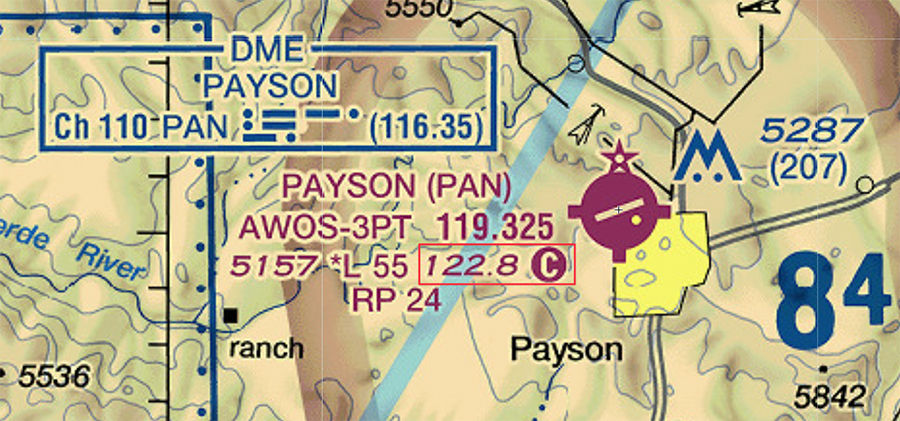
Chart Supplements (Airport/Facility Directory)
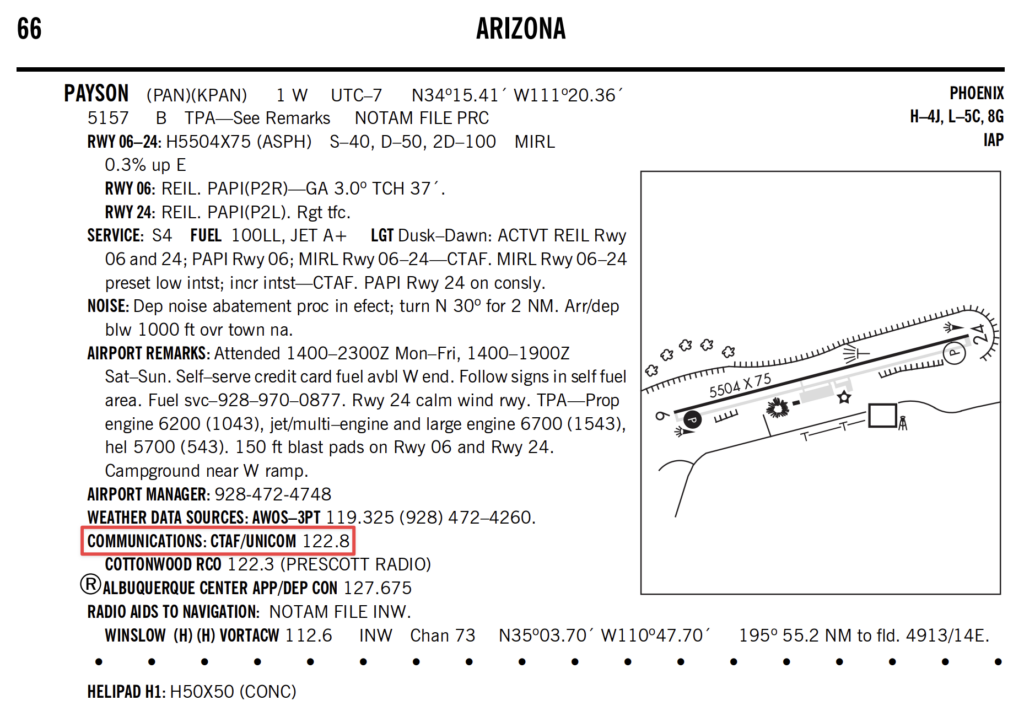
FAA Chart Supplement entries show CTAF, UNICOM, MULTICOM, and tower frequencies, with hours of operation and special notes.
Example:
CTAF/UNICOM: 122.8
TWR: 118.3 (0700-2100)
Flight Planning Apps and Websites
ForeFlight, Garmin Pilot, SkyVector, and similar platforms provide up-to-date frequency info, integrating NOTAMs and chart supplements for pre-flight planning and in-flight reference.
Special Features: Pilot-Controlled Lighting (PCL) via CTAF
Some airports allow pilots to activate lighting remotely by keying the mic on CTAF:
- 3 clicks: Low intensity
- 5 clicks: Medium intensity
- 7 clicks: High intensity
Lights stay on for about 15 minutes, re-key to extend. PCL systems control runway, taxiway, and sometimes approach lights. Instructions are found in the Chart Supplement or AIP.

Best Practices and Safety Tips for CTAF Use
- Monitor CTAF from 10 miles out
- Announce all required positions and intentions
- Use standard, clear phraseology, state airport name at start/end
- Listen before transmitting
- Keep transmissions brief in busy conditions
- Use CTAF for PCL as needed
- Review local procedures and NOTAMs
- Practice radio calls, especially as a student pilot
- Stay visually vigilant, radio is only one layer of safety
- Never use CTAF for non-essential conversation
- Double-check the correct frequency before transmitting
Glossary of Related Terms
- CTAF (Common Traffic Advisory Frequency): Radio frequency for self-announcing aircraft position/intention at non-towered/tower-closed airports.
- UNICOM (Universal Communications): Non-governmental ground station frequency for airport info/services, often doubles as CTAF.
- MULTICOM: Frequency (usually 122.9 MHz in the US) for airports with no control tower or UNICOM, used as CTAF.
- FSS (Flight Service Station): Facility providing weather briefings, flight planning, and assistance, not for traffic coordination.
- Pilot-Controlled Lighting (PCL): System allowing pilots to activate airport lighting via CTAF mic clicks.
Mastering CTAF use is essential for all pilots operating at non-towered or tower-closed airports. It enhances safety, situational awareness, and efficient airfield operations, making it one of general aviation’s most important communication tools.
Frequently Asked Questions
- What is CTAF used for?
- CTAF (Common Traffic Advisory Frequency) is used by pilots at non-towered or tower-closed airports to announce their positions and intentions. This communication helps all aircraft in the vicinity maintain situational awareness and coordinate safely without air traffic control.
- How do pilots know which CTAF frequency to use?
- Pilots find the correct CTAF frequency in official sources such as sectional charts, the FAA Chart Supplement, airport directories, or flight planning apps. The frequency may be listed as CTAF, UNICOM, or the tower frequency (when the tower is closed).
- What are common CTAF frequencies in the US?
- Common CTAF frequencies in the United States include 122.7, 122.8, 122.9, 123.0, and 123.05 MHz. The precise frequency for each airport is always published in official aviation documents and should be checked before flight.
- What is the difference between CTAF, UNICOM, and MULTICOM?
- CTAF is for pilot-to-pilot communication at non-towered airports. UNICOM is used for airport information or ground services and often doubles as CTAF. MULTICOM (typically 122.9 MHz in the US) is used at airports without UNICOM or a control tower, serving as the CTAF for traffic coordination.
- How is Pilot-Controlled Lighting (PCL) related to CTAF?
- Pilot-Controlled Lighting (PCL) allows pilots to activate airport lighting by keying their microphone on the CTAF frequency a specific number of times. This enables safe night operations at non-towered airports without ground staff present.
This is a reference entry. TarmacView provides drone inspection services and doesn't sell the equipment or materials described in this glossary.