What is Concrete Mix Design?
Concrete mix design is the systematic engineering process of determining the most economical and practical combination of locally available concrete ingredients, cementitious materials, fine and coarse aggregates, water, and chemical admixtures, to produce concrete that meets specified fresh and hardened property requirements with an acceptable level of reliability. The output of mix design is a set of batch weights per unit volume of concrete, expressed either as weights per cubic yard (lb/yd³) or per cubic meter (kg/m³), along with the corresponding mix proportions by weight (e.g., 1:2.5:3.0:0.45 for cement:fine aggregate:coarse aggregate:water).

Definition and Objectives of Concrete Mix Design
Concrete mix design is defined by ACI Committee 211 as the process of selecting proportions for concrete mixtures to achieve specified properties in both the fresh and hardened states while maintaining economy. The absolute volume method is the most widely accepted proportioning procedure for normal-density concrete, as documented in ACI PRC-211.1-22 (Selecting Proportions for Normal-Density and High-Density Concrete, Guide). This guide supersedes ACI 211.1-91 and represents the current state of practice in North American concrete proportioning.
The primary objectives of concrete mix design are fourfold. First, workability, the fresh concrete must be capable of being properly mixed, transported, placed, consolidated, and finished without segregation or excessive bleeding, with a slump appropriate for the construction method (typically 1–3 inches for pavement concrete, 3–5 inches for building elements, and up to 8 inches for pumpable concrete). Second, strength and durability, the hardened concrete must achieve the specified compressive or flexural strength at the designated age (typically 28 days) and must resist the anticipated exposure conditions including freeze-thaw cycles, sulfate attack, chloride ingress, alkali-silica reaction, and abrasion from traffic. Third, economy, the proportions should use the minimum cementitious content consistent with achieving the required properties, and should maximize the use of locally available aggregates while minimizing water content. Fourth, uniformity, the mix must be reproducible from batch to batch under normal production variations in materials, batching accuracy, and environmental conditions.
The required characteristics are determined by the intended application, exposure conditions, size and shape of structural elements, and construction methods. For airport pavements, the ICAO Aerodrome Design Manual Part 3 (Doc 9157) provides additional guidance on concrete quality requirements specific to runway, taxiway, and apron pavements subjected to aircraft loading. The manual emphasizes that pavement concrete must resist fuel and oil spillage, deicing chemical attack, and thermal shock from jet blast, in addition to structural load requirements.
ACI 211 Absolute Volume Method
The ACI 211 Absolute Volume Method is the standard proportioning procedure for normal-density concrete in the United States and many other countries. It is based on the fundamental principle that the sum of the absolute volumes of all concrete constituents, cement, supplementary cementitious materials (SCMs), fine aggregate, coarse aggregate, water, and air, must equal one unit volume of concrete (typically 1 cubic yard or 1 cubic meter). The absolute volume of each solid material is calculated by dividing its mass by its specific gravity multiplied by the density of water (62.4 lb/ft³ or 1000 kg/m³).
The procedure consists of eight sequential steps. Step 1: select the slump appropriate for the type of construction, based on ACI 211 tables or project specifications. Step 2: select the nominal maximum aggregate size (NMAS) considering member dimensions, reinforcement spacing, and slab thickness. For airport pavements, FAA P-501 permits NMAS up to 2 inches (50 mm) for the full depth and up to 1.5 inches (38 mm) for the top lift. Step 3: estimate the mixing water content and air content required for the selected slump and NMAS, using tabulated values for non-air-entrained and air-entrained concrete. Step 4: select the water-cementitious materials ratio (w/cm) based on the required strength and durability requirements, using either established strength-versus-w/cm relationships from field data or the ACI 211 table of approximate relationships. Step 5: calculate the cementitious materials content by dividing the estimated water content by the selected w/cm. Step 6: estimate the coarse aggregate content using the bulk volume factor from ACI 211 Table 6.3.3, which depends on NMAS and fineness modulus of fine aggregate. Step 7: estimate the fine aggregate content by subtracting the absolute volumes of all other constituents from the unit volume, then converting the remaining volume to weight using the fine aggregate specific gravity. Step 8: adjust batch weights for aggregate moisture conditions, the batch water must be reduced by the free moisture contributed by the aggregates, and aggregate weights must be increased to account for absorbed water not contributing to the water content.
ACI 211 provides worked examples for three common scenarios: Example 1, mixture proportioning using portland cement only (straight cement mix), Example 2, mixture proportioning of a binary mixture containing fly ash, Example 3, mixture proportioning using a cementitious efficiency factor (k-value approach) to account for the relative contribution of SCMs to strength. The 2022 edition of ACI PRC-211.1 also includes a fourth example using target paste volume, reflecting modern trends toward performance-based specification and volume-based proportioning rather than traditional weight-based methods.
The absolute volume method produces a first approximation of mixture proportions that must be verified through trial batching. The ACI guide explicitly states that proportions calculated by any method should always be considered provisional, subject to revision based on trial batch results. The method is not applicable without modification to lightweight aggregate concrete, pervious concrete, self-consolidating concrete, or roller-compacted concrete, each of which has its own dedicated ACI guide for proportioning.
Water-Cement Ratio Selection for Strength and Durability
The water-cementitious materials ratio (w/cm) is the single most important parameter in concrete mix design because it governs both strength and durability of the hardened concrete. Abrams Law, formulated by Duff Abrams in 1918, states that for given cement and aggregate materials, the compressive strength of properly compacted concrete is inversely proportional to the water-cement ratio. Mathematically, this relationship is expressed as: f’c = A / B^(w/c), where f’c is the compressive strength, A and B are empirical constants, and w/c is the water-cement ratio by mass. For typical portland cement concrete, a reduction in w/cm from 0.50 to 0.40 can increase 28-day compressive strength from approximately 4,000 psi to 5,500 psi.
The selection of w/cm involves considering both strength requirements and durability exposure classes simultaneously. The controlling w/cm is the lowest value required to satisfy all applicable criteria. For strength, the target w/cm is determined from the required average compressive strength (f’cr), which must exceed the specified compressive strength (f’c) by a margin that accounts for expected variability in production and testing. ACI 318 requires that f’cr = f’c + 1.34 × s (where s is the standard deviation of test results) when sufficient field data are available, or alternatively f’cr = f’c + 2,500 psi when f’c ≤ 5,000 psi and no field records exist. The relationship between w/cm and strength is established from Table 9-3 of ACI 211.1 or from Fig. 9-2 of the PCA Design and Control of Concrete Mixtures manual.
For durability, maximum w/cm limits are mandated by building codes and project specifications based on exposure conditions. ACI 318 Table 19.3.2.1 specifies the following maximum w/cm and minimum f’c requirements: for concrete exposed to freezing and thawing in a moist condition or to deicing chemicals, maximum w/cm of 0.45 and minimum f’c of 4,500 psi, for concrete in continuous contact with water and requiring low permeability, maximum w/cm of 0.50 and minimum f’c of 4,000 psi, for concrete exposed to chlorides from deicing salts, salt water, brackish water, or seawater, maximum w/cm of 0.40 and minimum f’c of 5,000 psi. For sulfate exposure, the requirements become more stringent as sulfate concentration increases, with very severe sulfate conditions (over 10,000 ppm SO₄) requiring a maximum w/cm of 0.40 and Type V or HS cement.
For airport pavement concrete under FAA P-501, the primary strength criterion is flexural strength (modulus of rupture) at 28 days, typically specified at 650–700 psi for airport pavements, rather than the compressive strength used for building concrete. The w/cm for airport concrete is selected to achieve the target flexural strength while also satisfying durability requirements for freeze-thaw exposure. FAA P-501 Section 501-5.2 requires that the concrete be designed for a 28-day flexural strength that meets or exceeds the acceptance criteria specified in the project documents, with statistical quality control applied to production results.
Aggregate Proportioning
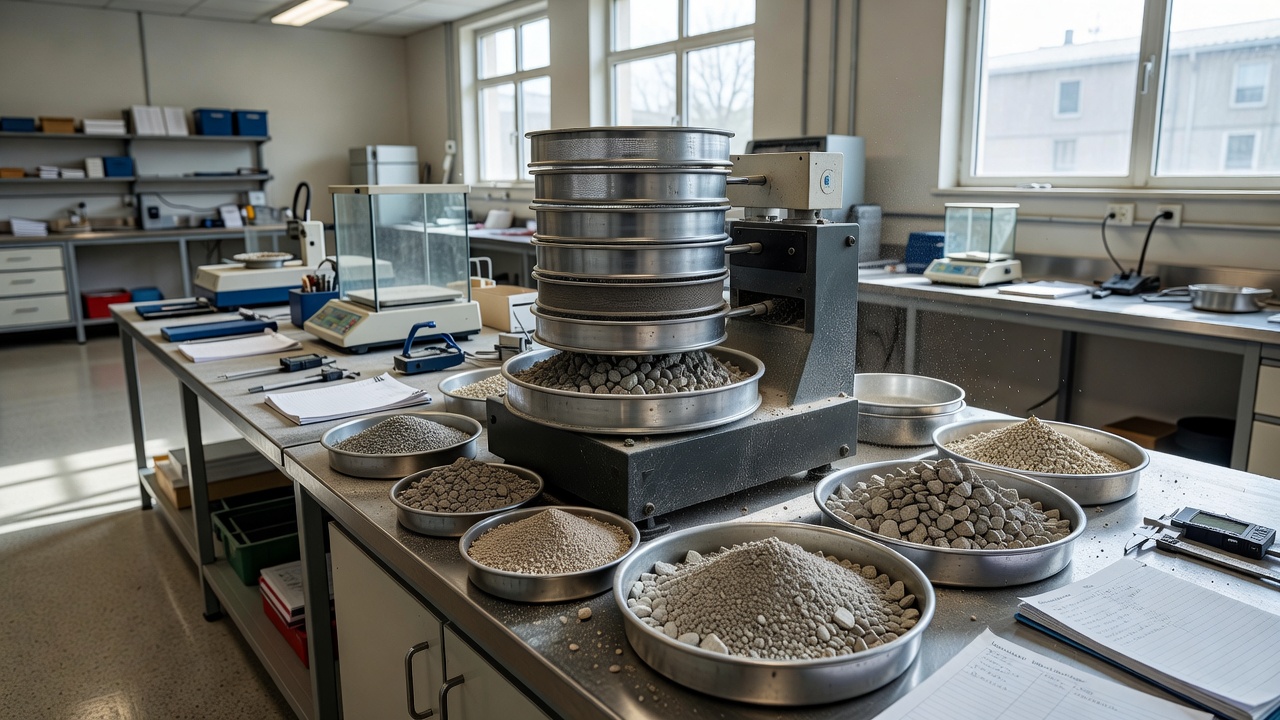
Aggregate proportioning involves determining the optimal blend of fine and coarse aggregates to produce concrete that is workable, economical, and durable. Aggregates occupy between 60% and 80% of the total volume of concrete, making their selection and proportioning critical to mix performance. The two key characteristics that govern aggregate proportioning are grading (particle size distribution) and particle shape and surface texture.
The fineness modulus (FM) of fine aggregate is a single-number index of the fineness of the aggregate, calculated as the sum of the cumulative percentages retained on the standard sieves (No. 4, No. 8, No. 16, No. 30, No. 50, No. 100) divided by 100. Typical FM values for concrete sand range from 2.3 to 3.1. A lower FM indicates finer sand, which requires more water for a given workability but produces a creamier mix. A higher FM indicates coarser sand, which reduces water demand but may produce harsher, less workable concrete. The ACI 211 method uses FM to determine the bulk volume of coarse aggregate per unit volume of concrete, a lower FM (finer sand) requires a higher bulk volume of coarse aggregate to fill the voids, while a higher FM (coarser sand) requires less coarse aggregate.
The combined aggregate grading, the gradation of the total aggregate blend, is increasingly recognized as critical to concrete performance. The Shilstone method (also known as the “Coarseness Factor Chart Method”) evaluates the combined grading of fine and coarse aggregates using two parameters: the coarseness factor (CF) and the workability factor (WF). The CF is the percentage of the total aggregate passing the 3/8-inch sieve expressed as a fraction of the material retained on the No. 8 sieve. The WF is the percentage of total aggregate passing the No. 8 sieve. These two parameters are plotted on a chart divided into zones representing different workability characteristics. Mixes falling in the central zone exhibit good workability and resistance to segregation, while mixes in the outer zones may be prone to segregation, harshness, or excessive water demand.
The coarse aggregate for concrete must be graded up to the largest nominal size practical under job conditions. For airport pavements, FAA P-501 allows coarse aggregate gradation per ASTM C 33 in several size groups: Size No. 3 (1½ to ¾ inch), Size No. 57 (1 inch to No. 4), and Size No. 67 (¾ inch to No. 4), with the note that when NMAS exceeds 1 inch, aggregates shall be furnished in two size groups. The specification also imposes a maximum 8% by weight of flat or elongated pieces (ratio exceeding 5:1 per ASTM D 4791), which is stricter than typical building concrete requirements.
Admixture Selection and Dosage
Chemical admixtures and supplementary cementitious materials (SCMs) are essential components of modern concrete mix design, present in the majority of commercially produced concrete. ACI PRC-211.1-22 notes that chemical admixtures are frequently used to accelerate or retard setting time, improve workability, reduce water requirements, or entrain air, while SCMs such as fly ash, slag cement, and silica fume improve strength, decrease permeability, increase resistance to alkali-aggregate reaction and sulfate attack, and reduce heat of hydration.
Air-entraining admixtures (AEA) are mandatory in concrete exposed to freezing and thawing in a moist condition. They introduce microscopic air bubbles (typically 20–300 µm in diameter) into the cement paste, providing space for water to expand when it freezes without damaging the concrete. The required total air content depends on NMAS and exposure severity: for ¾-inch aggregate, the target air content is 6.0% ± 1.5% by volume, for 1½-inch aggregate, 5.0% ± 1.5%, and for 3-inch aggregate, 4.0% ± 1.5%. Air content is measured by the pressure method (ASTM C 231) or the volumetric method (ASTM C 173). The dosage of AEA is highly sensitive to material variability and must be determined by trial batching rather than by formula.
Water-reducing admixtures (WRAs) reduce the water content of concrete for a given workability, allowing lower w/cm and higher strength without additional cement. High-range water-reducing admixtures (HRWRAs), commonly called superplasticizers, can reduce water content by 12% to 30%, enabling the production of high-strength concrete (f’c > 8,000 psi) and self-consolidating concrete. WRAs are classified by ASTM C 494 into Types A (water-reducing), D (water-reducing and retarding), E (water-reducing and accelerating), F (high-range water-reducing), and G (high-range water-reducing and retarding). The dosage of superplasticizer typically ranges from 4 to 20 fluid ounces per 100 pounds of cementitious material, with overdosage causing excessive retardation, segregation, or abnormal setting behavior.
Supplementary cementitious materials are incorporated into mix designs to replace a portion of the portland cement, typically 15–25% by weight for fly ash (Class F or C per ASTM C 618), 25–50% for ground granulated blast-furnace slag (Grade 100 or 120 per ASTM C 989), and 5–10% for silica fume (per ASTM C 1240). The SCM replacement rate affects water demand, setting time, strength development rate, and durability properties. For FAA P-501 airport concrete, fly ash is permitted subject to ASTM C 618 requirements with a loss on ignition maximum of less than 6% for Class F or N, and blast furnace slag must meet ASTM C 989 Grade 100 or 120. The FAA specification also notes that supplementary optional chemical and physical properties from Tables 1A and 2A of ASTM C 618 shall apply when fly ash is used with reactive aggregates.
Trial Batch Adjustment
Trial batching is the laboratory or field validation step that follows theoretical mix design calculations. No matter how carefully proportions are computed, the calculated mix is only a first approximation that must be verified by producing a small batch (typically 2–5 ft³ in the laboratory, or a full truckload in the field), testing its properties, and adjusting as necessary. ACI PRC-211.1-22 emphasizes that trial batch procedures are essential because assumptions about material properties, aggregate specific gravity, absorption, moisture content, cement fineness, admixture effectiveness, are never precisely equal to actual values, and the interactions between materials cannot be predicted solely by calculation.
The trial batch test program for a proposed mix design includes measuring: slump per ASTM C 143 (the standard 12-inch cone test) to verify workability, air content per ASTM C 231 (pressure method) or C 173 (volumetric method) for air-entrained concrete, unit weight per ASTM C 138 to calculate actual yield, temperature per ASTM C 1064 to verify it is within specification limits (typically 50–90°F), and compressive strength at 3, 7, and 28 days per ASTM C 39 (for building concrete) or flexural strength at 7 and 28 days per ASTM C 78 (center-point loading) or ASTM C 293 (third-point loading) for pavement concrete.
Yield correction is one of the most critical trial batch adjustments. The actual volume of concrete produced (the yield) rarely equals the design volume due to differences between assumed and actual air content, specific gravities, and moisture conditions. The yield is calculated by dividing the total batch weight by the measured unit weight. If the actual yield differs from the design yield by more than 1–2%, all batch weights must be adjusted proportionally to restore the target volume. Relative yield (R_Y) is defined as the ratio of the actual batch volume to the design volume, expressed as a percentage. A relative yield below 100% means the batch is short (more concrete needed per yard), while a yield above 100% means the batch is over-yielding.
Moisture adjustment must account for the fact that aggregates are never in a perfectly saturated surface-dry (SSD) condition at the time of batching. The free moisture contributed by aggregates must be subtracted from the batch water addition, and the aggregate weights must be increased to compensate for the water that is not part of the mix. The batch-ready moisture-adjusted water weight (w_batched) equals the design water content minus the total free water contributed by both fine and coarse aggregates. Failure to perform moisture adjustment can result in an incorrect w/cm, leading to either higher or lower strength than designed.
Strength adjustment may be required if the measured 28-day strength deviates from the target. The common adjustment is to modify the w/cm, for a 500 psi strength shortfall at a w/cm of 0.50, reducing the w/cm to approximately 0.47 may provide the required strength increase. However, multiple trial batches at different w/cm values are recommended to establish a reliable strength-versus-w/cm relationship for the specific materials being used.
Mix Design for Airport Concrete (FAA P-501)
FAA P-501 (Portland Cement Concrete Pavement) is the governing specification for airport pavement concrete in the United States, published as Item P-501 in FAA Advisory Circular 150/5370-10 (Standard Specifications for Construction of Airports). The specification establishes requirements for concrete materials, proportioning, production, placement, finishing, curing, and acceptance for airport runways, taxiways, and aprons. Internationally, ICAO Doc 9157 Aerodrome Design Manual Part 3 provides complementary guidance on pavement concrete quality, emphasizing that pavement bearing strength and durability depend fundamentally on concrete quality.
Airport pavement mix design differs from building concrete mix design in several critical respects. Flexural strength (modulus of rupture) is the primary acceptance criterion, not compressive strength. FAA P-501 Section 501-5.2 requires concrete to achieve a 28-day flexural strength meeting specified acceptance criteria, with statistical quality control applied to production results. The typical target flexural strength for airport pavements is 650–700 psi at 28 days, though this varies by project and pavement design. The relationship between flexural and compressive strength is approximately f_r = 7.5 × sqrt(f’c) (in psi), meaning a 650 psi flexural strength corresponds to roughly 5,500–6,000 psi compressive strength.
Aggregate requirements under FAA P-501 are more stringent than for typical construction. Coarse aggregate must meet flat and elongated particle limits (maximum 8% at 5:1 ratio per ASTM D 4791), and when NMAS exceeds 1 inch, aggregates must be furnished in two size groups to ensure proper gradation control. The specification includes provision for D-cracking evaluation, in areas affected by D-cracking, the contractor must provide certification that the aggregate does not have a history of D-cracking, or the aggregate must achieve a durability factor of 95% or greater per ASTM C 666 (rapid freezing and thawing test). Fine aggregate must conform to ASTM C 33 gradation with specific sieve limits.
Air entrainment is mandatory for all airport pavement concrete exposed to freezing temperatures. The required total air content for FAA P-501 concrete is typically 4.5–6.5% by volume, depending on NMAS. The spacing factor of the air-void system should not exceed 0.008 inches (200 µm) per ASTM C 457, though this is typically a performance verification rather than a routine acceptance criterion.
Cement and cementitious materials under FAA P-501 must conform to ASTM C 150 (Types I, II, III, or IV) or ASTM C 595 (Types IP, IS, S, I(PM)). Low-alkali cements (less than 0.6% total equivalent alkalinity Na₂O + 0.658 × K₂O) are specified when reactive aggregates are present. Fly ash (ASTM C 618) and ground blast furnace slag (ASTM C 989 Grade 100 or 120) are permitted as SCMs with specific quality limits. The specification requires that all cementitious materials meet suitable criteria for deleterious alkali-aggregate reaction based on service records or testing per ASTM C 227, C 295, C 289, or D 1260.

Statistical Quality Control of Mix
Statistical quality control (SQC) of concrete production is an integral part of mix design implementation, particularly for airport pavements where the consequences of concrete failure are severe. The FAA P-501 specification requires statistical acceptance criteria based on the moving average of flexural strength test results, typically evaluated in sets of three consecutive beams. The statistical approach recognizes that even the best-designed mix will exhibit batch-to-batch variability due to normal variations in materials, batching accuracy, mixing efficiency, temperature, curing, and testing.
The key SQC parameters for concrete mix control are: mean strength, the average of all test results within a defined evaluation period, standard deviation (s), a measure of the dispersion of individual test results about the mean, calculated as the root-mean-square of deviations, coefficient of variation (COV), the ratio of standard deviation to mean, expressed as a percentage, which normalizes variability for different strength levels, moving average, typically the average of the last three consecutive test results, used for acceptance decisions in FAA P-501, and required average strength (f’cr), the target strength for mix design, set above the specified strength (f’c) by a margin of 1.34 × s to ensure that not more than 1 in 100 individual tests falls below f’c.
For airport pavement concrete, ACI 214R (Evaluation of Results of Tests Used to Determine the Strength of Concrete) provides the framework for interpreting variability. Typical within-test variability (variation between companion cylinders from the same sample) should be less than 3.0% COV for properly conducted testing. Between-test variability (batch-to-batch variation) for a well-controlled operation should be less than 10–12% COV. When the COV exceeds 15%, investigation and corrective action are warranted.
The control chart is the primary SQC tool for monitoring concrete production. Individual strength results are plotted against the upper and lower control limits, typically set at ±3 standard deviations from the mean. Trends, such as three consecutive results increasing or decreasing, two results outside ±2 standard deviations, or any result outside the specified strength, trigger investigation. The moving average chart (typically averages of 3 or 5 consecutive tests) smooths day-to-day variation and reveals longer-term changes in concrete quality.
Lack-of-fit between the approved mix design and production results is the most common cause of concrete acceptance failures. When production concrete consistently underperforms compared to trial batch concrete, the causes may include: differences in cement source or fineness between trial and production, changes in aggregate moisture content not compensated by batch plant corrections, variations in mixer efficiency (truck mixer vs. central mixer), differences in ambient temperature affecting setting and curing, or errors in batching accuracy. The forensic investigation of such discrepancies involves revisiting the mix design assumptions and verifying the trial batch procedures.
Mix Design Documentation
Mix design documentation is the formal record of the concrete proportioning process, including all assumptions, calculations, material certifications, trial batch results, and approval signatures. Proper documentation is essential for quality assurance, regulatory compliance, and forensic investigation of concrete performance issues. FAA P-501 requires that the contractor submit a complete mix design to the engineer for approval prior to construction, including material source certifications, gradation test reports, and trial batch test results.
A complete mix design submittal should include: mix design number and date, project name and location, specification reference (e.g., FAA P-501, ACI 318, or project-specific requirements), design compressive or flexural strength (f’c or f_r), target slump and allowable range, target air content and allowable range, maximum w/cm, cementitious material type and source, with ASTM designation, SCM type and source, replacement percentage by weight, and ASTM designation, fine aggregate source, specific gravity (SSD basis), absorption, fineness modulus, and moisture condition at time of design, coarse aggregate source, specific gravity (SSD basis), absorption, nominal maximum size, dry-rodded unit weight, and moisture condition, chemical admixture type, brand, dosage rate (oz/cwt or fl oz/100 lb cementitious), and ASTM classification, batch weights per cubic yard for all ingredients at SSD condition and at actual moisture condition, water content including water from admixtures and ice, material certification reports including cement mill certificates, aggregate test reports, and admixture certificates of compliance, trial batch test results including slump, air content, unit weight, yield, temperature, strength at all test ages, and any adjustments made, and signature of the qualified concrete technologist or engineer responsible for the design.
For airport projects under FAA P-501, the mix design must also demonstrate that aggregates are non-reactive with cement alkalies, based on service records or testing per the specified ASTM methods. The documentation should include the petrographic analysis (ASTM C 295), chemical test (ASTM C 289), or mortar-bar expansion test (ASTM C 227 or D 1260) results as required by the engineer.
Mix Design and Inspection, Forensic Comparison
The relationship between approved mix design and field inspection is critical for forensic evaluation of concrete pavement performance. When distresses such as scaling, spalling, cracking, or surface deterioration are observed during condition surveys, the mix design provides the baseline against which in-place concrete is compared to determine whether material deficiencies contributed to the observed distress.
The forensic comparison of concrete against its approved mix design involves several analyses. Water-cement ratio verification, when concrete shows low strength or high porosity, cores are tested for compressive strength and compared against the strength-versus-w/cm relationship established during mix design. A significantly lower strength than expected suggests either a higher w/cm than specified (possibly from uncontrolled water addition at the jobsite) or inadequate curing. Air content verification, for concrete exposed to freezing and thawing, petrographic analysis (ASTM C 457) measures the air-void system parameters including total air content, specific surface (mm²/mm³), and spacing factor (mm). A spacing factor exceeding 0.008 inches (0.20 mm) indicates inadequate air entrainment and explains freeze-thaw deterioration. Aggregate gradation verification, sieve analysis of aggregate extracted from hardened concrete (by dissolving the cement paste with acid) verifies whether the in-place aggregate grading matches the approved mix design. Deviations in fineness modulus or coarse aggregate factor may indicate aggregate segregation during placement or changes in aggregate supply. Cement content verification, chemical analysis of hardened concrete for CaO or SiO₂ content can estimate actual cementitious content and verify it against the design quantity. Unit weight and yield verification, cores measured for unit weight (density) can identify excessive entrained or entrapped air, honeycombing, or segregation.
For airport pavement inspection under ICAO Annex 14 and FAA PAVEAIR (the FAA pavement management system), surface distresses such as joint spalling, corner breaks, and scaling are evaluated in the context of mix design adequacy. A pavement exhibiting extensive joint deterioration may indicate poor aggregate quality (susceptibility to D-cracking), inadequate air entrainment, or excessive w/cm at the joints due to bleed water accumulation during construction. The mix design provides the baseline for these forensic determinations.
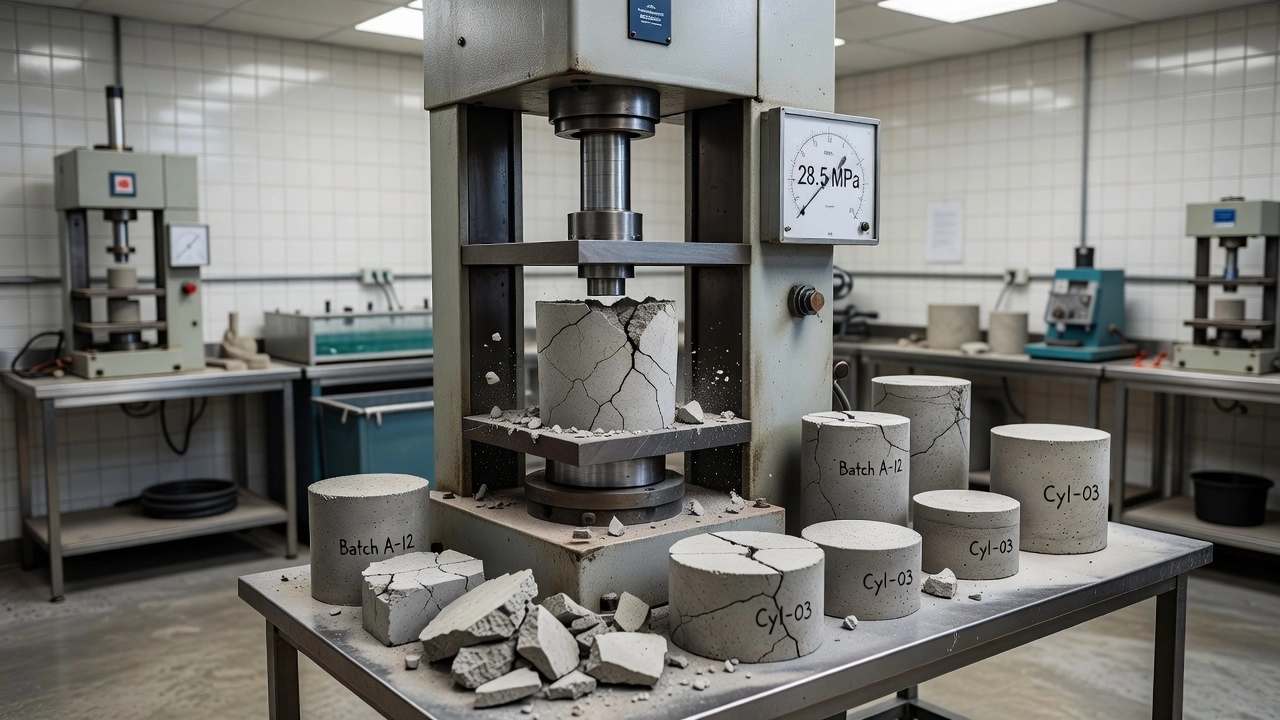
Key relationships between mix design parameters and field-observed distresses include: high w/cm (> 0.50) causally linked to reduced strength, increased permeability, scaling from freeze-thaw cycles, surface dusting, and reduced abrasion resistance, low cementitious content (< 500 lb/yd³) related to poor finishability, increased bleed water, weakened paste-aggregate bond, and increased shrinkage cracking, inadequate air entrainment (< 4.0% total air for 1½-inch aggregate) resulting in surface scaling, paste deterioration, and joint deterioration from freeze-thaw, high flat and elongated particle content (> 8%) producing harsh mixes with poor consolidation, increased void content, and reduced flexural strength in pavements, aggregate reactivity manifesting as map cracking, popouts, and joint closure associated with alkali-silica reaction (ASR), and excess fines in fine aggregate (< 2% passing No. 200 sieve) relating to increased water demand and drying shrinkage.
The TarmacView platform integrates mix design data with automated pavement condition inspection, enabling direct correlation between material specifications and observed performance. By linking mix design parameters to distress types and severities identified through AI-powered image analysis, inspection teams can rapidly identify whether material deficiencies are driving pavement deterioration and prioritize corrective actions accordingly.
Frequently Asked Questions
- What is the most widely used concrete mix design method?
- The ACI 211 Absolute Volume Method is the most widely used concrete mix design method in North America. It calculates proportions based on the absolute volume occupied by each constituent (cement, water, aggregates, air) in a unit volume of concrete. The method involves eight sequential steps: selecting slump, selecting nominal maximum aggregate size, estimating water and air content, selecting water-cement ratio, calculating cement content, estimating coarse aggregate content, estimating fine aggregate content, and adjusting for moisture conditions.
- What is the difference between mix design and mix proportioning?
- Mix design refers to the process of determining required and specifiable characteristics of a concrete mixture, selecting the target strength, durability requirements, workability, and material constraints based on project specifications and exposure conditions. Mix proportioning is the subsequent calculation step that determines the actual quantities (weights or volumes) of each ingredient to achieve those specified characteristics. In practice, the terms are used interchangeably, but the distinction matters: design sets the targets, proportioning computes the batch weights.
- How does FAA P-501 differ from standard concrete mix design?
- FAA P-501 (Portland Cement Concrete Pavement) is the specification for airport pavement concrete in the United States. It differs from building concrete mix design in several critical ways: it specifies flexural strength (modulus of rupture) rather than compressive strength as the primary acceptance criterion, requires larger nominal maximum aggregate sizes (up to 2 inches), mandates air entrainment for freeze-thaw resistance, imposes strict flat and elongated particle limits on coarse aggregates (maximum 8% at 5:1 ratio), requires specific aggregate gradation bands, and enforces statistical quality acceptance criteria based on moving average of flexural strength results.
- Why is trial batching necessary in mix design?
- Trial batching is necessary because theoretical calculations from mix design methods are first approximations only. Actual material properties, aggregate absorption, specific gravity, moisture content, cement fineness, admixture effectiveness, vary from assumed values. The trial batch verifies that the calculated proportions actually produce concrete with the target slump, air content, unit weight, and strength. Adjustments are then made for yield correction (actual volume vs. designed volume), moisture compensation (free water on aggregates), and strength optimization. Without trial batching, production concrete could fail to meet specification requirements.