What is Controlled Airspace?
Controlled Airspace
Controlled airspace is the backbone of modern aviation, providing the structure and rules necessary for safe and efficient movement of thousands of aircraft every day. This article explores the definition, regulatory framework, differences from uncontrolled airspace, operational requirements, and the unique characteristics of each class of controlled airspace.
Definition and Overview
Controlled airspace refers to a volume of air where air traffic control (ATC) provides services and applies specific operational rules. It’s designed to minimize collision risks and organize air traffic, especially in areas with high traffic density or complex operations. The International Civil Aviation Organization (ICAO) and national authorities such as the FAA in the U.S. or EASA in Europe define and regulate controlled airspace to ensure harmonized, international standards.
Controlled airspace includes all altitudes, from ground level near airports to high-altitude enroute corridors. The main classes, A, B, C, D, and E, are based on factors like traffic density, proximity to airports, and the type of ATC service provided. Each class supports different operational needs, balancing safety, efficiency, and accessibility for commercial airlines, military, and general aviation.
Regulatory Framework
The regulatory backbone for controlled airspace is established internationally by ICAO and locally by national aviation authorities. ICAO’s Annex 11 and Doc 4444 provide the foundation for airspace classification and ATC procedures, adopted with local adaptation. In the U.S., Title 14 CFR Parts 71 and 91, as well as the Aeronautical Information Manual (AIM), detail the rules and requirements for controlled airspace.
The European Union Aviation Safety Agency (EASA) and Eurocontrol play similar roles in Europe, adapting ICAO’s framework to regional needs. Each country’s Aeronautical Information Publication (AIP) provides the official, current details for pilots and operators.
Controlled airspace design, its lateral and vertical boundaries, operational hours, and procedures, is continually updated to reflect evolving technology, airport expansions, and changing traffic patterns.
Controlled vs. Uncontrolled Airspace
The key distinction in airspace management is between controlled and uncontrolled airspace:
- Controlled airspace (Classes A, B, C, D, E): ATC services are provided, specific flight rules, equipment, and communication requirements apply.
- Uncontrolled airspace (Class G): No ATC services, pilots are responsible for see-and-avoid and have fewer requirements.
Controlled airspace is where the highest safety standards apply, especially near busy airports and high-altitude corridors. Uncontrolled airspace typically exists at low altitudes or in remote areas with low traffic density. Aeronautical charts clearly depict the boundaries and requirements for both types, allowing pilots to plan and conduct flights safely.
Classes of Controlled Airspace
Class A Airspace
Class A covers high-altitude enroute corridors, typically from 18,000 feet MSL up to and including FL600 (60,000 feet). In the U.S., it includes airspace over the contiguous states and Alaska, extending 12 nautical miles offshore.
- Operations: Only IFR flights are permitted, all aircraft require ATC clearance.
- Equipment: Two-way radio, Mode C transponder, ADS-B Out, and (above FL240) DME or RNAV.
- Separation: ATC provides positive separation for all aircraft.
- Depiction: Not shown on VFR charts, overlays all lower airspace.
Class B Airspace
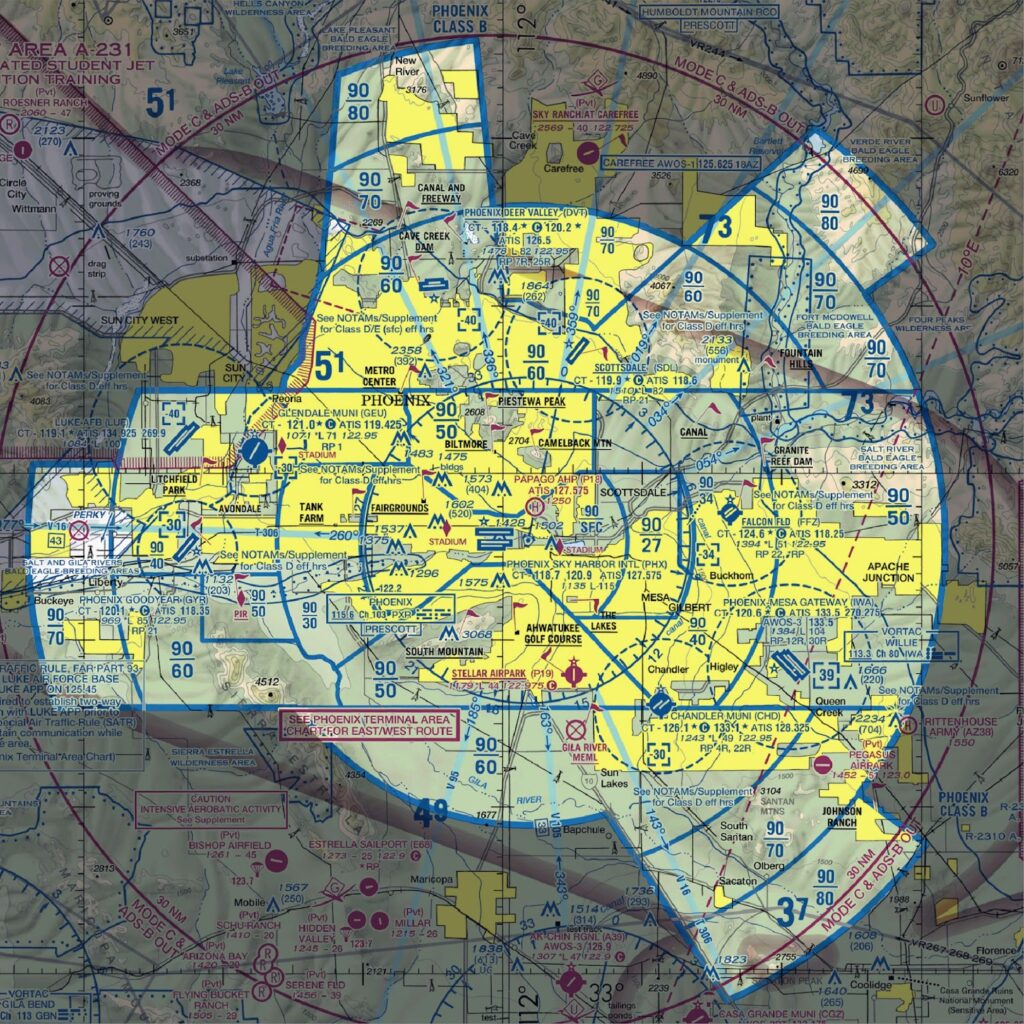
Class B surrounds the nation’s busiest airports, usually extending from the surface up to 10,000 feet MSL in a multi-layered “wedding cake” configuration.
- Entry: Explicit ATC clearance required for all flights (IFR and VFR).
- Equipment: Two-way radio, Mode C transponder, ADS-B Out, private pilot certificate or specific student endorsement.
- Services: ATC provides separation for all aircraft.
- Weather Minimums: 3 statute miles visibility, clear of clouds.
- Depiction: Solid blue lines on charts, sector altitude blocks and Mode C veil (solid magenta circle, 30 nm radius).
Class C Airspace
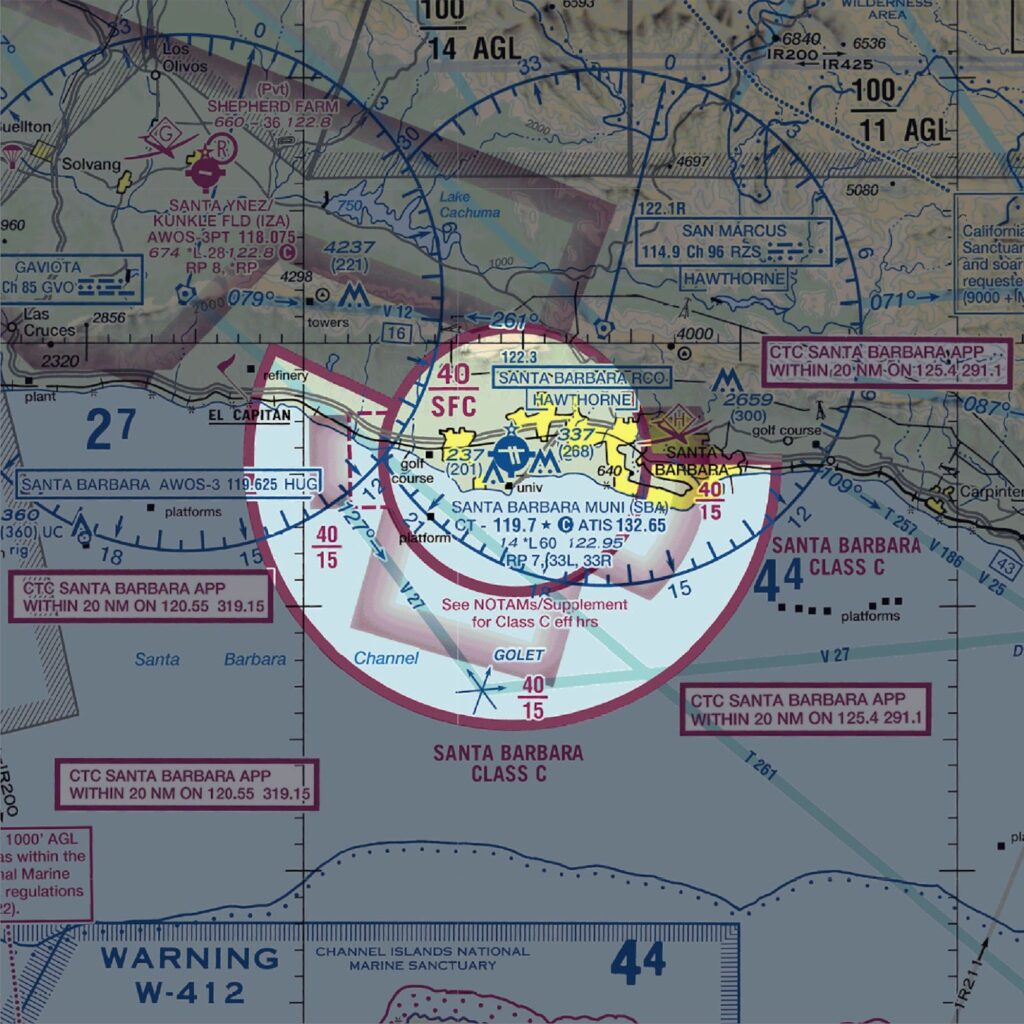
Class C surrounds busy regional airports with significant commercial and general aviation.
- Typical Structure: Two tiers, inner core (surface to 4,000 feet AGL, 5 nm radius), outer shelf (1,200 to 4,000 feet AGL, 10 nm radius).
- Entry: Two-way radio communication with ATC before entry, explicit clearance not required.
- Equipment: Two-way radio, Mode C transponder, ADS-B Out.
- Services: ATC separates IFR and VFR/IFR, but not VFR/VFR.
- Weather Minimums: 3 statute miles visibility, 1,000’ above/500’ below/2,000’ horizontal from clouds.
- Depiction: Solid magenta lines, sector altitudes and frequencies labeled.
Class D Airspace
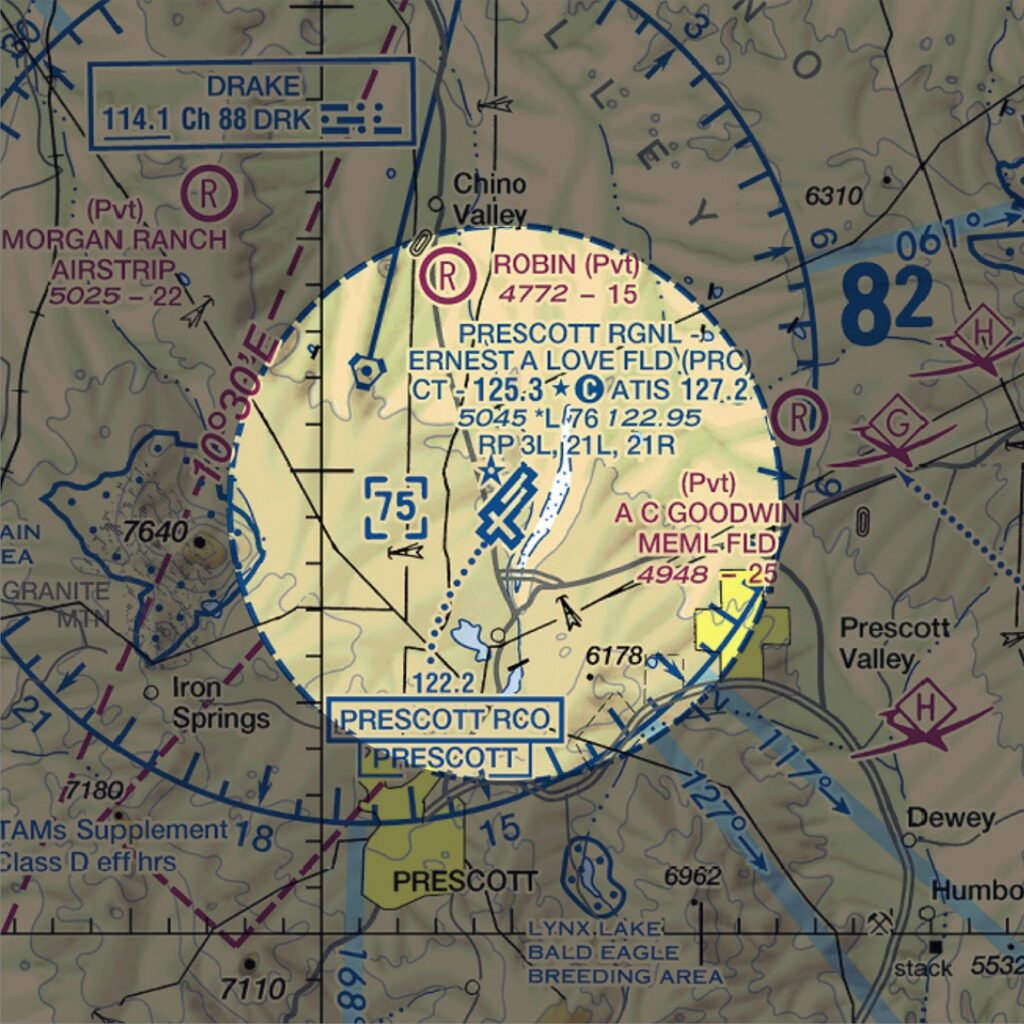
Class D covers airports with an operational control tower and lower traffic complexity.
- Typical Structure: Surface to 2,500 feet AGL, 3–5 nm radius.
- Entry: Two-way radio communication with tower before entering.
- Equipment: Two-way radio, transponder only if within a Mode C veil.
- Services: ATC separates IFR only, VFR pilots get advisories as workload permits.
- Weather Minimums: 3 statute miles visibility, 1,000’ above/500’ below/2,000’ horizontal from clouds.
- Depiction: Dashed blue lines, ceiling altitude marked in a box.
Class E Airspace
Class E is controlled airspace not classified as A, B, C, or D. It covers most enroute corridors and transition areas.
- Typical Structure: Begins at surface, 700 ft, 1,200 ft, or (rarely) 14,500 ft AGL, up to (not including) 18,000 ft MSL. Above FL600, airspace is also Class E.
- Entry: No specific requirements for VFR below 10,000 ft MSL, IFR flights require clearance.
- Equipment: Mode C transponder and ADS-B Out above 10,000 ft MSL.
- Weather Minimums: 3 sm visibility, 1,000’ above/500’ below/2,000’ horizontal (below 10,000 ft MSL), 5 sm and 1,000’ vertical/1 sm horizontal (above 10,000 ft).
- Depiction: Shaded magenta (floor at 700 ft), shaded blue (1,200 ft), dashed magenta (surface-based).
Operational Requirements
Entry Procedures
- Class A: IFR flight plan and clearance required.
- Class B: Explicit ATC clearance for all.
- Class C/D: Establish two-way radio contact before entry.
- Class E: No requirements for VFR below 10,000 ft MSL, IFR needs clearance.
Equipment & Communication
- Mode C transponder and ADS-B Out: Required in A, B, C, and above 10,000 ft MSL in E.
- Two-way radio: Required in all but Class E (VFR below 10,000 ft MSL).
- ATC communication: Mandatory in A, B, C, D, not for VFR in E.
ATC Services
- Class A/B: Full ATC separation for all.
- Class C: IFR and IFR/VFR separation.
- Class D: IFR separation, VFR advisories if possible.
- Class E: IFR separation only.
Pilot Responsibilities
Pilots must comply with ATC instructions unless an emergency dictates otherwise. VFR pilots must remain vigilant and avoid other aircraft, even when receiving advisories.
Weather Minimums
- Class A: No VFR, governed by instrument procedures.
- Class B: 3 sm visibility, clear of clouds.
- Class C/D/E (below 10,000 ft MSL): 3 sm, 1,000’ above/500’ below/2,000’ horizontal.
- Class E (at/above 10,000 ft MSL): 5 sm, 1,000’ above/1,000’ below/1 sm horizontal.
Noncompliance can lead to regulatory action and endanger safety.
Chart Depictions & Visual References
Aeronautical charts are the pilot’s primary tool for identifying controlled airspace. Standardized symbology includes:
- Class A: Not depicted.
- Class B: Solid blue lines, sector altitude blocks, Mode C veil.
- Class C: Solid magenta lines, sector altitudes.
- Class D: Dashed blue lines, ceiling altitude box.
- Class E: Shaded magenta/blue, dashed magenta for surface-based.
Conclusion
Controlled airspace is the foundation of safe, efficient aviation operations worldwide. Its structure, rules, and ATC services protect lives and property and enable the growth of global air travel and commerce. Pilots, controllers, and regulators must all understand and adhere to the requirements of each class to maintain the integrity of the airspace system.
For more detailed operational guidance, refer to your national Aeronautical Information Publication (AIP), the Aeronautical Information Manual (AIM), and ICAO documentation.
Frequently Asked Questions
- What is controlled airspace?
- Controlled airspace is a defined region over which air traffic control (ATC) services are provided according to airspace classifications. It helps organize and separate aircraft to ensure safety and efficiency, and it encompasses airspace classes A, B, C, D, and E.
- What are the main classes of controlled airspace?
- The main classes are: Class A (high-altitude, IFR only), Class B (around major airports, strict entry), Class C (regional airports with moderate traffic), Class D (small towered airports), and Class E (enroute and transition airspace not otherwise designated). Each has unique requirements and services.
- How does controlled airspace differ from uncontrolled airspace?
- Controlled airspace provides ATC services and requires compliance with specific rules and equipment. Uncontrolled airspace (Class G) has no ATC services, pilots rely on see-and-avoid and have fewer equipment/communication requirements.
- What equipment is required in controlled airspace?
- Requirements vary by class but generally include a two-way radio, Mode C transponder, and ADS-B Out in Classes A, B, and C, and above 10,000 feet MSL in Class E. Some airspaces have additional equipment mandates for entry.
- Are weather minimums different in controlled airspace?
- Yes. Classes B, C, D, and E have specific visibility and cloud clearance minimums for VFR flight to ensure safety. For example, Class B requires 3 miles visibility and clear of clouds, while Class E above 10,000 feet MSL requires 5 miles visibility and 1,000 feet vertical and 1 mile horizontal cloud clearance.
- How is controlled airspace depicted on aviation charts?
- Class B uses solid blue lines, Class C solid magenta, Class D dashed blue, and Class E shaded magenta or blue, or dashed magenta for surface-based areas. Each includes altitude and frequency information to aid pilot navigation and compliance.
This is a reference entry. TarmacView provides drone inspection services and doesn't sell the equipment or materials described in this glossary.