What is a Cover Meter (Pachometer)?
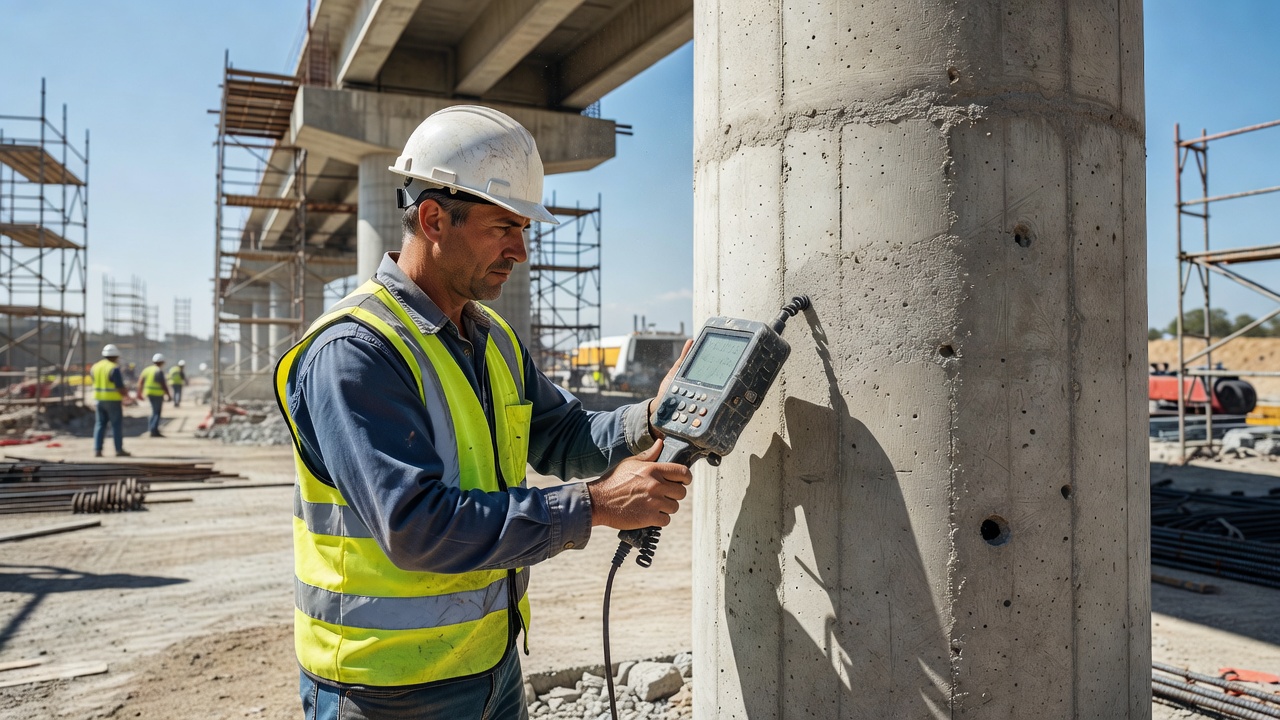
What is a Cover Meter?
A cover meter, also referred to as a pachometer, rebar locator, or rebar detector, is a non-destructive testing (NDT) instrument designed to detect, locate, and characterize steel reinforcement embedded in concrete structures. The device measures the thickness of the concrete cover (the distance from the concrete surface to the nearest surface of the reinforcing bar), determines the spatial position and orientation of reinforcing bars, and estimates the bar diameter under favorable conditions. Cover meters operate on well-established electromagnetic principles and represent one of the most widely used NDT tools in civil engineering for reinforced concrete condition assessment.
The term “pachometer” derives from the Greek pachys (thick) and metron (measure), literally meaning “thickness measurer.” While “pachometer” is used interchangeably with “cover meter” in many regions, some practitioners reserve “pachometer” specifically for instruments measuring concrete cover over reinforcement, distinguishing them from general-purpose metal detectors. The first commercial cover meters appeared in the 1950s based on magnetic reluctance technology, followed by eddy current instruments in the following decades. Today’s digital instruments combine pulse-induction technology, advanced signal processing, and integrated data visualization to deliver real-time rebar mapping and cover assessment on concrete structures ranging from bridge decks to high-rise columns.
Primary applications include quality control verification of cover depth on new construction to ensure compliance with durability specifications and building codes, locating reinforcement before destructive operations such as coring, cutting, or drilling to prevent damage to structural steel and cutting hazards, mapping unknown reinforcement layouts in existing structures where design documentation is unavailable, supporting half-cell potential corrosion surveys by precisely locating bars for electrical connection, and assessing concrete cover for corrosion risk evaluation in aggressive environments such as marine structures, parking garages, and bridges exposed to de-icing salts.
Principle of Operation: Electromagnetic Induction and Eddy Current
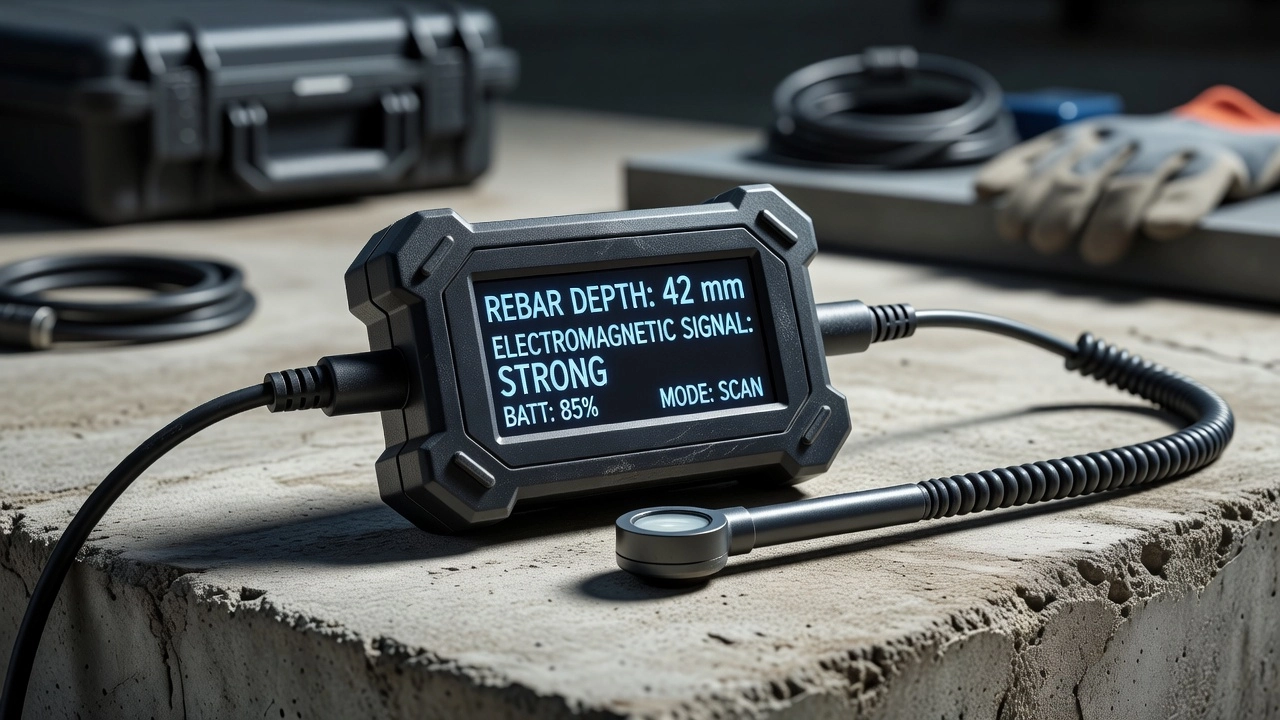
The operating principle of a cover meter is rooted in electromagnetic induction, first described by Michael Faraday in 1831. An alternating current flowing through a coil within the instrument’s probe generates a primary magnetic field that propagates outward through the concrete. When this time-varying magnetic field encounters a conductive ferromagnetic object, such as a steel reinforcing bar, it induces circulating electrical currents, called eddy currents, within the bar according to Faraday’s law. These eddy currents flow in closed loops around the circumference of the bar and, in accordance with Lenz’s law, produce a secondary magnetic field that opposes the primary field.
The cover meter measures the change in impedance of the probe coil caused by the interaction between the primary and secondary magnetic fields. The magnitude of this impedance change depends on several factors:
- Distance to the bar: Signal strength decreases exponentially with increasing cover depth following an inverse power law relationship. The signal amplitude is approximately proportional to 1/d³ where d is the depth to the bar center.
- Bar diameter: Larger bars present a greater surface area for eddy current induction, producing stronger secondary fields and larger signal amplitudes for a given depth.
- Bar orientation: The strongest signal occurs when the longitudinal axis of the probe is aligned parallel to the reinforcing bar. The signal diminishes as the probe rotates away from parallel alignment.
- Steel magnetic permeability: Variations in steel composition and cold-working history affect the ferromagnetic properties and thus the induced signal. Standard structural steel (Grade 40, 60, 75) has relative permeability in the range of 100-1000.
- Concrete properties: Concrete is generally non-magnetic and non-conductive at the operating frequencies of cover meters (typically 50 Hz to 10 kHz), meaning the concrete matrix itself does not significantly affect signal propagation. However, certain aggregates containing magnetite or other magnetic minerals can introduce minor interference.
Pulse Induction Technique
Most modern cover meters employ pulse induction (PI) technology rather than continuous-wave electromagnetic induction. In a PI system, the probe coil transmits short, high-current pulses (typically lasting 10-100 microseconds) at a repetition rate of several hundred pulses per second. During the pulse, a strong magnetic field builds up. When the pulse ends, the field collapses, and the receiver circuit measures the decay of the secondary magnetic field induced by any eddy currents still circulating in nearby metal objects. The decay characteristic, specifically the time constant and amplitude of the decay curve, encodes information about the size, depth, and conductivity of the detected object.
The key advantage of pulse induction over continuous-wave systems is its ability to discriminate the signal from the transmitted pulse. Because the receiver measures the magnetic field after the transmitted pulse has ended, there is no interference from the primary field. This allows detection of metal at greater depths and with higher signal-to-noise ratios. Additionally, pulse induction is inherently less sensitive to ground effects and concrete variability than continuous-wave systems.
Magnetic Reluctance Principle
An older but still relevant operating principle is magnetic reluctance, used in early cover meters such as the “Covermeter” line. In a reluctance-based system, a permanent magnet or electromagnet creates a steady magnetic field. Ferrous reinforcement in the concrete distorts this field, and a Hall-effect sensor or magnetometer measures the resulting change in magnetic flux density. The change in reluctance (the magnetic equivalent of electrical resistance) is correlated to the proximity and size of the steel.
The NIST study by Carino (1992) compared magnetic reluctance and eddy current meters and found that while both technologies effectively locate rebar and measure cover depth, they differ in key aspects: reluctance meters show less sensitivity to bar diameter variation but greater sensitivity to bar spacing effects, while eddy current meters generally provide better resolution for distinguishing individual bars in congested reinforcement and superior performance for locating bar ends. Modern instruments have largely adopted eddy current or pulse induction technology due to their superior dynamic range and discrimination capabilities.
Equipment Types and Operation
Cover meters range from simple handheld devices for spot-check measurements to sophisticated systems with multi-sensor arrays, integrated data logging, and wireless connectivity to tablet computers for real-time visualization.
| Device Category | Example Models | Key Capabilities | Typical Cover Range |
|---|---|---|---|
| Basic / Spot-check | Profometer PM8000 Lite, Elcometer 331 Model T | Rebar detection, single-point cover measurement, audio-visual indication | 0-80 mm |
| Advanced / Scanning | Profometer PM8000, Hilti Ferroscan PS300 | Grid scanning, line scanning, diameter estimation, data logging, Neighboring Rebar Correction | 0-100 mm |
| Expert / Imaging | Profometer PM8000 Pro | Area scanning, 2D/3D visualization, remote operation via tablet, corrosion potential integration | 0-120 mm |
| Corrosion Integration | Profometer PM8500 Corrosion Kit | Cover measurement + half-cell potential mapping, multi-electrode wheel probes | 0-100 mm |
Key components common to all cover meters include:
- Probe / Search head: Contains the transmitting and receiving coils. Different probe types exist for shallow (0-60 mm) and deep (60-120 mm) measurement ranges. Some universal probes offer switchable low/high range settings.
- Control unit: Houses the signal generation, processing electronics, user interface, and display. Modern instruments use color LCD touchscreens with intuitive menu navigation.
- Calibration blocks: Reference blocks made of non-conductive material (plywood, plastic, or dry concrete) with bars of known diameter at known depths. Essential for instrument calibration and verification before each survey.
- Data management software: Desktop or cloud applications for importing scan data, generating cover maps, creating inspection reports, and exporting data to BIM/CAD platforms. Examples include Hilti PROFIS Ferroscan Map, ElcoMaster, and Proceq Linkware.
Scanning Modes
Cover meters offer several measurement modes depending on the inspection objective:
Spot-check mode, The operator places the probe at a single location and reads the cover depth directly. This is used for quick verification of cover at specific points, such as checking cover at beam mid-spans or column faces before drilling anchor bolt holes.
Line scanning mode, The operator moves the probe along a predefined line while the instrument continuously records cover readings. The device produces a profile showing cover variation along the scan line, allowing identification of individual bars as peaks in the signal response. The probe must be moved perpendicular to the target rebar direction, and the strongest signal occurs when the probe axis is parallel to the bar.
Grid scanning (area scanning) mode, The operator performs multiple parallel line scans at regular spacing to create a two-dimensional cover map of a structural element. The instrument interpolates between scan lines to produce contour plots, color-coded cover maps, and 3D representations of the reinforcement layout. Grid scanning is essential for comprehensive deck surveys, wall assessments, and slab investigations.
Rebar mapping mode, Dedicated to locating and documenting the full reinforcement layout. The operator scans in two orthogonal directions, and the instrument automatically identifies bar positions, spacing, and orientation. The resulting map shows the complete reinforcement grid with measured cover values at each bar intersection.
Measuring Concrete Cover Depth
The fundamental measurement performed by a cover meter is the determination of concrete cover, the distance from the exposed concrete surface to the nearest surface of the embedded reinforcing steel. This parameter directly controls the durability of reinforced concrete structures because the cover provides the primary barrier against ingress of chlorides, carbon dioxide, moisture, and oxygen that initiate and propagate reinforcement corrosion.
The measurement process follows a systematic procedure prescribed by BS 1881-204:1988 and manufacturer recommendations:
Surface preparation: The concrete surface must be clean, dry, and free of debris, loose material, and surface moisture that could affect probe contact or signal propagation. Form oil residues, curing compounds, or surface coatings may need to be removed.
Calibration verification: Before each survey session, the operator verifies the instrument calibration against a calibration block with known bar diameter and cover depth. The reading must fall within the ±5% or ±2 mm tolerance specified by BS 1881-204. If not, the instrument must be recalibrated per the manufacturer’s instructions.
Bar location: The operator sweeps the probe across the concrete surface in a systematic pattern to locate the reinforcing bars. The maximum signal (peak reading) indicates the probe is directly above the bar. Most instruments provide both audio (varying pitch) and visual (bar graph, numeric readout) feedback.
Cover measurement: Once a bar is precisely located, the probe is held stationary at the peak signal position, and the cover depth reading is recorded. For maximum accuracy, the operator should take multiple readings (typically 3-5) at the same location and record the average.
Bar diameter input: Accurate cover measurement requires the correct bar diameter to be entered into the instrument. If the bar diameter is unknown, the operator must either use the spacer method (see section on diameter estimation) to determine it or accept reduced accuracy using an assumed diameter.
Signal Depth Relationship
The relationship between signal amplitude (S) and cover depth (d) follows a characteristic inverse power law. The NIST study by Carino established that for eddy current cover meters, the relationship can be modeled as:
S = a × d⁻ⁿ
where a is a calibration constant depending on bar diameter and instrument sensitivity, and n is an exponent typically ranging from 1.5 to 3.0 depending on probe geometry. For a typical probe with a 50 mm coil diameter, n ≈ 2.5, meaning a 20% increase in cover reduces the signal by approximately 44%. The practical consequence of this steep signal decay is that the measurement sensitivity decreases rapidly with depth, an instrument that can resolve 1 mm cover variation at 20 mm depth may only resolve 5 mm at 80 mm depth.
Maximum Measurable Cover
The maximum cover depth that can be reliably measured depends on several factors: instrument design and probe power, bar diameter, bar spacing (closer spacing reduces maximum measurable depth), configuration of secondary reinforcement, and presence of adjacent steel elements (embedded plates, conduits, anchors). For standard probes, practical maximum measurable covers are:
- Standard / shallow probe (low range): 40-60 mm
- Universal probe (low range): 60-80 mm
- Universal probe (high range): 80-120 mm
- Deep probe / extended range: 100-180 mm (with reduced accuracy)
The Barnes & Zheng (2008) study found that with 100 mm bar spacing and 24-28 mm diameter bars, a Proceq Profometer 5 could reliably measure covers up to 85-90 mm, exceeding the manufacturer’s stated maximum for low-range operation. However, measurement errors increased significantly when operating in high-range mode, with the study recommending that high-range settings only be used when low-range detection fails.
Estimating Bar Diameter
One of the more challenging capabilities of a cover meter is the estimation of reinforcing bar diameter. The fundamental difficulty arises because the signal amplitude depends on both cover depth and bar diameter, two unknowns that must be decoupled.
The standard technique for diameter estimation is the spacer method (also called lift-off method). The operator takes two cover readings at different distances from the concrete surface: one directly on the surface (cover reading C₁ with unknown bar diameter D₁), and a second reading with a non-conductive spacer of known thickness t placed between the probe and the concrete surface (resulting in cover reading C₂ with the same unknown bar diameter D₂, but at an effective cover of C₁ + t). Since the relationship between signal and cover depends on bar diameter, solving the two equations simultaneously yields both the true cover and the bar diameter.
Modern digital cover meters automate this process. The operator places the probe on the concrete surface, presses a button to take the first reading, then places a spacer (typically 10-20 mm thick, made of acrylic or polypropylene) under the probe and takes the second reading. The instrument’s microprocessor solves the two simultaneous calibration equations and displays both the estimated cover and bar diameter on the screen.
Factors affecting diameter estimation accuracy:
- Cover depth: Diameter estimation becomes unreliable for covers exceeding 60 mm, as the signal difference between two spacer measurements becomes small relative to measurement noise.
- Bar spacing: Closely spaced bars cause interference that distorts the signal-depth relationship, reducing diameter estimation accuracy.
- Bar diameter range: Estimation is most accurate when the actual bar diameter falls within the calibrated range of the instrument. Most instruments are factory-calibrated for bar sizes from 6 mm to 40 mm (US #3 through #12).
- Secondary reinforcement: Perpendicular bars beneath the measured bar can introduce systematic errors in diameter estimation.
- Probe orientation: The probe must be precisely aligned parallel to the bar for accurate diameter estimation.
The Hoki (2011) thesis at Brigham Young University demonstrated that, for bridge deck surveys, if the operator inputs a bar size within one US standard size of the actual bar (e.g., inputting #5 when the bar is actually #4 or #6), the cover measurement error remains within 0.125 inches (3.2 mm). This tolerance means that even an educated guess of bar diameter can yield acceptable cover accuracy for many applications.
Rebar Mapping and Layout Documentation
Beyond point measurements of cover depth, cover meters serve a critical function in rebar mapping, creating a comprehensive spatial representation of the reinforcement layout within a concrete element. This is essential for several scenarios: assessing structures with missing or unreliable design documentation, verifying as-built reinforcement against design specifications, locating reinforcement for structural capacity evaluation and load rating, and mapping rebar for corrosion assessment correlation with half-cell potential surveys and delamination surveys.
The mapping process typically follows a grid-based approach:
- A reference grid is established on the concrete surface, typically with 100-500 mm spacing depending on the expected bar spacing and the level of detail required. For bridge decks, a 150 mm × 150 mm grid is common.
- Line scans are performed along each grid line in two orthogonal directions. The operator marks the location of each detected bar directly on the concrete surface using chalk or marker.
- Cover depth readings are recorded at regular intervals along each bar or at critical locations such as mid-span, near supports, and at construction joints.
- The recorded data is imported into specialized software (e.g., PROFIS Ferroscan Map, ElcoMaster, Profometer Linkware) which generates:
- Cover contour maps: Color-coded contour plots showing spatial variation of cover depth across the element surface.
- Bar location plans: Scaled drawings showing the position, spacing, and orientation of each detected bar.
- 3D reinforcement models: Three-dimensional visualizations of the reinforcement cage, including multiple layers.
- Statistical summaries: Mean, minimum, maximum, and standard deviation of cover readings for each structural element.
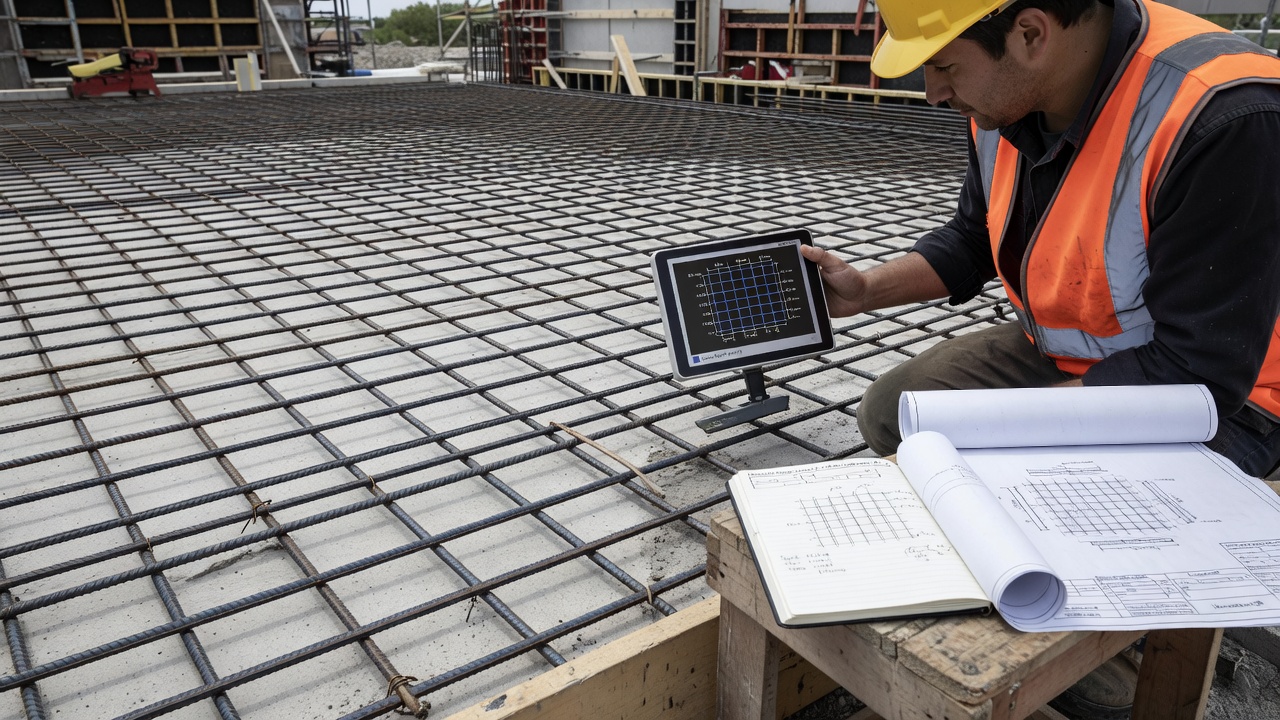
Modern cover meters with area scanning capability, such as the Profometer PM8000 Pro, use multi-sensor arrays and integrated odometry (wheel encoders on the scanning cart) to automate data collection. The operator pushes the scanning cart along the concrete surface, and the instrument continuously records probe position and cover readings, building a dense data set that software interpolates into high-resolution cover maps. This technology dramatically reduces inspection time for large-area surveys, a 50 m² bridge deck can be mapped in 1-2 hours compared to a full day using manual grid methods.
Accuracy and Influencing Factors
Cover meter accuracy is governed by a complex interplay of instrument factors, site conditions, reinforcement configuration, and operator procedure. The authoritative reference for accuracy expectations is BS 1881-204:1988, which specifies:
- Laboratory conditions (calibrated instrument, known bar size, single bar, optimal probe alignment): ±5% or ±2 mm, whichever is greater.
- Favorable site conditions (known bar size, bars at >100 mm spacing, single layer of reinforcement): Approaching laboratory accuracy.
- Average site conditions (cover <100 mm, moderate bar congestion, bar size known within one standard size): ±15% or ±5 mm, whichever is greater.
- Adverse conditions (cover >100 mm, congested reinforcement, unknown bar size, multiple layers): Accuracy can degrade to ±20-30%.
Key Factors Affecting Accuracy
Bar diameter setting, The most significant operator-controllable factor affecting cover measurement accuracy. Barnes & Zheng demonstrated that setting an incorrect bar diameter can shift cover readings by 10-20% of the measured value. Specifically, setting a smaller bar diameter than actual causes the meter to underestimate the cover, while setting a larger diameter causes overestimation. For example, measuring #8 (25 mm) bars with the meter set to #3 (10 mm) can produce cover readings 15-25% below true cover. This has critical implications for durability assessment, an operator who underestimates cover may incorrectly judge a structure as having inadequate protection.
Adjacent parallel bars, When bars are spaced closer than approximately 100 mm (4 inches), the magnetic fields from adjacent bars overlap, causing the measured signal to be stronger than for an isolated bar at the same depth. This produces cover readings that are systematically lower than true cover. The Hoki study found that at bar spacings greater than 100 mm, the interference effect diminishes to within the practical importance threshold of 0.125 inches. For closer spacings, the error increases non-linearly.
Secondary (perpendicular) bars, Transverse bars beneath the target longitudinal bars create additional magnetic field interactions. Research shows that scanning directly above a secondary bar can introduce errors of 1-4% in cover readings, with the effect being more pronounced at greater cover depths. The effect is mitigated by modern probe designs that are most sensitive to bars parallel to the probe axis and least sensitive to perpendicular bars.
Probe range selection, Using the high-range setting on a universal probe when the low range could achieve detection introduces measurement errors. Barnes & Zheng found that high-range readings are systematically lower (by 5-15%) than low-range readings for the same bar at the same depth. Manufacturers explicitly recommend that high range should only be used when low range cannot detect the bar.
Concrete properties, The concrete matrix generally does not affect electromagnetic signal propagation at cover meter frequencies. However, certain exceptions exist: aggregates containing magnetite (common in heavy-weight concrete for radiation shielding), steel fiber reinforcement, carbon fiber reinforcement, and high moisture content in immature concrete can all introduce minor signal perturbations.
Steel variability, Variations in steel permeability due to differences in chemical composition, cold-working history (e.g., threaded bars vs. smooth bars), and corrosion state can affect signal strength. Ribbed bars produce a slightly different signal response than smooth bars, though modern instruments are typically calibrated against standard ribbed reinforcing bars.
Surface roughness, Irregular concrete surfaces can cause inconsistent probe-to-surface contact, introducing air gaps that effectively increase the probe-to-bar distance. This produces erroneously high cover readings. For rough surfaces, using a spacer or ensuring firm probe contact is essential.
Cover Meter and Corrosion Assessment
Cover meters play an indispensable supporting role in corrosion assessment of reinforced concrete structures. The most widely used electrochemical technique for evaluating corrosion risk is the half-cell potential mapping method, standardized in ASTM C876. This technique measures the electrical potential difference between a reference electrode (typically copper/copper sulfate, Cu/CuSO₄) placed on the concrete surface and the embedded reinforcing steel. Potential values more negative than -350 mV (vs. CSE) indicate a greater than 90% probability of active corrosion.
For half-cell measurements, the operator must:
- Establish an electrical connection to the reinforcing steel, this requires locating a bar with the cover meter to determine a safe drilling location (avoiding cutting the bar).
- Drill a small hole through the concrete cover to expose the bar, then attach a lead wire via a threaded connection, clamp, or magnet.
- Map potential readings on a grid, the same grid used for cover mapping, to correlate cover depth with corrosion probability.
The integration of cover measurement and half-cell potential data provides powerful diagnostic insight:
- Areas with low cover + high corrosion probability indicate that inadequate cover allowed chloride or carbonation penetration to initiate corrosion. This is common in bridge decks where epoxy-coated bars were placed with insufficient cover.
- Areas with adequate cover + high corrosion probability suggest the concrete itself is compromised (high permeability, cracking, or contamination with chlorides during construction).
- Areas with low cover + low corrosion probability may indicate that the structure is dry or that corrosion initiation has not yet occurred but remains a future risk.
Manufacturers now offer integrated systems that combine cover measurement and half-cell potential mapping in a single instrument. The Profometer PM8500 Corrosion Kit includes a cover meter probe and a multi-electrode wheel (four-wheel or one-wheel electrode) that simultaneously collects cover and potential data. The data is merged in software to produce composite maps showing cover depth contours overlaid with corrosion potential contours, enabling engineers to directly correlate reinforcement protection level with corrosion activity.
Cover Meter vs. Ground Penetrating Radar for Rebar Detection
Ground Penetrating Radar (GPR) is the primary alternative to cover meters for rebar detection in concrete. While both technologies serve overlapping purposes, they operate on fundamentally different physical principles and have distinct capabilities, advantages, and limitations.
| Parameter | Cover Meter | Ground Penetrating Radar |
|---|---|---|
| Operating principle | Electromagnetic induction (eddy current / magnetic reluctance) | Electromagnetic wave reflection (radar) |
| Detection capability | Ferrous metal only | Any material with dielectric contrast (metal, plastic, voids, tendons, delamination) |
| Maximum detection depth | 100-180 mm (depending on probe and bar spacing) | 400-800 mm (with 1.5-2.7 GHz antenna) |
| Cover measurement accuracy | ±1-5 mm (depending on conditions) | ±5-15 mm (depending on dielectric calibration) |
| Bar diameter estimation | Yes, with spacer method (±1 bar size) | No |
| Spatial resolution | High for individual bars at close spacing | Moderate, hyperbolic reflections can overlap at close bar spacing |
| Data interpretation | Simple, direct numeric readout | Complex, requires trained interpreter for radargram analysis |
| Surface condition sensitivity | Low, works through coatings, tile, thin toppings | Moderate, affected by surface moisture, high conductivity, chloride contamination |
| Operator expertise required | Low to moderate | High |
| Speed of large-area surveys | Moderate (grid-by-grid scanning) | Fast (continuous rolling surveys) |
| Equipment cost | $2,000-$10,000 | $15,000-$40,000 |
The Tešić et al. study (2021), “Comparison of cover meter and ground penetrating radar performance in structural health assessment: case studies,” examined both methods across nine different concrete structures including bridge decks, columns, beams, walls, and slabs. Key findings included:
- Cover meters proved superior for precise cover measurement (±2 mm vs ±5-15 mm for GPR) and for locating bars in thin elements (<100 mm thick).
- GPR excelled at detecting reinforcement in deep elements (cover >100 mm), identifying post-tensioning tendons, locating voids and delamination, and mapping complex multi-layer reinforcement configurations.
- In congested reinforcement (bar spacing <75 mm), cover meters resolved individual bars more reliably than 2.7 GHz GPR, which produced overlapping hyperbolic reflections.
- For structures where cover was less than 60 mm and bar spacing exceeded 100 mm, typical of parking garages and building slabs, cover meters provided more accurate and faster assessments than GPR.
- For bridge decks with unknown construction history, combined use of both methods yielded the most comprehensive assessment, with cover meter providing precise cover on exposed bars and GPR mapping deep prestressing strands and lower mat reinforcement.
The practical guidance for engineers is: use a cover meter when precise cover measurement is required (durability compliance, corrosion risk assessment, pre-drilling verification), bar spacing is relatively wide (>75 mm), cover is less than 100 mm, and bar diameter estimation is needed. Use GPR when deep penetration is required (>100 mm), non-metallic objects or voids need detection, rapid large-area scanning is necessary, or multi-layer reinforcement configuration must be determined.
Standards Governing Cover Meter Testing
BS 1881-204:1988, “Testing concrete, Recommendations on the use of electromagnetic covermeters”, is the primary international standard governing cover meter practice. Published by the British Standards Institution, it provides comprehensive guidance on:
Calibration procedures: Three calibration methods are described:
- Method A (Calibration blocks): Using test blocks with bars of known diameter at known depths. The blocks must be constructed from non-conductive, non-magnetic materials (plywood, plastic, dry concrete) with dimensions sufficient to avoid edge effects. Minimum block dimensions are typically 400 mm × 400 mm × depth exceeding the bar embedment.
- Method B (In-situ correlation): After cover measurement, concrete is selectively broken out to expose the bar, and the actual cover is measured with a depth gauge. The correlation is used to adjust subsequent readings.
- Method C (Correlation graphs): Multiple readings at different spacer thicknesses are plotted against cover to generate a calibration curve specific to the bar size and instrument combination.
Accuracy requirements: The standard specifies that a calibrated cover meter should achieve ±5% or ±2 mm accuracy under laboratory conditions and ±15% or ±5 mm under average site conditions for covers less than 100 mm. For site conditions meeting specific criteria, the ±5% or ±2 mm target can be approached.
Measurement methodology: The standard details requirements for surface preparation, probe placement, scan procedure (recommended speed of 0.5 m/s maximum), data recording (minimum three readings per location), and instrument maintenance.
Reporting format: Required information includes instrument make and model, probe type and serial number, calibration date and validity, bar diameter setting, bar spacing, date of survey, operator identity, weather conditions (temperature, humidity), and all measured cover values with statistical summary.
Limitations: The standard explicitly cautions about accuracy degradation under: congested reinforcement (bar spacing < bar diameter × 6), covers exceeding probe working range, presence of multiple layers of reinforcement, steel with rust or scaling, and magnetic aggregates.
Other relevant standards and guidance documents include:
- ASTM C876-22, Standard Test Method for Corrosion Potentials of Uncoated Reinforcing Steel in Concrete (covers half-cell potential mapping, which integrates with cover meter surveys).
- ACI 228.2R, Report on Nondestructive Test Methods for Evaluation of Concrete Structures (provides context and guidance for cover meter use within a comprehensive NDT program).
- FHWA-HRT-04-133, Manual for Corrosion Protection of Concrete Structures (discusses cover measurement as a key parameter in service life prediction models).
- EN 12504-1, Testing concrete in structures, Cored specimens (references cover measurement for locating reinforcement before coring).
- ISO 1920-7, Testing of concrete, Non-destructive tests on hardened concrete (general framework including cover meter methods).
Use in Inspection Workflows
Cover meter testing is integrated into a multi-tier inspection workflow for reinforced concrete structures. Typical protocols, such as those published by ACI Committee 228 and various state DOT bridge inspection manuals, follow a hierarchical approach:
Tier 1, Preliminary survey: Visual inspection combined with chain drag or hammer sounding to identify areas of surface distress. Cover meter spot-checks at representative locations (typically 10-20 points per structural element) provide initial cover data. This tier is often sufficient for routine inspections of structures in good condition.
Tier 2, Detailed inspection: Systematic cover meter survey using grid scanning (typically 150-500 mm grid) over the entire accessible surface of the element. Cover contour maps are generated, and areas of substandard cover are identified for focused investigation. Rebar layout is documented, and diameter is estimated at representative locations. This tier is appropriate for structures with known deterioration, structures approaching design life, or structures scheduled for major rehabilitation.
Tier 3, Comprehensive investigation: Full cover meter survey combined with complementary NDT methods: half-cell potential mapping for corrosion risk, ultrasonic pulse velocity for internal quality, ground penetrating radar for deep reinforcement and void detection, and core sampling with petrographic and chemical analysis for material properties. Cover meter data provides the spatial framework for correlating all other NDT results. This tier is reserved for critical structures (major bridges, lifeline infrastructure), structures with advanced deterioration, forensic investigations of failures, and structures requiring load rating or remaining service life assessment.
Practical workflow for a typical bridge deck inspection:
- Review available design drawings and construction records to determine nominal bar sizes, spacing, and cover requirements.
- Calibrate the cover meter using the appropriate calibration method (Method A using blocks matching expected bar sizes).
- Divide the deck into survey zones (typically by span or by lane) and establish a reference grid with 150 mm × 150 mm or 300 mm × 300 mm spacing.
- Perform line scans in the transverse direction (perpendicular to the main longitudinal reinforcement) to locate bars and measure cover at each grid intersection.
- Perform line scans in the longitudinal direction to locate transverse reinforcement and verify bar spacing.
- Document bar locations directly on the concrete surface using permanent marker.
- Record cover readings at each bar location, entering the actual bar diameter if known or an assumed diameter if unknown.
- For areas with cover more than 20% below specification, take additional readings using the spacer method to estimate actual bar diameter and confirm cover accuracy.
- Import data into software to generate cover maps, statistical summaries, and compliance reports.
- Identify areas requiring further investigation (corrosion testing, core sampling for carbonation depth and chloride profiling, delamination survey).
The cover meter remains one of the most practical, cost-effective, and widely deployed NDT tools in the concrete inspection engineer’s arsenal. When used properly, with correct calibration, appropriate probe selection, accurate bar diameter input, and awareness of limitations, it provides reliable data essential for durability assessment, structural evaluation, and informed maintenance and repair decisions across the entire infrastructure lifecycle.
Frequently Asked Questions
- How does a cover meter detect rebar in concrete?
- A cover meter operates on electromagnetic induction. The device generates an alternating magnetic field from a coil in the probe. When this field encounters a steel reinforcing bar, it induces eddy currents in the bar, which create a secondary magnetic field. The cover meter measures the change in coil impedance or signal attenuation caused by this secondary field. The signal strength is inversely related to the depth of the bar, deeper bars produce weaker signals. By calibrating the device against known depths, the cover meter converts signal strength into a cover depth reading. Modern instruments also use pulse-induction techniques that separate the transmitted signal from the received signal, allowing detection only when ferrous metal is present.
- What is the accuracy of a cover meter?
- According to BS 1881-204:1988, a calibrated cover meter should be accurate to within ±5% or ±2 mm, whichever is greater, under laboratory conditions. Under typical site conditions with covers less than 100 mm, practical accuracy is within ±15% or ±5 mm. Accuracy depends on several factors: correct bar diameter setting, spacing between adjacent bars, presence of secondary (perpendicular) bars, probe selection (shallow vs deep), and whether the bar size is known. Research by Barnes & Zheng (2008) showed that setting the correct bar diameter in the meter significantly improves accuracy, using a default 12 mm setting on 24 mm bars can introduce measurable errors. Modern instruments with Neighboring Rebar Correction (NRC) technology achieve ±1 mm accuracy on first-layer rebar even in congested reinforcement.
- What is the difference between a cover meter and ground penetrating radar (GPR)?
- Cover meters and GPR serve different but complementary roles. Cover meters use electromagnetic induction at low frequencies (typically <10 kHz) and are limited to detecting ferrous metal within approximately 100-120 mm depth. They excel at measuring cover depth, locating individual bars, and estimating bar diameter with high precision (±1-2 mm). GPR emits high-frequency electromagnetic pulses (0.2-4 GHz) and detects reflections from any material with different dielectric properties. GPR penetrates up to 600-800 mm, detects all buried objects (rebar, tendons, conduits, voids, delamination), and produces continuous 2D radargrams. However, GPR requires more expertise to interpret, is sensitive to moisture and chloride content, and cannot estimate rebar diameter. For projects requiring precise cover measurement, such as verifying code compliance or supporting corrosion assessment, a cover meter is preferred. For deep investigation or mapping of complex reinforcement patterns, GPR is more suitable.
- Can a cover meter estimate rebar diameter?
- Yes, a cover meter can estimate rebar diameter under favorable conditions. The technique used is called the spacer method or lift-off method: the operator takes two readings at different distances from the surface (with and without a non-conductive spacer of known thickness). Since the signal strength depends on both cover depth and bar diameter, solving two simultaneous equations yields both parameters. Modern digital cover meters automate this process with onboard algorithms. However, diameter estimation accuracy decreases with increasing cover depth, congested reinforcement, and when the bar diameter lies outside the calibrated range. Research indicates that diameter estimation is most reliable for bars less than 25 mm diameter at covers less than 60 mm. The NIST study by Carino (1992) confirmed that magnetic reluctance meters and eddy current meters show different sensitivities to bar diameter, with eddy current meters generally performing better for diameter estimation.
- What standards govern cover meter testing?
- The primary standard is BS 1881-204:1988 'Testing concrete, Recommendations on the use of electromagnetic covermeters,' published by the British Standards Institution. This standard covers calibration procedures, measurement methodology, accuracy requirements (within ±5% or ±2 mm under lab conditions), and reporting formats. It describes three calibration methods: Method A (calibration blocks with known bar sizes and depths), Method B (in-situ correlation with exposed bars after concrete removal), and Method C (correlation graphs using spacer blocks). Other relevant documents include ACI 228.2R 'Nondestructive Test Methods for Evaluation of Concrete Structures,' which references cover meters as a primary NDT method for reinforcement assessment. Various national transportation authorities (FHWA, state DOTs) have their own protocols for cover meter surveys on bridge decks and infrastructure.