What is a Cross Section?
Cross Section: Plane Cutting Through Object
Introduction: Visualizing the Inside of Solids
A cross section is the two-dimensional shape exposed when a three-dimensional object is sliced by a plane. This concept is deeply embedded in mathematics and the sciences, allowing us to look inside objects and analyze their internal structure, an essential skill whether you’re calculating the strength of a beam, diagnosing a medical condition, or designing a new product. From the growth rings in a tree trunk to the CT scan of a human body, cross sections bridge the gap between what’s on the outside and what lies within.
Cross-sectional analysis is fundamental in geometry, engineering, architecture, medicine, manufacturing, and more. It helps us quantify, model, and understand shapes that would otherwise remain hidden. Cross sections are also central to mathematical methods like Cavalieri’s Principle, which states that solids with equal cross-sectional areas at every height have equal volumes.
Core Definition: What Is a Cross Section?
A cross section is the intersection of a solid object and a plane. The result is a two-dimensional figure that reveals the internal arrangement and geometry of the solid. The shape and area of a cross section depend on both the object’s geometry and the orientation of the slicing plane.
- Planar cross section: The intersection lies in a single, flat plane.
- Non-planar cross section: In rare cases or in higher mathematics, intersections may not be perfectly flat (e.g., if the object or plane is curved).
In calculus, the area of a cross section as a function of position is key to finding the volume of irregular solids. In higher dimensions, the idea extends to slicing 4D (or higher) objects, where the cross section is itself a 3D solid.
Everyday Examples: Cross Sections in the Real World
Cross sections are everywhere:
- Food: Slicing bread or carrots produces cross sections (the face of the slice).
- Nature: Cutting a tree trunk reveals circular cross sections and growth rings.
- Engineering: The strength of a cable or beam depends on its cross-sectional area.
- Medicine: CT and MRI scans create cross-sectional images for diagnosis.
- Manufacturing: 3D printing “slices” digital models into cross sections to build objects layer by layer.
- Culinary Arts: Sushi rolls, cakes, and layered desserts show their internal composition through cross sections.
Mathematical Perspective: Geometry of Cross Sections
Mathematically, cross sections help us:
- Visualize symmetry and internal structure
- Calculate areas and volumes (using integration in calculus)
- Classify and distinguish solids (by the kinds of cross sections they produce)
- Interpret engineering and architectural drawings
In projective geometry, cross sections relate to projections and shadows. In topology, slicing higher-dimensional objects with a hyperplane yields cross sections that help us understand complex shapes.
Why Study Cross Sections?
Cross sections serve several purposes:
- Visualization: See inside objects to understand structure and function.
- Measurement: Calculate area, perimeter, and volume.
- Design: Engineers and architects use cross-sectional views to design and analyze beams, columns, and pipes.
- Diagnosis: Medical imaging relies on cross-sectional analysis for non-invasive diagnostics.
- Analysis: In geology, cross-sectional diagrams reveal subsurface features. In manufacturing, they ensure components meet specifications.
Cross Sections by Shape: Key Solids
1. Sphere
Any plane slicing a sphere creates a circle (unless it just touches the sphere, in which case the cross section is a point). The radius of the cross-section circle depends on the distance from the center.
2. Cube
A cube can be sliced to produce squares (plane parallel to a face), rectangles, triangles, or even a regular hexagon (with a plane cutting through three pairs of parallel edges).
3. Cylinder
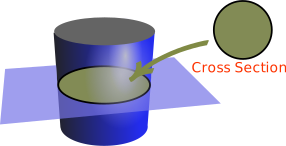
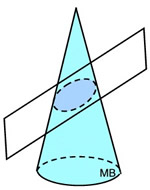
Slicing a cylinder parallel to its bases yields a circle. Slicing perpendicular to the base through the central axis yields a rectangle. An oblique slice produces an ellipse.
- Parallel to base:

- Perpendicular to base:
- Slanted:

4. Prism
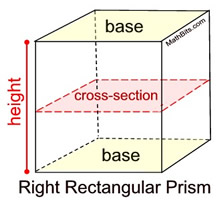
A prism is a polyhedron with two congruent, parallel bases. Slicing parallel to the base yields a cross section congruent to the base. Other slices can produce rectangles, parallelograms, triangles, or hexagons.
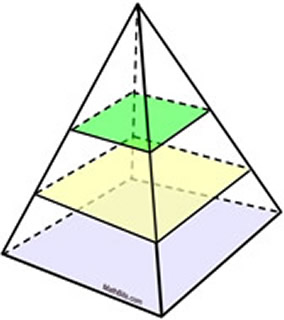
5. Pyramid
A pyramid with a polygonal base and triangular faces converging at an apex produces similar polygons when sliced parallel to the base. Other slices can yield triangles, trapezoids, or pentagons.
6. Cone
A cone sliced parallel to the base yields a circle. Oblique slices yield ellipses, parabolas, or hyperbolas, the famous conic sections.
- Circle:
Cone horizontal cross section (PDF) - Triangle:

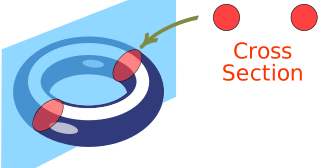
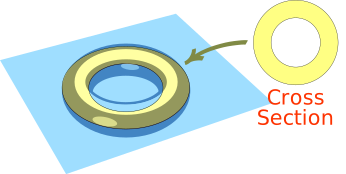
7. Torus
A torus (donut shape) can be sliced to produce circles, annuli (ring shapes), or more complex curves depending on orientation.
- Vertical:
- Horizontal:
Orientation of the Slicing Plane
The orientation of the plane determines the cross-sectional shape:
| Solid | Parallel to Base | Perpendicular to Base | Slanted/Oblique |
|---|---|---|---|
| Sphere | Circle | Circle | Circle |
| Cube | Square | Square | Rectangle, hexagon, etc. |
| Cylinder | Circle | Rectangle | Ellipse |
| Rectangular Prism | Rectangle | Rectangle | Triangle, trapezoid, etc. |
| Rectangular Pyramid | Rectangle (smaller) | Triangle, trapezoid | Pentagon |
| Cone | Circle | Triangle | Ellipse, parabola, hyperbola |
| Torus | Annulus, 2 circles | 2 circles | Ovals, complex curves |
Special Cases: Maximum Number of Sides
For polyhedra, a plane can intersect each face at most once, so the cross section of a cube or rectangular prism has at most six sides (a hexagon). For curved solids, cross sections can have infinitely many points (as in a circle or ellipse).
Applications Across Disciplines
- Engineering: Structural strength relies on cross-sectional area and shape.
- Architecture: Floor plans and elevation views are cross sections of buildings.
- Medicine: Cross-sectional imaging is critical for diagnostics.
- Geology: Geologic cross sections reveal subsurface layers and structures.
- Manufacturing: Pipes, beams, and wires are specified by their cross sections.
Interactive Exploration
Modeling clay, 3D software, or even slicing fruit can bring cross sections to life. Many educational tools and digital simulators allow you to choose a solid, rotate it, and virtually “cut” it to see the resulting cross section from any angle.
Conclusion
Cross sections unlock the hidden interiors of solids, making them an essential tool for mathematicians, scientists, engineers, and artists. By understanding and visualizing cross sections, we gain powerful insights into the structure, function, and beauty of the three-dimensional world.
Frequently Asked Questions
- What is a cross section in mathematics?
- In mathematics, a cross section is the two-dimensional shape formed when a plane intersects a three-dimensional solid. It represents the set of points common to both the solid and the slicing plane, revealing the interior features and geometry of the object.
- Why are cross sections important?
- Cross sections are vital for visualizing the internal structure of objects, calculating properties like area and volume, and conducting structural analysis. They are widely used in engineering, architecture, medicine, geology, and manufacturing for both design and diagnostic purposes.
- Can cross sections be more complex than simple shapes?
- Yes. While some solids produce regular shapes (like circles or squares), others, depending on the object's geometry and the angle of the slicing plane, can yield ellipses, polygons with varying sides, or even more complex curves.
- How are cross sections used in medical imaging?
- Techniques such as CT and MRI scans create images of cross sections of the human body. By analyzing these slices, doctors can diagnose conditions, plan surgeries, and monitor internal structures in detail.
- What is the maximum number of sides a cross section can have?
- For polyhedra, the cross section's maximum number of sides is limited by the number of faces of the solid. For example, a cube can generate a hexagonal cross section. Curved solids, like spheres and cylinders, yield cross sections that are curves (e.g., circles, ellipses) with infinitely many points.
This is a reference entry. TarmacView provides drone inspection services and doesn't sell the equipment or materials described in this glossary.