What is Crosshole Sonic Logging (CSL)?
Crosshole Sonic Logging (CSL) for Deep Foundation Integrity
1. Definition and Application
Crosshole Sonic Logging (CSL), also referred to as ultrasonic crosshole testing or cross-hole sonic logging, is a non-destructive testing (NDT) method standardized under ASTM D6760 for evaluating the structural integrity of cast-in-place concrete deep foundations. CSL is the most widely specified ultrasonic method for quality assurance of drilled shafts, bored piles, caissons, and slurry walls in major infrastructure projects worldwide.
CSL uses ultrasonic pulses transmitted between parallel access tubes pre-installed within the reinforcement cage of a foundation element before concrete placement. The tubes are filled with water to provide acoustic coupling between the ultrasonic transducers and the surrounding concrete. A transmitter probe emits ultrasonic pulses at frequencies typically between 25 and 50 kHz, while a receiver probe in an adjacent tube detects the signals after they travel through the concrete. The pulse velocity, first arrival time (FAT), and signal energy or amplitude are recorded at regular depth intervals as the probes are pulled simultaneously from the base to the top of the foundation element.
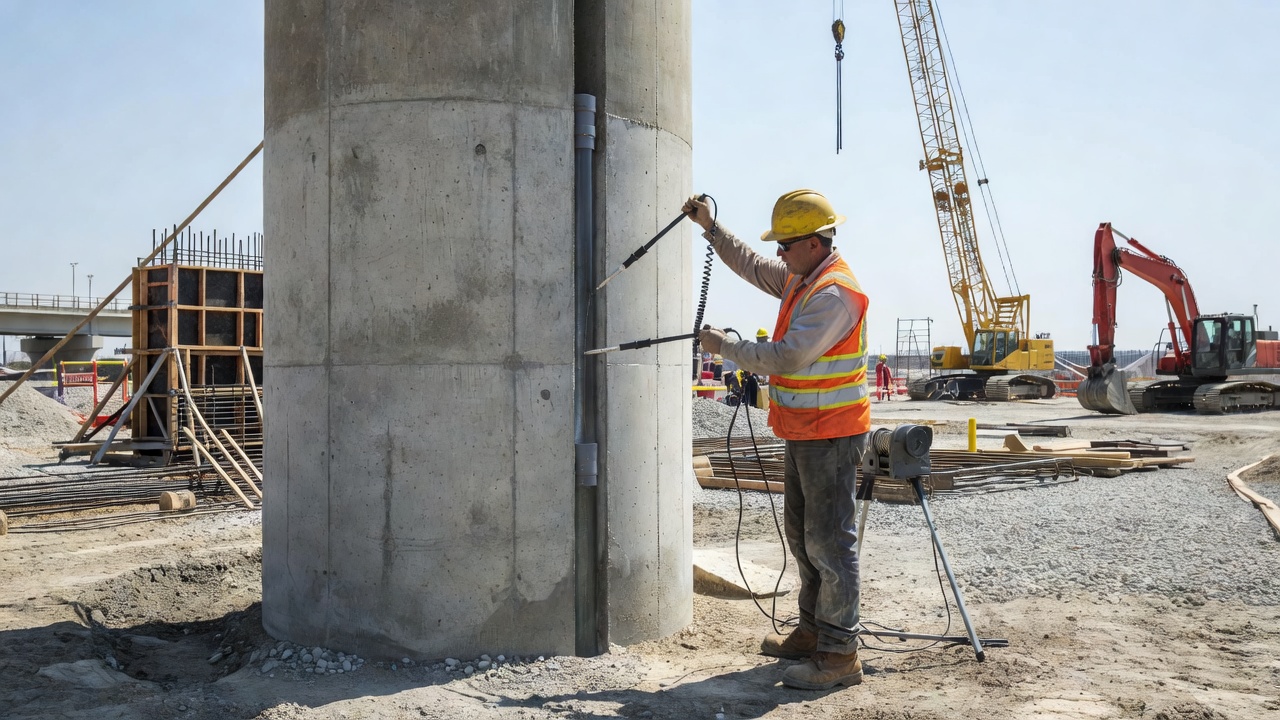
The method is applicable to any length of foundation element, there is no theoretical depth limitation as long as access tubes extend to the full depth of the shaft. CSL is widely applied to bridge foundations, high-rise building piles, marine structures, wind turbine foundations, transmission tower bases, and other critical infrastructure where foundation failure would have severe consequences. According to the Federal Highway Administration (FHWA) Geotechnical Engineering Circular No. 10 (GEC-10) on Drilled Shafts (FHWA-NHI-18-024), CSL is specified on virtually all major transportation projects involving drilled shaft foundations in the United States.
The intent of CSL testing, as defined by the Deep Foundations Institute (DFI) Task Force on CSL Terminology and Evaluation Criteria, is to identify irregularities such as soil intrusion, necking, soft bottom conditions, segregation, voids, honeycombing, and other anomalies that could result in poor structural performance of the foundation. The DFI task force emphasizes that CSL test results alone should not be the sole basis for accepting or rejecting a shaft, they are one component of a comprehensive evaluation framework that includes construction records, concrete test results, and engineering judgment.
2. CSL Principle: Wave Speed and Signal Attenuation
The fundamental principle of CSL is based on the relationship between ultrasonic pulse velocity and concrete quality. The velocity of a compressional (P-wave) ultrasonic pulse through concrete is a function of the material’s elastic modulus, density, and Poisson’s ratio, as described by the following relationship:
Vp = √[E(1-ν) / ρ(1+ν)(1-2ν)]
Where Vp is the compressional wave velocity, E is the dynamic modulus of elasticity, ρ is the material density, and ν is Poisson’s ratio. In practical terms, higher-quality concrete with greater density and stiffness transmits ultrasonic pulses faster than low-quality, deteriorated, or defective concrete.
For normal structural concrete, pulse velocities typically range between 3,500 and 4,500 meters per second (m/s). Values above 4,000 m/s generally indicate good-quality concrete. Velocities between 3,000 and 3,500 m/s suggest questionable quality, while values below 3,000 m/s are strongly indicative of poor-quality concrete, voids, or other significant defects. A local reduction in velocity of 15-25% or more compared to the average velocity of the sound concrete in the same shaft is typically considered indicative of an anomaly requiring further investigation.
Signal attenuation, the reduction in amplitude or energy of the ultrasonic pulse as it travels through concrete, provides a second independent indicator of concrete condition. The amplitude of the received signal decreases due to scattering at aggregate boundaries, absorption by the cement paste matrix, and reflection or diffraction at defect interfaces. Inhomogeneities such as cracks, voids, honeycombing, or soil inclusions cause significant local attenuation of the ultrasonic signal, often more pronounced than the velocity reduction. Modern CSL systems measure both relative energy (RE) and first arrival time (FAT), providing two complementary parameters for anomaly detection.
| Parameter | Sound Concrete | Questionable | Defective |
|---|---|---|---|
| Pulse Velocity (m/s) | > 4,000 | 3,000 - 4,000 | < 3,000 |
| FAT Increase (%) | < 10% | 10 - 20% | > 20% |
| Relative Energy (%) | > 60% | 30 - 60% | < 30% |
| Wave Speed Reduction | < 10% | 10 - 20% | > 20% |
The frequency of the ultrasonic pulse influences the detection resolution and penetration capability. Higher frequencies (40-50 kHz) provide better resolution for detecting smaller defects but have higher attenuation and thus shorter effective penetration distances. Lower frequencies (20-30 kHz) penetrate greater distances between tubes but have poorer resolution. The practical spacing between access tubes is generally limited to approximately 3.6 meters (12 feet) for reliable signal transmission. For larger-diameter shafts, additional tubes must be installed to maintain tube spacing within acceptable limits.
The acoustic impedance mismatch between concrete and air is approximately 100,000:1, meaning that even thin air-filled voids act as almost perfect reflectors of ultrasonic energy. A void as thin as 1-2 mm can block the direct ultrasonic path and cause the signal to travel around it, resulting in measurable delays in first arrival time and significant energy loss. Water-filled voids, by contrast, have a smaller impedance mismatch with concrete and may produce less pronounced attenuation.
3. Access Tube Installation
The quality and reliability of CSL results depend critically on proper installation of access tubes. The tubes must be installed before concrete placement, attached securely to the reinforcement cage, and maintained in a clean, parallel, and watertight condition throughout construction.
Tube materials are typically Schedule 40 steel or Schedule 40 or 80 PVC with nominal inside diameters of 38 mm (1.5 inches) or 50 mm (2.0 inches) . Steel tubes are preferred for deep shafts and aggressive environments due to their greater stiffness, better resistance to damage during cage handling and concrete placement, and superior acoustic coupling (steel has a closer acoustic impedance match to concrete than PVC). PVC tubes are more economical and adequate for most applications but require thicker walls (Schedule 80) for deep shafts to resist hydrostatic pressure at depth.
Tube layout requirements per ASTM D6760 and FHWA GEC-10:
- Minimum number of tubes: Three tubes for any shaft, four is standard practice for shafts exceeding 0.9 m (3 ft) diameter
- Spacing guideline: One tube for every 250-355 mm (10-14 inches) of shaft diameter for circular elements
- Placement: Tubes are attached to the inner side of the longitudinal reinforcement cage, spaced evenly around the perimeter
- Coupling: For rectangular elements (slurry wall panels, barrettes), tubes are placed on both long sides
- Tube termination: Tubes must extend from the planned shaft base elevation to a sufficient height above the cut-off elevation to allow probe access
- Tops and bottoms: Tube bottoms must be sealed (typically with a steel plate welded or epoxied), tops must have removable watertight caps to prevent debris entry
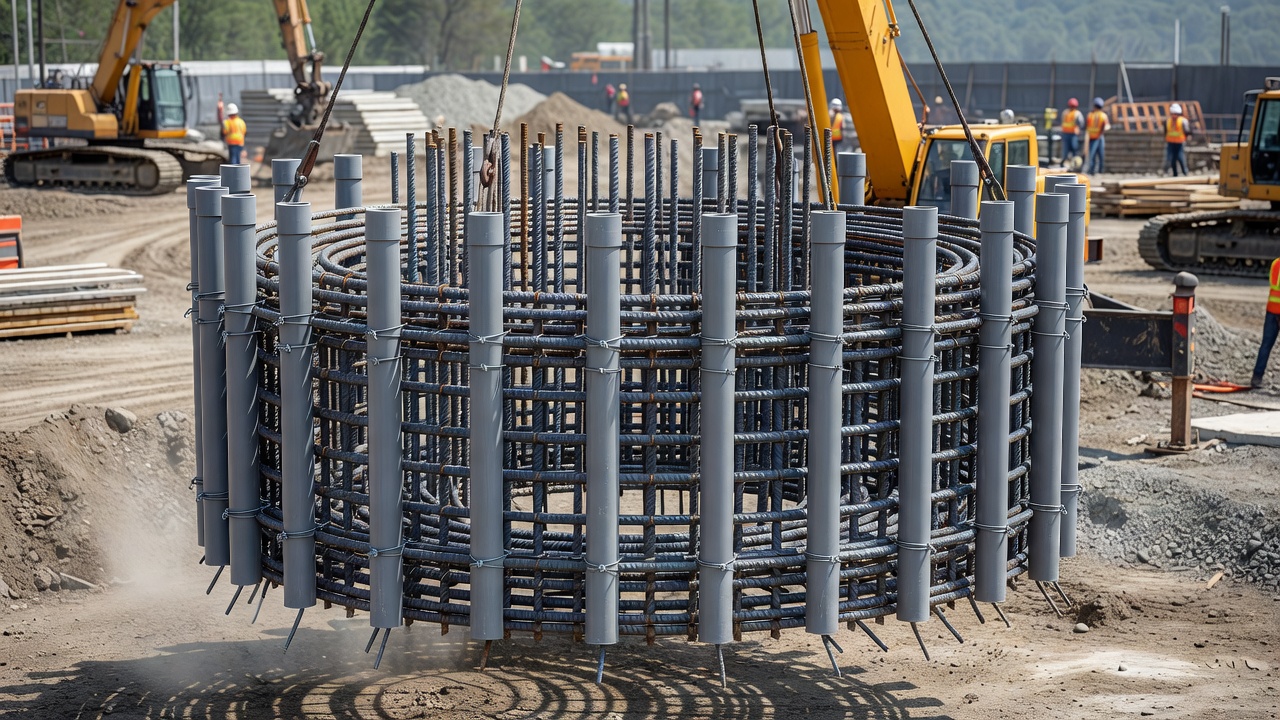
Tube attachment requires careful execution. The tubes are secured to the reinforcement cage using wire ties, U-bolts, or specialty clips at vertical intervals of 1-2 meters (3-6 feet) to prevent movement during cage lifting and concrete placement. The tubes must be kept as parallel as possible, non-parallel tubes introduce geometric uncertainty in the raypath length calculation, which directly affects velocity determination. Cage deformation during lifting or concrete placement can cause tube misalignment that produces false anomalies in CSL data.
Post-installation verification includes:
- Flushing each tube with water to remove debris
- Passing a mandrel (a cylindrical calibration gauge) or borescope through each tube to verify continuity
- Checking for leaks at sealed bottoms and connections
- Measuring and recording tube positions at the top of the shaft using a north reference for circumferential anomaly mapping
- Marking each tube with a unique identification label
According to FHWA research and DFI guidance, improper tube installation is the leading cause of unreliable CSL results. Tubes that are crushed, blocked, or displaced during concrete placement can produce data that is difficult or impossible to interpret. The cost of tube installation is small compared to the cost of constructing a defective shaft that goes undetected.
4. Test Procedure (ASTM D6760)
The CSL test procedure is prescribed by ASTM D6760, Standard Test Method for Integrity Testing of Concrete Deep Foundations by Ultrasonic Crosshole Testing. The standard defines equipment requirements, calibration procedures, testing methodology, and reporting formats.
Pre-test preparation:
Before testing, concrete must have achieved sufficient strength, typically minimum 7 days curing or 70% of design compressive strength, though this varies by specification. The access tubes are flushed with clean water to remove any debris, then filled completely with water for acoustic coupling. A wetting agent may be added to reduce surface tension and improve probe-to-water coupling.
Equipment calibration is performed using a water bath calibration tube, a reference tube of known dimensions filled with water at the same temperature as the field tubes. The transmitter and receiver probes are submerged in the calibration bath, and the system measures the baseline transit time through water. This zero-offset calibration accounts for:
- Probe internal delays
- Cable length variations
- Electronic system delays
- Water temperature effects on acoustic velocity
Equipment requirements per ASTM D6760:
| Component | Specification |
|---|---|
| Transmitter frequency | 25 - 50 kHz (typically 40-50 kHz for standard testing) |
| Receiver frequency response | 20 - 60 kHz (matching transmitter range) |
| Sampling rate | Minimum 1 MHz (higher rates provide better time resolution) |
| Depth encoder resolution | ±10 mm or better |
| Pulse repetition rate | Sufficient for continuous data at specified pull rate |
| Amplitude measurement | Minimum 8-bit resolution (12-bit recommended) |
| Data acquisition | Automated with depth-triggered recording |
Testing sequence:
The probes are lowered to the base of the access tubes in adjacent tube pairs (e.g., Tube A-Tube B, Tube B-Tube C, Tube C-Tube A for a three-tube configuration). In a four-tube configuration, diagonal pairs are often tested in addition to adjacent pairs. The standard test uses horizontal raypaths, the transmitter and receiver probes are maintained at the same elevation throughout the test.
The probes are pulled upward simultaneously from base to top at a controlled rate, typically between 0.5 and 2.0 meters per minute. Data is recorded at depth increments of 10-50 mm (0.4-2.0 inches), depending on the required resolution and the expected size of defects. At each depth increment, the system records:
- First Arrival Time (FAT), the time at which the first ultrasonic energy is detected
- Signal amplitude or Relative Energy (RE), the peak-to-peak amplitude or integrated energy of the initial portion of the waveform
- Full waveform, the complete time-domain signal for later processing and waterfall plot generation
- Depth, from the encoder measurement
For quality assurance, a reversed test is performed by swapping the transmitter and receiver positions and repeating the logging for each pair. This helps identify directional bias caused by equipment issues or coupling asymmetries.
Post-test procedures include:
- Water temperature recording
- Verification of data completeness (100% depth coverage)
- Preliminary field review of data to identify gross anomalies that may require immediate investigation
- Data transfer to processing software for detailed analysis
5. Data Interpretation: First Arrival Time, Energy, and Waterfall Diagrams
CSL data interpretation relies on the analysis of three primary data outputs: first arrival time (FAT) profiles, relative energy (RE) profiles, and waterfall diagrams. These are examined together to identify zones of anomalous concrete that may indicate structural defects.
First Arrival Time (FAT):
The first arrival time is the elapsed time from the trigger of the transmitted pulse to the detection of the first ultrasonic energy at the receiver. It represents the fastest wave path through the concrete between the two tubes. FAT is inversely proportional to pulse velocity, lower velocities produce longer arrival times.
FAT data is plotted as a continuous profile with depth, typically showing FAT in microseconds (μs) on the horizontal axis and depth on the vertical axis. The analyst identifies:
- Baseline FAT: The average FAT for sound concrete in the shaft, established from the majority of the profile
- Localized FAT delays: Sudden increases in FAT at specific depths, indicating slower wave propagation and potential anomalies
- Graded FAT changes: Gradual increases in FAT over a depth range, suggesting a zone of poorer-quality concrete
ASTM D6760 does not define specific acceptance criteria, it explicitly leaves interpretation to engineering judgment. However, industry practice and DFI guidance provide commonly used thresholds. The French standard AFNOR NF P94-160-1 suggests a 20% FAT increase as the threshold for a significant anomaly. Many US state DOTs use 10-20% velocity reduction as the threshold for “questionable” concrete and greater than 20% velocity reduction for “poor” concrete. It is critical to note that a 20% FAT increase does not equal a 20% velocity decrease, the relationship is nonlinear, with a 20% FAT increase corresponding to approximately a 17% velocity decrease.
Relative Energy (RE):
The relative energy or relative amplitude represents the strength of the received ultrasonic signal, typically expressed as a percentage of a reference value (the maximum signal or the average signal in sound concrete). Energy is attenuated by:
- Voids and air-filled defects: Almost complete signal loss
- Cracks and delaminations: Partial attenuation with frequency-dependent effects
- Honeycombing and low-density concrete: Moderate to severe attenuation
- Soil inclusions: Significant scattering and absorption
RE profiles are plotted alongside FAT profiles, with depth on the vertical axis. Coincident FAT increases and RE decreases are strong indicators of a genuine anomaly. Isolated FAT increases without energy loss may result from geometric factors (non-parallel tubes) rather than material defects. Conversely, isolated energy drops without FAT changes may indicate coupling problems (air bubbles on the probe face, debris in the tube) rather than concrete defects.
Waterfall Diagrams:
The waterfall diagram is the most comprehensive visual representation of CSL data. Each horizontal line in the waterfall represents the complete ultrasonic waveform at a specific depth increment, plotted as positive and negative peaks. A series of these waveforms at successive depths creates the waterfall effect.
In the waterfall presentation:
- The first arrival appears as the initial dark vertical band on the left side of each waveform
- Consistent first arrival times produce a straight vertical line on the left edge of the waterfall
- Delayed first arrivals appear as a rightward shift (kink or bulge) in the waterfall pattern
- Signal attenuation appears as reduced intensity (lighter shading or narrower waveform) in the waterfall
- Complete loss of signal appears as a blank or nearly blank zone in the waterfall
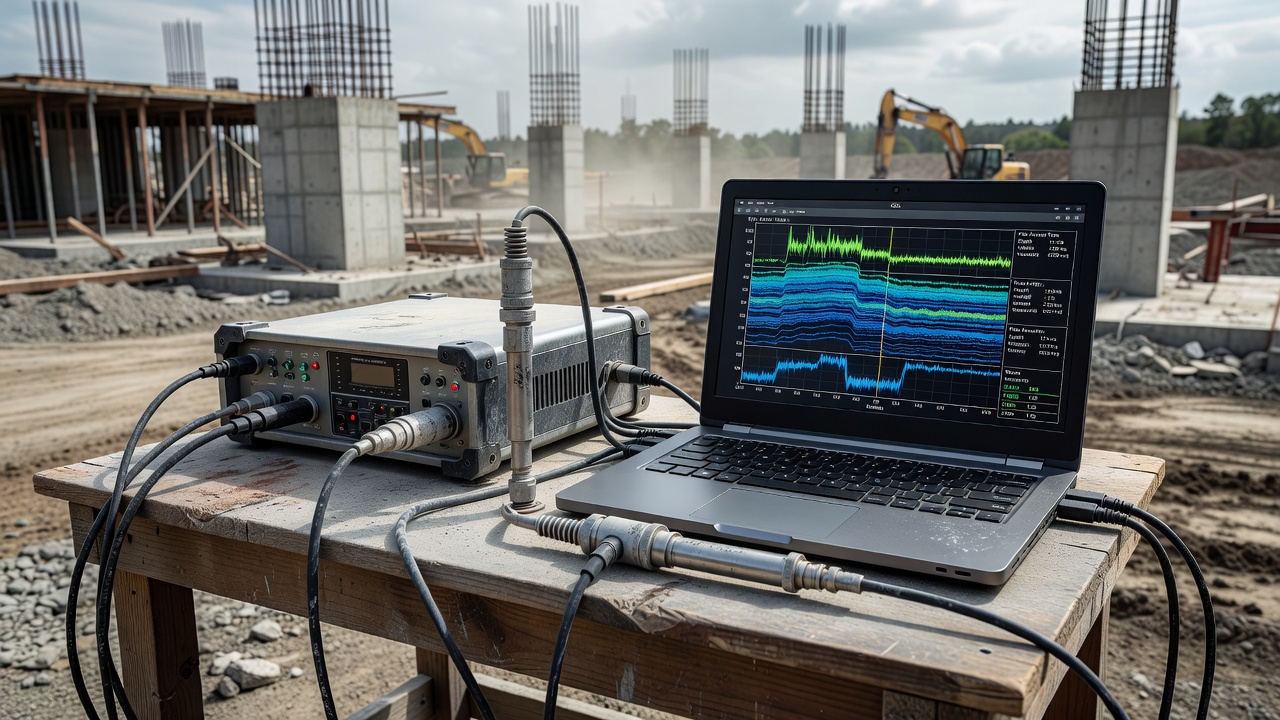
The waterfall diagram enables the analyst to:
- Visually assess the continuity and uniformity of concrete quality along the entire shaft length
- Identify the exact depth of anomaly boundaries
- Distinguish between discrete anomalies (localized FAT/energy changes at a single depth) and extended zones of poor concrete (changes spanning multiple depth increments)
- Detect subtle changes that might not be apparent from FAT or RE profiles alone
- Assess the severity of signal degradation, from minor attenuation to complete signal loss
Data normalization is essential for consistent interpretation. CSL data is typically normalized to a baseline segment of the shaft that exhibits representative sound concrete properties. Deviations from this baseline are expressed as percentages. The DFI task force recommends that CSL rating criteria not rely solely on hard boundary values (e.g., “FAT > 20% = defect”) but instead incorporate the shape, size, location, and extent of anomalies, as well as their persistence across multiple tube pairs, into the evaluation.
6. CSL Tomography
CSL tomography (also called crosshole tomography or ultrasonic tomography) is an advanced extension of standard CSL that produces two-dimensional (2D) or three-dimensional (3D) images of the internal condition of a drilled shaft. While standard CSL provides a series of point measurements along discrete horizontal raypaths between adjacent tube pairs, tomography reconstructs the spatial distribution of wave speed across the full cross-section of the foundation element.
Principle of tomography:
Standard CSL uses only horizontal raypaths, the transmitter and receiver probes are maintained at the same elevation, providing one measurement per depth increment per tube pair. In tomographic data acquisition, additional angled or diagonal raypaths are collected by offsetting the transmitter and receiver probes vertically. For example, the transmitter may be at depth D while the receiver is at depth D+0.3 m (D+1 ft), producing a raypath that traverses the concrete at an angle.
By acquiring multiple angled raypaths at each depth level, a dense network of intersecting paths is established through the concrete volume. The travel time along each raypath represents the integrated effect of the concrete properties along that path. Tomographic inversion algorithms, typically based on Simultaneous Iterative Reconstruction Technique (SIRT) or algebraic reconstruction, iteratively solve for the wave speed distribution that best fits the observed travel times across all raypaths.
Tomographic data acquisition:
- Multiple offsets: Typically 5 to 15 vertical offsets per tube pair, ranging from zero (horizontal) to offsets equal to the tube spacing
- Bidirectional measurements: Transmitter in Tube A, receiver in Tube B, and vice versa
- All tube pairs: Each adjacent and diagonal pair is tested with full offset series
- Depth increments: 50-200 mm (2-8 inches) for the horizontal passes, passes repeated at each offset
The result for a shaft with four access tubes (six tube pairs) and ten offset positions per pair is approximately 60 raypaths per depth level, vastly more information than the six horizontal raypaths of standard CSL.
Tomographic imaging output:
The inversion process produces velocity contour maps or color-coded tomograms showing the spatial distribution of P-wave velocity across the shaft cross-section. These images:
- Delineate the shape, size, and position of anomalies within the shaft
- Distinguish between central core defects (within the reinforcement cage) and peripheral defects (in the cover zone), though limitations exist for defects entirely outside the tube array
- Provide quantitative velocity values across the cross-section
- Enable volume estimation of defective concrete for structural capacity evaluation
When tomography is indicated:
Tomography is not performed routinely, it is a diagnostic tool deployed when standard CSL indicates potential anomalies. According to the DFI task force and FHWA guidance, tomography is recommended when:
- Standard CSL shows localized FAT delays or energy reductions in one or more tube pairs
- Anomaly boundaries are unclear from standard CSL profiles
- The spatial extent of a suspected defect must be defined for repair planning
- Structural capacity calculations require detailed knowledge of defect size and location
- Verification of anomaly character is needed before coring or other invasive investigation
Limitations of tomography:
- Rigid raypath assumption: Most tomographic algorithms assume straight raypaths, but ultrasonic waves refract at velocity boundaries, bending toward higher-velocity zones. This can distort tomographic images, particularly at sharp velocity contrasts.
- Tube position uncertainty: If access tubes are not parallel (due to cage deformation), the assumed raypath geometry is incorrect, introducing systematic errors in the inversion.
- Resolution limits: Tomographic resolution is controlled by raypath density and wavelength. Features smaller than half the wavelength (approximately 50-100 mm at 40 kHz in concrete) are not resolved.
- Cover zone blind spot: Like standard CSL, tomography cannot reliably image concrete outside the array of access tubes.
7. Anomaly Classification
The classification of CSL anomalies has evolved significantly through the work of the Deep Foundations Institute (DFI) Task Force on CSL Terminology and Evaluation Criteria, published in October 2019. This document established standardized terminology and evaluation criteria to replace inconsistent, agency-specific rating systems that had proliferated across the industry.
Standardized terminology per DFI:
| Term | Definition |
|---|---|
| Anomaly | Abnormal data that deviates from expectations, and may indicate a flaw or defect |
| Flaw | Any imperfection in the planned shape or material of the foundation that may not necessarily affect its performance |
| Defect | Any flaw that, because of size, location and inferred concrete properties, will have a significant adverse effect on the performance of the foundation |
This hierarchy is critical: not all anomalies are flaws, and not all flaws are defects. The DFI task force explicitly cautions against using the term “defect” until an irregularity has been proven likely to significantly reduce the shaft’s capacity or durability.
CSL classification categories recommended by DFI:
Class A (Acceptable): CSL results are within normal expected ranges for sound concrete. First arrival times are consistent with the baseline, and relative energy is high throughout the profile. Minor localized variations (FAT increase < 10%) that do not persist across multiple tube pairs are considered acceptable.
Class B (Conditionally Acceptable): CSL results show anomalies that are not clearly Class A or Class C. FAT increases of 10-20% and/or moderate energy reductions are observed in one or more tube pairs. Class B shafts require additional evaluation, typically involving tomography, coring, structural analysis, or a combination, to determine whether the anomalies constitute flaws or defects affecting foundation performance.
Class C (Highly Abnormal): CSL results show significant deviations from expected values, with FAT increases exceeding 20% and/or severe energy reductions, often across multiple tube pairs and contiguous depth intervals. Class C shafts are presumed to contain significant defects requiring remediation, repair, or replacement unless detailed investigation demonstrates otherwise.
The DFI task force emphasizes that CSL classification alone should not be the sole basis for shaft acceptance or rejection. The evaluation must consider:
- Anomaly size, shape, and location relative to the shaft cross-section
- Anomaly position along the shaft length, defects near the top (high load transfer zone) are more critical than those at mid-depth
- Persistence across multiple tube pairs, anomalies present in only one tube pair may be localized and less critical
- Shaft design parameters, axial vs. lateral loading, end-bearing vs. friction shaft, seismic demands
- Redundancy, number of shafts in the foundation system
- Construction records, tremie logs, concrete placement records, cage installation reports
Common anomaly types and their CSL signatures:
- Void (air-filled): FAT increase > 20%, near-complete energy loss, sharp anomaly boundaries, waveform showing only noise
- Soil inclusion: FAT increase of 15-30%, severe energy loss, ragged anomaly boundaries, possible multiple narrow anomalies
- Honeycombing: FAT increase of 10-25%, moderate to severe energy reduction, graded anomaly boundaries with gradual transition to sound concrete
- Necking (reduced cross-section): FAT increase proportional to section reduction, energy loss varying with severity, anomaly extending over some depth range
- Segregation: FAT increase of 10-20%, energy reduction, anomalies typically in upper shaft zones where aggregate settled
- Soft bottom (weak toe concrete): Progressive FAT increases and energy reductions over the bottom 0.5-2.0 m of the shaft, often associated with sediment accumulation at the base
Research summarized by the DFI task force indicates that CSL can reliably detect flaws occupying 10-15% or more of the cross-sectional area when located within the reinforcement cage between access tubes. Flaws outside the cage in the cover zone may remain undetected even if they occupy a larger percentage of the cross-section, because the ultrasonic raypaths do not pass through those zones.
8. CSL for Bridge Foundations
Bridge foundations are among the most critical applications of Crosshole Sonic Logging. Drilled shafts supporting bridge piers, abutments, and tower foundations are typically large-diameter (1.0 to 3.5 meters or 3 to 12 feet), heavily loaded, and constructed in challenging subsurface conditions where undetected defects could lead to catastrophic failure.
The FHWA Geotechnical Engineering Circular No. 10 (GEC-10), Drilled Shafts: Construction Procedures and Design Methods (FHWA-NHI-18-024), provides comprehensive guidance on CSL for transportation structures. According to GEC-10, CSL is the primary non-destructive test method specified for drilled shaft integrity verification on Federal-aid highway projects. The document states that CSL should be performed on 100% of production shafts on major bridges, unless alternative NDT methods are specifically justified.
CSL application to bridge foundation types:
Bridge pier shafts: Large-diameter drilled shafts (1.5-3.5 m) supporting multi-column bents or single-column piers. CSL is essential for verifying the integrity of these shafts, which are typically designed for combined axial, lateral, and moment loading from superstructure dead load, live load, wind, seismic, and scour effects.
Bridge abutment shafts: Smaller-diameter shafts (1.0-1.8 m) supporting abutment foundations. CSL is specified for abutment shafts in seismic zones or where subsurface conditions (soft soils, karst, scour-prone streams) increase the risk of construction defects.
Cable-stayed and suspension bridge anchorages: Massive concrete anchorages for cable-stayed and suspension bridges often contain multiple drilled shaft groups or large-diameter shafts (up to 4.0 m). CSL provides quality assurance for these critical tension-resisting foundation elements.
Marine bridge foundations: Shafts constructed in riverine, coastal, or offshore environments where tremie concrete placement through water or drilling slurry increases the risk of defects. CSL is the primary method for verifying shaft integrity where visual inspection of the exterior is impossible.
Cost-benefit considerations for bridges:
The cost of CSL testing (typically $500-$2,000 per shaft, depending on depth, number of tubes, and reporting requirements) is negligible compared to the cost of a foundation failure or the expense of remedial work after load has been applied. According to FHWA data, the cost of repairing a defective shaft discovered during construction is typically 3-10 times the cost of CSL testing for all shafts on the project. The cost of remediating a shaft that fails under service loads is orders of magnitude higher, often requiring partial or complete bridge demolition.
Project requirements for CSL on bridge projects:
Most state Departments of Transportation (DOTs) have supplemental specifications based on ASTM D6760 that include:
- Testing frequency: Typically 100% of production shafts for major bridges, 50% for lesser structures
- Tube requirements: Minimum 4 tubes for shafts > 1.2 m diameter, spacing not exceeding 355 mm
- Testing age: Concrete age minimum 7 days or 70% design strength
- Data submission: Raw data files, processed profiles (FAT, RE, velocity, waterfall diagrams), and an interpretive report signed by a Professional Engineer
- Acceptance criteria: Typically based on velocity reduction thresholds (some DOTs use 10-20% reduction as “questionable,” >20% as “poor”)
- Investigation protocol: Defined procedures for investigating anomalies, including tomography, coring through the anomaly zone, and structural capacity evaluation
9. CSL vs Low-Strain Pile Integrity Testing
CSL and Low-Strain Pile Integrity Testing (PIT) are the two most widely used NDT methods for deep foundations, but they serve different purposes and have fundamentally different capabilities. Understanding their differences is essential for selecting the appropriate method for a given project.
Low-Strain Pile Integrity Testing (PIT), standardized by ASTM D5882, uses a hand-held hammer to impart a low-strain impact on the pile head. The impact generates a compressive stress wave that travels down the pile shaft. Reflections of this wave occur at changes in impedance (cross-sectional area changes, material property changes, cracks, voids) and at the pile toe. A sensor (accelerometer or geophone) mounted on the pile head records the reflected wave signal. The resulting reflectogram (velocity vs. time plot) is analyzed to identify reflection events and their arrival times, which are converted to depth using the known wave speed in concrete.
| Parameter | CSL (ASTM D6760) | PIT (ASTM D5882) |
|---|---|---|
| Principle | Ultrasonic transmission between tubes | Stress wave reflection from pile head |
| Access tubes required | Yes (installed pre-concrete) | No |
| Depth limitation | None (practical limit: tube length) | L/D ratio < 40-45 for reliable toe detection |
| Resolution | High (can detect 10% cross-section anomalies) | Moderate (15-20% cross-section changes) |
| Defect localization | Precise depth and circumferential position | Depth only, no circumferential information |
| Tomography capability | Yes (2D/3D velocity imaging) | No |
| Soil stiffness effect | None | Can mask or distort toe reflections |
| Test speed | 15-45 minutes per tube pair | 2-5 minutes per pile |
| Planning requirement | Must be specified before concrete placement | Can be performed at any time |
| Interpretation difficulty | Moderate (requires pattern recognition) | High (requires wave propagation expertise) |
| Equipment cost | Higher (probes, encoder, multichannel system) | Lower (hammer, sensor, data collector) |
| Per-test cost | $500-$2,000 per shaft | $100-$500 per pile |
When CSL is preferred:
- Large-diameter drilled shafts (> 1.0 m) where PIT wave reflections from the pile head are too weak to provide reliable data
- Deep foundations with L/D > 40 where PIT toe reflections are indistinct
- Critical infrastructure (major bridges, high-rise buildings, marine structures) where high-resolution defect detection is required
- Shafts requiring detailed defect mapping for structural capacity evaluation or repair design
- Piles with variable soil conditions that would mask PIT reflections
- Projects where access tubes are already specified for quality assurance
When PIT is preferred:
- Small-diameter piles (0.3-0.9 m) where tube installation is impractical
- Predominantly friction piles where integrity issues are most likely near the pile head
- Rapid screening of large numbers of piles (e.g., 200+ piles on a building project)
- Budget-constrained projects where the cost of CSL cannot be justified
- Retrospective testing of existing foundations where access tubes were not installed
- Pre-construction baseline testing for quality control
Combined use of CSL and PIT:
For major infrastructure projects, a dual-approach strategy is increasingly common: PIT is performed on all production piles for initial screening and qualitative assessment, while CSL is performed on a subset of critical piles or piles that show anomalous PIT results. This approach balances cost and coverage. FHWA GEC-10 recommends that for drilled shafts with CSL, supplementary PIT testing may provide additional information about overall shaft condition, particularly for detecting defects above the top of the access tubes.
10. CSL and Foundation Inspection
CSL is an integral component of comprehensive deep foundation inspection programs that span the entire construction process from excavation through acceptance. The method is specified in construction contracts, referenced in quality assurance plans, and recognized by building codes and transportation agency standards as the primary NDT method for verifying drilled shaft integrity.
Integration with construction inspection workflow:
CSL testing is not performed in isolation, it is one element of a multi-layered quality assurance framework that includes:
- Pre-construction: Subsurface investigation, foundation design review, contractor qualification, and CSL specification development
- During construction: Continuous inspection of drilling, cage placement, tube installation, concrete placement (tremie monitoring), and concrete sampling/testing
- Post-construction: CSL testing at specified concrete age, followed by data analysis and reporting
- Acceptance: Engineering evaluation of CSL results combined with construction records, concrete test data, and potentially other NDT results
Timing of CSL in the construction sequence:
CSL testing is performed when concrete has achieved sufficient strength but before the shaft is loaded by superstructure construction. Typical timing:
- Minimum 7 days after concrete placement (most common specification)
- Alternative criterion: 70% of 28-day design compressive strength confirmed by cylinder testing
- Shaft head must be trimmed to cut-off elevation and the top of the shaft prepared flush
- Access tubes must be cut off flush with the finished shaft surface or extended above it with fittings
Correlation with construction records:
The most reliable CSL interpretations are those that correlate anomalies with construction events. A comprehensive inspection program includes:
- Tremie log review: Depth of tremie pipe, concrete levels vs. time, interruptions or delays in concrete supply
- Concrete placement records: Volume of concrete placed vs. theoretical volume (overbreak/underbreak indicators), concrete temperature, slump test results
- Cage installation records: Cage placement depth, centering device condition, tube alignment verification
- Drilling records: Excavation method, casing installation, slurry use and properties, base cleaning procedure
- Water or slurry inflow events: Locations where groundwater or drilling slurry entered the excavation during concrete placement
Anomalies that correlate with recorded construction events, particularly delays, concrete supply interruptions, or slurry management issues, are more confidently diagnosed as genuine defects requiring remediation. Anomalies with no corresponding construction event record may warrant additional investigation before deciding on remediation.
Remediation options based on CSL results:
When CSL identifies anomalies classified as defects requiring remediation, several options are available depending on defect size, location, and structural significance:
- Structural analysis: If the remaining sound cross-section is adequate for design loads, the shaft may be accepted with documentation
- Core drilling verification: Coring through the anomaly zone provides physical confirmation of defect type and extent, cores are visually examined for honeycombing, soil, or void structure and tested for compressive strength
- Grouting: Pressure grouting of void zones through drill holes can fill empty voids and restore some structural continuity
- Shaft enlargement: Excavation around the defect zone and placement of additional concrete (limited to shallow anomalies)
- Shaft rejection and replacement: For shafts with defects that cannot be repaired or that occupy a critical portion of the cross-section, rejection and replacement may be the only option
- Foundation system modification: Adding additional shafts to redistribute load away from the defective shaft
Reporting requirements per ASTM D6760:
The CSL test report must include, as a minimum:
- Project identification, shaft number, and test date
- Tube layout diagram with orientation (north reference)
- Equipment description and calibration records
- Test parameters (frequency, gain, sampling rate, pull rate)
- Data for each tube pair: FAT profile, relative energy profile, velocity profile, waterfall diagram
- Baseline concrete velocity and anomaly thresholds used
- Identification and classification of anomalies
- Professional interpretation and recommendations
- Engineer of Record signature and stamp
The QR-secured report format increasingly adopted by transportation agencies links field evidence directly to the final report, supporting transparent communication with owners, contractors, and regulatory agencies.
CSL for ongoing structural health monitoring:
While CSL is primarily a construction quality assurance tool, it is occasionally used for post-construction evaluation of existing foundations where access tubes were installed during original construction but no initial CSL was performed, or where changes in condition (e.g., after a seismic event, scour exposure, or change in loading) warrant re-testing. Tubes that have been maintained with caps and kept clear of debris can be re-accessed years after construction for repeat CSL testing. The comparison of baseline CSL data (from initial construction) with re-test data provides the most sensitive indicator of developing defects.
The DFI task force emphasizes that CSL is most valuable when performed proactively as part of a planned quality assurance program, rather than reactively after a problem is suspected. When access tubes have been properly installed and maintained, CSL provides deep foundation engineers with the most comprehensive, high-resolution data available for assessing the internal integrity of concrete deep foundations.
Frequently Asked Questions
- What is Crosshole Sonic Logging (CSL) and how does it work?
- Crosshole Sonic Logging (CSL) is an ultrasonic non-destructive testing method standardized under ASTM D6760 for evaluating the integrity of deep foundation elements. It works by transmitting ultrasonic pulses from a transmitter probe to a receiver probe lowered into parallel water-filled access tubes installed inside the reinforcement cage before concrete placement. The pulse velocity, first arrival time (FAT), and signal energy are measured at small depth intervals as the probes are pulled upward from the base to the top of the shaft. Slower wave speeds or attenuated signals indicate potential anomalies such as voids, honeycombing, soil inclusions, or poor-quality concrete between the tube pair.
- What types of anomalies can CSL detect in drilled shafts?
- CSL can detect a range of anomalies including voids and air pockets, honeycombing, soil inclusions (soil trapped in the concrete matrix), necking (reduction in cross-section), concrete segregation, water or sediment intrusion, soft bottom conditions, and poor-quality or low-density concrete zones. According to the Deep Foundations Institute (DFI) task force, CSL can reliably detect flaws occupying approximately 10-15% of the cross-sectional area when located within the reinforcement cage between access tubes.
- How many access tubes are needed for a CSL test?
- For circular drilled shafts, a minimum of three access tubes is required, though four is typical. FHWA and ASTM D6760 recommend one access tube for every 10 to 14 inches (250-355 mm) of shaft diameter. For circular shafts, tubes should be evenly spaced around the perimeter. For rectangular elements such as slurry walls, tubes are placed on each side. The tubes, typically Schedule 40 steel or PVC with 1.5 to 2 inch (38-50 mm) inside diameter, are attached to the inner side of the reinforcement cage prior to concrete placement.
- What is the difference between CSL and Low-Strain Pile Integrity Testing (PIT)?
- CSL (ASTM D6760) uses ultrasonic probes in pre-installed access tubes to measure wave speed and energy between tube pairs, offering high-resolution defect detection and tomography. PIT (ASTM D5882) uses a low-strain impact on the pile head to generate stress waves and analyze reflections, requiring no access tubes but providing lower resolution. CSL has no depth limitation, can map defect shape via tomography, and is unaffected by soil stiffness. PIT is faster, cheaper, and suitable for short piles (L/D under 40-45) where access tubes are not installed.
- How is CSL data interpreted using waterfall diagrams?
- CSL data is commonly presented as waterfall diagrams, where each horizontal line represents the complete ultrasonic waveform at a specific depth. First arrival time (FAT) and relative energy are plotted alongside the waterfall as continuous profiles with depth. The FAT profile shows the arrival time of the first ultrasonic energy, increases in FAT indicate slower wave velocity, suggesting low-quality concrete or defects. The relative energy profile shows signal amplitude, decreases indicate attenuation caused by voids, cracks, or poor concrete. Acceptable concrete typically shows consistent FAT and high energy, while anomalies produce localized FAT delays and energy drops.
- What is CSL tomography and when is it used?
- CSL tomography is an advanced data processing technique that produces 2D or 3D images of the internal condition of a drilled shaft. While standard CSL uses horizontal raypaths (transmitter and receiver at the same elevation), tomography incorporates angled or diagonal raypaths by offsetting the transmitter and receiver probes vertically. This creates a dense array of intersecting ray paths through the concrete, enabling tomographic inversion algorithms to reconstruct the spatial distribution of wave speed. Tomography can delineate the shape, size, and position of anomalies within the shaft, providing more detailed information for repair decisions.
- What are the limitations of Crosshole Sonic Logging?
- CSL has several important limitations: it requires pre-planning to install access tubes before concrete placement, tubes must be parallel for reliable results (cage deformation can cause misinterpretation), CSL cannot detect defects outside the reinforcing cage in the concrete cover zone, coupling issues (air bubbles, debris in tubes) can produce false positives, the method detects anomalies between tube pairs only, zones without tube coverage are not tested, data interpretation requires experienced personnel, and CSL results should not be the sole basis for shaft acceptance or rejection without considering other factors.
- What standards govern CSL testing?
- CSL testing is governed by ASTM D6760 (Standard Test Method for Integrity Testing of Concrete Deep Foundations by Ultrasonic Crosshole Testing) as the primary international standard. The Deep Foundations Institute (DFI) has published Terminology and Evaluation Criteria of Crosshole Sonic Logging as Applied to Deep Foundations, which provides classification guidance. FHWA Geotechnical Engineering Circular No. 10 (FHWA-NHI-18-024) on Drilled Shafts provides extensive guidance on CSL for transportation structures. Various state DOTs have supplemental specifications based on these standards.