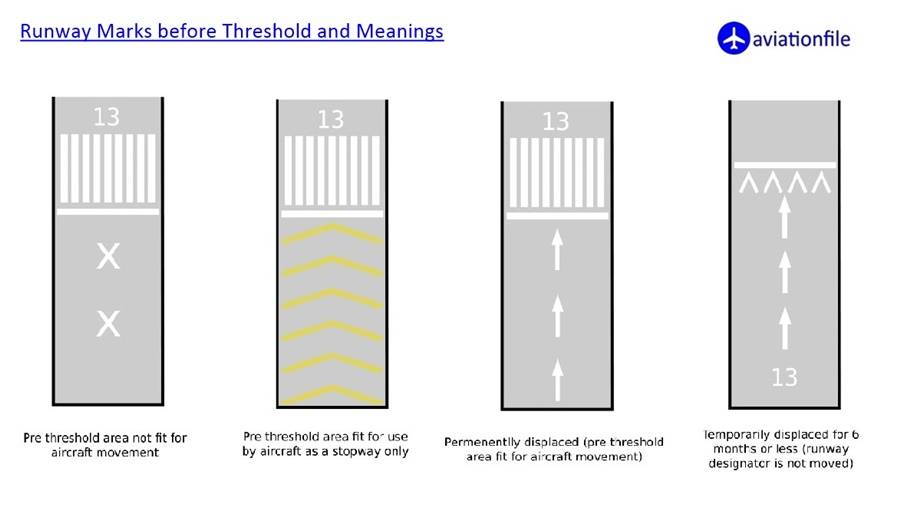
A displaced threshold is a runway marking indicating that the landing threshold is moved further down the runway from its physical beginning. This enables safe clearance over obstacles, pavement protection, noise abatement, and compliance with safety areas, while still allowing the displaced area for takeoff, taxi, and rollout in the opposite direction.
Definition
A displaced threshold is an operational feature of a runway where the touchdown point for landing aircraft is moved a specified distance inward from the physical end of the paved surface. This adjustment is made to enhance safety, accommodate environmental or infrastructure constraints, and optimize runway use. The area before the displaced threshold is clearly marked and is not used for the landing touchdown in that direction, though it remains available for takeoff, taxi, and rollout from the opposite direction.
Purpose and Reasons for Use
Displaced thresholds serve several important purposes:
Obstacle Clearance: Ensures aircraft approach over obstacles (trees, buildings, terrain) at a safe height, as required by ICAO Annex 14 and FAA regulations.
Pavement Protection: Prevents landing on runway sections that are not structurally suitable for touchdown forces, which may be older or temporarily repaired pavement.
Noise Abatement: Shifts landing further from noise-sensitive areas, reducing disturbance to nearby communities.
Safety Area Compliance: Ensures adequate Runway Safety Area (RSA) or Runway End Safety Area (RESA) in accordance with regulatory standards.
Construction or Maintenance: Allows runway use while work is performed near the original threshold.
Proximity to Other Airfield Features: Avoids interference with intersecting taxiways, runways, or protected areas.
Each application is based on evaluating safety, operational efficiency, and regulatory compliance.
Operational Details
Landing: Aircraft must not touch down before the displaced threshold. Doing so may be unsafe or a regulatory violation.
Takeoff: The entire runway, including the displaced section, is typically available for takeoff rolls in both directions.
Landing Roll-Out (Opposite Direction): Aircraft landing from the opposite direction may use the displaced area for roll-out, maximizing stopping distance.
Taxiing: The displaced area may be used for taxiing, depending on airport layout and procedures.
Declared Distances
LDA (Landing Distance Available): Begins at the displaced threshold, not the physical end.
TORA (Takeoff Run Available): Typically includes the full paved length.
TODA (Takeoff Distance Available): Also generally includes the displaced area.
ASDA (Accelerate-Stop Distance Available): Includes the full paved length unless otherwise specified.
Example: A 10,000 ft runway with a 2,000 ft displaced threshold has:
LDA: 8,000 ft (for landing in direction of displacement)
TORA, TODA, ASDA: 10,000 ft (full length)
Types of Displaced Thresholds
Permanent: Result from enduring obstacles, long-term noise abatement, or unrecoverable pavement limitations. Depicted on all official charts.
Temporary: Due to short-term construction, maintenance, or temporary obstacles. Communicated by NOTAMs and updated charts.
Both types must be well-marked and documented for flight crews.
Markings, Signs, and Identification
Displaced thresholds are distinguished by:
White arrows along the runway centerline pointing toward the threshold.
A wide solid white threshold bar (ten feet wide) perpendicular to the centerline.
Arrowheads across the width just before the threshold bar.
Runway numbers start only after the threshold.
Green threshold lights at the displaced threshold (approach side).
Red runway end lights at the true end of the pavement (departure side).
White runway edge lights along both the displaced and landing portions.
Markings and lighting comply with ICAO Annex 14 and FAA AC 150/5340-1.
Lighting for Displaced Thresholds
Threshold Lighting: Green lights at the displaced threshold for approach.
Runway End Lighting: Red lights at the physical end, visible to departing or opposite-direction aircraft.
Edge Lighting: White, possibly amber near runway end.
Approach Lighting Systems: May extend beyond the displaced threshold for additional guidance.
Temporary displacements might use portable lights and extra signage.
Declared Distances and Calculation
Declared distances change as follows:
LDA is shortened by the displacement; starts at the displaced threshold.
TORA, TODA, ASDA usually remain the full runway length unless otherwise noted.
Pilots must use these published values for performance calculations and compliance.
Operational Implications and Practical Considerations
For Pilots
Preflight Planning: Always check current airport diagrams, charts, and NOTAMs.
Landing: Never land before the displaced threshold bar.
Takeoff: Use the full paved runway unless local restrictions apply.
Situational Awareness: Recognize arrow markings, threshold bars, and green lights.
Performance Calculations: Use the correct LDA for safe stopping.
For Airport Operators
Publish Accurate Data: LDA, TORA, TODA, and ASDA must be current and precise.
Mark and Light Thresholds: Strictly maintain markings and lighting to standards.
Communicate Changes: Issue NOTAMs and update charts for any threshold changes.
For Surveyors and Planners
Measure Precisely: Ensure accurate depiction of physical ends and displaced thresholds in all documentation.
Ongoing Assessment: Regularly evaluate the need for threshold displacement due to obstacles, safety area compliance, or environmental changes.
Examples and Use Cases
Farnborough Airport (EGLF): Both runways have a 2,099 ft displaced threshold due to noise abatement and obstacle clearance, reducing LDA to 5,906 ft.
San Jose International (KSJC), Runway 30L: 2,537 ft displaced threshold, LDA reduced to 7,614 ft out of 11,000 ft.
Summary Table: Displaced Threshold Area Usage
Operation
Area Before Displaced Threshold
Area Beyond Displaced Threshold
Takeoff (either direction)
Permitted
Permitted
Landing (toward displacement)
Not Permitted
Permitted
Landing Roll-Out (opposite direction)
Permitted
Permitted
Taxiing
Permitted (as designated)
Permitted
Related Terms
Runway Threshold: The beginning of the portion of the runway available for landing.
Runway Safety Area (RSA): Cleared area to reduce risk to aircraft from undershoots or overruns.
Runway Stopway: Area beyond runway for aborted takeoff roll.
Displaced thresholds are critical for safe, efficient, and compliant airport operations. Understanding their markings, operational implications, and regulatory background is essential for pilots, airport operators, planners, and anyone involved in aviation safety.
Frequently Asked Questions
Displaced thresholds are used to ensure safe obstacle clearance on approach, protect runway pavement from landing impact, reduce noise over sensitive areas, and maintain compliance with safety area requirements. Other reasons include construction, maintenance, or proximity to other airfield features. The area before the displaced threshold is not suitable for landing, but may be usable for takeoff or taxiing.
No, aircraft are prohibited from landing on the area before a displaced threshold in the direction of displacement. This section may not be engineered or cleared for the impact of a touchdown, and landing on it can be hazardous or violate regulations. However, it may be used for takeoff runs and rollout after landing from the opposite direction.
Pilots identify a displaced threshold by distinctive runway markings: white arrows along the centerline lead up to a wide solid white threshold bar, with arrowheads across the width just before the bar. Green threshold lights mark the landing threshold at night. These visual cues ensure pilots know the correct landing point.
Landing Distance Available (LDA) begins at the displaced threshold and is shorter than the full runway length. Takeoff Run Available (TORA) usually includes the entire paved runway, including the displaced area, unless local restrictions apply. Pilots must use the correct declared distances for takeoff and landing calculations.
Displaced thresholds can be permanent or temporary. Permanent displacements address enduring obstacles, noise abatement, or pavement limitations. Temporary displacements result from construction, maintenance, or transient obstacles, and are typically communicated via NOTAMs and temporary signage.
Enhance Runway Safety and Compliance
Discover how understanding displaced thresholds improves pilot performance, airport management, and passenger safety.
A displaced threshold is a relocated runway threshold that shortens the available landing distance from one approach direction, while preserving the full paveme...
A runway threshold is the marked beginning of the portion of a runway usable for landing, indicated by standardized markings and lighting. Thresholds can be sta...
A runway threshold is the marked start of runway surface available for landing, defined by international standards for safety and operational consistency. It in...
6 min read
Airport operations
Runway markings
+2
Cookie Consent We use cookies to enhance your browsing experience and analyze our traffic. See our privacy policy.