What is Distance Measuring Equipment (DME)?
Distance Measuring Equipment (DME)
Distance Measuring Equipment (DME) is a foundational aviation radio navigation system, providing real-time, accurate slant range distance between an aircraft and a fixed ground station. Operating in the UHF band (960–1215 MHz), DME supports pilots and air traffic controllers with essential distance data for en-route navigation, terminal procedures, and precision approaches. Its role in modern aviation is critical, not just as a stand-alone aid, but as a component of integrated navigation suites (like VOR/DME, ILS/DME, and RNAV systems), and as a terrestrial backup for satellite navigation systems.
How DME Works
DME measures the elapsed time between the transmission of interrogation pulses from the aircraft (interrogator) and the reception of reply pulses from the ground-based transponder. The process is as follows:
- The aircraft’s DME unit transmits paired pulses on a specific UHF frequency.
- The ground DME station receives these pulses, waits a standardized 50 microsecond reply delay, and sends paired response pulses back on a paired frequency.
- The aircraft system measures the total round-trip time, subtracts the known reply delay, and converts the remainder to a distance (slant range), displayed in nautical miles.
This slant range includes both the horizontal distance and the aircraft’s altitude above the ground station, meaning the number displayed is the straight-line, not ground track, distance.
DME cannot provide bearing or azimuth information, it strictly measures distance. For bearing, it is often paired with VOR or TACAN systems.
Main Components of a DME System
- Airborne Interrogator: The aircraft’s DME unit, transmitting interrogation pulses and calculating slant range.
- Ground Transponder (DME station): Receives interrogation signals, applies the fixed delay, and sends reply pulses.
- Cockpit Display: Shows slant range (in NM), and often groundspeed and time-to-station.
- Frequency Pairing: When a pilot selects a VOR/ILS frequency, the associated DME frequency is engaged automatically via standardized tables.
DME stations are classified by power and intended use:
| Type | Output Power | Typical Use | Max Range |
|---|---|---|---|
| High-Power DME | ~1,000 W | En-route (w/ VOR) | Up to 199 NM |
| Low-Power DME | ~100 W | Terminal/approach (w/ ILS/LOC) | Local/short |
DME in Integrated Navigation
DME is rarely used alone. Its integration with other aids enables comprehensive navigation:
- VOR/DME: Provides both bearing and distance from a single facility, core to airway navigation.
- VORTAC: Combines VOR, TACAN (with DME), supporting both civil and military users.
- ILS/DME: Used in approaches, replacing marker beacons for identifying step-down fixes and missed approach points.
- DME/DME RNAV: Aircraft FMS can calculate its position by triangulating distances from two (or more) DME stations, enabling RNAV procedures even without GNSS.
Modern avionics automate frequency pairing, reducing pilot workload and enhancing safety during busy flight phases.
Applications and Operational Use
DME supports all phases of flight:
- En-Route Navigation: Used with VOR/DME and VORTACs to define airways, fixes, and facilitate position reporting.
- Terminal/Approach: Short-range DME (co-located with ILS or LOC) is essential for step-down fixes and approach minima, often replacing marker beacons.
- RNAV Procedures: DME/DME allows for precise RNAV operations, especially where VOR or GNSS coverage is limited or unavailable.
- Backup for Satellite Navigation: DME provides a vital backup if GPS/GNSS is degraded or unavailable.
- Military Aviation: TACAN systems use DME for distance, ensuring interoperability at joint-use facilities.
Frequency, Pairing, and Channelization
DME functions within the internationally protected 960–1215 MHz UHF band, using 1 MHz-spaced channels (X and Y modes) for interrogation and reply. Each VOR or ILS frequency is paired (via lookup tables) with a DME channel, simplifying cockpit management and preventing errors.
Pulse pair coding and channel randomization allow multiple aircraft to use the same facility simultaneously without interference. Modern DME ground stations can handle hundreds of interrogations per second.
DME Performance and Limitations
- Accuracy: ±0.2 NM or 3% of distance (whichever is greater), per ICAO standards.
- Resolution: Typically displayed in 0.1 NM increments.
- Slant Range: Displays straight-line distance, at high altitude over the station, the displayed value equals altitude in NM.
- Line-of-Sight: UHF signals require unobstructed paths, terrain or buildings can block or degrade the signal.
- Capacity: Each station is designed for high traffic, with load management to prevent overload.
- No Bearing Provided: DME is strictly for distance, azimuth must be obtained from another navaid.
- Backup Role: Remains essential as a backup in case of GNSS outage, and is required for certain operations.
Regulatory Standards
DME is regulated by ICAO (Annex 10) and national authorities (FAA, EASA). Key requirements include:
- Mandatory Equipment: DME (or RNAV equivalent) is often required above certain altitudes or on specific routes.
- Facility ID: Stations transmit three-letter Morse identifiers, synchronized with co-located VOR/ILS.
- Failure Procedures: Pilots must notify ATC and use alternate navigation if DME fails.
- Frequency Management: DME channels are strictly managed to prevent interference.
Real-World Examples
- En-Route: “15 DME from ABC VOR on the 270 radial” allows precise ATC reporting.
- Approach: Step-down fixes and missed approach points are defined by DME distances (e.g., “At 5 DME, descend to 2,000 ft”).
- DME/DME RNAV: Aircraft FMS uses two or more DMEs for precise, GNSS-independent navigation.
- Backup: DME infrastructure ensures safe navigation during GNSS outages.
Visual Example
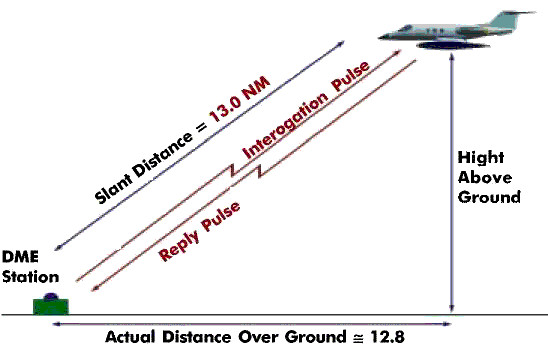
Illustration: Slant range (direct line-of-sight) vs. horizontal ground distance. At altitude directly over the station, the DME reading equals the aircraft’s altitude in nautical miles.
Related Terms
- VOR (VHF Omnidirectional Range): Provides bearing, often paired with DME.
- ILS (Instrument Landing System): For precision approaches, DME provides distance.
- RNAV (Area Navigation): Flexible routing using DME/DME triangulation or GNSS.
- TACAN: Military navigation, includes DME for distance.
- VORTAC: Combined VOR and TACAN, supporting all users.
- Slant Range: Direct, straight-line distance between aircraft and station.
- Frequency Pairing: Standardized method for linking VOR/ILS and DME frequencies.
References
- FAA GBN DME
- Skybrary: Distance Measuring Equipment (DME)
- Wikipedia: Distance Measuring Equipment
- CFINotebook: DME
- ICAO Annex 10, Volume I
- FAA AIM Chapter 1
Last reviewed: July 23, 2025
This entry is created for tarmacview.com and is intended for pilots, engineers, aviation students, and professionals. Always consult current regulatory and manufacturer documentation before flight or system installation.
Frequently Asked Questions
- What is DME and how does it work?
- DME (Distance Measuring Equipment) is an aviation navigation aid that measures the slant range distance from an aircraft to a ground station by timing the round-trip of radio pulses. The aircraft sends interrogation pulses to a ground transponder, which replies after a fixed delay. The elapsed time, minus the known delay, is converted to distance, displayed in nautical miles. DME only provides distance, not bearing.
- How accurate is DME?
- DME typically provides slant range accuracy within ±0.2 nautical miles or 3% of the measured distance, whichever is greater. Its update rate and resolution are sufficient for high-speed and precision operations in all phases of flight.
- Is DME still required with GPS navigation?
- Yes. While GNSS (like GPS) is now primary for navigation, DME is mandated as a backup in many regions and is essential for compliance with certain airspace and procedures, as well as for redundancy in the event of GNSS outages or interference.
- What is the difference between slant range and ground distance?
- Slant range is the straight-line distance between the aircraft and the DME station, incorporating both horizontal and vertical (altitude) components. Directly over a DME at altitude, the distance displayed is the aircraft’s height above the station (in nautical miles).
- What does VOR/DME or ILS/DME mean?
- VOR/DME indicates a navigation facility that provides both azimuth (direction) and distance from a single site, combining VOR and DME. ILS/DME combines precision approach guidance (ILS) with DME distance, often used for step-down fixes and replacing marker beacons on approaches.
This is a reference entry. TarmacView provides drone inspection services and doesn't sell the equipment or materials described in this glossary.