What is Eddy Current Testing (ET)?
Eddy Current Testing for Surface and Near-Surface Defects
1. Principle of Eddy Current Testing
Eddy Current Testing (ET), also referred to as Eddy Current NDT or Electromagnetic Testing, is a non-destructive testing method that uses Faraday’s law of electromagnetic induction to detect discontinuities and measure material properties in electrically conductive materials. The method was first observed by French physicist Léon Foucault in 1855, who demonstrated that a conductor exposed to a varying magnetic field induces circulating electric currents within the material, and was later adapted for industrial applications by Professor Friedrich Forster in 1933, whose work forms the foundation of modern eddy current instrumentation.

1.1 Electromagnetic Induction
The fundamental operating sequence of eddy current testing follows a well-defined chain of physical events. An alternating current (AC) is applied to a wire coil within the eddy current probe. This AC produces a primary alternating magnetic field that oscillates at the same frequency as the driving current, typically ranging from 100 Hz to 10 MHz depending on the application. When the probe is brought within close proximity (typically 0-5 mm) of an electrically conductive material, the fluctuating magnetic field penetrates the material and, by Faraday’s Law, induces an electromotive force (EMF) within the conductor. This EMF causes eddy currents, named for their resemblance to eddies (circular currents) in a flowing stream, to circulate within the material in closed loops.
By Lenz’s Law, these induced eddy currents create a secondary magnetic field that opposes the primary field from the probe coil. The interaction between the primary and secondary fields changes the complex electrical impedance of the coil, comprising both resistive (R) and inductive reactance (X) components. This impedance change is the fundamental measurement parameter in eddy current testing. Any discontinuity in the material, a crack, void, corrosion pit, or thickness change, disrupts the normal flow of eddy currents, forcing them to travel around, beneath, or through the defect. This disruption alters the secondary magnetic field and consequently the coil impedance. The instrument plots these impedance changes on a display, typically as an impedance plane diagram with resistance on the x-axis and inductive reactance on the y-axis, allowing the operator to distinguish between different types of signals.
1.2 Impedance Change and Signal Analysis
The coil is characterized by its complex impedance Z₀ = R₀ + jX₀, where R₀ represents the resistive (real) component corresponding to power dissipation in the coil, and X₀ = 2πfL₀ represents the reactive (imaginary) component proportional to frequency f and inductance L₀. When a conductive test material approaches the coil, two simultaneous effects occur: (1) eddy currents increase power dissipation through Joule heating, causing R to increase, and (2) the secondary opposing magnetic field reduces net magnetic flux, causing X to decrease (inductive reactance drops). The resulting impedance change is visually represented on a normalized impedance plane, where the impedance point moves along characteristic trajectories that correspond to specific material conditions.
Key variables that control eddy current response include: electrical conductivity (σ), higher conductivity produces stronger eddy currents but shallower penetration, magnetic permeability (μ), higher permeability causes severe signal attenuation and background noise in ferromagnetic materials, test frequency (f), higher frequencies increase surface sensitivity but reduce penetration depth, lift-off, the distance between probe and material surface produces a strong signal that must be distinguished from defect signals, edge effect, disruption of eddy currents near material boundaries, and proximity effect, interaction with adjacent conductive materials. The art of eddy current testing lies in understanding how these variables interact and in selecting appropriate parameters to isolate the signals of interest from interfering variables.
1.3 Depth of Penetration and Skin Effect
Eddy currents are strongest at the material surface and decrease exponentially with depth, a phenomenon known as the skin effect. The standard depth of penetration (δ), also called skin depth, is formally defined as the depth at which eddy current density falls to approximately 37% (1/e) of its surface value. The governing equation is:
δ = 1 / √(π · f · μ₀ · μᵣ · σ) (in meters)
For practical field calculations, a simplified formula is used for non-ferromagnetic materials:
δ (mm) = 503 / √(μᵣ · σ · f) where σ is conductivity in %IACS.
At depth 2δ, eddy current density is approximately 14% of the surface value, at 3δ, it drops to 5%, at 5δ, it is below 1% and essentially negligible for detection purposes. The practical detection limit for most subsurface defects is approximately 2-3δ. Frequency selection is the primary control the operator has over penetration depth. In aluminum (30% IACS), at 100 kHz the skin depth is approximately 0.9 mm, while at 1 MHz it reduces to 0.3 mm. For steel bridge inspection, the combination of high magnetic permeability (μᵣ ≈ 100-200) and moderate conductivity (≈ 10% IACS) means skin depth at 100 kHz is only approximately 0.05 mm, explaining why high frequencies (1-2 MHz) are used to concentrate energy near the surface where cracks are detectable.
| Material | Conductivity (%IACS) | Frequency | δ (approx.) | Effective Detection Depth (~3δ) |
|---|---|---|---|---|
| Aluminum 2024 | 30% | 100 kHz | 0.9 mm | 2.7 mm |
| Aluminum 2024 | 30% | 500 kHz | 0.4 mm | 1.2 mm |
| Copper | 100% | 100 kHz | 0.5 mm | 1.5 mm |
| Carbon Steel | ~10% (μᵣ≈100) | 100 kHz | 0.05 mm | 0.15 mm |
| Stainless Steel 304 | ~2.5% | 100 kHz | 3.2 mm | 9.6 mm |
| Titanium 6Al-4V | ~1% | 1 MHz | 1.6 mm | 4.8 mm |
1.4 Key Variables Affecting Eddy Current Response
Six primary variables control the eddy current signal and must be understood for proper test setup and data interpretation. Electrical conductivity (σ) varies with alloy composition, heat treatment, temperature, and mechanical deformation, this makes ET useful for material sorting but also means conductivity variations can mask or mimic defect signals. Magnetic permeability (μ) dominates the signal from ferromagnetic materials (carbon steel, iron, nickel), where small local variations in permeability, caused by residual stress, grain structure, or heat treatment, can produce signals larger than those from cracks. Test frequency (f) directly controls penetration depth according to the skin effect equation. Lift-off, the physical gap between probe and test surface, produces one of the strongest signals in eddy current testing, it is used beneficially for coating thickness measurement but is a noise source in crack detection. Edge effect occurs when the probe approaches within one probe diameter of a material edge, distorting eddy current flow and producing false indications. Proximity effect arises when other conductive materials are near the test region, such as adjacent fasteners or structural members.
2. Eddy Current Probe Types
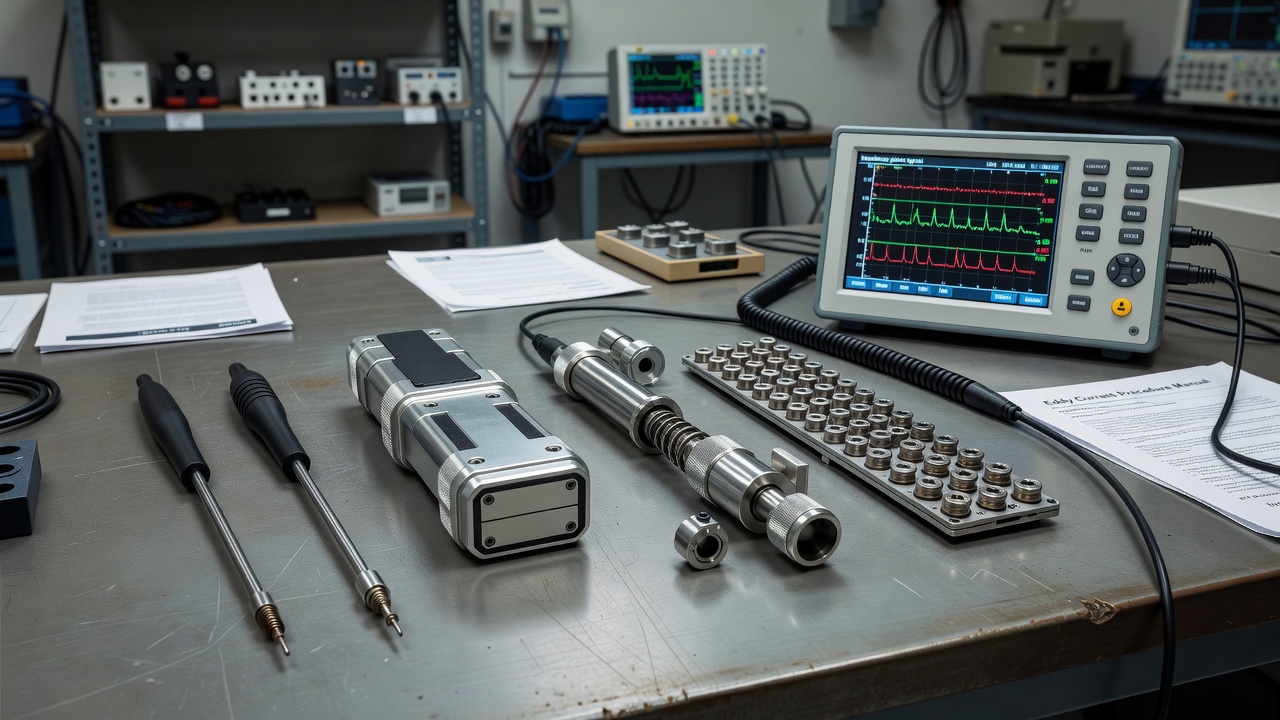
Probe selection is arguably the most critical decision in eddy current test design. The probe determines the spatial resolution, penetration depth, sensitivity to defect orientation, and applicable frequency range of the inspection. The four fundamental probe architectures, absolute, differential, reflection (transmit-receive), and array, each offer distinct advantages and limitations.
2.1 Absolute Probes
Absolute probes use a single test coil that serves as both the exciter, generating the primary magnetic field, and the receiver, sensing impedance changes caused by eddy currents in the test material. The coil measures the absolute impedance relative to a reference or balance state, typically established by nulling the probe in air or on a reference standard. Absolute probes are sensitive to all variables: cracks, conductivity changes, permeability variations, lift-off, and geometry changes. This comprehensive sensitivity makes them useful for measuring absolute material properties, conductivity, coating thickness, and heat treatment condition, but also means they are more susceptible to drift and lift-off noise than differential designs.
Sub-types of absolute probes include shielded and unshielded configurations. Shielded absolute probes incorporate a ferrite ring or cup that constrains and focuses the magnetic field into a small region (typically 3-12 mm diameter), reducing the edge effect and improving sensitivity to small cracks in confined areas such as fastener rows. Unshielded probes have a broader, less-focused field but lower cost and simpler construction. Pencil probes, the most common absolute probe form factor, have coil diameters from 1.5 to 5 mm and operate at frequencies from 100 kHz to 6 MHz, making them ideal for high-resolution surface crack detection. Absolute probes may incorporate a separate balance coil housed in the probe body to maintain stable electrical balance and extend the usable frequency range.
2.2 Differential Probes
Differential probes use two identical active coils arranged side-by-side (in a “figure-8” or back-to-back D configuration) and connected electrically in opposition. The output signal represents the difference between the responses of the two coils. When both coils see identical conditions, gradual conductivity changes, temperature drift, or uniform lift-off, their signals cancel, producing no output. When one coil encounters a localized discontinuity, a crack, pit, or inclusion, that the other coil does not, the signal imbalance generates a characteristic double-peaked indication (first positive, then negative) that is easily recognized by trained operators.
Differential probes offer excellent lift-off compensation, lift-off signals that affect both coils equally cancel out, and are insensitive to slow conductivity or permeability variations, making them ideal for detecting small, sharp discontinuities in tubing, bolt holes, and weld toes. The self-nulling property eliminates the need for frequent rebalancing during scanning. However, differential probes have a critical limitation: they cannot detect long gradual changes such as gentle wall loss from uniform corrosion, long shallow cracks, or slowly varying conductivity gradients, because both coils see the same condition simultaneously and the signal cancels. Defects longer than the coil spacing (typically 3-10 mm) may produce weak or ambiguous signals. Differential probes are the standard choice for rotary bolt hole scanners, where they detect cracks in the hole bore and countersink area with high reliability.
2.3 Reflection (Transmit-Receive) Probes
Reflection probes, also called transmit-receive or driver-pickup probes, use separate coils for excitation and detection. A larger driver coil generates the primary magnetic field, while one or more smaller pickup coils, positioned within the driver coil, adjacent to it, or at a specific spatial offset, detect the secondary magnetic field from the eddy currents. The physical separation of driver and receiver coils provides several advantages: (1) higher gain, the driver coil can be driven at higher current without saturating the receiver electronics, (2) wider frequency range, the separate coils can be optimized for different frequency responses, (3) lower electrical drift, elimination of the bridge balance requirement improves long-term stability, (4) better signal-to-noise ratio, the receiver can be designed with optimal impedance matching for the expected signal range.
Reflection probes excel in applications requiring deep penetration or multi-layer inspection. In aircraft inspection, sliding probes (a type of reflection probe with a specific driver-receiver spatial offset) are used to detect cracks in second-layer aluminum structure beneath the visible skin, operating at frequencies of 1-50 kHz to penetrate through the first layer (typically 1-2 mm thick) and into the underlying chord or splice plate. Ring probes, encircling reflection probes placed over installed fasteners, provide 360° coverage around fastener holes for detecting cracks radiating from the hole edge. Reflection-differential configurations, combining a single driver with two differential receiver coils, are standard in high-speed rotating bolt hole scanners where they provide the best combination of sensitivity, stability, and noise rejection.
2.4 Eddy Current Array (ECA) Probes
Eddy current array (ECA) probes represent the most advanced probe technology, containing multiple individual coil elements (typically 16 to 64 or more) arranged in a row, matrix, or custom geometry in a single probe housing. The coils are multiplexed, activated and deactivated in a specific high-speed sequence, to eliminate mutual inductance interference (cross-talk) between adjacent coils while maximizing spatial coverage. Each element can be configured as absolute, differential, or reflection type depending on the application requirements.
ECA probes offer transformative advantages over conventional single-coil probes: (1) dramatic speed improvement, covering a wide area in a single pass eliminates the need for raster scanning, (2) real-time C-scan imaging with encoded positional data produces visual maps of the inspected region, (3) higher probability of detection (POD), the multi-element coverage is less operator-dependent than manual single-coil scanning, (4) conformable designs, flexible ECA probes can adapt to curved surfaces, pipe diameters, weld caps, and complex geometries, (5) multi-frequency operation, different elements can operate at different frequencies simultaneously, (6) post-processing capability, stored data can be re-analyzed with different filters, gain settings, or analysis algorithms. ASTM E2884-22 provides the standard guide for eddy current testing using conformable sensor arrays, and ASTM E3052-21 specifically covers ECA examination of carbon steel welds. ECA is the method of choice for corrosion mapping, large-area weld inspection, aircraft skin and lap-joint inspection, and heat exchanger tube inspection.
2.5 Specialized Probe Form Factors
Beyond the four fundamental architectures, specific probe form factors have been developed for common inspection scenarios. Surface spot probes are used for low-frequency subsurface crack and corrosion detection (100 Hz-50 kHz), typically having larger diameters (12-25 mm) to accommodate lower frequencies for deeper penetration. Bolt hole probes are designed to inspect the inside diameter of fastener holes, available in manual configurations with adjustable collars for depth indexing and automated versions with rotating scanners for high-speed inspection. Donut probes encircle installed fasteners to detect cracks radiating from the fastener hole without removing the fastener. Sliding probes, used in aircraft multi-layer lap-joint inspection, have a flat, low-profile design that slides along the surface and detects cracks and corrosion through multiple layers. Encircling coils (OD probes) surround cylindrical parts such as bars, tubes, and wires for production-line inspection, while ID probes are inserted inside heat exchanger and boiler tubes for internal surface inspection. Wheel probes incorporate the coil inside a rolling tire assembly for continuous scanning of flat surfaces.
| Probe Type | Typical Application | Frequency Range | Coil Configuration |
|---|---|---|---|
| Pencil Surface Probe | HFEC surface crack detection | 100 kHz - 6 MHz | Absolute (shielded or unshielded) |
| Surface Spot Probe | LFEC subsurface cracks, corrosion | 100 Hz - 50 kHz | Absolute or Reflection |
| Bolt Hole Probe (Manual) | Hole ID crack inspection | 100 kHz - 2 MHz | Absolute or Differential |
| Rotating Scanner Probe | High-speed bolt hole inspection | 100 kHz - 2 MHz | Reflection-Differential |
| Sliding Probe | Multi-layer aircraft structure | 1 - 50 kHz | Reflection (Transmit-Receive) |
| Encircling Coil (OD) | Tube/bar production line | 1 kHz - 1 MHz | Absolute or Differential |
| ID (Bobbin) Probe | Heat exchanger tubing | 1 kHz - 500 kHz | Differential or Absolute |
| Eddy Current Array (ECA) | Wide-area scanning, welds, C-scan | Multiple frequencies | Depends on element type |
3. Crack Detection with Eddy Current Testing
Eddy current testing is one of the most effective NDT methods for detecting surface-breaking and near-surface cracks in conductive materials. Under favorable conditions, surface cracks as small as 0.5 mm in length and 0.1-0.2 mm in depth can be reliably detected. The sensitivity of ET to cracks derives from the physical interaction between eddy currents and the discontinuity: when eddy currents encounter a crack, they are forced to flow around and beneath it, increasing the effective path length and changing both the amplitude and phase of the detected signal.
3.1 How Cracks Affect Eddy Currents
When eddy currents flow through a region containing a crack, the current density distribution is disrupted in three ways. First, the crack presents a high-impedance barrier to current flow, forcing currents to divert around the crack tips and beneath the crack root. This diversion increases the effective current path length, which increases the resistive losses and reduces the inductive reactance. Second, the crack creates a shadow zone immediately beneath the crack where current density is reduced, affecting the secondary magnetic field generated by the eddy currents. Third, at the crack edges, current density concentrates as current lines crowd together, creating local signal peaks that can be used for crack length measurement.
The resulting impedance plane signature depends on the probe type. With an absolute pencil probe, a crack produces a characteristic looping trajectory on the impedance plane as the probe scans across the crack, the signal rotates through a phase angle that correlates with crack depth. With a differential probe, the crack produces a figure-8 or S-shaped double indication (first positive, then negative) as the two coils pass over the crack sequentially. Experienced operators can estimate crack depth from the signal amplitude and phase angle by comparing against calibration standards containing artificial defects of known depth, typically electrical discharge machining (EDM) notches or sawcuts in reference blocks.
3.2 Orientation Sensitivity and Scanning Strategy
Eddy current detection is highly orientation-dependent. Maximum sensitivity occurs when eddy currents flow perpendicular to the crack, the crack interrupts the current path most severely, producing the largest signal. Minimum sensitivity occurs when eddy currents flow parallel to the crack, currents can flow around the crack ends with minimal disruption. This directional sensitivity requires careful scanning strategy for reliable crack detection. With pencil probes (which produce a radial eddy current pattern centered on the probe), cracks in any orientation relative to the scan direction can be detected, but signal amplitude varies with orientation. With differential probes, best results are obtained when scanning perpendicular to the expected crack orientation. Rotary scanners for bolt holes provide 360° coverage, eliminating orientation concerns.
Practical scanning guidelines: For welds, scan longitudinally along the weld toe to detect transverse cracks and transversely across the weld to detect longitudinal cracks. For aircraft skins, scan in both orthogonal directions or use a probe with omnidirectional sensitivity. For bolt holes, rotary scanners provide inherent 360° coverage. The rule of thumb is that eddy current testing cannot detect defects oriented parallel to the surface (lamination-type defects) because such defects do not interrupt the flow of eddy currents, which run parallel to the surface. This is a fundamental limitation of the method.
3.3 Frequency Selection for Crack Detection
Frequency selection involves balancing penetration depth against sensitivity. High-frequency eddy current (HFEC) testing, typically 100 kHz to 6 MHz, concentrates eddy currents near the surface, providing maximum sensitivity to surface-breaking cracks at the expense of limited penetration depth. HFEC is used for surface crack detection in aluminum (100-500 kHz), titanium and stainless steel (1-2 MHz), and magnetic steel (1-2 MHz, where higher frequencies help overcome permeability noise). Low-frequency eddy current (LFEC) testing, 100 Hz to 100 kHz, achieves greater penetration by operating below the frequency where the skin depth is comparable to the depth of interest. LFEC is used for subsurface cracks in non-ferrous structures, second-layer cracks in multi-layer aircraft assemblies (1-50 kHz), and corrosion detection on the far side of thin materials (100 Hz-10 kHz).
The optimum test frequency is typically chosen so that the standard depth of penetration (δ) equals or slightly exceeds the depth of interest. When inspecting for cracks at a known depth d, selecting a frequency where δ ≈ d provides the best balance of sensitivity and penetration. Multi-frequency techniques use two or more frequencies simultaneously, a high frequency for surface sensitivity and a lower frequency for deeper penetration, enabling characterization of defects at different depths in a single scan. Modern digital instruments can simultaneously display signals from multiple frequencies, allowing the operator to correlate responses and separate surface from subsurface indications.
4. Conductivity Measurement and Material Sorting
Eddy current testing’s ability to measure electrical conductivity with high accuracy makes it an indispensable tool for material identification, heat treatment verification, and quality control in manufacturing and maintenance operations. Conductivity is an intrinsic material property that varies with alloy composition, heat treatment condition, temperature, and mechanical deformation, enabling ET to distinguish between different materials and conditions that appear identical externally.
4.1 How ET Measures Conductivity
For non-ferromagnetic materials (μᵣ = 1), the change in coil impedance at a fixed frequency and lift-off is a function of conductivity alone. Modern eddy current instruments use this relationship to measure conductivity by comparing the impedance response from the test material against reference standards of known conductivity. The measurement is typically performed at a frequency of 60 kHz using a specially designed conductivity probe, a shielded absolute probe with a flat sensing surface. Conductivity is expressed in %IACS (International Annealed Copper Standard), where 100% IACS equals the conductivity of annealed copper at 20°C (resistivity of 1.7241 × 10⁻⁸ Ω·m, equivalent to 58 MS/m). ASTM E1004-23, Standard Test Method for Determining Electrical Conductivity Using the Electromagnetic (Eddy Current) Method, defines the test procedure, accuracy requirements (±0.5% IACS of reference value), and applicable materials (nonmagnetic metals with flat or slightly curved surfaces).
| Material | Typical Conductivity (%IACS) |
|---|---|
| Copper (annealed) | 100-102% |
| Aluminum 1100-O | 59% |
| Aluminum 2024-T3 | 30% |
| Aluminum 7075-T6 | 32% |
| Aluminum 6061-T6 | 43% |
| Brass (70/30) | 27% |
| Titanium 6Al-4V | ~1% |
| Stainless Steel 304 | ~2.5% |
| Carbon Steel | ~10% (but permeability dominates) |
4.2 Heat Treatment Verification
Conductivity measurements provide a powerful non-destructive method for verifying heat treatment condition of aluminum alloys and other non-ferrous metals. The relationship between conductivity and heat treatment is governed by the alloying element distribution in the metal matrix. Solution heat treatment and quenching force alloying elements into solid solution, distorting the crystal lattice and scattering electrons, this reduces conductivity. Subsequent aging (precipitation heat treatment) causes alloying elements to precipitate out of solution as fine particles, reducing lattice distortion and increasing conductivity. Overaging causes further precipitation and coarsening, continuing the conductivity increase.
For aluminum alloy 2024: the annealed condition (O temper) has conductivity of approximately 50% IACS, solution treated and naturally aged (T3) has approximately 30% IACS, artificially aged (T6) has approximately 38% IACS, and cold worked and aged (T8) has approximately 40% IACS. A wing spar manufactured at 28% IACS that reads 34% IACS after a fire event indicates loss of heat treatment (overaging), prompting part replacement. Conductivity standards representing a range of values are used to calibrate instruments, and temperature compensation is critical, aluminum conductivity changes by approximately 1% IACS per 20°F (11°C) . All standards and test parts must be at the same temperature for accurate readings.
4.3 Alloy Sorting and Identification
Eddy current conductivity testing is widely used for positive material identification (PMI) and sorting in manufacturing, receiving inspection, and maintenance operations. The method can distinguish between different alloy compositions where conductivity ranges do not overlap, verify that delivered material matches the specified alloy or temper, detect mixed batches in production, and identify clad versus non-clad aluminum alloys. ASTM E703-20 covers electromagnetic sorting of nonferrous metals, and ASTM E566-24 covers sorting of ferrous metals. Limitations include overlapping conductivity ranges between different alloys (requiring supplementary methods such as hardness testing or chemical analysis for definitive identification), and the inability to distinguish alloys with very similar conductivity values.
5. Coating Thickness Measurement
Eddy current testing provides a rapid, non-destructive method for measuring the thickness of non-conductive coatings on conductive substrates, paint, anodizing, powder coating, plastic, ceramic, or other insulating layers on metal surfaces. The measurement principle exploits the lift-off effect: as coating thickness increases, the probe-to-metal distance increases, reducing the eddy current density in the substrate and producing a measurable impedance change. The method works on both ferrous and non-ferrous conductive substrates.
5.1 Amplitude-Sensitive and Phase-Sensitive Methods
Two primary measurement approaches are standardized. The amplitude-sensitive method (ISO 2360:2017) measures the change in signal amplitude as the probe is lifted from the substrate surface by the coating layer. This method is simpler and suitable for non-conductive coatings on non-magnetic conductive base metals. Calibration is performed using coating thickness reference standards of known thickness, and the instrument displays thickness directly based on the lift-off amplitude. The phase-sensitive method (ISO 21968:2019) uses the phase angle of the impedance signal, rather than amplitude, to determine coating thickness. Phase-sensitive measurement offers several advantages: it is less affected by substrate conductivity variations, provides better accuracy for conductive coatings (where the coating itself contributes to the eddy current signal), and maintains accuracy over a wider measurement range.
Practical measurement considerations: Higher test frequencies (1-6 MHz) provide greater sensitivity to thin coatings but limit the maximum measurable thickness. The amplitude-sensitive method is adequate for most paint and anodizing applications (typical range 0-500 μm), while the phase-sensitive method is preferred for thicker coatings or when substrate material variability is a concern. ASTM E376-19 provides the standard practice for measuring coating thickness by magnetic-field or eddy current methods, and ASTM E2338-22 covers characterization of coatings using conformable eddy current sensors without requiring coating reference standards.
5.2 Applications in Aerospace and Manufacturing
Coating thickness measurement with eddy current is extensively used in aerospace maintenance for verifying paint thickness on aircraft skins (excessive paint adds weight and can mask corrosion), anodized layer thickness on aluminum components, and primer thickness on structural parts. In manufacturing quality control, ET coating gauges verify powder coating thickness on metal furniture, appliance enclosures, automotive parts, and architectural components. The method’s portability, instant readout, and ability to measure on complex curved surfaces make it ideal for both laboratory and field use. Calibration requires reference foils or certified coated standards representing the expected thickness range, and measurements should be taken at multiple locations to characterize coating uniformity across the part surface.
6. Eddy Current Testing for Steel Bridges
Eddy current testing is increasingly adopted for steel bridge inspection, particularly for detecting fatigue cracks in welded connections, stiffeners, gusset plates, girder flanges, and other fracture-critical members. The method offers significant advantages over other NDT techniques for bridge applications: eddy currents can penetrate non-conductive paint coatings, typically up to 5 mm thick, eliminating the costly and time-consuming need for coating removal before inspection. This capability alone can reduce inspection preparation time by 50-80% compared to magnetic particle testing (MT) or dye penetrant testing (PT), which require bare metal surfaces.
6.1 Overcoming Permeability Challenges
Ferromagnetic carbon steel presents unique challenges for eddy current testing. The high magnetic permeability (μᵣ ≈ 100-200) of structural steel causes two problems: (1) severe signal attenuation due to the skin effect (skin depth at 100 kHz is approximately 0.05 mm, limiting penetration to the immediate surface), and (2) permeability noise from local variations in magnetic properties caused by residual stress, grain structure variations, heat-affected zones, cold working, and welding. These permeability variations can produce signals larger than those from actual cracks, masking defect indications.
Modern digital eddy current flaw detectors address these challenges through several techniques. Higher test frequencies (1-2 MHz) minimize permeability noise effects because the magnetic properties of steel become more uniform at high frequencies. Specialized probe designs, including shielded pencil probes and reflection-differential probes, help discriminate crack signals from permeability noise based on phase angle differences. Multi-frequency techniques enable the operator to compare signals at two or more frequencies, separating frequency-dependent crack responses from permeability noise. Digital signal processing with filters and phase rotation allows suppression of noise signals while preserving crack indications. With proper equipment and technique, ET can reliably detect surface cracks as small as 0.5 mm deep and 5 mm long in painted steel bridge members.
6.2 Bridge Inspection Applications
Eddy current testing is applied to a wide range of steel bridge components and defect types. Welded connections, the most common location for fatigue cracking, are inspected along the weld toe, heat-affected zone (HAZ), and weld cap. ET can detect toe cracks, undercut, lack-of-fusion near the surface, and crater cracks. Cover plates and stiffeners, where stress concentrations lead to fatigue cracking, are scanned for cracks initiating at the weld termination points. Girder flanges are inspected for transverse and longitudinal cracks, particularly in regions of high stress range and at flange splice locations. Gusset plates at truss connections are scanned for cracks radiating from bolt holes or weld termini. Fracture-critical members (FCMs), components whose failure would cause collapse, receive particular attention, with ET applied to the most highly stressed regions.
The Federal Highway Administration (FHWA) recognizes ET as an accepted NDT method for steel bridge crack detection, and the technique is specified in many state DOT inspection programs. ASTM E3052-21, Standard Practice for Examination of Carbon Steel Welds Using an Eddy Current Array, provides the formal procedure for ECA examination of bridge welds, including probe selection, frequency optimization, calibration on reference standards, and crack depth sizing. The standard covers surface-breaking cracks in carbon steel welds with coating thickness up to 5 mm, addressing flush-ground and not-flush-ground weld geometries.
7. Eddy Current Testing for Aluminum Structures
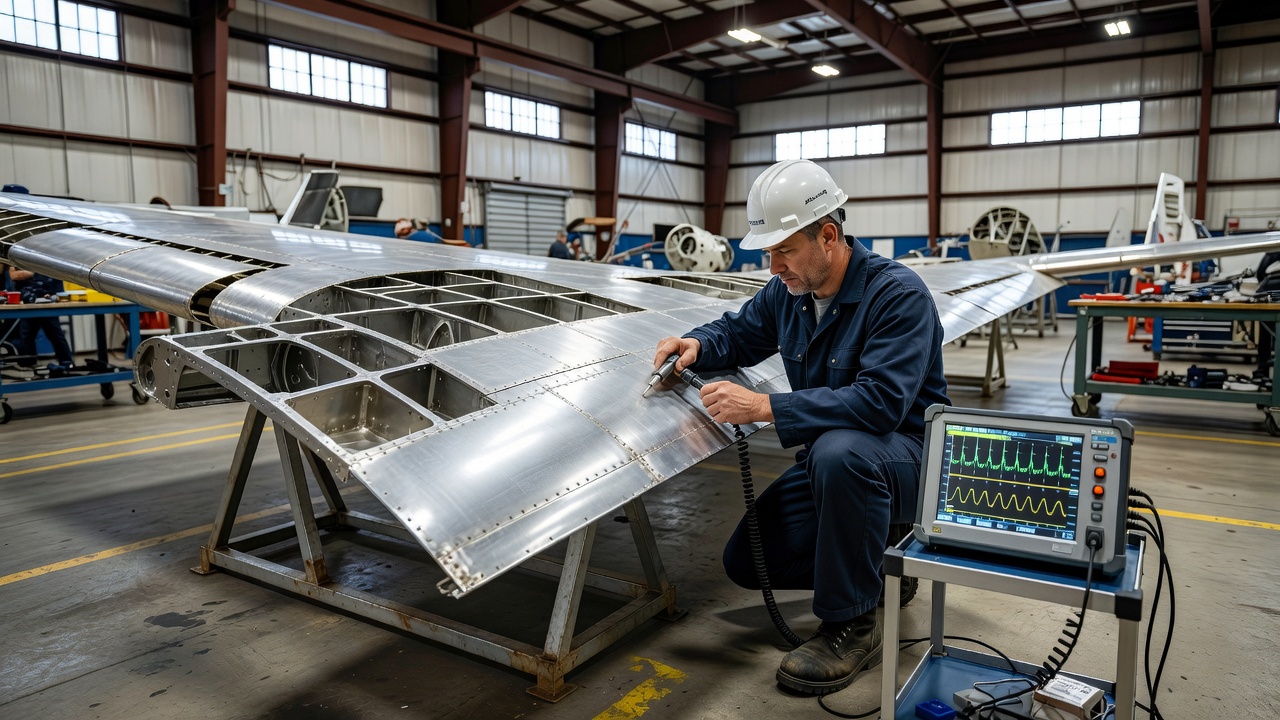
Aluminum is nearly an ideal material for eddy current testing. Its non-ferromagnetic nature (μᵣ = 1) eliminates permeability noise, and its good electrical conductivity (typically 25-60% IACS depending on alloy and temper) produces strong eddy current signals. This makes ET the method of choice for aluminum structure inspection across aerospace, transportation, and industrial applications.
7.1 Aerospace Applications
The aerospace industry is the largest user of eddy current technology, where it is mandated by FAA Airworthiness Directives and specified in aircraft maintenance manuals for inspecting critical structural components. Common aerospace ET applications include: aircraft skin inspection for surface cracks using HFEC pencil probes (100-500 kHz), lap-joint inspection using sliding reflection probes (1-50 kHz) to detect cracks and corrosion in multi-layer skin structures, fastener hole inspection using bolt hole probes and rotating scanners to detect cracks radiating from fastener holes in the skin and underlying structure, corrosion detection and quantification in thin aluminum skin (0.016-0.080 inch thick) where back-side corrosion reduces material thickness, and conductivity-based heat treatment verification to confirm that components have not been subjected to overtemperature conditions. Multi-layer detection is a unique ET capability, low-frequency probes can penetrate through several aluminum layers with non-conducting adhesive bond lines, detecting defects in the second or third layer that cannot be reached by ultrasonic testing due to the planar interface reflections.
7.2 Other Aluminum Structure Applications
Beyond aerospace, ET is applied to welded aluminum structures, including friction stir welds in aerospace and transportation, welded aluminum pipe and tube, and structural aluminum extrusions, for detecting surface and near-surface weld defects. Aluminum tubular products are inspected per ASTM E215-22 (Standardizing Equipment for Electromagnetic Examination of Seamless Aluminum-Alloy Tube) for crack, lap, and seam detection during manufacturing. Aluminum rail cars and marine structures are inspected for fatigue cracking in welded connections. Heat exchanger tubes made of aluminum-brass or other aluminum alloys are inspected with ID (bobbin) probes for pitting, cracking, and wall thinning.
8. Advantages of Eddy Current Testing
The widespread adoption of eddy current testing across industries is driven by a unique combination of advantages that differentiate it from other NDT methods.
No couplant required, Unlike ultrasonic testing, which requires liquid or gel couplant between the transducer and test surface, ET operates with direct contact or a small air gap. This eliminates couplant cleanup, couplant-related contamination concerns, and the need to work with wet surfaces in cold or windy conditions.
Non-contact measurement, The probe does not need to physically contact the test surface. ET can inspect hot materials immediately after heat treatment, underwater structures, and surfaces with limited access. A gap of up to several millimeters can be tolerated, maintained as controlled lift-off.
No surface preparation, ET works through non-conductive coatings, paint, anodizing, primer, powder coating, plastic coatings, up to several millimeters thick. This is the single most significant time-saving advantage in field inspection, eliminating coating removal and reapplication that can account for 50-80% of inspection preparation time in bridge and aerospace applications.
High speed, ET measurements are nearly instantaneous. Production line speeds of up to 150 m/s (500 ft/s) are achievable for tube and wire inspection. Handheld scanning speeds of 0.1-0.5 m/s are typical for field crack detection. Eddy current array probes can scan entire bridge weld details or aircraft skin panels in minutes rather than hours.
High sensitivity, Under favorable conditions, ET can detect surface cracks as small as 0.5 mm in length. This sensitivity exceeds that of visual inspection and dye penetrant testing for many applications and approaches the sensitivity of magnetic particle testing on ferromagnetic materials.
Versatility, A single eddy current instrument with interchangeable probes can perform crack detection, conductivity measurement, coating thickness measurement, material sorting, heat treatment verification, corrosion detection, tube inspection, and bolt hole inspection. This multi-function capability reduces equipment costs and simplifies training.
Automation capability, ET is easily automated for production line inspection of uniform parts, tubes, bars, wires, bearings, and machined components. Automated systems provide consistent, repeatable inspection at high throughput with minimal operator intervention.
Portability, Modern digital eddy current instruments weigh 2-5 kg (4-11 lb) and are battery-powered for field use. Handheld instruments with color displays, impedance plane plotting, and data storage capabilities are available from multiple manufacturers.
Immediate feedback, Results are displayed in real time on the instrument screen, allowing operators to make instant accept/reject decisions and adjust scanning technique as needed.
9. Limitations of Eddy Current Testing
A thorough understanding of ET limitations is essential for selecting the appropriate NDT method and avoiding false calls or missed defects.
Conductive materials only, ET cannot inspect plastics, ceramics, composites (carbon fiber composites are conductive but produce non-homogenous eddy current behavior), concrete, wood, glass, rubber, or other non-conductive materials. This is the most fundamental limitation and the primary reason ET is typically combined with ultrasonic or other NDT methods for comprehensive inspection.
Shallow penetration, The skin effect limits ET to surface and near-surface detection. In aluminum, practical detection depth is approximately 3-10 mm depending on frequency. In ferromagnetic steel, effective detection depth is less than 0.2 mm. Deep subsurface defects (more than 5-10 mm below surface in non-ferrous materials) cannot be detected by conventional ET.
Permeability noise, Ferromagnetic materials (carbon steel, iron, nickel, and their alloys) exhibit local variations in magnetic permeability that produce signals that can mask or mimic crack indications. This requires higher test frequencies, specialized probe designs, and experienced operators for reliable inspection.
Orientation sensitivity, ET cannot detect defects oriented parallel to the material surface (lamination-type defects) because eddy currents flow parallel to the surface and are not interrupted by planar defects parallel to the current flow. Defects oriented parallel to the eddy current flow direction also produce weak or no signals.
Edge effect, When the probe approaches within approximately one probe diameter of a material edge, the eddy current field is distorted, producing a strong signal that can mask defect indications. This requires maintaining a minimum edge distance or using shielded probes.
Lift-off interference, Variations in probe-to-surface distance produce strong signals that must be distinguished from defect signals. While stabilized probes and phase analysis techniques can separate lift-off from defect signals, excessive lift-off or rough surfaces can compromise inspection reliability.
Skilled interpretation required, Eddy current signals are complex and affected by multiple variables simultaneously. Separating crack indications from conductivity variations, lift-off changes, permeability noise, edge effects, and geometry effects requires Level II or Level III certified personnel with significant practical experience.
Reference standards needed, Calibration requires reference standards of the same material, geometry, and heat treatment condition as the test piece, containing artificial defects (EDM notches, sawcuts, drilled holes) of known size. These standards must be purchased or fabricated for each material and application.
Environmental noise sensitivity, Electromagnetic interference from nearby power lines, welding equipment, radio transmitters, and other electrical equipment can introduce noise into ET signals.
10. Standards and Certification for Eddy Current Testing
Eddy current testing is governed by a comprehensive framework of international standards that define equipment requirements, test procedures, data interpretation, personnel qualification, and reporting formats. Compliance with applicable standards is essential for ensuring repeatability, comparability, and legal defensibility of inspection results.
10.1 ASTM Standards
ASTM International, through Subcommittee E07.07 on Electromagnetic Method, publishes the most comprehensive set of ET standards:
| Standard | Title | Scope |
|---|---|---|
| ASTM E3052-21 | Examination of Carbon Steel Welds Using an Eddy Current Array | ECA crack detection and sizing in welds with coating up to 5 mm |
| ASTM E2884-22 | Eddy Current Testing Using Conformable Sensor Arrays | Guide for flexible ECA on curved surfaces |
| ASTM E1004-23 | Conductivity Measurement Using Electromagnetic Method | Standard for %IACS measurement |
| ASTM E376-19 | Coating Thickness Measurement | Magnetic-field and ET methods |
| ASTM E243-24 | Copper and Copper-Alloy Tubes | Electromagnetic examination |
| ASTM E571-24 | Nickel and Nickel Alloy Tubular Products | Electromagnetic examination |
| ASTM E309-24 | Steel Tubular Products | Eddy current examination |
| ASTM E426-16(2021) | Titanium and Austenitic Stainless Steel Tubular Products | Electromagnetic examination |
| ASTM E215-22 | Seamless Aluminum-Alloy Tube | Equipment standardization |
| ASTM E566-24 | Ferrous Metal Sorting | Electromagnetic sorting |
| ASTM E703-20 | Nonferrous Metal Sorting | Electromagnetic sorting |
| ASTM E1629-12(2025) | Absolute Eddy-Current Probe Impedance | Probe characterization |
| ASTM E2338-22 | Coatings Using Conformable Sensors | Without coating reference standards |
| ASTM E690-25 | In Situ Examination of Nonmagnetic Heat Exchanger Tubes | Field tube inspection |
10.2 ISO Standards
International standards for ET include:
- ISO 15549:2019, Non-destructive testing, Eddy current testing, General principles
- ISO 12718:2019, ECT, Vocabulary (defines 200+ terms)
- ISO 15548-1:2013, Equipment, Instrument characteristics and verification
- ISO 15548-2:2013, Equipment, Probe characteristics and verification
- ISO 15548-3:2008, Equipment, System characteristics and verification
- ISO 20339:2017, Equipment for ECT, Array probe characteristics and verification
- ISO 17643:2015, ECT of welds by complex-plane analysis
- ISO 2360:2017, Non-conductive coatings on non-magnetic metals, Amplitude-sensitive method
- ISO 21968:2019, Non-magnetic metallic coatings, Phase-sensitive method
- ISO 20669:2017, Pulsed eddy current testing of ferromagnetic components
- ISO 10893-2:2011, Automated ECT of seamless and welded steel tubes
10.3 Personnel Certification
Eddy current testing personnel must be certified according to recognized schemes. ISO 9712:2021 provides the international framework for NDT personnel qualification and certification, with specific requirements for each NDT method including ET. In North America, ASNT SNT-TC-1A provides recommended practice for employer-based certification programs, while NAS 410 (National Aerospace Standard) governs aerospace NDT personnel certification. Three certification levels exist: Level I, performs specific operations under supervision, Level II, sets up, calibrates, performs, interprets, and reports tests according to procedures, Level III, develops procedures, trains personnel, and manages NDT programs. All levels require documented training hours (typically 40-200 hours depending on level and method), passing a written examination, and demonstrating practical proficiency on representative test specimens.
10.4 Aerospace Standards and Procedures
The aerospace industry maintains specific ET procedures mandated by FAA Airworthiness Directives and detailed in aircraft manufacturer maintenance manuals. Common procedures include: HFEC surface crack inspection of skins (100-500 kHz pencil probes), LFEC subsurface/second-layer inspection (1-50 kHz sliding or spot probes), bolt hole rotary scanning with reflection-differential probes (100 kHz-2 MHz), conductivity measurement per ASTM E1004 (60 kHz), coating thickness measurement per ASTM E376, and corrosion mapping with spot or ECA probes. Calibration features, typically EDM notches of specified depth and length in reference standards, dictate the detectable flaw size for each procedure.
11. Signal Interpretation and Impedance Plane Analysis
The impedance plane display, also called the impedance plane diagram or complex-plane display, is the standard visualization format for modern eddy current instruments. The display plots resistance (R) on the x-axis versus inductive reactance (X) on the y-axis, representing the complex impedance of the probe coil. The combination gives the total impedance vector Z = √(R² + X²), with phase angle φ = arctan(X/R). Changes in material condition, defects, conductivity variations, lift-off, permeability changes, cause the impedance point to move along characteristic trajectories (lissajous patterns) on the display.
11.1 Signal Separation and Phase Analysis
The power of impedance plane analysis lies in phase discrimination, the ability to separate signals from different variables based on their phase angle. When a crack occurs, the impedance vector rotates through a specific phase angle that is relatively constant for a given crack depth and material. Lift-off signals follow a different phase trajectory. By setting a phase rotation control, the operator can align the lift-off signal with the horizontal axis so it produces minimal vertical deflection, while crack signals, occurring at a different phase, produce a vertical indication that is clearly visible. This technique, called lift-off suppression, is fundamental to successful eddy current inspection. Similarly, conductivity changes and permeability variations each produce characteristic phase angles that allow the operator to distinguish them from crack signals with proper setup.
Signal amplitude correlates with defect severity, deeper and longer cracks produce larger signal amplitudes. Signal phase correlates with defect depth, shallower defects produce smaller phase rotations relative to lift-off, while deeper defects produce larger phase rotations. This phase-amplitude relationship enables crack depth sizing when calibration standards with known depth notches are used to establish the correlation.
11.2 Multi-Frequency and Mixing Techniques
Multi-frequency eddy current testing uses two or more test frequencies simultaneously to separate signals from different sources. The technique is particularly valuable for inspecting multi-layer structures, where signals from fasteners, skin, and underlying structure overlap. By operating at frequencies f₁ and f₂, and applying signal mixing, subtracting a weighted version of the f₂ signal from the f₁ signal, the operator can cancel the response from an interfering variable (such as fastener proximity or conductivity variations) while preserving the response from the target defect. Modern instruments can simultaneously display multiple frequency channels and their mixes on separate impedance plane displays, providing comprehensive signal separation.
12. Comparison with Other NDT Methods
Eddy current testing occupies a specific niche in the NDT method spectrum. Understanding its capabilities relative to other methods is essential for selecting the right approach for each inspection scenario.
| Aspect | Eddy Current Testing | Ultrasonic Testing | Magnetic Particle Testing | Dye Penetrant Testing |
|---|---|---|---|---|
| Couplant required | No | Yes (gel, water) | No | No (cleaner required) |
| Surface preparation | Minimal (works through paint) | Requires clean, smooth surface | Requires bare metal (no coating) | Requires clean, bare surface |
| Material requirement | Conductive only | Conductive and non-conductive | Ferromagnetic only | Non-porous surfaces |
| Penetration depth | Shallow (skin effect limited) | Deep (up to several meters) | Surface and near-surface | Surface-breaking only |
| Detection orientation | Perpendicular to current flow | Perpendicular to sound beam | Perpendicular to magnetic field | Any orientation (surface) |
| Speed | Very fast | Moderate | Moderate | Slow (multiple steps) |
| Coating penetration | Yes (non-conductive up to 5 mm) | No | No | No |
| Portability | Excellent | Excellent | Good | Excellent |
| Automation | Excellent (production lines) | Good | Limited | Limited |
| Quantification | Good (depth sizing with calibration) | Excellent (depth, size, orientation) | Limited (length only) | Limited (length only) |
| Personnel skill | High (signal interpretation) | High | Moderate | Low |
ET offers the unique combination of high speed, no surface preparation, no couplant, and coating penetration that makes it the method of choice for surface crack detection in painted structures and for production-line inspection of conductive materials. When combined with ultrasonic testing, ET for rapid surface scanning and UT for deep subsurface volumetric inspection, the two methods provide complementary coverage of both surface and internal defects.
Frequently Asked Questions
- What is Eddy Current Testing and how does it work?
- Eddy Current Testing (ET) is a non-destructive testing method based on electromagnetic induction. An alternating current flows through a coil in the probe, generating an oscillating magnetic field. When brought near a conductive material, this field induces circulating electron currents called eddy currents within the material. These eddy currents generate their own secondary magnetic field that opposes the primary field, changing the coil impedance. Discontinuities such as cracks, corrosion, or material property variations disrupt eddy current flow, altering the impedance signal which is displayed on an instrument for analysis. The method requires no couplant, works through non-conductive coatings up to several millimeters thick, and provides immediate results.
- What types of defects can eddy current testing detect?
- Eddy current testing is highly sensitive to surface-breaking and near-surface cracks as small as 0.5 mm in length under favorable conditions. It detects fatigue cracks, stress corrosion cracks, heat-affected zone cracking, and pitting corrosion in conductive materials. ET also detects subsurface defects in multi-layer structures (up to 2-3 layers deep depending on frequency selection), measures thickness reduction from corrosion on the far side of thin materials, and identifies material property changes including conductivity variations, heat treatment condition, and hardness changes. However, ET cannot detect defects oriented parallel to the surface (lamination-type defects) or defects in non-conductive materials.
- What materials can be inspected with eddy current testing?
- Eddy current testing can only inspect electrically conductive materials. Suitable materials include aluminum, copper, brass, bronze, titanium, stainless steel, carbon steel (surface defects only), Inconel, Monel, and other conductive alloys. ET works exceptionally well on non-ferromagnetic materials (aluminum, titanium, copper, austenitic stainless steel) where magnetic permeability noise does not interfere. Ferromagnetic materials like carbon steel can be inspected but require higher test frequencies (1-2 MHz) and specialized probe designs to minimize permeability variation noise. ET cannot inspect plastics, ceramics, composites, concrete, rubber, wood, or other non-conductive materials.
- What are the advantages of eddy current testing over other NDT methods?
- ET advantages include: (1) No couplant required, unlike ultrasonic testing, no liquid or gel is needed. (2) Non-contact measurement, probe does not need to touch the surface. (3) No surface preparation, works through paint, anodizing, and thin non-conductive coatings up to several mm thick, saving significant preparation time. (4) High speed, capable of scanning at production line speeds up to 150 m/s. (5) High sensitivity, detects surface cracks as small as 0.5 mm. (6) Portable, handheld instruments available for field use. (7) Versatile, single instrument can perform crack detection, conductivity measurement, coating thickness, and material sorting. (8) Multi-layer capability, can detect defects through multiple metal layers. (9) Immediate feedback, real-time results displayed on impedance plane.
- What are the limitations of eddy current testing?
- Key limitations include: (1) Conductive materials only, cannot inspect plastics, composites, ceramics, or concrete. (2) Shallow penetration, limited to surface and near-surface detection due to the skin effect, practical depth limit is approximately 2-3 standard depths of penetration (typically 5-10 mm for aluminum, less for steel). (3) Permeability noise, ferromagnetic materials create signal noise from permeability variations that can mask defect signals. (4) Orientation sensitivity, cannot detect defects parallel to the surface or parallel to eddy current flow direction. (5) Edge effect, signals become unreliable near material edges. (6) Skilled interpretation required, complex signal analysis requires trained Level II or Level III personnel. (7) Lift-off sensitivity, probe-to-surface distance changes create strong signals that must be distinguished from defect signals. (8) Reference standards needed, calibration requires representative standards with known defects or properties.
- What is the standard depth of penetration in eddy current testing?
- The standard depth of penetration (δ), also called skin depth, is the depth at which eddy current density falls to approximately 37% (1/e) of its surface value. It is calculated as δ = 1/√(πfμσ), where f is frequency, μ is magnetic permeability, and σ is electrical conductivity. Higher frequencies produce shallower penetration but better surface sensitivity, lower frequencies penetrate deeper but with reduced sensitivity. For aluminum at 100 kHz, δ ≈ 0.3 mm, at 10 kHz, δ ≈ 0.9 mm. At 2δ (two skin depths), current density is about 14% of surface value, this is the practical detection limit for most subsurface defects. Frequency selection is the primary control the operator has over penetration depth and must be optimized for each application.
- How is eddy current testing used for steel bridge inspection?
- Eddy current testing is highly effective for steel bridge inspection, particularly for detecting surface-breaking fatigue cracks in welded connections, stiffeners, gusset plates, and girder flanges. A major advantage is that eddy currents penetrate non-conductive paint coatings applied to bridge structures, eliminating the costly and time-consuming need for coating removal before inspection. Modern digital flaw detectors with optimized probe designs and higher test frequencies (1-2 MHz) can overcome the permeability noise challenges of ferromagnetic steel. ASTM E3052-21 specifically covers eddy current array examination of carbon steel welds for crack detection and sizing. ET is used by DOT agencies and bridge contractors to inspect fracture-critical members, welded details, and areas prone to fatigue cracking without disrupting bridge operations or requiring lane closures.
- What probe types are used in eddy current testing?
- Four main probe types are used: (1) Absolute probes, use a single coil for both generating and sensing eddy currents, measure absolute material properties, sensitive to all variables including cracks, conductivity, and lift-off. (2) Differential probes, use two opposing coils, self-nulling for gradual changes, excellent for detecting small, localized defects in tubing and bolt holes but can miss long gradual defects. (3) Reflection (transmit-receive) probes, use separate driver and pickup coils, offer higher gain, wider frequency range, and better signal-to-noise ratio, ideal for low-frequency deep penetration and multi-layer inspection. (4) Eddy current array (ECA) probes, contain multiple coils in a single assembly, enable wide-area coverage in a single pass with C-scan imaging, can be conformable for complex geometries.
- What standards govern eddy current testing?
- Key standards include: ASTM E3052-21 (Practice for Examination of Carbon Steel Welds Using an Eddy Current Array), ASTM E2884-22 (Guide for Eddy Current Testing Using Conformable Sensor Arrays), ASTM E1004-23 (Conductivity Measurement), ASTM E376-19 (Coating Thickness), ASTM E243-24 (Copper Tubes), ASTM E571-24 (Nickel Alloy Tubes), ASTM E309-24 (Steel Tubular Products), ASTM E566-24 (Ferrous Metal Sorting), ASTM E703-20 (Nonferrous Metal Sorting), and ASTM E1629-12 (Probe Impedance Determination). ISO standards include ISO 15549:2019 (General Principles), ISO 12718:2019 (Vocabulary), ISO 15548 series (Equipment), ISO 17643:2015 (Weld Examination), ISO 2360:2017 (Coating Thickness, Amplitude Method), and ISO 21968:2019 (Coating Thickness, Phase Method). Personnel certification follows ISO 9712, ASNT SNT-TC-1A, or NAS 410.
- How is conductivity measured with eddy current testing?
- Eddy current instruments measure the phase and magnitude of coil impedance, which correlates directly with electrical conductivity of non-ferromagnetic materials at a fixed frequency and lift-off. Conductivity is expressed in %IACS (International Annealed Copper Standard) where 100% IACS equals the conductivity of annealed copper (58 MS/m). ASTM E1004-23 defines the standard test method. Applications include: verifying alloy composition (aluminum 2024-T3 ≈ 30% IACS, 7075-T6 ≈ 32% IACS), verifying heat treatment condition (solution treated and aged aluminum has different conductivity than annealed), detecting heat damage from fire exposure, sorting mixed material batches, and identifying clad versus non-clad alloys. Temperature compensation is critical, aluminum conductivity changes approximately 1% IACS per 20°F (11°C).