What is flux in photometry and radiometry?
Flux – Rate of Light Energy Flow in Photometry and Radiometry
Flux is the fundamental quantity for describing the rate at which light energy flows through a surface or medium. In the contexts of radiometry and photometry, flux is the bridge between the physical measurement of electromagnetic energy and the perceptual realities of human vision. This makes flux central to nearly every application in scientific, industrial, and regulatory lighting, from the design of aircraft cockpit displays to the calibration of optical instruments and the implementation of safety lighting in transportation and public spaces.
1. Radiometric vs Photometric Systems: Foundations and Key Differences
Radiometry measures the absolute energy carried by electromagnetic radiation, across ultraviolet, visible, and infrared wavelengths, without considering human perception. Its foundation is the watt (W), expressing energy transfer per unit time.
Photometry is a subset of radiometry that considers only visible light, weighting measurements by how sensitive the average human eye is to each wavelength. Photometric units, such as the lumen (lm), candela (cd), and lux (lx), describe light in terms meaningful to human experience, using the CIE Standard Luminosity Function (V(λ)).
| Aspect | Radiometry (Physical) | Photometry (Human Perception) |
|---|---|---|
| Measurement Basis | All electromagnetic wavelengths | Visible wavelengths, eye-sensitivity weighted |
| Key Units | Watt (W), Joule (J) | Lumen (lm), Candela (cd), Lux (lx) |
| Detector Type | Uniform response (e.g., photodiode) | Spectrally weighted (V(λ)-matched) |
| Usage Contexts | Scientific, industrial, technical | Lighting for human use, regulatory standards |
This distinction is critical: technical systems (e.g., fiber optics, remote sensing) use radiometric units, while environments designed for people (e.g., offices, cockpits, highways) rely on photometric quantities.
2. Definition: Flux (Φ) – The Rate of Light Energy Flow
Flux (Φ) is defined as the rate at which energy passes through a surface, mathematically:
[ \Phi = \frac{dQ}{dt} ]
where Q is energy (in joules), and t is time (in seconds). In optics, this can be:
- Radiant flux (Φₑ): Total electromagnetic energy flow, measured in watts (W).
- Luminous flux (Φᵥ): Visible, eye-weighted energy flow, measured in lumens (lm).
Flux is the basis for other quantities: intensity (flux per solid angle), irradiance/illuminance (flux per unit area), and radiance/luminance (flux per unit area per solid angle).
| Quantity | Symbol | Definition |
|---|---|---|
| Radiant Flux | Φₑ | Rate of flow of total electromagnetic energy (radiometry) |
| Luminous Flux | Φᵥ | Rate of flow of visible, eye-weighted energy (photometry) |
| Energy | Q | Total radiant or luminous energy (Joules) |
3. Mathematical Formulation and Units
Radiometric Flux (Φₑ)
[ \Phi_e = \frac{dQ_e}{dt} ]
- SI Unit: Watt (W) = 1 Joule/second
Photometric Flux (Φᵥ)
[ \Phi_v = 683 \int_{380,nm}^{780,nm} \Phi_{e,\lambda} \cdot V(\lambda) d\lambda ]
- SI Unit: Lumen (lm)
| System | Nomenclature | Description | Symbol | Formula | SI Unit |
|---|---|---|---|---|---|
| Radiometric | Radiant Flux | Total energy flow (all wavelengths) | Φₑ | Φₑ = dQₑ/dt | Watt (W) |
| Photometric | Luminous Flux | Visible, eye-weighted energy flow | Φᵥ | Φᵥ = 683 ∫Φₑ,λ V(λ)dλ | Lumen (lm) |
4. The Role of Human Visual Response: CIE Standard Luminosity Function
The CIE Standard Luminosity Function V(λ) defines the relative sensitivity of the human eye to wavelengths from about 380 to 780 nm, peaking at 555 nm (green). This weighting function converts objective energy measurements to perceived brightness.
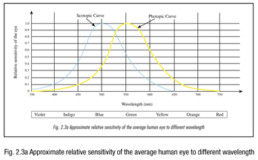
- Photopic vision (daylight): V(λ), peak at 555 nm
- Scotopic vision (low light): V’(λ), peak at 507 nm
[ \Phi_v = 683 \int_{380,nm}^{780,nm} \Phi_{e,\lambda} \cdot V(\lambda) d\lambda ]
Example:
1 watt at 555 nm = 683 lumens.
1 watt at 650 nm (V(λ) ≈ 0.107) ≈ 73 lumens.
These standards ensure that lighting for safety and navigation (e.g., aviation) is optimized for human perception, not just raw power.
5. Measurement Contexts and Practical Examples
Radiant Flux (Φₑ) in Practice
Used in:
- Calibration of IR beacons, UV disinfecting systems, solar sensors, and fiber optics
- Scientific research and technical system calibration
Example:
An IR LED for night vision emits 0.5 W radiant flux, vital for night operations, but invisible to the eye.
Luminous Flux (Φᵥ) in Practice
Used in:
- Specifying lamps, displays, and safety lighting for human use
- Meeting regulatory standards in aviation, workplaces, and public spaces
Example:
Aircraft reading light rated at 300 lm, ensures adequate brightness for pilots without glare.
Measurement Tools
- Radiometric: Thermopiles, flat-response photodiodes, calorimeters
- Photometric: Photometers with V(λ) filters, integrating spheres, lux meters
Integrating Sphere Example:
Captures all emitted light regardless of direction, crucial for certifying aviation lights to ICAO/FAA specs.
6. Extended Terminology: Related Quantities
Flux is the foundation for:
| Quantity | Symbol | Description | Radiometry Unit | Photometry Unit |
|---|---|---|---|---|
| Flux | Φ | Energy per unit time | Watt (W) | Lumen (lm) |
| Intensity | I | Flux per unit solid angle | W/sr | Candela (cd = lm/sr) |
| Irradiance/Illuminance | E | Flux per unit area (incident) | W/m² | Lux (lx = lm/m²) |
| Radiance/Luminance | L | Flux per unit area per solid angle | W/(m²·sr) | cd/m² (nit) |
Example:
- Intensity: Landing light beam (cd)
- Illuminance: Runway surface light level (lx)
- Luminance: Display or surface brightness (cd/m²)
7. Quantitative and Qualitative Examples
Comparing Two Sources
- Source A: 1 W at 555 nm → 683 lm
- Source B: 1 W at 650 nm → 73 lm
Both emit the same physical power, but Source A appears nearly 10× brighter.
Room Lighting
To achieve 500 lx (ICAO/OSHA standard) over 4 m², need a fixture emitting 2000 lumens (500 × 4).
Data Transmission
Optical fiber at 1550 nm (IR): 3 mW radiant flux, critical for communication, but no photometric relevance.
8. Units, Conversions, and Standards
| Quantity | SI Unit | Symbol |
|---|---|---|
| Radiant Flux | Watt | W |
| Luminous Flux | Lumen | lm |
| Luminous Intensity | Candela | cd |
| Illuminance | Lux | lx |
| Luminance | Candela/m² | cd/m² (nit) |
Relationships:
- 1 lumen = 1 candela × 1 steradian (lm = cd·sr)
- 1 lux = 1 lumen/m²
- 1 candela = 1 lumen/steradian
Standards Bodies:
- CIE: Photometric standards and definitions
- SI: International System of Units
- ICAO/FAA: Aviation lighting safety and performance
9. Visual Aids
- Spectral Sensitivity Curves: CIE V(λ) for photopic vision, V’(λ) for scotopic vision
- Integrating Sphere: Used for total luminous/radiant flux measurements
- Comparative Diagrams: Show difference in perceived brightness for different wavelengths at equal power
10. Summary
Flux is the universal metric for the flow of light energy, underpinning both the physical science of radiometry and the human-centered discipline of photometry. By distinguishing between radiant (watts) and luminous (lumens) flux, professionals in aviation, industry, and science can ensure that lighting is measured, specified, and regulated for both objective performance and human safety. The correct understanding and application of flux, guided by CIE, SI, and ICAO standards, are essential for compliance, innovation, and the advancement of optical technology.
Understanding flux, and its radiometric and photometric forms, empowers accurate light measurement, safe system design, and optimal human experience in any environment where light matters.
Frequently Asked Questions
- What is the difference between radiant flux and luminous flux?
- Radiant flux is the total power of electromagnetic radiation (all wavelengths) measured in watts, while luminous flux is the power of visible light weighted by the human eye's sensitivity, measured in lumens.
- Why do we need both radiometric and photometric measurements?
- Radiometric measurements quantify total light energy for technical or scientific applications, regardless of human vision. Photometric measurements are essential for environments where human perception and comfort are priorities, such as workplaces, public spaces, or aviation cockpits.
- How is luminous flux calculated from radiant flux?
- Luminous flux is calculated by multiplying the spectral radiant flux at each wavelength by the human eye’s sensitivity (V(λ)), integrating over the visible spectrum, and scaling by 683 lm/W (the peak efficacy at 555 nm).
- What instruments are used to measure flux?
- Radiant flux is measured using radiometers, thermopiles, or photodiodes with flat spectral response. Luminous flux is measured with photometers equipped with V(λ)-matching filters or integrating spheres for total light capture.
- Why is flux important in aviation and safety lighting?
- Accurate flux measurement ensures that lighting systems meet international safety standards, providing sufficient visibility for pilots and personnel without causing glare, fatigue, or regulatory non-compliance.
This is a reference entry. TarmacView provides drone inspection services and doesn't sell the equipment or materials described in this glossary.