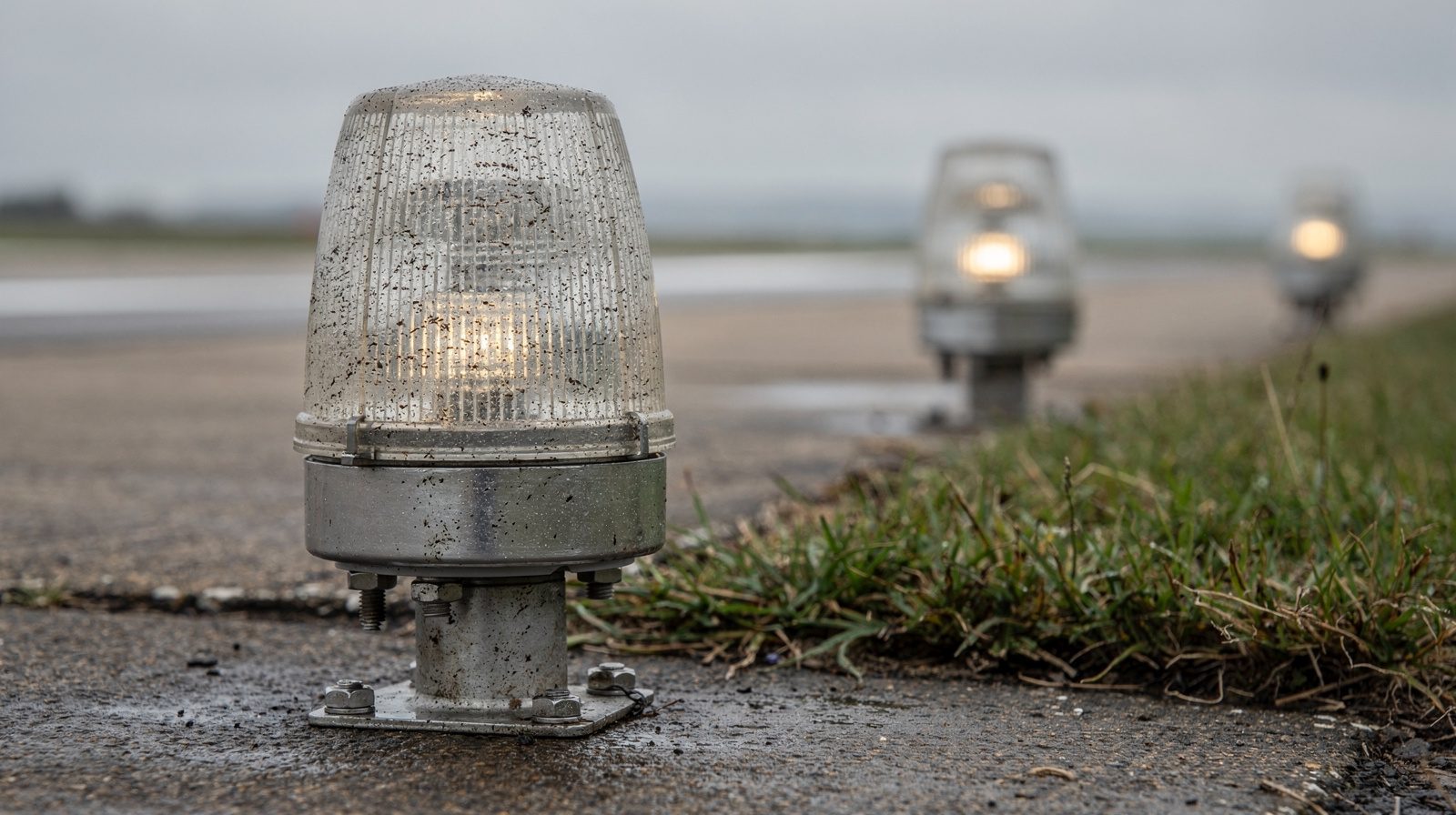
What is an Incandescent Lamp in Airport Lighting?
Incandescent Lamp (Light Source Using Heated Filament) in Airport Lighting
Definition
An incandescent lamp is an electric light source that produces visible light by heating a tungsten filament to high temperatures using an electric current. The filament, encased in a glass bulb filled with inert gas or a vacuum, emits a continuous spectrum of light (incandescence) closely resembling natural daylight in terms of color rendering. Historically, these lamps were the primary technology for airport and airfield lighting, offering instant-on capability, excellent color fidelity, and reliable operation in series circuits controlled by constant current regulators.
Historical Context and Evolution
Early airports used open flames for marking runways and taxiways, but these were unreliable and unsafe. The introduction of incandescent lamps in the 1930s revolutionized airfield lighting, enabling standardized, durable, and instantly controllable lighting systems. By the mid-20th century, incandescent lamps formed the backbone of airport visual aids: runway edge lights, taxiway lights, approach lighting, beacons, and signage.
Their robust design, immediate illumination, and compatibility with constant-current circuits made them the global standard, codified by FAA and ICAO regulations. However, with growing energy efficiency concerns and the rise of LED technology, offering longer life, reduced maintenance, and lower consumption, incandescent lamps are being phased out in favor of newer solutions. Still, they remain in use at many airports worldwide, particularly in legacy infrastructures.
Technical Operation and Construction
Filament and Bulb Design
- Filament: Made from tungsten, chosen for its high melting point (3,422°C) and durability. Often coiled (or coiled-coil) to maximize light output and resist vibration.
- Bulb: Glass envelope, either evacuated or filled with inert gas (argon or krypton) to prevent oxidation and slow tungsten evaporation.
- Base: Standardized types (prefocus, bayonet, screw) for secure mounting and interchangeability.
- Aviation Grade: Designed for harsh airport conditions (temperature swings, moisture, vibration) with reinforced supports and seals.
- Color: Raw light is warm white, external colored lenses or filters are used to comply with aviation color standards.
Electrical and Optical Characteristics
- Series Circuits: Lamps are powered in series by constant current regulators (typically 6.6A AC), ensuring uniform brightness and allowing for precise dimming.
- Photometric Output: Provides a continuous spectrum with high color rendering (CRI ~100). Filters are used to achieve required aviation colors (white, blue, green, or red).
- Instant-On: Achieves full brightness immediately, vital for safety-critical airport applications.
Applications in Airport and Airfield Lighting
- Runway Edge Lighting: Outlines runway boundaries for takeoff/landing, using clear or filtered lamps in weather-resistant fixtures.
- Taxiway Lighting: Blue (edges) and green (centerlines) filtered lamps guide aircraft between runways and terminals.
- Approach Lighting Systems (ALS): Arrays of high-intensity lamps provide alignment cues for landing in low visibility.
- Obstruction Lighting: Red or white lamps mark structures and hazards.
- Illuminated Signage: Lamps backlight runway/taxiway identification signs.
Series Circuit Operation
- Constant Current Regulators (CCR): Maintain uniform lamp brightness across entire circuit.
- Dimming: Adjusted by reducing CCR output current.
- Fail-Safe: Lamp bases may include shunt devices to maintain circuit continuity if a bulb fails.
- Maintenance: Fixtures are designed for easy access and rapid replacement due to relatively short lamp life.
Performance Characteristics
Luminance and Chromaticity
- Luminance: High and instant, essential for visibility in airport environments.
- Color Rendering: Excellent due to continuous spectrum, accurate color discrimination is maintained for all aviation signal colors with proper filters.
Lifespan
- Typical Life: 1,000–2,000 hours, reduced by voltage surges, vibration, frequent cycling, or harsh environments.
- Maintenance: Regular replacement cycles are required, increasing labor and operational costs compared to LEDs.
Energy Efficiency
- Efficiency: Low (5–15% of energy converted to visible light), with most energy lost as heat.
- Heat Output: Can help prevent snow/ice on outdoor fixtures, but represents wasted energy.
Color Rendering and Response Time
- Color Rendering Index (CRI): Near 100, excellent for visual signal recognition.
- Response Time: Instant-on, with no warm-up or cool-down required.
Comparison with LED Technology
| Attribute | Incandescent Lamp | LED (Light-Emitting Diode) |
|---|---|---|
| Efficiency | 10–20 lumens/watt | 80–150+ lumens/watt |
| Lifespan | 1,000–2,000 hours | 35,000–50,000+ hours |
| Maintenance | Frequent bulb changes | Infrequent, reduced labor |
| Color Output | Requires filters/lenses | Direct color emission |
| Heat Output | High (can melt snow/ice) | Low (may need de-icing in cold) |
| Dimming | Simple, linear | Requires driver/electronics |
| Compatibility | Legacy circuit friendly | May need upgrades/drivers |
| Environmental | Higher energy/waste | Lower carbon footprint |
While LEDs offer superior efficiency, lifespan, and maintenance savings, incandescent lamps’ high heat output can prevent snow/ice accumulation on airport lights. LEDs require specific drivers and may need additional anti-icing features in cold climates.
Regulatory Standards
- FAA (U.S.): Advisory Circulars (e.g., AC 150/5345-46) specify lamp/fixture properties for airport use.
- ICAO (Global): Annex 14 defines photometric, chromaticity, and installation standards.
- Testing: Lamps and fixtures must pass photometric and durability tests.
- Transition Policies: Regulatory bodies encourage upgrades to LEDs for sustainability, efficiency, and reduced environmental impact, but require continued compliance with visual performance standards during transitions.
Safety and Operational Implications
- Reliability: Incandescent lamps’ instant-on and robust construction supported safe aircraft operations for decades.
- Maintenance: Frequent replacement is a drawback, proactive programs are necessary to avoid outages.
- Legacy Systems: Many airports still use incandescent lamps where budgets or compatibility limit upgrades.
- Transition to LEDs: Requires evaluation of circuit compatibility, photometric equivalence, and operational training for maintenance staff.
Summary
The incandescent lamp, once the cornerstone of airport and airfield lighting, is renowned for its instant illumination, high color fidelity, and compatibility with standard airport circuits. While superseded by LEDs in most new installations, it remains relevant in legacy systems and as a benchmark for optical performance in aviation lighting. Understanding its operation, advantages, and limitations is vital for airport lighting professionals overseeing both maintenance and modernization efforts.
Further Reading
- FAA AC 150/5345-46: Specification for Runway and Taxiway Lighting Fixtures
- ICAO Annex 14, Volume I: Aerodrome Design and Operations
- LED versus Incandescent Lighting in Airfield Applications – ACRP Synthesis 35
If you are considering upgrading your airport lighting system or need support with legacy incandescent installations, contact our team for expert guidance and solutions.
Frequently Asked Questions
- What is an incandescent lamp and how does it work?
- An incandescent lamp is an electric light source that generates light by passing an electric current through a thin tungsten filament. The filament’s resistance causes it to heat up to temperatures between 2,000 and 3,000 Kelvin, emitting visible light through incandescence. The filament is enclosed in a glass bulb filled with inert gas or a vacuum to prevent oxidation. This technology provides instant illumination and excellent color rendering, making it historically important for airport lighting.
- Why were incandescent lamps widely used in airport and airfield lighting?
- Incandescent lamps became the standard for airport lighting from the 1930s onward due to their immediate full-intensity output, high reliability, robust construction, and superior color rendering. Their compatibility with constant-current series circuits in airfields, ease of dimming, and established regulatory standards (FAA, ICAO) made them ideal for runway edge lights, taxiway lights, approach lighting systems, and obstruction beacons.
- How do incandescent lamps compare to LEDs in airport lighting?
- Incandescent lamps are less energy efficient, converting only 5–15% of energy to light, while LEDs exceed 80–150 lumens per watt. Incandescent bulbs last 1,000–2,000 hours versus 35,000–50,000+ hours for LEDs. LEDs offer precise color output, lower maintenance, and greater energy savings, but incandescent lamps generate enough heat to melt snow/ice on fixtures, which can be beneficial in cold climates. Transitioning to LED often requires infrastructure upgrades for electrical compatibility.
- What are the regulatory standards for incandescent airport lamps?
- The FAA (e.g., AC 150/5345-46) and ICAO (Annex 14) define strict specifications for lamp wattage, intensity, color, beam pattern, and durability. Lamps must undergo photometric testing to ensure compliance. Regulatory bodies have issued transition guidelines to encourage the replacement of incandescent lamps with more efficient technologies, like LEDs, while maintaining safety and performance.
- Are incandescent lamps still used in airports today?
- Yes, although most new airport lighting projects specify LED technology, incandescent lamps remain in use in legacy systems or where budget, supply chain, or compatibility constraints exist. They continue to serve as reference standards for color and optical performance, especially in older installations not yet upgraded to LEDs.
This is a reference entry. TarmacView provides drone inspection services and doesn't sell the equipment or materials described in this glossary.