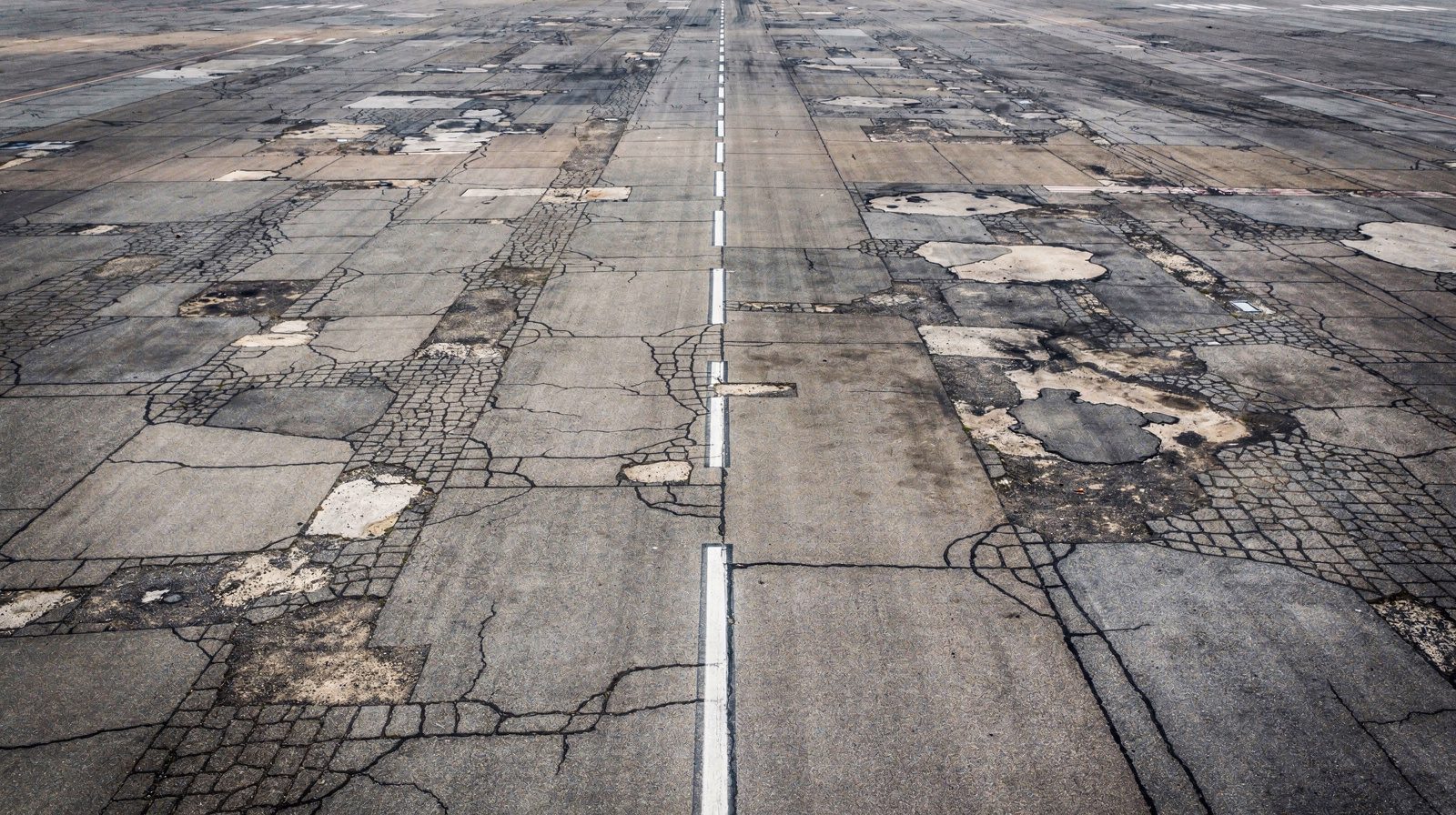
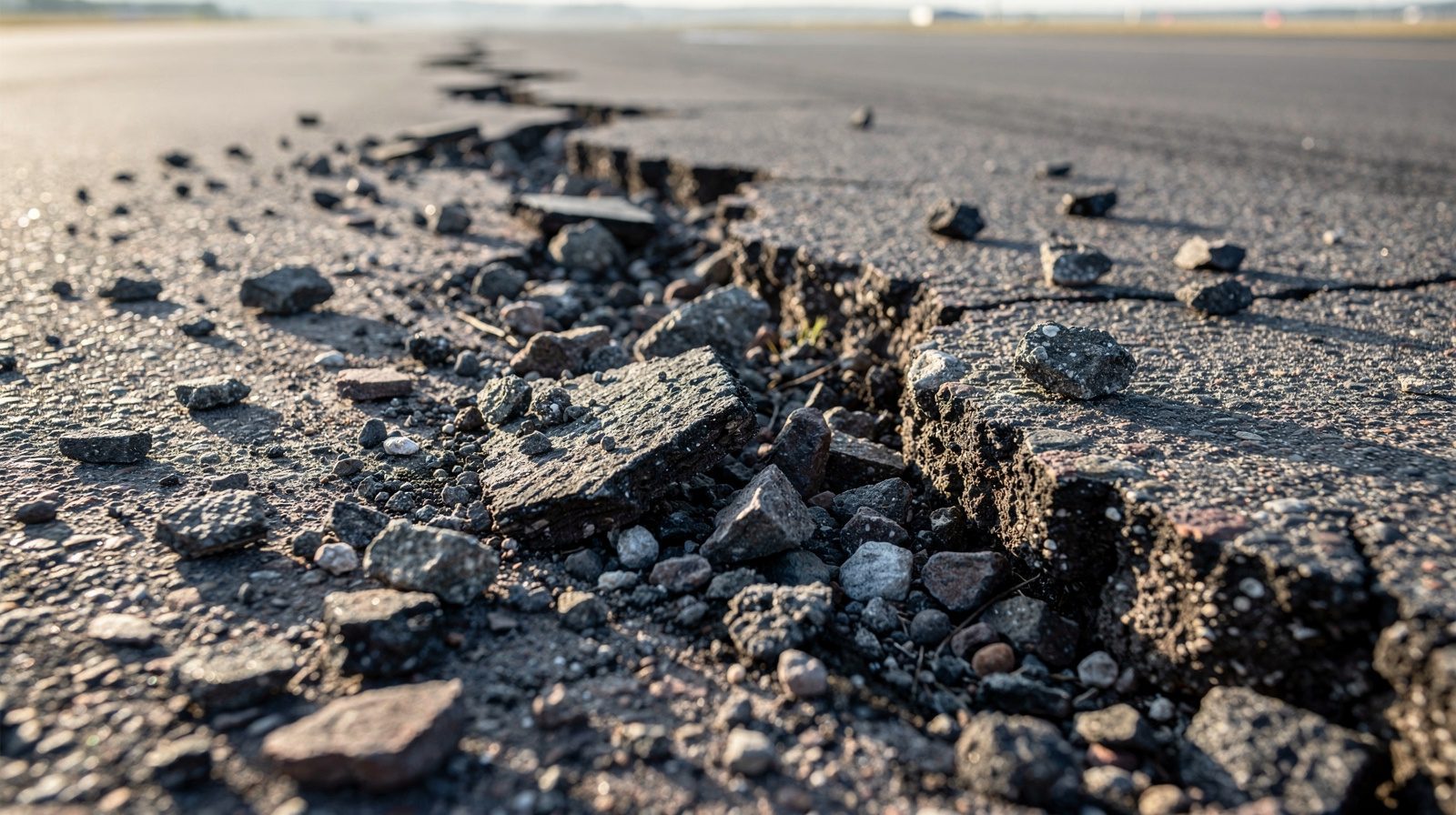
What is Joint Spalling in Concrete Pavements?
Definition and Location of Joint Spalling
Joint spalling is a distinctive and highly prevalent form of deterioration in jointed Portland cement concrete (PCC) pavements, formally defined as the cracking, breaking, chipping, or fraying of the concrete slab edges occurring at transverse and longitudinal joints. In the authoritative FHWA Long-Term Pavement Performance (LTPP) Distress Identification Manual (5th Edition, FHWA-HRT-13-092), joint spalling is classified under the Joint Deficiencies category and is subdivided into two distinct distress types: Spalling of Longitudinal Joints (JCP 6) and Spalling of Transverse Joints (JCP 7). This formal classification reflects the significance of this distress in pavement management systems worldwide.
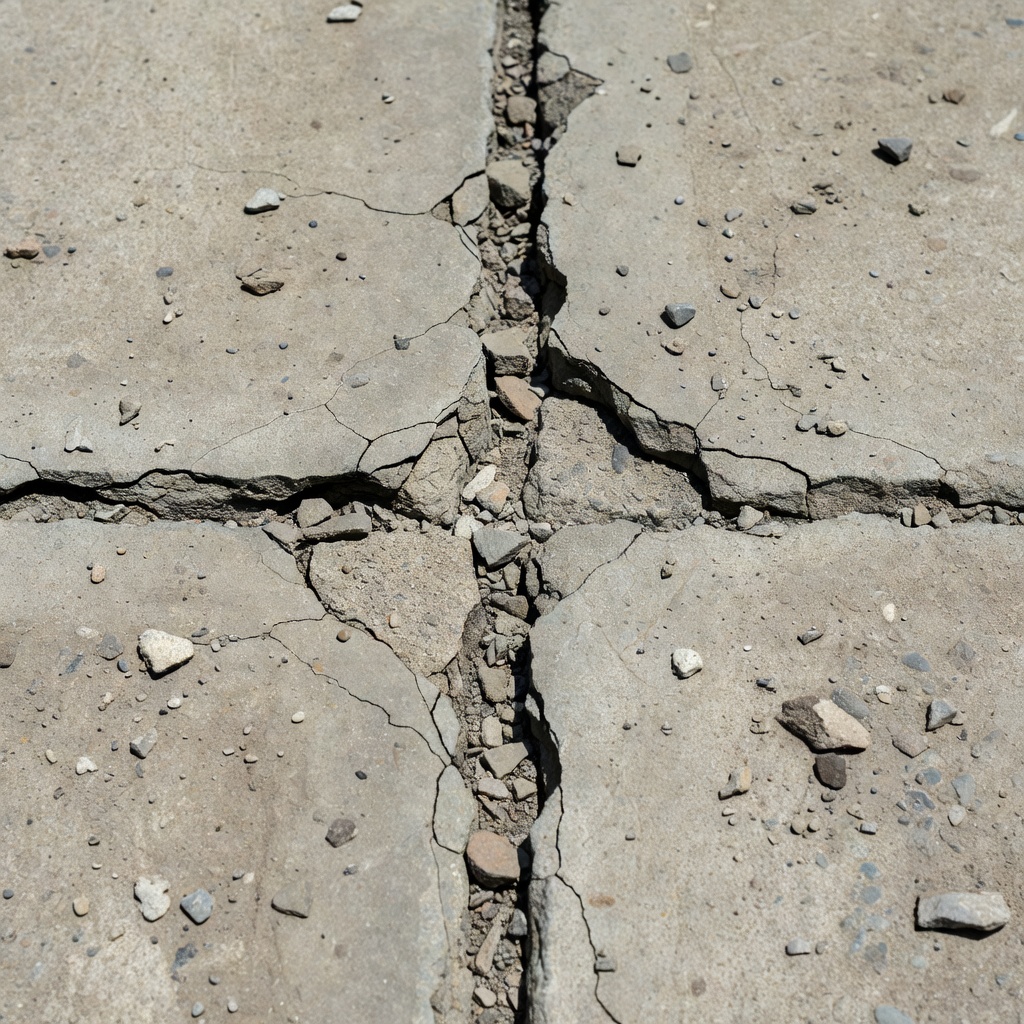
The physical manifestation of joint spalling involves the breakdown of concrete slab edges within approximately 0.6 m (2 ft) of the joint face, as defined by the ASTM Standard Practice for Pavement Condition Index Surveys. The spall does not extend vertically through the full slab thickness in its early to moderate stages. Instead, the fracture plane intersects the joint at an angle, creating a triangular or wedge-shaped zone of broken concrete that is bounded by the joint face on one side and a fracture plane on the other. This angled fracture characteristic is critical for distinguishing joint spalling from full-depth structural cracks. As the distress progresses, the spalled zone expands both laterally along the joint and downward through the slab cross-section.
The spatial distribution of joint spalling follows a predictable pattern across pavement networks. Spalling occurs most frequently at transverse contraction joints where thermal and moisture movements are concentrated. It is also common at longitudinal construction joints and at the intersection points where transverse and longitudinal joints meet, these slab corners are particularly susceptible because they are subjected to stress concentrations from two orthogonal joint systems. In pavements with tied concrete shoulders, spalling at the lane-shoulder joint interface is a frequent finding because the differential movement between the trafficked lane and the shoulder creates shear stresses at the joint edge. The distress can occur on both sides of a joint, but typically develops more severely on the leave side, the side from which traffic exits, because the impact loading from vehicles crossing the joint is higher on that side.
The rate of spalling progression depends on the underlying cause, traffic volume, climate, and joint maintenance history. Spalling caused by incompressible material intrusion can progress from initial hairline edge cracking to severe material loss within 6 to 18 months under heavy traffic, particularly in hot climates where thermal expansion cycles are pronounced. Spalling driven by D-cracking (freeze-thaw aggregate deterioration) progresses more slowly, typically requiring 3 to 8 years to advance from incipient cracking to significant material loss. Understanding this progression rate is essential for pavement management prioritization, spalls that are progressing rapidly due to incompressible intrusion must be addressed with greater urgency than those driven by slower material-related mechanisms.
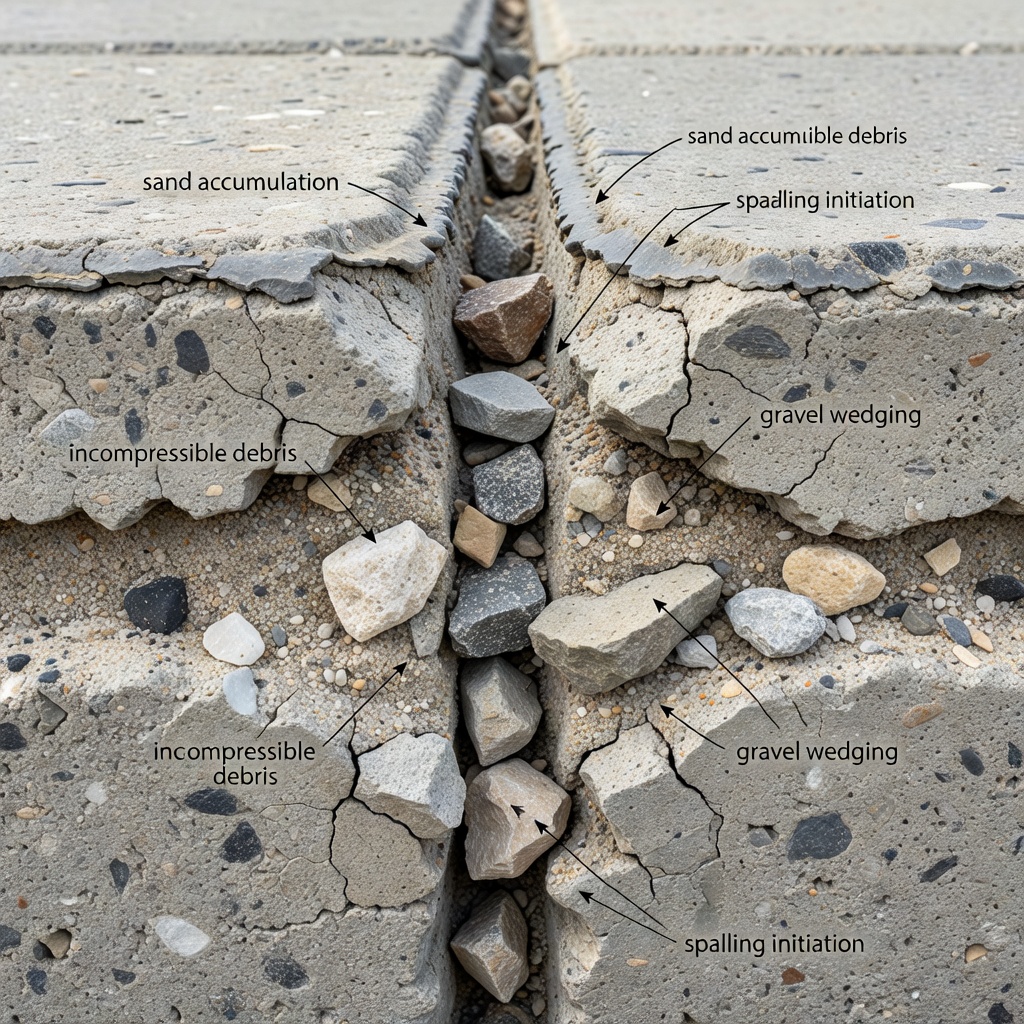
The distinction between joint spalling and crack spalling is an important diagnostic consideration. Joint spalling is confined to the edges of intentionally constructed joints, saw-cut contraction joints, formed construction joints, or preformed expansion joints. Crack spalling, by contrast, occurs at the edges of random cracks that develop within the slab panel. Both involve the same fundamental mechanisms of edge breakdown, but the location relative to the joint or crack network and the structural implications differ. Joint spalling affects the load transfer system (dowel bars, aggregate interlock) and can rapidly progress to faulting and pumping if left unaddressed.
Causes of Joint Spalling
Joint spalling arises from multiple distinct mechanisms that interact with the pavement’s structural, material, and environmental conditions. Identifying the root cause of spalling is essential for selecting appropriate repair strategies and preventive measures. The five primary causal mechanisms are: incompressible material intrusion, D-cracking (freeze-thaw aggregate deterioration), construction defects, traffic-induced fatigue, and freeze-thaw deterioration of the cement paste.
Incompressible Material Intrusion
The most frequently cited cause of joint spalling is the infiltration of incompressible materials, sand, gravel, rocks, debris, and other hard particles, into the joint reservoir. This mechanism is directly linked to joint sealant failure. When the joint sealant deteriorates, debonds, or is extruded from the joint, the resulting void becomes a trap for particulate matter that accumulates on the pavement surface. During periods of thermal expansion, when concrete slab temperatures rise on hot days or during summer months, the slabs expand toward one another, attempting to close the joint gap. If incompressible materials are present in the joint, they prevent full closure, generating high compressive stresses at the slab edges that can exceed the concrete tensile and shear strength. These stresses cause the slab edge to fracture, creating the characteristic spall.
The mechanics of this process are governed by the coefficient of thermal expansion of concrete, which is typically between 8 and 12 microstrain per degree Celsius (approximately 5.5 to 8.5 x 10^-6 per degree Fahrenheit). For a 6 m (20 ft) slab panel subjected to a 30 degree C (54 degree F) temperature increase, the unrestrained thermal expansion would be approximately 1.5 to 2.2 mm (0.06 to 0.09 inches). If even a small amount of incompressible debris fills this gap, the slab cannot expand freely, and the restrained expansion generates compressive stresses that can reach 3.5 to 7.0 MPa (500 to 1,000 psi), sufficient to fracture concrete with typical tensile strengths of 2.5 to 4.0 MPa (350 to 580 psi). The resulting spall propagates from the point of highest stress concentration, typically at the top edge of the joint where the saw-cut creates a stress riser.
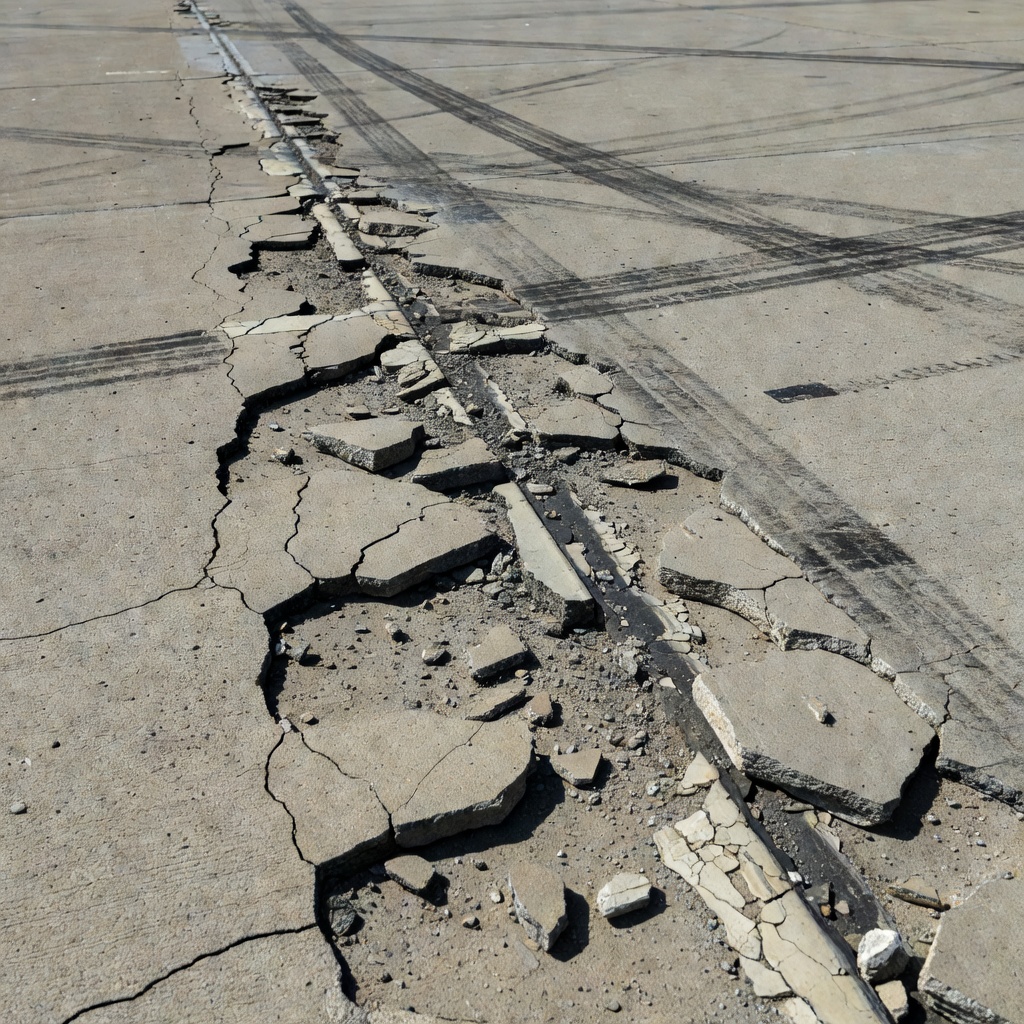
The severity of incompressible-induced spalling depends on the quantity and size of debris trapped in the joint. A few small sand grains may cause minor cosmetic spalling, while gravel or aggregate-sized particles lodged at multiple points along a joint can cause extensive, severe spalling affecting both slab edges over significant joint length. The cyclic nature of the damage is important, each thermal expansion cycle drives the debris deeper into the joint and causes additional fracturing at the spall boundary, progressively enlarging the affected zone. In cold climates, the problem is compounded by the use of deicing chemicals and abrasives (sand, cinders) that accumulate at joints and provide an abundant source of incompressible materials.
D-Cracking (Freeze-Thaw Aggregate Deterioration)
D-cracking, also known as durability cracking (Distress Type JCP 2 in the LTPP system), is a materials-related distress that frequently leads to secondary joint spalling. D-cracking is caused by the freeze-thaw deterioration of susceptible coarse aggregate particles within the concrete. When moisture penetrates the aggregate pore structure and freezes, the expansion of ice generates hydraulic and osmotic pressures that exceed the tensile strength of the aggregate, causing it to fracture from within. This process typically initiates at slab corners adjacent to joints and propagates along the joint line.
The progression from D-cracking to spalling follows a well-documented sequence. In the initial stage, closely spaced crescent-shaped hairline cracks form alongside the joint, with the cracking pattern running parallel to the joint face. At this stage, the concrete surface remains intact, and the cracking is classified as D-cracking (not spalling). As freeze-thaw cycles continue, the aggregate deterioration intensifies, and the D-cracked zone becomes weakened to the point where traffic loading breaks away the surface material, creating a spall at the slab edge. The resulting spall is distinguishable from incompressible-induced spalling by the presence of the characteristic crescent-shaped cracking pattern in the concrete adjacent to the spalled zone and by the dark staining from moisture and deicing chemical accumulation that typically accompanies D-cracking.
The critical distinction between D-cracking-induced spalling and primary joint spalling matters for repair strategy selection. If spalling caused by D-cracking is repaired with a standard partial-depth patch without addressing the underlying aggregate deterioration, the new patching material will not stop the progression of D-cracking in the adjacent concrete, and the repair will likely fail within 3 to 5 years as the D-cracking propagates into the patched area. In such cases, more extensive removal of D-cracked concrete or full-depth slab replacement with freeze-thaw durable aggregate may be necessary.
Construction Defects
Several construction-related deficiencies can predispose concrete joints to spalling. The most significant is overworking of the concrete during finishing operations at the joint location. When concrete is excessively worked, through prolonged vibrating, edging, or troweling, the coarse aggregate is displaced downward, and excess mortar rises to the surface. This creates a weak, mortar-rich zone at the slab edge that has reduced abrasion resistance, lower tensile strength, and increased permeability compared to properly consolidated concrete. The water-to-cement ratio (w/cm) in this overworked zone can be significantly higher than the design w/cm because bleed water accumulates during finishing, further reducing strength.
Inadequate consolidation around dowel bars is another construction-related cause of joint spalling. When the concrete is not properly vibrated during placement around the dowel baskets, voids and honeycombing can develop at the dowel-concrete interface. These voids create stress concentrations that initiate cracking at the dowel location, which can propagate to the slab edge and manifest as joint spalling. The FHWA Technical Advisory on Concrete Pavement Joints (T 5040.30) emphasizes that good concrete consolidation, especially around dowels and tie bars, is essential for satisfactory joint performance.
Improper saw-cut timing and depth also contribute to spalling. If saw-cutting is performed too early (before the concrete has gained sufficient strength), the saw blade causes raveling and edge breakout along the cut, creating a pre-existing spall that worsens under traffic. If saw-cutting is performed too late, uncontrolled random cracking may develop before the joint is cut. The FHWA recommends that saw-cutting begin as soon as the concrete has gained sufficient strength to prevent raveling, typically 4 to 12 hours after placement depending on ambient temperature and concrete mix design.
Traffic-Induced Fatigue Loading
Repeated traffic loading across joints creates fatigue stresses in the concrete at the slab edge that can initiate or accelerate spalling. This mechanism is most significant on high-volume highways and airport runways and taxiways where heavy loads are applied at high frequencies. When a vehicle or aircraft tire crosses a joint, the load is transferred from the approach slab to the leave slab through aggregate interlock and dowel bars. At the joint edge, the unsupported concrete at the slab corner experiences higher tensile and shear stresses than the slab interior, and these stress concentrations can lead to fatigue cracking that manifests as spalling.
Freeze-Thaw Deterioration of Cement Paste
Freeze-thaw deterioration of the cement paste itself can cause joint spalling. This mechanism is distinct from D-cracking and occurs when the paste is not adequately protected by air entrainment. If the air content is too low, the air-void spacing factor exceeds the recommended maximum (0.20 mm per ACI 201), or the concrete is critically saturated near joints, the paste can deteriorate under repeated freeze-thaw cycling, weakening the concrete at the joint edge to the point where traffic loading breaks it away.
| Causal Mechanism | Primary Driver | Typical Time to Onset | Distinguishing Features |
|---|---|---|---|
| Incompressible Intrusion | Failed joint seal + thermal expansion | 6-18 months after seal failure | Spall at joint face, debris visible in joint, both slab edges affected |
| D-Cracking | Freeze-thaw of susceptible aggregate | 10-25 years | Crescent-shaped cracks adjacent to spall, dark staining, slab corners affected |
| Construction Defects | Overworking, poor consolidation | 1-5 years | Isolated spalls at specific joints, weak mortar layer at spall surface |
| Traffic Fatigue | Heavy load repetitions | 5-15 years | Spalling in wheel path locations, associated with faulting and pumping |
FHWA LTPP Severity Classification
The FHWA Long-Term Pavement Performance (LTPP) Program established the definitive standard for classifying joint spalling severity through the Distress Identification Manual (DIM). The classification applies to both Spalling of Longitudinal Joints (JCP 6) and Spalling of Transverse Joints (JCP 7), using a consistent three-level severity system (Low, Moderate, High) based on the degree of cracking, fragmentation, material loss, and FOD (foreign object debris) potential.
Low Severity
Low-severity joint spalling is defined by one of two conditions. First, the spall is broken into one or two pieces defined by low-severity cracks, with little or no FOD potential. Low-severity cracks are characterized by tight crack widths (typically less than 3 mm), no spalling of the crack itself, and no measurable faulting. Second, the spall may be defined by one medium-severity crack (crack width 3 to 6 mm) but still with little or no FOD potential. The spall has not progressed to the point where concrete fragments are loose or missing, and the structural integrity of the joint edge is largely intact. The quantitative criteria for low-severity classification correspond to spall widths of less than 75 mm (3 inches) measured perpendicular to the joint face, with spall depths confined to the upper one-third of the slab thickness.
Moderate Severity
Moderate-severity joint spalling is characterized by more extensive fragmentation and the beginning of material loss. The spall is broken into two or more pieces defined by medium-severity cracks, where a few small fragments may be absent or loose. The medium-severity cracks have widths of 3 to 13 mm. The spalled zone typically extends 75 to 150 mm (3 to 6 inches) from the joint face. The joint sealant is almost always non-functional at this stage. Load transfer efficiency may be reduced because the spalling has compromised the aggregate interlock mechanism at the joint.
High Severity
High-severity joint spalling represents the most advanced stage of joint edge deterioration. The spall is broken into two or more pieces defined by high-severity fragmented cracks with loose or absent fragments. The crack widths exceed 13 mm. Pieces of the spall have been displaced to the extent that a tire damage hazard exists. The spall has deteriorated to the point where loose material is causing high FOD potential, a critical concern for airport pavements where FOD can be ingested into jet engines. At high severity, the spalled zone typically extends more than 150 mm (6 inches) from the joint face, and the depth of material loss may exceed one-third of the slab thickness.
| Severity Level | Spall Fragmentation | Crack Severity | Material Loss | FOD Potential | Typical Spall Width |
|---|---|---|---|---|---|
| Low | 1-2 pieces | Low or one medium crack | None or minimal | Little to none | < 75 mm |
| Moderate | 2+ pieces | Medium cracks | Some fragments loose/absent | Some FOD potential | 75-150 mm |
| High | 2+ pieces | High-severity fragmented cracks | Significant loss, pieces displaced | High FOD/tire hazard | > 150 mm |
Relationship to Joint Sealant Condition
The condition of joint sealant is inextricably linked to the development and progression of joint spalling. The FHWA LTPP Distress Identification Manual explicitly recognizes this relationship by classifying Transverse Joint Seal Damage (JCP 5a) and Longitudinal Joint Seal Damage (JCP 5b) as separate distress types that directly precede and contribute to joint spalling. The causal chain is well-established: sealant failure leads to joint infiltration leads to spalling development.
Sealant Failure Mechanisms
Joint sealants fail through several distinct mechanisms. Adhesive bond failure occurs when the sealant loses its bond to the concrete sidewalls of the joint reservoir, the most common failure mode, caused by inadequate surface preparation during installation or thermal movement stresses. Cohesive failure occurs when the sealant splits within itself, typically due to excessive joint movement relative to the sealant extensibility limits. Extrusion occurs when the sealant is forced out of the joint reservoir by repeated compression cycles. Oxidation hardening causes the sealant to become brittle and lose elasticity.
The FHWA Tech Brief on Joint Sealing (FHWA-HIF-18-019) provides extensive guidance on sealant material selection and installation practices. The Tech Brief emphasizes that joint seals limit the introduction of incompressible materials from entering and becoming lodged in the joint, noting that during periods of thermal expansion, the presence of these incompressible materials may lead to spalling or blowups.
Sealant Material Performance
The choice of joint sealant material significantly influences spalling susceptibility. The FHWA Tech Brief classifies joint seals into three categories: formed-in-place sealants, preformed compression seals, and joint fillers.
| Sealant Type | Typical Service Life | Joint Movement Capacity | Airport Applicability |
|---|---|---|---|
| Hot-poured asphalt (ASTM D6690) | 3-8 years | 50-200% extension | Not recommended for fuel-spill areas |
| Silicone (ASTM D5893) | 8-10 years | 50-100% extension | Yes, with fuel-resistant grades |
| Preformed compression (neoprene, ASTM D2628) | Up to 20 years | Compression-dependent | Yes, with fuel-resistant neoprene |
Silicone sealants are the predominant choice for airport concrete pavement joints because of their fuel-spill resistance, jet-blast resistance, and long service life. The Fed Spec SS-S-200E classification includes silicone formulations designed for airfield applications.
Sealant Reservoir Design
Proper reservoir design is essential for sealant performance. The shape factor, the ratio of sealant depth to width, determines how stresses are distributed within the sealant during joint movement. For silicone sealants, a shape factor of 2:1 (width-to-depth) is recommended by FHWA and ACPA. A backer rod is installed at the bottom of the reservoir to establish the proper sealant depth, prevent three-sided adhesion, and support the sealant during installation.
Sealant Maintenance and Spalling Prevention
Regular joint sealant inspection and maintenance is the single most effective spalling prevention measure for existing concrete pavements. The ACPA recommends that joint sealants be inspected annually and replaced based on expected service life, typically 5 to 8 years for hot-poured asphalt, 8 to 10 years for silicone, and 15 to 20 years for preformed compression seals.
The consequences of deferred joint sealant maintenance follow a predictable timeline. Within 1 to 2 years of sealant failure, incompressible materials accumulate in the joint, and minor edge cracking appears. After 3 to 5 years, moderate spalling develops with loose fragments. After 5 to 10 years, high-severity spalling can develop, potentially requiring full-depth slab replacement. Life-cycle cost analysis consistently shows that timely sealant replacement (at $2 to $6 per linear meter) is far more cost-effective than managing spalling and structural deterioration.
Measurement of Joint Spalling
The measurement protocols for joint spalling are standardized in the FHWA LTPP Distress Identification Manual and in ASTM D6433 and ASTM D5340.
Dimensional Measurement
Joint spalling is quantified through three primary dimensions: spall width, spall length, and spall depth. Spall width is measured perpendicular to the joint face at the widest point of the spalled zone. Spall length is measured along the joint for the total extent of the spalled zone. The LTPP protocol specifies that spalling is only recorded if the total length exceeds 75 mm (3 inches) for longitudinal joints and 100 mm (4 inches) for transverse joints. Spall depth is estimated to determine whether the distress is confined to the upper slab portion or extends through the full slab thickness.
FHWA LTPP Recording Protocol
For Spalling of Longitudinal Joints (JCP 6): The distress is recorded as meters of spalled length at each severity level. For Spalling of Transverse Joints (JCP 7): The distress is recorded as both the number of affected joints and the meters of spalled length at each severity level.
ASTM PCI Measurement
For PCI calculation per ASTM D6433 and ASTM D5340, joint spalling is measured in square meters of affected area. The distress density is calculated as: Distress Density (%) = (Total Spalling Area / Sample Unit Area) x 100. The distress density is then used with the appropriate deduct value curve to determine the deduct value.
Automated Measurement Technologies
Modern AI-powered pavement inspection systems can automatically measure joint spalling from high-resolution pavement images. These systems use computer vision algorithms, deep convolutional neural networks (CNNs) trained on thousands of annotated spalling images, to detect spalled zones at joints, classify severity, and measure dimensions. The automated approach offers consistent classification, precise dimensional measurements with millimeter accuracy, high-speed data collection, and temporal comparison for tracking progression.
| Measurement Parameter | Manual Protocol | Automated (AI) Protocol |
|---|---|---|
| Spall width | Measured at widest point with ruler | Pixel-level measurement from image |
| Spall length | Measured along joint with tape measure | Continuous measurement along detected spall boundary |
| Severity classification | Visual assessment per LTPP criteria | ML classification from crack features |
| Repeatability | Variable (inter-inspector differences up to +/-20%) | High (consistency >95% between survey passes) |
Joint Spalling in Airport PCC Pavements
Joint spalling in airport concrete pavements presents unique challenges due to strict operational safety requirements, lower tolerance for FOD, and aggressive repair thresholds.
FAA Standards and Requirements
The FAA Advisory Circular 150/5380-6C provides the primary guidance for identifying and repairing joint spalling on airport pavements. The FAA classifies joint spalling severity with specific attention to FOD potential. High-severity spalling on runways and high-speed taxiways should be repaired immediately upon detection. The FAA Advisory Circular 150/5320-6G specifies joint design requirements including joint spacing of 4.6 to 6.1 m, joint width of 3 to 8 mm, and concrete material requirements including maximum w/cm of 0.45 and air content of 5 to 7 percent.
ICAO Annex 14 Requirements
ICAO Annex 14 Section 9.4 specifies that the surface of a runway shall be maintained free of any defect that might impair safety. The ICAO Aerodrome Design Manual (Doc 9157, Part 3) recognizes joint spalling as a significant pavement distress and recommends regular inspection and timely repair.
Airport Pavement Condition Index (APCI)
The ASTM D5340 standard for APCI surveys defines joint spalling measurement protocols and deduct value curves calibrated for airfield pavements. The APCI deduct values for joint spalling are higher than highway equivalents, reflecting the increased safety significance.
FOD Prevention Programs
Airport FOD prevention programs include daily visual inspections, regular PCI surveys (every 3 to 5 years), and prompt repair of identified defects. Joint spalling that produces fragments smaller than 25 mm in diameter is a potential FOD hazard because such fragments can be ingested into jet engines.
Detection of Joint Spalling
Visual Inspection
The primary detection method is visual inspection during pavement condition surveys. The visual indicators include: cracking at the slab edge, chipping or fraying of the joint edge, missing material at the slab edge, loose fragments that can be dislodged by tire action, discoloration from moisture and deicing chemical accumulation, and exposed aggregate.
Chain Drag Survey
The chain drag method is a simple acoustic technique. Sound intact concrete produces a clear ringing tone, while deteriorated concrete produces a hollow sound. Chain dragging can detect spalling-related deterioration before surface cracks become visible, making it valuable for early detection.
Ground Penetrating Radar (GPR)
GPR uses electromagnetic pulses to image subsurface conditions. High-frequency antennas (1.5 to 2.6 GHz) detect spalling-related deterioration by identifying changes in dielectric properties. GPR surveys can be conducted at traffic speed (up to 80 km/h).
Impact Echo Testing
Impact echo uses mechanical impact to generate stress waves. In joint spalling applications, it can determine the depth of deterioration, a critical parameter for repair design.
AI-Powered Visual Inspection Systems
Computer vision and deep learning systems use semantic segmentation models (U-Net, DeepLabV3+) trained on labeled distress images to automatically detect and classify joint spalling at traffic speed (60 to 90 km/h).
| Detection Method | Capabilities | Speed |
|---|---|---|
| Visual inspection | Full assessment: dimensions, severity, FOD potential | Walking speed (2-5 km/h) |
| Chain drag | Subsurface delamination detection | Walking speed (3-6 km/h) |
| Ground Penetrating Radar | Subsurface deterioration profiling | Traffic speed (up to 80 km/h) |
| Impact Echo | Spall depth measurement | Point-specific |
| AI-powered imaging | Automated detection, measurement, classification | Traffic speed (60-90 km/h) |
Prevention of Joint Spalling
Joint Design
Joint spacing must be designed to control crack locations. The FHWA recommends maximum joint spacings of 4.5 to 6.0 m for JPCP. Joint width should be 3 to 8 mm for contraction joints. Dowel bars are recommended for all pavements carrying more than 100 trucks per day or all airport pavements serving aircraft with gross weights exceeding 30,000 kg.
Concrete Material Selection
Air entrainment of 5.0 to 7.0 percent for freeze-thaw resistance. w/cm maximum of 0.45 for airport pavement concrete. Coarse aggregate with durability factor of at least 70 per ASTM C666 (FHWA) or 80 (FAA). Minimum cementitious content of 335 kg/m^3 per FAA Item P-501.
Joint Construction Practices
Saw-cut timing: 4 to 12 hours after placement. Saw-cut depth: one-quarter to one-third of slab thickness. Avoid overworking concrete at joint edges during finishing.
Joint Sealant Installation
Proper sealant installation includes reservoir preparation (cleaning and drying), backer rod installation (25 percent larger diameter than reservoir width), and sealant placement in a recessed configuration (3 to 6 mm below surface).
Ongoing Maintenance
Regular joint sealant replacement at 5 to 8 year intervals for hot-poured, 8 to 10 years for silicone, and 15 to 20 years for preformed compression seals. Pavement surface cleaning (weekly for airport runways) removes incompressible materials before they enter joints.
Repair of Joint Spalling
Spall Cleaning and Sealant Restoration (Low Severity)
For low-severity spalling, the repair objective is to remove incompressible materials and restore joint sealant. The spalled area is cleaned with compressed air, the joint sealant is removed for the full spalled length plus 150 mm beyond each end, and new sealant is installed.
Partial-Depth Patching (Moderate Severity)
For moderate-severity spalling, partial-depth patching involves removal of deteriorated concrete to 50 to 100 mm depth (one-third slab thickness). The six-step procedure includes: delineation of repair limits (extending 75 mm beyond visible spall), concrete removal using lightweight jackhammers, preparation of repair cavity including bonding agent application, placement of patching material, joint restoration by saw-cutting through the patch, and curing.
Full-Depth Slab Replacement (High Severity)
For high-severity spalling extending more than one-third slab thickness, full-depth slab replacement is required, including saw-cutting 300 mm beyond visible distress, slab removal, base preparation, dowel bar installation, and concrete placement with proper mix design.
Special Considerations for D-Cracking-Induced Spalling
When spalling is caused by D-cracking, standard partial-depth patching will not stop aggregate deterioration progression. Repair options include extended partial-depth removal (to one-half slab thickness), full-depth slab replacement with freeze-thaw durable aggregate, or surface sealers to slow moisture ingress.
Distinction from Other Concrete Pavement Distresses
Joint Spalling vs Corner Breaks
Corner breaks (JCP 1) are full-depth cracks at approximately a 45-degree angle from the joint intersection. The critical distinction is that a corner break is a single, full-depth crack, while joint spalling involves multiple partial-depth cracks and fragments confined to the slab edge.
Joint Spalling vs D-Cracking
D-cracking (JCP 2) presents as crescent-shaped hairline cracks with no material loss. Joint spalling involves actual material loss. When D-cracking progresses to material loss under traffic, the distress transitions from D-cracking to spalling. Both must be recorded separately for PCI purposes.
Joint Spalling vs Blowups
Blowups (JCP 11) are sudden catastrophic failures caused by compressive stress exceeding concrete strength. While both are caused by incompressible intrusion, blowups involve global compressive stress causing slab buckling over 1 to 3 m, while spalling is localized to the slab edge.
Joint Spalling vs Scaling
Scaling (JCP 8b) is a surface defect affecting the general slab surface, not specifically joint edges. Scaling produces uniform loss of surface mortar across the slab, while spalling produces localized material loss at the joint.
| Distress Type | LTPP Code | Location | Depth | Primary Cause | Key Diagnostic Feature |
|---|---|---|---|---|---|
| Joint Spalling (Longitudinal) | JCP 6 | Longitudinal joint edges | Partial depth | Incompressible intrusion, D-cracking | Multiple fragments at slab edge |
| Joint Spalling (Transverse) | JCP 7 | Transverse joint edges | Partial depth | Incompressible intrusion, D-cracking | Fragmentation at joint face |
| Corner Break | JCP 1 | Slab corner (45 degrees from joint) | Full depth | Traffic load + loss of support | Single through-crack separating corner |
| D-Cracking | JCP 2 | Adjacent to joints, edges | Surface to mid-depth | Freeze-thaw aggregate deterioration | Crescent-shaped hairline cracking pattern |
| Blowup | JCP 11 | At joint or crack | Full depth | Incompressible materials + thermal expansion | Sudden, explosive, extensive shattering |
| Scaling | JCP 8b | General slab surface | Surface only | Paste freeze-thaw, deicing chemicals | Flaking of surface mortar over large areas |
Frequently Asked Questions
- What causes joint spalling in concrete pavements?
- Joint spalling is caused by several distinct mechanisms. The most common cause is the infiltration of incompressible materials (sand, gravel, debris) into the joint. When the concrete slab expands during hot weather, the incompressible material prevents the joint from closing, generating high compressive stresses that fracture the slab edge. A second common cause is D-cracking, freeze-thaw deterioration of susceptible coarse aggregate particles adjacent to the joint, which weakens the concrete to the point where traffic loading breaks it away. Other causes include weak concrete at the joint from overworking during construction (creating a high water-to-cement ratio zone), inadequate consolidation around dowel bars, impact from heavy traffic loads, and freeze-thaw deterioration of the cement paste itself. Joint sealant failure often precedes spalling because failed sealant allows both water and incompressible materials to enter the joint.
- How is joint spalling classified by severity in the FHWA LTPP system?
- The FHWA LTPP Distress Identification Manual classifies joint spalling into two separate types: Spalling of Longitudinal Joints (JCP 6) and Spalling of Transverse Joints (JCP 7). Both are classified into three severity levels. LOW severity: spall is broken into one or two pieces defined by low-severity cracks with little or no FOD (foreign object debris) potential, or defined by one medium-severity crack. The spall width is less than 75 mm and no loose material is present. MODERATE severity: spall is broken into two or more pieces defined by medium-severity cracks with a few small fragments loose or absent, or defined by one severe fragmented crack with hairline cracks, or loose material causing some FOD potential. HIGH severity: spall is broken into two or more pieces defined by high-severity fragmented cracks with loose or absent fragments, or pieces displaced to create a tire damage hazard, or high FOD potential from loose material.
- What is the relationship between joint sealant condition and spalling?
- Joint sealant condition is directly correlated with spalling development. When joint sealant fails, through adhesive bond loss, cohesive splitting, extrusion, or oxidation hardening, the joint becomes open to infiltration of incompressible materials (sand, gravel, debris) and water. Incompressible materials trapped in the joint prevent normal thermal expansion and contraction of the slabs, leading to compressive stresses that cause spalling at the slab edge. Water infiltration through failed seals exacerbates D-cracking (freeze-thaw aggregate deterioration) and pumping (erosion of base material). The FHWA identifies joint seal damage (JCP 5a and 5b) as a separate distress type that often precedes spalling. Proper sealant selection (silicone or preformed compression seals for airport pavements), correct reservoir design (shape factor of 2:1 for silicone, 1:1 for hot-poured), and regular sealant maintenance every 5-10 years are critical spalling prevention measures.
- How is joint spalling measured during pavement inspection?
- Joint spalling is measured according to FHWA LTPP protocols. For spalling of longitudinal joints (JCP 6), the unit of measurement is meters of affected joint length at each severity level. For spalling of transverse joints (JCP 7), the unit is number of affected joints and meters of spalled length at each severity level. The measurement includes: spall width, measured at the widest point perpendicular to the joint, typically from 25 mm to over 75 mm depending on severity, spall length, measured along the joint for the total extent of the spalled zone, spall depth, estimated or measured from the spall surface to the deepest point of concrete loss. For airport PCI surveys per ASTM D5340, joint spalling also requires assessment of FOD potential, and any spall creating loose fragments on runways or high-speed taxiways triggers immediate repair. AI-powered inspection systems can automatically measure joint spalling dimensions with millimeter precision.
- How is joint spalling in airport pavements different from highway pavements?
- Joint spalling in airport pavements receives stricter inspection and repair thresholds due to the Foreign Object Debris (FOD) hazard. Loose concrete fragments from spalled joints on runways can be ingested into jet engines, a catastrophic safety risk. FAA AC 150/5380-6C has stricter FOD criteria, requiring immediate action for any spall with loose pieces on runways. Airport pavements typically use wider joints (6-8 mm) with silicone sealants that meet fuel-spill and jet-blast resistance standards (Fed Spec SS-S-200E). The ASTM D5340 Airport PCI system has modified distress definitions and deduct values versus ASTM D6433 for roads. ICAO Annex 14 requires runway surfaces be maintained free of any defect impairing safety. The repair urgency is higher, even low-severity spalls on airports may be prioritized if located in high-speed traffic zones like runway exit taxiways.
- How is joint spalling repaired?
- Joint spalling repair depends on severity. LOW severity: clean the spalled area, remove loose material, restore joint sealant. If the spall is minor, filling with polymer-modified cementitious mortar may suffice. MODERATE severity: partial-depth patching, saw-cut a rectangular perimeter extending at least 75 mm beyond visible spall limits, remove deteriorated concrete to a depth of 50-100 mm (typically one-third slab thickness), clean the cavity, apply bonding agent, place rapid-setting patching material, and restore the joint with new sealant. HIGH severity: if spalling extends more than one-third through the slab thickness or affects load transfer, full-depth slab replacement with new dowel bar installation is required. For airport pavements, FAA AC 150/5380-6C specifies that partial-depth spall repairs use FAA Item P-501 patching concrete or rapid-setting polymer concrete. The joint must be reestablished over the original joint location with proper sealant installation.
- What prevents joint spalling in new concrete pavements?
- Joint spalling prevention starts with design and construction. Key measures include: (1) proper joint design, adequate joint width (typically 3-8 mm for contraction joints) based on slab length, temperature range, and expected joint movement, (2) durable concrete, proper air entrainment (5-7% for freeze-thaw resistance), low water-to-cement ratio (<=0.45), and freeze-thaw resistant coarse aggregate (ASTM C666 durability factor >=80), (3) proper joint construction, saw-cutting at the correct time (before random cracking develops), appropriate saw-cut depth (1/3 to 1/4 slab thickness), and avoiding overworking concrete at joint edges during finishing, (4) joint sealant installation, proper reservoir preparation (cleaning, drying), correct sealant selection for climate and traffic, backer rod installation at correct depth, and proper sealant configuration (recessed 3-6 mm below surface), (5) ongoing maintenance, periodic joint sealant inspection and replacement every 5-10 years, preventing debris accumulation on pavement surface, and prompt repair of joint seal damage before incompressibles enter the joint.
- How does joint spalling differ from corner breaks?
- Joint spalling and corner breaks are distinct distress types in the FHWA LTPP system. Joint spalling (JCP 6 and 7) is the cracking, chipping, or fraying of slab edges at the joint itself, the distress is confined to the slab edge along the joint line and typically does not extend vertically through the full slab thickness. The spall intersects the joint at an angle. A corner break (JCP 1) is a crack that propagates from the joint intersection at approximately a 45-degree angle, separating a portion of the slab corner from the rest of the slab. The corner break extends vertically through the full slab thickness. The crack length along each side is between 0.3 m and one-half the slab width. While both occur at slab corners, the distinguishing features are: (1) corner breaks involve a single through-crack, joint spalling involves multiple small fragments at the edge, (2) corner breaks extend full depth, spalling is typically partial depth, (3) corner breaks are primarily load-related, spalling is primarily caused by incompressible intrusion or D-cracking.