What is Kelvin (K)?
Kelvin (K): SI Unit of Thermodynamic Temperature
Overview
The kelvin (symbol: K) is the fundamental SI unit of thermodynamic temperature, underpinning all scientific and engineering temperature measurements. Defined since 2019 by fixing the Boltzmann constant (k) at exactly 1.380 649 × 10⁻²³ J·K⁻¹, the kelvin provides a direct link between temperature and microscopic energy. This definition, rooted in immutable physical constants, ensures that the kelvin is universally stable, reproducible, and independent of any material substance or artifact.
Unlike Celsius and Fahrenheit, the kelvin is an absolute scale: it begins at absolute zero (0 K), the theoretical point where a system’s entropy and thermal motion reach their minimum. The magnitude of one kelvin interval is identical to one degree Celsius, but the scales differ in their starting points.
The kelvin’s role as an SI base unit makes it central to physical law, thermodynamics, metrology, engineering, and especially aviation and aerospace applications, where precise, traceable temperature knowledge is vital for safety and performance.
Defining Kelvin: Physical Foundation
The kelvin is defined as:
The kelvin, symbol K, is the SI unit of thermodynamic temperature. It is defined by taking the fixed numerical value of the Boltzmann constant k to be 1.380 649 × 10⁻²³ joule per kelvin (J·K⁻¹).
Why is this important?
By tying the definition to the Boltzmann constant and, via the joule, to the SI units of mass (kg), length (m), and time (s), the kelvin is anchored in the very fabric of physical law. This ensures temperature is universally measurable, accurate, and stable, regardless of time or location.
Key Constants Table
| Constant | Symbol | Value | Unit |
|---|---|---|---|
| Boltzmann constant | k | 1.380 649 × 10⁻²³ | J·K⁻¹ |
| Planck constant | h | 6.626 070 15 × 10⁻³⁴ | J·s |
| Hyperfine transition (Cs) | Δν_Cs | 9 192 631 770 | Hz |
The Kelvin Scale: Absolute and Universal
The Kelvin scale starts at absolute zero (0 K, −273.15°C), where all classical molecular motion ceases. Every unit interval (1 K) is the same as one degree Celsius. The Kelvin scale is linear and unbounded above, making it essential for scientific equations, quantum mechanics, and thermodynamics.
Key points:
- Absolute zero (0 K): The lowest possible temperature, the null point for all temperature measurement.
- No negative values: All physically meaningful temperatures are non-negative on the kelvin scale.
- No degree symbol: Kelvin is written as “K”, never “°K”.
Absolute Zero: The Null Point
Absolute zero (0 K) is the theoretical temperature where a system’s entropy is lowest and classical motion ceases. It is unreachable in practice, but modern cryogenic and laser cooling techniques can approach it within billionths of a kelvin.
Why does it matter?
- Sets the reference for all thermodynamic temperature measurements.
- Underpins calculations in entropy, internal energy, material properties, and quantum phenomena.
- Critical for extreme environment engineering, such as space systems.
Boltzmann Constant: The Energy–Temperature Bridge
The Boltzmann constant (k) bridges the microscopic world (energy per particle) and the macroscopic world (temperature). It is foundational in statistical mechanics and thermodynamics.
- Formula: Average kinetic energy per degree of freedom = (1/2)kT
- For an ideal gas molecule: Mean kinetic energy = (3/2)kT
Fixing k’s value in the SI definition of kelvin ensures that temperature is based on fundamental physics, not material artifacts.
Thermodynamic Temperature
Thermodynamic temperature is the absolute, substance-independent measure of temperature. It determines the direction of heat flow and spontaneous processes, and is used in all core thermodynamic equations (e.g., Carnot efficiency, entropy, Gibbs free energy).
- Only the kelvin is approved in the SI for thermodynamic temperature.
- All scientific equations involving temperature require kelvin to yield physically meaningful results.
Kelvin’s Role as an SI Base Unit
The kelvin is one of the seven fundamental SI base units. Its definition, via the Boltzmann constant, relates it directly to the kilogram, metre, and second:
[ 1,\text{J} = 1,\text{kg} \cdot \text{m}^2 \cdot \text{s}^{-2} ]
This ensures universal traceability and compatibility with all SI-based measurements.
Derived SI quantities using kelvin:
- Entropy: J·K⁻¹
- Specific heat: J·kg⁻¹·K⁻¹
- Thermal conductivity: W·m⁻¹·K⁻¹
Kelvin in Scientific Equations
Kelvin must be used in scientific formulas where temperature is an absolute measure:
- Ideal Gas Law: ( PV = nRT ), with T in kelvin.
- Planck’s Law (Blackbody radiation): T in kelvin.
- Boltzmann Distribution: ( e^{-E/kT} )
- Entropy changes: ( dS = \delta Q_{rev}/T )
- Heat capacity: Intervals in kelvin.
Historical Evolution of Kelvin
Milestones:
- 1848: Lord Kelvin proposes the absolute temperature scale.
- 1954: Kelvin defined via the triple point of water.
- 1968: Name changed from “degree kelvin” (°K) to “kelvin” (K).
- 2019: Redefined by fixing the Boltzmann constant.
This constant-based definition enhances universality and eliminates reliance on material reference points.
The Triple Point of Water
The triple point of water (273.16 K, 611.657 Pa) is where water’s solid, liquid, and vapor phases coexist. It was the historical reference for kelvin’s definition. Now, it remains vital for calibration, especially using Vienna Standard Mean Ocean Water (VSMOW) for isotopic consistency.
Vienna Standard Mean Ocean Water (VSMOW)
VSMOW defines the precise isotopic composition of water used as a reference in temperature calibration, ensuring reproducibility and consistency worldwide.
Kelvin, Celsius, and Fahrenheit: Scale Relationships
Conversions:
- Kelvin–Celsius: ( T_{^\circ\mathrm{C}} = T_\mathrm{K} - 273.15 )
- Celsius–Kelvin: ( T_\mathrm{K} = T_{^\circ\mathrm{C}} + 273.15 )
- Fahrenheit–Celsius: ( T_{^\circ\mathrm{C}} = (5/9)(T_{^\circ\mathrm{F}} - 32) )
- Celsius–Fahrenheit: ( T_{^\circ\mathrm{F}} = (9/5)T_{^\circ\mathrm{C}} + 32 )
- Kelvin–Fahrenheit: ( T_{^\circ\mathrm{F}} = (9/5)(T_\mathrm{K} - 273.15) + 32 )
| Event | Kelvin (K) | Celsius (°C) | Fahrenheit (°F) |
|---|---|---|---|
| Absolute zero | 0 | −273.15 | −459.67 |
| Triple point (water) | 273.16 | 0.01 | 32.02 |
| Freezing (water) | 273.15 | 0 | 32 |
| Boiling (water) | 373.15 | 100 | 212 |
Realization and Measurement of Kelvin
After the 2019 redefinition, kelvin is realized by:
- Acoustic Gas Thermometry: Measures speed of sound in gases.
- Dielectric Constant Gas Thermometry: Uses dielectric constant’s temperature dependence.
- Johnson Noise Thermometry: Relies on thermal noise in resistors.
- Fixed-Point Cells: Use phase transitions for calibration.
National metrology institutes disseminate temperature standards and calibrations in kelvin.
The Phase Diagram of Water
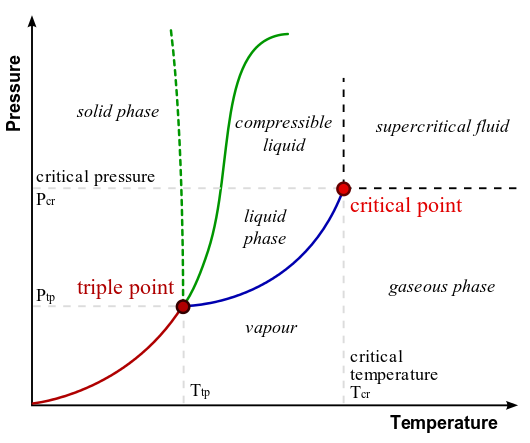
A phase diagram shows the regions where water is solid, liquid, or vapor, and highlights the triple point (273.16 K), freezing point (273.15 K), and boiling point (373.15 K). It is essential for calibration and understanding environmental control in aviation and science.
Applications and Importance
- Aviation & Aerospace: For calibrating sensors, managing environmental systems, and performing thermodynamic calculations at high altitudes or in space.
- Metrology: Ensures SI traceability and consistency in industry and research.
- Science & Engineering: Fundamental for physics, chemistry, material science, and all fields involving temperature.
Summary
Kelvin (K) is the cornerstone of temperature measurement in science, engineering, and technology. Its definition, based on the Boltzmann constant, ensures that it is universal, stable, and tied to the fabric of physical law. As an SI base unit, it is indispensable for accurate, reproducible, and meaningful temperature data, essential for modern applications from aviation to quantum research.
References
- Bureau International des Poids et Mesures (BIPM). SI Brochure: The International System of Units (SI), 9th Edition
- National Institute of Standards and Technology (NIST). The Kelvin
- Consultative Committee for Thermometry (CCT). Mise en pratique for the definition of the kelvin
Frequently Asked Questions
- Why is kelvin considered an absolute temperature scale?
- Kelvin is absolute because it starts at absolute zero, the point where all thermal motion ceases, according to the laws of physics. This makes it independent of arbitrary reference points, unlike Celsius or Fahrenheit, and essential for thermodynamic calculations.
- How is kelvin realized in practice after the 2019 SI redefinition?
- Kelvin is realized using experiments based on fundamental physical constants, such as acoustic gas thermometry, Johnson noise thermometry, and dielectric constant gas thermometry. These methods link temperature to the Boltzmann constant, enabling universal and reproducible measurements.
- What is the relationship between kelvin, Celsius, and Fahrenheit?
- Kelvin and Celsius scales have identical intervals, 0 K is −273.15°C. The formulas are: T(°C) = T(K) − 273.15 and T(K) = T(°C) + 273.15. Fahrenheit relates via T(°F) = (9/5)T(°C) + 32 and T(°F) = (9/5)(T(K) − 273.15) + 32.
- Why is the Boltzmann constant important in the kelvin’s definition?
- The Boltzmann constant (k) connects microscopic energy (per particle) to macroscopic temperature. By fixing its value, the kelvin is linked directly to fundamental physics, ensuring stability and reproducibility without relying on material artifacts.
- Where is kelvin used in aviation and aerospace?
- Kelvin is vital for calibrating temperature sensors, managing environmental control systems, performing engine thermodynamics, and ensuring safety in extreme conditions, such as high altitudes or space, where absolute temperature knowledge is crucial.
This is a reference entry. TarmacView provides drone inspection services and doesn't sell the equipment or materials described in this glossary.