What is Low Visibility?
Definition
Low visibility is a condition of reduced sight distance for which an aerodrome applies low-visibility procedures. The sources used here define the operations that low visibility brings, not a single visibility value.
Pilots, controllers and weather services use the term in different ways. The sections below show each use with its source and its values.
What causes low visibility
The US Federal Meteorological Handbook calls any phenomenon in the atmosphere, other than precipitation, that reduces horizontal visibility an obscuration. It lists these obscurations:
- Mist reduces visibility to less than 7 statute miles (11 km) but not below 5/8 statute mile (1 km).
- Fog reduces horizontal visibility to less than 5/8 statute mile (1 km). It is based at the Earth’s surface.
- Smoke is a suspension in the air of small particles that combustion produced.
- Volcanic ash is fine particles of rock powder from a volcano.
- Widespread dust and sand are particles that the wind raised from the ground.
- Haze is a suspension of extremely small, dry particles. See the haze page.
- Spray is water droplets that the wind tore from the crests of waves.
The WMO uses the same 1 km line. Fog is the term when microscopic droplets reduce horizontal visibility at the surface to less than 1 km. Mist is the term when they do not. Precipitation, such as drizzle, rain and snow, also lowers visibility.
How visibility is measured: runway visual range
Runway visual range (RVR) is the range over which the pilot of an aircraft on the runway centre line can see the runway surface markings. It also covers the lights that delineate the runway or identify its centre line (ICAO Annex 14).
SKYbrary describes how RVR differs from visibility:
- RVR is not an observation of a meteorological parameter. It is calculated from the atmospheric extinction, the visual threshold of illumination and the intensity of the runway lights.
- It is reported when the visibility or RVR for a runway is below 1,500 m.
- For take-off and landing, RVR values supersede the reported visibility.
- The reported value represents the touchdown zone for non-precision and category I runways. Category II adds the mid-point, and category III adds the stop-end.
Weather categories
The US Aviation Weather Center sorts ceiling and visibility into four flight categories:
| Category | Ceiling | Visibility |
|---|---|---|
| VFR | above 900 m (3,000 ft) AGL | above 8 km (5 miles) |
| MVFR | 300 to 900 m (1,000 to 3,000 ft) AGL | 4.8 to 8 km (3 to 5 miles) |
| IFR | 150 m (500 ft) to below 300 m (1,000 ft) AGL | 1.6 km (1 mile) to below 4.8 km (3 miles) |
| LIFR | below 150 m (500 ft) AGL | below 1.6 km (1 mile) |
For MVFR, IFR and LIFR, either value is enough to place the weather in the category. For VFR, both values must be met. These categories classify the weather. They are not the aerodrome definition of low-visibility operations.
How EU rules define it
EU rules (Regulation (EU) No 139/2014) define these terms:
- Low-visibility operations (LVOs) are approach or take-off operations on a runway. They apply with a runway visual range below 550 m or a decision height below 200 ft.
- Low-visibility take-off is a take-off with a runway visual range below 550 m.
- Low-visibility procedures are procedures applied at an aerodrome to ensure safety during low-visibility operations.
Landing in low visibility
ICAO Annex 14 defines three categories of precision approach runway. Each category has a limit for the decision height (DH) and for RVR.
| Category | Decision height | Runway visual range |
|---|---|---|
| I | not lower than 60 m (200 ft) | 550 m or more, or visibility of 800 m or more |
| II | lower than 60 m (200 ft), not lower than 30 m (100 ft) | 300 m or more |
| III | lower than 30 m (100 ft), or no decision height | less than 300 m, or no RVR limit |
A runway of a higher category also serves the lower categories. See the pages on CAT I, CAT II and CAT III approaches.
Low-visibility procedures at an aerodrome
The aerodrome operator must establish low-visibility procedures if the aerodrome serves low-visibility take-offs. The same applies to approach and landing below 550 m RVR or 200 ft decision height. The procedures:
- coordinate the movement of aircraft and vehicles
- restrict or prohibit activities on the movement area
- include criteria for preparation, initiation and termination, based on RVR and cloud ceiling values
- are set up with the air traffic services provider, published in the AIP, and need prior approval by the competent authority
When the preparation criteria are set, the operator considers the aerodrome layout, the control tower location, the available equipment and the traffic density.
When the procedures are in effect, persons and vehicles on the movement area should be restricted to the essential minimum. The critical and sensitive areas of the ILS should be safeguarded. The operator should also set up low-visibility taxi routes with air traffic services. Construction or maintenance activities must not take place near aerodrome electrical systems.
For a take-off with an RVR below 125 m, EU guidance adds two conditions. An ILS localiser used for guidance must meet category III requirements, and the ILS sensitive area must be protected.
Lights in low visibility
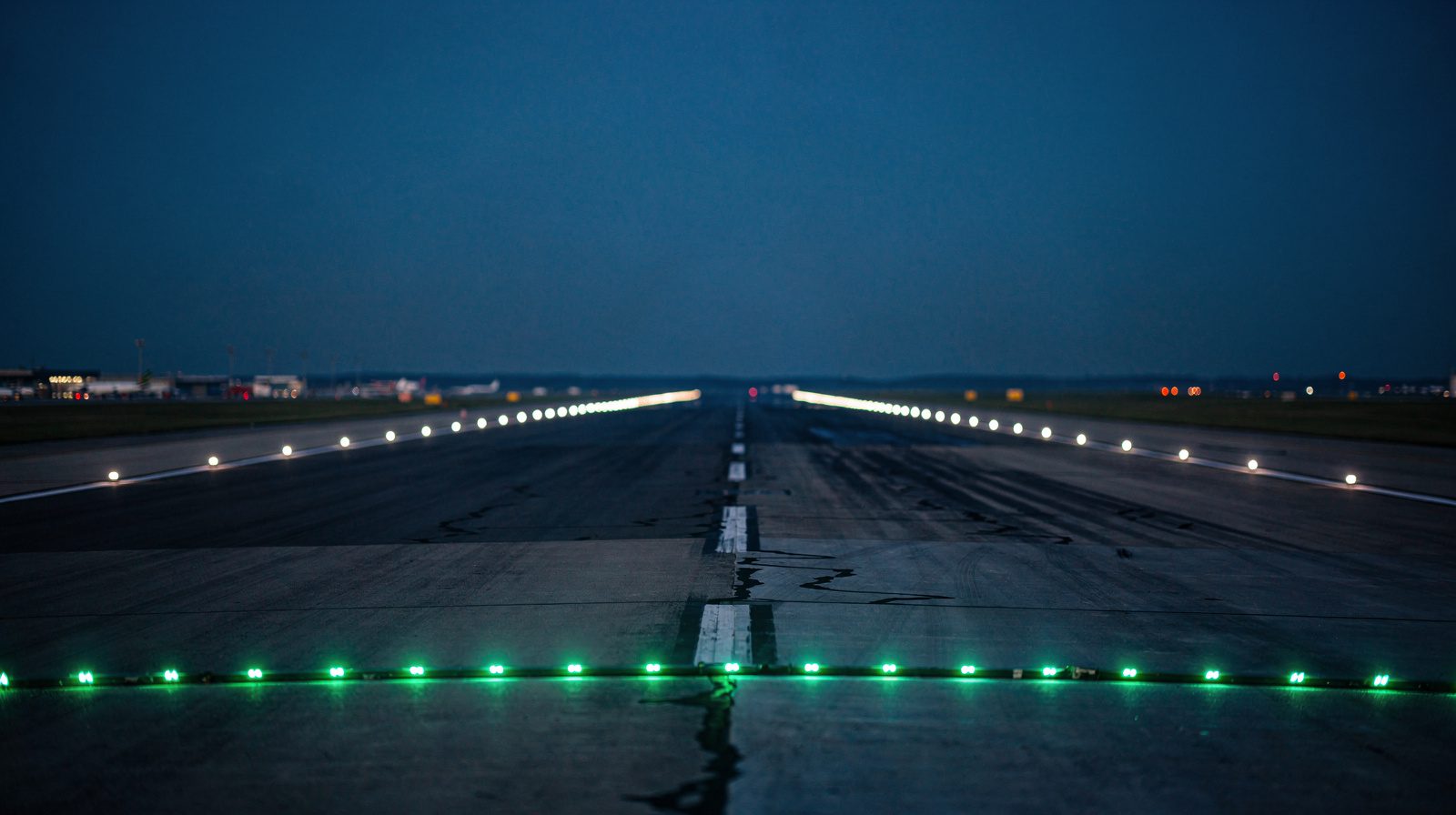
The FAA describes four taxiway light types for low visibility. Taxiway centreline lights facilitate ground traffic. Clearance bar lights and runway guard lights increase the conspicuity of holding positions and runway intersections. Stop bar lights confirm the ATC clearance to enter or cross the active runway below 1,200 ft (365 m) RVR.
FAA values for stop bars and clearance bars:
- Uncontrolled stop bars are generally on for all operations below 1,200 ft (365 m) RVR.
- Stop bars are required below 600 ft (183 m) RVR on illuminated taxiways that give access to the active runway.
- Clearance bars are installed at designated hold points for operations below 600 ft (183 m) RVR.
The FAA also states that a maintenance programme is necessary at airports with low-visibility taxiway lighting systems.
Serviceability objectives
EU rules set preventive maintenance objectives that depend on category and RVR. For precision approach category II or III, at least these shares of lights must be serviceable:
- 95 % in the inner 450 m of the approach lighting, the runway centre line lights, the threshold lights and the runway edge lights
- 90 % in the touchdown zone lights
- 85 % in the approach lighting beyond 450 m
- 75 % in the runway-end lights
For category I, the objective is 85 % in the approach lighting, threshold, edge and runway-end lights.
Below 550 m RVR, the objectives for other lights are:
- no more than two lights of a stop bar remain unserviceable
- no two adjacent taxiway centre line lights are unserviceable
- for a take-off runway, at least 95 % of the centre line and edge lights, and 75 % of the runway-end lights, are serviceable
For a take-off at 550 m RVR or more, the objective is 85 % of the runway edge and end lights. A light is unserviceable in two cases. Its main beam average intensity is below 50 % of the specified value, or its filter is missing or damaged or its colour is wrong.
Relevance to airfield inspection
Unserviceable stop bar, centre line and runway lights count against the objectives above. A lighting inspection that records each unit as lit or dark, per system and per taxiway, gives the counts to compare with them. See the guide on runway light serviceability limits.
Frequently Asked Questions
- What does low visibility mean?
- Low visibility means that people can see only a short distance, so an aerodrome must apply special procedures. In EU rules, low-visibility operations are approach or take-off operations with a runway visual range below 550 m or a decision height below 200 ft.
- What is the difference between low visibility, low-visibility operations and low-visibility procedures?
- Low visibility is the weather condition. In EU rules, low-visibility operations are approach or take-off operations with an RVR below 550 m or a decision height below 200 ft. Low-visibility procedures are the aerodrome measures that keep those operations safe.
- What is runway visual range?
- Runway visual range (RVR) is the range over which a pilot on the runway centre line can see the runway surface markings. It also covers the lights that delineate the runway or identify its centre line. EU rules use RVR and decision height to define low-visibility operations.
- What causes low visibility in aviation?
- Any weather phenomenon, other than precipitation, that reduces horizontal visibility is an obscuration. The US handbook lists mist, fog, smoke, volcanic ash, widespread dust, sand, haze and spray. Precipitation such as drizzle, rain and snow also reduces visibility.
- Do the EU and the FAA use the same limit for low visibility?
- No single limit applies everywhere. EU rules define low-visibility operations at an RVR below 550 m. FAA texts on taxiway lighting refer to 1,200 ft (365 m) RVR, for example for stop bars and for the low-visibility lighting systems.
- How do aircraft land in low visibility?
- They fly a precision approach to a runway that has the right category. ICAO sets a decision height not lower than 60 m (200 ft) and an RVR of at least 550 m for category I. Category II needs at least 300 m RVR. Category III uses lower or no limits.
- Which airfield lights matter most in low visibility?
- Lights that guide and control traffic on the ground. Below 550 m RVR, EU maintenance rules set stricter serviceability objectives for stop bars, taxiway centre line lights and runway lights.
References
- easa-ear-aerodromes
- Easy Access Rules for Aerodromes (Regulation (EU) No 139/2014), including CS-ADR-DSN Issue 7 EASA
- icao-annex-14-vol-i
- Annex 14 to the Convention on International Civil Aviation, Volume I, 9th edition (2022) ICAO
- skybrary-rvr
- Runway Visual Range (RVR) SKYbrary
- noaa-fmh1-2019
- Federal Meteorological Handbook No. 1 (FCM-H1-2019), Surface Weather Observations and Reports NOAA, Office of the Federal Coordinator for Meteorology
- wmo-cloud-atlas-fog-mist
- International Cloud Atlas: Fog compared with Mist World Meteorological Organization
- faa-aim-2-1
- Aeronautical Information Manual, chapter 2 section 1, paragraph 2-1-10 Taxiway Lights FAA
- faa-ac-150-5340-30j
- AC 150/5340-30J, Design and Installation Details for Airport Visual Aids FAA
- awc-cigvis-help
- Ceiling and Visibility Dashboard help NOAA Aviation Weather Center
This is a reference entry. TarmacView provides drone inspection services and doesn't sell the equipment or materials described in this glossary.