What is the Luminosity Function?
Luminosity Function in Aviation and Photometry
The luminosity function is a fundamental concept in photometry and color science, describing how the human eye perceives the brightness of different wavelengths of visible light. It provides the mathematical bridge between physical measurements of light (radiometry) and human vision (photometry), ensuring that lighting systems are designed and measured in ways that reflect actual human perception.
Definition
The luminosity function quantifies the average spectral sensitivity of the human eye. There are two primary forms:
- Photopic luminosity function (V(λ)): Applies to daylight or bright conditions, peaking at 555 nm (green).
- Scotopic luminosity function (V′(λ)): Applies to nighttime or low-light conditions, peaking at 507 nm (blue-green).
Both functions are defined over the visible spectrum (typically 380–780 nm), normalized to a peak value of 1.
Physiological Foundations
The human retina contains two main types of photoreceptors:
- Cones: Responsible for color and high-acuity vision, active in bright (photopic) conditions.
- Rods: More sensitive to light, active in low (scotopic) conditions, but color-blind.
The combined output of these cells underlies our spectral sensitivity, which is mathematically captured by the luminosity functions. Under intermediate (mesopic) conditions, both rods and cones contribute.
Psychophysical experiments, such as heterochromatic flicker photometry, are used to derive the standard observer models that form the basis of the CIE-defined luminosity functions.
Historical Development
- 1924: The International Commission on Illumination (CIE) established the first standard photopic luminosity function (V(λ)), providing a reproducible basis for photometric measurements.
- 1951: The scotopic function (V′(λ)) was introduced for low-light applications.
- Later refinements: Adjustments by Judd and Vos improved the accuracy, especially in the blue region, but the CIE 1931 (photopic) and CIE 1951 (scotopic) functions remain the regulatory standards.
These standards have enabled harmonized lighting measurement and specification worldwide, underpinning aviation and countless other industries.
Mathematical Representation
The luminosity function is a dimensionless curve, usually tabulated at 1-nm intervals. Photometric quantities are calculated by integrating a light source’s spectral power distribution with the appropriate luminosity function:
[ L_v = K_m \int_{380}^{780} L(\lambda) \cdot V(\lambda) , d\lambda ]
Where:
- (L_v): Photometric luminance (cd/m²)
- (L(\lambda)): Spectral radiance (W·m⁻²·sr⁻¹·nm⁻¹)
- (K_m): Maximum luminous efficacy (683 lm/W at 555 nm for photopic vision)
Analogous equations apply for illuminance (lux) and for the scotopic function with (K’_m = 1700) lm/W.
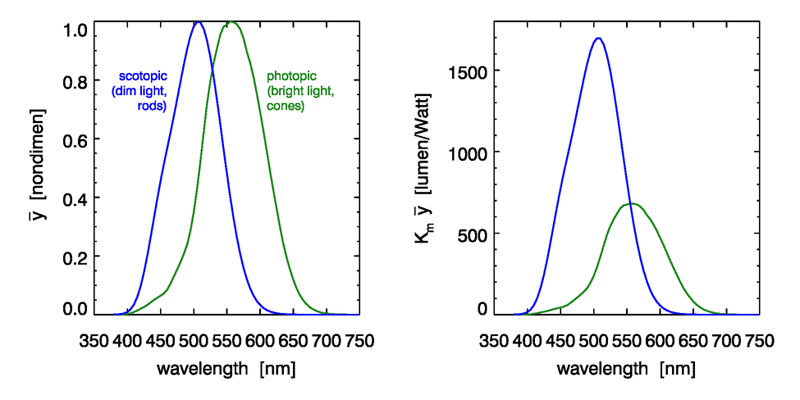
Normalized photopic (V(λ), green) and scotopic (V′(λ), blue) luminosity functions, with efficacy in lm/W.
Application in Aviation
Lighting Design and Regulation
The luminosity function is foundational for designing:
- Runway and taxiway lighting
- Cockpit and instrument panel illumination
- Airfield signage
ICAO Annex 14 and other aviation standards specify luminance, illuminance, and chromaticity requirements based on photometric quantities derived from the luminosity function. This ensures that lighting is visible and consistent for pilots, regardless of location or manufacturer.
Measurement and Compliance
Lighting is measured using photometers and spectroradiometers that match the CIE standard observer response. This guarantees regulatory compliance and effective visual performance.
Energy Efficiency
Lighting sources optimized for the peak of the luminosity function (around 555 nm) provide maximum perceived brightness per watt, allowing for energy savings and reduced environmental impact.
Practical Examples
- Aviation LEDs: Modern LED systems are designed to match the V(λ) curve, delivering high brightness and efficiency.
- Red cockpit lighting: Used at night to preserve pilots’ dark adaptation, as rods (scotopic vision) are minimally sensitive to red.
- Calibration: All aviation lighting equipment is calibrated according to the luminosity function to ensure standardization.
Limitations and Considerations
- Individual variation: Actual human sensitivity varies with age, genetics, and adaptation, but the standard curve is an average.
- Mesopic vision: In dawn, dusk, or street lighting, both rods and cones contribute, and transitional models may be needed.
- Environmental impact: Overly bright or poorly targeted lighting can cause glare and light pollution, understanding spectral sensitivity helps mitigate these effects.
Related Glossary Terms
| Term | Definition |
|---|---|
| Photometry | Measurement of visible light as perceived by human vision. |
| Luminous Flux (Φv) | Total perceived light output, in lumens (lm). |
| Luminous Intensity | Light output in a particular direction, in candelas (cd). |
| Illuminance | Luminous flux per unit area, in lux (lx). |
| Luminance | Luminous intensity per unit area per solid angle, in cd/m². |
| Photopic Vision | Vision under bright conditions, cone-mediated, peak at 555 nm. |
| Scotopic Vision | Vision under low-light conditions, rod-mediated, peak at 507 nm. |
| Luminous Efficacy | Ratio of luminous flux to radiant power, in lm/W. |
Key Facts
- V(λ) peaks at 555 nm (photopic), V′(λ) at 507 nm (scotopic).
- Maximum luminous efficacy is 683 lm/W (photopic), 1700 lm/W (scotopic).
- Photometric units (lm, cd, lx) rely on the luminosity function.
- Aviation lighting standards are based on the CIE luminosity function.
- Calibration to the standard observer is required for regulatory compliance.
Aviation and ICAO Relevance
The International Civil Aviation Organization (ICAO) requires all airfield and cockpit lighting to be specified and measured using the standard luminosity function. This ensures pilots have consistent, reliable visual references, enhancing safety and operational efficiency in all lighting conditions.
Conclusion
The luminosity function is the backbone of photometric measurement and aviation lighting design. By accurately modeling human visual sensitivity, it enables lighting systems that are safe, efficient, and fully compliant with international standards. Its application ensures that what is measured is truly what is seen, providing a foundation for visibility and safety in aviation and beyond.
Frequently Asked Questions
- What is the difference between photopic and scotopic luminosity functions?
- The photopic luminosity function (V(λ)) represents human visual sensitivity under well-lit (daylight) conditions, peaking at 555 nm, where cone cells dominate. The scotopic function (V′(λ)) applies to low-light (night) conditions and peaks at 507 nm, reflecting rod cell sensitivity. The choice of function affects how lighting is measured and perceived in different environments.
- Why is the luminosity function important in aviation?
- The luminosity function is critical for designing and regulating airfield, cockpit, and signage lighting to ensure it is visible, safe, and energy-efficient according to how the human eye perceives brightness. ICAO and other aviation authorities require lighting systems to be specified and measured using the standard luminosity function to guarantee compliance and consistency worldwide.
- How does the luminosity function relate to photometric units like lumen and lux?
- Photometric units such as lumen (lm) and lux (lx) are derived by weighting the physical power of light by the luminosity function, ensuring that measurements correspond to perceived brightness for humans. This allows lighting designers to optimize systems for both energy use and visual effectiveness.
- Are there variations in human visual sensitivity that affect the luminosity function?
- Yes, individual factors such as age, genetics, and adaptation state can affect spectral sensitivity. The standard luminosity functions are averages based on psychophysical studies of representative observers, providing a practical basis for engineering and regulatory purposes despite individual variation.
- What is the role of the luminosity function in colorimetry?
- In colorimetry, the luminosity function is used as the Y component in CIE color spaces, linking brightness perception to color measurements. This is essential for accurate color rendering and brightness specification in displays, lighting, and visual signaling.
This is a reference entry. TarmacView provides drone inspection services and doesn't sell the equipment or materials described in this glossary.