The Pavement Condition Index (PCI) is a numerical rating from 0 (failed) to 100 (excellent) that quantifies pavement surface condition based on observed distress type, severity, and extent per ASTM D6433. Used globally for roads, parking lots, and airport pavements, the PCI methodology is adapted for aviation infrastructure in ICAO Doc 9157 Part 3 and FAA AC 150/5380. Covers calculation method, distress deduct curves, and AI-based proxy assessment.
Pavement Condition Index (PCI) — The Complete Technical Reference
Pavement Condition Index (PCI) is the most widely used pavement condition assessment methodology worldwide. Defined under ASTM D6433-20, PCI transforms subjective visual observations into an objective numerical score between 0 and 100 that quantifies the structural integrity and surface serviceability of asphalt, concrete, and composite pavements.
Definition and Numerical Scale (0–100)
The PCI system assigns a single numeric value representing the overall condition of a pavement section. The scale ranges from 0, indicating a completely failed pavement requiring full reconstruction, to 100, representing a pavement in pristine condition with no visible defects. This 101-point scale is subdivided into seven condition rating categories that provide actionable maintenance and rehabilitation guidance.
The PCI is not a direct structural measurement — it does not measure load-bearing capacity, layer stiffness, or remaining fatigue life. Instead, PCI functions as a surface distress-based proxy for overall pavement health. The underlying principle is that surface distress patterns correlate strongly with subsurface structural deterioration. Research by the U.S. Army Corps of Engineers Construction Engineering Research Laboratory (CERL) in the 1970s, led by Dr. Mohamed Y. Shahin, established the empirical relationships between observed distress and overall pavement condition that form the foundation of the PCI method.
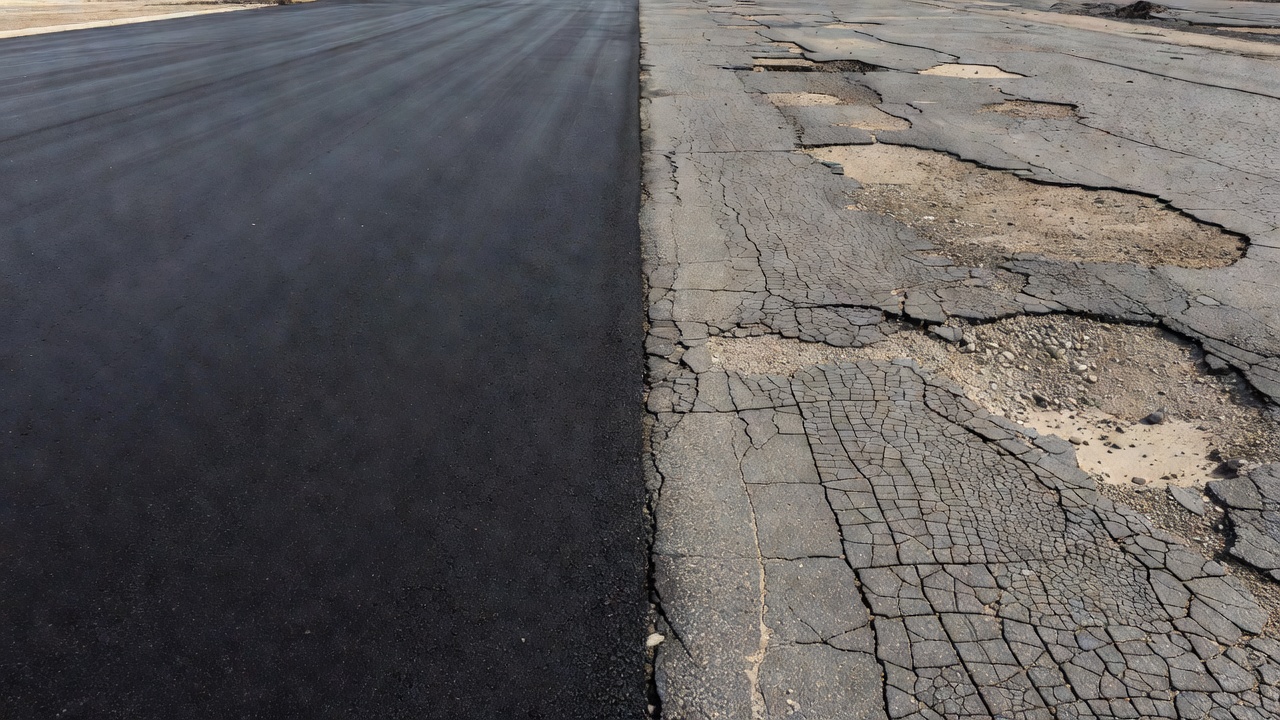
Each PCI score corresponds to a specific condition rating, maintenance trigger, and typical repair strategy. A pavement scoring PCI 86–100 (Good) requires only routine cleaning and crack sealing. At PCI 71–85 (Satisfactory), preventive maintenance such as thin overlays or surface treatments becomes economical. PCI 56–70 (Fair) signals the onset of moderate structural deterioration — this is the typical threshold at which airport authorities begin planning rehabilitation interventions. Below PCI 55, pavements enter the Poor-to-Failed range where major structural overlays, full-depth repairs, or complete reconstruction become necessary.
ASTM D6433-20 Standard Overview
ASTM D6433-20, titled “Standard Practice for Roads and Parking Lots Pavement Condition Index Surveys,” is the definitive procedural document governing PCI determination. The standard was first published as D6433-99 in 1999 and has undergone multiple revisions (D6433-03, D6433-07, D6433-11, D6433-18, D6433-20). Each revision has refined distress definitions, updated deduct curves, and incorporated lessons from thousands of field surveys conducted globally.
Scope and Applicability
ASTM D6433-20 explicitly covers asphalt-surfaced (flexible) pavements and Portland cement concrete (rigid) pavements for roads, streets, and parking lots. The standard defines 19 distress types for flexible pavements and 16 distress types for rigid pavements. Each distress type has specific measurement protocols, severity-level definitions, and photographic reference examples.
The standard does not directly cover airport pavements, military airfields, or heliports — these are addressed through separate standards such as ASTM D5340 (Standard Test Method for Airport Pavement Condition Index Surveys) and military specification MIL-STD-621A. However, the core methodology (inspection unit definition, distress sampling, deduct value assignment, corrected deduct value calculation) is identical across all versions.
Key Requirements
ASTM D6433-20 mandates that PCI surveys be conducted by certified or trained raters who can correctly identify and classify pavement distress. The standard requires:
Statistical sampling with a minimum of 20% of sample units for 95% confidence level with ±5 PCI points precision
Random sampling of sample units within homogeneous pavement sections
Distress measurement to specific tolerances (crack widths measured to 1/16-inch, areas measured to 0.1 square feet)
Photographic documentation of representative distresses
Seasonal consistency — all surveys completed within a single construction season
Version History
ASTM D6433 has undergone substantial evolution: D6433-99 introduced the first standardized method for roads and parking lots. D6433-07 added expanded distress definitions and modified deduct curves based on field validation studies. D6433-20 included updated severity-level photographs and clarified measurement protocols for complex distress patterns like alligator cracking with multiple severity levels in the same area.
PCI Calculation Method
The PCI calculation follows a rigorous five-step procedure that converts raw field measurements into the final index score. Understanding this calculation methodology is essential for any pavement engineer conducting condition assessments.
Inspection Unit Hierarchy
The PCI system uses a three-tier spatial hierarchy:
Branch — The largest management unit, typically a contiguous pavement facility (e.g., Runway 14/32, Main Terminal Apron, Interstate Highway I-95). Each branch is assigned a unique identifier in the pavement management database.
Section — A subdivision of a branch with uniform construction history, traffic loading, drainage, and condition. Sections should be at least 500 square meters (5,400 square feet) for reliable PCI calculation. Sections are the primary reporting unit for PCI scores.
Sample Unit — The actual inspection area. For flexible pavements, standard sample units are 2,500 ± 500 square feet (232 ± 46 square meters). For rigid pavements, sample units contain approximately 20 ± 2 concrete slabs. Sample units may be adjusted for narrow pavements, shoulder areas, or irregular geometries.
Sampling Strategy
Full coverage (100% survey) of all sample units is recommended for project-level design where PCI will directly determine repair quantities. For network-level pavement management covering 50+ lane-miles, ASTM D6433-20 permits statistical sampling. The minimum number of sample units to inspect is calculated as:
Where (N) = total sample units, (t) = t-statistic (typically 1.96 for 95% confidence), (s) = estimated standard deviation (typically 10 PCI points for first surveys), and (e) = allowable error (±5 PCI points). The standard practice samples 20–30% of all sample units, with additional units inspected if the 95% confidence interval exceeds ±5 PCI points.
Distress Mapping and Measurement
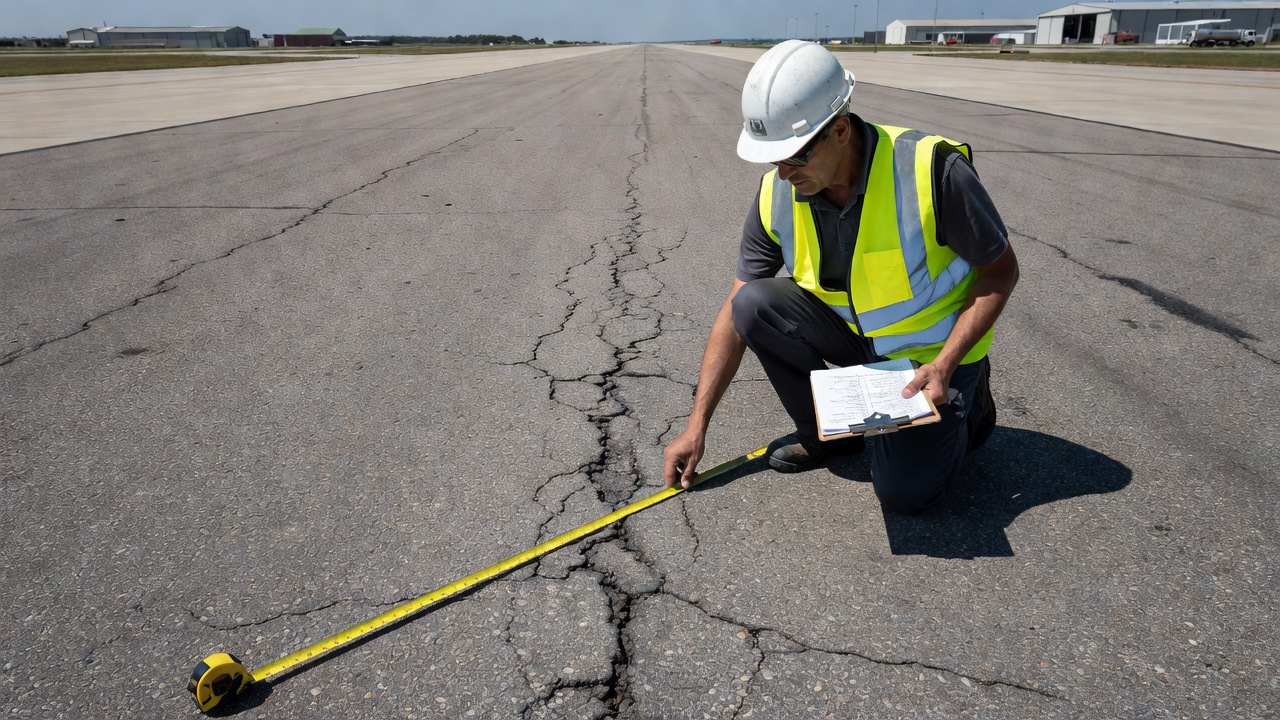
During field inspection, each sample unit is carefully examined. Raters walk the entire sample area and record the following for each distress type encountered:
Distress type — Selected from the 19 flexible or 16 rigid distress categories defined in ASTM D6433
Severity level — Low (L), Medium (M), or High (H), determined by specific measurement criteria for each distress type
Extent/density — Measured as total crack length (feet or meters), area affected (square feet), or number of occurrences (e.g., pothole count)
Location — Within the sample unit and relative to lane/shoulder boundaries
Deduct Values
Each distress-severity-density combination has a corresponding deduct value (DV) — a numeric reduction subtracted from 100 (perfect condition). Deduct values are obtained from precomputed deduct curves published in ASTM D6433-20. These curves are the empirical heart of the PCI method, derived from thousands of pavement evaluations conducted by CERL between 1974 and 1982.
Deduct curves are specific to:
Pavement type (flexible vs. rigid)
Distress type (each of 19 or 16 types has its own curve)
Severity level (three curves per distress type, one for each severity)
The curves are plotted with distress density (%) on the x-axis and deduct value (0–100) on the y-axis. At zero distress density, the deduct value is always zero. As density increases, the deduct value rises following a nonlinear curve that reflects the accelerating rate of deterioration.
Corrected Deduct Value (CDV) Procedure
When multiple distress types exist in a single sample unit, their deduct values cannot simply be summed — the combined effect is less than additive because multiple distress modes interact. ASTM D6433 specifies a corrected deduct value (CDV) iteration procedure:
Sum all individual deduct values to get total deduct value (TDV).
Count the number of deduct values > 5 — denote this as (q).
Determine the highest individual deduct value (HDV).
Calculate m using the formula: (m = 1 + \frac{9}{98}(100 - \text{HDV})) — this limits the number of deduct values included in the iteration.
Reduce the smallest deduct value to 2 if more than (m) deduct values exceed 5.
Recalculate TDV and look up the CDV from the CDV correction curves in ASTM D6433-20 (Appendix X3). There are separate curves for flexible pavements (Figure X3.1) and rigid pavements (Figure X3.2), each curve corresponding to a different (q) value (number of individual deduct values > 5).
Iterate by reducing the smallest non-zero deduct value to 2 and recalculating until only one deduct value exceeds 5 or the CDV stabilizes.
Select the maximum CDV from all iterations — this is the final corrected deduct value for the sample unit.
Calculate PCI = 100 − CDV.
This iterative correction procedure prevents over-penalizing pavements with multiple mild distress types while still capturing the compounded effect of severe, widespread distress.
Distress Types by Pavement Type
Flexible (Asphalt) Pavement Distresses — 19 Types
ASTM D6433-20 defines 19 distress types for asphalt-surfaced pavements, each with specific severity-level criteria:
Buckling or shattering of concrete at a transverse joint or crack
Square feet / square meters
62
Corner Break
Crack intersecting a joint and the slab edge, forming a triangular piece
Square feet / square meters
63
Divided Slab
Slab divided into three or more pieces by intersecting cracks
Square feet / square meters
64
Durability (D) Cracking
Series of closely spaced hairline cracks parallel to joints, caused by freeze-thaw
Square feet / square meters
65
Faulting
Vertical displacement of slab edges at joints or cracks
Linear feet / meters
66
Joint Seal Damage
Condition of joint sealant material allowing infiltration of water and incompressibles
Linear feet / meters
67
Lane/Shoulder Drop-off
Vertical difference between slab and shoulder
Linear feet / meters
68
Linear Cracking
Single longitudinal, transverse, or diagonal crack
Linear feet / meters
69
Patching (Large)
Repair area larger than 0.5 m²
Square feet / square meters
70
Popouts
Small diameter depressions (25–100 mm) in the concrete surface
Count
71
Pumping
Ejection of water and fine material from beneath the slab through joints
Linear feet / meters
72
Scaling
Surface mortar flaking or peeling, exposing coarse aggregate
Square feet / square meters
73
Settled Shoulder
Vertical displacement of the shoulder relative to the slab
Linear feet / meters
74
Shrinkage Cracks
Fine hairline cracks not extending through full slab depth
Square feet / square meters
75
Spalling (Joint/Corner)
Cracking, breaking, or chipping at slab joints or corners
Linear feet / meters
76
Shattered Slab Intersection
Multiple interconnected cracks at slab intersections
Count
Each distress type has three severity levels (Low, Medium, High) with specific measurement criteria. For example, Low-severity alligator cracking features hairline cracks with no spalling or pumping, while High-severity features wide cracks (>2 mm) with significant spalling and pumped fines visible.
PCI in Airport Pavements (ICAO Doc 9157, FAA AC 150/5380)
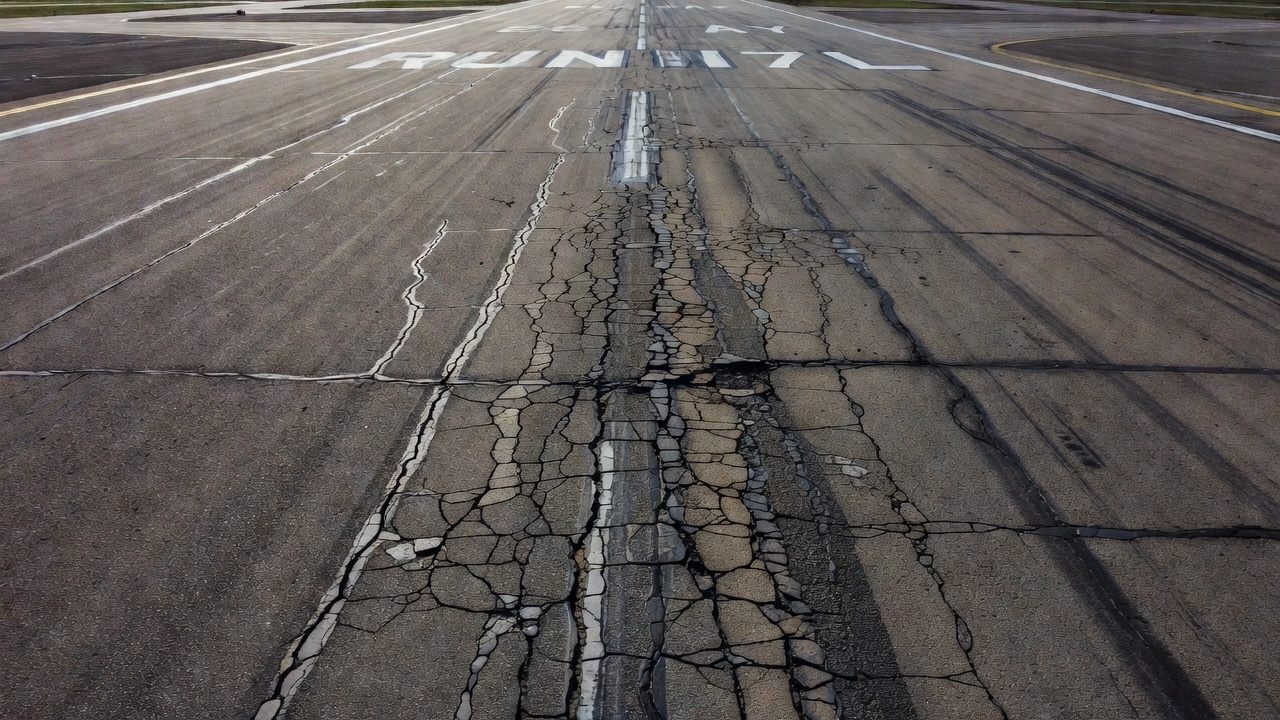
Airport pavement condition assessment is uniquely demanding — runway failures can cause catastrophic accidents, and pavement closures for rehabilitation cause massive operational disruptions. Both ICAO and the FAA have established specific guidance for PCI application in the airfield environment.
ICAO Doc 9157 Part 3 — Aerodrome Design Manual: Pavements
The International Civil Aviation Organization publishes Doc 9157, Part 3 — Aerodrome Design Manual: Pavements, which provides comprehensive guidance on airport pavement design, evaluation, and maintenance. The manual explicitly references PCI as the preferred condition assessment method for aerodrome pavements.
ICAO Doc 9157 Part 3 requires that airport operators:
Conduct regular PCI surveys as part of an Airport Pavement Management System (APMS)
Maintain a pavement condition database tracking PCI scores over time for each runway, taxiway, and apron
Use PCI trends to forecast remaining service life and plan rehabilitation timing
Report PCI data to national aviation authorities for infrastructure funding prioritization
The manual recognizes that PCI values lose meaning if surveys are less frequent than the rate of pavement deterioration, and recommends survey intervals of 1–3 years depending on traffic intensity and pavement age. For pavements with PCI below 70, annual surveys are recommended until rehabilitation is completed.
FAA Advisory Circular AC 150/5380-7B
The United States Federal Aviation Administration’s AC 150/5380-7B — Airport Pavement Management Program (2014) provides the most detailed airport-specific PCI implementation guidance. The advisory circular mandates that all airports receiving federal funding (AIP grants) maintain an approved pavement management program.
Key requirements from AC 150/5380-7B include:
Inspection frequency: Annual PCI surveys for runways and taxiways at commercial service airports; biennial surveys for general aviation airports
Minimum PCI thresholds: PCI 70 is the FAA-recommended minimum for runways before overlay planning begins; PCI 55 is the reconstruction trigger
Sample unit size adjustment: Airport pavement sample units are typically 5,000 ± 2,000 square feet to account for wide runway surfaces
Additional airfield distress types: Airport-specific distresses include jet blast erosion, fuel spill damage, and rubber accumulation (not captured in ASTM D6433’s 19 distress types)
Repair type correlation: The AC provides direct correlation between PCI range and recommended repair types, from crack sealing (PCI 70+) through mill-and-fill overlays (PCI 40–70) to full reconstruction (PCI < 40)
ASTM D5340 — Airport-Specific Standard
While ASTM D6433 covers roads and parking lots, ASTM D5340 (Standard Test Method for Airport Pavement Condition Index Surveys) is the airport-specific variant. D5340 adds distress types relevant to the airfield environment, including jet blast erosion (from high-temperature engine exhaust), fuel spill damage (chemical softening of asphalt binders), and rubber accumulation (landing zone deposits on runways). The deduct curves in D5340 are calibrated for high-load, high-frequency aircraft traffic rather than the lower-load road traffic patterns in D6433.
PCI Rating Scale
The ASTM standard defines seven condition rating categories that translate the 0–100 numeric score into actionable maintenance language:
PCI Score Range
Rating Category
Color Code
Interpretation
Typical Action
86–100
Good
Dark Green
No or minimal distress; pavement performs as designed
Routine maintenance, crack sealing
71–85
Satisfactory
Light Green
Minor distress visible; structural integrity unaffected
Complete failure; pavement requires total reconstruction
Full reconstruction
In airport operations, the color-coded PCI maps are integrated into Airport Pavement Management Systems (APMS) where each pavement section is displayed with its PCI color. A typical APMS dashboard shows the airfield as a network of colored polygons — green runways indicating good condition, yellow taxiways indicating fair condition, and red aprons indicating poor condition requiring funding requests.
FAA guidance sets PCI 70 as the threshold for preventive maintenance on runways. Below PCI 70, the rate of deterioration accelerates exponentially — a pavement at PCI 65 may lose 5–10 PCI points per year, whereas a pavement at PCI 85 may lose only 1–2 points annually. This nonlinear deterioration curve makes early intervention at PCI 70–85 dramatically more cost-effective than delayed rehabilitation at PCI 40–55.
AI-Based PCI Proxy Assessment
Traditional PCI surveys are labor-intensive, requiring certified raters to walk every sample unit, measure distresses by hand, and manually compute deduct values. A single mile of urban roadway requires 8–12 inspector-hours. For a major international airport with 12,000 feet of runway, multiple taxiways, and 50+ acres of apron, a full PCI survey can require 200+ inspector-hours and cost $50,000–$150,000.
Artificial intelligence and computer vision technologies are transforming PCI assessment by enabling automated visual PCI proxy computation from imagery.
Deep Learning Distress Detection
Modern AI-based PCI assessment uses convolutional neural networks (CNNs) such as YOLOv8, Mask R-CNN, and U-Net architectures trained on thousands of labeled pavement images. These models can:
Classify distress type — Identify which of the 19 asphalt distress types are present in an image, with typical accuracy of 85–95%
Quantify distress density — Calculate the pixel area or linear extent of each distress type within the image frame
Determine severity level — Classify distress as Low, Medium, or High based on crack width thresholds (hairline < 1mm, medium 1–3mm, wide > 3mm)
Compute PCI proxy — Map detected distress combinations to an estimated PCI score using lookup tables derived from ASTM deduct curves
Imaging Platforms
Three primary imaging modalities support AI-based PCI proxy:
Vehicle-mounted camera systems capture continuous 2D pavement images at highway speeds (60+ mph). Systems with multiple downward-facing cameras achieve 4–8 mm/pixel resolution — sufficient for detecting cracks as narrow as 2 mm. Combined with GPS geotagging, each image is precisely located for GIS-based PCI mapping.
Drone-based aerial surveys using high-resolution RGB cameras (36+ megapixel) flown at 30–50 meters altitude capture 0.5–1.5 cm/pixel resolution. Drone surveys cover 30–50 acres per flight hour, making them ideal for airport apron areas and large parking lots. The oblique imagery perspective from drones can detect distress patterns not visible from vehicle-mounted nadir cameras.
LiDAR point cloud analysis uses laser-scanned pavement surfaces to detect depressions, rutting, bumps, and shoving based on elevation differentials. LiDAR can measure rut depth to 1 mm accuracy independent of lighting conditions.
TarmacView AI PCI Proxy
TarmacView implements a computer vision-based PCI proxy that processes drone-captured orthomosaic imagery through a custom deep learning pipeline:
Image acquisition: 2 cm/pixel RGB drone imagery flown at standard survey altitudes
Orthomosaic generation: Photogrammetric stitching of 1,000+ individual images into a single, georeferenced pavement map
Deep learning inference: Trained models detect, classify, and quantify all 19 ASTM D6433 distress types at pixel-level precision
PCI proxy calculation: Distress density and severity feed into ASTM-compliant deduct value lookup tables to produce a PCI-equivalent score
Condition mapping: PCI scores are rendered as color-coded GIS polygons overlaid on the orthomosaic, enabling visual identification of deterioration hotspots
The TarmacView PCI proxy achieves ±8 PCI points standard error compared to manual ASTM-compliant surveys — sufficient for network-level pavement management decisions and maintenance prioritization.
Limitations of Visual-Only PCI
Despite its widespread adoption, the PCI method has several documented limitations that pavement engineers must understand:
Surface Distress Blindness
PCI exclusively measures visible surface distress. It cannot detect subsurface conditions such as base course degradation, subgrade weakening, moisture damage within pavement layers, or loss of structural capacity — all of which may be advanced even when the surface appears relatively intact. A pavement with a stable, crack-free surface but a saturated, failed base course may score PCI 90 while being structurally unsafe for aircraft or heavy truck loading. Structural evaluation tools such as falling weight deflectometer (FWD) testing, ground-penetrating radar (GPR), or core sampling are required to verify the structural condition underlying the PCI surface rating.
Rater Subjectivity
Even with ASTM’s detailed severity-level criteria, inter-rater variability is a documented problem. Studies by the FHWA have shown that two certified PCI raters surveying the same pavement section can produce PCI scores 8–15 points apart for moderate condition pavements. Subjectivity is most pronounced for distresses with continuous severity gradation (weathering/raveling, polished aggregate) where the boundary between Low and Medium severity is subjective. Regular rater calibration workshops and automated image analysis are increasingly used to reduce this variability.
Seasonal and Environmental Dependence
PCI scores are sensitive to the timing of surveys. A pavement surveyed in winter when cracks are closed (due to thermal contraction of the asphalt) will score higher than the same pavement surveyed in summer when cracks are fully open. Pavements evaluated after rainfall may show pumping and surface water that obscures crack patterns. ASTM D6433-20 recommends that surveys be conducted during dry periods when ambient temperature exceeds 50°F (10°C) to minimize seasonal bias.
No Functional Performance Measurement
PCI measures structural condition but not functional performance — a pavement can have excellent PCI (few cracks, intact surface) but provide poor ride quality due to roughness, poor skid resistance from polished aggregate, or excessive noise. The International Roughness Index (IRI) and skid resistance testing (using locked-wheel or ribbed-tire methods) are complementary measures that capture functional performance not addressed by PCI.
Insensitivity at Extremes
The PCI scale shows nonlinear sensitivity — it is most sensitive in the mid-range (PCI 30–70) where condition changes rapidly. At the high end (PCI 85–100), pavements with measurably different distress levels may compress into the same rating category. At the low end (PCI 0–20), the scale cannot differentiate gradations of failed pavement. This nonlinearity means PCI is best used as a prioritization tool rather than an absolute condition measure.
Comparison with Other Indices
PCI is one of several pavement condition indicators used in infrastructure management. Understanding its relationship to other indices is critical for developing comprehensive pavement management systems.
PCI vs. Present Serviceability Index (PSI)
The Present Serviceability Index (PSI), developed during the AASHO Road Test (1958–1962), measures a pavement’s ability to serve its intended function from the user’s perspective. PSI ranges from 0 (impassable) to 5 (perfect), with a typical minimum acceptable PSI of 2.5 for major highways.
The key distinction is that PCI measures structural surface condition through visible distress, while PSI measures functional ride quality based on roughness, cracking, patching, and rutting. The two indices correlate only moderately — a pavement with numerous surface cracks (low PCI) may still provide acceptable ride quality (moderate PSI), while a smooth pavement with weak subsurface structure may have good PSI but rapidly declining PCI.
The empirical PSI equation for flexible pavements (AASHTO 1993) is:
Where SV = slope variance (roughness), C = cracking (ft/1000 ft²), P = patching (ft²/1000 ft²), and RD = rut depth (inches). This equation shows that roughness contributes most heavily to PSI, while PCI gives equal weight to all distress types.
PCI vs. International Roughness Index (IRI)
The International Roughness Index (IRI) is a pure ride-quality measure expressed in inches/mile or meters/kilometer. IRI measures the cumulative suspension movement of a standard quarter-car model traversing the pavement profile at 50 mph. Lower IRI values indicate smoother roads (typical new pavement: 60–100 in/mi; rough pavement: 200+ in/mi).
IRI and PCI measure fundamentally different aspects of pavement condition:
Parameter
PCI
IRI
What it measures
Surface distress (cracks, spalls, etc.)
Ride quality / roughness
Scale
0 (failed) to 100 (excellent)
0 (perfect) to 500+ (very rough)
Measurement method
Visual survey
Profilometer / inertial profiler
Speed of survey
0.5–2 mph walking
Highway speed
Driver/aircraft feedback
No correlation
Direct correlation
Maintenance trigger
Structural intervention
Resurfacing for ride comfort
Nonlinearity
Moderate
Linear with road profile
Research by the World Bank and FHWA has established approximate conversion relationships. A general correlation for flexible pavements is:
[
PSI = 5 \times e^{-0.004 \times IRI}
]
This equation enables conversion between IRI and PSI, but the PCI-to-IRI correlation is weaker and site-specific, typically with R² values of 0.4–0.6. A pavement can have low IRI (smooth ride) but low PCI (severe cracking) — this combination is common in cold climates where thermal cracking creates surface distress without affecting roughness.
PCI vs. Structural Number (SN) and Layer Thickness
While PCI measures surface condition, structural evaluation tools such as the falling weight deflectometer (FWD) measure layer stiffness and remaining structural capacity. The Structural Number (SN) from the AASHTO pavement design method accounts for layer thicknesses, moduli, and drainage coefficients. A pavement with PCI 90 but SN below design requirements needs structural strengthening regardless of its good surface condition.
For comprehensive pavement management, all three indices should be used together: PCI for surface deterioration tracking, IRI for functional performance monitoring, and FWD-based SN for structural capacity assessment.
Conclusion
The Pavement Condition Index (PCI) remains the most widely adopted and longest-standing standardized methodology for quantifying pavement surface condition. Developed through decades of empirical research by the U.S. Army Corps of Engineers and codified in ASTM D6433, PCI provides a common language for pavement engineers, airport operators, transportation agencies, and funding authorities to communicate condition, prioritize investments, and plan rehabilitation strategies.
The method’s seven-category rating scale — from Good (PCI 86–100) through Failed (PCI 0–10) — transforms complex distress patterns into actionable management data. The deduct value and corrected deduct value calculation procedures ensure objective, repeatable condition scoring that accounts for the interaction of multiple distress types.
For airport pavements specifically, the methodology is adapted through ICAO Doc 9157 Part 3 and FAA AC 150/5380-7B, with additional distress types (jet blast erosion, fuel spill damage, rubber accumulation) and airport-specific sampling protocols defined in ASTM D5340. Airports with comprehensive APMS programs track PCI annually, using the score trends to trigger maintenance at PCI 70 and reconstruction at PCI 55 — thresholds established by decades of empirical pavement performance data.
The emergence of AI-based PCI proxy assessment using drone-captured imagery and deep learning computer vision is democratizing pavement condition assessment. Systems like TarmacView achieve PCI-proxy scores within ±8 points of manual ASTM D6433 surveys while reducing field inspection time by 80% and enabling year-over-year condition comparison through precisely georeferenced orthomosaic imagery.
However, PCI is not a complete pavement condition picture. Its exclusive focus on visible surface distress means it cannot detect subsurface structural deterioration, and its moderate correlation with ride quality (IRI) and functional performance (PSI) means that all three indices should be used in parallel for comprehensive pavement management. The informed pavement engineer uses PCI as one tool in a multi-indicator assessment framework that also includes structural testing (FWD), roughness profiling (IRI/PSI), and nondestructive evaluation (GPR) to develop a complete understanding of pavement health.
Frequently Asked Questions
PCI (Pavement Condition Index) is a visual distress-based index ranging from 0 to 100 that measures surface condition through detailed crack mapping, spalling, and raveling surveys per ASTM D6433. PSI (Present Serviceability Index) measures ride quality and user comfort, calculated from roughness (IRI), cracking, patching, and rut depth. A road can have high PCI (few visible cracks) but low PSI (rough ride), or vice versa. PCI drives structural maintenance decisions; PSI drives user satisfaction and functional performance assessment.
FAA AC 150/5380-7B recommends PCI surveys every 1 to 3 years depending on traffic volume and pavement age. High-traffic runways (Category D/E) should be inspected annually. Low-traffic general aviation runways may extend to 3-year intervals. ICAO Annex 14 requires regular condition reporting without specifying exact frequency, leaving it to individual state aviation authorities. Most airport pavement management systems (APMS) use annual PCI data to trigger maintenance thresholds at PCI 70 (overlay trigger) and PCI 55 (reconstruction trigger).
Yes. Automated PCI surveys use vehicle-mounted cameras, LiDAR, ground-penetrating radar, and AI image analysis. ASTM D6433-20 permits automated methods if they achieve equivalent accuracy to manual visual surveys. Modern systems like TarmacView use deep learning models (YOLOv8, Mask R-CNN) trained on thousands of pavement images to detect and classify 19 asphalt distress types with 85–95% accuracy compared to certified human raters. Automated PCI surveys cover 30+ miles per day versus 0.5 miles per day for manual teams, drastically reducing cost and inspection time.
The ASTM D6433 PCI scale uses seven categories: 86–100 = Good (minimal maintenance), 71–85 = Satisfactory (routine maintenance), 56–70 = Fair (some rehabilitation needed), 41–55 = Poor (major rehabilitation required), 26–40 = Very Poor (overlay or reconstruction needed), 11–25 = Serious (imminent reconstruction), and 0–10 = Failed (complete reconstruction required). In airport applications, the FAA typically sets a minimum acceptable PCI of 70 for runways and 55 for taxiways and aprons depending on critical aircraft classification.
TarmacView provides AI-powered visual pavement condition assessment that produces PCI-proxy grades from drone imagery — reducing field inspection time by up to 80% while maintaining ASTM-compliant distress classification.
The Pavement Condition Index (PCI) is a numerical indicator from 0 (failed) to 100 (excellent) that rates pavement surface condition based on observed distress ...
ASTM D6433 — Standard Practice for Roads and Parking Lots Pavement Condition Index Surveys
ASTM D6433-20 defines the Pavement Condition Index (PCI) methodology for roads and parking lots, establishing inspection unit definition, distress identificatio...
A pavement distress survey systematically identifies, classifies, and measures each distress type, severity, and extent on a pavement section following standard...
19 min read
Pavement Condition
PCI Survey
+2
Cookie Consent We use cookies to enhance your browsing experience and analyze our traffic. See our privacy policy.