What is Peak Intensity?
Peak Intensity / Maximum Luminous Intensity (Photometry)
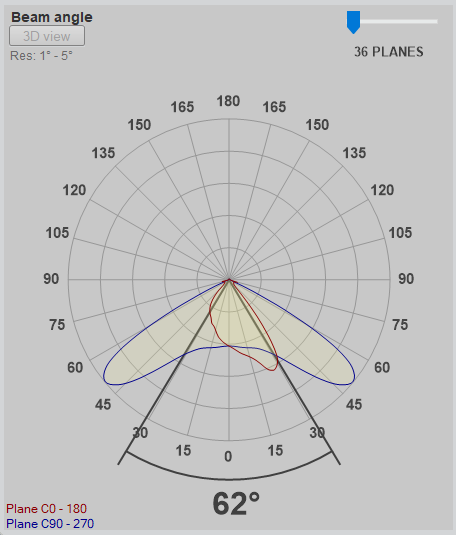
Definition and Fundamentals
Peak intensity (also called maximum luminous intensity) is the highest value of luminous intensity that a light source emits in any direction, measured in candelas (cd). It characterizes the “brightness” of the beam at its most concentrated point, such as the center of a spotlight. This metric is central to photometric specification, allowing professionals to compare and select lighting solutions based on how effectively they deliver light in the directions that matter most for a given application.
Luminous intensity, the underlying quantity, measures how much visible light (weighted by human eye sensitivity) is emitted per unit solid angle in a given direction. The SI unit for this is the candela (cd).
Peak intensity is especially relevant for lighting products designed to project light directionally, spotlights, floodlights, projectors, runway edge lights, automotive headlamps, and more. In such cases, the maximum value, not the average or total, often determines compliance with safety regulations and the effectiveness of the lighting system.
Luminous Intensity ((I_v)): The Building Block
Luminous intensity ((I_v)) is defined as:
[ I_v = \frac{d\Phi_v}{d\Omega} ]
Where:
- (d\Phi_v) is the luminous flux (in lumens, lm) emitted into an incremental solid angle (d\Omega) (in steradians, sr).
A point source emitting uniformly in all directions would have constant intensity, but real lamps generally have intensity distributions that vary with angle, forming a “beam.”
For a surface at distance (r) from the source and perpendicular to the beam, the illuminance ((E_v), in lux) is:
[ E_v = \frac{I_v}{r^2} ]
This formula allows designers to predict how bright a surface will appear at a given distance from a source with known intensity.
Luminous Flux ((\Phi_v)): Not the Same as Intensity
Luminous flux ((\Phi_v)), measured in lumens (lm), is the total visible light output of a source in all directions. It’s the sum of all the light energy emitted, giving a holistic view of a lamp’s total output. However, high luminous flux does not necessarily mean high peak intensity, if the lamp spreads its light widely, the intensity in any one direction will be less.
For a uniform point source:
[ \Phi_v = I_v \times 4\pi ]
For directional sources:
[ \Phi_v = \int I_v(\theta, \phi) \sin\theta, d\theta, d\phi ]
Total flux is measured with integrating spheres, while intensity distribution is measured with goniophotometers.
Beam Angle: The Shape of the Beam
Beam angle defines the angular spread of light above a certain threshold of the peak intensity, usually the angle where the intensity drops to 50% of the peak ((0.5 \times I_{max})), called the Full Width at Half Maximum (FWHM).
Common definitions:
| Term | Definition | Relative Intensity | Typical Use |
|---|---|---|---|
| Beam Angle | Width at 50% of peak | 0.5 × Imax | Spotlights, stage lighting |
| Field Angle | Width at 10% of peak | 0.1 × Imax | Floodlights, architecture |
| Cutoff Angle | Width at 2.5% or 3% | 0.025–0.03 × Imax | Glare, regulatory limits |
A high peak intensity with a narrow beam illuminates a small area very brightly, a wide beam spreads the same or more total light over a larger area with a lower peak.
Solid Angle ((\Omega)): How Light Fills Space
A solid angle ((\Omega), in steradians, sr) is a 3D measure of how wide a beam extends from the source. For a conical beam:
[ \Omega = 2\pi \left(1 - \cos\left(\frac{\alpha}{2}\right)\right) ]
where (\alpha) is the beam angle in radians.
This is fundamental for converting between peak intensity and total luminous flux within a beam:
[ \Phi_v = I_v \cdot \Omega ]
Candela (cd): The SI Unit
The candela is the SI base unit for luminous intensity. One candela is defined as the luminous intensity, in a given direction, of a source emitting monochromatic radiation of frequency (540 \times 10^{12}) Hz (roughly 555 nm, the peak sensitivity of the human eye) with a radiant intensity of 1/683 watt per steradian.
All laboratory measurements of luminous intensity are traceable to this definition, ensuring international consistency and comparability.
Key Laboratory Measurement Methods
Goniophotometer: Mapping the Intensity Distribution
A goniophotometer is used to measure the luminous intensity of a light source at various angles around it. The lamp is rotated, and a detector captures intensities at precise increments, creating a full intensity distribution map. The highest value recorded is the peak intensity.
- Types: Type A, B, C (most lighting uses Type C, dual-axis rotation).
- Data is output as photometric files (.IES, .LDT) for use in simulation and compliance checking.
Integrating Sphere: Measuring Total Flux
An integrating sphere measures total luminous flux by capturing all light emitted in any direction and averaging it. It cannot measure directionality or peak intensity directly.
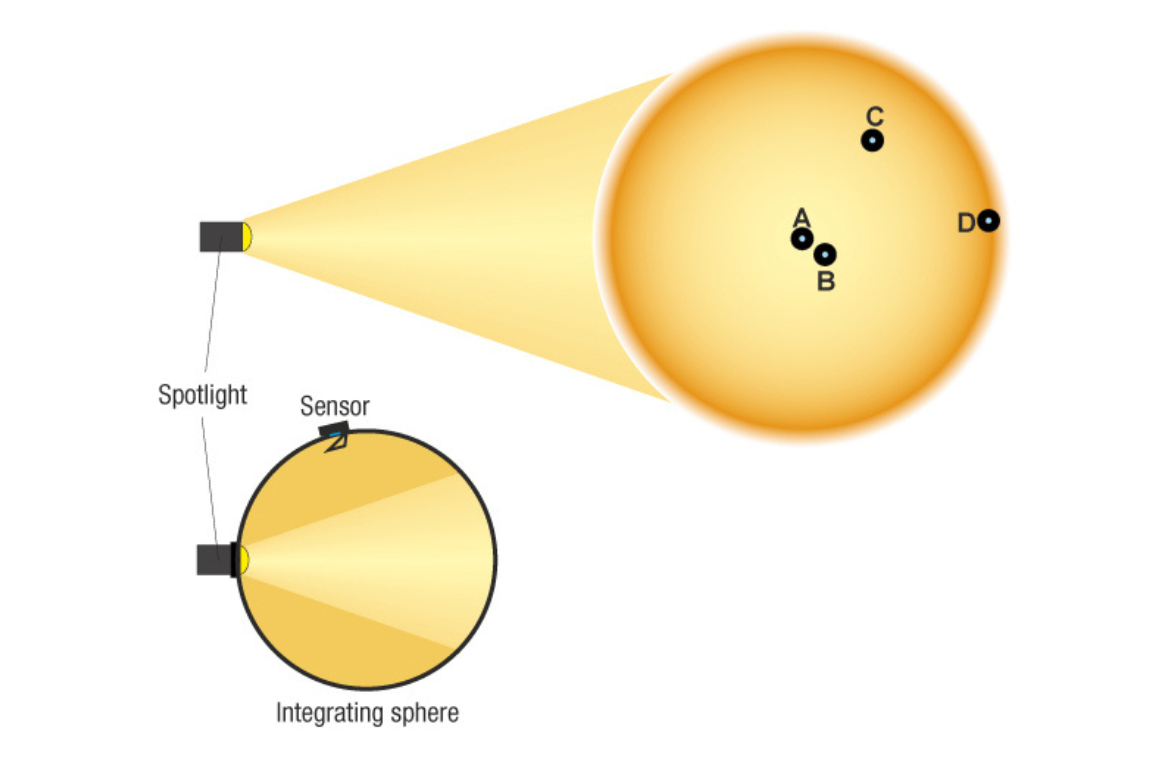
Luxmeter: Quick Field Estimation
A luxmeter measures illuminance (lux) at a point. When placed at a known distance directly in front of the beam, it can estimate peak intensity:
[ I_v = E_v \cdot r^2 ]
However, this is much less accurate than laboratory methods and assumes a well-defined beam and precise alignment.
Spectroradiometer: Color and Spectral Analysis
A spectroradiometer measures the spectral power distribution (SPD) and can provide colorimetric data. When paired with suitable optics, it can measure spectrally-weighted intensity, critical for analyzing LED and specialty lighting products.
Measurement Standards and Protocols
Adherence to recognized standards is essential for reliable, comparable results:
- CIE S 025/E:2015: LED lamp/luminaire measurement protocol.
- IES LM-79: North American standard for solid-state lighting measurements.
- EN 13032-1/4: European photometric measurement standard.
- DIN 5032: German standard covering photometric techniques.
Best Practices Include:
- Allowing thermal stabilization before measurement.
- Documenting all measurement geometry, ambient conditions, and equipment used.
- Reporting full intensity distribution, not just peak values.
Application Examples
Aviation Lighting
Regulations such as ICAO Annex 14 specify exact peak intensities for runway, approach, and taxiway lights to ensure safety and visibility. Compliance requires laboratory-verified measurements.
Automotive and Architectural Lighting
Headlamps, spotlights, and facade illumination must meet strict directional intensity specifications. Peak intensity defines visibility, glare, and compliance with road or building codes.
Performance and Display Lighting
Stage and exhibit lighting rely on high peak intensity with precise beam angles to create desired visual effects without excess spill or glare.
Calculation Examples
Example:
A spotlight has a measured peak intensity of 20,000 cd and a beam angle of 10°. To find the solid angle ((\Omega)):
[ \Omega = 2\pi \left(1 - \cos\left(\frac{10°}{2}\right)\right) \approx 0.024~\text{sr} ]
Approximate luminous flux within the beam:
[ \Phi_v = 20,000~\text{cd} \times 0.024~\text{sr} = 480~\text{lm} ]
Summary
Peak intensity is the single most important metric for characterizing the maximum “brightness” of a light source in any direction, especially for directional lighting. It is measured in candelas, mapped using goniophotometers, and governed by international standards for accuracy and comparability. Understanding how peak intensity relates to beam angle, luminous flux, and solid angle is essential for anyone specifying, designing, or evaluating lighting systems for safety, performance, or regulatory compliance.
Further Reading
- CIE S 025/E:2015 Test Method for LED Lamps, LED Luminaires and LED Modules
- IES LM-79-19: Approved Method for Electrical and Photometric Measurements of Solid-State Lighting Products
- ICAO Annex 14 – Aerodrome Design and Operations
Related Terms
- Luminous Flux (Lumen)
- Beam Angle
- Illuminance (Lux)
- Goniophotometer
- Solid Angle (Steradian)
- Integrating Sphere
- Photometric Data Files (IES/LDT)
- ICAO Lighting Standards
Peak intensity is at the heart of photometric science and practical lighting engineering. Mastery of this concept ensures that lighting systems are both effective and compliant, delivering light where and when it is most needed.
Frequently Asked Questions
- What is peak intensity in lighting?
- Peak intensity, or maximum luminous intensity, is the highest value of luminous intensity (measured in candelas) that a light source emits in any direction. This value is essential for specifying and comparing lighting products, especially in applications where directional performance is critical, such as runway lights, spotlights, and automotive headlamps.
- How is peak intensity measured?
- Peak intensity is typically measured using a goniophotometer, which maps the light output at various angles around a source. The highest recorded value is reported as the peak. Measurements follow international standards like CIE S 025 or IES LM-79 to ensure accuracy and comparability.
- Why is peak intensity important for aviation and other regulated industries?
- In aviation, automotive, and other regulated fields, safety and visibility depend on precise light performance at specific viewing angles. Standards like ICAO Annex 14 require minimum and maximum peak intensities to ensure lights are visible to pilots and drivers under all conditions.
- What is the difference between peak intensity and luminous flux?
- Peak intensity refers to the brightest point in a specific direction (candelas), while luminous flux (lumens) is the total light output in all directions. A lamp can have a high peak intensity but low total flux if its beam is very narrow.
- How does beam angle relate to peak intensity?
- Beam angle is the angular width over which the intensity remains above a certain proportion (typically 50%) of the peak. A narrow beam with high peak intensity focuses light tightly, while a wide beam spreads the light more, lowering the peak intensity for the same total output.
This is a reference entry. TarmacView provides drone inspection services and doesn't sell the equipment or materials described in this glossary.