What is Post-Tensioning (PT) in Concrete Structures?
Post-Tensioning in Concrete Structures
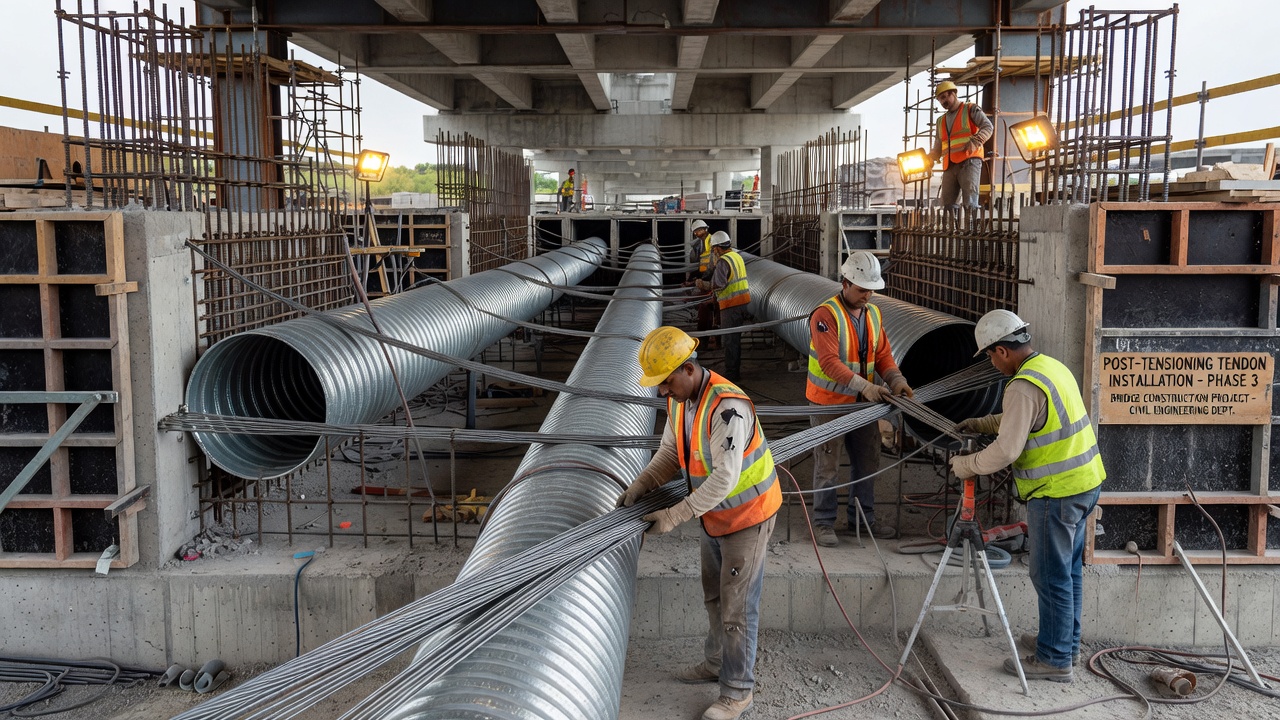
Principles of Prestressing
Prestressed concrete is concrete in which internal compressive stresses are intentionally introduced, typically by tensioning high-strength steel elements, to counteract tensile stresses that will develop under service loads. Concrete’s tensile strength is approximately only 10% of its compressive strength, ranging from 2 to 5 MPa (300–700 psi) depending on grade, compared to compressive strengths of 20 to 80 MPa (3,000–12,000 psi). Without prestressing, concrete would crack under relatively low tensile stress, limiting span lengths and requiring deeper sections. Prestressing effectively delays or eliminates these cracks, producing a structural material that behaves elastically under service loads.
The fundamental principle is to apply compression to regions of a member that will later experience tension under applied loads. A hydraulic jack tensions the steel tendon (strand or bar) to approximately 70–80% of its ultimate tensile strength, typically 0.75 fpu for normal applications, where fpu is the specified tensile strength of the prestressing steel. After the tendon is anchored against the concrete using mechanical anchorages, the tendon attempts to shorten elastically. This shortening force is transferred as compression into the concrete section. When service loads are applied, the induced tensile stresses must first overcome this pre-existing compression before any net tension develops in the concrete.
The “book analogy” is often used to explain the principle: stack books side by side and squeeze them firmly from both ends. The compression creates enough friction that the stack can be lifted as a single unit and even support additional load on top without the books falling apart. The concrete member behaves similarly under prestress, the compressive force holds the material together against applied bending moments.
Key stress states in a post-tensioned member include three critical conditions. Initial condition at the time of force transfer: the concrete is compressed and the tendon carries the jacking force minus immediate losses. Immediate losses include friction loss between the tendon and duct (characterized by wobble coefficient k and curvature coefficient μ per AASHTO LRFD), elastic shortening of the concrete as it compresses under the prestress force, and seating loss as the wedges seat into the anchorage upon release of the jack. Service condition under full design loads: applied loads induce tension, reduced by the existing compression. The goal is either zero tension (fully prestressed, Class U per ACI 318) or limited tension within the concrete tensile capacity (partially prestressed, Class T or C). Ultimate condition at failure: prestressing contributes to the ultimate flexural strength, and the section is analyzed similarly to reinforced concrete using strain compatibility and equilibrium.
Pretensioning versus post-tensioning represents the two fundamental categories of prestressed concrete. In pretensioning, the tendons are tensioned between fixed abutments in a precast plant before the concrete is cast. After the concrete reaches sufficient strength (typically 24–48 hours at 70% of specified compressive strength), the tendons are released, transferring force to the concrete through bond between the steel and the surrounding concrete. Pretensioning is efficient for mass production of standardized precast elements such as hollow-core slabs, double tees, and AASHTO bridge girders, with span ranges up to approximately 60 m. In post-tensioning, the tendons are tensioned after the concrete has hardened. Ducts are placed in the formwork before casting, the concrete is poured and cured, and then the tendons are threaded through the ducts and tensioned against the hardened concrete. Force is transferred through mechanical anchorages bearing directly on the concrete rather than through bond. Post-tensioning enables span ranges from 20 m to over 200 m and is the dominant method for cast-in-place bridges, segmental construction, and building slabs.
Internal and external prestressing address different structural configurations. Internal prestressing uses tendons embedded within the concrete cross-section, which is the most common arrangement. External prestressing locates tendons outside the concrete, for example, inside box girder voids, and is frequently used for strengthening existing structures. Linear prestressing applies to beams, slabs, and girders, while circular prestressing wraps tendons around the circumference of tanks, pipes, and silos to resist hoop tension from internal pressure.
Post-Tensioning System Components
Prestressing Steel, Strands and Bars
The predominant type of prestressing steel in modern post-tensioning is the 7-wire strand conforming to ASTM A416/A416M. Each strand consists of six outer wires helically wound around a straight center wire (king wire) in a 1×7 configuration. The helical winding provides mechanical interlock with grout (in bonded systems) and enables the strand to be gripped effectively by wedges. Grade 270 strand (1860 MPa specified tensile strength) with low-relaxation characteristics is the standard for most PT applications, where relaxation at 1000 hours is limited to ≤ 2.5% per ASTM A416.
| Property | 0.5 in (12.7 mm) Strand | 0.6 in (15.24 mm) Strand |
|---|---|---|
| Nominal cross-sectional area | 98.7 mm² (0.153 in²) | 140 mm² (0.217 in²) |
| Grade (specified tensile strength) | 1860 MPa (270 ksi) | 1860 MPa (270 ksi) |
| Minimum breaking load | 183.7 kN (41,300 lb) | 260.7 kN (58,600 lb) |
| Minimum yield load at 1% elongation | ~167 kN (~37,500 lb) | ~236 kN (~53,000 lb) |
| Weight per 1000 m | 775 kg | 1102 kg |
| Minimum elongation in 610 mm | 3.5% | 3.5% |
| Relaxation at 1000 hours (low-relaxation) | ≤ 2.5% | ≤ 2.5% |
The 0.6 in (15.24 mm) strand has largely replaced the 0.5 in (12.7 mm) strand as the industry standard for bridge construction because its higher cross-sectional area reduces the number of strands required for a given prestress force, simplifying anchorage zones and reducing duct congestion. Strand size tolerances mean actual dimensions vary from nominal, PTI references Minimum Ultimate Tensile Strength (MUTS) as the acceptance criterion rather than nominal dimensions.
High-strength bars conforming to ASTM A722/A722M Type II provide an alternative to strands for specific applications. Bars are available in Grade 150 (1035 MPa minimum yield strength) with diameters from 16 mm (5/8 in) to over 50 mm (2 in). Typical bridge applications use 32 mm (1-1/4 in) or 35 mm (1-3/8 in) diameter bars for transverse post-tensioning, vertical post-tensioning in webs, and anchorage zone confinement. Bars are inherently less susceptible to corrosion than strands due to their lower strength, larger cross-sectional diameter, and smaller surface-area-to-volume ratio. Bar systems are also used for soil anchors, rock anchors, and foundation tie-downs where high forces in short lengths are required.
Anchorages
Active (stressing) anchorages are located at the end where the hydraulic jack bears against the concrete. The complete anchorage assembly includes several components. The bearing plate transfers the tendon force to the concrete, it may be a basic flat plate for smaller tendons or a special casting with integral confinement reinforcement for multi-strand tendons. The bearing stress under the plate is limited by ACI 318 provisions, typically to 0.85 fci’ √(A₂/A₁) where fci’ is the concrete compressive strength at transfer and A₂/A₁ is the ratio of supporting surface to bearing area, limited to a maximum of 2. The wedge plate (multi-strand systems) houses the individual wedges for each strand. The wedges are two-part or three-part tapered, heat-treated steel components with internal serrations (teeth) that grip the strand when tension is released. The wedge angle and serration pattern are designed to provide secure gripping without damaging the strand wires or causing stress concentrations. The trumpet forms the transition between the bearing plate and the duct, providing a smooth path for the tendon and sealing the duct end. Confinement reinforcement, typically spiral reinforcement, surrounds the local anchorage zone to resist the bursting and spalling forces that develop as the concentrated prestress force spreads into the concrete section. The encapsulation cap provides corrosion protection by sealing the exposed anchorage after stressing.
Dead-end (fixed) anchorages are the non-stressing end. For unbonded single-strand tendons, the dead end is typically pre-assembled at the factory with a bullet-shaped swaged fitting that bears against a concrete cone. For bonded multi-strand tendons, the dead end typically consists of a bearing plate similar to the active end but without the wedge plate.
Intermediate anchorages are located at construction joints to allow staged stressing of portions of a tendon. This is common in segmental bridge construction where cantilever tendons are stressed at each segment before the next segment is cast or erected.
Anchorage zones are divided into two regions per PTI terminology. The local zone is the prismatic region immediately surrounding the bearing plate, including confinement reinforcement and minimum concrete cover. The general zone (Saint-Venant region) extends from the anchorage a distance equal to the overall member depth, through which the concentrated prestress force spreads to a linear stress distribution.
PT Ducts
Ducts form the void in which the tendon is placed and, for bonded systems, contain the grout. Two types of ducts are used.
Corrugated steel ducts are spiral-wound from galvanized strip steel with a minimum wall thickness of approximately 0.6 mm (0.024 in). The corrugations provide mechanical bond between the duct and the surrounding concrete and between the duct and the grout, ensuring composite action. Per AASHTO LRFD Bridge Design Specifications, the minimum inside cross-sectional area of the duct must be 2.0 to 2.5 times the net area of the tendon. For a 19-strand 0.6 in tendon with a total steel area of 2,660 mm², the minimum duct area is 5,320 mm², corresponding to a duct inner diameter of approximately 82 mm. In practice, duct inner diameters range from approximately 60 mm for small tendons to over 200 mm for large multi-strand tendons. Steel ducts must be galvanized to resist corrosion and must be adequately supported within the formwork to prevent displacement during concrete placement.
HDPE (plastic) ducts are manufactured from high-density polyethylene with corrugated or ribbed external surfaces for bond with concrete. Plastic ducts offer several advantages: they are inherently corrosion-resistant with no galvanic coupling with steel, provide a watertight enclosure when properly connected, have lower friction coefficients than steel ducts, and are flexible enough to accommodate curved profiles without kinking. Plastic ducts require UV protection if stored in sunlight prior to installation and must be properly connected at joints to prevent grout leakage. Plastic ducts are increasingly preferred for aggressive environments and are required for FHWA Tendon Protection Level PL-3.
Grout
Cementitious grout is the material pumped into the duct after stressing to create bond between the tendon and the surrounding concrete (for bonded systems) and to provide corrosion protection via an alkaline environment. Per PTI M55.1 (Specification for Grouting of Post-Tensioned Structures), grout must meet stringent requirements: water/cement ratio ≤ 0.44, 28-day compressive strength ≥ 35 MPa (5,000 psi) per ASTM C109, zero bleed water after initial mixing per ASTM C940, plastic expansion of 0–10% after 3 hours per ASTM C1741, efflux time of 11–30 seconds per ASTM C939, maximum chloride ion content < 0.08% by mass of cementitious material, and fluidity retention for ≥ 30 minutes after mixing. Pre-bagged grouts are strongly preferred for consistency and quality control. Thixotropic grouts, which stiffen at rest but flow when agitated, are used for vertical tendons where sagging or drainage would be a concern.
Encapsulation Systems
An encapsulated tendon is fully enclosed in a watertight covering from end to end. The system includes plastic sheathing (for unbonded) or plastic duct (for bonded), corrosion-inhibiting coating, an encapsulation cap over each anchorage, and sealed trumpet and coupler connections. FHWA defines four Tendon Protection Levels: PL-1A (standard interior), PL-1B (standard exterior), PL-2 (enhanced for moderate exposure), and PL-3 (maximum protection for aggressive environments, with fully encapsulated systems, plastic ducts, and sealed anchorages).
Bonded versus Unbonded Post-Tensioning
Bonded PT Systems
In bonded post-tensioning, the prestressing steel is placed inside a corrugated duct (steel or plastic) that is cast into the concrete. After the concrete reaches sufficient strength and the tendons are stressed, cementitious grout is pumped into the duct under pressure, completely filling all voids around the tendons. Once the grout hardens, it creates a permanent mechanical and chemical bond between the tendon and the surrounding concrete.
The bonded tendon cannot move relative to the concrete after grouting, force transfer occurs through bond stress over a short transfer length. The grout provides an alkaline environment (pH 12.5–13) that passivates the steel surface, forming a stable iron oxide layer that resists corrosion. At ultimate load, bonded strands can reach their yield stress because bond allows strain compatibility with the adjacent concrete. Bonded systems provide resistance to progressive collapse, if one strand fractures, the bonded strand can develop its force over a short distance into the grout, preventing catastrophic propagation.
Applications include bridges (segmental, cast-in-place, spliced girders), large transfer girders in buildings, heavy-load structures, and structures in marine or aggressive environments where superior corrosion protection is essential.
Disadvantages include the requirement for skilled grouting operations with rigorous quality control and testing, higher friction losses (wobble and curvature coefficients for steel ducts are k = 0.0002/ft and μ = 0.15–0.25 per AASHTO), the fact that internal bonded tendons cannot be replaced, and the need for watertight ducts to prevent grout leaks.
Unbonded PT Systems
In unbonded post-tensioning, each strand is individually coated with corrosion-inhibiting grease and extruded with a seamless plastic (HDPE) sheath through which the strand is free to move relative to the concrete. Force is transferred only through the end anchorages and, for external tendons, intermediate deviators.
At ultimate load, the unbonded strand stress is limited because strain is not compatible with the adjacent concrete. The stress at nominal flexural strength (fps) for unbonded tendons is calculated per ACI 318 using simplified equations that account for the span-to-depth ratio and bonded reinforcement ratio. Unbonded systems have lower friction losses than bonded systems because there is no grout contact along the length. Single-strand (monostrand) is the most common configuration for building applications.
Applications include building slabs (elevated and on-grade), parking structures, mat foundations, beams and joists in buildings, and structures where future modification may be needed.
Advantages include rapid installation (no grouting and no curing time), replaceability (unbonded strands can be detensioned and pulled out), lower friction losses requiring fewer strands for the same prestress force, reduced deflection compared to equivalent bonded sections, and easier creation of future openings.
Disadvantages include lower corrosion protection (only grease and the plastic sheath), vulnerability at anchorages where water can ingress at the pocket, potential for progressive collapse if anchorages fail, lower ultimate flexural strength compared to equivalent bonded systems, higher long-term deflection under sustained loads, and more non-prestressed reinforcement required per code.
Comparison Table
| Property | Bonded PT | Unbonded PT |
|---|---|---|
| Corrosion protection | Excellent (grout + duct + concrete) | Moderate (grease + sheath) |
| Ultimate strength | Higher (strands can reach yield) | Lower (limited by anchor capacity) |
| Replaceability | Not replaceable (internal tendons) | Replaceable |
| Friction loss | Higher (k=0.0002/ft, μ=0.15–0.25) | Lower (k=0.001/ft, μ=0.05–0.08) |
| Installation speed | Slower (grouting and curing required) | Faster (no grouting) |
| Progressive collapse resistance | Better (bond develops force locally) | Weaker (anchorage-dependent) |
| Common applications | Bridges, heavy transfer girders | Building slabs, parking structures |
| Minimum non-prestressed rebar | ~0.12% (non-curtailed) | Higher, code-dependent per ACI 318 |
Hybrid Systems
Bonded and unbonded systems can be mixed within a single structure. For example, unbonded monostrand tendons in typical floor levels with bonded multi-strand tendons in transfer girders and columns. This approach optimizes the advantages of each system, rapid installation and replaceability for the slabs, and high ultimate strength with superior corrosion protection for critical structural elements.
Grouting and Corrosion Protection
Cementitious Grout Requirements
Grouting is the most critical quality-control operation in bonded post-tensioning. PTI M55.1-12 (updated to M55.1-19) defines the specification for grouting of post-tensioned structures. The grout must meet stringent fresh and hardened properties.
| Parameter | Requirement per PTI M55.1 |
|---|---|
| Water/cement ratio (w/c) | ≤ 0.44 (pre-bagged), field-mix ≤ 0.45 maximum |
| 28-day compressive strength (ASTM C109) | ≥ 35 MPa (5,000 psi) |
| Bleed water (ASTM C940) | Zero bleed after initial mixing |
| Plastic expansion (ASTM C1741) | 0–10% after 3 hours, must not cause duct bursting |
| Efflux time (ASTM C939 flow cone) | 11–30 seconds |
| Maximum chloride ion content | < 0.08% by mass of cementitious material |
| Fluidity retention | ≥ 30 minutes after mixing |
| Maximum aggregate size | 2.36 mm (No. 8 sieve) if sand added |
Pre-bagged grouts are strongly preferred for consistency because they are factory-blended with precisely controlled proportions of cement, supplementary cementitious materials (silica fume, fly ash), expansion agents, plasticizers, and corrosion inhibitors. Field-mix grouts require rigorous QC testing of each batch.
Thixotropic grouts are formulated to remain stiff at rest (preventing sagging or drainage in vertical or inclined tendons) but flow readily when subjected to pumping pressure. This reversible property makes them ideal for vertical risers and inclined web tendons in segmental bridges.
Vacuum Grouting
For long tendons (greater than 50 m), vertical or inclined profiles, and aggressive environments, vacuum grouting is specified. A vacuum pump draws a negative pressure of approximately −0.08 MPa (−0.8 bar) at the highest outlet before grout is pumped in from the lowest inlet. The vacuum removes air from the duct, eliminating trapped air pockets that would otherwise remain as voids. The grout is drawn into the duct by both the pumping pressure and the negative pressure, ensuring complete filling of the thin annular spaces between individual wires of multi-strand tendons. Vacuum grouting significantly reduces the risk of grout voids, the most common durability defect in bonded PT systems.
Grouting Operations
Grouting must be performed within a limited time after stressing, typically ≤ 20 days, with shorter intervals specified for aggressive environments where tendons are exposed to moisture or chlorides. The grout is pumped continuously from the lowest inlet to the highest outlet. All outlets must discharge grout of the same consistency as the intake before being sequentially closed. The minimum grout cap pressure at the highest outlet is typically 0.5–1.0 MPa. After grouting, inlets and outlets are sealed with positive shut-off valves, and the caps remain pressurized during the initial set period.
Corrosion Protection Strategy
Corrosion protection in PT structures follows a three-level strategy. Level 1, Grout provides alkaline passivation (pH 12.5–13), forming a stable passive iron oxide layer on the steel surface. Level 2, Duct and encapsulation provide a physical barrier against water and chloride ingress. Level 3, Concrete cover provides tertiary protection. For aggressive environments (marine, deicing salts, industrial), enhanced protection includes fully encapsulated systems with plastic ducts, sealed anchorages with encapsulation caps, epoxy-coated strand per ASTM A882, and stainless steel strand for extreme environments.
Post-Tensioning for Bridges
Segmental Construction Methods
Balanced cantilever construction is the most widely used method for medium to long-span post-tensioned bridges. Segments are erected symmetrically about each pier, either precast match-cast segments or cast-in-place using form travelers. Precast segments are match-cast against adjacent segments in the casting yard to ensure perfect fit at joints, which are epoxied before applying post-tensioning. Cast-in-place balanced cantilever uses traveling formwork that supports each newly cast segment until the cantilever tendons are stressed. Span ranges from 50 to 230 m for precast and up to 230+ m for cast-in-place. The tendon system includes cantilever tendons in the top slab or webs that resist dead load during construction, and continuity tendons in the bottom slab that are stressed after the closure pour to resist positive live load moments.
Span-by-span construction uses an erection truss or gantry to support an entire span. Segments are epoxy-joined and post-tensioned in a single operation, typically achieving a construction cycle of one span per week. Span range is typically ≤ 45 m (150 ft). External tendons located inside the box girder void are common, deviated at intermediate saddles to create the required profile. External tendons are inspectable and replaceable throughout the life of the structure.
Progressive cantilever construction starts at one abutment and progresses incrementally toward the opposite abutment, with segments delivered along the completed portion and added at the advancing end. Temporary supports at midspan are required. This method is used where access is limited, such as the Linn Cove Viaduct on the Blue Ridge Parkway.
Cast-in-Place Post-Tensioned Bridges
For shorter spans (20–50 m), cast-in-place post-tensioned bridges on falsework are economical. The superstructure is cast on temporary supports, typically using solid or cellular cross-sections. Draped tendon profiles are low at midspan and rise to the top at interior supports for continuous spans, creating the variable eccentricity that provides both positive and negative moment capacity along the span. Transverse post-tensioning in the top slab of box girders, spaced at 0.6–0.9 m, distributes wheel loads transversely and controls longitudinal cracking. Vertical post-tensioning in webs and diaphragms provides confinement at anchorage zones.
Spliced I-Girder Bridges
Precast AASHTO or bulb-T girders are pretensioned for self-weight, erected as simple spans, then made continuous through cast-in-place closure joints. Longitudinal post-tensioning ducts in the webs are spliced at the closures, and post-tensioning is applied in phases, some tendons stressed on the non-composite section, the remainder after the deck slab cures.
Stay Cables and Extradosed Bridges
Stay cables in cable-stayed bridges are essentially unbonded external tendons with HDPE sheathing and wax or grout filling. Configurations include harp (parallel), fan (converging at pylon top), and semi-fan arrangements. Cable planes may be single central or twin edge planes. Span range extends from 90 to 760 m for major crossings. Extradosed bridges hybridize cable-stayed and post-tensioned box girder concepts, with shorter pylons, flatter cable inclination, and the deck acting as the primary load-carrying member. They are useful where pylon height is restricted.
Post-Tensioning for Airport Structures
Prestressed Concrete Pavements
Prestressed concrete pavements (PCP) for airports are post-tensioned with high-strength steel strands and are significantly thinner than conventionally reinforced pavements. Typical thickness is 150–250 mm compared to 350–450 mm for jointed reinforced concrete pavement. The primary advantage is the long jointless slab length, 150 to 300 m between joints, which eliminates most joints and their associated maintenance requirements. Reduced joint maintenance is particularly valuable for airfield pavements where joint sealant failures create foreign object debris (FOD) hazards and allow water ingress that accelerates pavement deterioration.
FAA design standards are defined in AC 150/5320-6E (Airport Pavement Design and Evaluation). The FAARFIELD design program uses 3D finite element analysis (NIKE3D_FAA) and layered elastic analysis (LEAF) to compute stresses and deflections. The design criterion for rigid pavements is the maximum horizontal stress at the bottom edge of the PCC slab under edge loading from aircraft gear. The 20-year design life uses Miner’s cumulative damage factor (CDF) rule. Aircraft tire pressures up to 1.5 MPa (221 psi) are accounted for in the analysis. Aircraft gear configurations are classified as Single (S), Dual (D), Dual Tandem (2D), Triple Tandem (3D), and Quadruple Tandem (4D).
Hangar Floors and Terminal Structures
Heavy-duty post-tensioned slabs in hangars support aircraft jacking loads and heavy maintenance equipment. Typical thickness ranges from 200 to 350 mm depending on aircraft type. Large panel sizes with minimal joints provide smooth rolling surfaces for aircraft movement. Bonded PT systems are commonly used for corrosion protection due to potential exposure to hydraulic fluids and deicing chemicals. Post-tensioned terminal structures use unbonded monostrand systems for elevated slabs, enabling large column-free spaces for passenger circulation.
ICAO Aerodrome Design Manual (Doc 9157 Part 3)
ICAO Doc 9157 Part 3 provides guidance on pavement design characteristics and the Pavement Classification Number (PCN) system for reporting bearing strength. Aircraft weight distribution allocates approximately 95% of the aircraft weight to the main landing gear and 5% to the nose gear. Wheel arrangement nomenclature follows Single (S), Dual (D), Triple (T), and Quadruple (Q) configurations with tandem designations (2S, 2D, 3D, etc.). The ICAO manual focuses primarily on conventional rigid and flexible pavement design methodology, with prestressed concrete pavement design addressed through national standards (FAA AC 150/5320 in the United States) and the ICAO framework providing aircraft load characterization.
PT Durability Issues
Corrosion Mechanisms
Chloride-induced corrosion is the most widespread cause of tendon deterioration. Chloride ions (Cl⁻) from deicing salts, marine exposure, or industrial environments penetrate the concrete cover and locally break down the passive oxide layer on the prestressing steel. Localized pitting corrosion initiates and propagates under the high tensile stress in the tendon. The critical chloride threshold for prestressing steel is approximately 0.2% by mass of cement, significantly lower than for conventional reinforcing steel, because the higher stress level and finer microstructure of high-strength steel make it more susceptible. Pitting reduces the cross-sectional area locally, concentrating stress and potentially leading to sudden brittle fracture without prior visible warning.
Stress Corrosion Cracking (SCC) results from the combined action of sustained tensile stress and a corrosive environment. SCC produces brittle fracture at stresses below the yield strength, with no significant plastic deformation. Common aggressive species include chlorides, nitrates, sulfates, and phosphates. Higher steel hardness increases the SCC crack growth rate.
Hydrogen Embrittlement is defined by PTI as brittle cracking in high-strength steels caused by the conjoint action of tensile stress and the presence of atomic hydrogen. Atomic hydrogen diffuses into the steel lattice, reducing ductility and causing brittle fracture. Sources include cathodic protection systems that are overprotected, galvanic coupling between dissimilar metals, and corrosion reactions that produce hydrogen ions. Hydrogen embrittlement is most dangerous for steels with tensile strength exceeding 1200 MPa, which includes Grade 270 (1860 MPa) prestressing strand. Failure can be sudden and catastrophic with no prior visible indication.
Grout Voids
Grout voids are the most common durability defect in bonded PT systems. Voids form at high points of draped tendons, anchorages, and trumpet-to-duct transitions. Formation mechanisms include evaporation of bleed water (especially in vertical and inclined tendons), poor grouting practice (insufficient pumping pressure, improper sequencing of vent closure), inadequate venting that traps air at high points, leaking ducts that allow grout loss, and incomplete filling from single-direction pumping. Voids provide a space for water accumulation and oxygen replenishment, creating conditions for accelerated localized corrosion. The corrosion rate in a void can be orders of magnitude higher than in properly grouted regions because the passive alkaline environment is absent and the void may be periodically flushed with oxygenated water.
Water Ingress at Anchorages
The anchorage is the most vulnerable zone for water ingress. Improperly sealed stressing pockets and ungrouted encapsulation caps provide direct pathways for water to reach the steel wedges and strand tails. Secondary pathways include cracks in the concrete around bearing plates, failed sealants, and leaking pocket formers. Water accumulation at the anchorage leads to corrosion of wedges and strand tails, potentially causing loss of anchorage capacity and tendon failure.
Duct Damage and Fretting Fatigue
Duct damage during construction, crushed or torn ducts from rebar congestion, over-consolidation of concrete, or formwork movement, creates openings for grout leakage and water ingress. During service, steel ducts can corrode in high-chloride environments, eventually perforating and creating pathways for chlorides to reach the tendon. External tendons at deviation saddles experience fretting fatigue from the cyclic movement of the tendon against the saddle under live load. This fretting reduces the strand cross-section at the saddle and can initiate fatigue cracks that propagate under continued cyclic loading.
Inspection and NDT of PT Structures
Visual Inspection
Visual inspection is the first step in any PT condition assessment. Inspectors examine anchor regions for cracks, staining, or efflorescence near anchor pockets, rust staining along tendon profiles, spalled or delaminated concrete over ducts, damaged or missing encapsulation caps, and water staining at joints. However, visual inspection alone cannot detect internal tendon corrosion, grout voids, or broken strands. Damage begins internally and may progress significantly before any surface symptoms appear.
Impact-Echo Testing
Impact-Echo (IE) is a single-sided NDT method that uses a mechanical impact (typically a spring-loaded solenoid or a small steel sphere) to generate low-frequency stress waves (typically 2–50 kHz) in the concrete. The waves propagate into the member and reflect from internal boundaries, voids, delaminations, ducts, or the opposite surface. A transducer adjacent to the impact point records the surface displacement caused by the reflected waves. The resulting time-domain signal is transformed to the frequency domain using a Fast Fourier Transform (FFT). The dominant frequency (f) is related to the depth of the reflecting interface (d) by d = β × Vp / (2f), where Vp is the P-wave velocity and β is a shape factor. Grout voids in ducts produce a distinct frequency shift compared to solidly grouted ducts. IE testing is rapid, cost-effective, and requires only single-sided access, making it ideal for bridge decks and slabs.
Ground-Penetrating Radar
Ground-Penetrating Radar (GPR) uses high-frequency electromagnetic waves (typically 900–1600 MHz antenna for PT inspection) transmitted into the concrete. Reflections occur at interfaces where the dielectric permittivity changes, between concrete and duct walls, between steel and grout, and between grout and air voids. GPR rapidly locates tendon ducts, maps their profile along the member length, identifies metallic versus plastic ducts, and detects moisture accumulation around ducts that may indicate grout voids or water ingress. GPR provides rapid screening with minimal surface preparation. The primary limitation is that GPR cannot reliably distinguish between solid grout and soft grout or between small voids and solid material because the dielectric contrast between set grout and dry air voids may be insufficient for reliable detection.
Ultrasonic Pulse Echo Tomography
Ultrasonic Pulse Echo (UPE) tomography uses arrays of low-frequency ultrasonic transducers (typically 25–100 kHz for concrete) to produce 3D tomographic images of internal features. Multiple transducers are arranged in a scanning array and fired in sequence. The reflected (echo) signals are processed using synthetic aperture focusing techniques (SAFT) or full-matrix capture with total focusing method (FMC/TFM) algorithms. UPE tomography provides detailed cross-sectional information about duct condition, distinguishing solid grout, soft grout, voids, and water-filled voids based on acoustic impedance contrasts. The limitation is slower survey speed compared to GPR screening and the need for a coupling agent (or dry-point contact transducers) and skilled interpretation.
Acoustic Monitoring
Acoustic Emission (AE) monitoring detects strand breaks in real time. Elastic stress waves released when a strand fractures propagate through the concrete or steel and are detected by piezoelectric sensors mounted on anchorages or along the tendon. AE monitoring provides continuous surveillance of critical tendons, especially external tendons and stay cables, and can localize the break location to within a few meters along the tendon length. Typical sensor spacing is 50–100 m. The challenge is distinguishing strand break signals from ambient noise (traffic, construction, thermal movement) using threshold-based event detection and waveform analysis.
Borescope Inspection
Endoscopy provides direct visual confirmation of internal conditions. A small-diameter (typically 6–10 mm) fiber-optic or video borescope is inserted through grout inlets, outlets, or drilled inspection ports. The inspector can directly observe the duct interior condition, grout filling level, corrosion state, and presence of moisture. Borescope inspection provides definitive verification of NDT findings but is limited to accessible duct ends and cannot inspect long sections without multiple access points.
Validation Protocol
Per industry practice (FPrimeC, FDOT), a progressive inspection protocol is recommended: Step 1, GPR scan to locate all ducts and map profiles. Step 2, IE or UPE at suspect locations (high points, deviators, anchorages). Step 3, Cross-reference NDT findings from all methods. Step 4, Confirm at ≥ 5% of test locations with invasive methods (coring, borescope) to calibrate and validate NDT results.
Repair and Strengthening of PT Structures
Tendon Replacement
Tendon replacement is feasible for unbonded systems where the individual monostrand tendons can be detensioned in a controlled manner and pulled out, then replaced with new greased and sheathed strand. The procedure involves locating and exposing the anchorages, installing detensioning equipment (a specialized jack or cutting procedure with safety restraints), releasing the prestress force in a controlled manner, removing the old tendon, installing the new strand, restressing to the specified force, and sealing the encapsulation. For bonded systems, internal tendons cannot generally be removed, and alternative strengthening methods must be used.
External Post-Tensioning
External post-tensioning is the most widely used active strengthening method for existing structures. As defined by PTI, external post-tensioning can increase and/or restore the capacity of most any structural element including beams, girders, one-way slabs, two-way slabs, prestressed and nonprestressed concrete, structural steel, and timber members. The system includes high-strength strands or bars, external deviators (saddles) attached to the structure, corrosion-protected tendon (greased and sheathed or placed inside HDPE pipes with grout), and end anchorage assemblies. External post-tensioning is an active system, unlike passive strengthening methods such as FRP wrapping or steel plate bonding, it applies a measurable compressive force that counteracts service loads immediately. Advantages include minimal added weight, full inspectability and replaceability, minimal disruption during installation, and no reduction in headroom.
CFRP Tendons
Carbon Fiber Reinforced Polymer (CFRP) tendons offer an alternative to steel for strengthening applications where corrosion resistance is paramount. CFRP provides no corrosion susceptibility, a high strength-to-weight ratio (approximately 5 times stronger than steel by weight), and excellent fatigue resistance. Limitations include a lower modulus of elasticity (approximately 40% of steel), which reduces the efficiency of prestress force development, creep rupture concerns under sustained high stress, and higher material cost. CFRP post-tensioning is used for strengthening corrosion-damaged structures, increasing capacity for higher live loads, and seismic retrofitting.
Grout Void Repair
When voids are detected by NDT and confirmed by borescope, they can be repaired by injecting low-viscosity cementitious or epoxy grout. Access holes are drilled to the void location, avoiding contact with the prestressing strands. Low-viscosity grout or epoxy is injected under low pressure (typically < 0.5 MPa to avoid duct bursting) until the void is filled. Post-injection borescope inspection verifies complete filling. Injection ports are then sealed.
Standards and Specifications
Post-Tensioning Institute (PTI)
| Standard | Title | Scope |
|---|---|---|
| PTI M55.1-12 (M55.1-19) | Specification for Grouting of Post-Tensioned Structures | Grout materials, equipment, testing, execution |
| PTI/ASBI M50.3-12 | Guide Specification for Grouted Post-Tensioning | System components, installation, QA/QC |
| PTI DC80.3-12 | Guide for Evaluation and Repair of Unbonded PT | Inspection, assessment, repair procedures |
| PTI DC80.2-10 | Guide for Creating Openings in Unbonded PT Slabs | Safe cutting and penetration procedures |
| PTI TAB.3-13 | Post-Tensioning Terminology | Standardized definitions for PT terms |
| ACI/PTI 320-25 | Joint ACI-PTI Building Code for PT | Code provisions for structural design |
American Concrete Institute (ACI)
| Standard | Relevance |
|---|---|
| ACI 318 | Building code provisions for prestressed concrete: minimum reinforcement, unbonded tendon requirements, stress limits at transfer and service, anchorage zone design, crack control, deflection |
| ACI 423 | ACI Committee on Prestressed Concrete, reports and guides on PT design, construction, evaluation |
| ACI 423.4R | Report on Corrosion Protection of PT Tendons |
| ACI 222.2R-14 | Report on Corrosion of Prestressing Steels, deterioration mechanisms (SCC, HE), protection methods |
AASHTO LRFD Bridge Specifications
| Document | Key Provisions |
|---|---|
| AASHTO LRFD Bridge Design Specifications | Prestress loss calculations (Article 5.9), duct area ≥ 2.0× tendon area, friction coefficients (k=0.0002–0.001/ft, μ=0.15–0.25), stress limits (jacking ≤ 0.80 fpu, service ≤ 0.80 fpy), anchorage zone design |
| AASHTO LRFD Bridge Construction Specifications | Installation, stressing, grouting, acceptance of PT systems, duct materials per Section 26 |
FHWA (Federal Highway Administration)
| Document | Purpose |
|---|---|
| FHWA-NHI-13-026 | Post-Tensioning Tendon Installation and Grouting Manual (Version 2.0), comprehensive guidance on materials, systems, installation, grouting, inspection, corrosion protection |
| FHWA-HIF-18-029 | Designing and Detailing Post-Tensioned Bridges to Accommodate Inspection, tech brief on accessibility |
| FHWA Report | Corrosion-Induced Major Tendon Failures in Post-Tensioned Bridges, failure case histories and root cause analysis |
Material and Testing Standards
| Standard | Title |
|---|---|
| ASTM A416/A416M | Standard Specification for Low-Relaxation, Seven-Wire Steel Strand for Prestressed Concrete |
| ASTM A722/A722M | Standard Specification for High-Strength Steel Bars for Prestressing Concrete |
| ASTM A882/A882M | Standard Specification for Epoxy-Coated Seven-Wire Prestressing Steel Strand |
| ASTM C109/C109M | Standard Test Method for Compressive Strength of Hydraulic Cement Mortars (grout cubes) |
| ASTM C939 | Standard Test Method for Flow of Grout for Preplaced-Aggregate Concrete (flow cone) |
| ASTM C940 | Standard Test Method for Expansion and Bleeding of Freshly Mixed Grouts for Preplaced-Aggregate Concrete |
| ASTM C1741 | Standard Test Method for Bleed Stability of Cementitious Post-Tensioning Tendon Grout |
Certification Programs
PTI and ASBI administer certification programs for personnel involved in PT construction and inspection: PTI Level 1 Unbonded PT Installer (field personnel), PTI Level 1 and 2 Unbonded PT Inspector, PTI Level 1 and 2 Unbonded PT Repair, Rehabilitation and Strengthening, and ASBI Grouting Certification for bonded PT bridge grouting. These programs require written examinations and demonstrated field proficiency, with recertification at specified intervals.
Glossary of Key Post-Tensioning Terms
| Term | Definition (per PTI TAB.3-13) |
|---|---|
| Tendon | Complete assembly of a prestressing element: anchorages, couplers, prestressing steel, sheathing or duct, and coating or grout |
| Bonded tendon | Tendon in which the prestressing steel is bonded to the concrete (via grout), permanently preventing relative movement |
| Unbonded tendon | Tendon in which the steel is prevented from bonding and is free to move relative to the concrete, force transfers only at anchorages and deviators |
| Encapsulated tendon | Tendon fully enclosed in a watertight covering including anchorages, sheathing with PT coating, and encapsulation caps |
| Anchorage zone | Region through which the concentrated prestressing force transfers to the concrete, including local and general zones |
| Jacking force | Temporary force exerted by the hydraulic jack during stressing |
| Initial losses | Losses during stressing: friction, elastic shortening, seating loss |
| Time-dependent losses | Concrete shrinkage, creep, steel relaxation |
| Grout | Cementitious mixture pumped into the duct to fill space around the prestressing steel |
| Bleed | Autogenous flow or emergence of mixing water from newly placed grout |
| Trumpet | Connection piece between the bearing plate and the duct |
| Wedge plate | Device housing wedges for multi-strand tendons |
| Pocket former | Device forming a recess for stressing access |
| Wobble friction | Friction from unintended angular deviations in the tendon profile |
| Hydrogen embrittlement | Brittle cracking in high-strength steel caused by the conjoint action of tensile stress and atomic hydrogen |
| Detensioning | Method for releasing force in a stressed tendon |
| Thixotropic | Material property: stiffens at rest, acquires lower viscosity when agitated (reversible) |
Compiled from FHWA-NHI-13-026 Post-Tensioning Tendon Installation and Grouting Manual (2013), PTI TAB.3-13 Post-Tensioning Terminology (2013), PTI M55.1-12, AASHTO LRFD Bridge Design Specifications, FAA AC 150/5320-6E, ICAO Doc 9157 Part 3, ACI 222.2R-14, ACI 318-19, and industry technical resources.
Frequently Asked Questions
- What is the difference between bonded and unbonded post-tensioning?
- Bonded post-tensioning uses corrugated steel or HDPE ducts placed in the concrete before casting. After the concrete hardens, the tendons are stressed and cementitious grout is pumped into the ducts, filling all voids. Once the grout cures, it creates a permanent bond between the tendon and the concrete, allowing strain compatibility at ultimate load. Bonded systems provide superior corrosion protection (alkaline grout environment, pH 12.5–13), resistance to progressive collapse, and the ability for strands to reach yield stress at ultimate. They are used in bridges, heavy transfer girders, and aggressive environments. Unbonded post-tensioning uses individual strands coated with corrosion-inhibiting grease and extruded with a seamless HDPE sheath. The strand is free to move relative to the concrete, with force transferred only through the end anchorages. Unbonded systems offer faster installation, no grouting, replaceability of individual strands, and lower friction losses. They are used in building slabs, parking structures, and mat foundations. The Post-Tensioning Institute (PTI) TAB.3-13 defines bonded tendons as those in which prestressing steel is bonded to concrete via grout, permanently preventing relative movement, and unbonded tendons as those in which steel is prevented from bonding and is free to move relative to concrete.
- How is corrosion protection provided in post-tensioned structures?
- Corrosion protection in PT structures follows a multi-level strategy. For bonded tendons: Level 1, Grout provides alkaline passivation (pH 12.5–13) forming a stable iron oxide layer on the steel surface. Per PTI M55.1-12, grout must have a water/cement ratio ≤ 0.44, zero bleed, 28-day compressive strength ≥ 35 MPa (5,000 psi), and maximum chloride ion content < 0.08% by mass of cementitious material. Level 2, The duct and encapsulation provide a physical barrier against water and chlorides. Plastic HDPE ducts are increasingly preferred over galvanized steel for aggressive environments. Level 3, Concrete cover provides tertiary protection. For unbonded tendons, corrosion protection relies on the grease coating (corrosion-inhibiting, typically calcium stearate or lithium-based) and the seamless plastic sheath. Anchorages are protected by encapsulation caps filled with grease or sealant. For aggressive environments (marine, deicing salts, industrial), FHWA recommends Tendon Protection Level PL-3, incorporating fully encapsulated systems, plastic ducts, sealed anchorages with caps, and optional epoxy-coated strand per ASTM A882 or stainless steel strand. The PTI DC80.3-12 and ACI 423.4R provide comprehensive guidance on corrosion protection and evaluation of PT structures.
- What non-destructive testing methods are used to inspect post-tensioned structures?
- Several NDT methods are used for PT structure inspection, typically applied in a progressive protocol. Ground-Penetrating Radar (GPR) using 900–1600 MHz antennas locates tendon ducts, maps profiles along the member length, identifies metallic vs plastic ducts, and detects moisture accumulation around ducts. GPR provides rapid screening with minimal surface preparation but cannot reliably distinguish solid grout from soft grout. Impact-Echo (IE) testing detects grout voids in ducts by generating stress waves from a mechanical impact and analyzing reflections from internal boundaries in the frequency domain, voids produce distinct frequency shifts compared to solid grout. Ultrasonic Pulse Echo (UPE) tomography uses arrays of low-frequency ultrasonic transducers (25–100 kHz) to produce 3D tomographic images based on acoustic impedance contrasts, detecting voids, soft grout, and corrosion within ducts. Acoustic emission monitoring detects strand breaks in real time by sensing elastic stress waves released when a strand fractures, with sensors mounted at 50–100 m spacing on critical tendons. Endoscopy (borescope inspection) provides direct visual confirmation by inserting a fiber-optic camera through grout inlets, outlets, or inspection ports. Per industry practice (FPrimeC, FDOT), a validation protocol recommends GPR scanning for duct location, IE or UPE at suspect locations, cross-referencing of NDT findings, and ≥5% invasive confirmation via coring or borescope at test locations.
- What standards govern post-tensioning design, construction, and inspection?
- Post-tensioning is governed by multiple standards organizations. The Post-Tensioning Institute (PTI) publishes: PTI M55.1-19 (Specification for Grouting of Post-Tensioned Structures, grout materials, testing, and execution), PTI/ASBI M50.3-12 (Guide Specification for Grouted Post-Tensioning, system components and QA/QC), PTI DC80.3-12 (Guide for Evaluation and Repair of Unbonded PT, inspection and repair procedures), PTI TAB.3-13 (Post-Tensioning Terminology). ACI publishes ACI 318 (Building Code Requirements for Structural Concrete, design provisions for prestressed concrete, minimum reinforcement, unbonded tendon requirements, anchorage zone design) and ACI 423 Series on prestressed concrete. AASHTO LRFD Bridge Design Specifications govern PT bridge design including prestress loss calculations (Article 5.9), minimum inside duct area ≥ 2.0× tendon net area, friction coefficients for design (wobble coefficient k = 0.0002–0.001/ft, curvature coefficient μ = 0.15–0.25), and stress limits (jacking force ≤ 0.80 fpu, stress at service ≤ 0.80 fpy). AASHTO LRFD Bridge Construction Specifications address installation, stressing, and grouting. FHWA-NHI-13-026 (Post-Tensioning Tendon Installation and Grouting Manual) serves as the definitive US reference for bridge PT. Material standards include ASTM A416 (7-wire strand, Grade 1860 MPa/270 ksi), ASTM A722 (high-strength bars, Grade 1035 MPa/150 ksi), ASTM C109 (grout compressive strength), ASTM C939 (grout flow cone), and ASTM C940 (grout bleed). For airport pavements, FAA AC 150/5320-6E provides design standards using FAARFIELD software.
- What are common durability issues in post-tensioned structures?
- The most significant durability issue in PT structures is tendon corrosion, which can lead to sudden brittle failure without warning. Chloride-induced corrosion occurs when chloride ions (from deicing salts, marine environments, or industrial exposure) penetrate the concrete cover and break down the passive oxide layer on prestressing steel. The chloride threshold for prestressing steel (< 0.2% by mass of cement) is lower than for conventional reinforcing steel due to higher stress levels. Stress Corrosion Cracking (SCC) results from the combined action of tensile stress and corrosive environment (chlorides, nitrates, sulfates), causing brittle fracture at stresses below yield. Hydrogen Embrittlement affects high-strength steels (> 1200 MPa tensile strength) when atomic hydrogen diffuses into the steel lattice, reducing ductility and causing sudden failure, sources include overprotected cathodic protection systems and galvanic coupling. Grout voids form at high points of draped tendons, anchorages, and trumpet-to-duct transitions due to bleed water evaporation, inadequate venting, poor grouting quality, leaking ducts, or incomplete single-direction pumping. Voids accumulate water and oxygen, accelerating localized corrosion. Water ingress at anchorages occurs through improperly sealed stressing pockets and ungrouted encapsulation caps. Duct damage during construction (crushed or torn ducts from rebar congestion) or service (corrosion of steel ducts in high-chloride environments) allows water and chlorides to reach the tendon. External tendons at deviation saddles experience fretting fatigue from cyclic movement under live load, reducing strand cross-section.