What is Preventive Maintenance for Pavements?
Preventive Maintenance, The Proactive Strategy for Pavement Preservation
Preventive maintenance is a planned strategy of cost-effective treatments applied to an existing pavement system at the optimal time, while the pavement is still in good-to-fair condition with significant remaining service life, to preserve the system, retard future deterioration, and maintain or improve functional condition without increasing structural capacity. This definition, adopted by the American Association of State Highway and Transportation Officials (AASHTO) in 1997 and reaffirmed by the Federal Highway Administration (FHWA) in its 2005 Pavement Preservation Definitions memorandum, establishes the conceptual foundation for one of the most cost-effective approaches in modern infrastructure asset management.
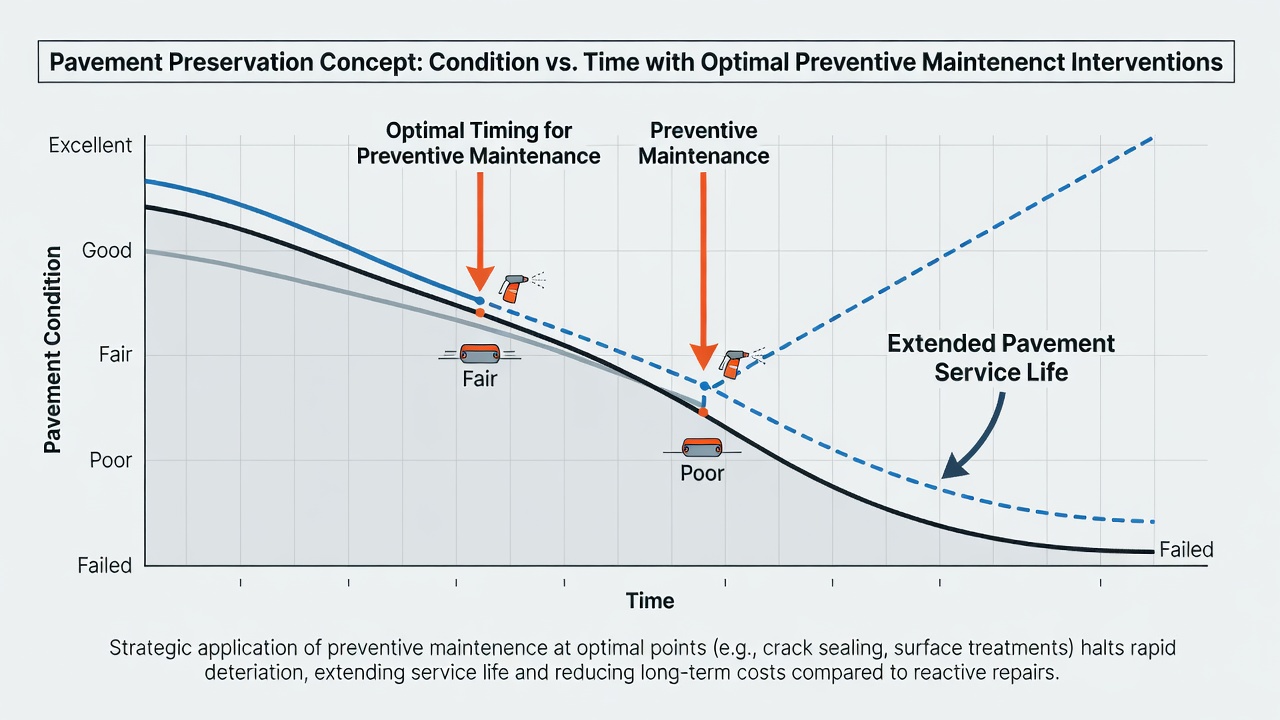
The fundamental philosophy of preventive maintenance rests on the well-documented observation that pavement deterioration follows a non-linear trajectory. A pavement in good condition (Pavement Condition Index of 80 to 100) deteriorates slowly, losing condition at a rate of roughly 2 to 4 PCI points per year depending on traffic and climate. As the pavement enters the fair-to-poor range (PCI 40 to 60), the deterioration rate accelerates significantly to 5 to 10 PCI points per year. Once the pavement reaches poor condition (PCI below 40), deterioration accelerates further to 10 to 15 PCI points per year, accompanied by structural damage that requires costly rehabilitation or reconstruction. The classic Pavement Preservation Curve illustrates this phenomenon: a pavement spends approximately 75% of its total service life losing the first 40% of its condition, and the remaining 25% of its life losing the last 60% of its condition. Preventive maintenance interventions applied during the early, slow-deterioration phase can extend the total service life by 5 to 15 years at a fraction of the cost of later corrective or rehabilitative actions.
The Economic Imperative
Multiple studies conducted by the FHWA, the National Cooperative Highway Research Program (NCHRP), state DOTs, and international airport authorities have quantified the economic benefits of preventive maintenance. The consistent finding is that one dollar invested in timely preventive maintenance eliminates or delays three to ten dollars in future rehabilitation or reconstruction costs. The FHWA’s Long-Term Pavement Performance (LTPP) program, which has monitored pavement performance at over 2,500 test sections across North America since 1987, provides the most authoritative empirical evidence. LTPP data analysis shows that pavements receiving timely preventive maintenance treatments achieve 30% to 50% longer service life than pavements maintained only through reactive repairs. The economic benefit accrues both to the agency (lower capital and maintenance costs over the analysis period) and to the user (fewer closures, smoother ride quality, reduced vehicle operating costs, and fewer delays).
For airport pavements, the economic case for preventive maintenance is even more compelling. Runway, taxiway, and apron closures for rehabilitation or reconstruction impose direct costs on airport operators and indirect costs on airlines, passengers, and the local economy through flight delays, rerouting, and capacity reductions. A well-timed preventive maintenance treatment, applied during a single nighttime closure window, can add years of service life at minimal operational disruption, whereas a structural overlay or reconstruction project may require runway closures lasting weeks or months.
Preventive vs Corrective vs Emergency Maintenance
Understanding the distinctions between preventive, corrective, and emergency maintenance is essential for proper treatment selection and program design. These categories exist on a spectrum from proactive to reactive, with fundamentally different cost structures, performance outcomes, and management approaches.
Preventive Maintenance is proactive and planned. Treatments are selected and scheduled based on objective condition data and predictive models, applied to pavements that are structurally sound but showing early signs of surface deterioration. The goal is to preserve the existing pavement investment and postpone the need for more costly interventions. Preventive maintenance does not increase the structural capacity or load-carrying capability of the pavement. It operates entirely at the surface or near-surface level, protecting the pavement from the environmental and traffic-related mechanisms that drive deterioration, water infiltration, oxidation, UV degradation, aggregate loss, and raveling.
Corrective Maintenance (also called reactive maintenance) is performed after a deficiency has developed that negatively impacts the safe, efficient operation of the facility. Corrective maintenance addresses existing distresses, potholes, localized raveling, spalled joints, edge failures, and other defects that have progressed beyond the preventive stage. The FHWA Pavement Preservation Definitions memorandum (September 12, 2005) classifies corrective maintenance as activities performed “in response to the development of a deficiency or deficiencies that negatively impact the safe, efficient operations of the facility and future integrity of the pavement section.” Corrective maintenance is inherently more expensive than preventive maintenance because the pavement damage has already occurred and the repair must address existing structural or material defects rather than simply protecting a sound surface. Examples of corrective maintenance include pothole patching, full-depth patching of localized failures, joint replacement in concrete pavements, and mill-and-fill repairs of localized rutting or shoving.
Emergency Maintenance addresses urgent safety hazards that require immediate attention to restore the facility to a minimum level of service. Emergency situations for pavements include concrete pavement blow-ups (sudden buckling caused by thermal expansion in joints that have become incompressible), washouts from flooding or storm events, rockfalls or landslides that deposit debris on the pavement, and sudden structural failures that create FOD (Foreign Object Debris) hazards on airfield pavements. Emergency maintenance is the most expensive and disruptive maintenance category, requiring immediate mobilization, often at premium rates, and typically providing only a temporary restoration while permanent repairs are designed and scheduled.
| Characteristic | Preventive Maintenance | Corrective Maintenance | Emergency Maintenance |
|---|---|---|---|
| Approach | Proactive, planned | Reactive, scheduled as needed | Reactive, immediate |
| Pavement condition | Good to fair (PCI 60–85) | Fair to poor (PCI 40–60) | Poor to failed (PCI below 40) |
| Structural condition | Sound, no structural distress | Some structural distress | Structural failure imminent or present |
| Cost per unit area | Low ($1–$6/m²) | Moderate ($5–$30/m²) | High ($30–$100+/m²) |
| Life extension | 5–15 years | 3–8 years | 1–3 years (temporary) |
| Planning horizon | 1–5 years ahead | Weeks to months ahead | Hours to days |
| Disruption | Minimal (same-day or overnight) | Moderate (days to weeks) | High (until restored) |
| Funding eligibility | AIP Grant Assurance No. 11 | Varies by scope | Emergency relief funds |
The FHWA guidance is clear: activities that increase structural capacity (major rehabilitation, structural overlays, reconstruction) are not considered pavement preservation and fall outside the preventive maintenance category. Activities that maintain or restore functional condition without adding structural strength, preventive maintenance and routine maintenance, are the proper components of a pavement preservation program. This distinction is codified in FAA Advisory Circular 150/5380-7B and is a key consideration for AIP (Airport Improvement Program) grant eligibility.
Pavement Condition Triggers
The decision to apply any preventive maintenance treatment must be grounded in objective condition data collected through systematic pavement inspection. The three primary condition indicators used to establish preventive maintenance triggers are the Pavement Condition Index (PCI), the International Roughness Index (IRI), and specific distress threshold criteria for each treatment type.
Pavement Condition Index (PCI) Triggers
The PCI is the most widely used pavement condition indicator for preventive maintenance decision-making. Developed by the U.S. Army Corps of Engineers in the 1970s and standardized as ASTM D5340 for airport pavements and ASTM D6433 for roads and parking lots, the PCI provides a numerical rating from 0 (failed) to 100 (excellent) based on the type, severity, and extent of visible pavement distress.
For airport pavements, the FAA Advisory Circular AC 150/5380-7B establishes the following preventive maintenance eligibility thresholds:
- PCI 60 or greater, Minimum condition for seal coat application (Item P-623). The pavement must be in at least fair condition with surface deterioration but no structural damage.
- Structural Condition Index (SCI) deduct value below 10, The SCI is the sum of deduct values for load-related distresses only (alligator cracking, rutting, shoving, depressions). A SCI deduct below 10 indicates that structural distress is minimal or absent.
- PCI between 60 and 80, The optimal window for preventive maintenance on airfield pavements. Below PCI 60, structural repairs are typically needed before any surface treatment will be effective. Above PCI 80, the pavement may not yet need treatment, though some agencies apply fog seals or rejuvenators at PCI 85+ as a strictly protective measure.
For highway and roadway pavements, the typical preventive maintenance PCI windows vary by agency:
| Agency/Reference | Preventive Maintenance PCI Window | Treatment Trigger |
|---|---|---|
| FHWA (general guidance) | 70–85 | When surface deterioration begins |
| AASHTO (NCHRP Report 523) | 65–80 | Early deterioration phase |
| California DOT (Caltrans) | 70–85 | Crack sealing at PCI > 70 |
| Texas DOT | 70–90 | Seal coat at PCI > 70 |
| Washington State DOT | 65–85 | Slurry/microsurfacing at PCI 65–85 |
| Typical airport (FAA guidance) | 60–80 | Seal coat at PCI 60+ |
International Roughness Index (IRI) Triggers
The IRI quantifies the longitudinal surface profile of the pavement in the wheel paths, expressed in meters per kilometer (m/km) or inches per mile (in/mile). While IRI is primarily a functional indicator reflecting ride quality, it serves as an important secondary trigger for preventive maintenance because it correlates with surface deterioration mechanisms, cracking, raveling, and deformation, that develop before structural failure occurs.
For airport pavements, FAA AC 150/5380-9 (Guidelines and Procedures for Measuring Airfield Pavement Roughness) provides the standard methods for IRI measurement and establishes trigger values. Typical preventive maintenance IRI triggers for airfield pavements are:
- Runways: IRI above 2.0 m/km (125 in/mile) triggers investigation, preventive maintenance is warranted when roughness becomes noticeable to pilots.
- Taxiways and aprons: IRI above 2.5 m/km (160 in/mile) typically triggers maintenance planning.
- Trigger interaction: When IRI increases by more than 0.3 m/km per year in combination with PCI decline, preventive maintenance timing should be accelerated.
For roadways, the FHWA and state DOTs typically use IRI thresholds of 1.5 to 2.5 m/km for preventive maintenance planning on interstate and primary highways, with higher thresholds for lower-volume roads.
Specific Distress Thresholds
In addition to composite indices (PCI, IRI), preventive maintenance decisions are guided by specific distress threshold criteria that define the maximum acceptable severity and extent of individual distress types before treatment must be applied. These thresholds ensure that preventive treatments are applied while the pavement is still a viable candidate.
The FAA’s guidance in AC 150/5380-6C and the treatment-specific specifications in AC 150/5370-10 establish the following distress thresholds for preventive maintenance eligibility:
- Crack density: Less than 20% of surface area affected by cracking. Pavements with more than 20% cracking density typically require crack sealing followed by a surface treatment, or a thin overlay.
- Crack width: Individual cracks wider than 3 mm (0.125 in) must be sealed before surface treatment application. Cracks narrower than 3 mm can be sealed by the surface treatment binder.
- Rut depth: Maximum 13 mm (0.5 in) for asphalt pavements. Deeper ruts indicate structural or mix instability that must be corrected before surface treatment.
- Alligator (fatigue) cracking: Zero tolerance for preventive maintenance, any alligator cracking, even at low severity, disqualifies the pavement section for surface treatment and indicates the need for structural repair or rehabilitation.
- Raveling: Low to moderate severity acceptable (loss of fines and fine aggregate), severe raveling (exposed coarse aggregate with loose particles) disqualifies the pavement.
- Flushing/bleeding: Low severity acceptable, moderate to severe flushing must be corrected before preventive treatment.
- Potholes: Zero, any potholes must be repaired before preventive maintenance.
Treatment Selection Matrices
The selection of the appropriate preventive maintenance treatment for a given pavement section is a multi-criteria decision that considers pavement type, condition, traffic level, climate, cost, and performance objectives. Treatment selection matrices, also called treatment decision trees or treatment recommendation tables, provide a systematic framework for matching pavement conditions with appropriate treatments.
The FHWA publication Selecting a Preventive Maintenance Treatment for Flexible Pavements (FHWA-IF-00-027, August 2000) and the updated Selecting a Preventive Maintenance Treatment for Rigid Pavements provide the most comprehensive treatment selection frameworks. For airport pavements, the FAA’s AC 150/5380-6C (Guidelines and Procedures for Maintenance of Airport Pavements) and the ACRP (Airport Cooperative Research Program) Report on pavement maintenance provide airfield-specific treatment selection guidance.
Asphalt Pavement Treatment Selection Matrix
| Pavement Condition | PCI Range | Primary Distress | Recommended Treatment | Expected Life Extension |
|---|---|---|---|---|
| Excellent | 85–100 | None or minor oxidation | None required, or fog seal / rejuvenating fog seal | 2–4 years |
| Good | 70–85 | Fine cracking (< 3 mm), minor raveling, oxidation | Crack sealing + fog seal, or slurry seal, or microsurfacing | 5–8 years |
| Fair | 60–70 | Moderate cracking (3–6 mm), moderate raveling, some block cracking | Crack sealing + microsurfacing, or chip seal, or thin overlay (25–40 mm) | 5–10 years |
| Fair-to-poor | 50–60 | Extensive cracking, some fatigue cracking, rutting < 13 mm | Thin overlay (40–50 mm) after milling, or cape seal | 7–12 years |
| Poor | Below 50 | Structural cracking, base failures, rutting > 13 mm | Not a preventive maintenance candidate, structural rehabilitation required | N/A |
Concrete Pavement Treatment Selection Matrix
| Pavement Condition | PCI Range | Primary Distress | Recommended Treatment | Expected Life Extension |
|---|---|---|---|---|
| Excellent | 85–100 | None | None required | N/A |
| Good | 70–85 | Joint sealant failure, minor spalling | Joint resealing, partial-depth spall repair | 5–8 years |
| Fair | 60–70 | Moderate joint deterioration, faulting 3–6 mm, cracking | Dowel-bar retrofit, diamond grinding, full-depth joint repair | 8–12 years |
| Fair-to-poor | 50–60 | Extensive faulting, slab cracking, corner breaks | Diamond grinding with dowel-bar retrofit, or thin unbonded overlay | 10–15 years |
| Poor | Below 50 | Multiple slab breaks, punchouts, pumping | Not a preventive candidate, reconstruction or thick overlay required | N/A |
The treatment selection process must also consider traffic level and composition, climate zone (freeze-thaw cycles, annual precipitation, temperature range), construction window availability, contractor capability and equipment availability, and budget constraints. The FHWA treatment selection framework incorporates these factors through a weighted scoring system, with higher weights assigned to factors that have the greatest impact on treatment performance in the specific project context.
Timing Optimization
The timing of preventive maintenance application is as critical as the treatment selection itself. Applying a treatment too early wastes resources on pavement that does not yet need protection, applying too late fails because structural deterioration has already begun. The methodology for determining the optimal timing has been extensively researched, most notably in NCHRP Report 523: Optimal Timing of Pavement Preventive Maintenance Treatment Applications (2004), which remains the definitive reference on this topic.
The Pavement Performance Curve Approach
The optimal timing methodology is based on the pavement performance curve, the mathematical relationship between pavement age or accumulated traffic and pavement condition (typically measured as PCI or IRI). The performance curve is established through historical condition data for the specific pavement section or for similar pavements in the same network. The curve is typically modeled using one of three functional forms:
- Exponential decay model: ( PCI(t) = PCI_0 \times e^{-kt} ), where ( k ) is the deterioration rate constant
- Sigmoidal (S-curve) model: ( PCI(t) = PCI_0 / (1 + e^{a + bt}) ), which captures the initial slow deterioration, followed by rapid deterioration, followed by a leveling-off near failure
- Polynomial model: ( PCI(t) = a + bt + ct^2 ), used for simpler curve-fitting applications
The deterioration rate (( k ) or the slope parameter ( b )) is determined by regression analysis of historical condition data and is influenced by pavement structural capacity (structural number or thickness), subgrade strength, traffic loading, environmental factors (freeze-thaw cycles, precipitation, temperature), and construction quality.
Benefit-Cost Ratio (BCR) Optimization
The optimal timing point is identified by calculating the Benefit-Cost Ratio (BCR) for each candidate treatment at each possible application age, then selecting the age that maximizes the BCR. The calculation follows this sequence:
- Define the analysis period, typically 20 to 40 years, covering at least two treatment cycles
- Establish the baseline performance curve, deterioration without treatment
- Apply the treatment performance curve, the expected condition trajectory after treatment, based on documented treatment performance data
- Calculate the benefit, the area between the treated and untreated performance curves (the cumulative condition improvement)
- Calculate the cost, the present value of all treatment costs, including initial cost, periodic maintenance, and user delay costs during construction
- Compute the BCR, benefit (in PCI-years or other condition units) divided by cost (in present-value dollars)
- Repeat for different treatment ages, the optimal timing is the age that produces the highest BCR
NCHRP Report 523 demonstrated that for typical flexible pavements, the BCR for crack sealing reaches its maximum when applied at pavement age 4 to 7 years (PCI 75 to 85), while the BCR for thin overlays peaks at age 8 to 12 years (PCI 65 to 75). The BCR for seal coats and microsurfacing typically peaks in the PCI range of 65 to 80, consistent with the FAA’s PCI 60+ eligibility threshold.
Remaining Service Life (RSL) Method
An alternative approach to timing optimization uses Remaining Service Life (RSL) as the decision variable. RSL is the estimated number of years until the pavement reaches a terminal condition level (typically PCI 40 for reconstruction or PCI 55 for major rehabilitation). The AASHTO Pavement Design Guide defines RSL as a function of the current condition, the terminal condition, and the deterioration rate.
The RSL method establishes treatment timing triggers as follows:
- RSL greater than 15 years, No treatment needed, continue condition monitoring
- RSL 10 to 15 years, Candidate for low-cost preventive treatments (crack sealing, fog seal)
- RSL 5 to 10 years, Candidate for intermediate preventive treatments (seal coat, microsurfacing, thin overlay)
- RSL 2 to 5 years, Candidate for structural rehabilitation (overlay or reconstruction)
- RSL less than 2 years, Emergency or urgent corrective maintenance
The FAA’s PAVER™ pavement management software implements both the PCI-based and RSL-based approaches, allowing airports to evaluate alternative treatment timing scenarios and select the most cost-effective strategy for each pavement section in the network.
Preventive Treatments
The range of preventive maintenance treatments available for pavement preservation spans multiple material systems, application methods, and performance characteristics. Each treatment has specific application conditions, design lives, cost structures, and constraints that determine its suitability for a given pavement section.
Crack Sealing and Crack Filling
Crack sealing is the most fundamental preventive maintenance treatment and is often a prerequisite for other surface treatments. The distinction between crack sealing and crack filling is important in pavement maintenance terminology. Crack sealing involves the placement of specialized materials into working cracks (those experiencing horizontal movement greater than approximately 2 mm per year) using unique reservoir configurations to prevent intrusion of water and incompressible material. Crack filling, by contrast, involves the placement of materials into non-working cracks (movement less than 2 mm per year) to substantially reduce water infiltration and reinforce the adjacent pavement. Crack sealing uses higher-performance materials (elastomeric sealants, often polymer-modified) and more extensive preparation (routing to create a reservoir), while crack filling uses lower-cost materials (asphalt emulsion, cutback asphalt) with minimal preparation.
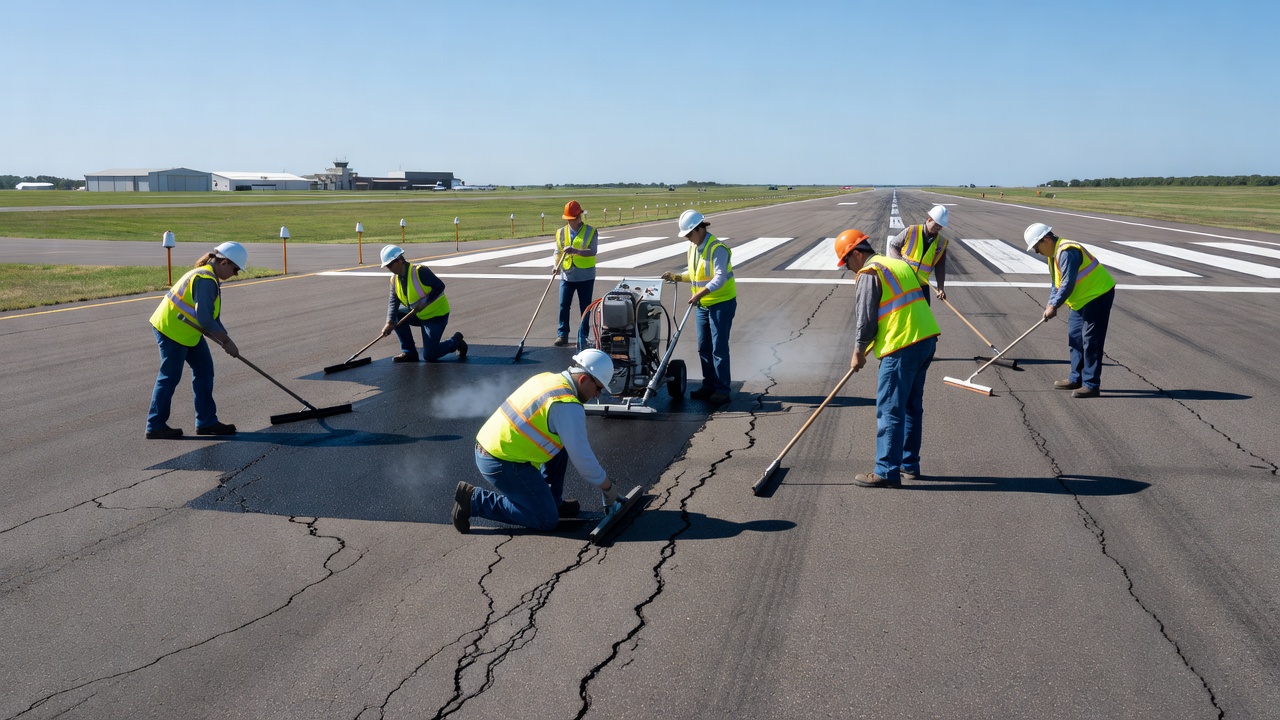
The FAA Item P-608 specification (Crack Sealing) requires: crack preparation by routing to a minimum 12 mm wide by 12 mm deep reservoir for cracks wider than 3 mm, use of hot-applied polymer-modified crack sealant meeting ASTM D6690 or AASHTO M 324, sealant application at 190°C to 210°C with a controlled overband width of 2 to 4 mm, and a cure time of 30 to 60 minutes before traffic. The expected service life of properly installed crack sealing is 3 to 5 years.
Seal Coats
Seal coats encompass a family of thin surface treatments applied to preserve structurally sound asphalt pavements. The major types, fog seals, chip seals, slurry seals, microsurfacing, and cape seals, are described in detail in the separate glossary entry for Seal Coats. In the context of preventive maintenance, the key distinction is that all seal coats are surface-protective treatments: they seal against water infiltration, retard oxidation, restore surface friction, and improve appearance, but they add no structural capacity. Seal coats are cost-effective when applied at PCI 60 to 80 and provide 3 to 12 years of life extension depending on type, traffic, and climate.
Thin Hot-Mix Asphalt Overlays
Thin hot-mix asphalt (HMA) overlays, ranging from 25 to 50 mm in compacted thickness, occupy a transitional position between preventive maintenance and minor rehabilitation. The AASHTO/FHWA pavement preservation definitions classify thin overlays as preventive maintenance when applied to structurally sound pavements with the primary purpose of surface preservation (reducing water infiltration, retarding aging, restoring surface characteristics). Thin overlays are classified as minor rehabilitation when applied to correct structural deficiencies or extend structural capacity.
The distinction depends on the pavement condition at the time of application. A 40 mm overlay applied to a pavement with PCI 65, no structural distress, and adequate remaining structural capacity is preventive maintenance. The same 40 mm overlay applied to a pavement with PCI 50, some fatigue cracking, and marginal structural capacity is minor rehabilitation. The FAA’s PAVER™ system and the AASHTO Pavement ME Design Guide provide formal methods for determining the structural adequacy of existing pavements and establishing the appropriate overlay thickness.
For airport pavements, thin HMA overlays must comply with FAA Item P-401 (Plant Mix Bituminous Pavements) or P-403 (Plant Mix Bituminous Pavements, Base Course), with mix design and compaction requirements tailored to the overlay application. The surface must be milled (minimum 25 mm) before overlay to ensure bond, correct surface irregularities, and maintain pavement elevation and clearance requirements.
Concrete Pavement Preventive Treatments
For rigid (concrete) airport pavements, the primary preventive maintenance treatments include:
Joint Resealing, The removal and replacement of deteriorated joint sealant in transverse and longitudinal joints. Joint sealant failure allows water and incompressible materials to enter the joint reservoir, leading to faulting, pumping, and slab cracking. The FAA Item P-613 specification (Joint Sealant) requires hot-applied polymer-modified sealant meeting ASTM D6690 or cold-applied silicone sealant meeting ASTM D5893. Joint resealing is typically performed on a 5-to-8-year cycle.
Dowel-Bar Retrofit (DBR), The installation of epoxy-coated steel dowel bars across transverse joints to restore load transfer in existing concrete pavements. DBR is indicated when joint faulting exceeds 3 mm and load transfer efficiency (measured by falling weight deflectometer testing) falls below 60%. The retrofit involves cutting slots across the joint, placing dowel bars in epoxy grout, and backfilling with high-early-strength concrete. DBR extends joint life by 10 to 15 years and is classified as preventive maintenance when applied before structural cracking develops.
Diamond Grinding, The removal of 3 to 6 mm of surface concrete using a rotating diamond-blade cutting head to restore surface smoothness, improve friction, and correct faulting. Diamond grinding is typically applied in conjunction with dowel-bar retrofit for comprehensive joint restoration. The FAA Item P-614 specification (Diamond Grinding) requires a smoothness tolerance of ±3 mm under a 4.5-meter straightedge and a restored texture depth of 0.5 to 1.5 mm.
Partial-Depth Spall Repair, The removal and replacement of deteriorated concrete at joint edges, cracks, and corners where spalling has extended less than one-third of the slab depth. Full-depth repair is required for spalls exceeding one-third of slab thickness.
Airport Preventive Maintenance Programs
The Federal Aviation Administration (FAA) mandates that all federally obligated airports implement a Pavement Management Program (PMP) that includes preventive maintenance as a documented and funded strategy. The requirements are established in FAA Advisory Circular AC 150/5380-7B (Airport Pavement Management Program, dated October 10, 2014) and enforced through Grant Assurance No. 11 (Pavement Preventive Maintenance), which airport sponsors must accept as a condition of receiving Airport Improvement Program (AIP) funds.
FAA Grant Assurance No. 11
Grant Assurance No. 11 states: “The Sponsor will maintain its pavement facilities in a condition that serves the needs of aeronautical users.” This assurance requires that airport sponsors:
- Conduct regular pavement inspections at intervals specified in AC 150/5380-7B
- Maintain a Pavement Management Program (PMP) that documents pavement conditions, treatment history, and planned M&R strategies
- Allocate sufficient funding for pavement maintenance, including preventive maintenance, from airport operating revenues
- Ensure that AIP-funded pavement projects include provisions for ongoing preventive maintenance
The FAA Office of Airport Compliance reviews airport pavement maintenance programs during compliance inspections and may withhold future AIP grants if pavement conditions are found to be below acceptable standards due to inadequate maintenance.
AC 150/5380-7B Requirements
AC 150/5380-7B establishes the minimum requirements for an airport PMP:
Inspection Frequency: Federally obligated airports must perform a detailed inspection of airfield pavements at least once per year. If a PCI survey per ASTM D5340 is performed and a documented history of pavement condition is maintained, the inspection frequency may be extended to three years. In addition, monthly drive-by inspections are recommended to detect unexpected changes in pavement condition.
PMP Components: The PMP must include: an inventory of all pavement areas (runways, taxiways, aprons, shoulders, overruns) with area, dimensions, construction history, and pavement type, condition data from PCI surveys or equivalent inspections, a pavement condition database with historical condition data for trend analysis, a treatment recommendation system that matches pavement condition with appropriate M&R strategies, a multi-year M&R program that prioritizes treatments based on condition, criticality, and budget, and a reporting system that documents treatment costs, performance, and outcomes.
Preventive Maintenance in the PMP: The FAA requires that the PMP specifically address preventive maintenance as a treatment strategy. For each pavement section in the network, the PMP must document: the recommended preventive treatment(s), the optimal timing based on condition triggers and performance curves, the estimated cost of the treatment, the expected life extension, and the priority ranking relative to other pavement needs in the network.
PAVER™ and PAVEAIR: The FAA provides two software platforms for PMP implementation. PAVER™ (developed by the U.S. Army Corps of Engineers) is the most widely used airport pavement management software, providing PCI calculation, deterioration modeling, treatment recommendation, and budget optimization functions. PAVEAIR is the FAA’s simplified PMP tool designed for smaller general aviation airports. Both tools incorporate the preventive maintenance philosophy and treatment selection logic described in AC 150/5380-7B.
ICAO Framework for Pavement Maintenance
The International Civil Aviation Organization (ICAO) addresses pavement maintenance through Annex 14, Aerodromes, Volume I (Aerodrome Design and Operations) and the ICAO Airport Services Manual, Part 2 (Pavement Surface Conditions). While ICAO does not prescribe specific preventive maintenance programs in the same level of detail as the FAA, the organization establishes performance requirements that effectively mandate preventive maintenance:
- Annex 14, Section 10.2: “The surface of a paved runway shall be maintained in a condition so as to provide good friction characteristics and low rolling resistance.”
- Annex 14, Section 10.2.1: “The surface of a paved runway shall be kept clear of any loose stones or other objects that could cause damage to aircraft.”
- ICAO Doc 9137, Part 2: Provides guidance on friction measurement programs, surface texture assessment, and the relationship between surface treatment condition and aircraft operational safety.
ICAO recommends that friction measurements using Continuous Friction Measuring Equipment (CFME) be conducted at least annually on runways, and that corrective action, including preventive surface treatments, be taken when friction levels fall below defined minimum thresholds. The ICAO Aerodrome Certification process requires that airport operators demonstrate that they have adequate maintenance procedures in place, including preventive maintenance programs for pavement surfaces.
Lifecycle Cost Analysis
Lifecycle Cost Analysis (LCCA) is the economic evaluation tool that quantifies the cost-effectiveness of preventive maintenance strategies compared to alternative M&R approaches. LCCA compares the total cost of ownership over the analysis period (typically 20 to 40 years) for different investment strategies, expressed in present-value dollars to account for the time value of money.
LCCA Methodology
The standard LCCA methodology for pavement investments follows the procedure outlined in the AASHTO Pavement ME Design Guide and FHWA’s Life-Cycle Cost Analysis in Pavement Design (FHWA-SA-98-079):
- Establish the analysis period, typically equal to the design life of the pavement (20 years for new airfield pavements, 40 years for highway pavements) or the planning horizon of the agency
- Identify candidate strategies, the alternative maintenance and rehabilitation scenarios to be compared (e.g., preventive maintenance every 7 years vs. rehabilitation at year 15 vs. reconstruction at year 20)
- Estimate initial costs, construction or treatment costs including design, mobilization, materials, labor, and equipment
- Estimate future costs, periodic maintenance, rehabilitation, and reconstruction costs over the analysis period, escalated for inflation
- Estimate user costs, delay costs, vehicle operating costs, and accident costs during construction or maintenance operations (optional but recommended for comprehensive analysis)
- Calculate salvage value, the remaining value of the pavement at the end of the analysis period
- Discount all costs to present value, using the real discount rate (typically 3% to 5% for public infrastructure projects per OMB Circular A-94)
- Compare alternatives, select the strategy with the lowest net present value (NPV) or lowest equivalent uniform annual cost (EUAC)
LCCA Example: Preventive Maintenance vs. Reconstruction
A typical LCCA comparison for a 100,000 m² airfield pavement illustrates the economic advantage of preventive maintenance:
| Cost Item | Strategy A: Preventive Maintenance | Strategy B: Reconstruction at Failure |
|---|---|---|
| Year 0: Initial condition | PCI 75 (existing) | PCI 75 (existing) |
| Year 7: Crack seal + slurry seal | $400,000 | – |
| Year 14: Microsurfacing | $600,000 | – |
| Year 20: Reconstruction | – | $8,000,000 |
| Year 21: New pavement (reconstructed) | PCI 100 | PCI 100 |
| Year 20 salvage value | $500,000 (remaining life) | $0 (failed pavement) |
| Net Present Value (3% discount rate) | $850,000 | $4,429,000 |
| Equivalent Uniform Annual Cost | $57,000/year | $298,000/year |
The preventive maintenance strategy saves approximately $3.6 million (81%) in net present value cost over the 20-year analysis period while maintaining the pavement in good-to-fair condition throughout, versus the reconstruction strategy that allows the pavement to deteriorate to failure before investing in replacement.
LCCA for Airport Pavements
The FAA requires LCCA for all major airport pavement projects funded through AIP. FAA AC 150/5380-7B explicitly states that the PMP should include “life-cycle cost comparisons between M&R alternatives” and that the selected strategy should represent “the best value over the lifecycle of the pavement considering initial cost, future maintenance costs, and expected performance.” The ACRP Report on Life-Cycle Cost Analysis for Airport Pavements (AAPTP Report 06-06) provides specific guidance for airport LCCA, including recommended analysis periods (20 to 40 years), discount rates (3% to 5% real), and unit costs for common airport pavement treatments.
Performance Monitoring After Treatment
The application of a preventive maintenance treatment is not the end of the process, it is the beginning of a new performance monitoring cycle. Post-treatment condition monitoring is essential to: verify that the treatment achieved its intended performance objectives, document the actual service life achieved for future planning, identify premature failures that require corrective action, and calibrate deterioration models for the PMS.
Monitoring Protocols
The FAA recommends the following monitoring protocol for preventive maintenance treatments on airport pavements:
- Immediate post-treatment inspection, Conducted within 7 days of treatment completion to verify compliance with specifications (thickness, coverage, texture depth, friction values, bond integrity)
- First-year inspection, Conducted at 12 months to document initial condition and identify any construction-related defects
- Periodic inspections, Conducted at intervals consistent with the PMP (annually or every 3 years for PCI surveys) to track condition over time
- Treatment end-of-life inspection, Conducted when the treatment reaches the end of its expected service life or when condition triggers indicate the need for retreatment
Performance Metrics
The key performance metrics for preventive maintenance treatments include:
- PCI trend, The rate of PCI decline after treatment, compared to the baseline (pre-treatment) deterioration rate. A successful treatment reduces the deterioration rate by 50% to 80% compared to the untreated pavement.
- IRI trend, The rate of roughness increase over time. Successful treatments maintain IRI below the trigger threshold for the expected service life.
- Friction retention, The decline in surface friction over time. FAA and ICAO establish minimum friction levels for airfield pavements, the treatment should maintain friction above these levels throughout its service life.
- Distress progression, The time to reappearance of specific distresses (cracking, raveling, flushing). Treatment failure is defined by the re-emergence of distress at trigger levels.
- Service life, The actual time from treatment application to the point where retreatment or rehabilitation is triggered. The achieved service life should meet or exceed the design service life for the treatment type.
Performance Feedback Loop
The condition data collected during post-treatment monitoring feeds back into the PMS deterioration models and treatment performance databases, improving the accuracy of future treatment selection and timing decisions. This performance feedback loop is a critical component of a mature pavement management program, enabling continuous improvement in preventive maintenance strategies based on empirical data from the agency’s own pavement network.
Preventive Maintenance in Pavement Management Systems
A Pavement Management System (PMS) is the organizational and analytical framework that enables systematic, data-driven preventive maintenance decision-making. The PMS integrates pavement condition data, deterioration models, treatment performance data, cost data, and budget constraints into a unified decision-support tool that identifies the optimal treatment type, timing, and funding level for each pavement section in the network.
PMS Components Relevant to Preventive Maintenance
Pavement Inventory, The PMS maintains a complete inventory of all pavement sections in the network, including area, pavement type, construction history, structural capacity, and traffic level. This inventory is the foundation for all subsequent analysis.
Condition Assessment, The PMS stores condition data from PCI surveys, IRI measurements, friction tests, and structural tests (FWD). Historical condition data enables trend analysis and deterioration modeling.
Deterioration Modeling, The PMS uses mathematical models to predict future condition for each pavement section under different M&R scenarios. The deterioration models are calibrated to local conditions using historical condition data.
Treatment Performance Data, The PMS documents the actual performance of each treatment applied, including service life achieved, condition improvement, and cost. This data informs future treatment selection and timing decisions.
Optimization, The PMS optimization engine evaluates all possible treatment strategies for the entire network over the analysis period (typically 5 to 20 years) and identifies the combination of treatments and timing that maximizes performance within budget constraints, or minimizes cost for a target performance level.
Multi-Year Program, The PMS output is a multi-year M&R program that specifies which pavement sections receive which treatments in which year, with associated costs and expected performance improvements. Preventive maintenance treatments are prioritized alongside rehabilitation and reconstruction needs.
FAA PAVER™ and Preventive Maintenance
The FAA’s PAVER™ system is the most widely used airport pavement management software in the United States. PAVER™ includes specific modules for preventive maintenance:
- Condition Prediction Module, Uses the PCI deterioration curve to predict future condition and identify the optimal treatment timing window
- Work History Module, Tracks all maintenance and rehabilitation activities, including preventive treatments, with costs and performance data
- M&R Module, Recommends appropriate treatments based on pavement type, condition, and network-level policies
- Budget Module, Performs multi-year budget optimization to allocate funding across preventive maintenance, rehabilitation, and reconstruction
PAVER™ implements the preventive maintenance philosophy by recommending treatments only for pavements that meet the condition triggers (PCI above threshold, no structural distress) and by prioritizing preventive treatments over rehabilitation for pavements in the fair-to-good condition range.
Integrating Preventive Maintenance into the Inspection Pipeline
In an inspection-based assessment workflow, preventive maintenance occupies a central position in treatment selection. The inspection data collected, PCI, IRI, distress types and severities, friction measurements, structural capacity, feeds directly into the preventive maintenance decision framework:
- Inspection → Collect condition data for each pavement section
- Condition assessment → Calculate PCI, IRI, and structural condition indicators
- Trigger evaluation → Compare condition data against preventive maintenance thresholds
- Treatment selection → Match pavement condition with appropriate preventive treatments
- Timing optimization → Determine the optimal application window based on deterioration rate and treatment performance data
- Cost analysis → Estimate treatment costs and compare lifecycle cost of preventive vs. corrective strategies
- Program prioritization → Rank preventive maintenance needs across the network
- Performance monitoring → Track post-treatment condition to verify performance and calibrate models
This data-driven workflow ensures that preventive maintenance decisions are based on objective condition evidence rather than subjective judgment or historical practices, maximizing the return on every maintenance dollar invested in the pavement network.

Related Terms
Corrective Maintenance, Reactive maintenance performed after pavement deficiency has developed, addressing existing distresses such as potholes and localized failures.
Pavement Preservation, The broader program of proactive treatments including preventive maintenance, minor rehabilitation, and routine maintenance.
Pavement Management System (PMS), The systematic process of identifying cost-effective M&R strategies for a pavement network.
Crack Sealing, The placement of specialized materials into working cracks to prevent water infiltration and extend pavement life.
Seal Coat, A thin bituminous surface treatment that protects pavement from water, oxidation, and wear.
Microsurfacing, A polymer-modified, quick-setting slurry surfacing system for high-traffic pavements.
Thin Overlay, A 25 to 50 mm hot-mix asphalt overlay applied for surface preservation.
Lifecycle Cost, The total cost of owning and maintaining a pavement over its design life, including initial construction, maintenance, rehabilitation, and user costs.
PCI (Pavement Condition Index), A numerical rating from 0 to 100 based on the type, severity, and extent of pavement distress.
Fog Seal, A light application of diluted asphalt emulsion for surface sealing and oxidation protection.
Frequently Asked Questions
- What is preventive maintenance for pavements and how does it differ from other maintenance types?
- Preventive maintenance is a planned strategy of cost-effective treatments applied to structurally sound pavements in good-to-fair condition before significant distress develops. It differs fundamentally from corrective (reactive) maintenance, which repairs pavements after deterioration has occurred, emergency maintenance, which addresses urgent safety hazards, and rehabilitation, which involves structural enhancements that increase load-carrying capacity. Preventive maintenance treatments, such as crack sealing, seal coats, microsurfacing, and thin overlays, do not add structural strength but protect the existing pavement from water infiltration, oxidation, and traffic wear, extending service life by 5 to 15 years at 20% to 40% of the cost of reconstruction.
- When should preventive maintenance be applied to an airport pavement?
- The optimal application window for preventive maintenance is when the pavement has a Pavement Condition Index (PCI) between 60 and 80 for airfield pavements, indicating fair-to-good condition with surface deterioration but no structural damage. The pavement must be structurally sound, free of alligator cracking, base failures, or rutting deeper than 13 mm. FAA Advisory Circular 150/5380-7B requires a Structural Condition Index deduct value below 10 for preventive treatments. Applying preventive maintenance too early (PCI above 85) wastes resources on pavement that does not need treatment, applying too late (PCI below 55) fails because structural deterioration has already begun. The concept is captured in the '70% rule' or 'Pavement Preservation Curve', pavements spend the first 75% of their life losing the first 40% of condition, and the last 25% of life losing the remaining 60% if left untreated.
- What preventive maintenance treatments are available for asphalt airport pavements?
- The range of preventive maintenance treatments for flexible (asphalt) pavements includes: crack sealing and crack filling (sealing working cracks wider than 3 mm with elastomeric sealant to prevent water infiltration), fog seals (light application of diluted asphalt emulsion to seal surface voids and retard oxidation), chip seals (asphalt binder followed by embedded crushed aggregate for skid resistance and waterproofing), slurry seals (cold-mixed emulsion and fine aggregate for surface texture restoration), microsurfacing (polymer-modified slurry seal with rapid curing and rut-filling capability up to 38 mm), cape seals (chip seal covered by slurry seal for crack-bridging and smoothness), thin hot-mix asphalt overlays (25 to 50 mm thick, providing limited structural contribution and surface renewal), and rejuvenating fog seals (emulsion with chemical rejuvenators that restore aged binder properties). For rigid (concrete) pavements, common treatments include joint resealing, dowel-bar retrofit, diamond grinding, and partial-depth spall repair.
- What are the FAA requirements for a preventive maintenance program at airports?
- Federally obligated airports in the United States must comply with FAA Grant Assurance No. 11 (Pavement Preventive Maintenance), which requires that the airport sponsor maintain its pavement facilities in a condition that serves the needs of aeronautical users. FAA Advisory Circular 150/5380-7B (Airport Pavement Management Program) provides the framework, requiring: a detailed inspection of airfield pavements at least once per year (or every three years if a PCI survey per ASTM D5340 is performed), a Pavement Management Program (PMP) with defined procedures for collecting, analyzing, maintaining, and reporting pavement data, and the use of cost-effective M&R strategies based on condition data. The FAA requires that AIP-funded preventive maintenance projects follow the specifications in AC 150/5370-10 (Item P-623 for emulsified asphalt spray seal coats, Item P-608 for crack sealing, etc.) and that the pavement candidate have a PCI of 60 or greater for seal coat eligibility.
- How is the optimal timing for preventive maintenance determined?
- The optimal timing for preventive maintenance is determined through benefit-cost analysis comparing different treatment timing scenarios. The methodology, documented in NCHRP Report 523 (Optimal Timing of Pavement Preventive Maintenance Treatment Applications), uses pavement performance curves (deterioration models) to predict the remaining service life of the pavement under different treatment scenarios. The optimal timing point is the earliest age at which the benefit-cost ratio (BCR) for a given treatment is maximized, typically corresponding to the point where the pavement condition performance curve begins to show accelerated deterioration. Key parameters include: the pavement type and structural number, traffic loading (equivalent annual departures for airports or ESALs for highways), environmental factors (freeze-thaw cycles, precipitation, UV exposure), the performance characteristics of candidate treatments, user delay costs during application, and the discount rate used for lifecycle cost calculations. The 'Pavement Preservation Curve' concept illustrates that treating a pavement at PCI 70 costs $1 per square meter and extends life by 7 years, while waiting until PCI 40 costs $5 to $10 per square meter and extends life by only 3 to 5 years.
- What pavement condition triggers indicate that preventive maintenance is needed?
- The primary condition triggers for preventive maintenance include: Pavement Condition Index (PCI) between 60 and 80 (indicating fair-to-good condition with surface deterioration but no structural damage), International Roughness Index (IRI) values above the agency-defined threshold but below rehabilitation trigger levels, specific distress thresholds such as crack density less than 20% of surface area, rut depth less than 13 mm (0.5 in), and no alligator or fatigue cracking, surface oxidation visible as graying or bleaching of the asphalt surface, minor raveling with loss of fines and fine aggregate, and declining surface friction values approaching the maintenance planning level. These triggers must be established as part of the Pavement Management System (PMS), with threshold values calibrated to local conditions, traffic levels, and agency budget constraints.
- How is the cost-effectiveness of preventive maintenance measured?
- Cost-effectiveness of preventive maintenance is measured using Lifecycle Cost Analysis (LCCA), which compares the total cost of ownership over the analysis period (typically 20 to 40 years) for different maintenance and rehabilitation strategies. The standard metrics include: Net Present Value (NPV), the sum of all discounted future costs, Equivalent Uniform Annual Cost (EUAC), the annualized cost of ownership, and Benefit-Cost Ratio (BCR), the ratio of pavement life extension benefits to treatment costs. FHWA studies have documented that a well-timed preventive maintenance program can reduce total pavement ownership costs by 30% to 50% over the analysis period compared to a 'do nothing until failure' approach. The AASHTO Pavement ME Design Guide provides a formal framework for LCCA of pavement investments, and FAA AC 150/5380-7B requires airports to consider lifecycle costs when selecting M&R strategies for AIP-funded projects.
- How does preventive maintenance fit into a Pavement Management System (PMS)?
- Preventive maintenance is a core component of a Pavement Management System (PMS), which is the systematic process of identifying cost-effective M&R strategies for a pavement network. Within the PMS framework, preventive maintenance occupies the 'preservation' category alongside minor rehabilitation, while the PMS optimization engine selects the optimal treatment type and timing for each pavement section based on condition data, deterioration models, treatment performance data, budget constraints, and agency policies. The PMS output, typically a multi-year M&R program, identifies which pavement sections should receive preventive treatments in each budget year, what treatment type is most cost-effective, and the expected performance improvement and life extension from each treatment. FAA AC 150/5380-7B mandates that federally obligated airports maintain a PMS that includes preventive maintenance as a documented strategy, using either the FAA's PAVER™ software, PAVEAIR, or an equivalent PMS tool.
This is a reference entry. TarmacView provides drone inspection services and doesn't sell the equipment or materials described in this glossary.