What is a Prime Coat in Pavement Construction?
Prime Coat in Pavement Construction
Definition and Purpose
A prime coat is an application of low-viscosity bituminous material applied to the surface of a prepared, untreated granular base course or subbase in advance of placing the first layer of hot mix asphalt (HMA) pavement. The material is designed to be fluid enough to penetrate into the upper stratum of the compacted granular layer, where it performs multiple critical functions in the pavement structure.
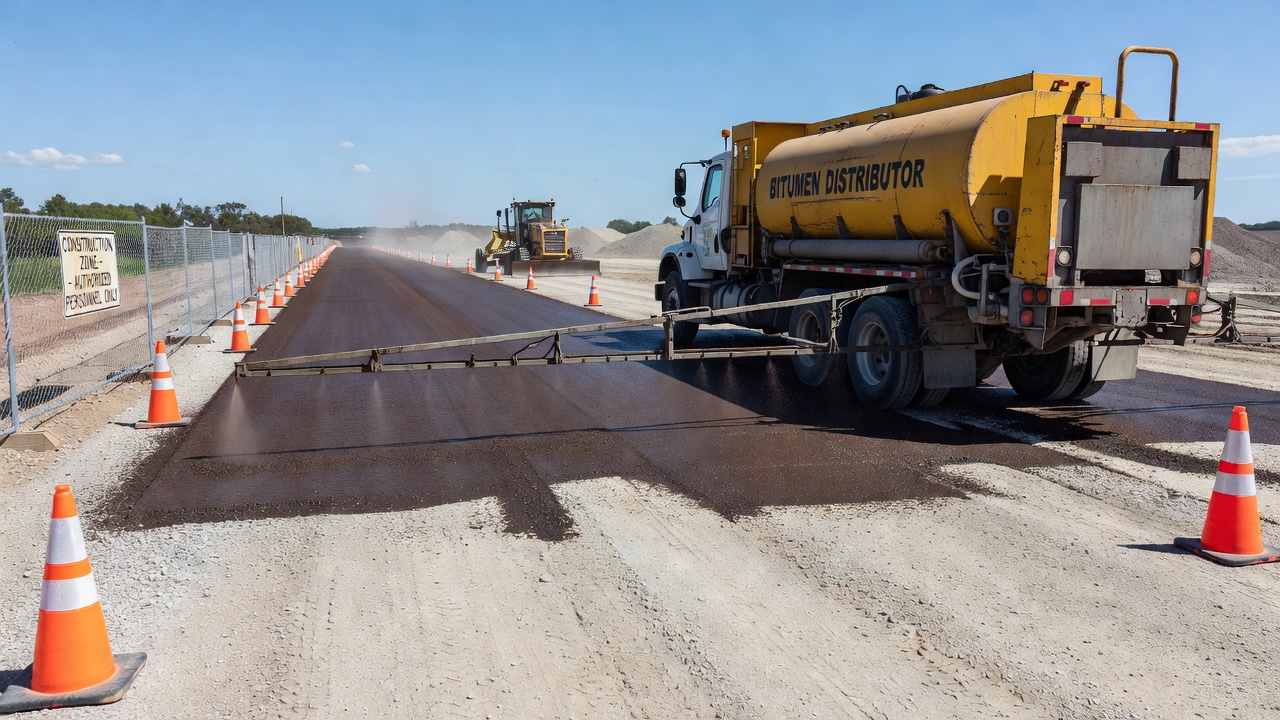
The four primary purposes of a prime coat, as established by the Asphalt Institute and transportation agencies worldwide, are:
- Coat and bond loose aggregate particles on the surface of the compacted granular base, creating a unified, stable surface that resistsraveling and erosion under construction traffic.
- Harden or toughen the base surface to provide a firm working platform for the paving train, including asphalt haul trucks, pavers, and rollers.
- Plug capillary voids in the base course surface to prevent moisture migration from the subgrade upward and rainfall infiltration downward, protecting the base from water damage.
- Provide adhesion between the granular base course and the overlying HMA layer, creating a monolithic pavement structure that distributes stress uniformly across the interface.
The Texas Transportation Institute (TTI) Research Report 0-5635-1 on Effective Prime Coats for Compacted Pavement Bases further defines a prime coat as “the application of a binder material onto the surface, or mixed into the uppermost portion of a compacted granular base course, to improve the performance of the pavement system.” This definition acknowledges both surface application and the mix-in method as valid priming techniques for different site conditions.
The fundamental concept behind priming is that an untreated granular base, regardless of how well it is compacted, remains a permeable, particulate structure. Without a prime coat, the base surface contains interstitial voids through which water can migrate, loose particles that can ravel under traffic, and insufficient surface cohesion to bond effectively with the asphalt layer above. The prime material bridges these deficiencies by filling surface voids, cementing particles, and creating a transitional zone of intermediate stiffness between the flexible base and the more rigid HMA.
Prime Coat Materials
The selection of prime coat material depends on the base course characteristics, environmental conditions during construction, project timeline, and regulatory constraints. Three primary categories of prime materials are used in pavement construction: medium-curing cutback asphalts, emulsified asphalts, and specialty proprietary formulations.
Medium-Curing Cutback Asphalts (MC Grades)
Medium-curing (MC) cutback asphalts have historically been the standard prime coat material due to their excellent penetration characteristics. These materials consist of penetration-grade asphalt cement dissolved in a petroleum solvent of medium volatility, typically kerosene-type diluents. The solvent temporarily reduces the viscosity of the asphalt, allowing it to flow into the base pores. Once applied, the solvent evaporates over time, leaving the asphalt residue as a binding and waterproofing film within the base.
MC-30 is the most commonly specified grade for prime coats. It is the most fluid of the standard MC grades, with a kinematic viscosity at 60°C (140°F) of 30–60 centistokes per ASTM D2027. This low viscosity enables deep penetration into dense or fine-grained base materials. MC-30 is typically applied at temperatures between 50°C and 70°C (120°F–160°F) to achieve optimal spraying consistency. Curing time for MC-30 ranges from 24 to 72 hours depending on ambient temperature, humidity, wind speed, and base porosity. In favorable conditions, MC-30 can penetrate 1–2 inches (25–50 mm) into the base course.
MC-70 is slightly more viscous than MC-30 (70–140 centistokes at 60°C) and is used for more open-graded or coarser base materials where deeper or more rapid penetration is desired. MC-70 requires slightly higher application temperatures (65°C–80°C) and may cure somewhat faster than MC-30 due to its higher asphalt content relative to solvent. Both MC-30 and MC-70 conform to ASTM D2027 and AASHTO M82 specifications.
Despite their effectiveness, cutback asphalts face significant environmental restrictions. The U.S. Environmental Protection Agency (EPA) has severely limited the use of cutback asphalts due to volatile organic compound (VOC) emissions released during solvent evaporation. The Virginia Department of Transportation (VDOT) discontinued cutback use more than 30 years ago as part of a state air quality agreement. Many other state DOTs followed suit, particularly in non-attainment areas for ozone. However, cutbacks remain in use in rural areas and in countries where environmental regulations are less stringent.
Emulsified Asphalts (CSS-1h, SS-1h, and Others)
Emulsified asphalts have largely replaced cutbacks for prime coat applications in regions where VOC restrictions apply. An emulsion consists of asphalt cement particles suspended in water through the action of an emulsifying agent (surfactant). Emulsions are classified as anionic (negatively charged particles) or cationic (positively charged particles), with the charge determining the emulsion’s affinity for different aggregate types.
CSS-1h (Cationic Slow-Setting, 1-hour) is the most widely specified emulsified asphalt for prime coats. The “h” designation indicates the emulsion is made with a harder (higher-viscosity) base asphalt, which improves the stiffness of the residual film after curing. CSS-1h typically contains 57–60% residual asphalt by mass. Per ASTM D2397, CSS-1h has a Saybolt viscosity of 20–100 seconds at 25°C and requires a minimum penetration of 40–90 dmm on the recovered residue. For prime coat applications, CSS-1h is often diluted with water at ratios of 1:1 to 3:1 (water to emulsion) to improve penetration into dense bases.
SS-1h (Slow-Setting, 1-hour) is the anionic equivalent of CSS-1h, conforming to ASTM D977. While functionally similar, SS-1h carries a negative electrostatic charge and is generally preferred for use with positively charged (calcareous) aggregates.
The challenge with emulsified primes is achieving adequate penetration. Because emulsion droplets are larger than dissolved asphalt molecules in cutbacks, and because the water carrier must break (separate from the asphalt) before the asphalt can bond, emulsions typically do not penetrate as deeply as cutbacks. Research by the Texas Transportation Institute (Report 1334-1F) found that standard emulsified asphalts sprayed onto a compacted base often form a thin surface film rather than penetrating deeply. To overcome this limitation, two primary techniques have been developed:
Dilution method: The emulsion is diluted with water (typically 50–75% water by volume) and applied in multiple light applications. Each application is allowed to break before the next is applied, building up penetration incrementally.
Mix-in method: The emulsion is mixed into the upper 1–2 inches (25–50 mm) of the base course during construction rather than sprayed onto the surface. This technique, documented in TTI Report 1334-1F, involves scarifying the compacted base to a specified depth, applying the emulsion, mixing with a pulverizer or grader, and recompacting. This method produces superior penetration and bond but requires additional equipment and construction time.
| Property | MC-30 Cutback | MC-70 Cutback | CSS-1h Emulsion |
|---|---|---|---|
| Viscosity | 30–60 cSt @ 60°C | 70–140 cSt @ 60°C | 20–100 Saybolt @ 25°C |
| Residual Asphalt | ~65–70% | ~70–75% | ~57–60% |
| Application Temp | 50–70°C | 65–80°C | 20–50°C (ambient or slightly warmed) |
| Typical Penetration | 25–50 mm | 30–60 mm | 5–20 mm (spray-on), 25–50 mm (mix-in) |
| Cure Time | 24–72 hours | 18–48 hours | 6–24 hours |
| VOC Emissions | High | High | Low |
| EPA Acceptability | Restricted | Restricted | Preferred |
Proprietary Prime Formulations
Several manufacturers produce proprietary prime materials designed to combine deep penetration with low environmental impact. These include:
Emulsified cutback alternatives: Products such as EK-35, PEP (Penetrating Emulsion Prime), and other specialty emulsions formulated with naphthenic or aromatic oils containing minimal asphalt content (0–12%). These products penetrate readily but may lack the binding power of conventional cutbacks. TTI studies found that these alternatives generally do not provide prolonged protection from rainfall and traffic as well as conventional cutbacks, but can be effective when pavement is placed within two weeks.
Polymer-modified emulsions: Some proprietary primes incorporate polymer modifiers (SBS, SBR, latex) to improve the strength and elasticity of the residual binder film. These products combine the penetration of emulsions with enhanced bonding performance.
Bio-based primers: Emerging sustainable alternatives derived from plant oils and agricultural byproducts are being developed as low-VOC, biodegradable prime options. These products are not yet widely adopted but represent a growing area of research.
Application Rate and Penetration
The application rate of prime coat is one of the most critical construction variables affecting pavement performance. Too little prime leaves the base unprotected and poorly bonded, too much prime creates a thick, unabsorbed film that becomes a slip plane and can cause bleeding.
Typical Application Rates
According to the Federal Highway Administration (FHWA) Guidelines for Using Prime and Tack Coats and numerous state DOT specifications, the following application rate ranges are standard:
For cutback asphalts (MC-30, MC-70):
- Typical range: 0.20 to 0.50 gallons per square yard (gal/yd²), equivalent to 0.9 to 2.3 liters per square meter (L/m²)
- For open-graded, porous bases: 0.30 to 0.50 gal/yd² (1.4–2.3 L/m²)
- For tight, dense-graded bases: 0.20 to 0.30 gal/yd² (0.9–1.4 L/m²)
- Missouri DOT specifies 0.40 to 0.50 gal/yd² for cutbacks, with 0.40 gal/yd² sufficient for smooth, tight surfaces
For emulsified asphalts (CSS-1h, SS-1h):
- Typical range: 0.10 to 0.30 gal/yd² (0.45–1.35 L/m²) of residual asphalt
- When diluted 1:1 or 2:1 with water, the diluted application rate must be adjusted upward to deliver the required residual rate
- Field observation: emulsions generally require lower residual rates than cutbacks because they do not penetrate as deeply and rely more on surface film formation
For specialty proprietary primers:
- Follow manufacturer recommendations, typically 0.15 to 0.35 gal/yd² (0.7–1.6 L/m²)
Factors Affecting Application Rate
The precise application rate must be determined in the field based on the following factors, as specified in MoDOT Standard Specification Section 408.4.2:
- Base gradation: Coarser, more open-graded bases absorb more prime and require higher rates. Dense-graded bases with high fines content may accept little prime, requiring lower rates.
- Base porosity: Bases compacted at or near optimum moisture content have lower void ratios and accept less prime than dry, undercompacted bases.
- Moisture content: A damp base surface (not saturated) absorbs prime more rapidly and completely than an extremely dry base, as confirmed by MoDOT specifications.
- Surface texture: Smooth, well-broomed surfaces require less prime, rough, raveled surfaces require more.
- Ambient conditions: Hot, dry, windy weather accelerates absorption and may necessitate higher rates, cold, humid weather slows absorption.
Penetration Requirements
For a prime coat to function properly, it must achieve a minimum penetration depth. The generally accepted standard requires that the prime material penetrate at least 1/4 to 1/2 inch (6–12 mm) into the base, with ideal penetration reaching 1 to 2 inches (25–50 mm). The Asphalt Institute’s MS-1 manual states that “penetration depth should be sufficient to ensure that the prime reaches below the surface to bind and waterproof the upper portion of the base.”
The Texas Transportation Institute developed a laboratory prime penetration test in Report 1334-1F to measure penetration depth and rate. The test involves filling a cylindrical mold with the actual base material compacted to field density, applying prime material to the surface under controlled conditions, then sawing the specimen longitudinally and measuring the visually distinct penetration depth.
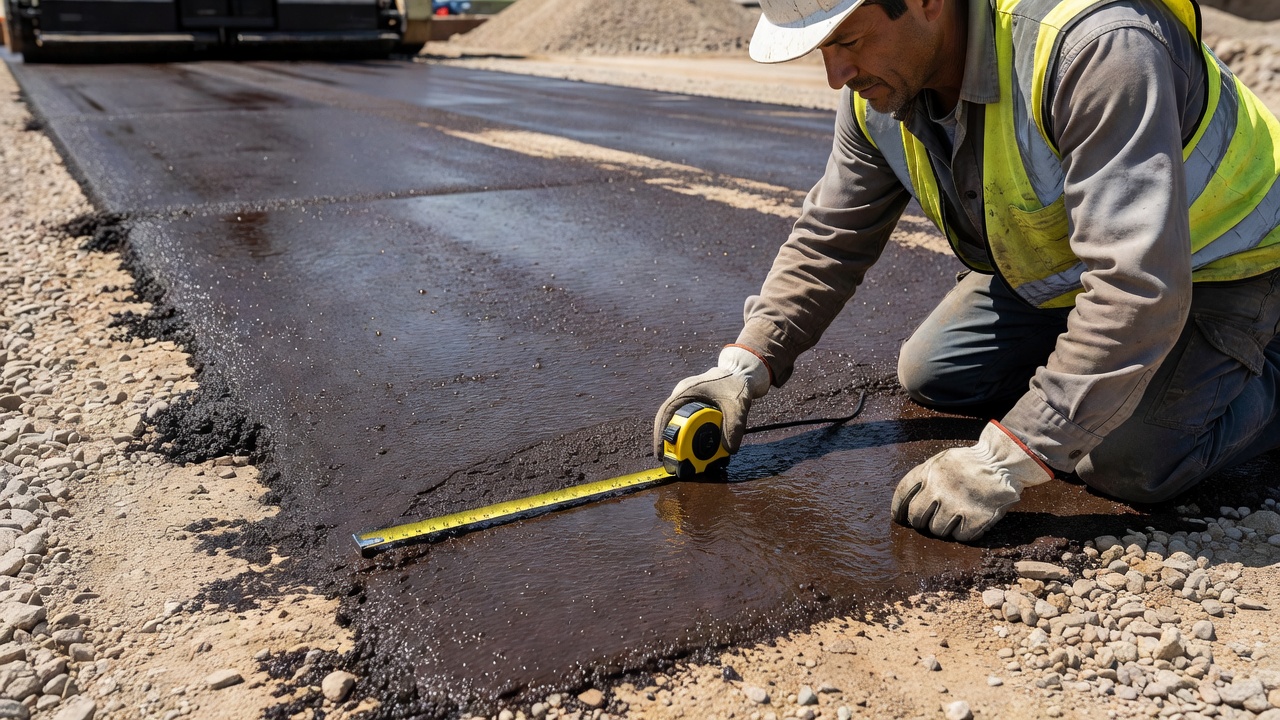
In the field, penetration adequacy is assessed qualitatively: within 24 hours of application, the prime should be visibly absorbed into the base surface with no standing liquid. The surface should appear uniformly dark, firm, and non-tacky to the touch. If the prime remains shiny, sticky, or pools on the surface after 24 hours, the application rate was excessive. If the surface appears light brown or gray with visible dry patches, the rate was insufficient.
Blotting Excess Prime
When excess prime remains on the surface after 24 hours of curing, evidenced by shiny, sticky, or soft areas, it must be remedied. The standard procedure, per MoDOT Section 408.4.2 and FHWA guidelines, is to apply clean, dry blotter sand uniformly over the affected area at a rate sufficient to absorb the excess. The blotter sand is then swept from the surface before paving. Failure to remove excess prime can create a slip plane between the base and HMA, leading to slippage cracking under traffic loads.
When a Prime Coat is Needed
The necessity of prime coat has been debated extensively in the pavement engineering community. The Asphalt Institute conducted studies over 20 years concluding that “few, if any, pavement failures can be attributed to the lack of a prime coat.” This finding, combined with changes in aggregate base gradation and the advent of dense-graded, high-fines bases that resist prime penetration, has led many agencies, including VDOT and numerous state DOTs, to discontinue routine prime coat requirements.
The FHWA Guidelines for Using Prime and Tack Coats provides the following decision criteria for determining when a prime coat is necessary:
Prime coat is recommended when:
The base will be exposed to weather for more than 7 days before paving. The prime provides temporary waterproofing, preventing rainfall from saturating and weakening the base. FHWA notes that “the major purpose of prime coat is to protect the underlying layers from wet weather.”
The base material is open-graded or contains low fines content. Such bases have high void ratios that require surface stabilization to preventraveling and particle loss under construction traffic. The prime binds surface particles and creates a durable platform.
Thin asphalt lifts (less than 3-3/4 inches or 95 mm) will be placed. Per MoDOT specifications, the base course is not primed “if the thickness of the succeeding pavement is greater than or equal to 3-3/4 in.” Thinner lifts require the prime’s additional bond strength to prevent slippage and shifting.
Light traffic will run on the base before paving. The prime hardens the base surface, preventingraveling, dust generation, and loss of surface fines under limited wheel loads.
Construction occurs during wet weather or in regions with high rainfall. The prime creates a waterproof membrane that prevents base saturation, which can delay paving and compromise pavement quality.
The project specifications explicitly require priming. Many owner agencies, including FAA, military (USACE/NAVFAC), and some international specifications, maintain prime coat requirements for specific pavement types.
Prime coat may be omitted when:
- The base is a dense-graded, high-fines material compacted to maximum density. Such bases have surface voids too small for prime penetration, resulting in a useless surface film.
- The HMA lift thickness exceeds 3-3/4 inches (95 mm). Thick lifts provide sufficient structural integration without prime.
- The base and HMA will be placed in the same construction sequence with minimal delay. Immediate paving eliminates the need for temporary base protection.
- Ambient temperatures are below 10°C (50°F). Cold temperatures significantly delay prime curing, increasing the risk of paving over uncured prime. FHWA notes that “prime is often deleted in cold weather because it is riskier to pave over uncured prime than over unprimed base.”
Airport Pavement Prime Coat Specifications
For airport pavements, the stringent requirements of ICAO Annex 14 and FAA Advisory Circular 150/5320-6G establish higher performance standards for all pavement layers, including priming.
The FAA’s Item P-208 (Aggregate Base Course) specification for federally funded airport projects requires that the aggregate base surface be “primed with a bituminous material” when paving is not immediate. FAA AC 150/5370-10F (Standards for Specifying Construction of Airports) specifies that prime coat for airport pavements shall conform to:
- Material: MC-30 or MC-70 cutback asphalt per ASTM D2027, or CSS-1h emulsified asphalt per ASTM D2397
- Application rate: 0.20 to 0.50 gal/yd² for cutbacks, 0.15 to 0.30 gal/yd² residual for emulsions
- Application temperature: Cutbacks at 50–80°C (120–180°F), emulsions at 20–70°C (70–160°F)
- Uniform coverage: The base must be uniformly coated with no bare spots, puddles, or runs
- Curing: The prime must be fully cured before HMA placement, the surface must be dry, firm, and non-tacky
ICAO Aerodrome Design Manual Part 3, Pavements (Doc 9157) provides guidance on prime coats for airport flexible pavements, emphasizing that the prime must “penetrate into the base course to form a waterproof layer and provide bond with the overlying asphalt.” The manual recommends that prime coat be applied at a rate that ensures complete penetration without excess surface material, and that the primed surface be protected from traffic until the subsequent layer is placed.
For military airfields, the Unified Facilities Criteria (UFC 3-270-01) requires prime coat application on all aggregate base courses that will be surfaced with asphalt concrete. Military specifications typically align with FAA requirements but may include additional quality control testing, including nuclear density gauge verification of base compaction before priming and sand patch testing for surface texture assessment.
Consequences of Improper or Omitted Priming
When prime coat is improperly applied or omitted where needed, several distinct pavement failure mechanisms can develop. These failures are well documented in pavement forensic investigations and research literature.
Slippage Cracking (Slippage Failure)
Slippage cracking is the most common failure attributed to improper priming. It manifests as crescent-shaped or half-moon cracks in the wheel paths, with the open side of the crescent pointing in the direction of traffic. These cracks occur when the HMA layer slides horizontally over the base course due to inadequate interlayer bond.
As described by the Asphalt Institute, if the prime coat is too heavy and does not fully absorb into the base, “a thick, gummy layer of asphalt on the aggregate surface” remains. This unabsorbed layer acts as a lubricant rather than a bonding agent, allowing the HMA to slide under braking and turning forces. VDOT studies identified that prime coats that “solidify as a heavy film on the aggregate base/subbase surface” can be “detrimental to the bond between the asphalt concrete and aggregate and can result in slippage failure.”
MoDOT’s Engineering Policy Guide explicitly warns: “If the prime coat is too heavy or too light, an inadequate bond is created and the mat may slip during compaction, which results in shoving and checking. In addition, a slippage failure (cracking) may occur after the pavement has been subjected to traffic.”
Moisture Damage
Without a properly penetrating prime coat, the granular base remains permeable to water. Rainfall can infiltrate through the HMA surface (via construction joints, cracks, or uncompacted areas) and become trapped in the base. Trapped moisture weakens the base by reducing internal friction between aggregate particles and can cause pumping, the ejection of water and fine particles through joints under traffic loading.
The Texas Transportation Institute’s study on effective prime coats confirmed that a primary function of prime is “sealing the surface pores in the base, thus reducing the migration of moisture and absorption of the first application of surface treatment binder.” Without this seal, water damage progresses rapidly, often requiring complete base reconstruction.
###raveling and Particle Loss
An unprimed or inadequately primed base surface suffersraveling, the dislodging and loss of aggregate particles under construction traffic or wind action. This creates an uneven, degraded surface that prevents uniform HMA placement. Loose particles become trapped between the base and HMA, creating localized stress concentrations and weak bonding zones. In airport pavements, loose particles also constitute foreign object debris (FOD) with high risk to jet engines.
Bleeding and Flushing
When prime is applied too heavily and does not absorb into the base, the excess asphalt rises to the surface when the hot HMA is placed. The heat of the HMA reduces the viscosity of the prime, causing it to migrate upward and create a binder-rich zone at the pavement surface. This results in asphalt bleeding, a shiny, slick surface with reduced skid resistance that is particularly hazardous on airport runways and high-speed roadways.
Reduced Pavement Life
The cumulative effect of inadequate priming is a measurable reduction in pavement service life. The FHWA Long-Term Pavement Performance (LTPP) program has documented correlations between base preparation quality (including priming) and pavement distress development. While LTPP data does not isolate priming as an independent variable, forensic studies consistently identify interlayer bond failure, the primary failure mechanism of poor priming, as a significant contributor to premature pavement failure.
Cost-benefit analyses indicate that the incremental cost of proper priming (approximately $0.10–$0.30 per square yard for materials and application) is negligible compared to the rehabilitation costs of a failed pavement. A base repair requiring partial- or full-depth patching costs $5–$20 per square yard, and complete base reconstruction costs $20–$50 per square yard, 50 to 500 times the cost of proper priming.
Prime Coat vs Tack Coat
Prime coat and tack coat are frequently confused, but they serve fundamentally different purposes in pavement construction and use different materials, application rates, and placement conditions.
| Property | Prime Coat | Tack Coat |
|---|---|---|
| Application surface | Untreated granular base or subbase | Existing asphalt, concrete, or primed base |
| Function | Penetrate, stabilize, waterproof base, bond base to first HMA layer | Bond between existing and new HMA layers |
| Typical material | MC-30, MC-70, CSS-1h (low viscosity) | CSS-1h, SS-1h, PG binders (moderate viscosity) |
| Application rate | 0.20–0.50 gal/yd² (cutback), 0.10–0.30 gal/yd² (emulsion residual) | 0.05–0.15 gal/yd² residual |
| Dilution | Often diluted 1:1 to 3:1 with water | Typically applied undiluted or slightly diluted |
| Penetration required | Yes, target 6–50 mm into base | No, surface film only |
| Cure time before paving | 12–72 hours minimum | 30–60 minutes (emulsion break time) |
| Temperature sensitivity | Cold weather delays cure significantly | Less weather-dependent, can apply in cooler conditions |
| Application temperature | Cutbacks: 50–80°C, Emulsions: 20–50°C | Emulsions: 20–70°C, PG binders: 150–180°C |
The critical operational distinction is that a prime coat is always applied to an untreated granular surface, while a tack coat is always applied to an existing bituminous or cementitious surface. The two are not interchangeable, applying a tack coat to a granular base would fail to penetrate and stabilize the base, while applying a prime coat to an existing HMA surface would create a slippage hazard with no structural benefit.
In a typical pavement construction sequence, the prime coat is applied first to the prepared granular base. After the prime has cured, the first (leveling or binder) HMA course is placed. If additional lifts are required, a tack coat is applied between each HMA lift. The tack coat ensures the lifts bond together as a monolithic structural section, while the prime coat ensures the base bonds to the first lift.
Inspection of Primed Surface
Quality control and acceptance inspection of prime coat application follows established protocols specified by agency standard specifications. The inspection process covers pre-application conditions, application parameters, and post-application quality.
Pre-Application Inspection
Before prime coat is applied, the inspector must verify:
- Base acceptance: The granular base must be compacted to the specified density, at the correct moisture content, with final grade and cross-section meeting tolerances. MoDOT specifications require the base to be “damp”, moist but with no standing water, as this “will absorb the prime more rapidly and completely.”
- Surface preparation: The base surface must be clean, free of dust, loose particles, oil, or other contaminants. Brooming or air blowing may be required before priming.
- Prime material certification: The delivered prime must have a manufacturer’s certification confirming compliance with applicable specifications (ASTM D2027 for MC cutbacks, ASTM D2397 for CSS-1h, etc.). Temperature-volume correction per ASTM D4311 must be applied for pay quantity measurement.
- Equipment calibration: The asphalt distributor must be calibrated to deliver the specified application rate at the target speed. Nozzle angle, bar height, and pump pressure must be verified.
Application Inspection
During prime application, the inspector monitors:
- Application temperature: Cutbacks must be within the specified temperature range (typically 50–80°C). MoDOT specifications require the inspector to measure and record the temperature at the distributor.
- Coverage uniformity: The spray pattern must provide uniform coverage with no streaks, overlaps, gaps, or segregation. Proper nozzle height prevents “striping” from overlapping spray cones.
- Application rate verification: The actual rate is determined by comparing before-and-after distributor meter readings, adjusted for temperature per ASTM D4311, and divided by the area covered. Tray tests (placing weighed pads on the base before spraying) may be used for verification.
- Edge and joint treatment: Adjacent passes must be overlapped 2–6 inches without double application. Start-and-stop transverse joints must be overlapped on paper or other protective material to prevent double coating.
Post-Application Inspection
After prime application and curing, the inspector evaluates:
- Penetration: Within 24 hours, the prime should be fully absorbed. If visible surface film remains, the rate was excessive. An unabsorbed area must be blotted with sand.
- Surface condition: The cured prime should appear uniformly dark brown to black, firm, and dust-free. Light brown areas indicate insufficient application, sticky or shiny areas indicate excess.
- Cure verification: The prime is considered cured when it “has hardened and penetrated into the base course to the extent that it cannot be picked up” per MoDOT Section 408.4.2.2. A simple field test involves pressing the surface with a thumb or boot, if no prime transfers, curing is adequate.
- Traffic restrictions: The primed surface must be protected from traffic until the prime has cured and the HMA is placed. If light construction traffic is unavoidable, the prime must be sufficiently hardened to prevent pickup.
Acceptance Criteria
The primed surface is accepted when:
- The application rate (adjusted to 60°F base temperature per ASTM D4311) falls within the specified range
- Coverage is visually uniform over the entire area
- The prime has fully cured with no bleeding, tackiness, or pickup
- No standing prime or puddles remain
- The surface grade and cross-section remain within tolerance (priming does not correct base deficiencies)
Deviations are addressed per the contract specifications. Typical remedies include:
- Insufficient coverage: Re-apply prime at the deficient rate to the affected areas
- Excess prime: Blot with sand and remove, if severe, scrape excess and re-apply at correct rate
- Non-uniform coverage: Correct equipment issues and re-apply to deficient zones
- Damaged or contaminated prime: Re-prepare affected area and re-prime
Airport Pavement Prime Coat
Airport pavements present unique demands for prime coat application due to the extreme loads imposed by aircraft, the safety-critical nature of runway surfaces, and the stringent regulatory oversight from ICAO and FAA.
Regulatory Framework
ICAO Annex 14, Aerodromes, Volume I establishes the international standards for aerodrome design and operations. While Annex 14 does not prescribe specific prime coat requirements, its specifications for pavement strength (Chapter 3), surface condition (Chapter 10), and construction quality (Chapter 10) create the performance framework that prime coat must satisfy.
ICAO Doc 9157, Aerodrome Design Manual, Part 3: Pavements provides detailed guidance on pavement design and construction for airports. The manual addresses prime coat within the context of flexible pavement construction, emphasizing its role in:
- Providing waterproofing for granular base courses during the construction period
- Establishing bond between the base and the first asphalt course
- Protecting the base from weather exposure before paving
- Creating a stable working platform for construction equipment
FAA Advisory Circular 150/5320-6G, Airport Pavement Design and Evaluation provides U.S. standards for airport pavement design. The AC references FAA Item P-401 (Hot Mix Asphalt) and P-208 (Aggregate Base Course) specifications, which establish prime coat requirements. FAA-funded projects must comply with these specifications as a condition of grant assurance.
FAA AC 150/5370-10F, Standards for Specifying Construction of Airports contains the detailed technical specifications for all pavement work items. Item P-209 (Crushed Aggregate Base Course) and P-210 (Caliche Base Course) specify priming requirements for airport base courses that will receive bituminous surfacing.
Airport-Specific Requirements
Airport prime coats differ from highway applications in several respects:
Higher compaction standards: Airport base courses are compacted to 95–100% of maximum dry density per ASTM D698 (Standard Proctor) or D1557 (Modified Proctor), compared to 90–95% for typical highway bases. This higher density reduces base porosity and requires careful prime rate adjustment.
Strict FOD control: The FAA mandates that all pavement construction procedures minimize foreign object debris (FOD) hazard. Excess prime that remains tacky can pick up and retain debris particles. Proper curing and blotting are essential for FOD prevention.
Chemical resistance: Airport pavements are exposed to jet fuel, hydraulic fluid, and deicing chemicals. The prime coat must be resistant to these chemicals to prevent softening or dissolution of the base bond. Polymer-modified PMB emulsions are increasingly specified for apron and fueling areas where chemical exposure is highest.
Surface friction: Runway surfaces require minimum friction levels per FAA AC 150/5320-6G. Bleeding of excess prime into the HMA surface reduces texture depth and friction. Proper prime application is essential to maintaining design friction levels.
Lighting and marking integration: Airport pavements contain embedded lighting fixtures, signage, and markings. Prime coat must not interfere with fixture embedment or marking adhesion. The primed base should receive utility installations before HMA placement.
Construction Best Practices for Airports
The FAA and ICAO recommend the following practices for airport prime coat construction:
- Apply prime only after the base course has passed all density, grade, and smoothness acceptance tests
- Use MC-30 or diluted CSS-1h for best penetration into high-density airport base courses
- Protect the primed surface from all traffic, including service vehicles, until HMA is placed
- Place HMA within 7 days of priming to prevent base contamination and prime deterioration
- In wet or cold conditions, defer priming until immediately before paving to minimize weather exposure
- Perform bond strength testing (ASTM D7000 or equivalent) on prime coat test strips before full-scale production
The investment in proper prime coat application for airport pavements is justified by the catastrophic consequences of pavement failure during aircraft operations. A pavement slippage failure on a runway or taxiway can close the facility for days, cost millions in emergency repairs, and create unacceptable safety risks. Proper priming represents a minimal cost increment that protects this critical infrastructure investment.
Summary
The prime coat is a specialized bituminous treatment applied to granular base courses to create a waterproof, stabilized surface that bonds effectively with the overlying hot mix asphalt layer. While modern dense-graded bases have reduced the universal necessity of priming, prime coat remains essential for specific conditions, open-graded bases, thin HMA lifts, delayed paving schedules, construction traffic exposure, and wet-weather construction. The selection of prime material (MC-30, MC-70, CSS-1h, or proprietary formulations) depends on penetration requirements, environmental regulations, base characteristics, and project timeline. Proper application requires careful rate selection based on field conditions, uniform coverage, adequate curing, and thorough inspection. Improper priming, too heavy, too light, or omitted where needed, can cause slippage cracking, moisture damage, bleeding, and premature pavement failure. In airport pavements, where safety and operational reliability are paramount, prime coat specifications follow FAA and ICAO standards that ensure the highest level of construction quality.
Frequently Asked Questions
- What is the difference between a prime coat and a tack coat?
- A prime coat is applied to an untreated granular base course before the first layer of asphalt, to penetrate and stabilize the base. A tack coat is applied between existing asphalt layers to provide interlayer bonding. Prime coats use lower-viscosity materials (MC-30, MC-70, CSS-1h) at higher application rates (0.2–0.5 gal/yd²) to achieve penetration, while tack coats use emulsions or PG binders at lower rates (0.05–0.15 gal/yd² residual) and do not require penetration.
- What application rate is recommended for prime coat?
- Application rates depend on the base material, prime type, and project specifications. For cutback asphalts (MC-30, MC-70), typical rates range from 0.20 to 0.50 gal/yd² (0.9 to 2.3 L/m²). For emulsified asphalts (CSS-1h, SS-1h), rates range from 0.10 to 0.30 gal/yd² (0.45 to 1.35 L/m²) of residual asphalt. The rate should be adjusted in the field based on absorption, if the prime is absorbed within 24 hours leaving no excess, the rate is correct. Excess prime requires blotting with sand.
- How long does prime coat take to cure before paving?
- Curing time varies by material and weather. Cutback asphalts (MC-30, MC-70) typically require 24–72 hours for the solvents to fully evaporate. Emulsified asphalts cure faster, generally 12–24 hours depending on temperature and humidity. The prime coat is considered cured when it has hardened and penetrated sufficiently that it cannot be picked up by hand pressure. In cold or humid weather, curing times increase significantly, many agencies omit priming in cold weather due to extended curing risk.
- What happens if you pave over an uncured prime coat?
- Paving over an uncured prime coat can cause serious pavement failures. If the prime has not fully cured (solvents evaporated or emulsion broken), the remaining moisture or solvents become trapped beneath the hot mix asphalt. As the trapped volatiles escape, they create voids and weaken the bond between base and asphalt. This leads to slippage cracking, bleeding (flushing of prime material through the HMA), pavement shoving during compaction, and premature structural failure requiring costly repairs.
- Is a prime coat always necessary for asphalt pavement?
- No. Modern dense-graded aggregate bases with high fines content achieve tight compaction that prevents prime penetration, negating its benefit. Many agencies including VDOT have discontinued routine priming. A prime coat is still recommended when: the base will be exposed to weather for 7+ days before paving, the base is an open-graded material requiring stabilization, thin asphalt lifts (<3.75 inches) are being placed, traffic will run on the base before paving, or during wet-weather construction requiring temporary waterproofing.