What is Propagation (Electromagnetic Waves)?
Propagation – Travel of Electromagnetic Waves (Physics)
Introduction
Propagation is the process by which electromagnetic (EM) waves, oscillating electric and magnetic fields, move through space or material media. Unlike mechanical waves (which require a material medium), EM waves can travel through the vacuum of space, making them essential for wireless communication, radar, navigation, and remote sensing in aviation and aerospace.
Understanding propagation is crucial for designing and operating reliable aviation systems. Signal behavior, range, clarity, attenuation, and interference, depends on the physical laws governing EM wave travel and the properties of the transmission medium (air, clouds, ionosphere, aircraft structures).
What Are Electromagnetic Waves?
Electromagnetic waves are self-sustaining oscillations of electric ((\vec{E})) and magnetic ((\vec{B})) fields, which propagate together at the speed of light. These fields are always perpendicular to each other and to the direction of travel. EM waves transfer energy and momentum, but not mass.
Key characteristics:
- Transverse nature: (\vec{E}) and (\vec{B}) are perpendicular to each other and to the direction of propagation.
- Can travel through vacuum: No material medium required.
- Governed by Maxwell’s equations: Fundamental laws of electromagnetism.
- Speed: In vacuum, (c \approx 299,792,458) m/s (the speed of light), less in materials.
Mechanical vs. Electromagnetic Waves
| Feature | Mechanical Waves | Electromagnetic Waves |
|---|---|---|
| Requires Medium | Yes | No (can propagate in vacuum) |
| Nature of Disturbance | Particle displacement | Field oscillation |
| Types | Longitudinal, transverse | Always transverse |
| Speed | Medium-dependent | (c) in vacuum |
| Aviation Relevance | Cabin acoustics, vibration | Radio, radar, satellite links |
Mechanical waves (e.g., sound) cannot propagate in space, while EM waves enable global and space-based communication and navigation.
How Do EM Waves Propagate?
Mutual Induction
EM waves propagate via mutual induction:
- A time-varying electric field generates a time-varying magnetic field (Faraday’s Law).
- A time-varying magnetic field generates a time-varying electric field (Maxwell’s addition).
This feedback loop allows EM waves to sustain themselves and propagate through any region where fields can exist, including vacuum.
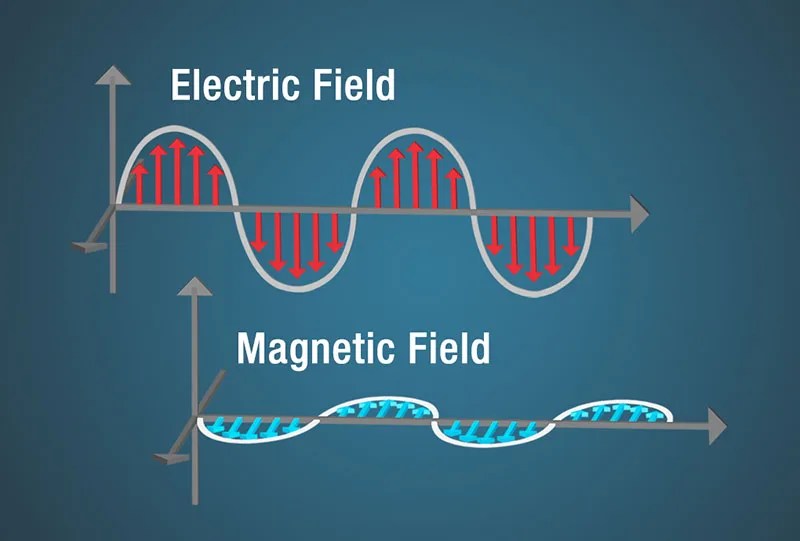
Red: Electric field ((\vec{E})), Blue: Magnetic field ((\vec{B})). Both are perpendicular to each other and to the propagation direction.
Direction and Polarization
- The direction of propagation is perpendicular to both (\vec{E}) and (\vec{B}).
- Polarization refers to the orientation of the electric field, it may be linear, circular, or elliptical, affecting antenna design and signal interactions.
The Mathematics of Propagation: Maxwell’s Equations
Maxwell’s equations explain how EM waves arise and propagate. In free space (no charges or currents), they lead to the wave equation for electric and magnetic fields:
[ \nabla^2 \vec{E} = \mu_0 \varepsilon_0 \frac{\partial^2 \vec{E}}{\partial t^2} ] [ \nabla^2 \vec{B} = \mu_0 \varepsilon_0 \frac{\partial^2 \vec{B}}{\partial t^2} ] [ c = \frac{1}{\sqrt{\mu_0 \varepsilon_0}} ]
EM waves are thus predicted to move at the speed of light.
Vector Relationship:
[
\vec{E} \perp \vec{B} \perp \vec{k}
]
where (\vec{k}) is the direction of propagation.
Poynting Vector ((\vec{S})):
[
\vec{S} = \frac{1}{\mu_0} (\vec{E} \times \vec{B})
]
represents the power flow (energy per unit area per second) in the wave.
Properties of Electromagnetic Waves
Frequency, Wavelength, and Energy
- Frequency ((f)): Oscillations per second (Hz).
- Wavelength ((\lambda)): Physical distance between repeating features (meters).
- Energy ((E)): For a photon, (E = hf) (Planck’s constant (h)).
These relate as: [ c = \lambda f ]
Electromagnetic Spectrum
EM waves span a vast frequency range:
| Type | Wavelength | Frequency (Hz) | Aviation Example |
|---|---|---|---|
| Radio | (>1) m | (<3 \times 10^8) | Voice comms, air navigation |
| Microwave | 1 mm–1 m | (3 \times 10^8-3 \times 10^{11}) | Radar, DME, SSR |
| Infrared | 700 nm–1 mm | (3 \times 10^{11}-4 \times 10^{14}) | IR sensors, cameras |
| Visible | 400–700 nm | (4 \times 10^{14}-7.5 \times 10^{14}) | Visual signaling |
| Ultraviolet | 10–400 nm | (7.5 \times 10^{14}-3 \times 10^{16}) | UV disinfection |
| X-rays | 0.01–10 nm | (3 \times 10^{16}-3 \times 10^{19}) | Security screening |
| Gamma rays | (<0.01) nm | (>3 \times 10^{19}) | Cosmic observations |
Aviation Uses by Frequency Band:
| Frequency Band | Range (Hz) | Aviation Use |
|---|---|---|
| VHF | 30–300 MHz | Voice comms, NAV |
| UHF | 300 MHz–3 GHz | Radar, DME, TCAS |
| S-band | 2–4 GHz | Weather radar |
| L-band | 1–2 GHz | GPS, ADS-B |
Propagation in Different Media
Vacuum
- Speed: (c), no attenuation or absorption.
- Use: Satellite communication, space navigation (GNSS).
Air
- Speed: Slightly less than (c).
- Attenuation: Minimal at VHF/UHF, more at higher frequencies or with precipitation.
- Effects: Refraction, scattering, absorption (by gases, precipitation).
Ionosphere
- Nature: Plasma layer in upper atmosphere.
- Effect: Reflects HF (3–30 MHz) for long-range comms, higher frequencies (VHF/UHF) pass through for satellite/GNSS.
Conductors (Metals)
- Effect: Strong reflection and absorption (shielding).
- Aviation application: Aircraft bodies act as Faraday cages, protecting avionics.
Water & Dense Media
- Speed: Much less than (c).
- Attenuation: High for RF/IR, limiting use to specialized applications.
Attenuation, Reflection, and Dispersion
- Attenuation: Signal loss due to absorption, scattering, or spreading. Significant at high frequencies, with obstacles, or in adverse weather.
- Reflection: Occurs at boundaries (ground, buildings, atmospheric layers), affecting signal paths.
- Dispersion: Frequency-dependent speed causes pulse spreading, important for certain bands and data links.
Production and Detection of EM Waves
Generation
- Antennas: Oscillating currents produce time-varying electric and magnetic fields.
- Specialized sources: Magnetrons (radar), klystrons, solid-state devices.
- Natural sources: Sun, lightning, cosmic phenomena.
Detection
- Antennas: Capture oscillating fields, induce currents for receivers.
- Sensors: Photodetectors (IR, visible), specialized radar receivers.
Propagation in Aviation: Applications
| Application | Propagation Principle | Impact |
|---|---|---|
| Radio Communication | Line-of-sight (VHF/UHF), ionospheric (HF) | Range, clarity, reliability |
| Radar | Reflection from objects, penetration of clouds | Weather, terrain, navigation |
| Satellite Navigation | Propagation in vacuum and atmosphere | Precise positioning, timing |
Factors Affecting Aviation Signal Propagation:
- Frequency band selection
- Atmospheric conditions (weather, ionosphere)
- Antenna type and orientation (polarization)
- Physical obstructions
Summary Table: EM Wave Propagation
| Property | Description | Aviation Example |
|---|---|---|
| Medium | Vacuum, air, ionosphere, metal | Air, clouds, cockpit, fuselage |
| Speed ((c)) | (3 \times 10^8) m/s in vacuum, less in media | GPS, radar, timing |
| Energy Transfer | By field oscillations, not particle motion | Radar, radio, signal strength |
| Directionality | Orthogonal fields and propagation vector | Antenna design, radar beams |
Conclusion
Propagation describes the fundamental journey of electromagnetic waves through space or materials, underpinning every aspect of wireless communication, navigation, radar, and sensing in aviation and aerospace. A thorough understanding of propagation, Maxwell’s laws, frequency effects, media interactions, and polarization, is essential for designing robust, safe, and efficient airborne systems.
Whether enabling clear radio calls, accurate GPS, or reliable radar, the science of propagation is at the heart of modern aviation technology.
Frequently Asked Questions
- How do electromagnetic waves propagate without a medium?
- Electromagnetic waves consist of coupled oscillating electric and magnetic fields that sustain each other as they travel. Unlike mechanical waves, which need a physical medium, EM waves propagate through vacuum by the process of mutual induction, each changing field generates the other, as described by Maxwell’s equations.
- Why is understanding propagation important in aviation?
- Propagation determines how radio, radar, and satellite signals behave in various atmospheric and operational conditions. It affects communication range, navigation accuracy, signal clarity, and susceptibility to interference, making it crucial for flight safety and efficient operations.
- What affects electromagnetic wave propagation in the atmosphere?
- Factors include frequency, atmospheric composition, weather (rain, fog), ionospheric conditions, obstacles (terrain, buildings), and polarization. These can cause reflection, refraction, attenuation, or absorption, impacting signal strength and reliability.
- What is the difference between mechanical and electromagnetic waves?
- Mechanical waves require a material medium (air, water, solids) and transfer energy via particle motion. Electromagnetic waves are oscillations of electric and magnetic fields that travel through vacuum or materials, carrying energy and information without transporting mass.
- How does frequency affect aviation communication and radar?
- Different frequencies interact differently with the atmosphere and obstacles. Lower frequencies (HF) can reflect off the ionosphere for long-range communication, while higher frequencies (VHF, UHF, microwaves) offer line-of-sight performance with higher data rates, ideal for radar and navigation but more susceptible to attenuation.
This is a reference entry. TarmacView provides drone inspection services and doesn't sell the equipment or materials described in this glossary.