What is Reflection in Optics?
Reflection – Return of Light from a Surface (Optics)
Reflection is a core phenomenon in optics and physics, describing the process by which electromagnetic waves, most notably visible light, are returned from an interface or surface rather than being absorbed or transmitted. This process is visible in everyday life: we see objects because they reflect ambient light, mirrors function due to their ability to reflect, and advanced technologies like telescopes, fiber optics, and lidar all rely on the controlled reflection of light.
Reflection is governed fundamentally by Maxwell’s equations and the boundary conditions they impose at interfaces between materials of different refractive indices. The efficiency, directionality, and nature of the reflected light are determined by properties such as surface roughness, material composition, angle of incidence, wavelength, and polarization.
Key Concepts in Reflection
Law of Reflection
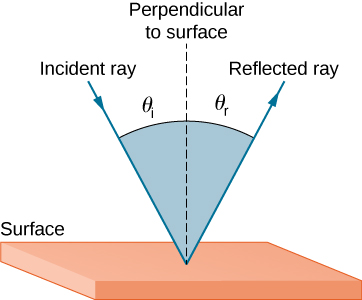
The law of reflection is foundational in geometric optics. It states:
The angle of incidence ((\theta_i)) is equal to the angle of reflection ((\theta_r)), both measured from the surface normal.
[ \theta_r = \theta_i ]
The incident ray, reflected ray, and the normal to the surface all lie in the same plane, the plane of incidence.
This simple geometric relationship underpins the operation of mirrors, periscopes, laser systems, and is the starting point for ray tracing in computer graphics and optical engineering.
Electromagnetic Perspective
At a deeper level, reflection is the result of electromagnetic boundary conditions at the interface of two media. When a light wave meets a boundary with a different refractive index, Maxwell’s equations dictate that certain components of the electric and magnetic fields must remain continuous.
This requirement results in part of the wave being reflected and part transmitted (refracted). The relative proportions and phase changes are described by the Fresnel equations, which depend on angle, wavelength, material properties, and polarization.
Fresnel Equations
The Fresnel equations predict how much light is reflected or transmitted at an interface, separately for each polarization:
- s-polarized (perpendicular): [ R_s = \left| \frac{n_1 \cos \theta_i - n_2 \cos \theta_t}{n_1 \cos \theta_i + n_2 \cos \theta_t} \right|^2 ]
- p-polarized (parallel): [ R_p = \left| \frac{n_1 \cos \theta_t - n_2 \cos \theta_i}{n_1 \cos \theta_t + n_2 \cos \theta_i} \right|^2 ]
Where (n_1, n_2) are refractive indices, (\theta_i) is the incidence angle, and (\theta_t) the transmission angle (from Snell’s Law).
At the Brewster angle, p-polarized light is not reflected at all, which is exploited in polarizing filters and coatings.
Types of Reflection
Specular Reflection
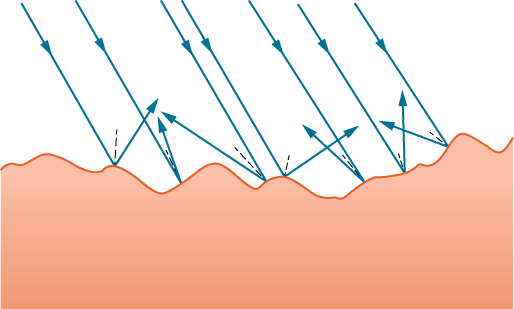
Occurs on optically smooth surfaces (roughness much less than the wavelength). Light reflects in a single, predictable direction, preserving image integrity, mirrors, polished metals, and calm water all show specular reflection.
Diffuse Reflection
Occurs when surface roughness is comparable to or greater than the wavelength. Light is scattered in many directions, making surfaces visible from all viewpoints, painted walls, paper, matte plastics, etc.
Lambert’s cosine law describes ideal diffuse reflection, where the intensity follows the cosine of the angle from the normal.
Partial and Total Internal Reflection
- Partial reflection: Most surfaces reflect only a portion of the incident light, the rest is transmitted or absorbed.
- Total Internal Reflection (TIR): When light travels from a denser to a rarer medium at an angle greater than the critical angle, all light is reflected internally.
[ \sin \theta_c = \frac{n_2}{n_1} \quad (n_1 > n_2) ]
TIR is the basis for fiber optics, prisms, and endoscopes.
Retroreflection
Retroreflection sends light back toward its source, regardless of the angle of incidence, using structures like corner-cube prisms or microbeads. Used in road signs, safety apparel, and optical metrology.
Surface Properties Affecting Reflection
Surface Roughness
Microscale or nanoscale roughness affects whether reflection is specular or diffuse. Smooth surfaces yield mirror-like reflection, rough surfaces scatter light. This is quantified by parameters like RMS roughness or power spectral density.
Material Type
- Metals: High reflectivity due to free electrons (e.g., silver, aluminum). Used for mirrors, reflectors.
- Dielectrics: Lower reflectivity at single interfaces, but can be enhanced with coatings (e.g., glass with anti-reflection or dielectric mirror coatings).
- Absorptive materials: Engineered to minimize reflection for applications like thermal detectors or stealth.
Angle of Incidence
Reflectivity increases with increasing angle of incidence, especially for s-polarized light. At the Brewster angle, p-polarized light is entirely transmitted.
Polarization
Reflection varies with light polarization. Polarizing optics like beam splitters and Brewster windows exploit this effect for controlling light in imaging and sensing systems.
Quantifying Reflection
Reflectivity vs. Reflectance
- Reflectivity: Intrinsic property of a material at a specific wavelength, angle, and polarization.
- Reflectance: Proportion of light reflected from a real surface, possibly including roughness, coatings, or multiple interfaces.
Bidirectional Reflectance Distribution Function (BRDF)
The BRDF describes how light is reflected at an opaque surface as a function of both incident and outgoing angles. It’s fundamental in remote sensing, computer graphics, and material characterization.
[ f_r(\theta_i, \phi_i, \theta_r, \phi_r) = \frac{dL_r(\theta_r, \phi_r)}{dE_i(\theta_i, \phi_i)} ]
Where (L_r) is reflected radiance, and (E_i) is incident irradiance.
Applications of Reflection
- Vision and Imaging: Most objects are visible due to reflected light.
- Mirrors and Optical Systems: From telescopes to microscopes, controlled reflection is essential.
- Fiber Optics: TIR enables long-distance light transmission.
- Remote Sensing and Lidar: Measuring surface reflectance helps map Earth, detect hazards, or guide autonomous vehicles.
- Display and Lighting: Managing reflection is key for glare reduction and illumination design.
- Solar Energy: Reflectors concentrate sunlight, anti-reflection coatings increase efficiency.
Reflection Across the Electromagnetic Spectrum
Although most visible in the optical regime, reflection occurs at all electromagnetic wavelengths:
- Radio and Microwaves: Used in radar, wireless communication.
- Infrared: Thermal imaging, spectroscopy.
- Ultraviolet and X-rays: Specialized mirrors and coatings are used for astronomy, lithography, and medical imaging.
Engineering and Controlling Reflection
Modern optics employs thin-film coatings, nanostructures, and metamaterials to engineer surfaces with custom reflection properties:
- Antireflection coatings: Minimize unwanted reflection.
- Dielectric mirrors (Bragg reflectors): Achieve near-total reflectivity at selected wavelengths.
- Black coatings: Maximize absorption for detectors or stray light suppression.
- Retroreflective materials: Enhance visibility in safety applications.
Reflection in Nature
Natural phenomena such as rainbows, halos, iridescent minerals, and the blue of the sky all involve complex interactions of reflection, refraction, and scattering.
Summary
Reflection is a universal optical process, critical to both natural vision and advanced technology. Its characteristics are determined by a combination of geometric, electromagnetic, and material factors. Mastering reflection enables the design of efficient optical systems, advanced imaging, high-performance sensors, and innovative materials.
Further Reading
- Born, M. & Wolf, E. (1999). Principles of Optics
- Hecht, E. (2016). Optics
- Saleh, B.E.A., & Teich, M.C. (2019). Fundamentals of Photonics
- Pedrotti, F.L., Pedrotti, L.S., & Pedrotti, L.M. (2017). Introduction to Optics
Related Terms
- Refraction: Bending of light as it passes into a different medium.
- Scattering: Random redirection of light by small particles or rough surfaces.
- Absorption: Conversion of light energy to heat or other forms by a material.
- Polarization: Orientation of the light wave’s electric field.
See Also
- Refraction
- Scattering
- Total Internal Reflection
- Fiber Optics
- Optical Coatings
Reflection, in all its forms, remains a central theme in the science and engineering of light, enabling us to see, communicate, sense, and explore the universe.
Frequently Asked Questions
- What is the law of reflection?
- The law of reflection states that the angle of incidence equals the angle of reflection, both measured from the normal to the surface. This principle holds for all smooth surfaces and underpins the operation of mirrors, telescopes, and many optical systems.
- How does surface roughness affect reflection?
- Surface roughness determines whether reflection is specular (mirror-like) or diffuse (scattered). Smooth surfaces reflect light in a single direction, while rough surfaces scatter it, causing objects to appear matte and visible from all angles.
- What is total internal reflection?
- Total internal reflection occurs when light tries to move from a higher to a lower refractive index medium at an angle greater than the critical angle, causing all light to be reflected within the original medium. This principle is fundamental for fiber optics.
- How are the Fresnel equations used in optics?
- The Fresnel equations quantify the amount of light reflected and transmitted at an interface, accounting for polarization and angle of incidence. They are essential for designing optical coatings, anti-reflective layers, and analyzing polarization effects.
- What is the difference between reflectivity and reflectance?
- Reflectivity is an intrinsic material property describing the fraction of incident light reflected at a surface under specified conditions, while reflectance refers to the overall proportion of light reflected from a surface, including effects of roughness and multilayer structures.
This is a reference entry. TarmacView provides drone inspection services and doesn't sell the equipment or materials described in this glossary.