What is Roller-Compacted Concrete (RCC) Pavement?
Definition and Characteristics
Roller-Compacted Concrete (RCC) pavement is a type of non-reinforced concrete pavement constructed using a zero-slump concrete mix placed with high-density asphalt paving equipment and compacted to final density using vibratory and pneumatic rollers. Unlike conventional portland cement concrete (PCC) pavement, RCC contains no steel reinforcement, no dowel bars, no tie bars, and forms are not required. The material achieves its structural capacity through the physical interlock of densely compacted aggregate particles bound by a hydrated cement paste matrix. The American Concrete Institute (ACI) Committee 327 defines RCC as “concrete compacted by roller compaction, a construction method that uses asphalt-type paving equipment and roller compaction to produce a high-quality, durable concrete pavement.”
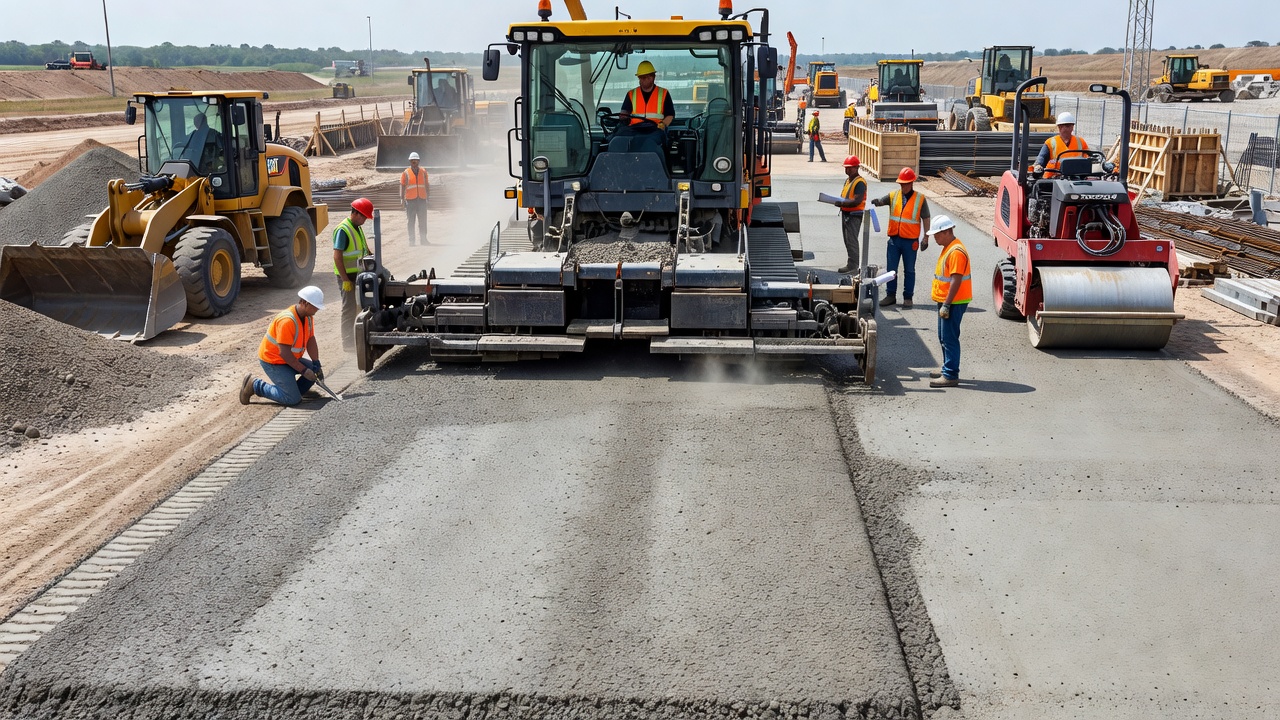
The defining characteristic of RCC is its zero-slump consistency, the concrete has a stiff, no-slump appearance similar to damp gravel, with a Vebe consistency typically between 30 and 90 seconds when tested per ASTM C1176. This dry consistency allows the freshly placed concrete to support the weight of compaction rollers immediately after the paver passes, which is essential for the construction process. The RCC mix has a water-to-cementitious materials ratio (w/cm) in the range of 0.30 to 0.45 by mass, significantly lower than the 0.40 to 0.55 range typical of conventional paving concrete. This low w/cm, combined with high compactive effort, produces a dense concrete matrix with very low permeability, typically less than 1,000 coulombs when tested per ASTM C1202 (Rapid Chloride Permeability Test).
Compressive strengths for RCC typically range from 4,000 to 6,000 psi (28 to 42 MPa) at 28 days for standard applications, with strengths up to 10,000 psi (70 MPa) achievable for high-performance mixtures using supplementary cementitious materials. Flexural strengths (modulus of rupture) range from 550 to 800 psi (4 to 6 MPa), which is comparable to or higher than conventional paving concrete for equivalent cementitious content. The elastic modulus of RCC ranges from 4 to 6 million psi (28 to 40 GPa), similar to conventional concrete.
RCC was first developed in the 1970s for the Canadian logging industry, which needed a low-cost, high-strength pavement that could withstand tracked vehicles, massive loads, and hydraulic fluid spills in log-sorting yards. The technology has since expanded worldwide to applications including port and intermodal facilities, military hardstands and tank trails, airport aprons and taxiways, industrial processing yards, highway shoulders and intersections, and municipal streets. The RCC Pavement Council estimates that over 100 million square yards of RCC pavement have been constructed in North America alone since the 1980s.
Key characteristics that distinguish RCC from conventional concrete pavement include:
| Characteristic | RCC Pavement | Conventional PCC Pavement |
|---|---|---|
| Slump | Zero (Vebe 30–90 s) | 1–4 in (25–100 mm) |
| Placement equipment | Asphalt paver (high-density) | Slipform paver or fixed forms |
| Compaction | Vibratory + pneumatic rollers | Internal vibration |
| Steel reinforcement | None | Dowels, tie bars, mesh |
| Joint spacing | 20–40 ft (6–12 m) | 15–20 ft (4.5–6 m) |
| Surface texture | As-rolled or diamond ground | Tined, broom, or grooved |
| Typical cost | 15–30% less than PCC | Baseline |
| Construction speed | 300–500 cy/hr | 100–200 cy/hr |
| Air entrainment | Not effective | Required for freeze-thaw |
RCC Mix Design
Cementitious Materials
The cementitious materials content in RCC is expressed as a percentage of the total dry materials (cement plus aggregates). For wearing course applications, cementitious materials typically constitute 11 to 15 percent of the total dry weight, with 12 to 14 percent being most common. A typical starting point for mix design is 470 to 550 lb of cementitious materials per cubic yard (280 to 330 kg/m³). Type I or Type II portland cement per ASTM C150 is standard. Supplementary cementitious materials (SCMs) including fly ash (Class C or F per ASTM C618) at 15 to 30 percent replacement, ground granulated blast furnace slag per ASTM C989 at 25 to 50 percent replacement, or silica fume per ASTM C1240 at 5 to 10 percent replacement are widely used to improve workability, reduce heat of hydration, lower cost, and enhance long-term strength and durability.
The optimum cementitious content is determined through laboratory testing using the soil compaction method per ACI 327. For a range of cementitious contents (e.g., 11, 13, and 15 percent), moisture-density relationships are established per ASTM D1557 (modified Proctor). At each cementitious content, the optimum moisture content is identified as the water content producing maximum dry density. Cylinders or beams are then compacted at the optimum moisture content for each cementitious level, cured, and tested at the specified age (typically 7, 28, and 90 days) for compressive strength per ASTM C39 or flexural strength per ASTM C78. The required cementitious content is selected from the strength-versus-cementitious-content curve to meet the design flexural or compressive strength plus a margin for variability.
Aggregates
RCC uses dense-graded aggregates that contain a higher percentage of fine aggregate than conventional concrete. The aggregate gradation should approach the 0.45 Power Curve for maximum packing density, which minimizes the void space between particles and reduces the paste volume required. The recommended nominal maximum aggregate size (NMAS) is 3/4 inch (19 mm) for most applications, with 5/8 inch (16 mm) or 1/2 inch (12.5 mm) used where a tighter surface finish is desired. The finer maximum size produces a tighter surface finish that is less prone to wear.
A typical RCC aggregate gradation band per ACI 327 and UFGS 32 13 16.16 follows these limits:
| Sieve Size | Percent Passing (Range) |
|---|---|
| 1 in (25 mm) | 100 |
| 3/4 in (19 mm) | 90–100 |
| 3/8 in (9.5 mm) | 60–85 |
| No. 4 (4.75 mm) | 40–60 |
| No. 16 (1.18 mm) | 20–40 |
| No. 50 (0.30 mm) | 8–22 |
| No. 100 (0.15 mm) | 4–12 |
| No. 200 (0.075 mm) | 2–8 |
The high proportion of particles passing the No. 200 sieve (typically 4 to 8 percent) is essential for producing a workable, compactable mix that achieves a tight surface finish. Crushed aggregate is preferred over rounded gravel because the angular particles provide better aggregate interlock, higher flexural strength, and a more stable surface. For the Portland International Airport RCC project, processed asphalt concrete aggregate (crushed material) was selected specifically because it is less susceptible to segregation during placement and produces higher flexural strengths than rounded gravel.
Water Content and Vebe Consistency
Water content is the most critical variable in RCC mix design because it determines both the compactability of the fresh concrete and the strength of the hardened concrete. The water content in RCC is expressed as a percentage of the total dry weight (cement plus aggregate), typically ranging from 5 to 8 percent. This corresponds to a water-to-cementitious materials ratio of approximately 0.30 to 0.45 by mass. The exact optimum water content is determined from the moisture-density relationship test (modified Proctor, ASTM D1557), where the water content producing maximum dry density is identified as the optimum moisture content (OMC).
Vebe consistency (ASTM C1176) is the primary measure of RCC workability. The Vebe test uses a cylindrical mold (typically 6-inch diameter for RCC) filled with concrete, mounted on a vibrating table with a transparent plastic disc applying a standard surcharge weight. The Vebe time is the duration in seconds required for the concrete to fully consolidate under combined surcharge and vibration. For RCC pavement mixtures, Vebe times range from 30 to 90 seconds, with the following general guidance:
| Vebe Time | Consistency | Application |
|---|---|---|
| Less than 30 s | Very wet | May not support roller, limited use |
| 30 to 45 s | Plastic | Suitable for thin lifts, moderate compaction |
| 45 to 75 s | Stiff | Optimal for most RCC pavements |
| 75 to 90 s | Very stiff | High compaction effort required, good for thick lifts |
| Greater than 90 s | Extremely stiff | Difficult to compact, not recommended |
Proper water content at the point of placement is crucial. If the mix is too wet (Vebe under 30 seconds), the roller may sink or cause surface waves. If too dry (Vebe over 90 seconds), the mix cannot be compacted to target density, resulting in high void content, low strength, and poor durability. The target Vebe time must be adjusted for ambient temperature, wind, and evaporation rate, as water loss during transport and placement can increase Vebe time by 10 to 30 seconds. The use of a continuous mixing plant (pugmill) allows precise control of water addition and provides the most consistent RCC production.
Paving Equipment
High-Density Asphalt Paver
The high-density paver is the cornerstone of successful RCC construction. These machines are specifically modified asphalt pavers equipped with tamping bars and vibratory screeds that provide pre-compaction of the RCC before rolling begins. The tamping bars, operating at 800 to 2,000 strokes per minute, impact the concrete and force aggregate particles into a denser arrangement. The vibratory screed operates at 2,000 to 3,500 vpm, further consolidating the material and leveling the surface. Together, these systems achieve a discharge density of 90 to 92 percent of maximum dry density, meaning the paver accomplishes up to 90 percent of the total compaction work.
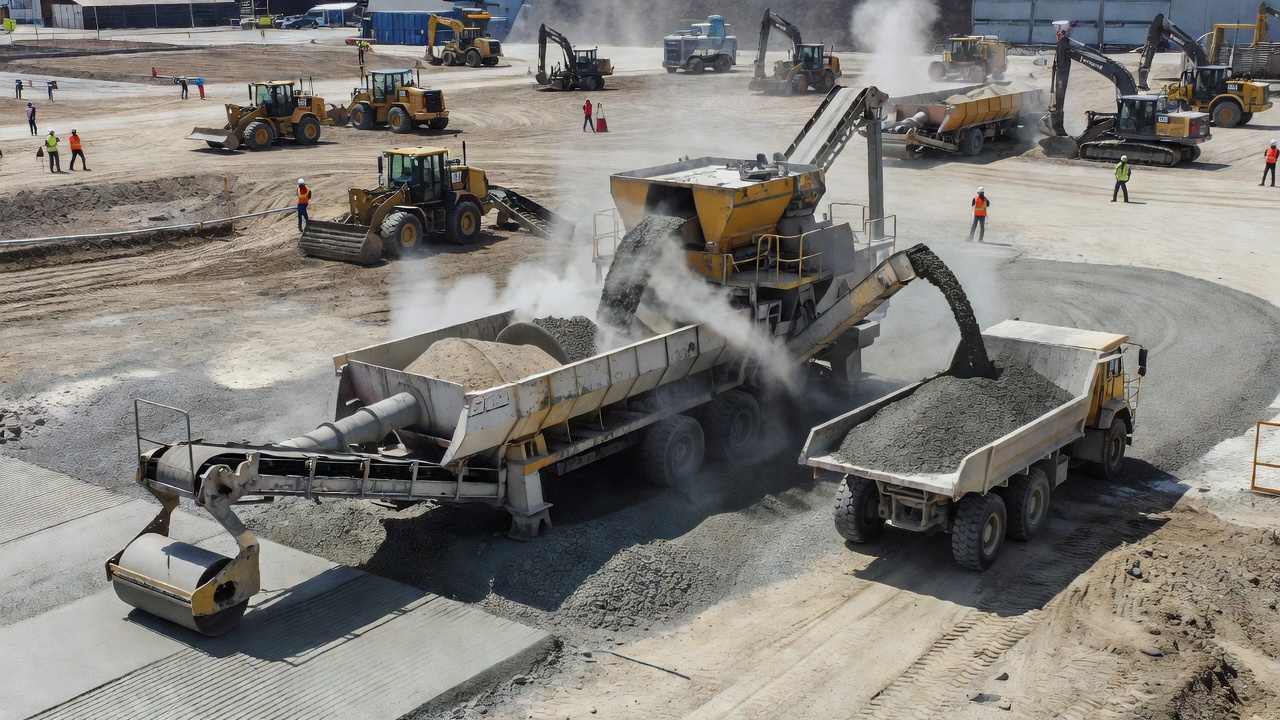
High-density pavers are typically track-mounted for stability on the RCC surface and for the higher tractive forces required to propel the machine through the stiff concrete. Key features include automatic grade control systems (stringline or laser-based), proportional feed systems to maintain uniform concrete distribution across the full paving width, and screed extensions for variable lane widths. The paver places RCC in lifts of 4 to 10 inches (100 to 250 mm) at widths up to 30 feet (9 m). Production rates of 300 to 500 cubic yards per hour are achievable with a properly sized paver. For lifts exceeding 10 inches, RCC is placed in multiple lifts. A material transfer device (MTD) is recommended between the dump trucks and the paver to provide a continuous, uniform feed and to reduce segregation.
Conventional Asphalt Paver
Conventional asphalt pavers (without tamping bars) have been used for RCC placement on smaller projects but are not recommended for lifts over 6 inches (150 mm). They achieve only 85 to 90 percent discharge density, resulting in greater reliance on rolling for compaction. This increases the risk of surface tearing, shoving, and poor ride quality. The U.S. Army Corps of Engineers UFGS 32 13 16.16 specification explicitly requires high-density pavers for military RCC projects.
Aggregate Spreaders
Aggregate spreaders (modified dozers or graders) have been used for RCC placement on very low-budget projects, but they produce poor surface smoothness, uneven density, and high segregation. Their use is not permitted on military, airport, or highway projects per standard specifications.
Compaction
Compaction of RCC to achieve 96 to 98 percent of maximum dry density is essential for strength, durability, and surface wear resistance. The compaction process follows a three-stage rolling sequence performed immediately behind the paver.
Vibratory Roller Compaction
The primary compaction rolling is performed using steel drum vibratory rollers with a minimum static weight of 10 tons (90 kN), with 12 to 15 ton rollers being preferred. These rollers operate in vibratory mode at frequencies of 2,500 to 3,500 vibrations per minute (vpm) with an amplitude setting appropriate for the lift thickness, low amplitude (0.015 to 0.025 inches) for lifts under 6 inches, and higher amplitude (0.030 to 0.050 inches) for lifts of 6 to 10 inches. The rolling pattern typically consists of two to four vibratory passes followed by two to three static passes (vibration off). Each pass overlaps the previous one by 6 to 12 inches. The rolling speed is maintained at 2 to 3 mph (3 to 5 km/h) to ensure adequate compactive effort per pass.
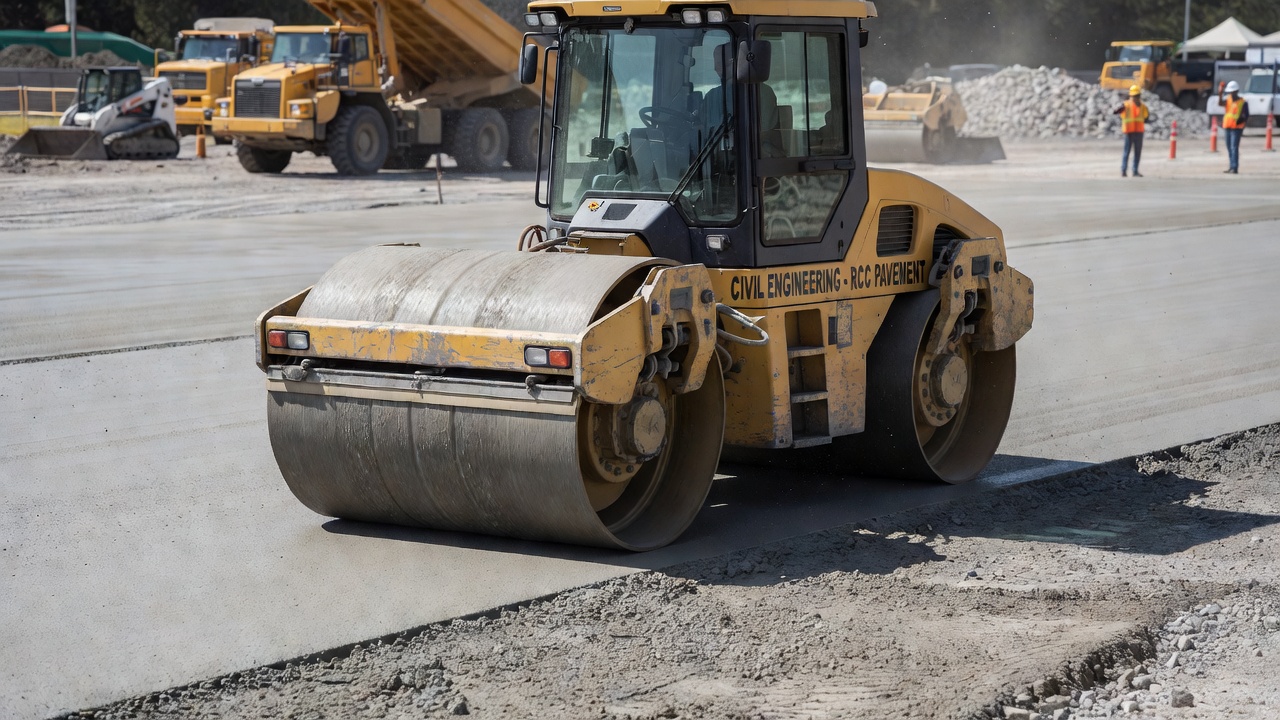
The time window between concrete discharge and final rolling is critical, it should not exceed 60 minutes under normal ambient conditions (70°F, 21°C). In hot, dry, or windy conditions, the allowable window may decrease to 30 to 45 minutes. The end of the allowable time window is defined as the moment when the concrete can no longer be compacted to target density without surface tearing. If the concrete stiffens beyond this point, it must be removed and replaced.
Pneumatic Roller Finishing
The final rolling stage uses a pneumatic-tired roller (rubber-tired roller) weighing 15 to 30 tons to seal the surface, close any remaining surface voids, and produce a smooth, tight finish. The pneumatic roller operates in static mode, typically making two to four passes at a speed of 3 to 5 mph (5 to 8 km/h). The kneading action of the rubber tires closes surface porosity and embeds any exposed aggregate particles, producing the characteristic dense, tight surface of well-constructed RCC. Tire pressure of 90 to 110 psi is typical.
Initial Density Monitoring
During construction, field density is monitored continuously using nuclear density gauges in direct transmission mode per ASTM D6938. Testing is performed immediately after each rolling pass to track density gain and determine the required number of passes. The optimum rolling pattern is established during the test section constructed at the start of the project, where the contractor demonstrates the combination of paver speed, roller type, roller passes, and vibration settings that consistently achieves target density.
Jointing
Transverse Contraction Joints
Transverse contraction joints are the most important joint type in RCC pavement. They are sawed or formed to control the location of cracking as the concrete shrinks during curing and thermal contraction. Joint spacing for RCC is typically 20 to 40 ft (6 to 12 m) for slab thicknesses up to 10 inches. For thicker slabs (10 to 14 inches), joint spacing may be extended to 40 to 60 ft (12 to 18 m), as thicker slabs develop lower tensile stresses from temperature and moisture gradients. The ratio of joint spacing to slab thickness (L/T) typically ranges from 24 to 48 for RCC, compared to approximately 20 for conventional pavement.
Saw cut timing is critical, cuts must be made after the concrete has gained sufficient strength to prevent raveling during sawing but before uncontrolled cracking develops. This timing is typically 4 to 24 hours after placement, depending on ambient temperature, concrete strength development, and lift thickness. In hot weather, sawing may begin as early as 4 hours, in cool weather, it may be delayed to 18 to 24 hours. Early-entry dry-cut saws with diamond blades are preferred for RCC, as they minimize water introduction that could cause surface deterioration. The saw cut depth should be a minimum of T/4 to T/3 of the slab thickness, with T/4 (25 percent) being the minimum recommended by the RCC Pavement Council to provide a controlled crack plane through the full slab depth.
Load transfer at transverse joints in RCC is achieved through aggregate interlock rather than dowel bars. The dense-graded angular aggregate in RCC provides excellent interlock, with load transfer efficiencies typically exceeding 70 percent for tight joints (crack widths less than 0.02 inches). As the joint opens with thermal contraction and drying shrinkage, load transfer efficiency decreases but remains adequate for most heavy-duty applications. No dowel bars are used in RCC pavement, which is a fundamental difference from conventional jointed concrete pavement.
Longitudinal Joints
Longitudinal joints in RCC are the construction joints between adjacent paving lanes. Two types exist:
Fresh longitudinal joints occur when the adjacent lane is placed within 60 minutes of the previous lane. In this case, the fresh joint can be rolled in tandem, the roller operates with one drum on the fresh concrete and the other on the adjacent lane, creating a monolithic bond between the two lanes. No joint preparation is required. Cold longitudinal joints occur when more than 60 minutes elapse between lanes. For cold joints, the edge of the first lane is trimmed back 6 to 12 inches to create a clean, vertical face. The trimmed face is cleaned and lightly moistened before the second lane is placed. Cold joints have very limited load transfer (less than 20 percent) and act as a weakened plane where longitudinal cracking can occur if the joint is not properly bonded.
UFGS 32 13 16.16 specifies that RCC pavement lane width should not exceed 20 ft (6 m). If the paving width is greater than 20 ft, intermediate longitudinal contraction joints should be provided at spacing not less than 10 ft.
Joint Sealing
Joint sealing in RCC is optional and depends on the application. For most industrial and heavy-duty applications, joints are left unsealed. For airport pavements, parking structures, and facilities where water infiltration must be minimized, joints may be sealed with a hot-poured or cold-applied sealant per ASTM D6690 or ASTM D5893. The sealant reservoir is formed by widening the saw cut to the specified dimensions, typically 0.5 inches wide by 1.0 inches deep for the sealant, with the lower portion of the cut serving as the crack inducer.
Surface Texture
The surface texture of RCC pavement is fundamentally different from conventional concrete pavement because RCC cannot be tined, broom-finished, or textured in the plastic state. The dry, stiff consistency prevents these operations. Surface texture options for RCC are limited to post-hardened treatments.
As-Rolled Surface
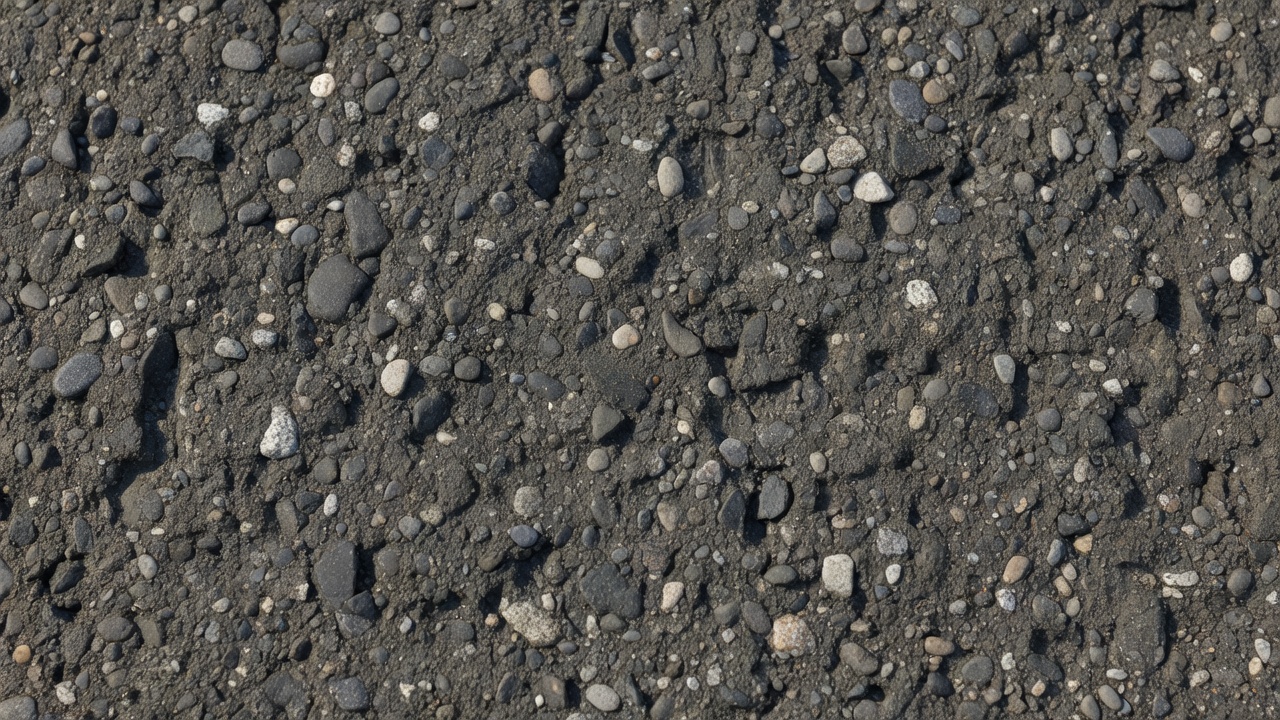
The as-rolled surface is the natural finish produced by the paver and roller compaction sequence. It is dense, tight, and smooth but has a mottled appearance with exposed fine aggregate particles. The surface exhibits a slight texture from the roller drums and tires. While adequate for low-speed industrial applications (20 to 30 mph), the as-rolled surface typically does not provide sufficient macrotexture for high-speed traffic or aircraft operations. The mean texture depth (MTD) of as-rolled RCC, measured by the sand patch test per ASTM E965, is typically 0.01 to 0.03 inches (0.2 to 0.8 mm), below the FAA minimum of 0.03 inches for runways and high-speed taxiways.
Diamond Grinding
Diamond grinding is the most reliable method for achieving a high-quality surface texture on RCC. Diamond-tipped grinding heads mounted on a self-propelled grinding machine cut longitudinal grooves 0.06 to 0.10 inches wide at a spacing of 0.20 to 0.25 inches, producing a corduroy-like texture with macrotexture depths of 0.03 to 0.06 inches (0.8 to 1.5 mm). Diamond grinding also improves ride quality by removing surface irregularities, typically reducing the International Roughness Index (IRI) from 100 to 150 inches/mile to 50 to 80 inches/mile. Diamond grinding is standard for RCC airport pavements and highway applications where surface friction and smoothness requirements are most demanding.
Diamond Grooving
Diamond grooving uses narrower, deeper cuts (0.10 to 0.20 inches wide by 0.25 to 0.50 inches deep) at closer spacing (0.50 to 0.75 inches) than diamond grinding. Grooving provides drainage channels that reduce hydroplaning risk and improve wet weather friction. For airport pavements, transverse grooving is common per FAA AC 150/5320-6C. For highways, longitudinal grooving improves directional stability and reduces noise.
Burlap Drag
Burlap drag is possible on RCC only when surface-active admixtures or retarding sprays are applied to the surface immediately after rolling. These admixtures delay the surface set, allowing a burlap drag to be performed 2 to 4 hours after placement. The resulting texture is similar to conventional concrete’s burlap finish but is shallower and less uniform. This technology is relatively recent (developed in the 2010s) and the long-term durability of the surface texture is still being evaluated.
Asphalt Overlay
A thin asphalt concrete overlay (HMA cap) of 1.5 to 3 inches (38 to 75 mm) can be placed over RCC to provide a smooth, friction-textured riding surface. This approach combines the structural strength of RCC with the surface characteristics of asphalt. It is used on some highway projects where the RCC provides the structural pavement and the asphalt provides the wearing course.
RCC Distresses
Transverse Cracking
Transverse cracking is the most common distress in RCC pavement, particularly when contraction joints are not provided. The cracking results from restrained shrinkage, as the concrete cools and dries after hydration, tensile stresses develop due to subgrade friction and the pavement’s own weight. Natural crack spacing in unjointed RCC ranges from 20 to 40 ft (6 to 12 m) for typical slab thicknesses of 8 to 12 inches. The cracks are generally tight (less than 1/16 inch or 1.5 mm wide) with good aggregate interlock providing load transfer efficiencies of 50 to 80 percent. Wider cracks (greater than 1/8 inch) can develop under severe thermal conditions or on subgrades with high friction, and these wider cracks may experience spalling, water infiltration, and pumping of subgrade fines.
Crack activity is highest during the first 90 days after construction, during which the concrete undergoes the majority of drying shrinkage and initial thermal contraction. After the first year, crack movement stabilizes at approximately ±0.01 to 0.03 inches per 10°F temperature change. For jointed RCC pavements, some intermediate cracking between sawed joints is not uncommon, particularly if the saw cut timing is delayed or the joint spacing is excessive.
Surface Wear
Surface wear (abrasion) occurs in RCC pavements exposed to tracked vehicles, steel-wheeled traffic, or snowplows. The surface paste (the thin layer of cement mortar at the surface) can erode, exposing fine aggregate particles that may become dislodged. Severe wear can lead to raveling, where the surface becomes rough and aggregate particles are lost. Surface wear is most pronounced when:
- The RCC was not compacted to target density in the upper lift
- The mix has insufficient fines passing the No. 200 sieve (less than 4 percent)
- Curing was inadequate, leaving the surface paste weak and poorly hydrated
- The pavement was opened to traffic before sufficient strength developed
Surface wear is measured in terms of depth of surface loss (typically 0.02 to 0.10 inches per year of heavy traffic) or by visual classification. Diamond grinding the surface removes the weak surface paste and exposes the dense internal matrix, significantly improving wear resistance.
Spalling
Spalling at joints and cracks is the chipping or breaking of concrete at the edges of the saw cut. Causes include:
- Saw cut timing errors, cutting too early causes raveling from the saw blade tearing the immature concrete, cutting too late allows uncontrolled cracking that bypasses the joint
- Inadequate saw cut depth, cuts shallower than T/4 may not induce a clean crack through the slab, resulting in random cracking that intersects the saw cut at an angle
- Freeze-thaw damage, water trapped in the saw cut reservoir freezes and exerts pressure against the joint faces, causing flaking and spalling
- Aggregate popouts, chert, pyrite, or other reactive aggregate particles near the joint edge expand and cause localized spalling
Spall severity is classified as low (loss of concrete within 2 inches of the joint, less than 1 inch deep), moderate (2 to 6 inches from the joint, 1 to 2 inches deep), or high (more than 6 inches from the joint, more than 2 inches deep). High-severity spalling at joints may require full-depth repair.
Longitudinal Cracking
Longitudinal cracking along construction joints indicates poor bond between adjacent paving lanes. It occurs when the time between adjacent lane placements exceeds 60 minutes and the cold joint preparation is inadequate, or when the transverse joint saw cuts do not align at the longitudinal joint. Longitudinal cracks are typically tight but can develop into wider cracks over time, particularly under traffic loading that causes differential deflection across the crack.
Pumping
Pumping is the ejection of water and fine-grained soil material from beneath the pavement through joints, cracks, or the pavement edge under the action of traffic loading. It occurs when:
- The subgrade or base is saturated
- Load transfer at joints or cracks is poor, causing high vertical deflections
- The base material is erodible (fine-grained soils, non-stabilized aggregates)
Pumping leads to void formation beneath the pavement (loss of support), which increases deflections and accelerates pavement deterioration. It is most common in RCC pavements on fine-grained subgrades without a stabilized base layer.
Inspection of RCC
Density Testing
In-place density testing is the primary acceptance test for RCC pavement. Nuclear density gauges(NDG) calibrated for RCC are used in direct transmission mode per ASTM D6938. The gauge measures wet density, dry density, and moisture content simultaneously through a probe inserted into a predrilled hole in the fresh concrete. Test frequency is typically one test per 500 square yards (420 m²) per lift, with a minimum of four tests per day’s production. Test locations should be randomly selected but distributed across the day’s placement.
The acceptance criterion is percent compaction relative to the maximum dry density (MDD) determined from the modified Proctor test (ASTM D1557). For most specifications:
- Target density: 96 to 98 percent of MDD (96% minimum for acceptance, 98% target for optimum performance)
- Pay adjustment: 100% of contract price for 96% compaction and above, 95% to 96% receives a pay deduction (typically 2 to 5 percent)
- Rejection threshold: Below 94% compaction requires removal and replacement or corrective action
Core density testing (ASTM C642) on extracted cores provides a secondary check on field density values. Cores are taken at a frequency of approximately one per 1,000 square yards, typically at 7 to 14 days after placement. The core density provides a direct measurement of the hardened concrete density, which should be 95 to 98 percent of MDD.
Thickness Verification
Pavement thickness is verified by core measurement and by taking depth measurements during construction. The specification tolerance is typically ±0.5 inches (12 mm) from the design thickness. Payment adjustment may apply for deficiencies. Areas where the measured thickness is less than 90 percent of the design thickness require corrective action, which may include removal and replacement or an overlay.
Surface Smoothness
Surface smoothness is evaluated using a 10-ft (3-m) straightedge placed parallel to the pavement centerline. The acceptable deviation is typically ±1/4 inch (6 mm) under the straightedge, with the deviation measured at the deepest point of the gap. For airport pavements, the tolerance may be tightened to ±1/8 inch (3 mm) per FAA standards. Areas exceeding the tolerance require diamond grinding or corrective action. For large projects, an inertial profiler may be used to measure the International Roughness Index (IRI), with target IRI values of 80 to 120 inches/mile (1.3 to 1.9 m/km) for industrial pavements and 40 to 70 inches/mile (0.6 to 1.1 m/km) for highways.
Joint Inspection
Joint inspection includes verification of:
- Saw cut timing: Cuts should be inspected for raveling, which indicates cutting too early
- Joint depth: Measured with a depth gauge, must be T/4 minimum
- Joint alignment: Lateral deviation should be less than 0.5 inches per 100 ft
- Joint width: For sealed joints, the reservoir dimensions must meet specifications
Visual Inspection
Visual inspection of the RCC surface documents:
- Surface wear, raveling, and aggregate loss
- Transverse and longitudinal cracking (location, width, length, orientation)
- Spalling at joints and cracks (severity classification)
- Surface segregation (areas where coarse aggregate is concentrated at the surface)
- Tearing or scabbing from the paver screed (surface defects caused by the paving process)
A complete distress survey is performed at 28 days and again at 1 year after construction to establish the baseline condition and monitor crack development.
RCC for Heavy-Duty and Airport Pavements
Design Considerations
RCC pavement design for heavy-duty applications follows the same principles as conventional rigid pavement design, modified for the specific material properties of RCC. The primary design inputs are:
- Flexural strength (modulus of rupture): 600 to 800 psi (4 to 6 MPa) at 28 days, typically verified by third-point loading per ASTM C78
- Subgrade reaction modulus (k-value): 100 to 300 pci (27 to 82 MN/m³), determined from plate load testing or CBR correlation
- Design period: Typically 20 to 40 years for heavy-duty and airport pavements
- Traffic loading: Expressed as equivalent single-axle loads (ESALs) for highways or as annual departures and maximum gross weight for airport pavements
For airport pavements, the FAA Advisory Circular 150/5320-6C methodology is used. The pavement is designed as a rigid pavement using the Westergaard edge-loading condition, with the flexural strength of the concrete and the k-value of the subgrade/subbase as inputs. The design procedure yields the required slab thickness for each aircraft type, and the critical aircraft (the one requiring the greatest thickness) governs the design. For the PDX airport project, the design aircraft was the Boeing 727 (gross weight 154,500 lb), yielding a 14-inch RCC section over 4 inches of aggregate base.
For military applications, design follows UFC 3-250-01FA. When transverse joints are provided, a 10 percent thickness reduction is allowed to account for estimated 25 percent load transfer at the joints. Without joints, a free-edge condition is assumed (0 percent load transfer), resulting in thicker sections.
Load Transfer Mechanisms
Load transfer in RCC pavements is provided entirely by aggregate interlock at joints and cracks. The dense-graded, angular aggregates used in RCC interlock mechanically when the joint or crack faces are in compression. Load transfer efficiency (LTE) is measured as the ratio of deflection on the unloaded side to deflection on the loaded side of the joint. For tight joints (less than 0.02 inches wide), LTE of 70 to 90 percent is typical. As the joint opens with temperature and moisture changes, LTE decreases to 50 to 70 percent. The FAA requirement for new rigid pavement joints is a minimum LTE of 75 percent. RCC does not use dowel bars, so LTE depends entirely on aggregate interlock.
Performance History
The first major airport RCC application, Portland International Airport (PDX), constructed in 1985, has performed well over its service life. The 14-inch RCC parking apron was designed for 700 psi flexural strength and has supported B747, DC-10, B767, and B727 aircraft without structural failure. Surface wear was noted in areas of heavy turning traffic, which was addressed through diamond grinding. The PDX project demonstrated that RCC can meet airport surface tolerance requirements (±0.03 ft elevation, ±1/4 inch per 10 ft straightedge) and provide the durability required for commercial aircraft loading.
Military applications include over 400,000 square yards at Fort Drum (1988), tank hardstands at Fort Hood, equipment shop facilities, and tank trails. The early military RCC pavements showed variable performance, with some projects experiencing surface wear and cracking. Improved construction technology, including high-density pavers, better quality control, and proper jointing, has significantly improved performance for projects constructed since 2000.
RCC vs Conventional PCC
RCC and conventional PCC pavement differ in material properties, construction methods, performance characteristics, and cost. The table below provides a comprehensive comparison:
| Property | RCC Pavement | Conventional PCC Pavement |
|---|---|---|
| Mix consistency | Zero-slump (Vebe 30-90 s) | Slump 1-4 in (25-100 mm) |
| Water-cement ratio | 0.30-0.45 | 0.40-0.55 |
| Cementitious content | 11-15% of dry weight (470-550 lb/cy) | 12-16% (470-600 lb/cy) |
| Aggregate gradation | Dense-graded, high fines | Gap-graded or dense-graded |
| Maximum aggregate size | 3/4 in (19 mm) typical | 1.5-2 in (38-50 mm) |
| Compaction method | Vibratory + pneumatic rollers | Internal vibration |
| Placement equipment | Asphalt paver (high-density) | Slipform paver |
| Steel reinforcement | None | Dowels, tie bars, mesh |
| Joint spacing | 20-40 ft | 15-20 ft |
| Load transfer | Aggregate interlock only | Dowel bars + aggregate interlock |
| Surface texture | As-rolled or diamond ground | Tined, broom, or grooved in plastic state |
| Air entrainment | Not effective | Required for freeze-thaw |
| Compressive strength (28d) | 4,000-8,000 psi | 3,500-6,000 psi |
| Flexural strength (28d) | 550-800 psi | 500-700 psi |
| Time to open to traffic | 24-48 hours | 7-14 days |
| Construction speed | 300-500 cy/hr | 100-200 cy/hr |
| Relative cost | 70-85% of PCC cost | Baseline |
| Smoothness (IRI) | 80-150 in/mi (as-rolled), 40-80 in/mi (ground) | 50-80 in/mi |
| Friction (BPN) | 50-60 (as-rolled), 60-75 (ground) | 55-75 |
| Field density acceptance | 96-98% of MDD | Does not apply |
| Core density acceptance | 95-98% of MDD | Does not apply |
When to Select RCC
RCC is preferred over conventional PCC when:
- Speed of construction is critical (large areas, short construction windows)
- Cost savings of 20 to 30 percent are achievable
- Steel reinforcement is not required for structural reasons
- The pavement will carry heavy, slow-moving, or stationary loads (aggregate interlock is adequate)
- Skilled concrete finishers are not available locally
- The project area is large enough (minimum 50,000 sq yd) to amortize specialized equipment mobilization
- A relatively short time window to opening to traffic (24 to 48 hours) is needed
When to Select Conventional PCC
Conventional PCC is preferred when:
- Surface smoothness and friction requirements are most stringent (runways, high-speed highways)
- Dowel bars are required for load transfer (heavy channelized traffic, weak subgrades)
- Steel reinforcement or continuously reinforced design is specified
- The pavement must be air-entrained for severe freeze-thaw environments
- Precise joint layout and sealing are required for aesthetic or functional reasons
- The project area is too small to justify RCC equipment mobilization
- Local contractors with RCC experience are not available
Standards and Guidance Documents
The following standards and guidance documents govern the design, construction, and evaluation of RCC pavements:
| Standard | Title | Applicability |
|---|---|---|
| ACI PRC-327-24 | Roller-Compacted Concrete Pavements, Guide | Comprehensive design and construction guidance |
| UFGS 32 13 16.16 | Roller Compacted Concrete (RCC) Pavement | U.S. military specifications |
| ASTM D1557 | Modified Proctor Compaction | Maximum dry density determination |
| ASTM C1176 | Making and Curing Test Specimens for RCC | Specimen fabrication for lab testing |
| ASTM C1435 | Molding RCC Cylinder Specimens Using Vibrating Hammer | Alternative specimen fabrication |
| ASTM D6938 | In-Place Density by Nuclear Gauge | Field density acceptance |
| ASTM C642 | Density, Absorption, and Voids in Hardened Concrete | Core density testing |
| ASTM C78 | Flexural Strength of Concrete (Third-Point Loading) | Design strength verification |
| FAA AC 150/5320-6C | Airport Pavement Design and Evaluation | Airport pavement design |
| UFC 3-250-01FA | Pavement Design for Roads, Streets, Walks, and Open Storage Areas | Military pavement design |
| ICAO Doc 9157 | Aerodrome Design Manual Part 3, Pavements | International airport pavement guidance |
Key Specifications and Quality Control Parameters
The following table summarizes the key quality control parameters for RCC pavement construction per UFGS 32 13 16.16 and ACI PRC-327-24:
| Parameter | Specification | Test Method | Frequency |
|---|---|---|---|
| Maximum dry density (MDD) | Establish per mix | ASTM D1557 | Per mix design |
| Optimum moisture content (OMC) | Establish per mix | ASTM D1557 | Per mix design |
| Field density | 96% minimum of MDD | ASTM D6938 (nuclear) | 1 per 500 sq yd |
| Core density | 95% minimum of MDD | ASTM C642 | 1 per 1,000 sq yd |
| Compressive strength (28d) | 4,000 psi minimum | ASTM C39 (from cores or cylinders) | 3 per 5,000 sq yd |
| Flexural strength (28d) | As designed (typically 550-800 psi) | ASTM C78 | Per project spec |
| Vebe consistency | 30-90 seconds | ASTM C1176 | 1 per 50 cy |
| Slab thickness | ±0.5 in of design | Core measurement | At each core location |
| Surface smoothness | ±1/4 in per 10 ft straightedge | Straightedge | 1 per 500 ft lane |
| Joint depth | T/4 minimum | Depth gauge | 1 per 10 joints |
| Joint spacing | Per design | Tape measure | Every joint |
| Curing compound coverage | Per manufacturer spec | Wet film gauge | Per batch |
Summary
Roller-Compacted Concrete pavement is a mature, cost-effective pavement technology that combines the structural performance of concrete with the construction speed of asphalt. Its zero-slump mix, placed with high-density asphalt pavers and compacted with vibratory rollers, produces a dense, high-strength pavement at 15 to 30 percent lower cost than conventional concrete. RCC has been successfully used for airports, military facilities, ports, industrial yards, and highways for over 40 years. The key to successful RCC construction is achieving target density (96 to 98 percent of maximum dry density) through proper mix design, equipment selection, and rolling procedures. While RCC has limitations, primarily in surface texture, jointing control, and the inability to incorporate steel reinforcement, it remains the pavement of choice for large-area, heavy-duty applications where economy and speed of construction are paramount.
Frequently Asked Questions
- What is Roller-Compacted Concrete (RCC) pavement?
- Roller-Compacted Concrete (RCC) pavement is a type of concrete pavement constructed using a zero-slump concrete mix that is placed with asphalt-type paving equipment and compacted to final density using vibratory rollers. It contains the same basic ingredients as conventional concrete, aggregates, portland cement, supplementary cementitious materials, and water, but with much lower water content, making it a stiff, no-slump material that can support compaction equipment immediately after placement. Unlike conventional PCC pavement, RCC requires no steel reinforcement, no dowel bars, no forms, no hand finishing, and no internal vibration. The finished product is a dense, high-strength concrete pavement that can be opened to traffic rapidly. RCC was first developed in the 1970s for the Canadian logging industry and has since expanded to airports, ports, military facilities, highways, and industrial applications worldwide.
- How does RCC differ from conventional concrete pavement?
- RCC differs from conventional PCC pavement in several fundamental aspects. First, the mix is a zero-slump concrete with Vebe consistency typically between 30 and 90 seconds, compared to the 1 to 4 inch slump of conventional paving concrete. Second, RCC is placed with asphalt paving equipment (high-density pavers with tamping bars) rather than slipform pavers, and is compacted using vibratory and pneumatic rollers rather than internal vibrators. Third, RCC contains no steel reinforcement, no dowel bars, and no tie bars. Fourth, RCC joints are typically sawed at wider spacing of 20 to 40 ft (6 to 12 m) compared to 15 to 20 ft for conventional pavement. Fifth, the surface texture of RCC is different, it cannot be tined or broom-finished in the plastic state, instead, surface texture is achieved through diamond grinding or grooving after hardening. Sixth, RCC does not use air-entrainment effectively and relies on its dense matrix for freeze-thaw durability. Seventh, RCC can typically be opened to traffic within 24 to 48 hours of placement due to its rapid strength gain. Finally, RCC typically costs 15 to 30 percent less than conventional concrete pavement due to the elimination of reinforcement, forms, finishing labor, and the use of faster construction methods.
- What are the main applications of RCC pavement?
- RCC pavement is used wherever strength, speed of construction, durability, and economy are primary needs. Major applications include: port, rail intermodal, and military facilities, distribution centers, parking areas, and storage facilities, streets, highways, intersections, shoulders, turn lanes, and bike paths, manufacturing facilities, heavy haul roads, and scrap yards, power plants and other industrial facilities, airfield pavements including parking aprons, taxiways, and maintenance areas, log sorting yards and forest haul roads, and over-topping protection for dams, embankment dam raises, and reservoir liners. RCC is particularly well-suited for heavy-duty applications where conventional asphalt would rut or shove under loading and where the cost of conventional reinforced concrete pavement is prohibitive. The first commercial airport application of RCC in the United States was at Portland International Airport (PDX) in 1985, where an 8-acre aircraft parking apron was constructed using RCC at a cost 32 percent lower than the asphalt concrete alternative.
- What is Vebe consistency and why is it important for RCC?
- Vebe consistency is a measure of the workability of zero-slump concrete used for RCC. It is determined using a Vebe consistometer apparatus, which consists of a cylindrical mold mounted on a vibrating table with a transparent disc that applies a standard surcharge. The Vebe time is the duration in seconds required for the concrete to be fully consolidated under a combination of surcharge weight and external vibration. For RCC pavement mixtures, Vebe times typically range from 30 to 90 seconds. Shorter Vebe times (30 to 45 seconds) indicate wetter, more workable mixes that compact more easily but may not support the paver and roller equipment. Longer Vebe times (60 to 90 seconds) indicate drier mixes that can support equipment immediately but require more compactive effort to achieve target density. The target Vebe time is selected based on the type of paving equipment, lift thickness, and ambient conditions. The Vebe test is standardized under ASTM C1176 and is critical for quality control during RCC production.
- How is RCC pavement inspected and what are the acceptance criteria?
- RCC pavement inspection focuses on three primary acceptance criteria: density, thickness, and surface smoothness. Density is measured using nuclear density gauges calibrated for RCC, with target compaction typically 96 to 98 percent of the maximum dry density determined from the moisture-density relationship (modified Proctor, ASTM D1557). In-place density is measured immediately after compaction, with testing at a frequency of at least one test per 500 square yards. Thickness is verified through core extraction, with cores also used to check bond between lifts. Surface smoothness is evaluated using a 10-ft (3-m) straightedge, with acceptable deviations typically limited to ±1/4 inch. Additional inspection items include checking joint alignment and depth, verifying saw cut timing (typically within 4 to 24 hours after placement), monitoring curing compound application at the specified coverage rate, and visual assessment of surface wear and segregation. Transverse cracking is monitored during the first 28 days, with crack widths measured and mapped. The test section constructed before main paving must demonstrate that the contractor can achieve all acceptance criteria consistently.
- What are the common distresses in RCC pavement?
- Common distresses in RCC pavement include transverse cracking, surface wear, spalling at joints and cracks, longitudinal cracking along construction joints, and raveling or surface disintegration. Transverse cracking is the most prevalent distress in RCC pavements that do not have sawed contraction joints, with natural crack spacing typically ranging from 20 to 40 ft (6 to 12 m). These cracks develop as the concrete shrinks during curing and are influenced by slab thickness, subgrade restraint, and the thermal coefficient of the concrete. While the cracks are generally tight (less than 1/16 inch wide) with good aggregate interlock providing load transfer, wider cracks can lead to water infiltration, pumping, and loss of support. Surface wear occurs in RCC pavements exposed to tracked or steel-wheeled vehicles, particularly where the surface has not been diamond ground to expose a dense wear-resistant matrix. Spalling at joints results from improper saw cut timing (cut too early or too late), inadequate joint depth, or freeze-thaw action in the joint reservoir. Longitudinal cracking between adjacent paving lanes indicates poor bond at the cold joint. Raveling occurs when the surface paste wears away, exposing and dislodging fine aggregate particles, typically due to insufficient fines, inadequate compaction near the surface, or curing deficiencies.
- Can RCC be used for airfield pavements?
- Yes, RCC has been successfully used for airfield pavements, primarily for aircraft parking aprons, taxiways, and maintenance areas. The first commercial airport application in the United States was at Portland International Airport (PDX) in 1985, which involved an 8-acre aircraft parking apron designed for Boeing 727, 747, DC-10, and other commercial aircraft. The RCC section was 14 inches thick, placed over 4 inches of aggregate base. The Federal Aviation Administration (FAA) methodology per Advisory Circular 150/5320-6C was used for thickness design, assuming a flexural strength of 700 psi. The project demonstrated that RCC can achieve FAA-required surface tolerances and provide long-term durability under aircraft loading. ICAO Aerodrome Design Manual Part 3 (Doc 9157) provides guidance on rigid pavement design that is applicable to RCC. However, RCC is typically not recommended for runways or high-speed taxiways where surface friction and smoothness requirements are most stringent, unless the surface is diamond ground to provide adequate macrotexture. For airport applications, surface friction testing per ASTM E303 (British Pendulum Number) or ASTM E1911 (Dynamic Friction Tester) should be performed on the finished surface.
- How are joints constructed in RCC pavement?
- Joints in RCC pavement are typically sawed after the concrete has hardened sufficiently to prevent raveling but before uncontrolled cracking occurs, usually within 4 to 24 hours after placement. Transverse contraction joints are sawed at spacing of 20 to 40 ft (6 to 12 m) for slabs up to 10 inches thick, and at wider spacing for thicker slabs. Joint depth is typically one-quarter to one-third of the slab thickness. A minimum depth of T/4 for the saw cut is recommended by the RCC Pavement Council. When joints are not sawed, the pavement will crack naturally at random spacing. Load transfer at sawed joints and natural cracks relies on aggregate interlock rather than dowel bars, which are not used in RCC. This is adequate for most heavy-duty applications because the dense gradation of the RCC mix provides excellent interlock. Longitudinal joints are formed by the construction joints between adjacent paving lanes. For fresh longitudinal joints (placed within 60 minutes), the joint can be rolled in tandem with the adjacent lane to create a monolithic bond. For cold longitudinal joints, the edge of the first lane is trimmed back 6 to 12 inches to create a vertical face. Joint sealant may be applied to sawed joints in areas where water infiltration is a concern, though many RCC pavements are left unsealed.
- What are the typical mix proportions for RCC pavement?
- Typical RCC mix proportions follow the soil compaction method of proportioning. Cementitious materials constitute 11 to 15 percent of the total dry weight of materials (cement plus aggregate), with 12 to 14 percent being most common for wearing course applications. Supplementary cementitious materials such as fly ash (Class C or F) or slag cement can replace 15 to 30 percent of the portland cement. Optimum moisture content typically falls between 5 and 8 percent by total dry weight, with the exact value determined from moisture-density relationship testing. Water-to-cementitious materials ratio (w/cm) is not directly controlled in RCC as in conventional concrete, instead, water content is set to achieve the target Vebe consistency. The w/cm typically falls in the range of 0.30 to 0.45 by mass. The aggregate is dense-graded with a nominal maximum aggregate size of 3/4 inch (19 mm) or 5/8 inch (16 mm). A typical gradation follows the 0.45 Power Curve for maximum density, with approximately 35 to 45 percent passing the No. 4 sieve and 4 to 8 percent passing the No. 200 sieve. For the PDX airport project, the final mix proportions per cubic yard were: Type I cement 488 lb, Class F pozzolan 119 lb, water 260 lb, and aggregate 3,250 lb, yielding a flexural strength of 710 psi at 28 days.
- What compaction equipment is used for RCC pavement?
- RCC compaction is achieved through a three-stage rolling process using specialized equipment. The primary compaction equipment is the high-density asphalt paver, which provides initial compaction of 90 to 92 percent of maximum density as it extrudes the RCC through tamping bars and a vibrating screed. The secondary compaction stage uses steel drum vibratory rollers with a minimum static weight of 10 tons (90 kN). These rollers operate in vibratory mode at frequencies of 2,500 to 3,500 vibrations per minute (vpm), making multiple passes until target density of 96 to 98 percent is achieved. A typical rolling pattern consists of two to four vibratory passes followed by two to three static passes. The final stage uses pneumatic-tired rollers (rubber-tired rollers weighing 15 to 30 tons) to seal the surface, close any remaining surface voids, and produce a smooth, tight finish. The pneumatic roller operates in static mode, typically making two to four passes. For dual-lift construction (total thickness greater than 8 to 10 inches), a material transfer device is recommended between the paver and the dump trucks to prevent segregation and ensure uniform feed for the second lift. The time window between concrete placement and final rolling is critical, it should not exceed 60 minutes under normal conditions to ensure adequate compaction before initial set.
- What are the cost advantages of RCC compared to conventional concrete pavement?
- RCC pavement typically costs 15 to 30 percent less than conventional jointed reinforced concrete pavement (JRCP) for equivalent structural capacity. The cost savings come from several factors: elimination of steel reinforcement and dowel bars (saving $2 to $5 per square yard), elimination of forms and form-setting labor (saving $1 to $3 per square yard), faster construction speeds allowing 300 to 500 cubic yards per hour production rate, reducing contractor overhead and equipment mobilization costs, reduced finishing labor since no hand finishing, floating, or brooming is required, elimination of internal vibration equipment and labor, earlier opening to traffic (24 to 48 hours versus 7 to 14 days for conventional PCC), and the ability to use locally available aggregates without requiring specialized concrete aggregate gradations. For the Portland International Airport project, the lowest RCC bid was 32 percent below the lowest asphalt concrete alternative. On military projects, RCC has been found to save 20 to 35 percent compared to conventional concrete pavement. Cost-effectiveness is maximized for large-area projects (greater than 50,000 square yards) where mobilization of specialized RCC equipment can be amortized. Smaller projects may not achieve the same level of savings.
- What surface texture options are available for RCC pavement?
- RCC pavement surface texture options are more limited than conventional PCC because the material cannot be tined, broom-finished, or textured in the plastic state. The primary surface texture options for RCC include: as-rolled finish (the natural surface produced by vibratory and pneumatic rollers, which is dense and smooth but may not provide adequate macrotexture for high-speed traffic), diamond grinding (the most common method for improving ride quality and surface friction, using diamond-tipped grinding heads to create a uniform, grooved surface texture with controlled macrotexture depths of 0.03 to 0.06 inches), diamond grooving (transverse or longitudinal grooves cut into hardened RCC to improve drainage and skid resistance), burlap drag (possible only when surface-active admixtures are used to retard surface drying, allowing limited surface texturing in the plastic state), and thin asphalt concrete overlay (asphalt cap placed over RCC to provide a smooth, friction-textured riding surface). For airport pavements where surface friction requirements are most stringent, diamond grinding is recommended to achieve FAA-specified macrotexture depths (minimum 0.03 inches per ICAO Annex 14). The British Pendulum Number (BPN) for diamond-ground RCC typically exceeds 60, meeting the minimum standard for aircraft operations.
- What are the limitations of RCC pavement?
- RCC pavement has several important limitations that must be considered during selection. First, the surface finish is not comparable to conventional concrete, the as-rolled surface is rough-textured with visible aggregate, and achieving FAA-class smoothness (1/8 inch per 16 ft for airfield pavements) requires diamond grinding. Second, the surface friction properties of as-rolled RCC are lower than tined or broom-finished conventional PCC, often requiring diamond grinding for high-speed applications. Third, air-entrainment is not effective in RCC due to the dry mix, freeze-thaw durability relies on the dense matrix and low permeability rather than an intentionally entrained air-void system. Fourth, transverse cracking will occur if contraction joints are not sawed, and even with sawed joints, some intermediate cracking may develop. Fifth, load transfer at joints relies entirely on aggregate interlock, no dowel bars are used, which may limit performance under very heavy channelized traffic or on weak subgrades. Sixth, RCC cannot be patched or repaired as easily as conventional concrete, small-area repairs are difficult due to the specialized compaction equipment required. Seventh, the construction process requires continuous, high-production operation, stop-and-go placement leads to cold joints and poor ride quality. Eighth, the availability of experienced contractors and high-density paving equipment is more limited than for either asphalt or conventional concrete paving. Finally, RCC is not suitable for projects requiring steel reinforcement, such as continuously reinforced concrete pavement (CRCP).
- How is density testing performed for RCC pavement?
- Density testing for RCC pavement is performed using two complementary methods. Field density is measured using nuclear density gauges calibrated for RCC in direct transmission mode. The gauge measures wet density, dry density, and moisture content simultaneously. Testing is performed immediately after rolling is complete, with the test frequency typically specified as one test per 500 square yards (420 square meters) per lift, with a minimum of four tests per day's production. The field dry density is compared to the maximum dry density determined from the moisture-density relationship (modified Proctor compaction, ASTM D1557) to calculate percent compaction. Target density for acceptance is typically 96 to 98 percent of maximum dry density. The second method is core extraction, 4-inch or 6-inch diameter cores are extracted from the hardened pavement at a frequency of approximately one core per 1,000 square yards. Cores provide direct measurement of in-place density (by ASTM C642), thickness, bond quality between lifts, and compressive or flexural strength. Cores also allow visual assessment of segregation, compaction uniformity, and surface wear resistance. For acceptance, a payment deduction is typically applied if the average density falls below 96 percent, and the pavement may be rejected if density falls below 94 percent. The test section constructed at the start of the project establishes the rolling pattern and demonstrates that target density can be consistently achieved.
- What is the role of supplementary cementitious materials in RCC?
- Supplementary cementitious materials (SCMs) play an important role in RCC mix design, particularly for improving long-term strength, durability, and economy. Fly ash (Class F or Class C) is the most commonly used SCM in RCC, typically replacing 15 to 30 percent of the portland cement by weight. Ground granulated blast furnace slag (GGBFS) is also used at replacement rates of 25 to 50 percent. Silica fume is less common due to the water demand of the dry RCC mix but can be used at 5 to 10 percent for high-strength applications. SCMs in RCC provide several benefits: they improve workability of the dry mix (particularly fly ash with its spherical particle shape), they reduce the heat of hydration, which is beneficial for thick lifts and mass RCC placements, they contribute to long-term strength gain through pozzolanic reaction, with strength increases of 20 to 40 percent between 28 and 90 days, they refine the pore structure, reducing permeability and improving freeze-thaw resistance, they reduce the cost of the mix since SCMs are generally less expensive than portland cement, and they reduce the carbon footprint of the pavement. For the Portland International Airport RCC project, Class F pozzolan was used at a replacement rate of approximately 20 percent, which was preferred over Class C due to its more uniform chemical composition. The RCC Pavement Council recommends that SCM use should be evaluated through trial batching and testing, as the optimum replacement rate depends on local material availability, strength requirements, and environmental conditions.
- What is the history and development of RCC pavement?
- Roller-Compacted Concrete pavement was first developed in the 1970s for the Canadian logging industry, which needed low-cost, high-strength pavements for large log-sorting yards that could withstand tracked vehicles, massive loads, and hydraulic fluid spills. These early applications demonstrated that RCC could be placed rapidly using asphalt paving equipment and achieve the strength necessary for heavy industrial loading. The technology spread to the United States in the early 1980s, with early applications at forest haul roads, port facilities, and log yards in the Pacific Northwest. A landmark project occurred in 1985 at Portland International Airport (PDX), where an 8-acre aircraft parking apron became the first commercial airport application of RCC in the United States. The project demonstrated that RCC could meet FAA surface tolerances and provide long-term durability under jet aircraft loading. In 1988, over 400,000 square yards of RCC pavement was constructed for the hardstand facility at Fort Drum, New York, marking one of the first major military applications. The U.S. Army Corps of Engineers developed UFGS 32 13 16.16, the unified facilities guide specification for RCC pavement, which remains the standard for military RCC projects. Throughout the 1990s and 2000s, RCC expanded into municipal streets, highway shoulders, intermodal terminals, and industrial facilities. The RCC Pavement Council was established to promote the technology and develop industry standards. ACI Committee 327 published the first comprehensive guide to RCC pavements (ACI 327R-14), updated in 2024 as ACI PRC-327-24. Today, RCC is recognized as a mature pavement technology worldwide, with applications in over 30 countries.
- How does RCC achieve freeze-thaw durability without air entrainment?
- RCC achieves freeze-thaw durability primarily through its dense matrix and very low permeability, rather than through an intentionally entrained air-void system as required for conventional concrete. While air-entraining admixtures are not effective in dry RCC mixes (Vebe times less than 60 seconds prevent proper air bubble formation), the hardened RCC has a void content typically below 4 to 5 percent due to the high compactive effort applied during construction. The low water-to-cementitious materials ratio (0.30 to 0.45) combined with dense aggregate gradation produces a pore structure with limited capillary porosity and very low connectivity. This low permeability restricts water ingress, which is the primary requirement for freeze-thaw resistance. Research by the Portland Cement Association and the U.S. Army Corps of Engineers has shown that well-compacted RCC (above 96 percent of maximum dry density) can achieve acceptable freeze-thaw durability in most North American climates. For severe freeze-thaw environments (more than 100 freeze-thaw cycles per year), some specifications require testing of RCC mixtures by ASTM C666 (rapid freezing and thawing) with a minimum durability factor of 80 percent after 300 cycles. When RCC does not meet this criterion, mitigation measures include using higher cementitious content, lower water content, or applying a diamond-ground surface to expose the dense internal matrix. The RCC Pavement Council notes that many RCC pavements constructed since the 1980s in cold climates continue to perform well without air entrainment.
- What is the role of the high-density paver in RCC construction?
- The high-density asphalt paver is the most critical piece of equipment for successful RCC construction. Unlike conventional asphalt pavers, high-density pavers are equipped with tamping bars, vibratory screeds, and heavier construction that provide significant pre-compaction to the RCC as it is extruded. The tamping bars operate at frequencies of 800 to 2,000 strokes per minute, impacting the concrete and forcing aggregate particles into a denser configuration. The vibratory screed (typically 2,000 to 3,500 vpm) further consolidates the material and levels the surface. Together, these systems achieve a discharge density of 90 to 92 percent of maximum dry density, meaning the paver accomplishes the majority of the compaction work. The remaining 4 to 8 percent density gain is achieved by the vibratory and pneumatic rollers. High-density pavers are typically track-mounted to provide stable traction on the RCC surface and to handle the higher torque requirements of placing the stiff material. They are capable of placing RCC in lifts of 4 to 10 inches (100 to 250 mm) thick at widths up to 30 feet (9 m) and at production rates of 300 to 500 cubic yards per hour. Key paver features include: automatic grade control using stringline or laser systems for surface tolerance control, a proportional feed system to ensure uniform concrete distribution across the full paving width, and quick-adjust screed extensions to accommodate varying lane widths. The use of a conventional asphalt paver (without tamping bars) is not recommended for RCC lifts over 6 inches, as the lower pre-compaction results in excessive rolling effort, surface tearing, and poor ride quality.
- How is RCC pavement designed for structural capacity?
- RCC pavement thickness design follows the same fundamental principles as conventional rigid pavement design, using the flexural strength (modulus of rupture) of the concrete as the primary structural input. For highway applications, the American Association of State Highway and Transportation Officials (AASHTO) Guide for Design of Pavement Structures is used, with modifications for RCC that account for the absence of dowel bars and the reliance on aggregate interlock for load transfer. For military applications, thickness is determined per UFC 3-250-01FA (Pavement Design for Roads, Streets, Walks, and Open Storage Areas), with a 10 percent thickness reduction allowed when transverse joints at 30 to 40 ft spacing are provided. For airport applications, FAA Advisory Circular 150/5320-6C (Airport Pavement Design and Evaluation) is used, with the RCC designed as a rigid pavement using the concrete flexural strength and the subgrade reaction modulus (k-value). The Portland Cement Association (PCA) has also developed thickness design procedures specifically for RCC pavements, which typically result in thicknesses 10 to 15 percent greater than conventional jointed concrete pavement designs to account for the higher material variability and lower load transfer efficiency at longitudinal construction joints. Typical design flexural strengths for RCC range from 550 to 800 psi (4 to 6 MPa) at 28 days, with compressive strengths of 4,000 to 8,000 psi (28 to 55 MPa). For the PDX airport project, the RCC pavement was designed for a flexural strength of 700 psi using FAA methodology, resulting in a section thickness of 14 inches over 4 inches of recycled aggregate base, supporting aircraft including the B747, DC-10, and B727 over a 20-year design life.