What is Routing and Sealing?
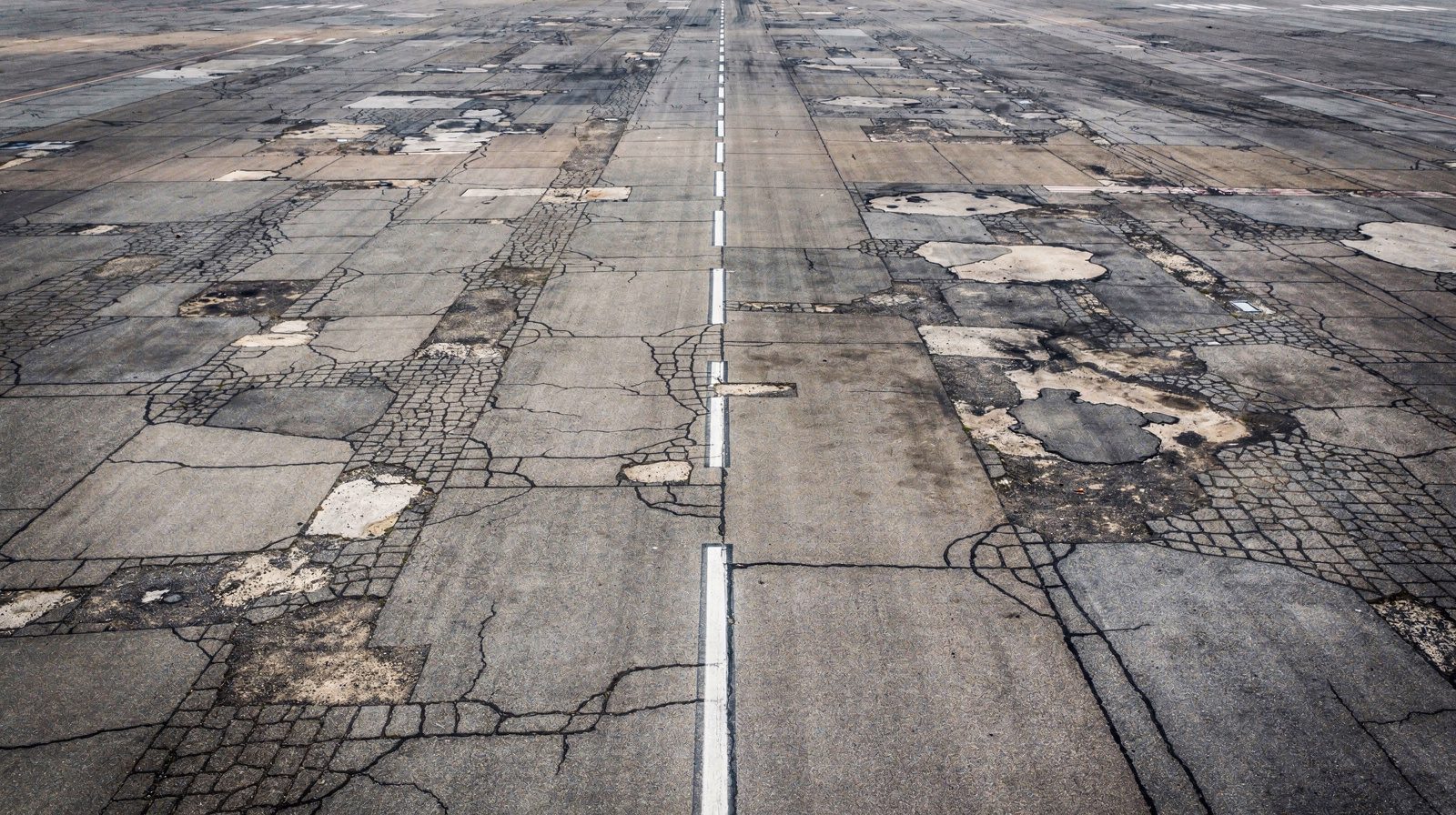
Routing and sealing is a precise crack treatment method classified as a preventive maintenance activity for both flexible and rigid pavements. The process involves mechanically cutting a portion of the pavement on either side and immediately above the crack to create a uniform rectangular reservoir, cleaning and drying that reservoir to bare adhesion surfaces, and then filling it with a hot-applied thermoplastic sealant material. This method, also known as crack sealing or rout-and-seal, is distinguished from crack filling by the presence of the routed reservoir and by its application to working cracks, those that experience significant seasonal horizontal movement due to thermal expansion and contraction of the pavement.
The primary purpose of routing and sealing is to prevent surface water from infiltrating into the pavement structure through existing cracks. Water intrusion is the single most destructive agent affecting pavement durability, causing weakening of the base and subgrade materials in flexible pavements and pumping, erosion, and loss of support in rigid pavements. In freeze-thaw climates, trapped water freezes and expands, accelerating crack deterioration. Routing creates a controlled geometry that allows the sealant to function as a flexible plug, deforming elastically to accommodate crack opening in winter and returning to shape when the crack closes in summer without rupturing or losing bond to the pavement walls. The Strategic Highway Research Program (SHRP) and the Federal Highway Administration (FHWA) have established routing and sealing as the standard treatment for working cracks through the Manual of Practice (FHWA-RD-99-147), which remains the authoritative guidance document for the industry.
Purpose of Routing the Reservoir
The routed reservoir serves four distinct engineering functions. First, it provides a uniform, clean surface for the sealant to bond to. Unrouted cracks have irregular, often contaminated sidewalls from traffic abrasion, oxidation, and debris infiltration. Cutting a fresh reservoir exposes clean aggregate and binder surfaces that form a strong adhesive bond with the molten sealant. Second, the reservoir accommodates crack movement through the volume and geometry of the sealant plug. The sealant stretches as the crack opens and compresses as it closes, the reservoir dimensions are engineered so the sealant never exceeds its maximum elongation capacity. Third, the reservoir creates a mechanical interlock between the sealant and the pavement. The rectangular cross-section with vertical walls provides resistance to pullout forces from traffic. Fourth, routing removes deteriorated crack edges, including minor spalling, oxidation, and the uppermost layer of aged asphalt or concrete that would otherwise prevent sealant adhesion.
The decision to route a crack rather than simply fill it depends on crack classification. Working cracks, defined by the FHWA and the Illinois Center for Transportation (ICT) as cracks with annual horizontal movement exceeding 0.1 inches (2.5 mm), require routing. Typical working cracks include transverse thermal cracks, reflective cracks from underlying PCC slabs, and longitudinal cold joints. Non-working cracks, with annual movement of 0.1 inches or less, may be candidates for crack filling without routing. Research by Smith and Romine (1999) demonstrated that routing improves sealant performance by approximately 40% compared to filling without routing, justifying the additional cost of the routing operation.
Reservoir Geometry
Reservoir geometry is the single most critical design parameter in routing and sealing. The geometry is defined by three dimensions: width, depth, and the shape factor (the ratio of width to depth). The FHWA Manual of Practice and the ICT Validation Study (ICT-17-008) both specify that the standard reservoir for asphalt pavement cracks shall be 19 mm × 19 mm (3/4 inch × 3/4 inch), producing a shape factor of 1.0.
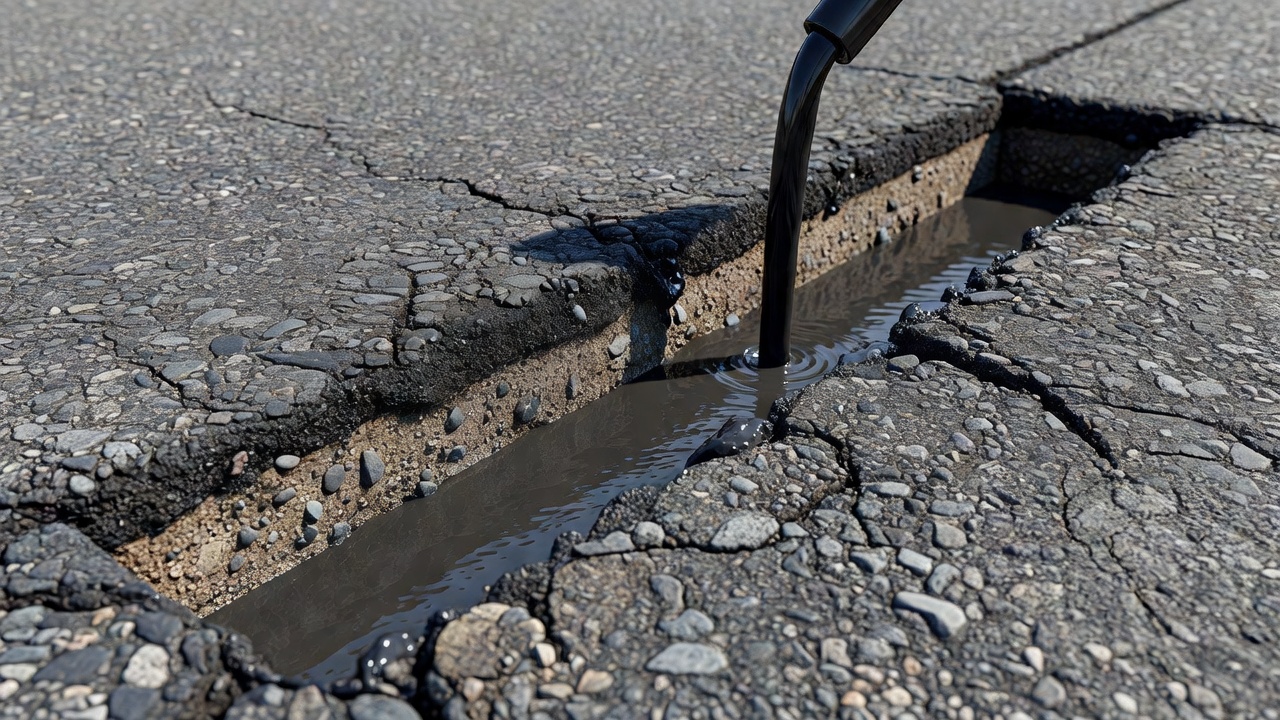
Shape factor is the engineering parameter that governs sealant strain during crack movement. When the crack opens, the sealant must stretch across the additional gap width. A reservoir with a width-to-depth ratio of 1:1 means the sealant plug is as thick as it is wide, distributing the tensile strain across a larger cross-section and reducing the stress at the bond interface. Research by Wang and Weisgerber (1993), Khuri and Tons (1992), and Chong and Phang (1988) all concluded that shape factors equal to or greater than 1.0 produce significantly better sealant performance than narrower, deeper routs. Shape factors below 1.0 concentrate strain at the bottom of the sealant plug, leading to premature adhesive failure at the sealant-pavement interface.
The table below summarizes recommended reservoir dimensions from authoritative sources:
| Parameter | Standard Value | Range | Application |
|---|---|---|---|
| Reservoir Width | 19 mm (3/4 inch) | 13–25 mm | Asphalt concrete, standard |
| Reservoir Depth | 19 mm (3/4 inch) | 13–25 mm | Asphalt concrete, standard |
| Shape Factor (W/D) | 1.0 | 1.0–1.5 | Must be ≥ 1.0 |
| Reservoir Width (Concrete) | 13–19 mm | 10–19 mm | PCC pavement cracks |
| Reservoir Depth (Concrete) | 13–19 mm | 10–19 mm | PCC pavement cracks |
| Maximum Crack Width | 19 mm | Up to 25 mm | Wider cracks need mastic |
Reservoir dimensions must be verified in the field using a Go/No-Go gauge, a precisely machined aluminum block matching the specified width and depth dimensions. The inspector inserts the block into the routed reservoir at regular intervals along the crack. If the block does not fit (too narrow or shallow), the router operator must adjust blade spacing or cutting depth. The ICT guidelines recommend trial cuts before beginning production routing, and periodic checks throughout the workday to account for blade wear.
Routing Equipment
Two primary types of equipment are used for crack routing: rotary impact routers with carbide-tipped bits and diamond-blade saws. Both are capable of producing the required rectangular reservoir cross-section, but they differ in application suitability, production rate, and operational characteristics.
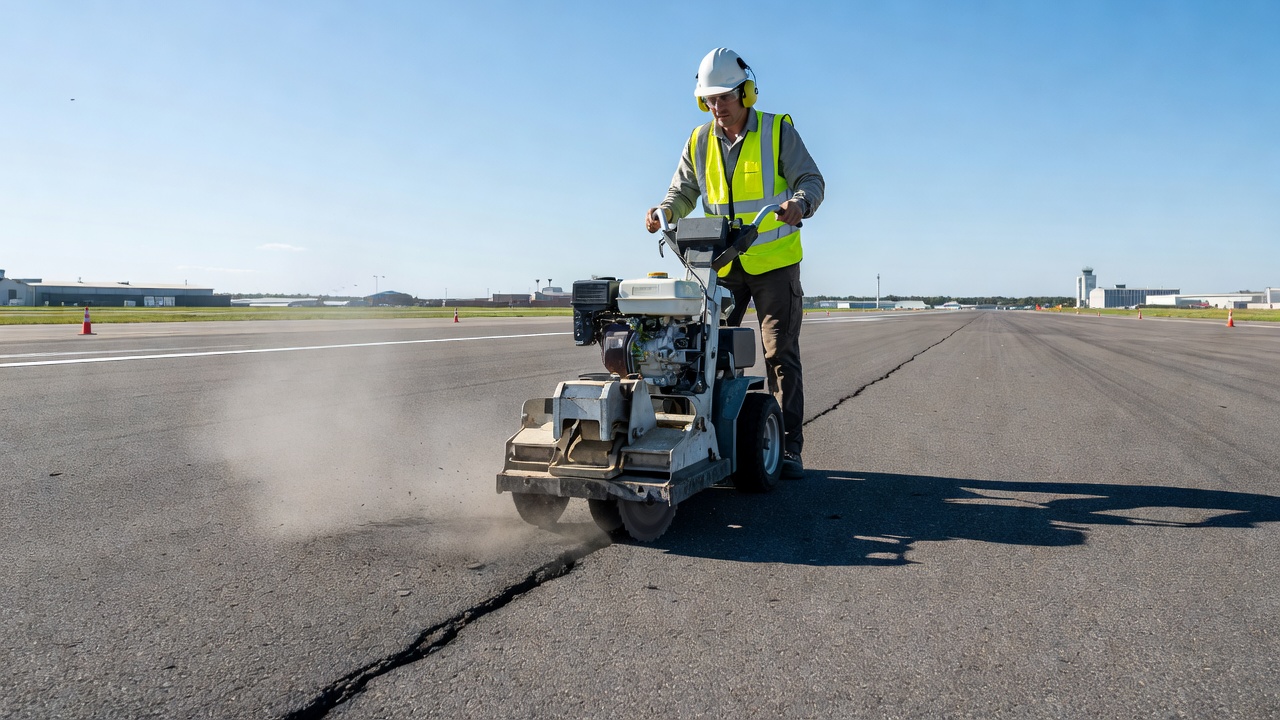
Rotary impact routers are the most common equipment for asphalt pavement crack routing. These machines use a rotating drum or spindle fitted with multiple carbide-tipped cutting bits that impact and chip away the pavement material. The router typically has adjustable blade spacing to vary the cutting width and adjustable depth control to maintain consistent reservoir depth. Crafco, Marathon Equipment, and SealMaster are among the major manufacturers of pavement routers. The rotary impact router works by cutting two parallel slots the width of the desired reservoir and then breaking out the material between them, leaving a clean rectangular channel. The carbide bits wear over time and must be replaced when the reservoir begins to develop a rounded or V-shaped cross-section. Typical production rates for rotary impact routers range from 500 to 1,500 linear feet (150 to 450 meters) per day, depending on crack spacing, pavement hardness, and crew experience.
Diamond-blade saws use a circular diamond-impregnated blade to cut the reservoir in one or two passes. For a standard 19 mm wide reservoir, a single wide blade or two closely spaced blades are used. Diamond saws produce the cleanest, most precise reservoir geometry with minimal spalling of the pavement edges. They are particularly preferred for portland cement concrete pavements, where the hard aggregate and cementitious matrix cause rapid wear of carbide bits. Diamond saws are also used in asphalt when the crack pattern is straight and the pavement is thin or tender. The primary disadvantage of diamond saws is lower production rate (approximately 300 to 800 linear feet per day) and higher blade replacement costs.
Both router types share common operational requirements. The cutting depth must be maintained within ±3 mm of the specified depth. The reservoir must be centered on the crack, not offset, to ensure the crack is centered in the sealant plug. For wavy or zigzag cracks, the router operator must carefully track the crack path, if the crack deviates more than half the reservoir width from the centerline, spalling of the pavement between the crack and the rout edge will occur. The ICT study found that spalling from misaligned routing can affect 10–20% of total crack length in tortuous crack patterns. In such cases, either increasing the reservoir width or switching to crack filling may be necessary.
Pavement routers may be self-propelled (riding units with the operator seated on the machine) or walk-behind units. Self-propelled routers offer higher productivity and reduced operator fatigue on large projects. Walk-behind routers are more maneuverable for residential streets, parking lots, and areas with tight turning radii. For airfield applications, the FAA Advisory Circular 150/5380-6C recommends routing equipment that can maintain consistent reservoir dimensions across the full width of runways and taxiways.
Crack Cleaning
Thorough cleaning of the routed reservoir is essential for sealant adhesion. The cleaning process is performed in multiple stages, as recommended by the FHWA Manual of Practice and the ICT installation guidelines.
Stage 1, Surface Cleaning. Immediately after routing, the pavement surface must be cleared of routing dust and debris. A mechanical sweeper, large vacuum system, or leaf blower removes loose material from the pavement surface. This prevents construction vehicle tires from re-depositing dust into the cleaned reservoirs. The surface cleaning must extend at least 300 mm on either side of the routed crack.
Stage 2, Reservoir Cleaning. Immediately before sealant placement, the reservoir interior must be cleaned of all remaining dust, loose aggregate particles, and moisture. The primary cleaning tool is a compressed air system, either a compressor with a hand-held nozzle or a hot-air lance. The compressor must be equipped with oil and moisture filters to deliver dry, oil-free air at minimum 100 psi (690 kPa) at the nozzle with a minimum flow rate of 150 cubic feet per minute (4.25 m³/min). Oil contamination on the reservoir walls will prevent sealant adhesion and cause premature failure.
Stage 3, Hot-Air Lance Drying. For optimum bond quality, a hot-air lance is used to both blow out remaining fine dust particles and dry the reservoir walls. The hot-air lance heats the pavement surfaces to 150–200°F (65–93°C), which drives off any residual moisture and raises the surface temperature of the reservoir walls closer to the temperature of the molten sealant. This thermal conditioning improves the wetting of the sealant onto the pavement surface and promotes better adhesion. Research by Masson and Lacasse (1999, 2000) at the National Research Council of Canada demonstrated that hot-air lance treatment significantly improves the sealant-AC bond strength compared to compressed air alone.
Critical cleaning constraints. Sealant installation must be postponed if the pavement is wet from rain, fog, or dew. The Canadian municipal best practice guidelines recommend that no crack sealing be performed within 24 hours of measurable precipitation, and that ambient relative humidity be below 80%. If moisture is observed in the reservoir despite surface drying, the hot-air lance should be used until the reservoir walls are completely dry. Pavement temperatures should be above 40°F (4°C) and rising at the time of installation. Cold pavement causes premature cooling of the molten sealant, preventing proper wetting and adhesion.
Sealant Selection for Routed Cracks
Sealant selection is governed by material specifications and the climatic conditions of the installation site. The primary specification standard for hot-applied crack sealants is ASTM D6690, Standard Specification for Joint and Crack Sealants, Hot Applied, for Concrete and Asphalt Pavements. This standard classifies sealants into four types:
| ASTM D6690 Type | Penetration (dmm) | Softening Point (°C) | Typical Application |
|---|---|---|---|
| Type I | 90 max | 80 min | Low movement, warm climates |
| Type II | 90 max | 80 min | Formerly ASTM D3405, standard use |
| Type III | 50–90 | 88 min | High movement, cold climates |
| Type IV | 90 max | 80 min | Polymer-modified, high performance |
Type II (historically ASTM D3405) is the most widely specified sealant for crack sealing in North America. It provides a balance of flexibility and strength suitable for moderate climates. Type III sealants have lower penetration (stiffer) and higher softening point, making them more resistant to tracking in hot climates. Type IV sealants are polymer-modified for improved low-temperature flexibility and resistance to thermal cracking, making them suitable for northern climates with severe freeze-thaw cycles.
Performance-based selection is advancing through the Performance-Graded (PG) sealant specification system developed by Al-Qadi and colleagues at the University of Illinois. This system, formalized in AASHTO standards, assigns sealants a Sealant Grade (SG) designation such as SG 52-34, where 52°C is the high-temperature grade and -34°C is the low-temperature grade. The sealant grade is determined through laboratory testing including rotational viscosity (AASHTO TP 85), accelerated aging (AASHTO TP 86), bending beam rheometer creep stiffness (AASHTO TP 87), direct tension (AASHTO TP 88), and direct adhesion testing (AASHTO TP 89). This specification allows agencies to select sealants based on the actual pavement temperature range at their location, rather than relying solely on ASTM type classifications.
For routed cracks, hot-poured rubberized asphalt sealants are the standard material. These sealants consist of asphalt cement modified with crumb rubber (typically 3–5% by weight), polymers, and other additives to improve elasticity, adhesion, and aging resistance. The sealant is heated to 350–400°F (177–204°C) in a double-jacketed or oil-jacketed kettle, which prevents localized overheating and degradation. Sealant temperature must be monitored continuously, overheating above the manufacturer’s recommended range causes volatilization of oils, hardening of the sealant, and loss of elasticity. The ICT guidelines state that sealant should not remain in the heated kettle for more than 8 hours without use.
Application Procedure
The application of sealant into the routed reservoir follows a precise sequence of operations to ensure proper fill, adhesion, and finished profile.
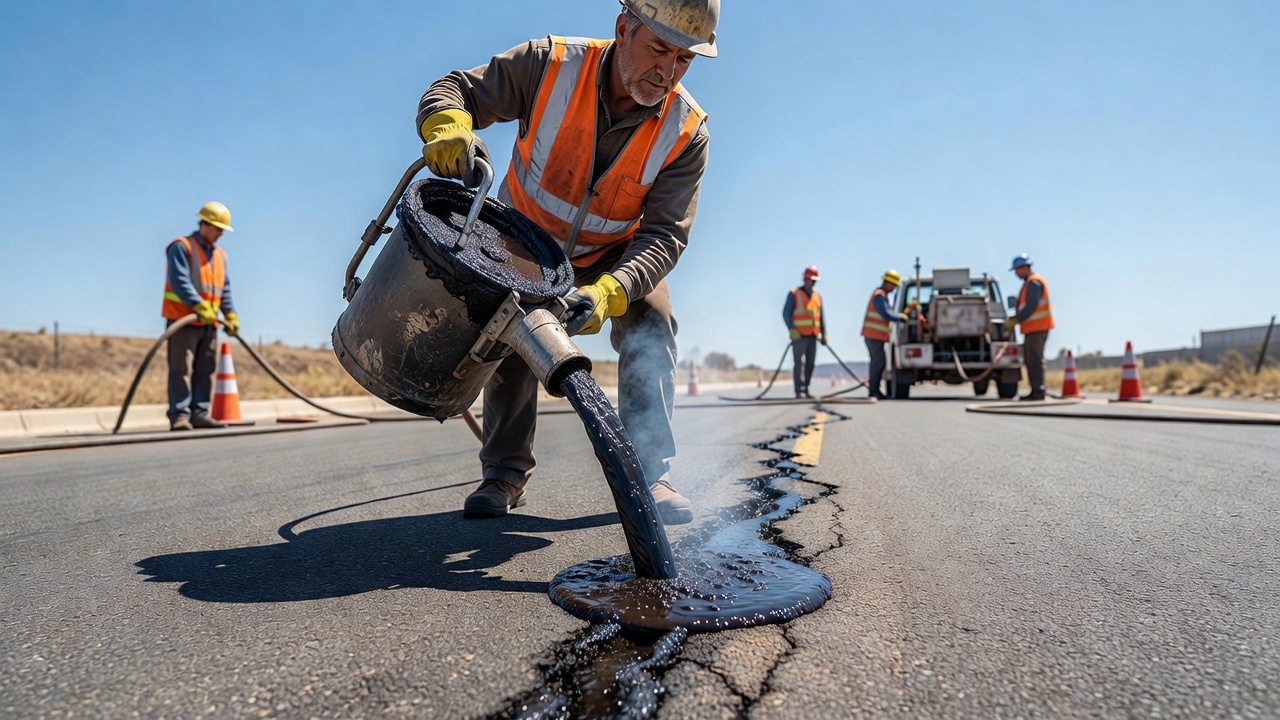
The sealant reservoir filling uses a pour pot or applicator wand attached to the heated kettle by a hose. The wand tip is placed at the beginning of the routed reservoir and the sealant is poured or injected as the operator walks along the crack. The reservoir must be slightly overfilled, the sealant surface should be approximately 1–2 mm above the surrounding pavement surface to compensate for cooling shrinkage and initial traffic compaction. The applicator wand must be kept in contact with the sealant surface to avoid trapping air bubbles in the reservoir. Air entrapment creates voids that become stress concentration points and initiate sealant failure.
Finishing is performed with a squeegee to level the sealant and create a smooth surface. The squeegee also forces sealant into intimate contact with the reservoir walls. Some specifications require a band or cap of sealant extending 25–50 mm on either side of the crack in addition to filling the reservoir. This overband provides additional sealant volume and covers any small surface cracks adjacent to the main crack. The overband thickness should be 2–3 mm above the pavement surface. In high-traffic areas, the overband may be minimized or eliminated to prevent tracking by vehicle tires.
Traffic protection and opening. After finishing, the sealant must be allowed to cool and set before traffic is permitted. The minimum cooling time is typically 15 minutes for hot-poured sealants. Some agencies use a blotting procedure, spreading fine sand, talc, or limestone dust over the fresh sealant to prevent tracking. The blotting material should be applied immediately after finishing and excess material swept away after the sealant has set. Alternatively, paper towels or release paper can be used in low-traffic areas. The Illinois Center for Transportation guidelines stress that the pavement section should remain closed for at least 15 minutes after sealant installation to prevent tracking and debris intrusion into the still-soft sealant.
Routing and Sealing vs Crack Filling
Routing and sealing (crack sealing) and crack filling are fundamentally different crack treatment methods, not interchangeable terms. The distinctions are defined by the crack characteristics, treatment procedure, and performance expectations as established by the SHRP study and subsequent field validation.
| Characteristic | Routing and Sealing | Crack Filling |
|---|---|---|
| Crack Type | Working cracks | Non-working cracks |
| Annual Movement | > 0.1 inch (2.5 mm) | ≤ 0.1 inch (2.5 mm) |
| Crack Width Range | 0.2–0.7 inches (5–19 mm) | 0.2–1.0 inches (5–25 mm) |
| Routing Required | Yes, creates reservoir | No, direct fill |
| Edge Deterioration | ≤ 25% of crack length | ≤ 50% of crack length |
| Sealant Application | Reservoir + optional overband | Flush fill or overband only |
| Cost per Linear Foot | Higher | Lower |
| Service Life Expectancy | 2–7 years | 1–3 years |
| Cost Effectiveness (life cycle) | Higher | Lower |
The decision to route or fill is determined during the pavement inspection. The crack’s working status is assessed by measuring crack width in both summer and winter conditions, observing the presence of secondary cracking or spalling at the crack edges, and evaluating the pavement condition rating (PCR). Pavements with PCR above 75 are suitable for routing and sealing as a first treatment, PCR above 50 may be suitable for a second treatment. Pavements with PCR below 50 require rehabilitation rather than crack treatment.
Field studies comparing rout-and-seal to clean-and-fill treatments consistently demonstrate that routing provides superior long-term performance. A Minnesota Department of Transportation study found that rout-and-seal repairs achieved approximately four years of service before failure, compared to two years for clean-and-fill. A 2020 study from the National Center for Asphalt Technology (NCAT) at Auburn University reported mean time to first failure (MTFF) exceeding 7.7 years for crack sealing treatments. The FHWA pooled fund study (TPF-5-225) validated that properly installed routed and sealed cracks extend pavement service life by 2 to 5 years.
Inspection of Routed-and-Sealed Cracks
Inspection of routing and sealing operations occurs at two stages: during installation (quality control) and after installation (performance evaluation). The inspection is critical because routed crack condition is a recurring item in pavement condition surveys.
Installation inspection follows a quality control checklist. The inspector verifies reservoir dimensions using the Go/No-Go gauge at intervals of approximately 50 feet (15 meters) along each crack. The reservoir must be rectangular, not V-shaped, rounded, or tapered. The reservoir must be centered on the crack, with no more than 3 mm deviation. The crack interior must be clean, dry, and free of dust when inspected with a bright light and by wiping with a white cloth, any soiling indicates inadequate cleaning. The sealant temperature at the applicator wand must be within the manufacturer’s specified range. The reservoir must be filled to at least 100%, the surface should be slightly convex above the pavement level. The sealant must be free of bubbles, voids, and contamination.
Post-installation performance inspection evaluates sealant condition over time. Common distresses in routed and sealed cracks include:
- Adhesive failure (debonding). The sealant separates from the reservoir wall, leaving a gap at the interface. This is the most common failure mode and results from inadequate cleaning, moisture at the bond line, or excessive sealant aging.
- Cohesive failure. The sealant tears internally, splitting through the body of the sealant plug. This occurs when the sealant exceeds its elongation capacity (typically 200–400% strain) due to crack movement exceeding the design range.
- Spalling. The pavement at the reservoir edges chips or breaks away. This results from poor routing technique, misaligned cuts, or freeze-thaw damage to aged pavement adjacent to the rout.
- Tracking. Sealant is picked up by vehicle tires and carried onto the surrounding pavement. This indicates sealant was applied too thick, cooled insufficiently before opening to traffic, or has not properly cured.
- Weathering. The sealant surface becomes brittle, cracked, and oxidized due to UV exposure and thermal aging. This is a long-term deterioration mode typically appearing after 3–5 years.
Performance inspection scales such as the SHRP Sealant Rating system classify sealant condition on a 0–9 scale, where 9 is perfect condition and 0 is complete failure requiring replacement. Sealants rated below 5 (more than 50% of the crack length showing failure) generally require re-treatment.
Performance Life
The performance life of routed and sealed cracks varies widely based on installation quality, sealant material, climate, traffic loading, and pavement condition at the time of treatment. Published research from multiple sources provides the following performance data:
- Typical service life: 2 to 7 years for hot-poured rubberized sealants installed in properly prepared reservoirs.
- Mean time to first failure (MTFF): Up to 7.7 years for crack sealing treatments in the NCAT study (2020), though this represents best-practice installations.
- Pavement life extension: 2 to 5 years of additional pavement service life when crack sealing is applied at the appropriate time (pavement age 3–5 years for first treatment).
- Optimal timing: Crack sealing is most cost-effective when the pre-treatment pavement condition is in the range of 81–89 on a 0–100 scale.
The University of Minnesota field study comparing rout-and-seal to clean-and-seal found that rout-and-seal repairs provided approximately 4 years of service at an average performance index level before failure. At equal performance levels, rout-and-seal offered a cost-benefit advantage over clean-and-seal of approximately 24% over a 35-year analysis period (University of Minnesota, 2019).
Performance life is also strongly influenced by the quality of the initial pavement surface. A 2023 MnDOT research summary emphasized that pavement temperatures should be 40°F (4°C) and rising at installation time, and that routing during warmer weather allows the crack to be at an intermediate width, ensuring the sealant reservoir is sized to accommodate both winter opening and summer closure. Sealant durability targets established by the Canadian National Guide to Sustainable Municipal Infrastructure call for sealant life of 6 to 12 years to avoid the need for replacement during the wearing course service life, but actual field performance in Canadian cities typically ranges from 2 to 7 years.
Asphalt vs Concrete Routing
Routing and sealing is applied to both asphalt concrete (AC) and portland cement concrete (PCC) pavements, but the techniques differ significantly due to the distinct material properties of each pavement type.
Asphalt concrete routing is performed on flexible pavements where the bituminous binder is susceptible to creep, oxidation, and temperature-dependent stiffness. The rotary impact router with carbide bits is the preferred tool for AC because the asphalt binder and aggregate are relatively soft and friable compared to concrete. Standard reservoir dimensions for AC are 19 mm × 19 mm. The reservoir must accommodate significant thermal movement, transverse cracks in AC can change width by 15–100% between summer and winter conditions. The AC pavement surface must be dry, and the ambient temperature must be above 40°F (4°C). In hot weather, the asphalt may become soft and rut under the router, requiring the reservoir to be cut when the pavement is cooler (morning hours) or using a diamond saw instead. The sealant for AC is typically hot-poured rubberized asphalt (ASTM D6690 Type II, III, or IV).
Concrete routing is performed on rigid portland cement concrete pavements. The hard, brittle nature of concrete makes diamond-blade saws the preferred cutting tool. Rotary impact routers experience rapid carbide bit wear in concrete and produce rougher cuts with more spalling. Reservoir dimensions for concrete are typically 13 mm to 19 mm wide and 13 mm to 19 mm deep. Concrete cracks generally have less annual movement than asphalt cracks (because the slab joints absorb much of the thermal movement), so shape factor requirements are slightly less critical. However, routing concrete cracks requires careful attention to the following considerations:
- Reinforcing steel. The router depth must be limited to avoid cutting through the concrete cover into the reinforcing steel. Cutting rebar accelerates corrosion and compromises structural integrity.
- Joint vs crack. Routing should not be performed on working joints in concrete pavements. Joints are designed to accommodate slab movement and require flexible sealants installed to different specifications.
- D-Cracking. Concrete with D-cracking (durability cracking from freeze-thaw deterioration of aggregate) should not be routed, as the routing operation will cause extensive spalling of the deteriorated concrete.
- Sealant type. For concrete, both hot-poured rubberized sealants (ASTM D6690) and cold-applied silicone sealants (ASTM D5893) are used. Silicone sealants offer superior UV resistance and elastic recovery for concrete pavement applications.
Airfield-specific considerations. The FAA Advisory Circular 150/5380-6C addresses routing and sealing for airport pavements. For flexible airfield pavements, the FAA recommends crack repair by routing to a minimum depth of 13 mm and width of 13 mm, with cleaning and filling using an approved sealant meeting ASTM D6690. For rigid airfield pavements, routing and sealing is used for cracks that are not working joints, with the repair procedure detailed in Appendix A of the circular. The FAA emphasizes that crack sealing on airfields must be extended to the full pavement width (shoulder to shoulder) and must be completed before seal coating operations. Airfield pavement crack sealing is also a critical element of foreign object debris (FOD) prevention. ICAO guidelines (ICAO Annex 14, Volume I, Section 10) and the ICAO Airport Services Manual reference routed and sealed cracks as a standard pavement maintenance activity that must be inspected and documented in airport pavement management programs.
Cost comparison. Routing and sealing of concrete pavements is generally 20–40% more expensive than asphalt routing due to higher blade costs, slower production rates, and more stringent quality control requirements. However, the extended service life of routed and sealed concrete pavement cracks (up to 7+ years) offsets the higher initial cost compared to repeated crack filling operations.
Frequently Asked Questions
- What is the difference between routing and sealing and crack filling?
- Routing and sealing (crack sealing) involves mechanically widening the crack to create a uniform reservoir, typically 19 mm wide and 19 mm deep, before cleaning and filling with hot-applied sealant. This is performed on working cracks that experience annual horizontal movement exceeding 0.1 inches. Crack filling, by contrast, applies sealant directly into the crack without routing, and is intended for non-working cracks with minimal movement. Routing provides superior sealant performance by creating a dedicated reservoir with optimal width-to-depth ratio (shape factor) that accommodates cyclic crack movement without sealant rupture or debonding.
- What reservoir dimensions are recommended for crack routing?
- The standard reservoir dimensions for crack routing are 19 mm (3/4 inch) width and 19 mm (3/4 inch) depth, producing a shape factor (width-to-depth ratio) of 1:1. A shape factor equal to or greater than 1.0 is essential for optimal sealant performance. Deeper reservoirs (up to 25 mm) may be used in thicker pavement sections, and narrower widths (13 mm to 16 mm) may be appropriate for concrete pavement joints. The reservoir must be rectangular in cross-section, V-shaped or rounded routs from worn blades significantly reduce sealant performance.
- What equipment is needed for routing and sealing cracks?
- The primary equipment includes: a crack router (either rotary impact router with carbide-tipped bits or diamond-blade saw), a hot-air lance or compressed air system for cleaning and drying the reservoir, a mechanical sweeper or leaf blower for dust removal, an oil-free compressor providing minimum 100 psi at the nozzle, a heated sealant kettle capable of maintaining application temperature, and a pour pot or applicator wand for sealant placement. Quality control requires a Go/No-Go gauge (a precisely machined aluminum block matching the specified reservoir dimensions) for field verification of rout geometry.
- When should routing and sealing be performed?
- Crack sealing is ideally performed during spring or fall when ambient temperatures are between 40°F and 80°F (4°C to 27°C) and the pavement is neither at its maximum nor minimum crack width. Working cracks open in winter and close in summer, sealing during moderate temperature conditions allows the sealant to accommodate both opening and closing movements within its elastic range. The pavement must be dry, no rain within 24 hours, no visible moisture in cracks, and ambient relative humidity below 80%. The pavement condition rating should exceed 75 for a first treatment and 50 for a second treatment.
- How long do routed and sealed cracks last?
- Properly installed routing and sealing typically provides 2 to 7 years of effective sealant life, with properly designed installations in favorable conditions achieving up to 7.7 years to reach mean-time-to-first-failure (MTFF). The SHRP study and subsequent field validations indicate that pavement service life extension from crack sealing ranges from 2 to 5 years, with high-quality installation and appropriate material selection achieving up to 3.6 years of extended pavement life. Performance is strongly influenced by reservoir geometry (shape factor ≥ 1.0), cleanliness of the rout, sealant heating temperature and duration, and the quality of bond between sealant and reservoir walls.
- Can routing be performed on concrete pavements?
- Yes, routing and sealing is performed on both asphalt concrete (flexible) and portland cement concrete (rigid) pavements. In concrete pavements, routing is typically used for cracks that are not working joints or for resealing cracks that have been previously filled. For concrete pavements, diamond-blade saws are more commonly used than rotary impact routers because they produce cleaner, straighter cuts with minimal spalling of the concrete edges. The recommended reservoir dimensions for concrete typically range from 13 mm to 19 mm width and depth. Routing concrete cracks requires attention to the presence of reinforcing steel and the potential for reflective cracking from the underlying slab movements.