What is Runway Condition Assessment?
Runway Condition Assessment and Reporting (GRF/RCAM)

Purpose and ICAO Global Reporting Format (GRF)
Runway surface condition assessment is the systematic evaluation of runway pavement conditions to determine their effect on aircraft braking performance, directional control, and stopping distances. The International Civil Aviation Organization (ICAO) developed the Global Reporting Format (GRF) to address a long-standing aviation safety challenge: runway excursions caused by ineffective braking action on contaminated runways. According to the Flight Safety Foundation, contaminated runway conditions represent the third most common landing excursion risk factor.
The GRF became mandatory on 4 November 2021 (delayed one year due to the COVID-19 pandemic) following amendments to multiple ICAO annexes and procedures documents. The regulatory foundation spans ICAO Annex 3 (Meteorological Service), Annex 6 (Operation of Aircraft), Annex 8 (Airworthiness), Annex 14 (Aerodromes), and Annex 15 (Aeronautical Information Services). Supporting procedures are detailed in PANS-Aerodromes (Doc 9981), PANS-AIM (Doc 10066), and PANS-ATM (Doc 4444).
The core purpose of the GRF is to replace the fragmented, locally-determined methods of reporting runway conditions with a single, globally-harmonized system. Under the old system, runway condition reporting varied significantly between countries and even between airports within the same country. Friction measurements from different devices produced inconsistent values that correlated poorly with actual aircraft braking performance. The GRF eliminates this ambiguity by providing a structured framework where the aerodrome operator assesses contaminant type, depth, and percentage coverage for each third of the runway, maps these observations to a numerical Runway Condition Code (RWYCC) using the Runway Condition Assessment Matrix (RCAM), and disseminates the information through a standardized Runway Condition Report (RCR).
The GRF applies to all airports regardless of their geographic location, local weather patterns, or operating conditions. Airports in tropical and arid climates are equally required to assess and report runway conditions when contaminants, including standing water from monsoon rains, are present. The assessment process begins whenever a contaminant covers 10% or more of any runway third. Reporting continues until the runway is fully dry or free of contamination.
The harmonization achieved by the GRF directly supports aircraft performance calculations. Major transport category aircraft manufacturers (Boeing, Airbus, Embraer, Bombardier) have produced performance data that correlates landing distance requirements with the RWYCC. Flight crews use the published RWYCC to determine whether a safe landing can be accomplished within the available landing distance, considering prevailing conditions. This represents a fundamental shift from the previous approach, where pilots received friction measurements or qualitative descriptions that were difficult to translate into operational performance decisions.
Runway Condition Assessment Matrix (RCAM)
The Runway Condition Assessment Matrix (RCAM) is the analytical tool that forms the operational core of the GRF methodology. It establishes a structured mapping between observable runway surface conditions and standardized numerical codes that directly correlate with aircraft performance data. The RCAM was originally developed by the Takeoff and Landing Performance Assessment Aviation Rulemaking Committee (TALPA ARC) in the United States, whose work was subsequently adopted and refined by ICAO for global implementation.
The RCAM consists of two primary sections: the Assessment Criteria (left side) and the Control/Braking Assessment Criteria (right side), also referred to as the Downgrade Assessment Criteria in the aerodrome operator version.
Assessment Criteria, Runway Surface Description and RWYCC
The Assessment Criteria portion of the RCAM lists nine categories of runway surface conditions arranged hierarchically from least slippery (top) to most slippery (bottom). Each category includes a description of the contaminant type and depth criteria, along with a corresponding preliminary RWYCC. The categories are:
| RWYCC | Runway Surface Description | Contaminant Details |
|---|---|---|
| 6 | Dry | No contaminant present. Maximum braking friction available. |
| 5 | Frost or Wet (water depth ≤3mm), Slush ≤3mm, Dry Snow ≤3mm, Wet Snow ≤3mm | Thin moisture or light frozen deposits. Braking deceleration normal. |
| 4 | Compacted Snow at -15°C OAT or colder | The snow has been compressed into a hard, dense layer. |
| 3 | Slippery Wet (wet runway with reduced friction), Dry Snow or Wet Snow >3mm depth, Compacted Snow warmer than -15°C OAT, Any depth of snow on top of compacted snow | Noticeable reduction in braking deceleration. |
| 2 | Standing Water >3mm depth, Slush >3mm depth | Water or slush depth sufficient to cause significant hydroplaning risk. |
| 1 | Ice | A transparent or translucent layer of ice firmly bonded to the pavement. |
| 0 | Wet Ice, Water on top of compacted snow, Slush on top of ice, Dry Snow or Wet Snow on top of ice | Combinations of contaminants producing the most slippery conditions. Braking minimal to non-existent. |
The contaminant depth thresholds are critical parameters in the RCAM. The 3 mm threshold distinguishes between conditions that typically produce acceptable braking (RWYCC 5) and conditions requiring significant performance adjustments (RWYCC 3 for snow, RWYCC 2 for water/slush). This threshold is derived from aircraft tire hydroplaning research, which demonstrates that hydroplaning risk increases substantially when water depth exceeds tire tread depth (typically 3 mm for aircraft tires operating at high speeds).
Control/Braking Assessment Criteria
The right side of the RCAM provides the criteria used to validate, downgrade, or upgrade the preliminary RWYCC. These include:
- Aeroplane deceleration or directional control observation: Descriptions of the braking effect experienced during vehicle or aircraft operations on the runway.
- Pilot report of runway braking action: Standardized qualitative terms used by flight crews to describe braking effectiveness.
The pilot braking action terminology is standardized as follows:
| Pilot Braking Action Term | Corresponding RWYCC Range | Description |
|---|---|---|
| Good | RWYCC 5 | Braking deceleration is normal for the wheel braking effort applied. Directional control is normal. |
| Good to Medium | RWYCC 4 | Braking deceleration or directional control is between Good and Medium. |
| Medium | RWYCC 3 | Braking deceleration is noticeably reduced for the wheel braking effort applied. Directional control is noticeably reduced. |
| Medium to Poor | RWYCC 2 | Braking deceleration or directional control is between Medium and Poor. |
| Poor | RWYCC 1 | Braking deceleration is significantly reduced for the wheel braking effort applied. Directional control is significantly reduced. |
| Less than Poor / Nil | RWYCC 0 | Braking deceleration is minimal to non-existent. Directional control is uncertain. |
Runway Condition Code (RWYCC) 0–6
The Runway Condition Code (RWYCC) is a numerical value from 0 to 6 assigned to each third of the runway that represents the assessed slipperiness of that section. RWYCC 6 corresponds to a dry runway with maximum available friction, while RWYCC 0 represents the most slippery conditions, typically wet ice or layered contaminants on ice, where braking deceleration is minimal to non-existent.
The RWYCC serves as the critical bridge between airport observations and aircraft performance computations. When a flight crew receives an RCR reporting RWYCC values of, for example, 3/3/2 for Runway 09, they immediately understand that the first two thirds of the runway offer Medium braking capability while the final third offers only Medium to Poor braking. This information is directly correlated with the aircraft manufacturer’s performance data, enabling the crew to calculate the actual landing distance required under those specific conditions.
RWYCC 6 (Dry) : A dry runway presents no contamination and provides optimal friction for all aircraft operations. No assessment or reporting is required under the GRF for dry runways. Braking action is not reported as it is considered nominal.
RWYCC 5 (Frost / Wet / Light Contamination) : This code applies when the runway is wet (visible dampness or water up to 3 mm depth), or when frost is present, or when loose contaminants (dry snow, wet snow, slush) are present at depths of 3 mm or less. Braking deceleration is normal for the wheel braking effort applied, and directional control is normal. Pilots report braking action as Good.
RWYCC 4 (Compacted Snow at Low Temperature) : Compacted snow at or below -15°C outside air temperature. At these low temperatures, compacted snow maintains sufficient structural integrity to provide braking deceleration between Good and Medium. Directional control is between Good and Medium. Pilots report braking action as Good to Medium.
RWYCC 3 (Slippery Wet / Deeper Snow / Warm Compacted Snow) : This is one of the most frequently assigned codes in winter operations. It applies to: slippery wet runways (wet pavement exhibiting reduced friction), dry snow or wet snow exceeding 3 mm depth, compacted snow at temperatures warmer than -15°C, and any depth of snow on top of compacted snow. Braking deceleration is noticeably reduced for the wheel braking effort applied, or directional control is noticeably reduced. Pilots report braking action as Medium.
RWYCC 2 (Standing Water / Slush >3mm) : Standing water or slush exceeding 3 mm depth. The risk of dynamic hydroplaning is significant at this code level. Braking deceleration or directional control is between Medium and Poor. Pilots report braking action as Medium to Poor. Many operators require flight crews to use RWYCC 2 performance data when landing on wet runways during moderate or greater rainfall, even if the published code is higher, as a conservative safety measure.
RWYCC 1 (Ice) : A runway with ice firmly bonded to the pavement surface. Braking deceleration is significantly reduced for the wheel braking effort applied, and directional control is significantly reduced. Pilots report braking action as Poor.
RWYCC 0 (Wet Ice / Layered Contaminants on Ice) : The most critical code, representing conditions where stopping capability is effectively absent. Wet ice, slush on top of ice, water on top of compacted snow, or any frozen contaminant layered over ice. Braking deceleration is minimal to non-existent, and directional control is uncertain. Pilots report braking action as Less than Poor (Nil) .
Contaminant Types and Coverage
The GRF methodology defines a specific set of contaminant descriptors that are used in runway condition reporting. These terms have been harmonized with aircraft manufacturer performance data, meaning each contaminant type has known effects on aircraft braking behavior as determined through extensive flight testing and analysis.
Dry Snow: Freshly fallen snow with low moisture content. Density typically ranges from 50 to 200 kg/m³. Dry snow compacts under aircraft tires and can be blown or dispersed by jet blast. Depth assessment is performed visually using reference markers, rulers, or probes.
Wet Snow: Snow that has begun to melt and contains liquid water. Density ranges from 200 to 500 kg/m³. Wet snow is heavier, more cohesive, and more difficult to displace than dry snow. It poses a greater risk of slush-like behavior at higher water content.
Slush: Snow or ice that has melted to a state where it contains sufficient water to form a fluid mixture. Slush density exceeds 500 kg/m³. Slush presents a significant dynamic hydroplaning risk because it cannot be fully displaced by tire tread and can lift the tire off the pavement surface at speeds above the hydroplaning threshold.
Standing Water: Liquid water of depth greater than 3 mm that has accumulated on the runway surface. Standing water is assessed separately from wet conditions (which are ≤3 mm depth). The critical depth threshold for hydroplaning is a function of aircraft ground speed and tire pressure. The FAA-recommended minimum depth for hydroplaning risk is 3 mm (1/8 inch).
Ice: A transparent or translucent layer of ice firmly bonded to the pavement surface. Ice can form from freezing rain, freezing fog, or the freezing of meltwater. The critical factor for ice assessment is the surface temperature and whether the ice is bonded or loose.
Wet Ice: Ice that has a film of liquid water on its surface, often caused by temperatures near 0°C, solar radiation, or chemical treatment. Wet ice is significantly more slippery than dry ice and corresponds to RWYCC 0.
Frost: A deposit of ice crystals formed by sublimation of water vapor onto surfaces whose temperature is below freezing. Frost is typically thin and can be removed by chemical treatment or mechanical sweeping. Frost on an otherwise dry runway corresponds to RWYCC 5.
Compacted Snow: Snow that has been compressed by mechanical rollers or aircraft traffic into a dense, hard layer. Compacted snow behavior depends critically on temperature: at -15°C and below it corresponds to RWYCC 4, while above -15°C it corresponds to RWYCC 3.
Layered Contaminants: The GRF also addresses combinations such as water on top of compacted snow, dry snow or wet snow on top of compacted snow, dry snow or wet snow on top of ice, and slush on top of ice. These layered conditions are assessed based on the topmost contaminant in combination with the underlying layer, and may result in lower RWYCC values than either contaminant alone would produce.
The percentage coverage of each contaminant within each runway third is a required assessment parameter. Coverage is reported in 10% increments. The assessment trigger is 10% coverage, below this threshold, the contaminant is considered not significant enough to affect aircraft performance and is not reported. Coverage reporting enables flight crews to understand whether contamination is uniform across the width and length of the runway third, or whether there are localized areas of more severe conditions.
Assessment Procedure (Runway Thirds)
The GRF mandates that runway condition assessment be performed on each third of the runway independently. The runway is divided longitudinally into three equal sections, each representing approximately 33% of the runway length. The RWYCC is reported for each third in the direction of the lower runway designation number.
For example, on Runway 09/27 (east-west orientation):
- RCR for Runway 09 reports thirds from the threshold of Runway 09 (eastern end) toward Runway 27
- RCR for Runway 27 reports thirds from the threshold of Runway 27 (western end) toward Runway 09
This bidirectional reporting is essential because contamination is rarely uniform along the runway length. Aircraft landing from opposite directions experience different contaminant distributions. An aircraft landing on Runway 09 might encounter the worst contamination in the first third (touchdown zone), while an aircraft landing on Runway 27 might encounter that same contamination in the last third (roll-out).
Step-by-Step Assessment Process
Step 1, Trigger: The assessment process is triggered whenever a contaminant (water, snow, slush, ice, frost) is present or suspected on an operational runway. The trigger threshold is 10% coverage of any contaminant within any runway third.
Step 2, Visual Observation: A trained aerodrome inspector conducts a physical inspection of the runway. The inspector observes and records for each runway third:
- Type of contaminant(s) present
- Percentage coverage of each contaminant
- Depth of loose contaminants (dry snow, wet snow, slush, standing water)
- Any uneven distribution or localized conditions
Step 3, Preliminary RWYCC Assignment: Using the RCAM, the inspector maps the observed contaminant type, depth, and coverage to the corresponding preliminary RWYCC for each runway third.
Step 4, Validation: The inspector considers additional information to validate the preliminary code:
- Pilot braking action reports (AIREPs) received since the last assessment
- Vehicle deceleration and directional control observations during the inspection drive
- Local knowledge of problem areas, drainage patterns, and temperature effects
- Friction measurement data (if state-approved and available)
- Prevailing and forecast weather conditions
Step 5, Downgrade or Upgrade Decision: Based on the validation step, the inspector either:
- Confirms the preliminary RWYCC
- Downgrades the code if conditions are more slippery than indicated
- Upgrades the code only if the preliminary code is 0 or 1 and there is clear evidence of better braking (upgrade limited to a maximum of code 3)
Step 6, RCR Generation: The final RWYCC for each third, along with contaminant type, depth, and coverage, is compiled into the standardized RCR data string.
Step 7, Dissemination: The RCR is transmitted to Air Traffic Services (ATS) for immediate dissemination via ATIS and voice communications. The Aeronautical Information Services (AIS) publishes the information via SNOWTAM.
Step 8, Monitoring: The aerodrome operator continues to monitor runway conditions. A significant change, defined as any change in RWYCC, contaminant type, reportable coverage, or contaminant depth exceeding the significant change threshold (3 mm for loose contaminants), triggers a new assessment and a new RCR.

Relationship to Friction Measurements
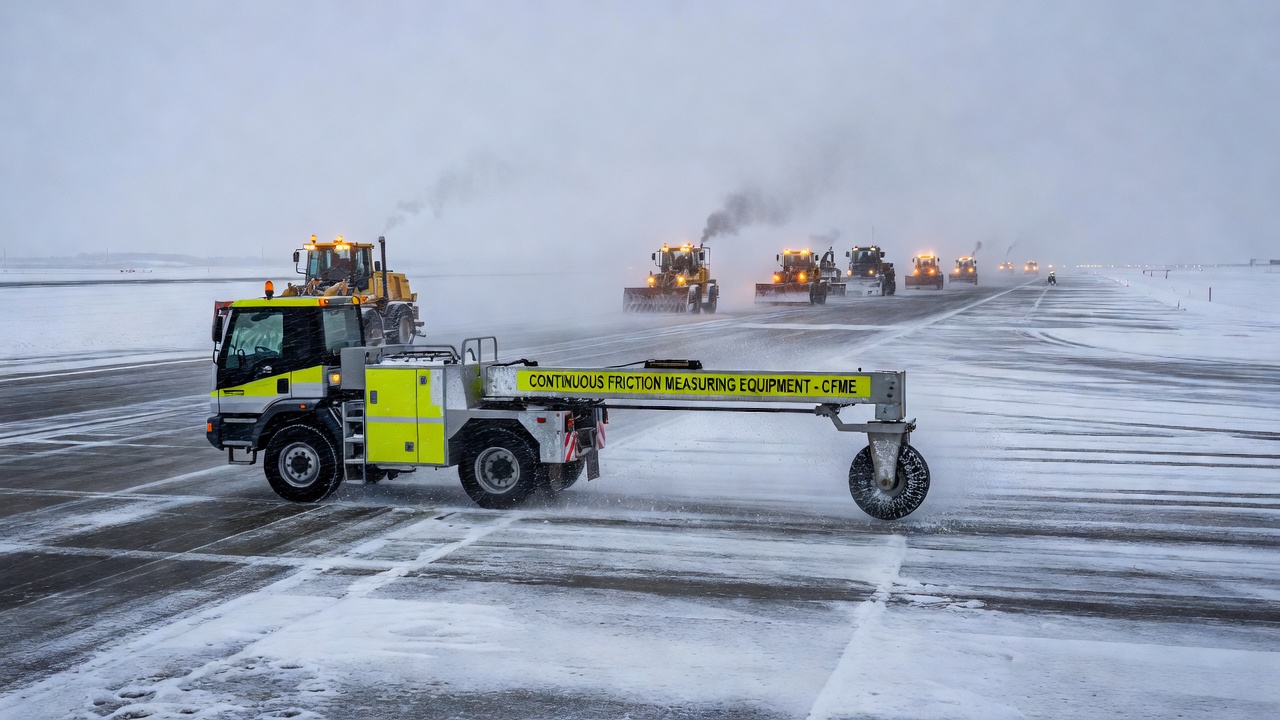
The relationship between friction measurement and the GRF is carefully defined. Prior to the GRF, many aerodromes relied primarily on Continuous Friction Measuring Equipment (CFME), such as the Mu-Meter, Skiddometer, Griptester, or Saab Friction Tester, to assess runway surface conditions. These devices measure the friction coefficient at a specific tire, speed, and water depth condition and report a “Mu” value.
Research conducted over several decades demonstrated that friction measurements from these devices often correlate poorly with actual aircraft braking performance on contaminated surfaces. The reasons include:
- CFME devices operate at lower speeds (typically 65–95 km/h) than aircraft landing speeds (120–260 km/h)
- CFME tires differ from aircraft tires in tread pattern, rubber compound, and inflation pressure
- CFME water application rates may not replicate actual rainfall intensity or contaminant depth
- Snow, slush, and ice produce friction readings that are highly variable and not reproducible across different devices
Under the GRF, friction measurement is not the primary method for determining RWYCC. The primary method is the visual assessment of contaminant type, depth, and coverage mapped through the RCAM. However, measured friction values can serve as supplementary data in the downgrade/upgrade validation process.
If a state (national aviation authority) approves the use of measured friction coefficients for RWYCC adjustment purposes, this must be formally published and the associated procedures documented. The RCR includes a specific field in the situational awareness section for state-approved friction coefficient information.
Where friction measurement remains valuable is in pavement maintenance management. Routine friction testing using CFME is essential for monitoring rubber deposit buildup, detecting pavement polishing, verifying the effectiveness of grooving or porous friction course surfaces, and scheduling surface treatments. These maintenance friction measurements are distinct from the operational RWYCC assessment and are not directly integrated into the GRF.
Reporting: SNOWTAM, ATIS, and NOTAM
The Runway Condition Report (RCR) is the standardized data string produced by the GRF assessment process. It consists of two sections: the Aeroplane Performance Calculation Section and the Situational Awareness Section.
Aeroplane Performance Calculation Section
This section contains the data required for aircraft performance computations, presented as a structured string of information. The mandatory fields are:
- Aerodrome location indicator (4-letter ICAO code)
- Date and time of assessment (MMDDhhmm UTC)
- Lower runway designation number (e.g., 09L, 27R)
- RWYCC for each runway third (e.g., 5/5/3)
- Percentage coverage for each third (e.g., 100/100/50)
- Depth of loose contaminant for each third (e.g., 02/03/NR)
- Condition description for each third (e.g., WET SNOW/SLUSH/ICE)
- Width of runway to which RWYCCs apply (if less than published width)
A complete RCR performance calculation section example:
FAZL 09111357 09L 5/5/2 100/100/100 02/02/03 SLUSH/SLUSH/SLUSH
Situational Awareness Section
This section provides supplementary information relevant to aircraft operations:
- Reduced runway length (if applicable)
- Drifting snow on the runway
- Loose sand on the runway
- Chemical treatment (mandatory if applied)
- Snowbanks (on runway, taxiway, and adjacent to runway)
- Taxiway and apron conditions
- State-approved friction coefficient information
- Plain language remarks
Dissemination Channels
SNOWTAM: A specialized NOTAM format defined in ICAO PANS-AIM (Doc 10066) for promulgating runway condition information. A SNOWTAM is generated whenever a new RCR is issued. It has a maximum validity of 8 hours, if conditions remain unchanged after 8 hours, a new SNOWTAM must be published to maintain currency. The SNOWTAM format was substantially revised as part of the GRF implementation to accommodate the structured RCR data string.
ATIS (Automatic Terminal Information Service): The RCR information is included in the ATIS broadcast for the aerodrome. Pilots receive the RWYCC and contaminant information during their pre-landing briefing. The ATIS format typically presents the RWYCC as a three-character group (e.g., “Runway 27 condition code 5/5/3”).
NOTAM (Notice to Airmen): Runway surface condition NOTAMs (formerly runway condition reports under the old system) are replaced by the SNOWTAM under GRF. However, other runway condition information, such as reduced declared distances or runway closures, continues to be published through standard NOTAM channels.
Voice Communications: ATS controllers relay RCR information to flight crews by voice radio when initiating approaches, particularly when ATIS is not available or when conditions have changed since the last ATIS broadcast.
Digital Data Link: The GRF is designed to support future digital data link transmission (e.g., Controller-Pilot Data Link Communications, CPDLC), enabling automated transmission of RCR data directly to aircraft flight management systems.
Changes from the Old RCR System
The transition from the previous runway condition reporting system to the GRF represents one of the most significant changes in aerodrome operations in decades. Key differences include:
| Aspect | Old System | GRF (New System) |
|---|---|---|
| Assessment Basis | Friction measurements (CFME Mu values) + qualitative observations | Standardized RCAM based on contaminant type, depth, and coverage |
| Code Structure | Friction coefficient ranges (e.g., 0.40–0.50) or qualitative terms (e.g., “poor,” “nil”) | Numerical RWYCC 0–6 with standardized definitions |
| Runway Division | Single value for the full runway length | Individual code for each third of the runway |
| Performance Link | Limited, friction values did not directly correlate with aircraft performance | Direct correlation with aircraft manufacturer performance data |
| Report Format | Free-text SNOWTAM with inconsistent terminology | Structured RCR data string with mandatory fields and standardized descriptors |
| Contaminant Descriptors | Varying national terms | Standardized ICAO contaminants list |
| Pilot Reports | Informally referenced | Integrated into the validation/downgrade/upgrade process |
| Global Harmonization | Significant national variation | Single global standard |
Old SNOWTAM format weaknesses: Under the pre-GRF system, a SNOWTAM might include text such as “RWY 09 covered with 5 cm wet snow, braking action poor, friction 0.32.” This free-text approach led to inconsistent interpretation. What constituted “poor” braking varied between pilots and aircraft types. Friction values from different measurement devices could not be directly compared. The contamination depth was reported for the entire runway without indicating where the worst conditions were located.
GRF improvements: The new system provides unambiguous numerical codes that are directly linked to aircraft performance. The three-zone reporting informs pilots exactly which portion of the runway is most critical for their landing. The standardized contaminant descriptors eliminate terminology confusion. The structured RCR data string ensures that all required information is always provided in a consistent format that can be processed by automated systems.
Visual Assessment vs Instrumented Assessment
The GRF methodology is fundamentally based on visual assessment by trained personnel, supplemented by instrumented measurements where appropriate. Understanding the distinction between these approaches is essential for proper GRF implementation.
Visual Assessment
Visual assessment is the primary method under the GRF. A trained aerodrome inspector conducts a physical drive or walk along the runway, observing and recording:
- Contaminant type identification (assisted by temperature measurement)
- Contaminant depth estimation (using rulers, probes, or reference markers)
- Coverage percentage estimation (based on knowledge of runway dimensions)
- Uneven distribution or localized conditions
- Drainage patterns and contaminant accumulation areas
The inspector’s judgment is informed by training, experience, and local knowledge of the specific runway’s behavior under different weather conditions. For example, an experienced inspector knows which runway sections typically accumulate standing water first, where snow drifts form, and where freezing occurs earliest.
The GRF explicitly states that the assessment is not a measurement but an evaluation based on trained judgment. Depth assessment for loose contaminants uses simple tools, a ruler, a pencil, or a finger, to estimate whether depth is above or below the 3 mm threshold and to provide approximate depth values for reporting.
Instrumented Assessment
Instrumented assessment provides supplementary data that can be used for:
- Validating the preliminary RWYCC
- Supporting downgrade decisions when instrumented data indicates more slippery conditions
- Supporting upgrade decisions (limited to RWYCC 0 or 1 upgrades) when instrumented data consistently indicates better braking
Available instrumented methods include:
- CFME friction measurements (state-approved only)
- Deceleration measurement devices installed in runway inspection vehicles
- Fixed or mobile weather observation systems providing surface temperature, precipitation intensity, and freezing point information
- Cameras and remote sensing systems for continuous runway monitoring
Limitation of Instrumented Data
The GRF recognizes that instrumented data cannot replace trained visual assessment for the primary determination of RWYCC. The reasons include:
- Instrumented measurements sample only a narrow path along the runway (typically the centerline or one wheel track), missing edge contaminants
- Friction values are affected by water depth, speed, temperature, and tire condition, variables that cannot be fully standardized across all measurement events
- Snow and ice friction measurements have particularly high variability and poor reproducibility
- No single instrument can reliably predict aircraft braking performance across all contaminant types and depths
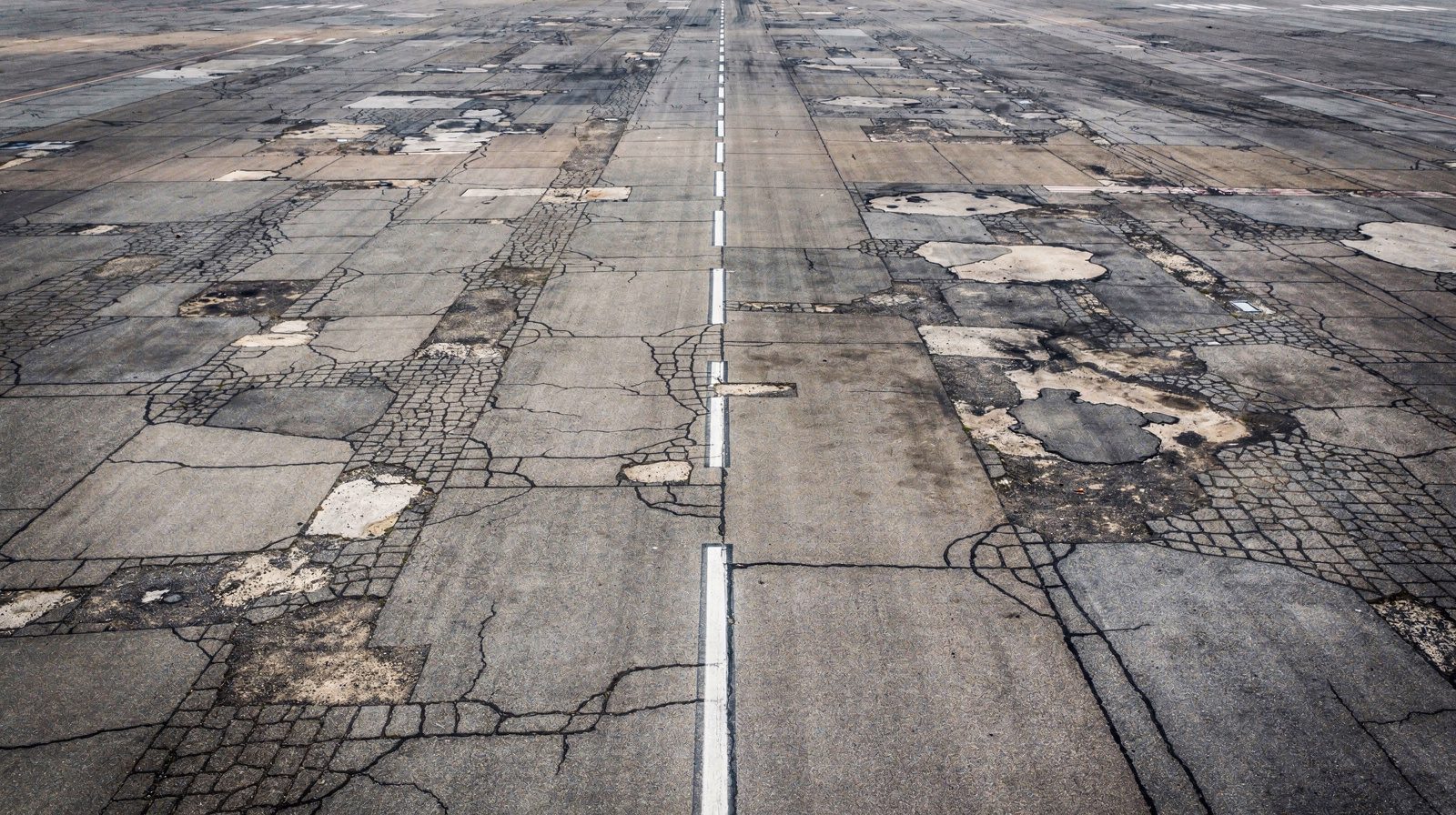
Role of Surface Distress in Condition Assessment
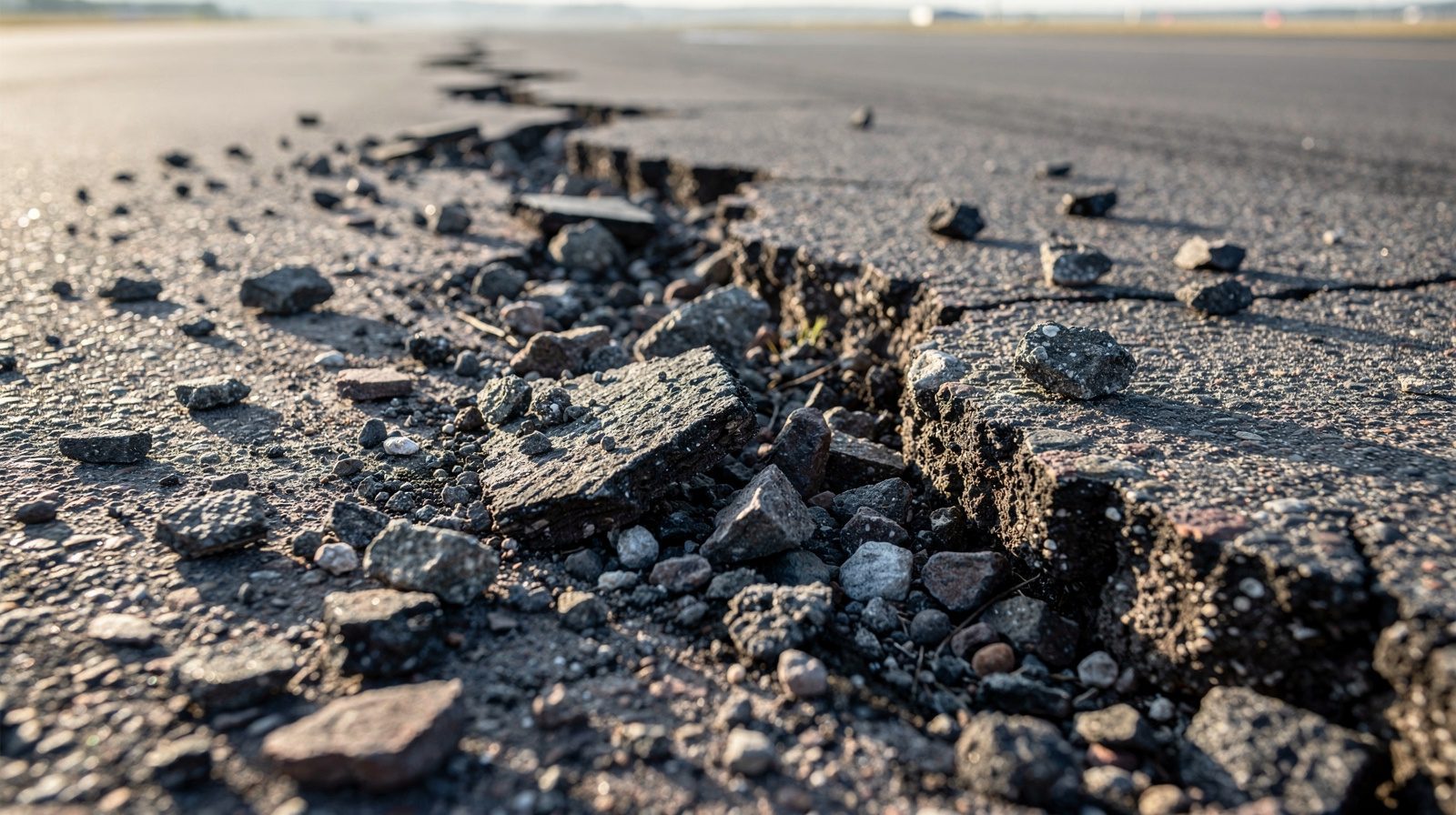
Runway surface distress conditions significantly influence how contaminants accumulate, how they are assessed, and how they affect aircraft braking performance. While the RCAM does not directly include pavement distress as a parameter, distress conditions affect the inspector’s assessment and the applicability of the standard RCAM codes.
Rutting: Longitudinal depressions in wheel paths caused by repeated traffic loading. Ruts collect and hold water, slush, and snow, creating localized areas of deeper contamination even when the average surface depth appears acceptable. Rutted runways may require a downgrade of the RWYCC because the contaminant depth in wheel paths exceeds the assessed average depth. Ruts deeper than 25 mm are considered significant by ICAO standards and require remedial action.
Ravelling and Weathering: Progressive loss of aggregate from the pavement surface. Ravelled surfaces have increased texture depth that can temporarily improve friction on dry and lightly wet surfaces, but can trap contaminants in surface voids, making complete removal (sweeping, blowing) more difficult. Ravelling also complicates depth assessment because the reference surface is uneven.
Polishing and Bleeding: Asphalt binder rising to the surface or aggregate polishing from traffic. Polished or bleeding surfaces have reduced microtexture, significantly reducing friction on wet surfaces. These conditions may cause the runway to be classified as “slippery wet” (RWYCC 3) even when the water depth is less than 3 mm. Routine friction testing is essential for identifying polishing and bleeding.
Cracking: Transverse, longitudinal, and block cracking allow water infiltration into the pavement structure. Surface cracks collect and retain contaminants, making complete clearance difficult. Cracks also provide sites for ice formation that persists after the surrounding surface has cleared.
Potholing and Localized Failure: Discrete depressions or holes in the pavement surface. Potholes present serious hazards including sudden water accumulation, ice formation, and FOD generation. Any contaminant present in a pothole must be assessed and reported as part of the runway third in which it is located.
Grooving and Porous Friction Courses (PFC) : Runways with transverse grooving or PFC overlays have significantly improved drainage characteristics. Water can drain through or be channeled away from the tire contact area, reducing hydroplaning risk. The GRF assessment should take grooves and PFC into account when evaluating wet conditions, a grooved runway may maintain RWYCC 5 even during moderate rainfall when a smooth surface would require downgrading to RWYCC 3.
Rubber Deposit Accumulation: Aircraft tire rubber deposits on the touchdown zone reduce pavement texture and friction. The interaction between rubber deposits and contaminants is complex, rubber can retain moisture, creating persistent damp or icy patches. ICAO recommends regular rubber removal when friction measurements in the touchdown zone fall below minimum recommended levels.
Training and Competency Requirements
Successful GRF implementation depends on the competency of personnel conducting runway condition assessments. ICAO, in collaboration with ACI (Airports Council International), has developed specialized training programs that have been validated by ICAO for aerodrome operators.
The training covers:
- GRF regulatory framework: Understanding the ICAO Annex and PANS requirements
- Contaminant identification: Recognizing all listed contaminant types and their characteristics
- Depth estimation techniques: Using reference tools and estimation methods for loose contaminants
- Coverage percentage estimation: Techniques for visually estimating contaminant coverage
- RCAM application: Step-by-step methodology for assigning preliminary RWYCC
- Downgrade and upgrade procedures: Criteria and decision-making for code adjustment
- RCR generation: Creating the correct data string in the required format
- SNOWTAM and dissemination: Understanding the information flow from assessment to pilot
- Local knowledge integration: Applying runway-specific characteristics to assessments
- Reporting significant changes: Recognizing conditions that trigger a new assessment
Competency is maintained through regular recurrent training, proficiency checks, and operational experience. Aerodrome operators must maintain records of inspector training and qualifications.
Operational Integration with Aircraft Performance
The ultimate purpose of the GRF is to enable flight crews to make accurate landing and take-off performance assessments. Aircraft manufacturers provide performance data that correlates landing distance requirements with RWYCC values. This data typically presents landing distance factors:
| RWYCC | Braking Action | Landing Distance Factor (Typical) |
|---|---|---|
| 6 | (Dry) | 1.00 (dry landing distance) |
| 5 | Good | 1.25–1.40 |
| 4 | Good to Medium | 1.40–1.50 |
| 3 | Medium | 1.50–1.65 |
| 2 | Medium to Poor | 1.65–1.80 |
| 1 | Poor | 1.80–2.00 |
| 0 | Nil | >2.00 |
Note: Actual factors vary by aircraft type, manufacturer, and operational procedures.
The flight crew uses the most conservative (lowest) RWYCC among the three runway thirds for their performance calculation. For example, with an RCR of 5/5/2, the crew uses RWYCC 2 performance data for the landing distance assessment, even though two thirds of the runway are coded 5. This conservative approach ensures that the stopping distance is adequate for the worst section of the runway.
Pilots also have the authority to override the published RWYCC based on their own observations or AIREPs from preceding aircraft. If a flight crew receives a braking action report of Poor from a preceding aircraft on a runway reported as RWYCC 3, they may use RWYCC 1 performance data for their landing calculation.
Summary
Runway Condition Assessment under the ICAO Global Reporting Format represents a fundamental advancement in aviation safety. By replacing inconsistent friction-based reporting with a structured, contaminant-based assessment methodology directly linked to aircraft performance data, the GRF provides flight crews with actionable, reliable information for making critical landing and take-off decisions. The RCAM serves as the analytical foundation, mapping observable surface conditions to standardized numerical codes. The RCR provides the communication framework, ensuring consistent, complete information dissemination through SNOWTAM, ATIS, and direct voice communications. The division of the runway into thirds enables precise localization of contamination hazards. Integration with pavement surface distress knowledge and friction measurement data provides a comprehensive picture of runway conditions. For aerodrome operators, successful GRF implementation requires trained personnel, standardized procedures, and a commitment to timely, accurate assessment and reporting.
Frequently Asked Questions
- What is the Global Reporting Format (GRF)?
- The Global Reporting Format (GRF) is an ICAO-mandated standardized methodology for assessing and reporting runway surface conditions, effective from November 2021. It provides a globally harmonized framework where aerodrome operators evaluate contaminant type, depth, and coverage across each third of the runway, assign a Runway Condition Code (RWYCC) using the Runway Condition Assessment Matrix (RCAM), and disseminate the information through a Runway Condition Report (RCR) via SNOWTAM, ATIS, and NOTAM.
- How is the Runway Condition Code (RWYCC) determined?
- The RWYCC is determined using the Runway Condition Assessment Matrix (RCAM). The aerodrome operator first visually assesses contaminant type (dry snow, wet snow, slush, standing water, ice, frost, compacted snow), depth, and percentage coverage for each third of the runway. The RCAM maps these parameters to a preliminary RWYCC from 0 (most slippery) to 6 (dry). The operator then validates, downgrades, or upgrades the code using additional data such as pilot braking action reports (AIREPs), vehicle deceleration observations, friction measurements, and local knowledge.
- What contaminants are assessed in the GRF methodology?
- The GRF methodology covers the following contaminants: dry snow, wet snow, slush, standing water, ice, wet ice, frost, and compacted snow. Combinations such as water on top of compacted snow, dry snow or wet snow on top of ice, and slush on top of ice are also included. Contaminants not listed (such as hail, mud, or sand) are reported in the situational awareness section of the RCR but do not receive a RWYCC.
- How is the runway divided for condition assessment?
- The runway is divided into three equal longitudinal thirds for assessment purposes. The RWYCC is reported for each third in the direction of the lower runway designation number. For example, RCR 09 reports thirds from the threshold of Runway 09. This allows pilots approaching from either direction to understand exactly where contaminants are located along the landing distance.
- What is the difference between the old RCR system and the new GRF?
- The old system relied primarily on friction measurements that had poor correlation with actual aircraft braking performance. The new GRF methodology uses a standardized RCAM based on contaminant type, depth, and coverage, directly linked to aircraft manufacturer performance data. The old SNOWTAM format was free-text with inconsistent terminology, whereas the GRF RCR uses a structured data string with mandatory fields, standardized condition descriptors, and a numerical RWYCC for each runway third.
- When should a downgrade or upgrade of the RWYCC be applied?
- A downgrade is applied when conditions are more slippery than indicated by the preliminary RCAM assessment, based on pilot braking action reports (AIREPs), vehicle behavior observations, local knowledge, or friction measurements. An upgrade may only be applied to RWYCC 0 or 1, and only up to code 3, following a structured assessment procedure. Upgrade requires positive evidence such as consistently reported Good braking action across multiple aircraft.
- What is the role of pilot braking action reports in runway condition assessment?
- Pilot braking action reports (special AIREPs) provide real-time validation of the published RWYCC. Pilots report braking action as Good, Good-to-Medium, Medium, Medium-to-Poor, Poor, or Less-than-Poor (Nil). These reports are used by the aerodrome operator to confirm, downgrade, or upgrade the RWYCC. Multiple consistent reports from different aircraft types increase confidence in the assessment. A single Poor braking report, especially when the published code is higher, triggers an immediate reassessment.
- How does friction measurement relate to the GRF?
- Friction measurement using Continuous Friction Measuring Equipment (CFME) is not the primary method for assigning RWYCC under the GRF. However, measured friction coefficients can be used as supplementary data in the downgrade/upgrade assessment process. The GRF explicitly recognizes that friction measurements often have poor correlation with actual aircraft braking performance on contaminated surfaces. If a state approves the use of measured friction coefficients, this must be published and the associated procedures must be documented.
- How does runway surface distress affect condition assessment?
- Runway surface distress, such as rutting, ravelling, polishing, bleeding, cracking, and potholing, directly affects drainage and contaminant accumulation. Distressed surfaces may hold standing water, slush, or ice in depressions, creating localized hazards that are not captured by average contaminant depth assessments. The GRF methodology requires inspectors to note uneven contaminant distribution and report it in the plain language remarks section of the RCR. Regular pavement condition surveys are essential to identify distress patterns that influence contaminant behavior.
- What training is required for GRF runway inspectors?
- GRF runway inspectors must complete specialized training validated by ICAO. ACI (Airports Council International) provides an online computer-based training module for aerodrome operators that covers visual assessment techniques, contaminant identification, depth estimation, RCAM application, downgrade/upgrade procedures, and RCR generation. Training emphasizes that assessment is based on trained judgment using standardized criteria, not precise measurement.