What is Spectral Bandwidth?
Spectral Bandwidth – Aviation & Physics Deep Dive
Definition and Fundamental Principles
Spectral bandwidth is the width of a continuous range of electromagnetic wavelengths or frequencies over which a physical system, device, or signal operates. It is essential in aviation, defining the portion of the electromagnetic spectrum used or detected by sensors, communication systems, and navigation aids. Bandwidth is measured in wavelength (Δλ), frequency (Δν), or energy (ΔE), typically using the full width at half maximum (FWHM) of a spectral feature.
In aviation, spectral bandwidth determines how much of the spectrum a sensor or channel covers, impacting the resolution, sensitivity, and capacity of systems such as radar, radio, lidar, and remote sensing. Whether for air traffic control communications, cockpit displays, or weather radar, the concept of bandwidth is central to efficient, reliable, and interference-free operation.
The Electromagnetic Spectrum in Aviation
The electromagnetic spectrum spans all frequencies, from radio waves for communications, to microwaves for radar, infrared for navigation, and visible light for displays. Each application requires a specific spectral region and bandwidth, regulated by organizations like the International Civil Aviation Organization (ICAO) and the International Telecommunication Union (ITU).
| Spectral Region | Typical Aviation Use | Bandwidth Examples |
|---|---|---|
| VHF/UHF | Voice comms, DME, transponders | 8.33 kHz (voice), 1 MHz (DME) |
| Microwave (X/C/K) | Weather radar, airborne radar, altimeters | 10–100 MHz (radar pulse) |
| Infrared/Visible | Enhanced vision, HUDs, navigation lights | 10–100 nm (IR sensors) |
Bandwidth choice balances resolution, capacity, and interference. Narrow bandwidths provide high resolution, broader bandwidths increase data rates but may suffer more from noise and require additional filtering.
Units and Formulae
- Frequency bandwidth (Δν): Hz, kHz, MHz, GHz, THz (used in radio, radar, microwave)
- Wavelength bandwidth (Δλ): nm, μm, m (used in optical, infrared, ultraviolet)
- Energy bandwidth (ΔE): eV, J (used in X-ray, gamma-ray)
Relationship:
$$ \Delta \nu = \frac{c}{\lambda^2} \Delta \lambda $$
Where $c$ is the speed of light and $\lambda$ is the central wavelength.
Quality factor (Q):
$$ Q = \frac{\nu_0}{\Delta \nu} $$
High-Q systems are narrowband, providing excellent selectivity, critical for aviation navigation and communication systems.
Technical Contexts
- Optical/Infrared: FWHM defines bandwidth for sensors, filters, lasers.
- Radio/Microwave: Bandwidth sets channel spacing and data capacity, tightly regulated in aviation.
- Spectrometers: Bandwidth dictated by slit width and dispersive elements.
- Digital Detectors: Pixel size and arrangement set minimum achievable bandwidth.
Measurement Methods
- Optical Spectrum Analyzer (OSA): For lasers, LEDs, spectrometers.
- Monochromators: For calibration of sensor bandwidth.
- Interferometry: For high-resolution measurement in navigation aids.
Key considerations:
- Slit width versus signal throughput (resolution vs. sensitivity)
- Detector 3-dB bandwidth (max frequency response)
- Digital sampling interval (must match or exceed bandwidth for accurate data)
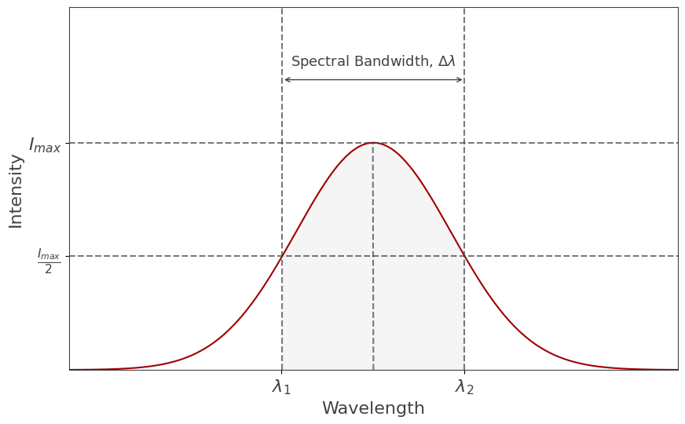
Figure: FWHM visualization of spectral bandwidth.
UV-Vis Spectroscopy & Materials Analysis
In UV-Vis spectroscopy, spectral bandwidth controls the ability to resolve fine features in aviation fuels, lubricants, and environmental samples. Narrow bandwidth enables detection of low-level contaminants, broader bandwidth may miss critical details. Portable spectrometers in aviation maintenance must balance speed (broader) and specificity (narrower).
Photonics: Lasers, LEDs, and Sources
- Lasers: Used in LIDAR and navigation, with extremely narrow bandwidths (<1 MHz), ensuring high coherence and measurement precision.
- Broadband sources: Used in multi-spectral imaging, environmental sensing, bandwidths of hundreds of nm.
- LEDs: Moderate bandwidth (10–100 nm), used in cockpit and navigation lighting.
Narrowband sources maximize resolution, broadband sources increase coverage and throughput.
Communications and Fiber Optics
Aircraft and airports use high-speed networks, bandwidth sets data capacity:
- Optical fiber: Wavelength-division multiplexing (WDM) relies on narrow, well-defined channel bandwidths.
- Radio/microwave links: Bandwidth allocation is strictly regulated, the Shannon–Hartley theorem links bandwidth, SNR, and maximum data rate.
Remote Sensing and Environmental Monitoring
- Multispectral sensors: Broad bandwidth channels (10–100 nm) for general monitoring.
- Hyperspectral sensors: Dozens or hundreds of narrow channels (1–10 nm) for high specificity.
- Environmental sensors: Narrowband filters isolate specific gas absorption features for air quality and weather monitoring.
Radar and Avionics
Radar bandwidth sets range resolution, wider bandwidth, finer resolution:
- Pulse radar: Bandwidth relates directly to minimum detectable object size.
- CW radar: Bandwidth and frequency stability affect velocity discrimination and clutter rejection.
- Navigation aids: Channel bandwidths are set by international standards for safety and interoperability.
Photodetectors and 3-dB Bandwidth
Photodetectors’ 3-dB bandwidth defines their maximum usable modulation frequency, critical for fast optical communications and LIDAR. Spectral response must match source and application for efficiency.
Design Trade-offs
- Resolution vs. sensitivity: Narrower bandwidth = higher resolution, lower throughput.
- Slit width: Controls bandwidth in spectrometers.
- Detector architecture: Pixel size sets achievable bandwidth in imaging sensors.
- Sampling: Digital systems must sample at intervals ≤ bandwidth to avoid information loss.
Key Physical Relationships
- Coherence time ($\tau_{\text{coh}}$): Longer for narrow bandwidths, vital for interferometry.
- Q-factor: Higher for narrowband, selective systems.
- Signal-to-Noise Ratio (SNR): Broader bandwidth increases noise, optimal bandwidth maximizes SNR for the application.
Example Applications
- Fuel analysis: Narrow bandwidth reveals contaminants.
- LIDAR: Narrowband lasers provide precise wind/shear measurements.
- Radar: Bandwidth determines target resolution and clutter rejection.
- Fiber-optic networks: Bandwidth dictates data rates and channel multiplexing.
Summary
Spectral bandwidth is a foundational parameter in aviation and physics, dictating system resolution, sensitivity, and information capacity. Proper bandwidth selection and management are essential for safe, efficient, and effective operation of aviation communication, navigation, remote sensing, and environmental monitoring systems.
For expert guidance on optimizing spectral bandwidth in your aviation or scientific application, contact us or schedule a demo .
Frequently Asked Questions
- What is spectral bandwidth in aviation?
- Spectral bandwidth in aviation refers to the range of electromagnetic wavelengths or frequencies utilized or detected by systems like radar, communication channels, and sensors. It defines how much of the spectrum is used, impacting resolution, sensitivity, and the amount of information transmitted or received.
- Why is spectral bandwidth important in radar and communication?
- Spectral bandwidth determines the resolution and information capacity of radar and communication systems. Wider bandwidth provides finer resolution and higher data rates but may increase susceptibility to noise and regulatory constraints. Proper bandwidth selection ensures clear signals and minimal interference.
- How is spectral bandwidth measured?
- Spectral bandwidth is typically measured as the Full Width at Half Maximum (FWHM) of a signal, using optical spectrum analyzers for light or specialized equipment for radio/microwave frequencies. In digital systems, the 3-dB bandwidth is used to define the frequency range where the signal remains above half its peak strength.
- What is the relationship between spectral bandwidth and system resolution?
- A narrower spectral bandwidth allows a system to resolve features that are closer together in wavelength or frequency, increasing spectral or spatial resolution. However, this may reduce signal strength or throughput, requiring a balance based on application needs.
- How does spectral bandwidth affect remote sensing in aviation?
- In remote sensing, the spectral bandwidth of sensors determines their ability to distinguish between different materials or atmospheric constituents. Narrow bandwidth enables detection of specific features, while broader bandwidth allows faster measurements but with less selectivity.
This is a reference entry. TarmacView provides drone inspection services and doesn't sell the equipment or materials described in this glossary.