What is Spectral Irradiance?
Spectral Irradiance and Related Radiometric & Photometric Quantities
Spectral irradiance is a foundational concept in optical science, crucial for understanding and quantifying how much energy from light sources arrives at a surface at each wavelength. It underpins the design and calibration of sensors, evaluation of solar energy systems, assessment of lighting technologies, and a wide spectrum of scientific research and industrial applications.
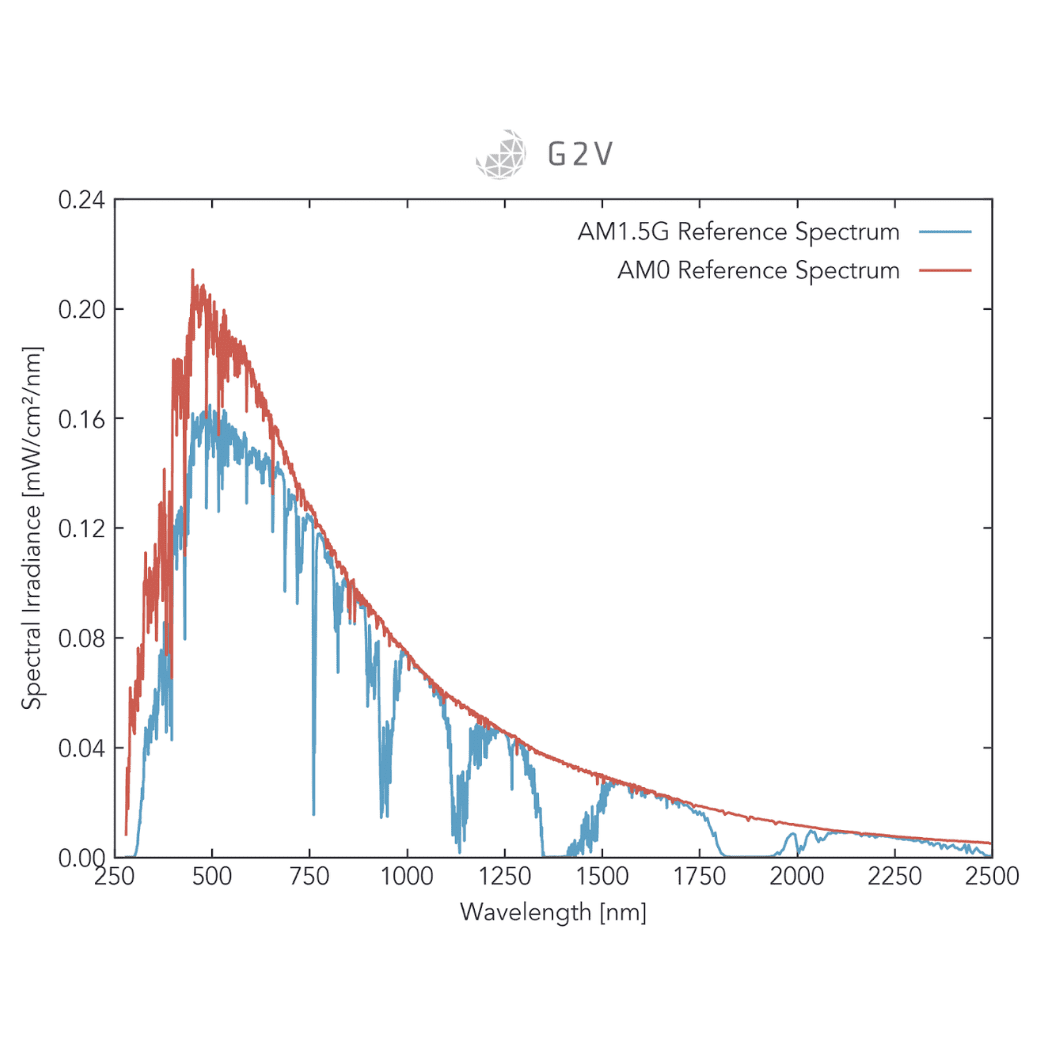
Figure: Typical spectral irradiance of sunlight at the Earth’s surface, demonstrating the distribution of energy across ultraviolet, visible, and infrared wavelengths.
Fundamentals of Spectral Irradiance
Spectral irradiance ($E_\lambda$) is the radiant flux (power) received by a surface per unit area, per unit wavelength interval. Mathematically:
$$ E_\lambda = \frac{d^2\Phi}{dA,d\lambda} $$
- $d^2\Phi$: Differential radiant flux (W)
- $dA$: Differential area (m²)
- $d\lambda$: Differential wavelength interval (nm or m)
SI unit: W·m⁻²·nm⁻¹
Spectral irradiance is always a function of wavelength, so it’s typically represented as a spectrum, a graph showing $E_\lambda$ versus wavelength. This level of detail allows researchers and engineers to analyze how energy is distributed across the electromagnetic spectrum for any light source or environment.
Radiometric Quantities: The Building Blocks
Radiant Flux ($\Phi$) and Spectral Flux ($\Phi_\lambda$)
- Radiant flux ($\Phi$): Total electromagnetic energy per unit time emitted, transferred, or received, measured in watts (W).
- Spectral flux ($\Phi_\lambda$): Radiant flux per unit wavelength interval (W·nm⁻¹).
Practical Uses:
- Characterizing lamp and LED output
- Calculating exposure received by surfaces or detectors
- Summing spectral flux over all wavelengths gives total radiant flux
Irradiance ($E$) and Spectral Irradiance ($E_\lambda$)
- Irradiance ($E$): Total radiant flux per unit area (W·m⁻²)
- Spectral irradiance ($E_\lambda$): Irradiance per unit wavelength (W·m⁻²·nm⁻¹)
Relationship: $$ E = \int_{0}^{\infty} E_\lambda,d\lambda $$
- Irradiance meters measure total power.
- Spectroradiometers provide a spectral breakdown.
Radiance ($L$) and Spectral Radiance ($L_\lambda$)
- Radiance ($L$): Radiant flux per unit area per unit solid angle (W·m⁻²·sr⁻¹)
- Spectral radiance ($L_\lambda$): Per unit wavelength as well (W·m⁻²·sr⁻¹·nm⁻¹)
Importance: Radiance measures both spatial and angular distribution, vital in imaging, remote sensing, and environmental science.
Radiant Intensity ($I$)
- Radiant intensity ($I$): Power emitted per unit solid angle (W·sr⁻¹)
- Used to describe point sources and directional emission patterns.
Photometric Quantities: Human-Centric Light Measurement
Photometric quantities represent light as perceived by the human eye. They are derived from radiometric values by weighting the spectral power distribution with the CIE standard luminosity function ($V(\lambda)$).
- Luminous flux ($\Phi_v$): Visible energy per unit time, in lumens (lm)
- Illuminance ($E_v$): Luminous flux per meter squared, in lux (lx)
- Luminance ($L_v$): Perceived brightness from a direction, in cd·m⁻²
Conversion Example: $$ \Phi_v = 683 \int_0^\infty \Phi_\lambda V(\lambda) d\lambda $$
- 683 lm/W is the peak luminous efficacy at 555 nm (green).
Spectral Illuminance and Radiometric–Photometric Conversion
Spectral illuminance ($E_{v,\lambda}$) is the photometric equivalent of spectral irradiance, quantifying visible light at each wavelength according to human sensitivity.
$$ E_{v,\lambda} = 683 \cdot E_\lambda \cdot V(\lambda) $$
- This process ensures that measurements reflect how humans perceive brightness, not just raw energy.
Measurement Techniques and Instrumentation
Instruments
- Spectroradiometer: Separates and quantifies light by wavelength, essential for spectral irradiance.
- Pyranometer: Measures total solar irradiance.
- Filtered Photodetectors: For specific spectral bands.
Calibration
- Calibration with standard lamps (e.g., tungsten-halogen, deuterium), traceable to NIST or equivalent bodies, is vital for accuracy.
- Spectral responsivity and cosine response are key calibration factors.
- Errors can arise from spectral mismatch, stray light, and angular misalignment.
Best Practice: Regular calibration and adherence to standards (CIE, ISO/IEC) ensure traceable, reliable measurements.
Units and Reference Table
| Quantity | Symbol | SI Unit | Description |
|---|---|---|---|
| Radiant Flux | $\Phi$ | W | Total power |
| Spectral Flux | $\Phi_\lambda$ | W·nm⁻¹ | Power per wavelength interval |
| Irradiance | $E$ | W·m⁻² | Power per area |
| Spectral Irradiance | $E_\lambda$ | W·m⁻²·nm⁻¹ | Power per area and wavelength |
| Radiance | $L$ | W·m⁻²·sr⁻¹ | Power per area and solid angle |
| Spectral Radiance | $L_\lambda$ | W·m⁻²·sr⁻¹·nm⁻¹ | Power per area, solid angle, and wavelength |
| Luminous Flux | $\Phi_v$ | lm | Visible power (weighted) |
| Illuminance | $E_v$ | lx (lm·m⁻²) | Visible power per area |
| Luminance | $L_v$ | cd·m⁻² | Visible power per area and solid angle |
| Luminous Intensity | $I_v$ | cd | Visible power per solid angle |
Applications of Spectral Irradiance
- Solar Energy: Determines photovoltaic efficiency and supports comparison under standardized spectra (e.g., ASTM G173 AM1.5).
- Material Science: Guides accelerated weathering and photodegradation studies.
- Spectroscopy: Enables quantitative analysis of absorption, fluorescence, and emission.
- Lighting Engineering: Assesses lamp/LED output, supports compliance, and optimizes human-centric lighting.
- Photobiology & Agriculture: Measures PAR (400–700 nm) for plant growth.
- Aviation & Aerospace: Calibrates sensors and evaluates environmental exposure.
Accurate spectral irradiance measurement is crucial for quality assurance, regulatory compliance, and technological innovation across these sectors.
Radiometric vs. Photometric Quantities
- Radiometric: Physical energy regardless of perception (watts, W·m⁻²·nm⁻¹).
- Photometric: Weighted by human eye sensitivity ($V(\lambda)$), for lighting and vision-related applications.
Conversion formula: $$ \text{Photometric Quantity} = 683 \int \text{Radiometric Quantity}(\lambda) \cdot V(\lambda), d\lambda $$
Measurement Traceability and Calibration
Ensuring accuracy in spectral irradiance and related measurements requires:
- Wavelength Calibration: Aligning measured and true wavelengths, often using emission lamps (Hg, Ne).
- Spectral Responsivity Calibration: Characterizing detector sensitivity versus wavelength.
- Absolute Irradiance Calibration: Using standard lamps with certified output.
- Cosine Response Verification: Checking angular sensitivity for diffuse/oblique light.
Regular calibration maintains accuracy as instruments age or environments change. Traceability to national/international standards (NIST, BIPM, CIE) is essential for reproducibility and comparability.
Summary
Spectral irradiance provides the detailed, wavelength-specific view of optical energy arriving at a surface. Mastery of its measurement and interpretation is foundational for fields ranging from solar energy and lighting engineering to environmental monitoring and optical sensor calibration. By understanding spectral irradiance and related radiometric and photometric quantities, professionals can ensure accurate, traceable, and application-relevant optical data.
Figure: Solar spectrum, illustrating the variation of spectral irradiance across UV, visible, and IR regions.
For questions about integrating spectral irradiance measurements into your workflow, or for expert calibration and consulting services, get in touch with our team or schedule a personalized demo .
Frequently Asked Questions
- What is the difference between spectral irradiance and total irradiance?
- Spectral irradiance (Eλ) quantifies the radiant power per area per wavelength interval, typically in W·m⁻²·nm⁻¹, detailing how energy varies across wavelengths. Total irradiance (E) is the sum of all spectral irradiance values integrated over all wavelengths, giving the total radiant power per area (W·m⁻²) at a surface.
- Why is spectral irradiance important in solar energy applications?
- Spectral irradiance helps evaluate how much energy at each wavelength reaches solar panels. Since solar cell materials respond differently across the spectrum, knowing the exact spectral distribution of sunlight is essential for optimizing panel efficiency and comparing photovoltaic technologies.
- How is spectral irradiance measured?
- It is measured using a calibrated spectroradiometer, which disperses light into its component wavelengths and measures the power at each. Accurate measurements require calibration against standard lamps, correction for instrument response, and accounting for factors like angular response and stray light.
- How does spectral irradiance relate to photometric quantities like illuminance?
- Photometric quantities such as illuminance (lux) are derived from spectral irradiance by weighting the spectrum with the human eye’s sensitivity curve (V(λ)). This converts physical energy measurements into values that reflect perceived brightness.
- What are the SI units of spectral irradiance?
- The SI unit of spectral irradiance is watts per square meter per nanometer (W·m⁻²·nm⁻¹).
This is a reference entry. TarmacView provides drone inspection services and doesn't sell the equipment or materials described in this glossary.