What is Thermal Segregation in Asphalt Pavements?
Thermal Segregation in Asphalt Pavements
Definition and Mechanism
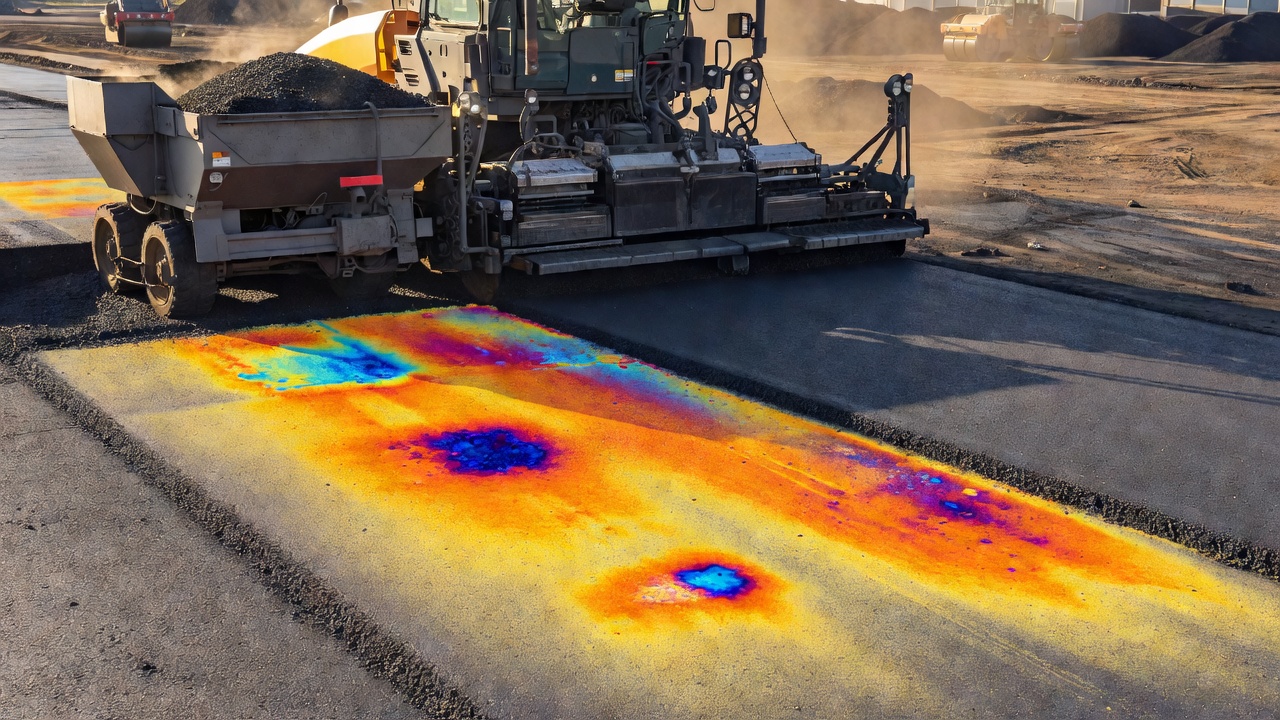
Thermal segregation, also referred to as temperature segregation, temperature differential damage (TDD), or cyclic segregation, is the non-uniform temperature distribution across the mat of uncompacted hot-mix asphalt (HMA) during paving operations. It results from differential cooling of portions of the mix during the transport and placement processes. The cooler material, when it reaches the paver screed, cannot be consolidated to the same density as the surrounding properly heated material, producing localized low-density zones with elevated air voids that are structurally compromised from the moment of construction.
The phenomenon was first formally identified by Steve Read, a graduate student at the University of Washington, during his master’s thesis in the summer of 1996: “Construction Related Temperature Differential Damage in Asphalt Concrete Pavements” (advisor: Dr. Joe Mahoney). The Washington State Transportation Center (WSTC) had observed zones of low in-place density in HMA pavements that showed no signs of gradation or aggregate segregation, and Read’s work conclusively linked these density defects to non-uniform temperature distribution during placement. The phenomenon was originally called cyclic segregation because the cold spots appeared at regular intervals corresponding to truck load cycles, then renamed temperature differential damage (TDD) before settling on thermal segregation.
The mechanism of thermal segregation is fundamentally distinct from gradation (aggregate) segregation. In gradation segregation, coarse and fine aggregate particles separate during handling, producing zones of differing aggregate structure. In thermal segregation, the aggregate gradation is uniform across the mat, the problem is purely one of temperature-driven compaction response. Asphalt binder viscosity is exponentially temperature-dependent: at the target placement temperature of approximately 300°F (149°C), the binder is sufficiently fluid to lubricate aggregate particles and allow the roller to densify the mix to the required in-place density. At 220°F (104°C), the binder viscosity is orders of magnitude higher, preventing adequate particle rearrangement under roller loading. The result is a pavement with uniform gradation but non-uniform density, the cold spots have air voids 3 to 5 percent higher than adjacent hot material, even when subjected to identical roller passes.
The practical significance of thermal segregation was demonstrated by Read’s WSDOT study: overlays affected by thermal segregation showed expected life reduced to roughly half, from the 12 to 15 years normally expected by WSDOT down to 6 to 8 years. The distress may not manifest during the first year after construction but can appear as long as two years after completion, making forensic diagnosis challenging.
Causes of Thermal Segregation
Truck Bed Cooling
The primary cause of thermal segregation is heat loss from the perimeter of the haul truck load. As hot-mix asphalt is loaded into the haul truck, heat loss immediately begins around the perimeter of the truck bed, the mix surfaces exposed to air at the top of the load, the mix contacting the metal sides and tailgate of the truck box, and the mix at the bottom in contact with the truck bed. The heat loss follows the fundamental heat transfer equation:
Q = UA(Tₛ − Tₐ)
Where Q is the rate of heat loss, U is the overall heat transfer coefficient, A is the area of heat transfer, Tₛ is the mix surface temperature, and Tₐ is the ambient air temperature. The temperature differential between the mix and the ambient air drives the heat loss, while wind increases convective heat transfer by elevating the effective U value.
Measured temperature gradients within a single truck bed are dramatic. After only 10 to 15 miles (16 to 24 km) of haul at mix temperatures of 290°F (143°C), temperature differentials as high as 80°F (27°C) have been documented across the truck bed, the center of the load remains near 300°F (149°C) while material at the sides and surface drops to 210°F (99°C) or lower. A documented extreme case from Australia involved a 150-mile (241 km) haul: the outside of the load measured 176°F (80°C), the top measured 205°F (96°C), and the center measured 305°F (152°C), a differential of 129°F (72°C) between center and perimeter.
Asphalt and aggregates have relatively low thermal conductivities, resulting in high percentages of cooling concentrated around the extremities of the truck bed. Heat is slowly conducted from the core outward, but the mix essentially insulates itself, the cool perimeter material protects the core from rapid heat loss. This thermal stratification means that when the truck dumps its load into the paver hopper, the coldest material exits last as the truck bed is raised and the cool side and tailgate material slides down into the hopper.
The key factors affecting heat loss from the truck bed include: mix temperature when loaded into the truck, ambient air temperature, presence or absence of truck bed insulation, size of the truck bed in relation to tonnage hauled, length of haul, speed of travel, waiting time at the paver, whether the load is covered with a tarp, and traffic delays encountered en route.
Paver Hopper Cooling and the Cyclic Mechanism
When a truck load exhibiting significant temperature differentials is dumped into the paver, a repeating mechanism of thermal segregation is initiated. The very cool material that was along the sides of the truck load is extruded toward the sides of the paver’s hopper as the load is dumped. As the truck is emptied and the pile of mix in the hopper runs down, this cool material falls inward onto the material over the slat conveyors. When the next truck arrives and dumps its load, this cold mix is conveyed back to the auger chamber and spread by the screed.
This mechanism repeats cyclically with each truck load, hence the original name cyclic segregation. The pattern is predictable: each truck load produces a cold zone or “fan” of cooler material in the mat, spaced at intervals matching the truck load cycles. The hopper wings are particularly problematic: cold material tends to be relatively stagnant in the wings of the paver hopper. When the wings are folded (elevated) to consume remaining mix, a sufficient mass of cold material is dumped into the material flow all at once, producing a pronounced cold area in the mat.
Wind and Ambient Temperature Effects
Lower ambient temperature directly increases the temperature differential between the mix and the surrounding air, accelerating heat loss from the exposed mix surface. Wind increases the convective heat transfer coefficient, drawing heat away from the mix surface more rapidly. Nighttime paving operations show amplified temperature differential effects because ambient temperatures are typically lower and radiant heat loss to the night sky is significant.
Open-graded friction courses (OGFC) and thin lifts cool significantly faster than dense-graded or thick lifts because their open structure allows air circulation through the mix and their reduced thickness provides less thermal mass. For thin overlays of 1 to 2 inches (25 to 50 mm), the cooling rate is substantially higher than for structural lifts of 4 to 6 inches (100 to 150 mm).
Hauling Delays and Paver Stops
Extended haul times increase the temperature gradient within the truck load because the cool perimeter has more time to conduct heat away from the core. Traffic delays compound the problem by extending the time the mix sits in the truck before placement. Waiting time at the paver (queuing) allows mix to continue cooling in the truck bed, with each minute of waiting increasing the temperature gradient.
Paver stops are particularly damaging. When the paver stops for more than 60 seconds, the mix sitting in the paver’s auger chamber and screed continues to cool without the benefit of fresh material being conveyed forward. When paving resumes, this cooled material is placed first, producing a transverse band of cold material. The TxDOT Tex-244-F specification explicitly excludes the area 2 feet behind and 8 feet in front of the last temperature measurement when a paver stop exceeds 60 seconds.
End-of-Load Segregation
The last material discharged from each truck load contains the coldest mix, material that was at the sides and tailgate of the truck bed. This creates a repeating pattern of cold material at regular intervals corresponding to truck load cycles, producing the characteristic cyclic fan-shaped pattern visible on thermal images. In windrow paving operations using belly dump trailers, material in the center of the windrow discharges first while cold material on the sides discharges last, producing concentrations of cold material at the end of each windrow load.
Temperature Differential Thresholds
The temperature differential threshold for defining thermal segregation has been established through extensive research and field validation. The primary standard is TxDOT Tex-244-F (Thermal Profile of Hot Mix Asphalt, effective July 2023), which defines a three-tier classification system:
| Classification | Temperature Differential | Action Required |
|---|---|---|
| No segregation | Less than 25°F (14°C) | None |
| Moderate thermal segregation | 25°F (14°C) to 50°F (28°C) | Corrective action for recurring instances |
| Severe thermal segregation | Greater than 50°F (28°C) | Suspend operations, evaluate via segregation density profile (Tex-207-F) |
The 25°F (14°C) threshold was established by NCHRP Report 441 (Stroup-Gardiner and Brown, 2000) and validated by the ROSAP/BTS study which confirmed that “the current 25°F temperature differential is still valid as a threshold to define thermal segregation” for modern Superpave and polymer-modified mixtures. The Washington State studies independently arrived at the same 25°F threshold for reduced density and performance.
The Louisiana Transportation Research Center (LTRC FR 604) identified a higher tier: temperature differentials of 75°F (42°C) or greater are classified as “highly segregated” with significantly reduced mechanical properties. These areas exhibit the most extreme density differentials and are the most prone to immediate performance problems.
The temperature differential is calculated as: Maximum Baseline Temperature − Minimum Profile Temperature. The Maximum Baseline Temperature is the maximum temperature observed in the first 20 feet of the thermal profile, and the Minimum Allowable Profile Temperature is the Maximum Baseline Temperature minus 25°F (14°C).
Consequences of Thermal Segregation
The consequences of thermal segregation on pavement performance are severe and well-documented. The fundamental problem is that cold spots do not achieve the same density as hot spots even when subjected to identical roller patterns. The densification of HMA is a process of particle rearrangement that requires the asphalt binder to be sufficiently fluid to lubricate aggregate movement. Below the compaction temperature range, typically defined by the temperature at which binder viscosity reaches 0.28 ± 0.03 Pa·s, the binder becomes too viscous to permit adequate particle rearrangement.
Density and Air Void Effects
Laboratory and field studies have documented that thermally segregated cold spots exhibit air voids 3 to 5 percent higher than adjacent properly compacted hot spots. For a typical HMA mix designed at 4.0 percent target air voids, the cold spot may achieve 7 to 9 percent air voids or higher. This difference is critical because the specification limit for in-place air voids in most agency specifications is typically 3 to 8 percent, and pavement performance models show exponential increases in distress rates above 7 to 8 percent air voids.
The density deficiency is proportional to the temperature differential. The NCAT/Auburn Fernandez Cerdas thesis (2012) documented that cold spots had significantly lower fracture energy than hot spots in laboratory testing, directly correlating to reduced cracking resistance. The study of 28 paving projects in Alabama found that thermal segregation negatively affects mat in-place densities across all mix types.
Fatigue Life Reduction
The most dramatic consequence of thermal segregation is the reduction in fatigue life. Laboratory testing documented in Astec Technical Bulletin T-134 (Brock and Jakob) compared 12.5 mm Superpave mix compacted at different temperatures:
| Compaction Temperature | Fatigue Cycles | Rut Depth |
|---|---|---|
| 340°F (171°C) | 300,000+ cycles | 0.53 mm |
| 240°F (116°C) | 51,798 cycles | 1.55 mm |
Mix compacted at 220°F (104°C) has approximately 10 to 12 percent of the fatigue life of mix compacted at 300°F (149°C). This is not a marginal reduction, it is a catastrophic loss of structural capacity.
Distress Patterns
Thermally segregated pavements exhibit a characteristic patchy distress pattern. The cold spots appear as isolated areas of raveling, cracking, and pothole formation within an otherwise sound pavement. The distress pattern typically includes:
Raveling, The progressive loss of aggregate particles from the pavement surface downward. In cold spots, the binder does not achieve adequate coating and adhesion between aggregate particles because the elevated air voids permit water and air infiltration, accelerating binder oxidation and embrittlement.
Fatigue (alligator) cracking, Interconnected cracks forming in the wheel paths. The elevated air voids in cold spots reduce the structural capacity of the pavement, causing it to crack under repeated traffic loading at a fraction of the expected number of load cycles.
Pothole formation, The progression of raveling and fatigue cracking to the point of localized pavement disintegration. Cold spots are the nucleation points for potholes in otherwise sound pavements.
The WSDOT study found that the distress may not appear for up to two years after construction, making it difficult to attribute the problem to its construction-phase cause during initial acceptance testing.
Moisture Damage Susceptibility
Elevated air voids in cold spots create a direct pathway for water infiltration. The interconnected void structure allows water to penetrate the pavement structure, leading to moisture damage (stripping), the loss of adhesion between the asphalt binder and aggregate particles. This is particularly problematic in rainy climates and in areas with freeze-thaw cycling, where water in the voids expands upon freezing, further damaging the aggregate-binder bond.
Airport Pavement Safety Hazards
In airport pavements, thermal segregation creates Foreign Object Debris (FOD) hazards, loose aggregate particles from raveling cold spots that can be ingested into jet engines or damage aircraft surfaces. Airport pavement specifications, while not containing explicit thermal segregation language in FAA P-401, implicitly require temperature uniformity through density and surface texture requirements. The use of material transfer vehicles (MTVs) at airports such as Clark International Airport in the Philippines, required “to decrease both physical and thermal segregation”, demonstrates recognition of this problem in the airport sector.
Detection Methods
Hand-Held Thermal Cameras

Hand-held thermal cameras provide a portable, flexible method for thermal segregation detection. Per TxDOT Tex-244-F, the thermal camera must meet the following specifications: measurement range of 32°F to 475°F (0°C to 246°C), accuracy of ±4.0°F (±2°C) or ±2 percent of reading, whichever is greater, minimum resolution of 19,200 pixels, LCD viewing screen of minimum 3.0 inches diagonal, storage capacity of minimum 500 images, thermal sensitivity less than 0.11°F (0.06°C), multiple measurement modes including centerspot, area box, and auto hot/cold detection, and variable emissivity from 0.1 to 1.0.
The operational procedure per Tex-244-F is: set emissivity to 1.00, reflected temperature to 68°F (20°C), distance to 10 feet (3 m), and color setting to Rainbow, allow minimum 5-minute warm-up for the camera, mark the pavement at 0 feet, 20 feet (6 m), and 150 feet (46 m) stations, walk 5 to 20 feet behind the paver at the same speed as the paver, parallel to the pavement edge, record the maximum baseline temperature in the first 20-foot section, determine the minimum allowable profile temperature as the maximum baseline temperature minus 25°F (14°C), continue to the 150-foot mark, recording minimum temperatures throughout, and identify areas as moderate segregation (25 to 50°F below baseline) or severe segregation (more than 50°F below baseline). A minimum of 15 thermal images must be captured for documentation between the markers.
The paver stop rule is critical: if the paver stops for more than 60 seconds, the area 2 feet behind and 8 feet in front of the last temperature measurement must be excluded from evaluation. This prevents the inevitable cooling from a paver stop from being incorrectly attributed to thermal segregation from other causes.
On the thermal camera display using the Rainbow color scheme, thermal segregation appears as dark blue or green areas surrounded by white or red zones representing the hot material. Abrupt color changes indicate the boundaries of thermal segregation zones.
Paver-Mounted Infrared Thermal Profiling Systems
Paver-mounted systems, commercialized as MOBA PAVE-IR, were developed through the Texas Transportation Institute (TTI) and TxDOT Research Project 5-4577-03 (FHWA/TX-09/5-4577-03-P1). The system consists of two infrared bars with five sensors each (10 sensors total), a master control box, distance measuring instrument (DMI), GPS receiver, laptop computer with Pave-IR software, and a 12 VDC deep-cycle battery.
The specifications of the system per Tex-244-F include: maximum transverse sensor spacing of 12 ± 1 inch (305 ± 25 mm), accuracy of ±4.0°F (±2°C) or ±2 percent of reading at object temperature above 32°F (0°C) and ambient temperature of 73°F ± 9°F (23°C ± 5°C), measurement repeatability of ±0.9°F (±0.5°C) or ±0.5 percent of reading, profiling width of at least 12 feet (3.7 m), full paving width, sample rate of 2 inches (50 mm) per scan recommended, and exclusion of areas within 2 feet (0.6 m) of the uncompacted mat edge.
The system provides real-time color-coded temperature display across the full mat width: exceeding target temperature displays as red, within target as green, and below target as blue. GPS coordinates are recorded for each temperature scan, enabling spatial analysis of thermal segregation patterns. Statistical analysis uses the 1st percentile for low temperature and 98.5th percentile for high temperature to characterize the temperature distribution.
Data output includes real-time color display, GPS-tagged temperature data, bar chart histograms, daily summary output files, and thermal profile reports for the entire project. Cloud capability through MOBA Pave Project Manager allows uploads, data analysis, and report generation for quality documentation.
Incentives for system use (per TxDOT specifications): Use of a thermal imaging system may eliminate the contractor’s requirement to run density profiles and may relax placement temperature requirements, recognizing that real-time thermal monitoring is a more effective quality tool than post-construction density testing.
Visual Pattern Recognition
Thermal segregation produces characteristic visual patterns on the pavement surface that experienced inspectors can identify even without thermal imaging equipment. The four primary patterns are:
Fan pattern, Caused by elevating the wings of the paver hopper to consume cool stagnant mix. The cold material is dumped into the material flow suddenly, producing a fan-shaped cold area in the mat.
Cyclic pattern, Repeating cold spots at intervals matching truck load cycles, typically 15 to 30 feet (4.5 to 9 m) apart depending on truck capacity and mat thickness. This is the original “cyclic segregation” pattern.
Edge bands, Parallel bands of cooler material along the mat edges, originating from the cool material that was in contact with the sides of the truck box. These bands are typically 6 to 12 inches (150 to 300 mm) wide and appear as longitudinal streaks of poorer surface texture.
Longitudinal streaks, Bands of cooler material parallel to the direction of paving, often resulting from partial hopper wing dumping or inconsistent material flow through the augers.
Other Detection Methods
ROSAN (ROad Surface ANalyzer) laser surface texture measurement, A non-contact laser system that measures surface texture to identify segregated areas. This method was recommended in NCHRP Report 441 for identifying segregation in HMA pavements after construction.
Nuclear density gauges, Used to confirm density differentials between suspected cold spots and adjacent hot material. Per NCAT/NCHRP 441 guidance, any segregated area with density 4 to 5 pounds per square foot (PSF) lower than the adjacent non-segregated area should be removed and replaced.
Core sampling and laboratory testing, The definitive method for verifying thermal segregation impacts. Cores taken from cold spots and adjacent hot spots are tested for air voids, gradation, asphalt content, and mechanical properties. Thermally segregated cold spots typically show air voids 3 to 5 percent higher than hot spots, uniform gradation between cold and hot zones, and reduced indirect tensile strength and fracture energy.
Prevention Methods
Material Transfer Vehicles with Remixing
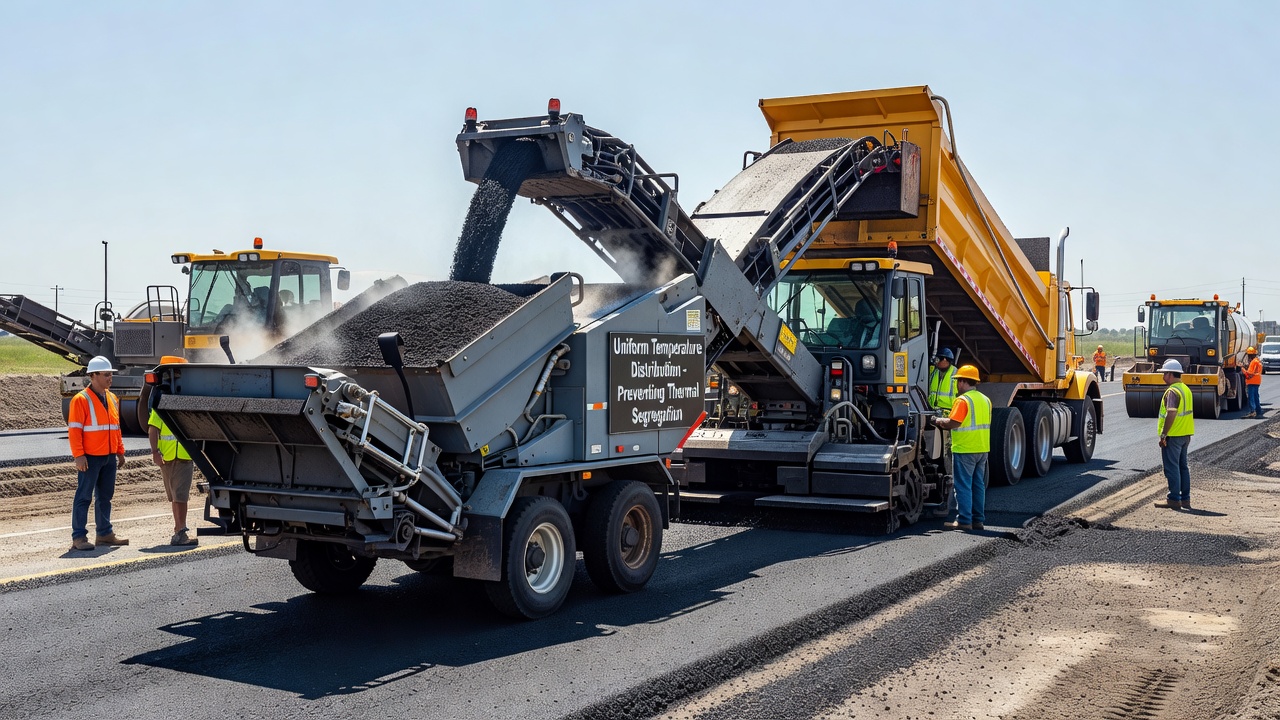
The single most effective preventive measure against thermal segregation is the use of Material Transfer Vehicles (MTVs) with remixing capability. The Roadtec Shuttle Buggy®, with its patented triple-pitch auger, is the gold standard. The auger has three different pitches that get progressively larger toward the center, mechanically remixing material from six different areas across the hopper. This remixing action blends the cold perimeter material with the hot core material, producing a uniform temperature discharge even when the incoming truck load has significant temperature differentials.
Documented performance from Astec Technical Bulletin T-134: without MTV, temperature differentials of 30 to 80°F (17 to 44°C) are common, with the Roadtec Shuttle Buggy triple-pitch auger, temperature differentials of less than 10°F (5.6°C) are consistently achieved across the full mat width. The Australian 150-mile haul case is illustrative: the incoming truck load had center material at 305°F (152°C) and outside material at 176°F (80°C), a 129°F (72°C) differential. After processing through the Roadtec MTV, the discharge temperature was 284°F (140°C) uniformly.
The NCAT/Auburn Fernandez Cerdas thesis (2012) provided quantitative validation: projects using the Roadtec SB-2500 (triple-pitch auger MTV) showed temperature differentials consistently below 10°F across the mat. Projects using belt transfer machines without remixing, such as the Blaw-Knox MC-330, showed average differentials of 30°F to 50°F (17°C to 28°C), despite the continuous material flow advantages of belt transfer.
MTVs provide a secondary benefit: they eliminate truck-to-paver contact, preventing the “bumping” that causes surface irregularities when haul trucks back into the paver. The MTV receives the truck load, stores it in a surge hopper, and feeds the paver at a uniform, controlled rate independent of truck arrival intervals.
Insulated Truck Beds and Tarping
Insulated truck beds reduce heat loss from the sides and bottom of the load. The insulation, typically polyurethane foam or mineral wool panels installed between the truck bed metal and a protective liner, reduces the heat transfer coefficient (U) in the Q = UA(Tₛ − Tₐ) equation, slowing the rate of perimeter cooling. Insulated beds are particularly important for long hauls and cold-weather operations.
Tarping (covering) trucks reduces surface heat loss and eliminates wind cooling effects during transport. A tarp traps a layer of still air above the mix surface, significantly reducing convective heat transfer. All loads should be tarped regardless of ambient temperature, even in warm weather, the wind cooling effect at highway speeds can produce significant surface cooling.
The Alaska DOT P-401 adaptation for cold-weather paving requires insulated truck beds and references the use of propane-powered infrared heating equipment attached to the paving machine for longitudinal joint heating, recognizing that thermal management is critical in sub-arctic conditions.
Logistics and Operations Management
Operational controls to minimize thermal segregation include: minimizing haul time by selecting plant locations close to the project, coordinating truck arrivals to minimize queuing and waiting at the paver, maintaining continuous paving without stops exceeding 60 seconds, proper loading procedures at the plant to minimize segregation during silo discharge, avoiding overfilling truck beds, which increases the cooling surface area relative to the load volume, and balancing production rate with paving speed to maintain consistent material flow.
The SHRP2 R06C study (Rapid Technologies to Enhance Quality Control) documented a practical example: at the start of one paving project, the average temperature differential was approximately 30°F (17°C). After adding two trucks to the haul fleet to improve logistics and reduce waiting times, the differential dropped to approximately 15°F (8°C), a 50 percent reduction achieved through logistics improvement alone, without equipment changes.
Remixing Pavers and Hopper Management
Remixing pavers incorporate internal augers that blend material within the paver itself. The Cedarapids 551 Remix Paver includes internal augers specifically designed to remix the material before it reaches the screed. The Roadtec Stealth™ Paver is designed solely for use with an MTV and uses gravity feed without conveyors, hopper wings, or push rollers, eliminating the hopper wing cooling mechanism entirely.
Hopper wing management is critical for conventional pavers. The cold material that accumulates in the hopper wings should be minimized by not allowing mix to sit in the wings for extended periods. When the wings must be folded (elevated) to consume remaining mix, the cold material should be blended with hot material in the hopper if possible, rather than being dumped directly into the material flow.
Paver hopper inserts containing pugmill mixers can be installed in the bottom of conventional paver hoppers to provide a limited remixing function. These are less effective than full MTV remixing but provide some temperature homogenization.
Thermal Segregation in Airport Paving
Airport asphalt paving presents unique challenges for thermal segregation management. ICAO Annex 14, Aerodromes references general pavement performance standards requiring uniform density and surface characteristics but does not contain explicit thermal segregation threshold language. The FAA P-401 specification (AC 150/5370-10H) references mixing and compaction temperature requirements through the Job Mix Formula (JMF) but, as of the latest published version, does not contain explicit thermal segregation language, temperature differential thresholds, or thermal profile testing requirements.
Despite the absence of explicit specification language, thermal segregation is a recognized concern in airport paving for several reasons:
FOD hazards, Cold spots that ravel produce loose aggregate particles on runway and taxiway surfaces, creating Foreign Object Debris that can be ingested into jet engines. This is a critical safety concern that drives more conservative quality requirements in airport paving than in typical highway paving.
Aircraft tire pressures, The high tire pressures (100 to 250+ psi, compared to 100 to 120 psi for highway trucks) impose greater shear stresses on the pavement surface, increasing the demand for uniform density in cold spots.
Pavement life requirements, Airport pavements are designed for longer service lives than typical highway pavements, making the life reduction from thermal segregation (50 percent per WSDOT) particularly consequential.
Best-practice adoption, Some individual airports have implemented thermal segregation requirements. Clark International Airport (CIAC, Philippines) requires the use of “self-propelled material transfer vehicles to decrease both physical and thermal segregation.” Research publications such as “Developing a Performance Specification for Airport Asphalt” (ResearchGate, 2017) have recommended incorporating MTV requirements into airport specifications for thermal segregation mitigation.
The Alaska DOT P-401 adaptation for cold-climate airport paving specifies temperature ranges of 200°F to 300°F (93°C to 149°C) and requires propane-powered infrared heating equipment for joint heating, reflecting recognition that temperature management is particularly critical in cold-weather airport paving.
Inspection of Thermally Segregated Pavement
Inspection for thermal segregation follows the protocols established in TxDOT Tex-244-F for thermal profiling. One thermal profile is required for each sublot placed, over a test section measuring approximately 150 feet (46 m) behind the paver. The contractor is required to conduct the thermal profile, and the engineer (agency representative) observes and verifies.
Acceptance Criteria
The acceptance criteria per Tex-244-F are based on the three-tier classification:
| Condition | Temperature Differential | Action |
|---|---|---|
| No segregation | < 25°F (< 14°C) | Accept |
| Moderate (recurring) | 25°F to 50°F (14°C to 28°C) | Corrective action required |
| Severe | > 50°F (> 28°C) | Suspend operations, evaluate per Tex-207-F |
For recurring moderate segregation, the corrective action may include: adjusting MTV or paver operations, modifying truck loading and tarping procedures, adjusting rolling patterns to provide additional compaction effort on identified cold areas, and increasing breakdown rolling effort.
For severe segregation, operations must be suspended immediately. The affected areas are evaluated using the segregation density profile procedure (Tex-207-F) , which involves core sampling at cold spot locations and adjacent hot spot locations for comparison of in-place densities and air voids. The contractor must modify the paving process to eliminate severe segregation before operations can resume. If recurring severe segregation cannot be eliminated, the engineer may suspend all paving operations pending a formal corrective action plan.
Density Profile Verification
The density profile is the quantitative confirmation of thermal segregation impact. Per Tex-207-F, cores are taken at the coldest identified locations and at adjacent properly compacted locations. The in-place density comparison determines whether the cold spots have achieved acceptable density. The NCAT/NCHRP 441 criterion for removal and replacement is any segregated area with density 4 to 5 PSF lower than the adjacent non-segregated area.
Hand-Held Camera Inspection
Per Tex-244-F, the hand-held thermal camera inspection for acceptance requires: 150-foot profile length per test, first 20 feet used to determine maximum baseline temperature, remaining 130 feet scanned for minimum temperatures, minimum 15 photographs for documentation between markers, and marking all locations where temperature falls below the minimum allowable profile temperature.
Specifications and Standards
TxDOT Tex-244-F (Primary Standard)
The most comprehensive thermal profiling specification is TxDOT Tex-244-F, Thermal Profile of Hot Mix Asphalt (effective July 2023). This standard applies to HMA specification items 341, 342, 344, 346, 347, and 348 in the TxDOT specification system. It covers both hand-held camera and paver-mounted system methods, provides detailed equipment specifications, operational procedures, data analysis requirements, and acceptance criteria.
AASHTO Provisional Standards
AASHTO T 330 was proposed as a provisional standard for thermal profiling of HMA but has not been formally adopted as a standard practice by all states. The TxDOT Tex-244-F standard has effectively become the de facto national reference for thermal segregation testing methodology.
NCHRP Report 441 (2000)
NCHRP Report 441, Segregation in Hot-Mix Asphalt Pavements, by Stroup-Gardiner and Brown (NCAT/Auburn) established the foundational research on HMA segregation, including the infrared thermography method for identifying segregation during paving operations and the ROSAN laser method for identifying segregation in completed pavements.
FAA Specifications
As discussed above, the FAA P-401 specification (AC 150/5370-10H) does not contain explicit thermal segregation language but references temperature requirements through JMF specifications. FAA Advisory Circulars on asphalt paving reference the general requirement for uniform density and surface characteristics.
Repair of Thermally Segregated Pavement
During-Construction Repairs
When thermal segregation is detected during paving operations, immediate corrective actions can mitigate the damage. For moderate segregation, the rolling pattern can be modified to apply additional compaction effort on identified cold areas, additional breakdown roller passes, increased roller weight, or vibration intensity adjustments.
For severe segregation with density differentials exceeding 4 to 5 PSF per NCHRP 441 guidance, the affected areas should be removed and replaced before the pavement is opened to traffic. The removal can be full-depth, milling out and replacing the full lift thickness, or partial-depth where the segregation is limited to the surface layer.
Post-Construction Repairs
For thermal segregation discovered after construction (typically during the first pavement condition survey), repair options include:
Removal and replacement, The most definitive repair. Mill out the affected areas down to sound pavement or full depth, tack the vertical faces, and replace with fresh HMA. The repair boundaries should extend at least 12 inches (300 mm) beyond the visibly affected area to ensure the transition zone is fully removed.
Overlay, A new HMA overlay over the entire affected area can restore surface uniformity and structural capacity. The overlay must be thick enough to provide structural contribution, for airport pavements, minimum overlay thickness per FAA P-401 is typically 5 inches (125 mm) for structural courses.
Surface treatments, Fog seals or slurry seals may be effective for mild surface-level thermal segregation where the density deficiency is limited to the upper 0.5 to 1 inch (12 to 25 mm) of the pavement. Chip seals can address moderate surface raveling. These treatments are not recommended for structurally significant thermal segregation where density differentials exceed the 4 to 5 PSF threshold.
Crack sealing and patching, For individual cold spots that have manifested as raveling or potholes, crack sealing and full-depth patching can address isolated distress. However, this is a reactive repair rather than a preventive one and is less cost-effective than identifying and addressing the problem during construction.
Long-Term Performance After Repair
The expected life of repaired thermally segregated pavement depends on the extent of the affected area and the quality of the repair. Full-depth removal and replacement can restore the pavement to its design life expectancy. Surface treatments on segregated but structurally intact pavement may achieve 3 to 7 years of additional service life depending on traffic levels and climate.
For unrepaired thermal segregation, the WSDOT study documented that affected overlays showed 50 percent reduction in expected life, from 12 to 15 years down to 6 to 8 years. The cold spots act as failure initiation points that progressively deteriorate and expand outward into sound pavement.
Pavement Condition Survey Identification
During pavement condition surveys (such as ASTM D6433, PCI method, or individual agency protocols), thermal segregation distress is identified by its characteristic patchy, localized pattern of raveling, cracking, and disintegration within an otherwise sound pavement. The distress typically appears as:
Isolated raveling areas, Patches of surface aggregate loss, typically 1 to 3 feet (0.3 to 0.9 m) in diameter, occurring at regular intervals corresponding to truck load cycles. These areas have a rough, pitted surface texture.
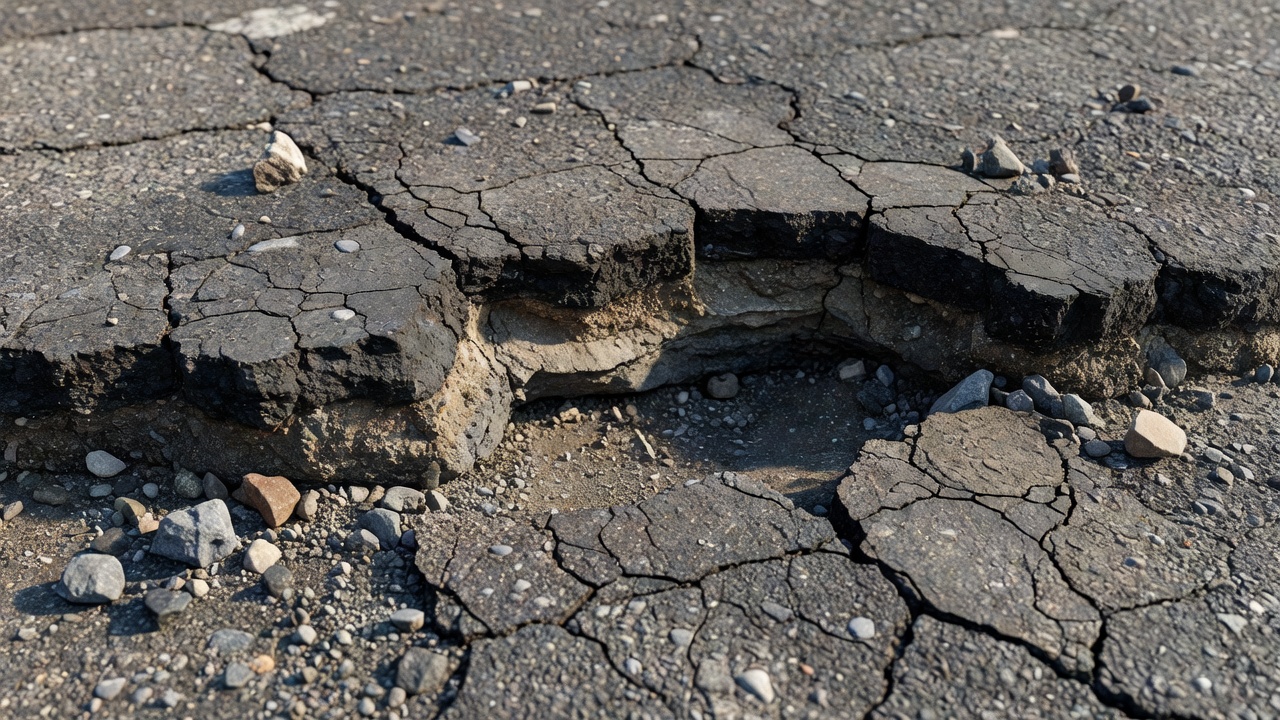
Localized fatigue cracking, Alligator cracking confined to the cold spot zones while the surrounding pavement remains crack-free. This pattern is distinctive because fatigue cracking normally develops uniformly across the wheel path, thermal segregation creates isolated fatigue patches.
Transverse cracking at intervals, Thermal cracking (transverse cracks) that appears at regular intervals matching truck load cycles. The cold spots, with their higher stiffness and reduced relaxation capacity, crack first under thermal contraction stresses.
Pothole clusters, Groups of potholes at regular spacing intervals, typically 15 to 30 feet (4.5 to 9 m) apart, corresponding to truck load cycles. Individual potholes form at the center of each cold zone and may coalesce over time.
Core verification, When thermal segregation is suspected during condition surveys, coring through cold spots and adjacent sound pavement provides definitive diagnosis. The cold spot core will show: higher air voids (3 to 5 percent above design), uniform gradation (identical to sound area, confirming no aggregate segregation), and possible moisture damage or stripping at the aggregate-binder interface.
Related Terminology
Thermal segregation is closely related to several other pavement distress and material terms. Air voids are the percentage of air spaces in the compacted pavement, thermal segregation produces localized zones of elevated air voids. Compaction is the process of densifying HMA with rollers, thermal segregation prevents adequate compaction in cold zones. Raveling is the surface distress most commonly associated with thermal segregation. Alligator cracking and pothole formation are secondary distresses that develop from the initial raveling and density deficiency. Density is the fundamental property affected, thermal segregation creates non-uniform density across the mat. Quality control is the management system that should detect and prevent thermal segregation during construction.
Frequently Asked Questions
- What is thermal segregation in asphalt pavements?
- Thermal segregation, also known as temperature segregation or temperature differential damage (TDD), is the non-uniform temperature distribution across an uncompacted hot-mix asphalt (HMA) mat during paving operations. It occurs when portions of the mix cool differentially during transport and placement, primarily mix on the surface and along the sides of haul truck beds, and mix stagnating in the wings of the paver hopper. When this cooler material reaches the screed, it cannot be consolidated to the same density as the surrounding hot material. The result is localized low-density zones with air voids typically 3 to 5 percent higher than the adjacent properly compacted mat. These zones are structurally compromised and prone to premature distress including raveling, fatigue cracking, thermal cracking, and pothole formation. Thermal segregation was first formally identified by Steve Read at the University of Washington in 1996 and was originally called cyclic segregation because the cold spots reappear at regular intervals corresponding to truck load cycles.
- What temperature differential defines thermal segregation?
- The established standard threshold defining thermal segregation is a temperature differential of 25°F (14°C) between the hottest and coldest portions of the uncompacted mat. This threshold was established by TxDOT Tex-244-F (Thermal Profile of Hot Mix Asphalt) and validated by NCAT research including the NCHRP 441 report and the ROSAP study. The TxDOT three-tier classification system is: No segregation, less than 25°F (14°C) differential, Moderate thermal segregation, 25°F to 50°F (14°C to 28°C) differential, requiring corrective action for recurring instances, and Severe thermal segregation, greater than 50°F (28°C) differential, requiring immediate suspension of paving operations and evaluation using segregation density profile procedures (Tex-207-F). The Louisiana Transportation Research Center identified a threshold of 75°F (42°C) as highly segregated with significantly reduced mechanical properties. The ROSAP/BTS study confirmed that the 25°F threshold remains valid for modern Superpave and polymer-modified mixtures.
- How is thermal segregation detected during paving?
- Thermal segregation is detected using two primary methods: handheld thermal cameras and paver-mounted infrared thermal profiling systems (Pave-IR / MOBA). Handheld thermal cameras per TxDOT Tex-244-F must have a minimum resolution of 19,200 pixels, accuracy of ±4.0°F, and measurement range of 32°F to 475°F. The operator walks 5 to 20 feet behind the paver, parallel to the pavement edge, recording temperature measurements over a 150-foot profile length. Paver-mounted systems consist of two infrared bars with five sensors each (10 sensors total) mounted across the full paving width at 12-inch transverse spacing. These systems provide real-time color-coded temperature displays, GPS-tagged data, statistical analysis (1st percentile low / 98.5th percentile high), and automated daily summary reports. Visual patterns of thermal segregation include fan-shaped patterns from elevating hopper wings, cyclic patterns at intervals matching truck load cycles, and edge bands or longitudinal streaks of cooler material.
- What causes thermal segregation in asphalt pavement construction?
- Thermal segregation has multiple causes originating during HMA transport and placement. The primary cause is truck bed cooling, heat loss from the perimeter of the truck load. Temperature differentials as high as 80°F (27°C) can develop across a truck bed after only 10 to 15 miles (16 to 24 km) of haul at mix temperatures of 290°F (143°C), with center material remaining at 300°F (149°C) while surface and side material drops to 210°F (99°C). Extended hauls, such as a documented 150-mile (241 km) haul in Australia, have shown outside temperatures of 176°F (80°C) versus center temperatures of 305°F (152°C). Paver hopper cooling occurs when cold material from the truck bed sides accumulates in the hopper wings and is periodically dumped into the material flow when the wings are folded. Wind and low ambient temperatures accelerate convective heat loss from exposed mix surfaces. Haul delays and paver stops exceeding 60 seconds compound the problem by allowing additional cooling time.
- What are the consequences of thermal segregation on pavement performance?
- The consequences of thermal segregation on pavement performance are severe. Laboratory testing documented in Astec T-134 and NCAT research shows that mix compacted at 220°F has approximately 10 to 12 percent of the fatigue life of mix compacted at 300°F. Cold spots exhibit air voids 3 to 5 percent higher than hot spots, making them significantly more susceptible to moisture damage, raveling, fatigue cracking, and thermal cracking. The Washington State Department of Transportation (WSDOT) study found that the expected life of an overlay affected by thermal segregation can be reduced to roughly half, from 12 to 15 years normally expected to 6 to 8 years. The distress pattern may not manifest during construction but can appear as long as two years after completion. Cold spots also exhibit significantly lower fracture energy in laboratory testing, directly correlating to reduced cracking resistance. In airport pavements, thermal segregation creates FOD (foreign object debris) hazards from raveling aggregate particles on the pavement surface.
- How can thermal segregation be prevented during asphalt paving?
- The most effective preventive measure against thermal segregation is the use of material transfer vehicles (MTVs) with remixing capability. The Roadtec Shuttle Buggy with patented triple-pitch auger remixes material from six different areas across the hopper, achieving temperature differentials of less than 10°F across the mat. A documented Australian project with a 150-mile haul showed center load at 305°F and outside at 176°F before the MTV, with uniform 284°F discharge after processing through the Roadtec. Other prevention measures include: insulated truck beds to reduce heat loss from sides and bottom, tarping all loads regardless of ambient temperature, minimizing haul times and coordinating truck arrivals to reduce waiting at the paver, maintaining continuous paving operations without stops exceeding 60 seconds, avoiding overfilling truck beds to control cooling surface area, and using surge capacity (storage silos at the plant) to reduce truck queuing. The NAPA Asphalt Paving Handbook states that temperature segregation can be minimized with a balanced, uninterrupted paving operation.