What is a Trajectory?
Trajectory – Path of a Moving Object
Definition
A trajectory is the path that a moving object traces through space as a function of time, shaped by its initial conditions, such as position, velocity, and angle, and the forces acting upon it. In physics, trajectories describe the locus of an object’s center of mass, whether it’s a thrown stone, an aircraft, or a satellite. Mathematically, the trajectory can be expressed as a vector function of time:
[ \vec{r}(t) = (x(t), y(t), z(t)) ]
where (x(t)), (y(t)), and (z(t)) are the coordinates of the object at time (t). The trajectory is determined by integrating the equations of motion, often using Newton’s laws, or more advanced frameworks like Lagrangian or Hamiltonian mechanics. Trajectories are vital across disciplines: from ballistics and astrodynamics to robotics, data science, and especially aviation, where 4D trajectory-based operations are central to modern air traffic management.
Fundamental Principles Governing Trajectory
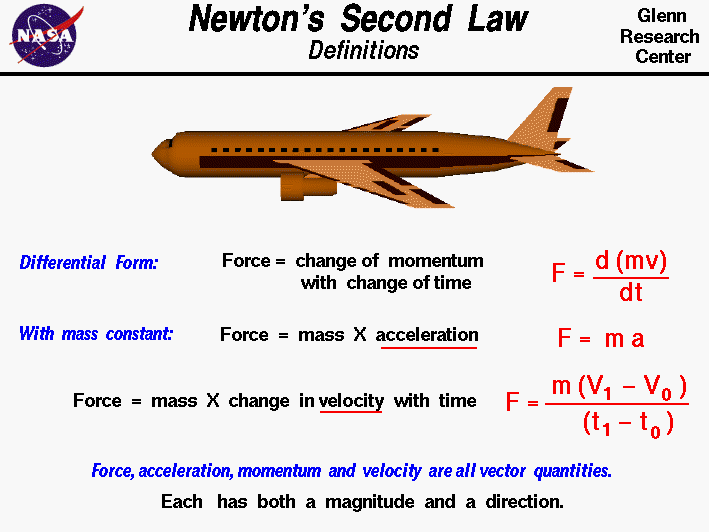
Trajectory analysis relies on classical mechanics, especially Newton’s laws. The Second Law of Newton ((\vec{F} = m\vec{a})) provides the fundamental relationship between the forces on an object and its acceleration, forming the basis for all trajectory predictions.
Kinematic equations relate displacement, velocity, acceleration, and time for constant acceleration, crucial for analyzing projectile motion. The superposition principle allows independent treatment of motion along each axis, simplifying calculations when forces (like gravity) act only in one direction.
When forces vary (due to air resistance, wind, or gravity changes), trajectory equations become differential equations, solved either analytically (for simple cases) or numerically (for complex, real-world scenarios). In aviation, trajectory management is addressed in ICAO’s Performance-Based Navigation (PBN) and Trajectory-Based Operations (TBO), requiring precise 4D planning for safety and efficiency.
Types of Trajectories
Trajectories are classified based on the acting forces and boundary conditions:
- Rectilinear Trajectory: Straight-line motion, as with a vehicle at constant speed on a level road, or a spacecraft coasting in deep space.
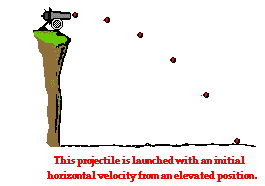
- Parabolic Trajectory: The classic path of a projectile under gravity with negligible air resistance (e.g., thrown ball, cannon shell).
- Circular Trajectory: Constant-radius motion under a centripetal force (e.g., satellite in low orbit, aircraft in a steady turn).
- Elliptical Trajectory: Bound orbits, such as planets around the sun or satellites around Earth.
- Hyperbolic/Escape Trajectory: Open, non-returning paths when object velocity exceeds escape velocity (e.g., interplanetary probes).
- Spiral Trajectory: Decaying or expanding orbits, such as satellites re-entering due to drag.
| Type | Description | Example Usecase |
|---|---|---|
| Rectilinear | Straight line | Deep space travel, straight cruise flight |
| Parabolic | Symmetric U-shape | Thrown ball, artillery shell |
| Circular | Constant-radius curve | Satellite orbit, aircraft holding pattern |
| Elliptical | Oval-shaped orbit | Planetary orbits, Hohmann transfers |
| Hyperbolic | Open, non-return | Comet escape, interplanetary probe |
| Spiral | Decaying/expanding orbit | Satellite reentry, spiral descent |
Mathematical Analysis of Trajectory
Decomposition of Motion
For an object launched at speed (v_0) and angle (\theta):
[ v_{0x} = v_0 \cos\theta, \quad v_{0y} = v_0 \sin\theta ]
- Horizontal Motion: (x = v_{0x} t) (constant velocity)
- Vertical Motion: (y = v_{0y} t - \frac{1}{2} g t^2) (accelerated by gravity)
Trajectory Equation:
[ y = x \tan\theta - \frac{g x^2}{2 v_0^2 \cos^2\theta} ]
Key Quantities
- Time of Flight: (T = \frac{2 v_0 \sin\theta}{g})
- Maximum Height: (H = \frac{v_0^2 \sin^2\theta}{2g})
- Horizontal Range: (R = \frac{v_0^2 \sin(2\theta)}{g})
With air resistance or varying forces, trajectory equations become more complex and require numerical solutions, crucial for realistic flight path predictions and advanced aviation systems.
Stepwise Problem-Solving Method for Projectile Trajectories
- Resolve Initial Velocity: Use trigonometry to find (v_{0x}) and (v_{0y}).
- Separate Motions: Treat horizontal (constant velocity) and vertical (constant acceleration) motions independently.
- Apply Kinematic Equations: Solve for unknowns (displacement, time, velocity).
- Combine Results: Use time as a common variable to connect vertical and horizontal motion.
For resultant velocity at any instant:
[ |\vec{v}| = \sqrt{v_x^2 + v_y^2}, \quad \phi = \tan^{-1}(v_y/v_x) ]
Aviation systems routinely use similar stepwise algorithms for trajectory-based navigation and conflict detection.
Worked Examples
Example 1: Trajectory of a Thrown Ball
A ball is thrown at (20,\text{m/s}) and (30^\circ):
- Time of flight: (T \approx 2.04,\text{s})
- Maximum height: (H \approx 5.10,\text{m})
- Horizontal range: (R \approx 35.35,\text{m})
Example 2: Fireworks Shell
A shell is fired at (70.0,\text{m/s}) and (75.0^\circ):
- Maximum height: (H \approx 233,\text{m})
- Time to max height: (t_{up} \approx 6.90,\text{s})
- Horizontal distance at max height: (x \approx 125,\text{m})
Applications & Contexts
- Sports: Optimizing throws and shots (e.g., basketball, golf).
- Engineering: Designing projectile paths, robots, and fountains.
- Space Science: Orbit and mission planning for satellites and probes.
- Military & Ballistics: Artillery, missile guidance, fire-control.
- Aviation: Flight path prediction, air traffic management, collision avoidance.
- Physics Research: Particle accelerators, laboratory experiments.
Review/Key Points
- A trajectory is the path of a moving object, shaped by initial conditions and external forces.
- Projectile motion is parabolic under gravity (no air resistance).
- Motions along horizontal and vertical axes are independent in ideal cases.
- Maximum range (no air resistance) is achieved at a (45^\circ) launch angle.
- Real-world trajectories are affected by drag, wind, and complex forces.
- Trajectory analysis underpins flight planning, navigation, and safety in aviation and aerospace.
Glossary of Related Terms
Projectile:
An object propelled into space and moving under only gravity and air resistance after launch.
Ballistics:
The science of the motion of projectiles.
Orbital Mechanics:
The study of trajectories of objects under gravitational influence in space.
Kinematics:
The branch of mechanics describing motion without regard to its causes.
Trajectory-Based Operations (TBO):
ICAO initiative for managing aircraft in airspace using 4D trajectory prediction for enhanced safety and efficiency.
Flight Path:
The route an aircraft, spacecraft, or projectile follows through space.
Range:
The horizontal distance traveled by a projectile.
Apogee/Perigee:
The highest/lowest point in an elliptical trajectory, especially in orbital mechanics.
4D Trajectory:
A path defined in three spatial dimensions plus time, crucial for modern aviation navigation.
Newton’s Laws:
Fundamental principles governing the motion and trajectory of objects.
For a deeper dive into trajectory science or to discuss aviation applications, reach out to our team or schedule a demo!
Frequently Asked Questions
- What is a trajectory in physics?
- A trajectory in physics is the path that an object follows through space as a function of time, determined by its initial position, velocity, direction, and the forces acting on it. Trajectories can be straight or curved, such as the parabolic arc of a thrown ball or the elliptical orbit of a satellite.
- How is a trajectory calculated?
- Trajectories are calculated by applying Newton’s laws of motion and kinematic equations. For simple projectile motion under gravity, you resolve the initial velocity into horizontal and vertical components, use equations for constant acceleration, and combine results to get the full path. More complex cases (air resistance, variable forces) require solving differential equations, often using computational methods.
- What are some real-world applications of trajectory analysis?
- Trajectory analysis is critical in aviation (flight path planning, air traffic control), space science (orbital insertion, satellite navigation), sports (ball trajectory optimization), engineering (robotics, fountains), and military applications (ballistics, missile guidance). Accurate trajectory prediction ensures safety, efficiency, and mission success in these fields.
- How does air resistance affect a trajectory?
- Air resistance (drag) opposes the motion of an object, causing it to decelerate. This shortens the range and lowers the maximum height compared to ideal projectile motion without air resistance, and distorts the path from a perfect parabola to a more complex curve.
- What is a 4D trajectory in aviation?
- A 4D trajectory in aviation specifies an aircraft's position in three spatial dimensions plus time. It's used for precise flight planning, conflict detection, and airspace optimization, allowing for improved safety and efficiency in modern air traffic management systems.
This is a reference entry. TarmacView provides drone inspection services and doesn't sell the equipment or materials described in this glossary.