What is Voids Filled with Asphalt (VFA)?
What is Voids Filled with Asphalt (VFA)?
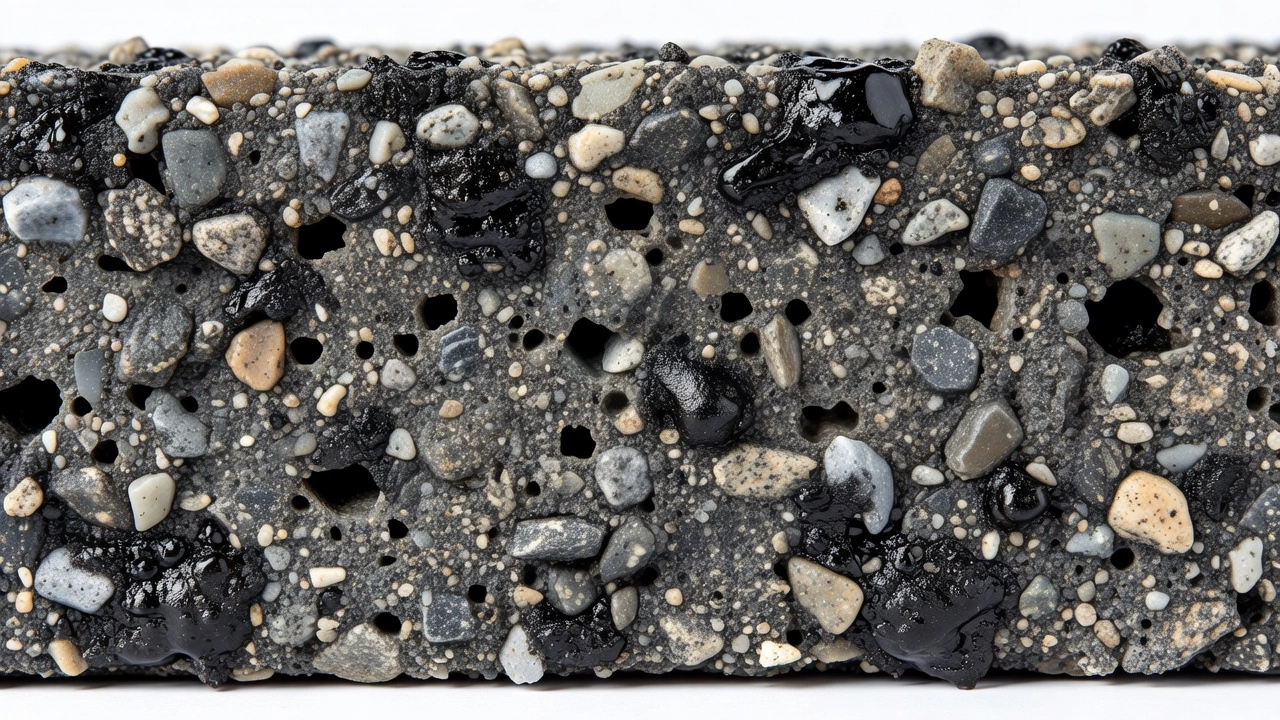
Voids Filled with Asphalt (VFA) is a derived volumetric parameter in asphalt mix design that expresses the percentage of the intergranular void space between aggregate particles, known as Voids in Mineral Aggregate (VMA), that is occupied by effective asphalt binder rather than by air. VFA is one of the four primary volumetric criteria used in the Superpave mix design system, alongside air voids (Va), Voids in Mineral Aggregate (VMA), and dust-to-binder ratio. It is also a standard parameter in the Marshall mix design method, where it is sometimes referred to as the asphalt-void ratio.
VFA is fundamentally a durability indicator because it reflects the relative volume of binder available to coat the aggregate particles within the compacted mixture. The binder coating protects the aggregate from moisture intrusion, provides adhesion between particles, and resists the oxidative aging effects of air infiltration. A mixture with adequate VFA has thick enough binder films to maintain these protective functions over the service life of the pavement. A mixture with low VFA has thin binder films that age rapidly and lose their adhesive properties, leading to raveling (the progressive dislodgement of aggregate particles from the pavement surface). A mixture with excessively high VFA has insufficient air void space remaining within the VMA, creating the risk that additional compaction under traffic will force binder to the pavement surface in a distress known as bleeding or flushing.
The VFA parameter is closely related to VMA and air voids through a simple mathematical relationship. At the standard design air void content of 4.0% (the target for both Superpave and Marshall designs), the VFA value is determined solely by the VMA. For example, a VMA of 14.0% with 4.0% air voids yields a VFA of 71.4%. A VMA of 15.0% with the same 4.0% air voids yields a VFA of 73.3%. This illustrates why VMA requirements must be adequate, insufficient VMA forces the VFA too high at the design air voids, creating bleeding risk, while excessive VMA may force VFA too low, creating durability concerns.
VFA requirements are specified in AASHTO M 323 (Standard Specification for Superpave Volumetric Mix Design) and vary with traffic level expressed in millions of Equivalent Single Axle Loads (ESALs) . The standard VFA range for low-traffic pavements (less than 0.3 million ESALs) is 70-80% , while for high-traffic pavements (3 million ESALs and above) the range narrows to 65-75% . This narrowing reflects the need for more air void space within the VMA at higher traffic levels to accommodate the additional densification that occurs under repeated heavy loading without causing bleeding.
Definition and Relationship to VMA and Air Voids
VFA is mathematically defined as the ratio of effective binder volume to the total volume of intergranular void space in the compacted mixture, expressed as a percentage. Understanding VFA requires understanding the three-component volumetric model of compacted asphalt: aggregate, asphalt binder, and air. In this model, the aggregate particles form a skeletal structure with spaces between them, these spaces constitute the VMA. Within the VMA, some space is occupied by the effective asphalt binder (the portion of the total binder that is not absorbed into the aggregate pores), and the remaining space constitutes the air voids.
The governing equation for VFA is:
VFA (%) = (VMA - Va) / VMA × 100
Where:
- VMA = Voids in Mineral Aggregate, expressed as a percentage of the total specimen volume
- Va = Air voids, expressed as a percentage of the total specimen volume
This equation can also be expressed in terms of binder volume:
VFA (%) = Vbe / (Va + Vbe) × 100
Where:
- Vbe = volume of effective asphalt binder (total binder volume minus absorbed binder volume)
- Va = volume of air voids
The relationship between VFA, VMA, and air voids is fundamentally interdependent. From the equation, it is clear that for any given VMA value, VFA increases as air voids decrease, and VFA decreases as air voids increase. This relationship is why VFA is described as a derived parameter, its value is determined by the two independently measured volumetric properties.
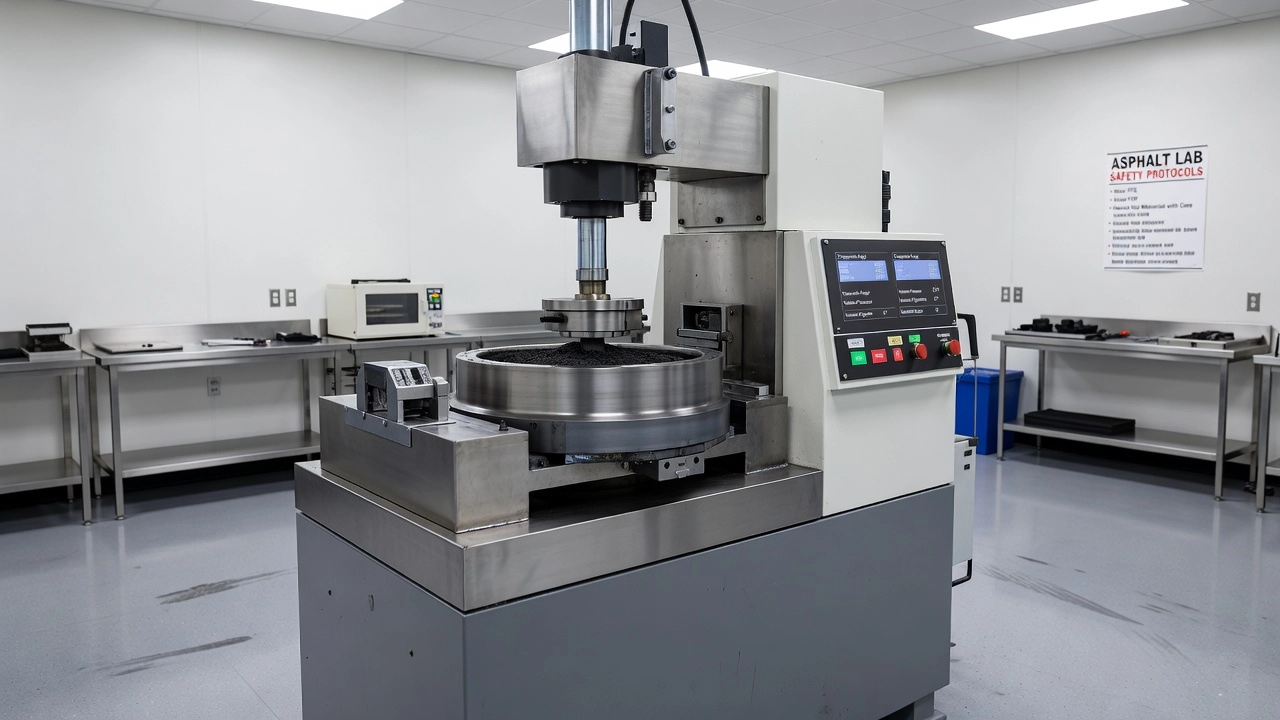
The VMA represents the total void space available within the compacted aggregate structure. This space must accommodate both the asphalt binder and the air voids. AASHTO M 323 defines VMA as the volume of intergranular void space between the aggregate particles of a compacted paving mixture that includes the air voids and the effective binder content, expressed as a percent of the total volume of the specimen. Minimum VMA requirements range from 11% for 37.5 mm NMAS to 16% for 4.75 mm NMAS. These minimums ensure that sufficient space exists within the aggregate structure to accommodate an adequate volume of asphalt binder for durability while maintaining the target air void content.
The air voids (Va) represent the small pockets of air between the coated aggregate particles. The target air void content in Superpave mix design is 4.0% at Ndesign, with some agencies specifying a range of 3-5% for acceptance. In the Marshall method, the target air voids range from 3-5% depending on traffic level and surface versus base course application. The air voids are essential for providing space for the binder to flow into during additional compaction under traffic and for preventing bleeding.
The interdependence of VFA, VMA, and air voids means that if any two of these three parameters are known, the third can be calculated. This relationship is the foundation of the volumetric design process. In mix design, the designer works with binder content as the primary variable, while the resulting VMA, air voids, and VFA are calculated from density measurements. At the design binder content (where air voids = 4.0%), the VMA and VFA must both meet their respective requirements.
The Colorado Asphalt Pavement Association technical document on volumetrics provides this practical explanation: VFA is related to VMA and air voids (Pa), as can be seen from the equation. A low VFA may result from high air voids, and a high VFA may result from low air voids. This relationship reinforces the importance of achieving proper VMA, if the VMA is too low, the designer has limited room to maneuver with binder content before either exceeding the maximum air voids or falling below the minimum VFA.
VFA Calculation
The calculation of VFA requires three fundamental laboratory measurements on the compacted asphalt mixture: the bulk specific gravity of the compacted mixture (Gmb) , the theoretical maximum specific gravity of the loose mixture (Gmm) , and the bulk specific gravity of the combined aggregate (Gsb) . These measurements are obtained through standardized AASHTO test procedures.
Step 1: Calculate Air Voids (Va)
The air void content is calculated from the bulk specific gravity (Gmb) and the theoretical maximum specific gravity (Gmm):
Va (%) = 100 × [1 - (Gmb / Gmm)]
The theoretical maximum specific gravity (Gmm) is determined using AASHTO T 209 (Theoretical Maximum Specific Gravity and Density of Hot-Mix Asphalt), commonly referred to as the Rice test. In this test, a loose sample of the asphalt mixture is placed in a vacuum pycnometer, and the air is evacuated to fill the voids with water. The Gmm represents the specific gravity of the mixture with zero air voids, the maximum density achievable.
The bulk specific gravity (Gmb) of the compacted specimen is determined using AASHTO T 166 (Bulk Specific Gravity of Compacted Hot-Mix Asphalt Using Saturated Surface-Dry Specimens). The compacted specimen is weighed dry, then submerged in water to determine its volume by water displacement, and the bulk specific gravity is calculated as the ratio of the mass to the volume.
Step 2: Calculate Voids in Mineral Aggregate (VMA)
VMA is calculated using the following formula:
VMA (%) = 100 - (Gmb × Ps / Gsb)
Where:
- Gmb = bulk specific gravity of the compacted mixture
- Ps = aggregate content, expressed as a percentage of the total mixture mass (100 - Pb, where Pb is the asphalt binder content by total mass)
- Gsb = bulk specific gravity of the combined aggregate, determined per AASHTO T 84 (fine aggregate) and AASHTO T 85 (coarse aggregate)
The bulk specific gravity of the aggregate (Gsb) accounts for the water-permeable voids within the aggregate particles. This is important because the absorbed asphalt binder occupies these permeable voids and does not contribute to the effective binder that coats the particle surfaces. A higher Gsb (less absorptive aggregate) means more of the total binder content is available as effective binder.
Step 3: Calculate Voids Filled with Asphalt (VFA)
With Va and VMA determined, VFA is calculated:
VFA (%) = (VMA - Va) / VMA × 100
The Washington State Department of Transportation (WSDOT) Materials Manual (TM 13) provides the following calculation format for VFA:
VFA = 100 × (VMA - Va) / VMA
Where VFA is reported to 1 decimal place.
Numerical Example:
Consider a Superpave mix design with the following values at optimum binder content:
- Gmb = 2.380
- Gmm = 2.479
- Gsb = 2.650
- Binder content (Pb) = 5.2%
- Aggregate content (Ps) = 94.8%
Step 1: Va = 100 × [1 - (2.380 / 2.479)] = 100 × (1 - 0.960) = 4.0%
Step 2: VMA = 100 - (2.380 × 94.8 / 2.650) = 100 - (225.6 / 2.650) = 100 - 85.1 = 14.9%
Step 3: VFA = (14.9 - 4.0) / 14.9 × 100 = 10.9 / 14.9 × 100 = 73.2%
At 73.2%, this VFA falls within the typical specification range of 65-78% for traffic levels from 0.3 to 30 million ESALs.
VFA Calculation from Effective Binder Content:
The VFA can also be calculated directly from the effective binder volume:
VFA (%) = Vbe / (Va + Vbe) × 100
Where Vbe (effective binder content by volume) is calculated as:
Vbe = (Gmb × Pbe) / Gb
Where:
- Pbe = effective asphalt binder content as a percentage of total mixture mass
- Gb = specific gravity of the asphalt binder (typically 1.02-1.04)
The effective binder content (Pbe) accounts for binder absorption into the aggregate pores:
Pbe = Pb - (Pba / 100) × Ps
Where:
- Pba = absorbed asphalt content, expressed as a percentage of aggregate mass
- Pb = total asphalt binder content by total mixture mass
- Ps = aggregate content by total mixture mass
The absorbed asphalt content (Pba) is determined from the aggregate specific gravities:
Pba = 100 × [(Gse - Gsb) / (Gse × Gsb)] × Gb
Where Gse is the effective specific gravity of the aggregate, calculated from Gmm and binder content:
Gse = (100 - Pb) / [(100 / Gmm) - (Pb / Gb)]
This more detailed calculation is necessary when evaluating whether the binder content is sufficient to provide adequate film thickness on the aggregate particles. The effective binder content is the binder that is actually available to form the adhesive film, the binder absorbed into the aggregate pores does not contribute to either film thickness or VFA.
VFA Specification Range
Per AASHTO M 323 (Standard Specification for Superpave Volumetric Mix Design), the VFA requirements are specified as a function of the design traffic level expressed in millions of Equivalent Single Axle Loads (ESALs) over a 20-year design period. The specification recognizes that higher traffic levels require more stringent control of VFA to prevent both bleeding and durability issues.
| 20-Year Design Traffic (million ESALs) | VFA Range (percent) |
|---|---|
| Less than 0.3 | 70 - 80 |
| 0.3 to less than 3 | 65 - 78 |
| 3 to less than 10 | 65 - 75 |
| 10 to less than 30 | 65 - 75 |
| 30 or greater | 65 - 75 |
For 9.5 mm nominal maximum aggregate size (NMAS) mixtures at design traffic levels ≥3 million ESALs, AASHTO M 323 specifies a narrower VFA range of 73-76%. This tighter range reflects the greater sensitivity of finer mixtures to binder content variations and the higher surface area of 9.5 mm NMAS aggregates that requires more precise control of binder volume.
The VFA ranges in AASHTO M 323 were developed based on extensive field experience and laboratory research conducted during the Strategic Highway Research Program (SHRP) and subsequent validation studies. The National Cooperative Highway Research Program (NCHRP) Report 573 (Verification of Gyration Levels in the Ndesign Table) provided extensive field validation data supporting these VFA requirements, demonstrating that mixtures meeting the specified VFA ranges generally perform well under real-world traffic conditions.
Changes in VFA Requirements Over Time: The original Superpave specification published in the 1990s included different VFA ranges than the current AASHTO M 323. The original specification for traffic levels from 3 to less than 10 million ESALs was 65-78% , but this was revised to 65-75% in later editions based on performance data showing that the upper end of the range was associated with bleeding and rutting in some field sections. Recent revisions to AASHTO R 35 and AASHTO M 323 have further refined the VFA requirements, with some agencies adopting modified ranges based on local experience. The NECEPT (Northeast Center for Excellence in Pavement Technology) Superpave training program documents that revised VFA ranges have been incorporated into the latest AASHTO specification updates.
The VFA range is also adjusted for different mix types in the Marshall mix design method. The Asphalt Institute MS-2 (Mix Design Methods for Asphalt Concrete) provides the following Marshall VFA criteria:
| Traffic Level | VFA Range (%) |
|---|---|
| Light traffic (surface course) | 70 - 80 |
| Medium traffic | 65 - 78 |
| Heavy traffic | 65 - 75 |
Note that these ranges are essentially identical to the Superpave ranges, reflecting the common understanding among asphalt technologists of the appropriate binder fill level for different traffic conditions regardless of the design method used.
The VFA specification must be understood in the context of the overall volumetric design criteria. At the design binder content where air voids equal 4.0%, the VFA is determined by the VMA value. The relationship can be expressed as:
- If VMA = 12.0% and Va = 4.0%, then VFA = 66.7%
- If VMA = 13.0% and Va = 4.0%, then VFA = 69.2%
- If VMA = 14.0% and Va = 4.0%, then VFA = 71.4%
- If VMA = 15.0% and Va = 4.0%, then VFA = 73.3%
- If VMA = 16.0% and Va = 4.0%, then VFA = 75.0%
This demonstrates that the VFA requirements constrain the minimum VMA that can be used for a given traffic level. For high-traffic pavements requiring VFA ≤75%, the VMA must be at least 16.0% if the VFA must also be ≥65%. However, the minimum VMA for 9.5 mm NMAS is 15.0%, which at 4.0% air voids gives VFA = 73.3%, within the acceptable range. For 37.5 mm NMAS with minimum VMA of 11.0%, VFA at 4.0% air voids is 63.6%, which is below the 65% VFA minimum for all traffic levels, meaning that mixes with 37.5 mm NMAS must exceed the minimum VMA to meet VFA requirements.
Note 9 of AASHTO M 323 provides important guidance: If the estimated design traffic level is between 3 and less than 10 million ESALs, and the mixture is designed with a 9.5 mm NMAS, agencies may use a VFA range of 73-76%. This note recognizes the challenges of meeting both VMA and VFA requirements with fine-graded 9.5 mm mixtures under higher traffic levels.
Low VFA, Thin Binder Films, Raveling, and Oxidation
When VFA is below the specified minimum (typically 65%), the mixture contains insufficient asphalt binder to adequately fill the void space within the aggregate structure. The consequence is that the binder film thickness on aggregate particles is reduced, and the binder films become thin enough to compromise the durability and integrity of the pavement.
Binder Film Thickness: The binder film thickness is the average thickness of the asphalt coating surrounding the aggregate particles. It is calculated by dividing the effective binder volume by the total surface area of the aggregate in the mixture. While VFA is not a direct measure of film thickness, there is a strong correlation between the two parameters, low VFA consistently corresponds to thin binder films. Research by Kandhal and Chakraborty and Sengoz and Agar has established that minimum film thickness values of 8-10 microns are necessary for adequate durability, with thicker films (9-10 microns) recommended for mixtures exposed to severe environmental conditions.
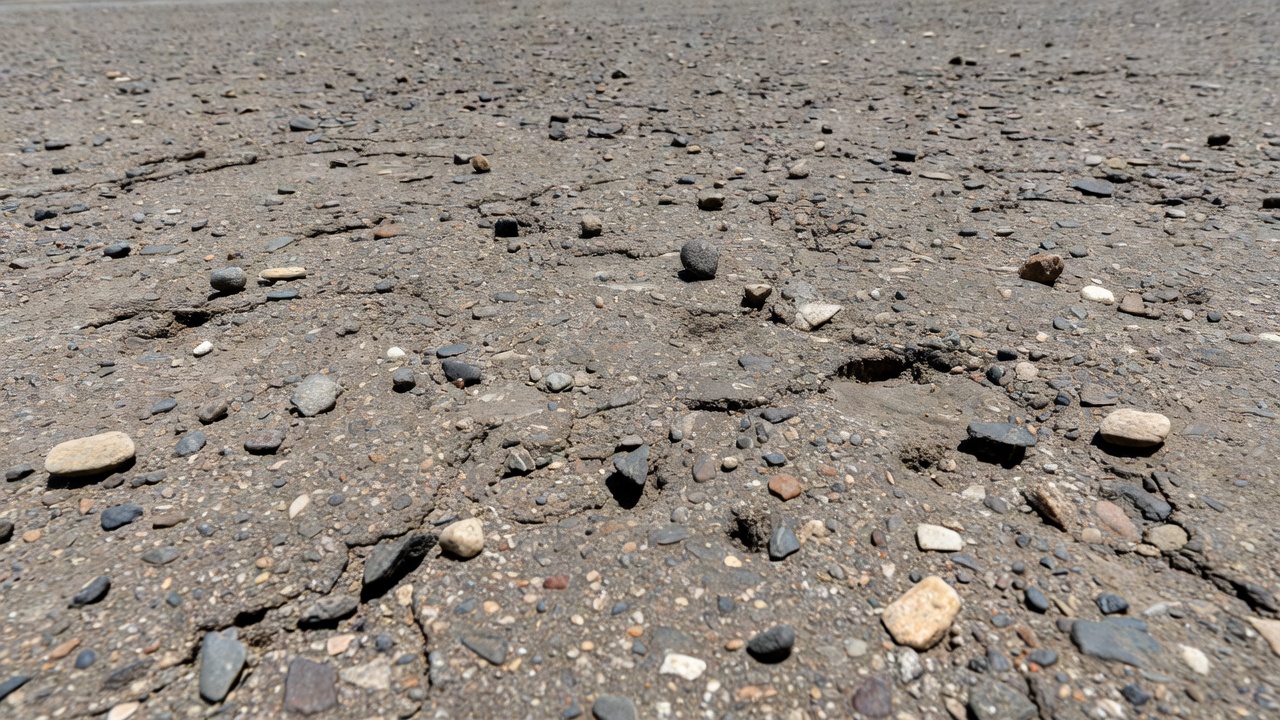
Oxidative Aging: Thin binder films are more susceptible to oxidative aging because oxygen from the air can more readily penetrate the entire film thickness. The oxidation process causes the asphalt binder to become harder and more brittle over time. The rate of oxidation is inversely proportional to the film thickness, thin films age much faster than thick films. The Strategic Highway Research Program (SHRP) research on binder aging demonstrated that the aging rate increases significantly when film thickness falls below 6-8 microns. The aging process is accelerated at high pavement temperatures and in sunny climates with high UV exposure. As the binder oxidizes and becomes brittle, the pavement loses its ability to flex under traffic loads, leading to fatigue cracking and block cracking.
Raveling: The most visible distress associated with low VFA is raveling, the progressive loss of aggregate particles from the pavement surface. Raveling begins when the thin binder films lose their adhesive bond to the aggregate particles, either through oxidative embrittlement or moisture damage. Individual aggregate particles become dislodged by traffic, leaving small depressions on the surface. As more particles are lost, the surface texture becomes rough and open, accelerating further aggregate loss. In severe cases, raveling can progress to the point where the surface texture is deeply pitted and loose aggregate creates a foreign object debris (FOD) hazard for aircraft operations on airport pavements.
The Colorado Asphalt Pavement Association technical document explains this mechanism explicitly: “If the VFA is too low, there is not enough asphalt to provide durability and to over-densify under traffic and bleed.” This succinctly captures the two-sided nature of the VFA requirement, it must be high enough to ensure binder film thickness adequate for durability, but not so high as to risk bleeding.
Moisture Damage Risk: Low VFA mixtures are also more susceptible to moisture damage (stripping) . Thin binder films provide less coating coverage on aggregate particles, leaving more aggregate surface area exposed to water infiltration. Water can penetrate the binder-aggregate interface and displace the binder, causing stripping of the binder from the aggregate. The combination of thin films and moisture damage can accelerate pavement deterioration significantly, particularly in climates with frequent rainfall or freeze-thaw cycles.
Low VFA in Pavement Inspection: During visual pavement condition surveys, the indicators of low VFA include:
- Surface raveling: loose aggregate particles on the pavement surface, rough texture
- Weathering: surface discoloration, loss of binder from the surface exposing aggregate
- Open surface texture: visible void spaces between aggregate particles at the surface
- Fretting: fine aggregate loss from the surface, creating a dusty or sandy appearance
- Early cracking: fine longitudinal or block cracking developing prematurely
These distresses are observable during routine Pavement Condition Index (PCI) surveys conducted per ASTM D5340 (Standard Test Method for Airport Pavement Condition Index Surveys) and ASTM D6433 (Standard Practice for Roads and Parking Lots Pavement Condition Index Surveys). The inspection of raveling at severity levels from low (beginning loss of fine aggregate) to high (coarse aggregate loss creating significant surface depressions) provides indirect evidence that the in-place VFA may be below optimal levels.
High VFA, Bleeding, Flushing, and Instability
When VFA exceeds the specified maximum (typically 78-80%), the mixture has insufficient air void space remaining within the VMA to accommodate the asphalt binder. This condition creates a pavement that is overly rich in binder, with the potential for several distinct distress mechanisms that compromise both structural performance and functional safety.
Bleeding (Flushing): The primary distress associated with high VFA is bleeding, also called flushing or fat spots. Bleeding occurs when the air voids in the pavement are nearly or completely filled with asphalt binder, and additional compaction under traffic forces the excess binder to the pavement surface. The binder accumulates on the surface as a shiny, sticky film that progressively darkens and thickens over time as more binder is extruded from the mixture under repeated traffic loading. Unlike some pavement distresses, bleeding is not reversible during cold weather or periods of low loading, once the binder has been forced to the surface, it remains there and continues to accumulate.
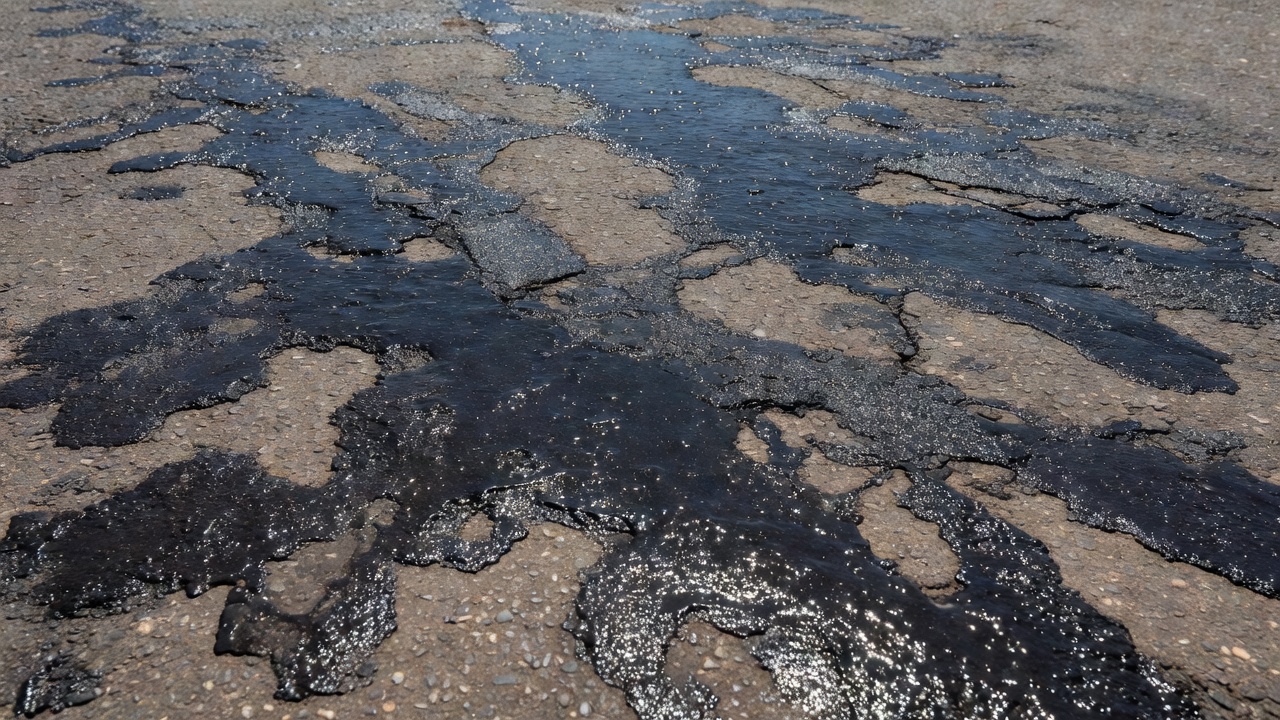
Friction Reduction: Bleeding creates a smooth, polished surface with significantly reduced skid resistance and surface friction. The excess binder fills the macrotexture of the pavement surface, eliminating the surface texture that provides tire-pavement friction. On airport runways, the reduction in friction during wet conditions can substantially increase aircraft landing distance and compromise directional control during crosswind landings. The FAA Advisory Circular 150/5320-12C (Measurement, Construction, and Maintenance of Skid-Resistant Airport Pavement Surfaces) addresses the hazards of low-friction pavement surfaces, emphasizing the importance of maintaining adequate macrotexture for aircraft braking performance. The ICAO Aerodrome Design Manual (Doc 9157, Part 3) similarly addresses the safety implications of reduced friction on runway surfaces.
Hydroplaning Risk: Bleeding substantially increases the risk of hydroplaning, the condition where a layer of water builds up between the aircraft tire and the pavement surface, causing the tire to lose contact with the pavement. The FAA identifies hydroplaning as a critical safety concern on airport runways, particularly during heavy rain events when standing water cannot drain from the smooth, binder-rich surface. The California Bearing Ratio (CBR) method of pavement design addresses drainage requirements, but bleeding directly undermines the surface drainage function by filling the texture that provides water egress pathways.
Rutting (Permanent Deformation): High VFA mixtures are susceptible to rutting, the accumulation of permanent deformation in the wheel paths under repeated traffic loading. When the air voids are reduced below approximately 2-3%, the mixture has insufficient void space to accommodate the lateral displacement of binder and aggregate under load. The excess binder acts as a lubricant within the aggregate structure, allowing aggregate particles to slide past one another and densify further. As the mixture densifies, the surface level drops in the wheel paths, creating longitudinal depressions (ruts) that can compromise pavement serviceability. The AASHTO R 35 requirement that air voids at Nmax must be ≥2.0% is specifically intended to prevent this condition, if the laboratory density at Nmax approaches 98% of theoretical maximum density (the point at which VFA would approach 100%), the mixture is considered too compactable for field use.
Tender Mix Behavior: High VFA mixtures often exhibit tender mix behavior during construction, they are difficult to compact because the binder acts as a lubricant, and the mat may shove or move under the roller rather than densifying properly. The mixture may fail the Ninitial requirement of the Superpave gyratory compactor, which specifies that at 8 gyrations (for medium traffic), the density must be ≤89.0% of theoretical maximum density. Mixtures that compact too quickly at Ninitial are likely to be tender in the field and unstable under traffic.
Pavement Inspection Indicators of High VFA:
During visual condition surveys, the indicators of high VFA include:
- Surface bleeding: shiny, black, sticky surface that may be tacky to the touch
- Fat spots: localized areas of concentrated binder accumulation
- Loss of surface texture: smooth appearance with no visible aggregate
- Wheel path rutting: longitudinal depressions in the wheel paths
- Surface deformation: horizontal displacement of the surface in the wheel paths
- Reflective appearance: glossy surface that reflects light (particularly visible on sunny days)
The Ohio Department of Transportation (ODOT) Pavement Condition Rating System (Appendix A, Distresses in Flexible Pavements) classifies bleeding into severity levels: Low (a thin film of asphalt on the surface causing slight discoloration) and High (a thick film covering a significant area with a shiny, reflective surface that may be tacky). The ODOT system notes that bleeding is caused by an excess amount of bituminous binder in the mixture and/or low air void content, directly linking the distress to high VFA conditions.
VFA and Binder Film Thickness
The relationship between VFA and binder film thickness is fundamental to understanding why VFA is such a critical mix design parameter. While VFA measures the percentage of void space filled with binder, the binder film thickness measures the actual thickness of the asphalt coating around the aggregate particles. These two parameters are correlated but not identical, VFA is a volumetric property of the entire mixture, while film thickness is a surface property of the aggregate particles.
Calculating Binder Film Thickness:
The average binder film thickness (TF) is calculated as:
TF (microns) = (Vbe × 1000) / (SA × Ws)
Where:
- Vbe = effective binder volume (cm³ per 100g of mixture)
- SA = surface area of the aggregate (m²/kg)
- Ws = mass of aggregate per 100g of mixture (g)
- 1000 = conversion factor from mm to microns
The surface area (SA) of the aggregate is estimated from the gradation using the Hveem surface area factors:
| Sieve Size | Surface Area Factor (m²/kg) |
|---|---|
| 4.75 mm (No. 4) | 0.41 |
| 2.36 mm (No. 8) | 0.82 |
| 1.18 mm (No. 16) | 1.64 |
| 600 µm (No. 30) | 2.87 |
| 300 µm (No. 50) | 6.14 |
| 150 µm (No. 100) | 12.29 |
| 75 µm (No. 200) | 32.77 |
For aggregate passing the 75 µm (No. 200) sieve, additional surface area factors are applied based on the percentage passing (typically 41-55 m²/kg per percent passing).
Relationship Between VFA and Film Thickness:
Research has consistently demonstrated that VFA and film thickness are correlated but not equivalent. A mixture with high VFA may still have thin binder films if the aggregate surface area is very high (such as in fine-graded mixes with high fines content). Conversely, a mixture with moderate VFA may have thick binder films if the aggregate is coarse with low surface area. This distinction is important because film thickness is the more fundamental indicator of durability, but VFA is easier to calculate and control in routine mix design and quality control.
Kandhal and Chakraborty conducted extensive research on the relationship between VMA, film thickness, and aging characteristics, finding that:
- Mixtures with film thickness less than 8 microns experienced rapid aging and durability loss
- Mixtures with film thickness between 9-10 microns provided optimal durability for most applications
- Mixtures with film thickness greater than 10 microns provided additional aging resistance but risked bleeding if VMA was inadequate
These findings are consistent with the VFA requirements in AASHTO M 323, which effectively constrain the film thickness within a range that provides adequate durability without excessive bleeding risk. For a typical dense-graded Superpave mix with 4% air voids and VMA of 13-15%, the corresponding film thickness typically ranges from 8-12 microns, which aligns with the recommended range from the research literature.
The ODOT research report on VMA and film thickness (cited in various technical publications) noted that the VFA requirement would allow a pavement to be constructed with as little as 3.76% asphalt content in some cases, which was considered too low for adequate field performance. This concern led to the recommendation that film thickness should be considered as an additional design criterion where durability is a primary concern, such as in airport pavements exposed to high tire pressures and jet blast.
VFA in Airport Mix Designs
Airport asphalt mixtures designed under the FAA P-401 specification (Plant Mix Bituminous Pavements, AC 150/5370-10H) incorporate VFA as a key volumetric design parameter. The FAA recognizes that airport pavements operate under different loading conditions than highways, including higher loads, higher tire pressures, and wider temperature ranges, and the VFA requirements are tailored accordingly.
FAA P-401 VFA Requirements: The FAA P-401 specification requires that mix designs for airport pavements meet VFA ranges that are generally consistent with AASHTO M 323 requirements. For P-401 Gradation 1 (19.0 mm NMAS, used for heavy-load pavements), the typical VFA range is 65-78% . For Gradation 2 (12.5 mm NMAS) and Gradation 3 (9.5 mm NMAS), the VFA ranges are adjusted based on the specific traffic level of the airport.
The FAA differentiates between mix design methods in P-401:
- Marshall mix design: uses the 75-blow Marshall compaction for heavy aircraft pavements, with VFA targets of 65-78%
- Superpave mix design: uses the Superpave Gyratory Compactor with gyration levels of 50 (general aviation) to 75 (commercial service), with VFA per AASHTO M 323
Grade Bumping for Airport Binders: The FAA requires grade bumping of PG binders for airport applications to account for the higher tire pressures of aircraft (100-300 psi for aircraft compared to 100-130 psi for truck tires). The grade bumping may shift the binder to a higher high-temperature grade, which changes the binder stiffness and alters the optimal VFA range. Stiffer binders (higher PG grades) can tolerate higher VFA values without bleeding because they are more resistant to flow under load. However, the FAA specifications maintain the standard VFA ranges regardless of the binder grade used, meaning that the VFA design target must be met with the selected binder grade.
Performance Testing Requirements: The FAA now includes performance testing requirements for airport mix designs, using the Asphalt Pavement Analyzer (APA) per AASHTO T 340 or the Hamburg Wheel Tracking Test per AASHTO T 324. These performance tests provide direct validation that the mixture (with its specific VFA) is resistant to rutting under simulated aircraft loading. The FAA specification requires a maximum rut depth of 10 mm at 4,000 passes in the APA at 250 psi hose pressure and 64°C. Mixtures that meet the VFA specification but fail the APA rutting test must be redesigned, indicating that VFA alone is not sufficient to ensure performance.
Airfield Pavement Durability Considerations: Airport pavements are exposed to unique environmental and operational conditions that affect the relationship between VFA and performance:
- Jet blast: High-velocity jet engine exhaust can erode thin binder films, accelerating raveling in low-VFA mixes
- Fuel spills: Jet fuel is a solvent for asphalt binder, and spills can dissolve and wash away binder, particularly in mixtures with thin films
- Deicing fluids: Chemical deicing fluids can soften the binder and reduce its viscosity, potentially causing bleeding in high-VFA mixtures
- High tire pressures: Concentrated loads from aircraft tires can force binder to the surface in high-VFA mixtures
- Rapid temperature changes: Aircraft braking generates localized high temperatures that can soften the binder and increase bleeding risk
The Yellowstone Airport Asphalt Study and other airfield pavement research have demonstrated that airport mixes with VFA values consistently below 65% exhibited premature raveling and aggregate loss within 3-5 years of service, particularly in the runway touchdown zones where aircraft braking and jet blast are concentrated. Conversely, airport mixes with VFA values above 78% in the wheel path areas developed bleeding within 2-3 years, requiring surface treatment to restore friction.
The FAA Airport Pavement Technology Program (AAPTP) Project 06-03 on performance-based specifications for HMA airfield pavements identified mix volumetrics (including VFA) as key Acceptance Quality Characteristics (AQCs) that should be measured during construction and linked to pavement performance predictions. The AAPTP report recommended that VFA be measured as part of construction acceptance and that the measured VFA be used in predictive models to estimate pavement performance over the design life. This represents a shift from using VFA solely as a design parameter to using it as a construction quality verification tool.
VFA and Pavement Inspection Indicators
The relationship between VFA and pavement surface distresses provides a critical bridge between mix design parameters and field condition assessment. Pavement inspectors and engineers can use surface distress observations to infer whether the in-place VFA may be contributing to premature pavement deterioration, even when original mix design records are unavailable.
Distress Patterns Associated with Low VFA:
When VFA is below the specified minimum, the following distress patterns are typically observable during Pavement Condition Index (PCI) surveys conducted per ASTM D5340 (Airports) and ASTM D6433 (Roads):
| Distress Type | Severity | Observable Characteristics | Likely VFA Contribution |
|---|---|---|---|
| Raveling | Low to High | Loss of fine then coarse aggregate | Thin binder films unable to hold particles |
| Weathering | Low to High | Surface discoloration, binder loss | Oxidative aging from thin films |
| Block Cracking | Low to High | Rectangular cracks >1 ft² | Brittle binder from rapid oxidation |
| Joint Cracking | Low to Medium | Cracks at longitudinal/transverse joints | Stiff, aged binder in low-VFA zones |
| Patching | Variable | Patched areas may show edge raveling | Insufficient binder at patch edges |
The progression of low-VFA related distress typically follows this sequence: initial weathering and surface discoloration (year 1-2), followed by fine aggregate loss and increased surface texture (year 2-3), progressing to coarse aggregate raveling and pitting (year 3-5), and ultimately to cracking and structural deterioration (year 5+). The rate of progression depends on climate, traffic level, and the actual VFA deficiency.
Distress Patterns Associated with High VFA:
When VFA exceeds the specified maximum, the following distress patterns are observable:
| Distress Type | Severity | Observable Characteristics | Likely VFA Contribution |
|---|---|---|---|
| Bleeding | Low to High | Shiny black surface, loss of texture | Excess binder forced to surface |
| Rutting | Low to High | Longitudinal depressions in wheel paths | Densification and lateral flow |
| Shoving | Low to High | Transverse displacement at intersections | Instability from excess binder |
| Corrugation | Low to Medium | Transverse ripples at regular intervals | Low stability from high binder |
| Polished Aggregate | Low to High | Smooth, rounded aggregate at surface | Thin binder film + wear |
The progression of high-VFA related distress typically follows: initial bleeding spots in wheel paths (year 1-2), followed by more extensive bleeding across the full wheel path width (year 2-3), development of rutting as the mixture densifies under traffic (year 3-5), and finally shoving or corrugation in areas with high shear stress (year 5+). On airport runways, the bleeding is typically most severe in the touchdown zone (where aircraft first contact the pavement) and the turnaround areas at runway ends.
Quantitative Inspection Methods:
Beyond visual observation, several quantitative methods can help inspectors assess whether VFA-related issues are present in the pavement:
Permeability Testing: Field permeability testing per ASTM D3637 (formerly ASTM PS 129) measures the rate of water flow through the pavement. Low-VFA mixtures (with thin binder films) tend to have higher permeability, allowing water and air to penetrate the pavement structure. High-VFA mixtures (with bleeding) tend to have very low permeability but poor surface drainage. Permeability values above 100 × 10⁻⁵ cm/s are generally considered indicative of a mixture with inadequate binder content and likely low VFA.
Macrotexture Measurement: Sand patch test per ASTM E965 (Measuring Pavement Macrotexture Depth Using a Volumetric Technique) measures the mean texture depth (MTD) of the pavement surface. Bleeding from high VFA reduces the MTD to values below 0.5 mm, indicating a polished, low-friction surface. The FAA and ICAO specify minimum macrotexture depths for new runway surfaces (typically ≥0.8 mm MTD), and values below this threshold suggest insufficient surface texture potentially caused by high VFA.
Friction Testing: Continuous friction measurement using devices such as the Mu-Meter (per ASTM E670) or the Continuous Friction Measuring Equipment (CFME) provides direct measurement of surface friction. Bleeding from high VFA reduces friction numbers, particularly at higher sliding speeds. The FAA Advisory Circular 150/5320-12C provides friction level classifications and guidance on when surface treatment is needed. A friction number below 0.50 at 40 mph (65 km/h) on a wet surface is generally considered cause for investigation, and if the cause is determined to be binder bleeding from high VFA, surface treatment is typically required.
Density Testing: Field density measurements using nuclear or non-nuclear density gauges, or core sampling per AASHTO T 166, provide direct measurement of in-place air voids. If the measured air voids are below 2-3%, the corresponding VFA is likely above 85%, indicating a high VFA condition even if laboratory mix design records show acceptable values. Conversely, if air voids exceed 8-10%, the VFA is likely below 55-60%, indicating a low VFA condition.
VFA Quality Control
VFA is an essential parameter in Quality Control (QC) and Quality Assurance (QA) programs for asphalt production. While the primary volumetric parameter controlled during production is typically air voids at Ndesign, VFA serves as a critical check that the mixture has not deviated from the approved design in ways that could affect durability or bleeding resistance.
Production Monitoring: During production, the QC laboratory tests samples of the plant-produced mixture at regular intervals (typically 1-2 tests per 500-1000 tons of production). The tested parameters include:
- Asphalt binder content (by ignition oven per AASHTO T 308 or extraction per AASHTO T 164)
- Gradation of extracted aggregate (per AASHTO T 30)
- Theoretical maximum specific gravity (Gmm per AASHTO T 209)
- Bulk specific gravity of compacted specimens (Gmb per AASHTO T 166)
- Compacted specimen air voids (Va)
- Voids in Mineral Aggregate (VMA)
- Voids Filled with Asphalt (VFA)
From these measured parameters, the VFA is calculated and compared to the Job Mix Formula (JMF) target. Most agencies specify a tolerance of ±2 to ±3 percentage points from the JMF target VFA for individual test results. The average of 4-5 consecutive test results must typically be within ±1.5 to ±2 percentage points of the target.
Acceptance Testing: Many agencies use Percent Within Limits (PWL) methodology per AASHTO R 9 for acceptance. Under PWL, the specification establishes an Upper Specification Limit (USL) and Lower Specification Limit (LSL) for VFA based on the approved JMF. The contractor’s test results are evaluated statistically to determine the percentage of the lot that falls within the specification limits. Typical PWL requirements for VFA specify a minimum PWL of 70-80% for full payment, with reduced pay factors (penalties) for lower PWL values.
Common VFA-Related QC Issues:
| Issue | Possible Cause | Corrective Action |
|---|---|---|
| VFA too high (above maximum) | Excess binder content | Reduce binder feed rate |
| VFA too high | Air voids too low | Check compaction temperature, gradation |
| VFA too high | VMA too low | Adjust aggregate gradation, increase VMA |
| VFA too low (below minimum) | Insufficient binder content | Increase binder feed rate |
| VFA too low | Air voids too high | Improve compaction or gradation |
| VFA too low | VMA too high | Adjust aggregate gradation |
Statistical Process Control: QC laboratories maintain control charts for VFA and other volumetric parameters to detect trends before they result in out-of-specification production. The control charts typically show the individual test values, the moving average, and the specification limits. If VFA values are trending toward either the upper or lower specification limit, adjustments to the plant production parameters (binder feed rate, aggregate feed proportions, mix temperature) can be made before the values exceed the specification limits.
Verification Testing: The owner’s agency (or its independent testing laboratory) performs verification testing on separate samples obtained at the same time and location as the contractor’s QC samples. F-tests and t-tests are used to compare the variance and mean of the contractor and agency test results. If the F-test and t-test results indicate that the two data sets are statistically equivalent, the contractor’s results are accepted for use in payment calculations. If the tests indicate a significant difference, resolution testing is required, typically involving a third independent laboratory.
The Colorado Asphalt Pavement Association notes that most DOT specifications require VFA in the range of 70-80% during the design phase, but this requirement is intended for the mix during the design phase only and is typically not a production requirement. This distinction is important: VFA is a design verification parameter that confirms the design is volumetrically acceptable, but during production, the emphasis shifts to air voids and binder content as the primary acceptance parameters. However, if the air voids or VMA deviate from the JMF target, the VFA calculation provides a check that the deviation has not created a durability or bleeding risk.
The FAA P-401 specification for airport pavements includes VFA as a required parameter in the mix design submission package. The contractor must submit a complete mix design report that demonstrates compliance with all volumetric criteria, including VFA. During production, the FAA requires that the contractor’s QC program includes VFA as a monitoring parameter, and the FAA’s independent assurance testing program includes VFA verification. The P-401 specification states: “The volumetric properties of the mixture, including air voids, VMA, and VFA, shall be within the limits specified in the approved JMF.”
Practical Guidance for QC Personnel:
QC personnel responsible for monitoring VFA should follow these guidelines:
- Verify calculations: Ensure that all specific gravities (Gmb, Gmm, Gsb) are correctly measured and that VMA and VFA are calculated using the correct formulas
- Track trends: Plot VFA values on control charts and watch for trends, a sustained upward or downward trend may indicate a developing problem even if individual values remain within specification
- Correlate with binder content: VFA typically increases with binder content, if VFA is high but binder content is within specification, check air voids and VMA
- Investigate outliers: Single VFA values outside the specification range should be investigated promptly, with retesting if necessary
- Document adjustments: Any changes to plant production parameters that affect VFA should be documented with the reason for the change and the expected effect
The VFA quality control process is an essential component of ensuring that the asphalt mixture delivered to the project will have the durability, stability, and surface characteristics necessary for satisfactory pavement performance over the design life. Proper attention to VFA during production helps prevent both premature raveling (from low VFA) and bleeding/flushing (from high VFA), both of which are costly to repair and hazardous to pavement users.
Frequently Asked Questions
- What does VFA stand for in asphalt mix design?
- VFA stands for Voids Filled with Asphalt. It is the percentage of the Voids in Mineral Aggregate (VMA) that is occupied by effective asphalt binder rather than by air. VFA is calculated as VFA (%) = [(VMA - Va) / VMA] × 100, where Va is the air void content. It is a critical volumetric parameter in both Superpave and Marshall mix design methods and is specified in AASHTO M 323 for Superpave mixes.
- What is the typical VFA specification range?
- Per AASHTO M 323, the VFA specification range depends on traffic level. For design traffic less than 0.3 million ESALs, VFA range is 70-80%. For 0.3 to less than 3 million ESALs, the range is 65-78%. For 3 million ESALs and above, the range is 65-75%. For design traffic levels ≥3 million ESALs with 9.5 mm NMAS mixtures, the specified VFA range shall be 73-76%. For airport pavements per FAA P-401, similar ranges apply depending on mix type and traffic.
- What happens if VFA is too low?
- Low VFA indicates that a small percentage of the VMA is filled with asphalt binder, meaning the binder films coating the aggregate particles are thin. This results in inadequate durability because thin binder films are susceptible to rapid oxidative aging, leading to brittle, cracked pavements. Low VFA also increases the risk of raveling, the progressive loss of aggregate particles from the pavement surface, because there is insufficient binder to hold the aggregate in place. VFA values below 65% are generally considered problematic for most traffic levels.
- What happens if VFA is too high?
- High VFA indicates that the VMA is nearly saturated with asphalt binder with very little air void space remaining. Under traffic loading, the mixture densifies further, causing the excess binder to be forced to the pavement surface, a condition known as bleeding or flushing. Bleeding creates a smooth, shiny surface with reduced friction that is hazardous for aircraft and vehicles, especially in wet conditions. High VFA also reduces mixture stability and can lead to permanent deformation (rutting). VFA values above 78-80% are typically considered excessive.
- How is VFA used in airport pavement mix design?
- The FAA incorporates VFA requirements within its P-401 specification (AC 150/5370-10H) for airport asphalt mixes. VFA requirements for airport pavements are similar to highway values, with typical target ranges of 65-78% depending on traffic level and gradation type. The FAA also requires performance testing with the Asphalt Pavement Analyzer (APA) to validate rutting resistance. VFA is one of several volumetric parameters verified during mix design submission and quality control testing for airport projects.
- How does VFA relate to VMA and air voids?
- VFA is mathematically derived from VMA and air voids (Va). The relationship is VFA = (VMA - Va) / VMA × 100. At the design air void content of 4%, VFA is determined entirely by the VMA value. For example, with VMA = 14% and Va = 4%, VFA = (14 - 4)/14 × 100 = 71.4%. If the same VMA is used but Va = 3%, VFA increases to 78.6%. VFA therefore reflects how completely the available void space (VMA) is filled with binder for a given air void content.
- Can VFA be adjusted after mix design?
- VFA can be adjusted within limits by changing the asphalt binder content, which changes both VMA and air voids simultaneously. Increasing binder content reduces air voids (Va) and increases VFA. Decreasing binder content increases air voids and reduces VFA. However, VFA adjustment is constrained because the air void content must remain at 4% at Ndesign. If VFA is outside the specification range at 4% air voids, the aggregate gradation must be redesigned to change VMA rather than simply adjusting binder content.
- Is VFA used in quality control during production?
- Yes, VFA is a key parameter in quality control and quality assurance programs for asphalt production. Most agencies specify VFA limits in the Job Mix Formula (JMF) and verify VFA during production testing. VFA is calculated from measured air voids and VMA values obtained from plant-produced mixtures. For acceptance, many agencies use Percent Within Limits (PWL) methodology to evaluate whether VFA meets specification. However, some agencies consider VFA primarily a design parameter and do not enforce it strictly during production, focusing instead on air voids and VMA.