What are Voids in Mineral Aggregate (VMA)?
Voids in Mineral Aggregate (VMA), Definition and Volumetric Concept
Voids in Mineral Aggregate (VMA) is defined as the volume of intergranular void space that exists between the aggregate particles in a compacted hot-mix asphalt (HMA) paving mixture, expressed as a percentage of the total bulk volume of the compacted mix. VMA encompasses the total space not occupied by the solid aggregate particles, it includes the air voids (the small pockets of air between the coated aggregate particles) and the volume of the effective asphalt binder (the portion of the asphalt cement that is not absorbed into the aggregate pores and remains available to coat the aggregate surfaces).
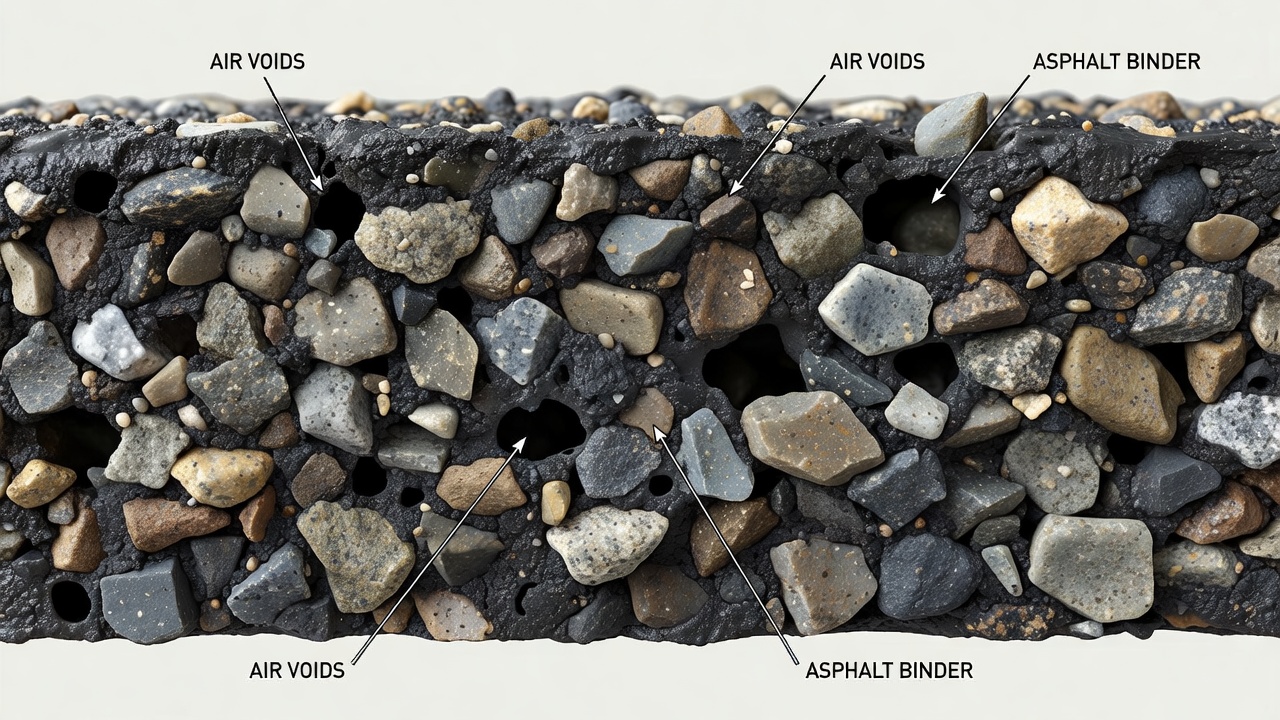
The volumetric concept of VMA is fundamental to understanding how asphalt mixtures function. In a compacted HMA mixture, the total bulk volume consists of three components: the volume of solid aggregate particles (including both the solid mineral matter and the water-permeable pores within the aggregate that are accessible to the asphalt binder), the volume of effective asphalt binder (the asphalt that coats the aggregate particles and provides adhesion between them), and the volume of air voids (the continuous and disconnected air spaces remaining after compaction). VMA represents the sum of the latter two components, the space available to accommodate the binder and the air.
The Asphalt Institute (MS-2, 7th Edition) describes VMA as “the volume of intergranular void space between the aggregate particles in a compacted paving mixture that includes the air voids and the effective asphalt content, expressed as a percent of the total volume of the mixture.” The Superpave mix design method (AASHTO M323 and R35) treats VMA as the primary volumetric control parameter, all other volumetric properties (air voids V_a, voids filled with asphalt VFA, effective binder content V_be) are functions of VMA.
The physical significance of VMA cannot be overstated. VMA is the single parameter that integrates the effects of aggregate gradation, particle shape and texture, compaction effort, binder content, and binder absorption. A mixture with adequate VMA has sufficient space to accommodate the optimum asphalt binder film thickness (typically 9 to 10 microns per NCAT research by Kandhal and Chakraborty) and the necessary air voids (typically 3% to 5% after construction) without compromising stability or durability. A mixture with inadequate VMA cannot simultaneously satisfy both binder content and air void requirements.
The concept was first formalized by Norman McLeod in a 1956 paper to the Highway Research Board, in which he argued that paving mixture design should be based on volumetric principles rather than weight-based proportions. McLeod proposed that a minimum of 15% VMA, combined with 3% to 5% air voids, would automatically ensure a minimum asphalt content of approximately 4.5% by weight (equivalent to 10% by volume), sufficient for pavement durability. This work became the foundation for the Asphalt Institute’s minimum VMA requirements, first published in 1964 and subsequently adopted, with modifications, into the Superpave system developed by the Strategic Highway Research Program (SHRP) in the 1990s.
VMA Calculation
The calculation of VMA requires the determination of several fundamental physical properties of the mixture and its constituent materials. The accurate determination of these properties governs the reliability of every VMA value used in mix design and quality control.
The VMA Equation
The standard equation for computing VMA is:
VMA = 100, (Gmb × Ps / Gsb)
Where:
| Symbol | Parameter | Description |
|---|---|---|
| VMA | Voids in Mineral Aggregate | Percent of total bulk volume of compacted mix |
| Gmb | Bulk Specific Gravity of Compacted Mixture | Ratio of mass of compacted specimen to mass of displaced water |
| Ps | Percent of Aggregate | Percent by weight of aggregate in the total mix (100, Pb) |
| Gsb | Bulk Specific Gravity of Combined Aggregate | Ratio of mass of aggregate to mass of water displaced by aggregate including permeable pores |
In practice, the calculation is performed using the more common formulation based on directly measured properties:
VMA = 100, (Gmb × (100, Pb) / Gsb)
Where Pb is the percent asphalt binder content by total weight of the mixture.
Step-by-Step Calculation
The determination of VMA for a compacted HMA specimen requires the following laboratory measurements:
Step 1, Determine the Bulk Specific Gravity of the Compacted Mixture (Gmb): The compacted specimen is weighed in air (dry mass), then submerged in water (submerged mass), and finally weighed in air after surfacing drying (saturated surface-dry mass). The bulk specific gravity is computed as: Gmb = Dry Mass / (SSD Mass, Submerged Mass). This test follows AASHTO T166 (Standard Method of Test for Bulk Specific Gravity of Compacted Hot Mix Asphalt Using Saturated Surface-Dry Specimens) or ASTM D2726. For specimens with high air void content (>6%) or open-graded mixtures, AASHTO T275 (Bulk Specific Gravity of Compacted Hot Mix Asphalt Using Paraffin-Coated Specimens) or AASHTO T331 (Vacuum Sealing Method) is used instead.
Step 2, Determine the Asphalt Binder Content (Pb): The asphalt content is determined by ignition oven per AASHTO T308 (Standard Method of Test for Determining the Asphalt Binder Content of Hot Mix Asphalt by the Ignition Method) or by solvent extraction per AASHTO T164. The ignition oven method is preferred for quality control because of its speed and precision. A correction factor must be applied to account for mass loss from the aggregate during ignition (typically 0.2% to 0.6%).
Step 3, Determine the Bulk Specific Gravity of the Combined Aggregate (Gsb): The bulk specific gravity of the coarse aggregate fraction (retained on the 4.75 mm sieve) is determined per AASHTO T85 (ASTM C127), and the bulk specific gravity of the fine aggregate fraction (passing the 4.75 mm sieve) is determined per AASHTO T84 (ASTM C128). The combined Gsb is then calculated as the weighted average of the component specific gravities based on the percentage of each fraction in the blend:
Gsb_com = 100 / [ (P1/(Gsb1)) + (P2/(Gsb2)) + … + (Pn/(Gsbn)) ]
Where P1, P2, …, Pn are the percentages of each aggregate component in the blend, and Gsb1, Gsb2, …, Gsbn are their respective bulk specific gravities.
Step 4, Calculate VMA: The VMA is then computed using the equation provided above. A VMA lower than the minimum specified value indicates insufficient intergranular void space. This typically requires adjustment of the aggregate gradation, change in aggregate source, or reduction of compaction effort.
Simplified Calculation Using Gmm
An alternative approach uses the maximum theoretical specific gravity (Gmm) of the mixture. The mixture is tested for Gmm per AASHTO T209 (ASTM D2041), and the air void content (V_a) is calculated as:
V_a = 100 × (Gmm, Gmb) / Gmm
Then, the voids filled with asphalt (VFA) is calculated, and VMA is derived from these values. However, the direct Gsb-based calculation is the recommended method in both AASHTO R35 and Asphalt Institute MS-2 because it provides a more direct assessment of the aggregate structure.
Precision and Bias
The precision of VMA determinations depends on the precision of each constituent measurement. Research by the National Cooperative Highway Research Program (NCHRP) and ASTM has established the following single-operator (repeatability) and multilaboratory (reproducibility) precision:
| Test | Standard Deviation (1s) | Acceptable Range (d2s) |
|---|---|---|
| Gmb (AASHTO T166) | 0.007–0.015 | 0.020–0.042 |
| Gmm (AASHTO T209) | 0.005–0.012 | 0.014–0.034 |
| Gsb coarse (AASHTO T85) | 0.010–0.020 | 0.028–0.056 |
| Gsb fine (AASHTO T84) | 0.015–0.030 | 0.042–0.084 |
The combined effect of these variances means that the acceptable range for VMA between two properly conducted tests in the same laboratory is approximately ±0.6% to ±1.0% . Between different laboratories, the acceptable range increases to ±1.2% to ±2.0% . This variability must be considered when interpreting VMA results, a VMA that is 0.3% below the minimum may not be statistically distinguishable from a value meeting the minimum.
A critical point emphasized by NCAT researchers is the effect of Gsb accuracy on VMA. The FHWA publication Is Your Gsb Correct? (NCAT 2017) demonstrates that an error of 0.020 in Gsb produces an error of approximately 0.7% to 0.9% in VMA. Since Gsb determination is the most operator-sensitive of the specific gravity tests, verification of Gsb values through independent testing is recommended for every new aggregate source and periodically during production.
Minimum VMA Requirements by Nominal Maximum Aggregate Size
The minimum VMA requirement is specified as a function of the Nominal Maximum Aggregate Size (NMAS), the smallest sieve size through which the majority of the aggregate sample passes, but on which some material may be retained. The NMAS governs the packing characteristics of the aggregate structure: smaller particles pack with greater interparticle void space because they have higher surface area per unit volume, while larger particles pack more tightly.
Superpave Minimum VMA (AASHTO M323)
AASHTO M323 (Standard Specification for Superpave Volumetric Mix Design) specifies the following minimum VMA values at the design air void content of 4.0% :
| Nominal Maximum Aggregate Size (NMAS) | Minimum VMA at 4.0% Air Voids |
|---|---|
| 9.5 mm (3/8 inch) | 15.0% |
| 12.5 mm (1/2 inch) | 14.0% |
| 19.0 mm (3/4 inch) | 13.0% |
| 25.0 mm (1 inch) | 12.0% |
| 37.5 mm (1.5 inch) | 11.0% |
When the design air void content differs from 4.0% , the minimum VMA is adjusted as follows:
- For 3.0% design air voids: subtract 1.0% from the tabulated minimum VMA
- For 5.0% design air voids: add 1.0% to the tabulated minimum VMA
For a 19.0 mm NMAS mixture designed at 3.0% air voids, the minimum VMA would be 13.0%, 1.0% = 12.0%. For the same mixture designed at 5.0% air voids, the minimum VMA would be 13.0% + 1.0% = 14.0%.
These minimum VMA values are mandatory, a mix design that does not meet the minimum VMA requirement is not acceptable under AASHTO M323 regardless of other performance characteristics. The rationale is that VMA below the minimum cannot provide the necessary space for adequate binder film thickness, and the resulting mixture will inevitably have reduced durability.
Asphalt Institute MS-2 Minimum VMA
The Asphalt Institute’s MS-2 (Mix Design Methods for Asphalt Concrete and Other Hot-Mix Types, 7th Edition) provides minimum VMA requirements for both Marshall and Superpave mix designs. The Marshall minimum VMA values follow the same NMAS-based system but historically were calibrated for 5% design air voids rather than 4%. The current MS-2 presents minimum VMA values corresponding to 3%, 4%, and 5% air void contents.
Historical Development of Minimum VMA Values
The minimum VMA requirements were not derived from fundamental research correlating VMA with field performance. McLeod’s original 1956 proposal of 15% minimum VMA was based on ensuring a minimum asphalt content of 4.5% by weight (10% by volume), assuming a bulk specific gravity of 2.65 for the aggregate and 1.01 for the asphalt cement, with zero absorption. The relationship between NMAS and minimum VMA was proposed by McLeod in 1959 and adopted by the Asphalt Institute in 1964, but the supporting data for the relationship was never published.
This historical context is critical. The minimum VMA values used today were based on assumptions that have been questioned repeatedly. The NCAT research by Kandhal and Chakraborty (1992) was the first systematic attempt to relate VMA to fundamental material behavior through film thickness and aging studies. Their work established the 9-10 micron film thickness target that, combined with 4% air voids, yields minimum VMA values that are consistent with the AASHTO tabulated values for most NMAS.
The minimum VMA requirements for 5% air voids in earlier editions of MS-2 were simply reduced by 1.0% to produce the 4% air void requirements now used in Superpave. This empirical adjustment lacks rigorous validation, and several state DOTs and researchers have called for a reexamination of the fundamental basis for minimum VMA. The NCHRP Project 9-69 (2018-2022) investigated the relationship between VMA and field performance and found that the current minimum VMA values are generally appropriate for the range of traffic levels and climates commonly encountered in North America.
VMA and Asphalt Binder Content
The relationship between VMA and asphalt binder content is the core of volumetric mix design. VMA determines the maximum achievable effective binder content for a given aggregate structure.
Effective Binder Content and Film Thickness
The effective asphalt binder content (V_be) is the volume of asphalt binder available to coat the aggregate particles after accounting for the binder absorbed into the aggregate pores. The V_be is calculated as:
V_be = VMA, V_a
Where V_a is the air void content at the design compaction level. For a mixture with 14.0% VMA and 4.0% design air voids, the effective binder content is 10.0% by volume of the total mix.
Asphalt film thickness is calculated by dividing V_be (converted to weight) by the total surface area of the aggregate (determined from the aggregate gradation using surface area factors per Asphalt Institute MS-2 Table 6.1). The surface area factors are:
| Sieve Size | Surface Area Factor (m²/kg) |
|---|---|
| 4.75 mm (No. 4) | 0.41 |
| 2.36 mm (No. 8) | 0.82 |
| 1.18 mm (No. 16) | 1.64 |
| 0.600 mm (No. 30) | 2.87 |
| 0.300 mm (No. 50) | 6.14 |
| 0.150 mm (No. 100) | 12.29 |
| 0.075 mm (No. 200) | 32.77 |
The film thickness in microns is: Film Thickness (microns) = V_be × 1000 / (Surface Area × Gb) , where Gb is the specific gravity of the asphalt binder.
NCAT research by Kandhal and Chakraborty established that a minimum film thickness of 9 to 10 microns is required to prevent accelerated aging of the asphalt binder. Below this threshold, the binder ages and hardens more rapidly, leading to a brittle pavement that cracks and ravels prematurely. The study used accelerated aging protocols from the Strategic Highway Research Program (SHRP), short-term aging of loose mix at 135°C for 4 hours, followed by long-term aging of compacted specimens in a pressure aging vessel (PAV) at 100°C for 20 hours.
Binder Drainage and Absorption
Two phenomena affect the relationship between total asphalt content and effective binder content:
Absorption: Asphalt binder is absorbed into the permeable pores of the aggregate particles. The volume of absorbed binder (V_ba) is unavailable to coat the aggregate surfaces. Absorption is calculated from the difference between the bulk specific gravity (Gsb) and the effective specific gravity (Gse) of the aggregate:
Gse = Gmm × (100, Pb) / (100, Gmm × Pb / Gb)
V_ba = (100, Pb) / (100) × (Gse, Gsb) / (Gse × Gsb)
Higher absorption, typical for sedimentary aggregates such as limestones and sandstones, reduces the effective binder content available for coating, requiring higher total asphalt content to achieve the same film thickness.
Drainage: In mixtures with very high binder content or open-graded aggregate structures, the binder can drain from the mixture during production, transportation, and placement. This is controlled by specifying a maximum VMA above which the mixture cannot retain the binder during handling. The phenomenon is most significant in stone matrix asphalt (SMA) and porous asphalt mixtures, where fibers or polymer modifiers are added to prevent binder drainage.
The VMA-Binder Content Trade-off
The VMA determines the binder capacity of the mixture, the maximum binder content that can be added while maintaining the design air void content. If the aggregate structure produces VMA of 14.0% and the design air voids are 4.0%, the binder capacity is 10.0% by volume. To convert to weight percent, the specific gravities of the binder and aggregate must be considered.
A mixture with VMA too low cannot accept the binder needed for adequate film thickness. If the required VMA for the design film thickness is 14.0% and the measured VMA is only 12.5%, the mixture would need either: (a) to increase the effective binder content (which would reduce air voids below the acceptable range, causing bleeding), or (b) to accept a lower binder content (which would produce a film thickness below the durability threshold). Both options produce an unacceptable mixture.
A mixture with VMA too high requires excess binder to fill the voids, increasing material cost and potentially causing tender mix behavior during construction. While the binder cost can be justified for improved durability, high VMA mixtures may be uneconomical and may exhibit reduced stability if the aggregate structure is overly open.
Effects of Low VMA
Low VMA, defined as VMA below the minimum specified value for the NMAS and design air void content, is one of the most serious deficiencies in asphalt mix design and production. The consequences manifest both immediately during construction and over the long term during the pavement service life.
Bleeding and Flushing
When a mixture has VMA below the minimum, the space available for the asphalt binder is insufficient. If the binder content is maintained at the level needed to coat the aggregate particles, the air void content drops below the acceptable minimum (typically <2.0%). Under traffic loading, the pavement is further densified by the passage of vehicles or aircraft. The aggregate particles are forced closer together, and the excess binder is squeezed out of the mixture onto the pavement surface.
This phenomenon is called bleeding (also known as flushing). The binder accumulates on the surface, creating a shiny, binder-rich film that significantly reduces skid resistance. On airport runways, bleeding creates a critical safety hazard, the loss of friction during wet conditions can lead to aircraft hydroplaning. ICAO Annex 14 requires that runway surfaces maintain adequate friction characteristics, and bleeding is cited as a condition requiring immediate corrective action.
Bleeding is visually observed during pavement condition surveys as a dark, glossy surface with visible binder accumulation. In severe cases, the binder forms a continuous film over the surface, eliminating the macrotexture needed for water dissipation and tire-pavement friction. The pavement becomes slippery when wet and may exhibit tracking of binder onto adjacent pavements.
Rutting
Low VMA is directly associated with rutting, the permanent deformation of the pavement in the wheel paths. The mechanism is twofold:
Densification rutting: When the mixture has insufficient VMA, the aggregate particles cannot rearrange under traffic because the interparticle voids are already minimized. Further compaction under traffic causes the particles to displace into the remaining void space, resulting in downward movement of the pavement surface. This type of rutting is characterized by a depression in the wheel path with no accompanying upward displacement at the sides.
Shear flow rutting: If the mixture has low VMA and the binder content is high enough to fill the limited void space, the binder acts as a lubricant between the aggregate particles. Under the shear stresses imposed by traffic loading, the aggregate skeleton cannot resist lateral movement, and the mixture flows outward from the wheel path. This type of rutting is characterized by a depression in the wheel path with raised shoulders at the sides.
Both rutting mechanisms are accelerated by high temperatures, the binder viscosity decreases, reducing the mixture’s resistance to permanent deformation. The Superpave binder specification (AASHTO M320) addresses this by requiring that the binder rutting parameter (G*/sinδ) meets minimum values at the high pavement design temperature. However, even the best binder cannot compensate for fundamentally inadequate VMA, the aggregate structure must provide sufficient interlock and internal friction to resist shear flow.
The Asphalt Institute states: “When VMA is not adequate, two possible problems occur: (A) When enough asphalt to coat the aggregate is added, low air voids and bleeding will result. (B) When not enough asphalt is added, low durability will result.”
Low Durability and Premature Aging
Low VMA forces either thin binder films or low air voids, both reduce pavement durability:
Thin binder films expose the asphalt binder to accelerated aging. The binder surface area exposed to oxygen, ultraviolet radiation, and water is larger relative to the binder volume. The binder oxidizes more rapidly, becoming harder and more brittle. The mixture loses flexibility and develops cracking under thermal and traffic loads. The NCAT study by Kandhal and Chakraborty demonstrated that film thickness below 9 microns resulted in significantly higher aging indices (viscosity ratio, complex modulus ratio) after both short-term and long-term accelerated aging.
Raveling, the progressive loss of aggregate particles from the pavement surface, is a direct consequence of thin binder films. The binder does not provide sufficient adhesion to hold the aggregate in place under the mechanical action of traffic. Raveling begins as a loss of fine aggregate (fines) and progresses to the loss of coarse aggregate, creating a rough, pitted surface that further accelerates deterioration.
Moisture damage (stripping): Thin binder films are more susceptible to moisture damage because the water can more easily penetrate the binder film and reach the aggregate surface. The presence of moisture at the binder-aggregate interface displaces the binder (a phenomenon called stripping), leading to loss of adhesion and structural failure of the pavement. The tensile strength ratio (TSR) test (AASHTO T283) measures the retained strength after moisture conditioning, mixtures with low VMA and thin binder films typically have lower TSR values.
Cracking
Low VMA mixtures develop fatigue cracking prematurely because the aged, brittle binder cannot withstand repeated tensile strains. The fatigue life (number of load repetitions to cracking) is directly related to the binder film thickness and the effective binder content. The Mechanistic-Empirical Pavement Design Guide (MEPDG) uses the effective binder content as one of the input parameters for the fatigue cracking prediction model. A reduction in effective binder content of 0.5% (by volume) can reduce fatigue life by 30% to 50%.
Low-temperature (thermal) cracking is also exacerbated by low VMA. The aged binder has higher stiffness at low temperatures and cannot relax thermal stresses as effectively. The pavement develops transverse cracks at regular intervals, the spacing corresponds to the temperature drop below the binder’s critical cracking temperature. In cold climates, thermal cracking is a leading cause of pavement failure, and adequate VMA (ensuring sufficient binder content and film thickness) is the primary mix design defense against this distress.
Effects of High VMA
While low VMA is the primary concern in most mix design situations, excessively high VMA also produces undesirable mixture characteristics.
Economic Impact
High VMA requires higher asphalt binder content to fill the larger void space and achieve the design air void content. For a typical dense-graded HMA mixture, each 1.0% increase in VMA requires approximately 0.6% to 0.8% additional asphalt binder content (by weight of total mix). Since asphalt binder is the most expensive component of HMA (typically $400 to $700 per metric ton versus $10 to $20 per metric ton for aggregate), the cost impact is substantial. For a 19.0 mm NMAS mixture with minimum VMA of 13.0% and typical binder content of 5.0%, increasing VMA to 16.0% would require approximately 6.5% to 7.0% binder, a 30% to 40% increase in binder cost.
Construction-Related Problems
High VMA mixtures exhibit behavior during construction that complicates placement and compaction:
Tender mix: The mixture may be unstable under the compaction rollers, it moves and shoves rather than densifying. The binder acts as a lubricant in the overly open aggregate structure, and the roller passes cause lateral displacement rather than vertical densification. This tender behavior is most pronounced at the intermediate temperature range (90°C to 120°C) where the binder viscosity is at a critical level.
Binder drainage: In mixtures with very high VMA, the binder can drain from the aggregate during storage in the silo, during transportation, and during placement. Binder drainage causes a non-uniform mixture, the bottom of the load may be binder-rich while the top is binder-starved. This variability leads to acceptance testing failures and localized pavement distress.
Performance Concerns
High VMA can reduce the structural contribution of the mixture:
Reduced stability: The open aggregate structure has less interparticle contact and lower internal friction. Under traffic loading, the aggregate particles may rearrange, leading to permanent deformation. This is distinct from the rutting caused by low VMA, high VMA rutting is characterized by consolidation rather than shear flow.
Higher permeability: High VMA mixtures with correspondingly high air voids (>7%) are more permeable to air and water. Water infiltration accelerates moisture damage (stripping) and freeze-thaw deterioration. Air infiltration accelerates binder oxidation. The permeability-air voids relationship is a power function, permeability increases exponentially as air voids increase above about 6.5% to 7.0%.
High VMA can be corrected by adjusting the aggregate gradation toward the maximum density line (the line on the 0.45 power gradation chart connecting the origin to the maximum aggregate size). Adding intermediate-size aggregate fractions fills the interparticle voids and reduces VMA to the target range.
VMA and Aggregate Properties
The aggregate characteristics, particle shape, angularity, surface texture, and gradation, are the fundamental determinants of VMA. The aggregate structure establishes the minimum achievable VMA for a given compaction effort, and the designer must select aggregates and gradations that produce VMA meeting or exceeding the minimum requirement.
Aggregate Shape, Angularity, and Surface Texture
Angular, crushed aggregate particles with rough surface textures produce higher VMA because the particles interlock with greater void space between them. The angular faces prevent the particles from sliding into the tightest packing arrangement. Rounded, uncrushed aggregate particles (such as natural gravels) produce lower VMA because the smooth surfaces allow tighter packing with less interparticle void space.
Superpave specifies consensus aggregate properties that directly influence VMA:
Coarse Aggregate Angularity (CAA), AASHTO T335: Specifies the minimum percentage of coarse aggregate particles (retained on the 4.75 mm sieve) with one or more mechanically crushed faces. The requirement depends on traffic level:
| Traffic Level (million ESALs) | Minimum Percent Crushed Faces (One Face) | Minimum Percent Crushed Faces (Two Faces) |
|---|---|---|
| < 0.3 | 55% | – |
| 0.3 to < 3 | 65% | – |
| 3 to < 10 | 75% | 60% |
| 10 to < 30 | 85% | 70% |
| > 30 | 95% | 80% |
| Airport (FAA P-401) | 90% | 75% |
Higher CAA requirements increase VMA by 1% to 3% compared to rounded aggregates, providing more space for binder and improving rutting resistance through enhanced aggregate interlock.
Fine Aggregate Angularity (FAA), AASHTO T304 (Method A): Measures the uncompacted void content of the fine aggregate fraction (passing the 2.36 mm sieve). Higher void content indicates more angular, less rounded particles:
| Traffic Level (million ESALs) | Minimum FAA (Uncompacted Void Content) |
|---|---|
| < 0.3 | 40% |
| 0.3 to < 3 | 40% |
| 3 to < 10 | 43% |
| 10 to < 30 | 45% |
| > 30 | 45% |
Higher FAA values increase VMA by providing a more angular fine aggregate skeleton that resists packing.
Flat and Elongated Particles, ASTM D4791: Specifies the maximum percentage of coarse aggregate particles with a length-to-thickness ratio exceeding a specified value (typically 3:1 or 5:1). The Superpave requirement is a maximum of 10% at a 5:1 ratio.
Flat and elongated particles reduce workability and can cause orientation issues during compaction that affect VMA uniformity. The requirement ensures that the aggregate particles pack in a consistent, predictable manner.
Aggregate Gradation
Aggregate gradation is the most direct control on VMA. The maximum density line on the 0.45 power gradation chart represents the gradation that produces the minimum VMA, as gradation approaches this line, the aggregate particles pack to the maximum density with the least interparticle void space. Moving away from the maximum density line (either coarser or finer) increases VMA.
The Superpave system specifies control points and a restricted zone on the 0.45 power chart. The restricted zone is a band along the maximum density line through which the gradation should not pass, passing through the restricted zone tends to produce a mixture with insufficient VMA. The restricted zone concept was introduced based on research indicating that gradations passing through this zone produce mixtures with poor rutting resistance and low VMA.
However, the restricted zone has been controversial. The NCAT research and several state DOTs have found that the restricted zone is not universally applicable, some mixtures that pass through the zone perform acceptably, while some that avoid the zone still exhibit low VMA. The restricted zone was removed as a requirement in some agency specifications (including the FAA) but remains in AASHTO M323 as a recommendation.
The practical approach to achieving adequate VMA through gradation control is:
- Coarser gradations (passing below the maximum density line on the 0.45 power chart) produce higher VMA because the larger particles create more interparticle void space
- Finer gradations (passing above the maximum density line) require more binder to achieve the same film thickness because the total surface area is higher
- Gap-graded gradations (skipping intermediate sizes) produce the highest VMA because the missing fractions create additional void space
Stone Matrix Asphalt (SMA) is an extreme example of gap-grading intentionally used to produce high VMA (typically 17% to 19%) to accommodate a high binder content (6.0% to 7.0%) with fibers or polymer modifiers to prevent drainage.
Mineral Filler (Passing 0.075 mm)
The minus 0.075 mm fraction (mineral filler) has a disproportionate effect on VMA. Filler increases the total surface area of the aggregate exponentially, a 1% increase in minus 0.075 mm material can increase surface area by 10% to 15%. This increased surface area requires additional binder to maintain the same film thickness, which in turn requires higher VMA to accommodate the additional binder.
However, filler also fills the interparticle voids between the larger aggregate particles, reducing VMA. The combined effect depends on the filler type, fineness, and packing characteristics. As a general rule, increasing filler content above approximately 4% to 6% reduces VMA, while decreasing filler below this range increases VMA.
The dust-to-binder ratio (percent passing 0.075 mm divided by effective binder content, expressed as a decimal) is specified in Superpave (AASHTO M323) to control this effect. The recommended range is 0.6 to 1.2 for most mixtures. A ratio below 0.6 indicates insufficient filler for the binder content, while a ratio above 1.2 indicates excess filler that may reduce VMA and create a dry, brittle mixture.
VMA in Airport Mix Designs
Airport asphalt mixtures are designed to more stringent volumetric requirements than highway mixtures due to the higher tire pressures, heavier loads, and critical safety requirements of aircraft operations.
FAA P-401 and P-403 Requirements
The FAA specifies airport HMA requirements in AC 150/5370-10 (Standard Specifications for Construction of Airports), Item P-401 (Hot Mix Asphalt Pavement) and Item P-403 (Plant Mix Pavement). VMA requirements are central to these specifications.
For Marshall-designed mixes using 75-blow Marshall compaction (the traditional FAA requirement), the minimum VMA values at 4% air voids are:
| Nominal Maximum Aggregate Size | Minimum VMA (FAA P-401, Marshall 75-blow) |
|---|---|
| 4.75 mm (No. 4) | 16.0% |
| 9.5 mm (3/8 inch) | 15.0% |
| 12.5 mm (1/2 inch) | 14.0% |
| 19.0 mm (3/4 inch) | 13.0% |
| 25.0 mm (1 inch) | 12.0% |
For Superpave Gyratory Compactor (SGC)-designed mixes, the FAA accepts the AASHTO M323 minimum VMA requirements when the SGC has been validated to produce volumetric properties equivalent to the 75-blow Marshall compaction at the design gyration level. The Airport Asphalt Pavement Technology Program (AAPTP) Report 05-06 validated the equivalent gyration levels for airport HMA, the number of gyrations at which the SGC produces the same density and VMA as the 75-blow Marshall hammer.
The FAA also requires VMA during production to be at or above the minimum specified value. Production acceptance criteria specify that VMA must be monitored as a running average of four samples, and no individual sample may fall more than 1.0% below the minimum without investigation and corrective action.
ICAO Considerations
The International Civil Aviation Organization (ICAO) does not directly specify VMA requirements but references national standards (FAA, AASHTO, national specifications) through the Aerodrome Design Manual, Part 3, Pavements (Doc 9157). The transition to the ACR-PCR method (Aircraft Classification Rating, Pavement Classification Rating) in 2020, which uses layered elastic analysis for pavement strength reporting, has implications for mix design because the assumed mixture stiffness used in the structural analysis depends on the binder content and air voids, both of which are governed by VMA.
Airport Mix Design Criticality
Airport HMA mixes operate under conditions that make VMA control more critical than for highway mixes:
Tire pressures of modern aircraft can exceed 1.5 MPa (220 psi), compared to 0.7 to 0.9 MPa for highway truck tires. These high tire pressures concentrate stress in the upper 50 to 75 mm of the pavement, making the surface course mixture properties, including VMA and effective binder content, critical for performance.
Channelized traffic on runways and taxiways concentrates loading in narrow wheel paths, increasing the rate of load applications per unit area. A single aircraft pass applies 1.5 to 3 times the load of a highway truck, and the loading is precisely channelized along the runway centerline.
Fuel spillage resistance requires that airport surface course mixtures have adequate binder content (governed by VMA) to resist the solvent action of jet fuel. Low VMA mixtures with thin binder films are more susceptible to fuel damage, leading to surface deterioration in aircraft parking aprons and fueling areas.
Safety-critical friction requires that the mixture does not bleed (which is directly linked to insufficient VMA). The FAA mandates friction testing of new HMA surfaces (per AC 150/5320-6G), and bleeding is a cause of failing friction tests that require corrective action.
VMA Testing and Quality Control
VMA determination during production is an integral part of HMA quality control and quality assurance (QC/QA) programs.
Laboratory Testing
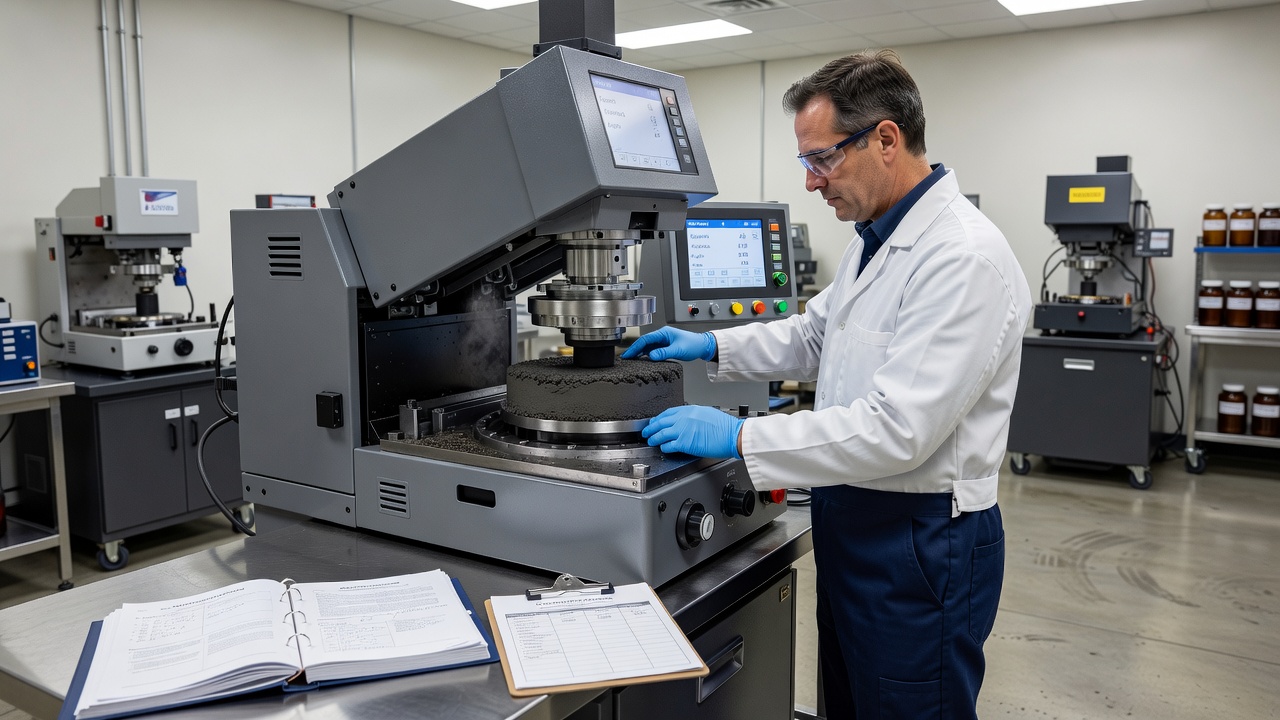
The VMA of plant-produced HMA is determined by testing compacted specimens prepared from samples taken at the plant or from the paver. The testing sequence is:
- Sample the mixture in accordance with AASHTO T168 (Sampling Bituminous Paving Mixtures)
- Compact specimens in the Superpave Gyratory Compactor (SGC) per AASHTO T312 (ASTM D6925) to the design number of gyrations (Ndesign)
- Determine the bulk specific gravity of the compacted specimens (Gmb) per AASHTO T166 or T331
- Determine the asphalt binder content (Pb) per AASHTO T308 (ignition oven)
- Determine the theoretical maximum specific gravity (Gmm) per AASHTO T209 on the uncompacted mixture
- Calculate VMA using the formula: VMA = 100, (Gmb × (100, Pb) / Gsb_jmf), where Gsb_jmf is the bulk specific gravity of the combined aggregate from the job mix formula
Production Tolerances
During production, VMA is expected to vary around the job mix formula (JMF) target. The typical acceptance criteria are:
- Average VMA of four consecutive samples: must be at or above the minimum specified value
- Individual VMA test result: may be up to 1.0% below the minimum before requiring investigation
- Maximum VMA: no upper limit is typically specified, but mixtures exceeding approximately 18% VMA should be investigated for gradation changes or consistency issues
Factors Affecting VMA During Production
Gradation changes are the most common cause of VMA variability during production. Changes in aggregate source, crusher operation, or stockpile management can alter the gradation. The critical sieves for VMA control are:
- 4.75 mm sieve (No. 4): Changes in this fraction directly affect the coarse-fine aggregate split and the packing of the intermediate aggregate structure. A 2% increase in material passing the 4.75 mm sieve (making the gradation finer) can reduce VMA by 0.5% to 1.0%.
- 0.075 mm sieve (No. 200): The minus 0.075 mm fraction (filler) has the most dramatic effect on VMA. A 0.5% increase in filler can reduce VMA by 0.3% to 0.6%.
Asphalt absorption increases when the plant storage time is extended or when the production temperature is elevated. The research by Chadbourn et al. (Minnesota DOT, 2000) documented that three of ten paving projects showed a VMA decrease of 1.9% or more between mix design and field production, attributed to high plant temperatures (above 170°C) and long storage times (over 12 hours). The increased absorption reduced the effective binder content, which in turn reduced VMA. The research concluded that controlling plant temperatures below 165°C and limiting silo storage times to 8 hours or less minimized VMA loss during production.
Aggregate degradation, the breakdown of aggregate particles during handling, drying, and mixing, generates additional fines. A study of the ten Minnesota projects found that increased minus 0.075 mm material of 0.3% to 0.8% during production was associated with VMA decreases of 0.5% to 1.5%. Aggregate degradation is most significant for softer aggregate types (limestones, sandstones) and when the drum mixer operates at elevated temperatures.
Corrective Actions for Low VMA
When the VMA of plant-produced mixture falls below the minimum requirement, the following corrective actions are taken in order of increasing cost and complexity:
- Check Gsb values: Verify that the Gsb of the in-service aggregates matches the design values. If Gsb has changed (due to a change in aggregate source or quarry face), recalculate VMA using the correct Gsb.
- Adjust gradation: If the gradation has drifted toward the maximum density line (becoming too dense), adjust cold-feed proportions to move the gradation coarser (away from the maximum density line). This is the most common and most effective correction.
- Reduce moisture content of the aggregates to reduce the amount of fines generated in the drum mixer.
- Reduce plant production temperature if elevated temperatures are causing increased absorption.
- Reduce storage time in the silo if extended storage is causing increased absorption.
- Increase VMA by adding coarse aggregate proportion and reducing intermediate and fine aggregate.
- Change aggregate source if the current aggregate consistently produces VMA below minimum.
VMA and Pavement Performance
The relationship between VMA and long-term pavement performance has been established through numerous field studies, laboratory investigations, and performance modeling.
Field Studies
The Long-Term Pavement Performance (LTPP) program, established by FHWA in 1987 under the Strategic Highway Research Program, has collected data from over 2,000 pavement test sections across North America. Analysis of the LTPP database has consistently shown that sections with VMA below the minimum requirement have:
- 30% to 50% higher fatigue cracking at equivalent traffic levels
- 2 to 3 times higher raveling rates
- 40% to 60% higher rutting rates in hot climates
- Significantly higher thermal cracking densities in cold climates
The NCAT Test Track in Auburn, Alabama, a 1.7-mile closed-loop accelerated pavement testing facility, has conducted multiple research cycles evaluating the relationship between volumetric properties and performance. Key findings specific to VMA include:
- Sections designed with VMA 0.5% to 1.0% below the minimum (but meeting air void requirements) developed measurable fatigue cracking after 5 to 7 million equivalent single-axle loads (ESALs), while sections meeting the minimum VMA remained crack-free beyond 10 million ESALs
- The binder film thickness in the low VMA sections was 6.5 to 7.5 microns, compared to 9.5 to 10.5 microns in the adequate VMA sections, consistent with the NCAT film thickness threshold findings
Performance Prediction Models
Modern pavement design methods incorporate VMA as an input parameter for performance prediction:
The AASHTO Mechanistic-Empirical Pavement Design Guide (MEPDG) uses the effective binder content (derived from VMA and air voids) in the following performance models:
- Fatigue cracking model: The allowable number of load repetitions to fatigue cracking is a function of the mixture tensile strain, the HMA modulus (which depends on binder content and air voids), and the binder content by volume. A 0.5% reduction in effective binder content (from VMA reduction) reduces predicted fatigue life by approximately 30% to 40%.
- Rutting model: The structural rutting model uses the HMA modulus, which depends on binder content and the degree of aging. Mixtures with VMA below minimum have higher aging rates, leading to higher stiffness and different rutting behavior, typically increased cracking rather than rutting, which shifts the distress mode rather than eliminating it.
The FAA FAARFIELD airport pavement design software uses the mixture modulus as a design input. Airport HMA mixtures designed to minimum VMA requirements have higher effective binder content, resulting in a lower modulus at high temperatures and higher modulus at low temperatures. The modulus is directly used in the layered elastic analysis to compute critical stresses and strains under aircraft loading.
Relationship to Other Volumetric Properties
VMA, air voids (V_a), and voids filled with asphalt (VFA) form the complete set of volumetric properties that describe the compacted mixture:
VFA = 100 × (VMA, V_a) / VMA
For a mixture with 14.0% VMA and 4.0% air voids: VFA = 100 × (14.0–4.0) / 14.0 = 71.4%
The VFA indicates what percentage of the available void space (VMA) is filled with effective binder. Superpave specifications (AASHTO M323) require VFA to be within specified ranges depending on traffic level:
| Traffic Level (million ESALs) | VFA Range at Ndesign (4% Air Voids) |
|---|---|
| < 0.3 | 70%, 80% |
| 0.3 to < 3 | 65%, 78% |
| 3 to < 10 | 65%, 75% |
| 10 to < 30 | 65%, 75% |
| > 30 | 65%, 75% |
The VFA acts as a check on the VMA, if the VMA is at the minimum and the binder content produces 4% air voids, the VFA will be within the specified range. If VMA is too high, the VFA may be too low (below 65%), indicating that the air voids are too high relative to the binder content, even if the total air void content is acceptable.
Aggregate Gradation and Aggregate Angularity

The interaction between aggregate properties and VMA is summarized by the following design principles:
Angular aggregates increase VMA, a mixture designed with 100% crushed limestone typically has 1.5% to 3.0% higher VMA than an identical gradation using uncrushed gravel. This higher VMA allows higher binder content and improved durability.
Maximum density gradation minimizes VMA, the 0.45 power curve on the gradation chart represents the theoretical maximum density. Moving away from this line in either direction (coarser or finer) increases VMA.
Gap grading maximizes VMA, intentionally omitting intermediate aggregate sizes produces the highest VMA values. This is the principle used in Stone Matrix Asphalt (SMA) and porous asphalt mixtures.
Fines content controls the practical VMA range, the minus 0.075 mm fraction has the highest surface area per unit weight. A 1% increase in minus 0.075 mm material increases surface area by 15% to 30% and typically decreases VMA by 0.3% to 0.8%.
Practical Implications for Pavement Inspection
During pavement condition surveys per ASTM D5340 (Airport PCI) or ASTM D6433 (Road PCI), the following distresses are indicative of potential VMA-related deficiencies:
- Bleeding (flushing): Directly associated with VMA too low to accommodate the binder content. The binder is forced to the surface under traffic compaction.
- Rutting: May be caused by low VMA (densification rutting or shear flow) or high VMA (consolidation rutting). The rut shape and the presence or absence of bleeding guide the diagnosis.
- Raveling: Loss of aggregate from the surface. Typically caused by thin binder films resulting from VMA that is too low for the required binder content.
- Fatigue cracking (alligator cracking): Premature fatigue cracking in the wheel paths is associated with binder aging from thin films, itself a consequence of low VMA.
- Thermal cracking: Transverse cracks at regular spacing. Accelerated by binder aging from thin films in low VMA mixtures.
When these distresses are observed, the mix design and production records should be reviewed for VMA compliance. A field investigation may include coring for laboratory measurement of in-place air voids, effective binder content, and VMA to confirm the diagnosis.
Conclusion
Voids in Mineral Aggregate (VMA) is the most important volumetric parameter in asphalt mixture design and quality control. It governs the maximum achievable binder content, controls the air void structure, establishes the binder film thickness, and determines the balance between durability and stability. Adequate VMA is a necessary condition for long-term pavement performance, without it, no combination of high-quality binder, well-graded aggregate, and proper construction can produce a pavement that resists the combined effects of traffic, climate, and time. The minimum VMA requirements specified by AASHTO, the Asphalt Institute, and the FAA are based on fundamental volumetric principles and decades of field performance experience. Adherence to these requirements is essential for the production of durable, long-lasting asphalt pavements for roads and airfields.
Frequently Asked Questions
- What is Voids in Mineral Aggregate (VMA)?
- Voids in Mineral Aggregate (VMA) is the volume of intergranular void space between the aggregate particles in a compacted asphalt paving mixture. It is expressed as a percentage of the total bulk volume of the compacted mix. VMA includes both the air voids (the small air pockets between coated aggregate particles) and the volume of effective asphalt binder (the asphalt cement that is not absorbed into the aggregate particles). VMA represents the total space available to accommodate the asphalt binder and the necessary air voids in the mixture. It is the most fundamental volumetric parameter in asphalt mix design, all other volumetric properties (air voids, voids filled with asphalt, effective binder content) derive from VMA.
- How is VMA calculated?
- VMA is calculated using the equation: VMA = 100, (Gmb × Ps / Gsb), where Gmb is the bulk specific gravity of the compacted mixture, Ps is the percent of aggregate by total weight of the mix, and Gsb is the bulk specific gravity of the combined aggregate. In practice, the calculation requires: (1) determining the bulk specific gravity of the compacted specimen (Gmb) per AASHTO T166 or T275, (2) determining the maximum theoretical specific gravity of the mixture (Gmm) per AASHTO T209, (3) determining the asphalt content by ignition oven (AASHTO T308) or solvent extraction, (4) determining the bulk specific gravity of the aggregate (Gsb) per AASHTO T84 and T85, and (5) applying the VMA formula. A common simplified version uses: VMA = 100, (Gmb × (100 - Pb) / Gsb), where Pb is the percent asphalt binder by total mix weight.
- What are the minimum VMA requirements in Superpave?
- Superpave (AASHTO M323) specifies minimum VMA requirements based on the nominal maximum aggregate size (NMAS) and the design air void level (typically 4.0%). The minimum VMA values at 4.0% air voids are: 9.5 mm NMAS, 15.0%, 12.5 mm NMAS, 14.0%, 19.0 mm NMAS, 13.0%, 25.0 mm NMAS, 12.0%, 37.5 mm NMAS, 11.0%. These values decrease as the NMAS increases because larger aggregate particles pack together with less interparticle void space. The minimum VMA values are adjusted for different design air void levels, for 3.0% design air voids, subtract 1.0% from the tabulated values, for 5.0% design air voids, add 1.0%.
- What happens when VMA is too low?
- Low VMA indicates that the aggregate structure is too dense, leaving insufficient space for the asphalt binder and necessary air voids. When VMA is below the minimum requirement, two problems occur: (1) if enough asphalt binder is added to properly coat the aggregate, the air voids become too low (<2%), leading to bleeding (excess binder rising to the surface), flushing, and rutting under traffic, (2) if asphalt binder content is reduced to maintain proper air voids, the resulting binder films are too thin, causing a dry, brittle mix that is prone to raveling, premature age hardening, fatigue cracking, and moisture damage (stripping). Low VMA is a leading cause of premature pavement failure observed during condition surveys.
- What happens when VMA is too high?
- Excessively high VMA indicates that the aggregate structure is too open, requiring higher than optimum asphalt binder content to fill the voids. This results in: (1) increased mix cost due to higher binder demand, (2) potential for binder drainage during production and placement, (3) tender mix behavior during compaction (difficulty achieving density), (4) reduced stability under traffic loading, (5) increased potential for permanent deformation if the excess voids are not properly filled. High VMA can be corrected by adjusting the aggregate gradation toward the maximum density line, increasing filler content (minus 0.075 mm material), or blending in additional intermediate-size aggregates.
- How does aggregate shape and texture affect VMA?
- Aggregate particle shape, angularity, and surface texture directly control VMA. Angular, crushed aggregates with rough surface textures produce higher VMA values because the particles interlock with greater interparticle void space. Rounded, smooth aggregates (such as uncrushed gravel) produce lower VMA values because the particles can pack more tightly together. Superpave consensus properties address this through: Coarse Aggregate Angularity (CAA), minimum percentage of crushed faces required based on traffic level, Fine Aggregate Angularity (FAA), minimum uncorrected void content of fine aggregate (AASHTO T304), and Flat and Elongated Particles, maximum ratio of length to thickness (typically 3:1 or 5:1). Higher angularity requirements increase VMA, which in turn allows higher binder contents for improved durability.
- What are the FAA VMA requirements for airport asphalt mixes?
- The FAA specifies minimum VMA requirements for airport HMA mixes in AC 150/5370-10 (Items P-401 and P-403). For Marshall-designed mixes with 75-blow compaction, FAA minimum VMA values at 4% air voids are: 4.75 mm NMAS, 16.0%, 9.5 mm NMAS, 15.0%, 12.5 mm NMAS, 14.0%, 19.0 mm NMAS, 13.0%, 25.0 mm NMAS, 12.0%. For Superpave Gyratory Compactor (SGC)-designed mixes, FAA accepts the AASHTO M323 minimum VMA requirements when using the appropriate number of gyrations (Ndesign) validated for airfield traffic. The FAA Airport Asphalt Pavement Technology Program (AAPTP) has validated gyration levels for airport mixes to achieve Marshall-equivalent volumetric properties.
- How is VMA controlled during production quality control?
- During HMA production, VMA is controlled by monitoring: (1) aggregate gradation, ensuring each sieve size fraction stays within the job mix formula tolerances (typically ±4% on 19 mm and 12.5 mm, ±3% on 4.75 mm, ±2% on 0.075 mm), (2) plant temperatures, excessive temperatures and long storage times increase asphalt absorption into the aggregate, reducing effective binder content and VMA, (3) aggregate degradation (breakdown of particles during production), which generates additional fines, increases surface area, and reduces VMA, (4) asphalt content, every ±0.1% change in binder content changes VMA by approximately ±0.1%, and (5) specific gravity of the compacted mixture, measured daily from plant-produced samples. Production tolerances for VMA typically require that the running average of 4 samples be at or above the minimum specified value.
- What is the relationship between VMA and asphalt film thickness?
- Asphalt film thickness is the calculated average thickness of the asphalt binder coating on the aggregate particles, typically expressed in microns. Film thickness is calculated by dividing the effective asphalt content by the total surface area of the aggregate (determined from the gradation using surface area factors per Asphalt Institute MS-2). Research by Kandhal and Chakraborty (NCAT) established that a minimum asphalt film thickness of 9 to 10 microns is required to prevent accelerated aging of the binder in HMA mixtures compacted to 8% air voids. VMA provides the space necessary to accommodate this film thickness. When VMA is too low, the film thickness decreases as the same binder volume is spread over the available aggregate surface, leading to durability problems. The required VMA to achieve adequate film thickness depends on the aggregate gradation's surface area, finer gradations (higher surface area) require higher VMA to achieve the same film thickness.
- Can VMA be too low if the mix performs well?
- No. VMA below the minimum requirement always compromises long-term pavement performance, even if short-term test results (stability, flow, density) appear acceptable. Low VMA means the aggregate structure does not have enough space for the necessary asphalt binder and air voids. The consequences may not appear immediately, the mix may compact well and show good initial stability, but over time, the thin binder films lead to premature age hardening, cracking, raveling, and moisture damage. Once the binder ages and becomes brittle, the pavement loses flexibility and fails under traffic and thermal loads. For this reason, minimum VMA requirements are mandatory in all standard mix design specifications (AASHTO, ASTM, FAA, Asphalt Institute) and are not subject to waiver based on performance testing.