What is a Xenon Lamp?
Xenon Lamp – Gas-Discharge Lamp Using Xenon in Airport Lighting
Definition and Context
A xenon lamp is a high-intensity gas-discharge lighting device in which an electric arc passes through ionized xenon gas, producing a powerful, broad-spectrum white light. Xenon lamps are pivotal in airport and airfield lighting, where their intense output and daylight-like quality ensure maximum visibility and safety for pilots. They are widely used in runway approach systems, sequenced flashing lights, obstruction beacons, and high-intensity landing lights. Xenon lamps are valued for their rapid response, high color rendering, and operational reliability, attributes essential for compliance with aviation standards such as ICAO Annex 14 and FAA Advisory Circulars.
Technical Explanation
Operating Principle
Xenon lamps are a type of gas-discharge lamp. They consist of a quartz envelope filled with xenon gas, within which two tungsten electrodes are positioned. When a high-voltage pulse is applied, the xenon gas ionizes and forms a plasma arc. Energetic electrons within this plasma excite xenon atoms, which emit photons across a broad visible spectrum as they return to their ground state. The result is intense, white light closely resembling natural daylight.
Key components include:
- Quartz/ceramic envelope: Withstands high temperatures and filters UV radiation.
- Tungsten electrodes: Precisely shaped for stable arc formation.
- Xenon gas fill: Pure or mixed for spectral tuning.
- Ballast: Controls current, provides high-voltage start, and ensures stable operation.
The arc’s continuous spectrum and high intensity are critical for airfield visibility, allowing accurate recognition of colors and markings under all conditions. Special filters may be used to block harmful UV output in human-accessible installations.
Electrical and Photometric Characteristics
- Starting voltage: 5,000–30,000 V (to initiate the arc)
- Operating voltage: Lower, regulated for the lamp’s wattage (typically 20–1500 W)
- Luminous efficacy: 60–100 lumens/watt for airfield types
- Color temperature: 4,000–6,000 K (daylight-like)
- Color rendering index (CRI): Usually 90+, critical for color discrimination
A well-matched ballast is mandatory to regulate current and ensure long lamp life.
Types and Variants of Xenon Lamps
Xenon lamps in aviation come in several forms, each optimized for specific roles:
- Linear Xenon Flashlamps: Tubular, emit intense pulses, used for approach strobes and sequenced runway lights.
- Short Arc Xenon Lamps: Compact arc gap, high-brightness point source for inset runway fixtures, PAPI, or searchlights.
- Circular and Helical Flashlamps: For omnidirectional beacons or custom optical systems.
- U-Bend and DC Pulsed Lamps: For compact or direction-specific installations like edge lighting.
- IPL and Laser Pump Flashlamps: Used in runway surface scanning or specialized navigation aids.
Comparison with other lamp types:
- Metal Halide: Tailored spectrum, good for floodlighting but slower start and less broad-spectrum than xenon.
- Cold Cathode Neon/Argon: Used for signage, not suitable for high-intensity requirements.
- Mercury Vapor/Sodium: High output but poor color rendering.
Lamp selection depends on light distribution, intensity, color quality, and infrastructure compatibility.
Features, Advantages, and Limitations
Advantages
- High intensity: Rivaling sunlight, crucial for visibility in all conditions.
- Excellent color rendering: Accurate color discrimination for pilots.
- Rapid response: Instant-on and fast pulsing for strobes and sequenced lights.
- Stability: Performs well over wide temperature ranges.
- Durability: No filament means high resistance to vibration and shock.
Limitations
- High starting voltage: Requires robust ballasts and insulation.
- UV output: Needs protective filtering or shielding.
- Service life: Shorter than LEDs, periodic maintenance required.
- Heat: High operating temperatures demand careful fixture design.
- Specialized handling: High-pressure and UV risk require trained personnel.
Performance Data and Use Cases in Airport Lighting
Performance Metrics
- Short arc lamps (e.g., 1500W): Over 100,000 lumens, ~5,800 K color temperature.
- Pulse flashlamps: Flashes exceeding 1,000,000 candelas, vital for approach strobes.
- 35W xenon HID: Up to 3× the output of 55W halogen, 5× that of 100W incandescent.
Applications
- Approach Lighting Systems (ALS): High output for pilot visibility from kilometers away.
- Runway Edge/Centerline Lights: Keeps airfield geometry visible at any distance.
- Sequenced Flashing Lights: “Rabbit” effect for approach guidance.
- Obstruction Beacons: Marks tall structures for aircraft safety.
- PAPI (Precision Approach Path Indicators): Sharp color transitions for glide path info.
- Emergency/Backup: Instant-on, high intensity for redundancy.
Comparison with Alternative Technologies
- Incandescent/Halogen: Xenon offers higher efficacy, longer life, better vibration resistance, and superior color rendering.
- LED: LEDs surpass xenon in efficiency, longevity, and fixture flexibility, but xenon’s broad spectrum benefits certain vision systems and legacy compatibility.
- Metal Halide/Cold Cathode: Metal halide offers tailored output but slower response, cold cathode is only for signage, not guidance.
Installation, Compatibility, and Maintenance
Installation
- Requires compatible ballasts for high-voltage start and stable operation.
- Fixtures must match xenon arc geometry for optimal optics and beam control.
- Wiring must handle high voltages and minimize EMI.
Compatibility & Upgrades
- Legacy xenon systems may be retained for regulatory compliance or where LED retrofits are complex/costly.
- Color and intensity matching is critical when mixing technologies.
Maintenance
- Always power down before servicing.
- Use gloves/goggles due to high pressure and UV risk.
- Inspect and maintain UV shields.
- Regular photometric testing and inspection of ballasts/starters are necessary.
Historical Development
Developed in the 1940s–50s, high-pressure xenon arc lamps improved on earlier neon and mercury vapor technology. Their adoption in aviation accelerated in the 1960s, driven by the need for high-performance approach and runway lighting. While LEDs are now common for new installations, xenon remains in use for high-intensity or legacy systems.
Regulatory Guidance and Standards
- FAA AC 150/5345-46E: Requirements for runway/taxiway lights.
- FAA AC 150/5345-53D: Certification for lighting equipment.
- ICAO Annex 14: Global standards for aerodrome lighting.
- RTCA DO-160D: Environmental and EMI compatibility.
Compliance with these standards is mandatory for installation and operation.
Visual Aids and Illustrations
| Type | Image | Typical Use |
|---|---|---|
| Linear Flashlamp | 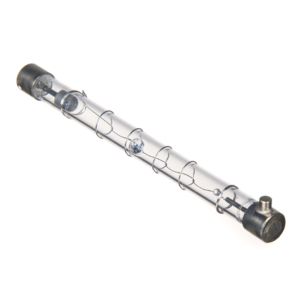 | Strobe, approach lighting |
| Short Arc | Runway, PAPI, searchlight | |
| Circular Flashlamp | Omnidirectional beacon, custom optics | |
| U-Bend Flashlamp | Directional, compact installations |
Image sources: Amglo, ADB Safegate
Summary Table: Key Data for Xenon Lamps in Airport Lighting
| Parameter | Typical Value / Range | Relevance to Airfield Lighting |
|---|---|---|
| Luminous Efficacy | 60–100 lumens per watt | High intensity for long-range cues |
| Color Temperature | 4,000–6,000 K | Daylight-like, improves visibility and color discrimination |
| Lamp Life | 2,000–5,000 hours (flashlamp: >1M flashes) | Reduces maintenance frequency |
| Start Time | Instant (ms) | Critical for signaling and strobes |
| Ballast Required | Yes | Regulates arc and protects lamp |
| EMI/RFI Sensitivity | Low (with quality ballasts) | Important for avionics compatibility |
| Regulatory Standards | FAA AC 150/5345-46E, DO-160D | Compliance required for installation |
| UV Output | Significant | Requires filtering/shielding |
| Cost | Moderate–High | Offset by performance/reliability |
Xenon lamps remain a staple in airport lighting for their unique blend of intensity, color fidelity, and instant operation. While LEDs are the future for many installations, xenon technology still sets the standard in applications where full-spectrum, high-output light and legacy compatibility are essential. For further technical details, consult ICAO Annex 14, FAA circulars, and manufacturer datasheets.
Frequently Asked Questions
- What are the main advantages of xenon lamps over incandescent or halogen lamps in airport lighting?
- Xenon lamps deliver much higher luminous output and better color rendering, providing daylight-like light that enhances pilot visibility and color discrimination. They also have greater resistance to vibration and longer operational lives, reducing maintenance and improving safety in critical airfield applications.
- Can xenon lamps be replaced with LEDs in legacy airfield systems?
- Yes, LED retrofits are possible and increasingly popular for energy and maintenance savings. However, compatibility with existing electrical and optical systems, as well as color and intensity requirements, must be carefully evaluated. Some applications still rely on xenon's full-spectrum output for regulatory compliance or vision system compatibility.
- What safety precautions are necessary when handling xenon lamps?
- Always de-energize fixtures before servicing, wear safety goggles and gloves to protect against high-pressure rupture and UV exposure, and avoid direct eye contact with operating lamps. Follow all manufacturer and regulatory guidelines for safe installation and maintenance.
- How does weather affect xenon lamp performance?
- Xenon lamps are reliable across a wide temperature range and maintain output in challenging conditions such as fog, rain, or snow. However, fixture lenses and reflectors should be kept clean, and lamps must be replaced as they age to ensure minimum intensity standards are maintained.
This is a reference entry. TarmacView provides drone inspection services and doesn't sell the equipment or materials described in this glossary.