What is a Zone?
Zone: Comprehensive Definition and Context
A zone is a meticulously defined area within a broader system, marked by specific operational, technical, safety, or regulatory requirements. In aviation and other high-risk industries, zones structure daily operations, enforce safety protocols, optimize resource management, and ensure compliance with international standards. Zones may be physical (e.g., airfield areas), logical (e.g., network segments), or regulatory (e.g., hazardous area classifications). Their boundaries and operational characteristics are dictated by risk analysis, operational needs, and best practices.
Systematic Classification of Zones by Operational Context
Zones are classified by purpose, risk profile, and regulatory framework. In aviation, the International Civil Aviation Organization (ICAO) defines zones within aerodromes (e.g., runway strips, obstacle-free zones), each with distinct operational and safety requirements. In industrial safety, zones prevent accidents involving flammable gases, vapors, or dusts, dictating the type of equipment, maintenance, and personnel training required. In emergency response, zones (hot, warm, cold) manage hazard spread and responder safety, while in IT, zones segment networks for security and management.
Hazardous Area Zoning: Explosive Atmospheres in Aviation and Industry
Definition and Rationale
Hazardous area zoning is vital wherever explosive atmospheres may occur, such as fuel farms, maintenance hangars, and chemical processing facilities. International standards like IEC 60079, ATEX, and IECEx govern these zones, minimizing ignition risk and ensuring operational safety.
- Zone 0: Explosive atmosphere present continuously or for long periods (e.g., inside a fuel tank).
- Zone 1: Likely presence during normal operation (e.g., near fuel dispensers).
- Zone 2: Unlikely, short-term presence (e.g., area around fuel facilities during a spill).
- Zone 20/21/22: Analogous classification for dusts.
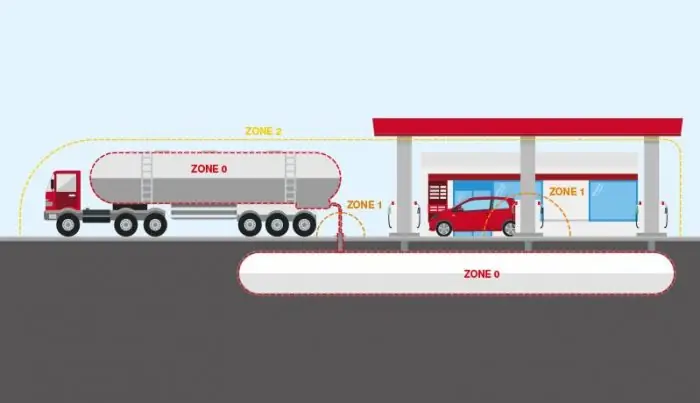
Application in Aviation
Hazardous zoning is critical for fuel storage, hydrant systems, and maintenance hangars at airports. Only certified equipment (e.g., Ex ia, Ex d) is permitted in each zone, and maintenance follows strict protocols. ICAO Doc 9481 and local regulations require rigorous risk assessment, clear marking, and regular review of hazardous zones.
Best Practices
- Mark zones with signage and color-coded lighting.
- Use only certified equipment, reassess zones after modifications.
- Document boundaries and procedures in the safety management system.
- Regularly review and update zone classifications.
Safety Operations Zoning: Emergency Response at Airports and Industrial Sites
Definition and Application
During emergencies (chemical spills, fires, aircraft accidents), zones manage hazard spread and responder safety:
- Exclusion/Hot Zone: Where hazard is present, highest PPE required.
- Contamination Reduction/Warm Zone: Buffer for decontamination.
- Support/Cold Zone: Clean area for command and support.
At airports, emergency zoning is applied for fuel spills, fires, or hazardous cargo incidents, as mandated by ICAO Doc 9137 and Annex 14.
Protocols & Best Practices
- Control access via barriers, signage, and briefings.
- Decontaminate before transitioning between zones.
- Map and train for zone boundaries.
- Drill regularly to test protocols.
Network and Cybersecurity Zoning: Logical Segmentation
Definition and Purpose
In IT, a zone is a logical/physical network segment, each with its own security and management policies. Common types are:
- DMZ (Demilitarized Zone): Exposes services to the internet.
- Internal Zone: For critical operations and data.
- Management Zone: Restricted to administrators.
- Guest/Untrusted Zone: For visitors or untrusted devices.
Segmentation is enforced by firewalls, VLANs, access lists, and monitoring, crucial for aviation IT, air traffic systems, and airline operations.
Best Practices
- Define and document all zones and boundaries.
- Enforce least privilege and rigorous firewall rules.
- Regularly audit and update security policies.
- Train staff on zoning and incident response.
DNS Zones
A DNS zone is a segment of the domain namespace managed by a specific organization, critical for redundancy and fault isolation in aviation systems.
Cloud Architecture Zoning: Landing Zones and Availability
Definition and Importance
In cloud computing, a zone (e.g., landing zone, availability zone) is a logically/physically separated environment for managing resources, security, and redundancy.
- Landing zone: Pre-configured, governed environment enforcing policies and segmentation.
- Availability zone: Physically separate data center within a region, ensuring high availability.
Aviation organizations use cloud zoning for resilience, compliance (ISO/IEC 27017, ICAO cybersecurity), and operational efficiency.
Best Practices
- Deploy critical systems across multiple availability zones.
- Use RBAC for strict access control.
- Automate compliance at the zone level.
- Maintain detailed documentation and reference architectures.
GIS and Spatial Analysis Zoning: Data-Driven Decisions
Definition and Methodology
In GIS, a zone is a collection of spatial features with shared attributes. Zonal operations aggregate or summarize data, enabling analysis for environmental monitoring, infrastructure planning, and aviation risk assessment.
- Raster zones: Defined by cell values (e.g., land cover).
- Feature zones: Defined by vector attributes (e.g., noise contours).
Application & Best Practices
- Align datasets in projection/resolution before analysis.
- Define transparent, reproducible zone criteria.
- Use validated GIS tools for accurate statistics.
- Document all steps and communicate with maps/charts.
Aviation-Specific Zoning: Airfield, Aircraft, and Airspace
Aerodrome Zoning (ICAO Annex 14)
- Runway Strip: Area including runway and stopway for over/undershoot protection.
- Obstacle Free Zone (OFZ): Airspace kept clear for takeoff/landing.
- Critical/Sensitive Areas: Protect ILS signals from interference.
Aircraft Zoning
- Segmentation for maintenance, safety, and redundancy (e.g., wiring zones, avionics bays, cargo holds).
Airspace Zoning (ICAO Annex 11 & 15)
- Control Zones (CTR): Around airports for arrivals/departures.
- Terminal Control Areas (TMA): Multiple airports for sequencing.
- Danger/Prohibited/Restricted Zones: Airspace with operational limitations.
These zones are charted in Aeronautical Information Publications (AIP) and are vital for safe, efficient flight operations and regulatory compliance.
A robust understanding and implementation of zoning principles is essential for safety, security, compliance, and efficiency in aviation, technology, and spatial operations. Whether managing airfields, IT infrastructure, hazardous materials, or emergency response, zones provide the structure required for modern complex systems.
Frequently Asked Questions
- What is a zone in aviation?
- In aviation, a zone is a precisely defined area, on the airfield, within airspace, or inside aircraft, used to manage operations, ensure safety, and comply with regulations. Examples include runway strips, obstacle-free zones, and airspace control zones, each with specific operational and safety requirements as mandated by ICAO and local authorities.
- How are hazardous zones classified in industry and aviation?
- Hazardous zones are classified based on the likelihood and duration of explosive atmospheres. For gases/vapors: Zone 0 (continuous), Zone 1 (likely), Zone 2 (unlikely/brief). For dusts: Zone 20, 21, 22 follow a similar logic. Equipment and procedures in each zone must comply with standards like ATEX and IECEx to prevent ignition and ensure safety.
- What is zoning in network security?
- Network security zoning involves segmenting an IT environment into logical or physical zones (e.g., DMZ, internal, management, guest), each governed by specific security policies, access controls, and monitoring. Zoning helps prevent unauthorized access, contain breaches, and comply with standards such as ISO/IEC 27001.
- What are landing zones and availability zones in cloud computing?
- A landing zone is a pre-configured, governed cloud environment that enforces security, compliance, and operational best practices. Availability zones are physically separated data centers within a cloud region, providing redundancy and high availability for mission-critical applications.
- How does GIS zoning support decision making?
- In GIS, zones are defined by shared spatial attributes (raster cells or vector features) for advanced analysis, such as noise mapping or land-use planning. Zonal statistics help aggregate and interpret data within each zone, supporting resource allocation, environmental monitoring, and policy decisions.
This is a reference entry. TarmacView provides drone inspection services and doesn't sell the equipment or materials described in this glossary.