What is Direct Current (DC)?
Direct Current (DC): Definition, Principles, and Applications
What is Direct Current (DC)?
Direct Current (DC) is the continuous, unidirectional flow of electric charge, most often electrons, from the negative terminal to the positive terminal of a voltage source. Unlike Alternating Current (AC), which reverses direction and changes amplitude periodically, DC maintains a constant voltage and steady polarity. This unwavering characteristic makes DC the foundation for batteries, modern electronics, renewable energy systems, and aircraft electrical networks.
DC was the earliest form of electricity harnessed for practical use, with applications in batteries and early generators. In a DC circuit, electrons move predictably, enabling precise control vital for semiconductors, digital devices, and mission-critical systems. The International Electrotechnical Vocabulary (IEV) defines DC as “an electric current whose direction does not change with time.”
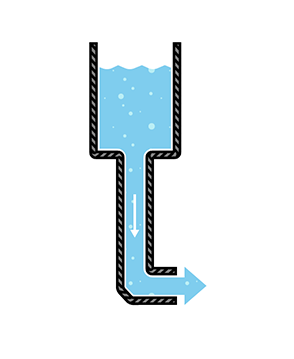
In DC, electrons flow in one direction, like water flowing through a pipe.
Key Technical Characteristics of DC
- Unidirectional Flow: Electrons travel in a single direction determined by the voltage source’s polarity, ensuring fixed positive (+) and negative (–) terminals. Reversing polarity reverses current direction, critical in sensitive circuits.
- Constant Voltage: Ideal DC features unchanging voltage ((V_{DC})), resulting in a flat line on a voltage-time graph. Real-world fluctuations are minimal compared to AC.
- Fixed Polarity: Devices like diodes, LEDs, and polarized capacitors require correct polarity to function and avoid damage.
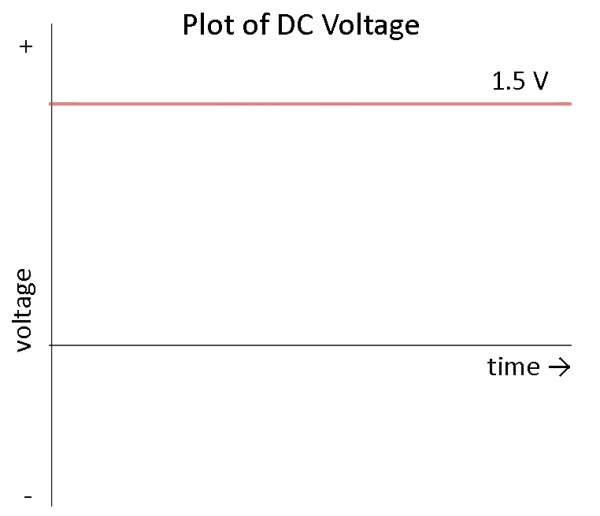
DC voltage is steady, a flat line over time.
Basic DC Circuit Principles
Ohm’s Law governs DC circuits:
[ V = I \times R ]
- V (Voltage): The potential difference driving charge flow.
- I (Current): The flow rate of electric charge (amperes).
- R (Resistance): The opposition to current (ohms).
Correct polarity ensures reliable operation for relays, sensors, and aviation instruments, where errors may compromise safety. Aircraft DC buses are meticulously managed to power critical instruments and navigation systems.
How is DC Generated?
Batteries: Electrochemical DC Sources
Batteries convert chemical energy to DC electricity via redox reactions. Key types:
| Chemistry | Voltage/Cell | Features | Uses |
|---|---|---|---|
| Lead-Acid | 2.0V | Robust, low cost | Vehicles, UPS, aviation |
| Nickel-Cadmium | 1.2V | Long cycle life | Emergency, aviation |
| Nickel-Metal Hydride | 1.2V | Higher capacity, less toxic | Consumer electronics |
| Lithium-Ion | 3.6–3.7V | Lightweight, high energy | Phones, laptops, EVs |
Batteries can be arranged in series (to increase voltage) or parallel (to increase capacity). Battery Management Systems (BMS) maximize performance and safety, crucial in electric vehicles and aircraft.
A battery cell: anode, cathode, and electrolyte produce DC current.
Solar Cells: DC from Sunlight
Solar (photovoltaic) cells use the photovoltaic effect to convert sunlight directly into DC electricity. Silicon p-n junctions release electrons when hit by photons, creating a current.
- Series connection: Increases voltage.
- Parallel connection: Increases current.
Efficiencies range 20–23% for commercial silicon cells. ICAO recommends solar-DC systems for remote airfield lighting and navigational aids.
Solar cells generate DC by separating charges at the p-n junction.
DC Generators: Electromechanical Sources
DC generators use electromagnetic induction: a rotating coil in a magnetic field. A commutator ensures output current flows in one direction, unlike AC generators.
- Applications: Backup power, industrial machines, railways, critical aviation systems.
- Reliability: Must meet strict aviation and industrial standards.
Rectifiers: AC to DC Conversion
Rectifiers use diodes to block alternating half-cycles of AC, yielding DC output. Types include:
- Half-wave: Single diode, pulsating DC.
- Full-wave (Bridge): Four diodes, smoother DC.
- Filtered: Add capacitors/inductors to approach pure DC.
Rectifiers power electronics, avionics, and emergency systems requiring DC.
A bridge rectifier uses four diodes to convert AC to DC.
DC Storage Technologies and Management
Batteries: Types and Aviation Use
| Chemistry | Energy Density (Wh/kg) | Cycle Life | Self-Discharge | Environmental Impact |
|---|---|---|---|---|
| Lead-Acid | 30–50 | 500–1000 | 3–5%/month | High (toxic) |
| NiCd | 45–80 | 1500–2000 | 15–20%/month | Moderate (toxic) |
| NiMH | 60–120 | 300–800 | 20–30%/month | Low |
| Li-Ion | 110–250 | 500–2000 | 2–5%/month | Moderate (flammable) |
Aviation: Lead-acid and NiCd dominate for proven reliability. Li-Ion is growing, with sophisticated BMS for safety (RTCA DO-311).
Capacitors and Supercapacitors
Capacitors store energy in an electric field. They charge/discharge quickly, ideal for power smoothing, emergency bridging, and starter systems.
- Capacitance: Farads, energy stored per volt.
- Supercapacitors: Higher capacity, bridge gap between batteries and capacitors.
Capacitors are key for filtering and short-term DC energy storage.
DC-DC Conversion: Matching Voltages to Needs
DC-DC converters adjust DC voltage levels to suit device requirements:
- Buck (Step-down): Output voltage < input.
- Boost (Step-up): Output > input.
- Buck-Boost: Output can be above or below input.
Used in electronics, electric vehicles, and aviation, modern converters are >90% efficient and meet strict EMI and safety standards.
A buck converter steps DC voltage down for sensitive circuits.
DC Applications: From Daily Life to Critical Systems
Consumer Electronics
All modern electronics, phones, laptops, cameras, run on DC. Even AC-powered devices convert mains power to DC internally. USB charging (5V DC) is universal.
Renewable Energy
Solar panels and batteries provide DC for off-grid and backup systems. Hybrid systems combine AC and DC buses for efficiency.
Electric Vehicles & Aviation
EVs and electric aircraft use DC batteries. DC fast charging delivers high-voltage DC directly to batteries, reducing charging time.
- Aviation: Avionics, emergency lighting, and UAVs rely on DC for redundancy and reliability.
LED Lighting
LEDs require DC. Drivers convert AC to DC for consistent brightness and color. Aviation lighting (runway, cockpit, indicators) increasingly uses DC-powered LEDs.
Telecommunications and Data Centers
Telecom systems (–48V DC) and data centers use DC for reliability, efficient backup integration, and reduced conversion losses.
Industrial Automation & Robotics
PLCs, sensors, and actuators in industrial automation rely on DC for precise, reliable operation.
Safety, Standards, and Future Trends
- Aviation: ICAO and FAA set standards for DC in aircraft, including redundancy, thermal management, and BMS certification.
- Renewables: DC microgrids and direct DC distribution are growing for efficiency.
- Electronics: Ever-smaller, more efficient DC-DC converters enable increased portability and functionality.
Summary
Direct Current (DC) is the bedrock of modern electricity, indispensable in batteries, electronics, renewable energy, aviation, and beyond. Its unidirectional, constant nature enables safe, predictable, and efficient power delivery for the world’s most critical systems.
For tailored DC solutions, including system design, aviation compliance, or renewable integration, contact us today.
See Also:
- Alternating Current (AC)
- Battery Management System (BMS)
- Photovoltaic Effect
- Rectifier
- DC-DC Converter
Frequently Asked Questions
- What is Direct Current (DC)?
- Direct Current (DC) is the continuous, unidirectional flow of electric charge, typically supplied by batteries, solar cells, or DC generators. It maintains constant polarity and voltage, making it crucial for electronics, aviation, renewable energy, and reliable backup systems.
- How is DC different from AC?
- While DC flows steadily in one direction with constant voltage and polarity, Alternating Current (AC) changes direction and amplitude periodically. DC is ideal for electronics, batteries, and sensitive devices, while AC is used for long-distance power transmission.
- Where is DC commonly used?
- DC is used in batteries, solar panels, portable electronics, electric vehicles, aviation backup and avionics systems, LED lighting, and data centers. Most modern electronics require DC power, even when supplied from AC mains.
- How is DC generated?
- DC is generated by batteries (electrochemical reactions), solar cells (photovoltaic effect), DC generators (commutators), and via rectifiers that convert AC to DC. Each method is tailored to specific applications and environments.
- What are the advantages of DC in aviation?
- DC provides reliable, predictable power for aviation backup systems, avionics, emergency lighting, and critical instruments. Its stable polarity and voltage simplify circuit design and enhance safety in mission-critical environments.