What is a Steradian?
Steradian – SI Unit of Solid Angle
A steradian (symbol: sr) is the International System of Units (SI) derived unit for quantifying solid angles in three-dimensional space. Analogous to how the radian measures planar angles in two-dimensional geometry, the steradian measures the “angular size” that a surface area subtends at the center of a sphere. This unit is fundamental in radiometry, photometry, antenna theory, and astronomy, wherever the spatial extent of an object or emission as seen from a point is relevant.
Mathematical Definition
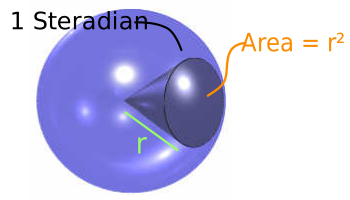
A solid angle quantifies the apparent size of an object as seen from a point, extending the idea of a planar angle into 3D. The steradian is defined such that one steradian is the solid angle subtended at the center of a sphere by a surface area equal to the square of the sphere’s radius:
[ \Omega = \frac{A}{r^2} ]
- ( \Omega ): solid angle in steradians (sr)
- ( A ): area on the sphere’s surface (m²)
- ( r ): radius of the sphere (m)
Key facts:
- The total solid angle around a point (full sphere): ( 4\pi ) sr (≈ 12.57 sr)
- One steradian “sees” about 8% of the surface area of a sphere.
Steradian vs. Radian
| 2D Angle (Radian) | 3D Solid Angle (Steradian) |
|---|---|
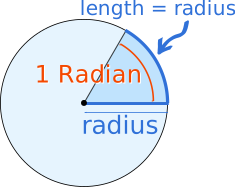
| Subtends arc length = r | Subtends area = r² |
| Full circle: 2π radians | Full sphere: 4π steradians |
| Measures planar angles | Measures solid angles |
A radian subtends an arc length equal to the radius, a steradian subtends an area equal to the radius squared.
Practical Applications
- Radiometry & Photometry: Measures angular distribution of energy or light. Luminous intensity (candela) is defined as lumens per steradian.
- Antenna Theory: Describes directivity and coverage, higher directivity corresponds to smaller solid angles.
- Astronomy: Quantifies the apparent size of celestial objects and fields of view.
- Computer Graphics: Used in light transport calculations for realistic rendering.
- Aviation/Atmospheric Sciences: Defines sensor and radar coverage, supporting ICAO standards.
Example Calculation
A detector of area 0.0025 m² is placed 2 m away from a light source. The solid angle subtended is:
[ \Omega = \frac{0.0025}{2^2} = 0.000625\ \text{sr} ]
If the detector receives 0.1 W, the radiant intensity is ( 0.1 / 0.000625 = 160 ) W/sr.
Conversion and Reference
- 1 steradian ≈ 3282.8 square degrees
- Total sky (sphere): ≈ 41,253 square degrees
- Moon’s apparent solid angle: ≈ ( 6.4 \times 10^{-5} ) sr
| Name | Symbol | Quantity Measured | SI Base Units | Type |
|---|---|---|---|---|
| Steradian | sr | Solid angle | m² / m² (dimensionless) | SI derived (special name) |
Advanced Mathematical Formulation
In spherical coordinates, the element of solid angle:
[ d\Omega = \sin\theta, d\theta, d\phi ]
- ( \theta ): polar angle (colatitude)
- ( \phi ): azimuthal angle (longitude)
Integrating over the entire sphere:
[ \int_{0}^{2\pi} \int_{0}^{\pi} \sin\theta, d\theta, d\phi = 4\pi\ \text{sr} ]
Steradian in Standards and Notation
- SI symbol: sr
- UNECE code: D27
- UCUM code: sr
- IEC 61360: 0112/2///62720#UAA986
Steradian is always written as “sr” in technical contexts to distinguish it from other dimensionless numbers.
Quick Reference Table
| Feature | Description |
|---|---|
| Name | Steradian |
| Symbol | sr |
| SI Classification | Coherent derived unit (special name) |
| Quantity measured | Solid angle |
| Base SI units | m²/m² (dimensionless) |
| Full sphere | ( 4\pi ) sr ≈ 12.57 sr |
| 1 sr as sky area | ≈ 8% of a sphere |
| Conversion | 1 sr = 3282.8 square degrees |
| Use cases | Radiant/luminous intensity, antenna beamwidth, astronomical field of view |
ICAO and International Standards
The steradian is referenced in ICAO and other international standards for aviation, satellite, and sensor systems, ensuring consistency in specifying angular coverage for radar, navigation aids, and remote sensing. It is essential for interoperability, data accuracy, and safety.
Visual Aids
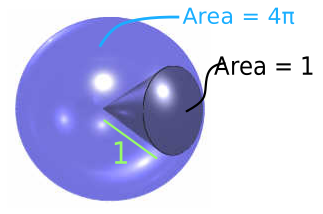
A sphere’s surface is ( 4\pi r^2 ), a full sphere subtends ( 4\pi ) steradians.
Summary
The steradian is the essential SI unit for solid angles, providing a rigorous, standardized measure for 3D angular coverage in science, engineering, and technology. It is dimensionless, universally recognized, and used wherever the spatial “spread” of a surface or emission from a point must be quantified.
If your work involves spatial measurements, sensors, or 3D modeling, understanding the steradian is vital for accurate and consistent results.
Frequently Asked Questions
- What is a steradian?
- A steradian (sr) is the SI unit for measuring solid angles in 3D space, defined as the angle that subtends a surface area equal to the square of a sphere’s radius. It allows for standardized comparison of spatial coverage, much like the radian does for planar angles.
- How do you calculate solid angle in steradians?
- Solid angle (Ω) in steradians is calculated as Ω = A / r², where A is the area on the sphere’s surface and r is the sphere’s radius. For a full sphere, the total solid angle is 4π steradians.
- How does a steradian compare to a radian?
- A radian measures planar angles in 2D, subtending an arc equal to the radius, while a steradian measures solid angles in 3D, subtending a surface area equal to the radius squared on a sphere. A full circle is 2π radians, a full sphere is 4π steradians.
- Where is the steradian used?
- Steradians are used in physics (radiometry, photometry), engineering (antenna theory), astronomy (measuring apparent sizes and fields of view), and in spherical geometry calculations.
- Is the steradian dimensionless?
- Yes. Its units are m²/m², making it dimensionless. However, the special name 'steradian' is used for clarity whenever solid angles are involved.
- How do you convert steradians to square degrees?
- 1 steradian ≈ 3282.8 square degrees. To convert, multiply the number of steradians by 3282.8.
- Why is the steradian important in science and engineering?
- Steradians provide a consistent and standardized measurement for 3D angular coverage, vital for quantifying light, electromagnetic waves, energy distribution, and spatial resolution in many scientific and technical fields.
This is a reference entry. TarmacView provides drone inspection services and doesn't sell the equipment or materials described in this glossary.