What is Stationary (Not Moving)?
Stationary (Not Moving) – Physics Glossary
Definition
A stationary object in physics is one whose position remains constant over time relative to a specified frame of reference. This means its velocity and acceleration are both zero in that frame. The concept is inherently relative, an object may be stationary in one frame (like a train seat to a passenger) and moving in another (to an observer on the platform). There is no absolute rest, all motion or lack thereof is measured with respect to a chosen frame. This concept is crucial in Newtonian mechanics for analyzing forces, equilibrium, and motion.
Mathematically, the object’s position vector r(t) does not change:
r(t₂) = r(t₁) for all times t.
Thus,
- Velocity (dr/dt) = 0
- Acceleration (d²r/dt²) = 0
This stationary state is the foundation for understanding equilibrium, where the sum of all forces and torques on the object is zero. In experimental physics, stationary objects serve as crucial reference points for measuring motion.
Reference Frames and Relativity of Motion
A reference frame is a coordinate system or viewpoint from which measurements of position, velocity, and acceleration are made. Whether an object is stationary depends entirely on the chosen frame. For example, a cup on a train table is stationary relative to the passenger yet moving relative to an observer on the platform.
Reference frames can be:
- Laboratory frame: standard in experiments
- Earth’s surface: default in daily life and aviation
- Moving frames: such as a car, train, or aircraft
The relativity of motion underpins all physical analysis, from everyday experiences to advanced aviation navigation. Instruments like radar and GPS are calibrated to specific frames to ensure accuracy. In aviation, ICAO documentation specifies reference frames for navigation and safety.
Mathematical Description
A stationary object’s position is constant:
[ x(t) = x_0 ] [ v = \frac{dx}{dt} = 0 ] [ a = \frac{dv}{dt} = 0 ]
Where:
- Position (x): meters (m)
- Velocity (v): meters/second (m/s)
- Acceleration (a): meters/second² (m/s²)
In equilibrium, the sum of all forces is zero (( F = ma )). If at rest initially and net force remains zero, the object stays stationary.
Graphical Representation
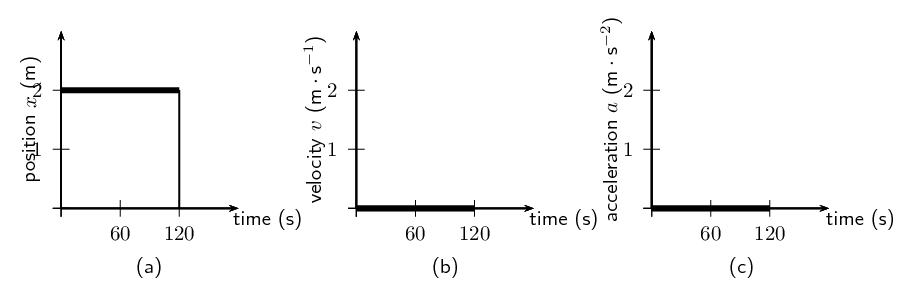
- Position vs. Time: horizontal line at x = constant
- Velocity vs. Time: horizontal line at zero
- Acceleration vs. Time: horizontal line at zero
| Time (s) | Position (m) | Velocity (m/s) | Acceleration (m/s²) |
|---|---|---|---|
| 0 | 2 | 0 | 0 |
| 60 | 2 | 0 | 0 |
| 120 | 2 | 0 | 0 |
Physical Laws: Connection to Newton’s First Law
Newton’s First Law of Motion (Law of Inertia) states:
“An object at rest will remain at rest, and an object in motion will remain in motion at constant velocity, unless acted upon by a net external force.”
For a stationary object, this means it will stay at rest as long as the net force is zero. This principle is foundational for safety systems like aircraft brakes and chocks, which keep stationary objects at rest.
Everyday and Technical Examples
- Everyday: Book on a table, parked car, person standing still
- Physics Labs: Instruments mounted on stationary stands
- Aviation: Stationary aircraft on apron, runway threshold lights, parked ground vehicles
- Space: Geostationary satellites (stationary relative to a point on Earth)
- Relative Motion: Passengers seated in a moving train are stationary relative to each other, moving relative to the ground
Equilibrium and Stationary State
Equilibrium occurs when total forces and torques are zero: [ \sum \vec{F} = 0 ] [ \sum \vec{\tau} = 0 ]
- Static equilibrium: object at rest (stationary)
- Dynamic equilibrium: object moves at constant velocity
Stationary state is a type of static equilibrium. In engineering and aviation, ensuring equilibrium is crucial for safety.
Worked Example: Stationary Object Analysis
Vivian stands 2 meters from a stop sign, unmoving for 120 seconds.
- Displacement: Δx = 0 m
- Velocity: v = 0 m/s
- Acceleration: a = 0 m/s²
Interpretation: Vivian is stationary for the entire interval.
Force Analysis: How Objects Remain Stationary
Objects remain stationary when all forces are balanced:
- Book on a table: gravity (down) balanced by table’s normal force (up)
- Aircraft on runway: brakes/friction and wheel chocks balance gravity and prevent rolling
Engineers use safety factors to ensure stationarity under unexpected loads (wind, earthquakes).
The Role of Friction in Stationarity
Static friction resists movement: [ F_{\text{friction, max}} = \mu_s N ] As long as applied force < static friction, the object remains stationary. This is key for aircraft tires, brakes, and ground equipment. ICAO specifies minimum friction standards for runways to ensure aircraft can remain stationary, even in bad weather.
Stationary in Non-Inertial Frames
In non-inertial (accelerating) frames, an object may appear stationary relative to that frame, but not in an inertial frame. For example, a passenger in an accelerating car is stationary in the car’s frame but accelerating relative to the Earth. Fictitious forces must be considered in such analyses.
In aviation, instruments detect actual acceleration to distinguish true stationary states from apparent ones.
Stationary in the Context of ICAO and Aviation Operations
ICAO defines procedures for handling stationary aircraft and vehicles:
- Annex 14: Requirements for marking and lighting stationary obstacles and parked aircraft
- Ground radar systems: Detect and display stationary vs. moving targets
- Transponder codes/ADS-B: Indicate stationary status for tracking and safety
Stationarity determines when ground services can approach and when passengers board or disembark.
Stationary Versus Uniform Motion
Stationarity is a special case of uniform motion: [ x(t) = x_0 + v t ] For stationary objects, v = 0, so [ x(t) = x_0 ] This continuity aids in transitioning between analyzing stationary and moving objects.
Graphical Summary
- Position vs. Time: Horizontal line at x = constant
- Velocity vs. Time: Flat at zero
- Acceleration vs. Time: Flat at zero
Summary
A stationary object remains at a fixed position in a given reference frame, with zero velocity and acceleration. This concept is fundamental in physics, engineering, and aviation for analyzing equilibrium, ensuring safety, and understanding motion. The state of being stationary is always relative to a chosen frame, making clear definitions essential for accurate analysis and safe operations.
Frequently Asked Questions
- What does 'stationary' mean in physics?
- In physics, 'stationary' refers to an object whose position does not change with time in a specified reference frame. Its velocity and acceleration are both zero, indicating it is at rest relative to that frame. This state is always defined in relation to a chosen coordinate system.
- Why is the idea of stationary relative?
- All motion and rest are relative, an object may be stationary in one reference frame but moving in another. For example, a seat is stationary to a train passenger but moving relative to someone standing on the platform. Absolute rest does not exist in physics, everything is measured relative to a chosen frame.
- How do you mathematically describe a stationary object?
- A stationary object has a constant position: x(t) = x₀. Its velocity (dx/dt) and acceleration (d²x/dt²) are both zero. In force analysis, a stationary object is at equilibrium, meaning all forces and torques acting on it cancel out.
- What role does friction play in keeping objects stationary?
- Friction, especially static friction, prevents unwanted movement by resisting applied forces up to a maximum value. As long as the applied force does not exceed this maximum, the object remains stationary. This is critical for safety in aviation, transportation, and engineering.
- How is stationarity important in aviation?
- In aviation, knowing when an aircraft is stationary is vital for ground operations, safety, and sequencing. ICAO standards define procedures for identifying and handling stationary aircraft on aprons, taxiways, and runways, and ground radar systems distinguish stationary from moving targets for collision prevention.
This is a reference entry. TarmacView provides drone inspection services and doesn't sell the equipment or materials described in this glossary.