Runway FOD That Comes From the Pavement Itself
Most runway debris is shed by the surface, not dropped on it. How to find the raveling, spalling and joint failure that make FOD, and what to seal first.
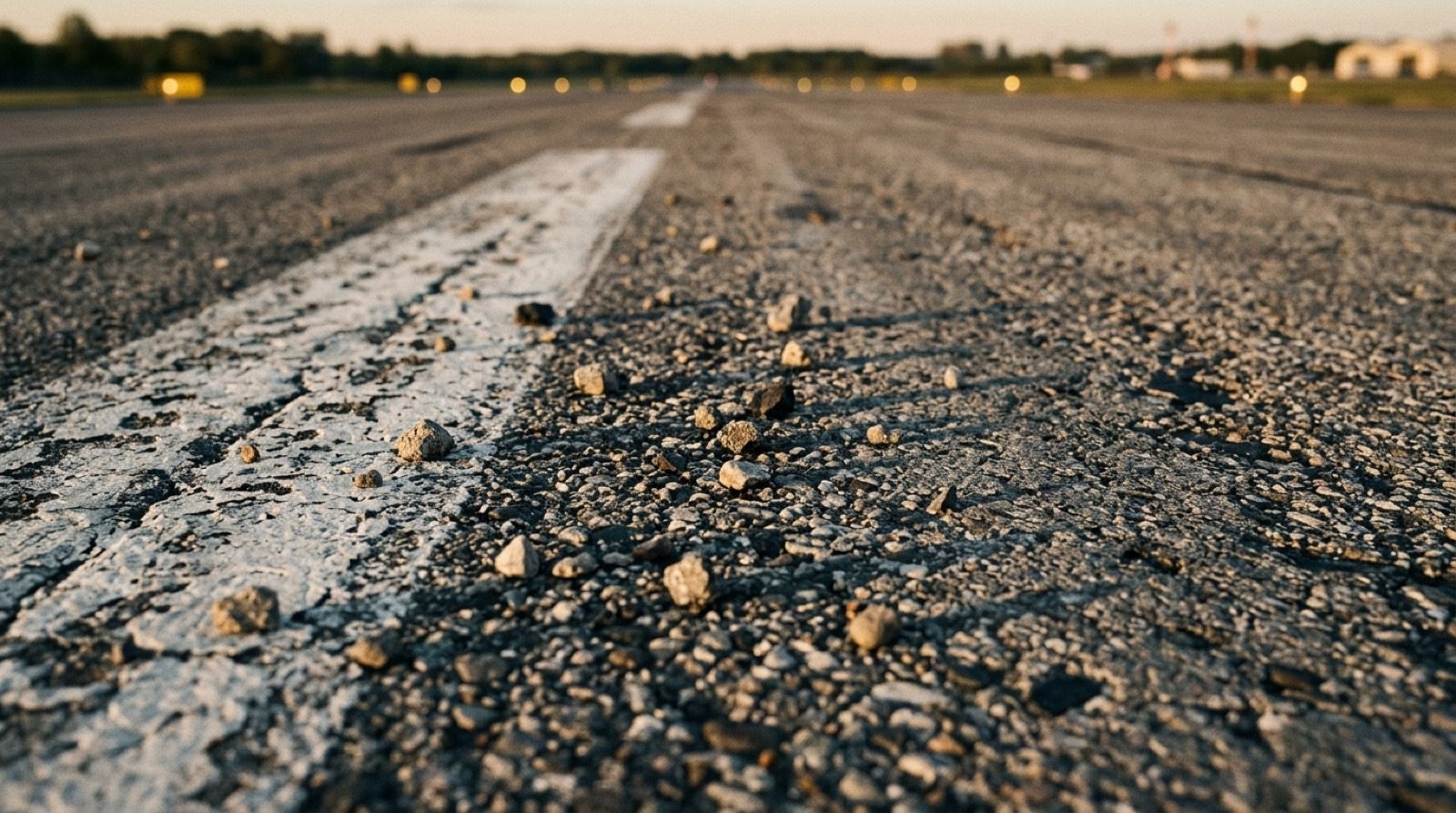
- 01 Sweeping and FOD detection deal with debris after it exists. Only pavement maintenance deals with the source, and the two programmes need to share one map.
- 02 Raveling, joint spalling and corner breaks are the distress families that shed material, and they are surface-visible, which is what makes them surveyable from the air.
- 03 The FOD-relevant repair priority is not the same as the condition-index priority, because a small spall in the touchdown zone matters more than a large crack on a shoulder.
- 04 A whole-surface survey with positioned imagery is what lets the sweeping route, the repair list and the FOD log point at the same places.
On this page · 11 sections
Who runs into this
The FOD programme is running. The runway is swept, the walk happens, the log is kept. And the log keeps filling with the same things: aggregate, grey mortar, bits of sealant, the occasional lump of concrete. Not tools, not hardware, not anything anyone dropped.
That is the pattern that brings someone to this page, and it shows up in four ways.
- The FOD log clusters. The same taxiway junction, the same touchdown zone, the same joint line, visit after visit.
- An engine inspection finds ingestion damage and the debris recovered is concrete or aggregate, which points back at the surface.
- Sweeping frequency has gone up and the amount collected has not gone down.
- A condition survey is years old, and the person who has to sign the next safety case cannot say which section is shedding.
What these have in common is that the aerodrome is treating debris as something that arrives. Foreign object debris from the pavement does not arrive. It is manufactured, continuously, by a surface that is coming apart in places nobody has mapped.
Where this applies, and where it does not
This applies where the FOD log is dominated by pavement material, which at most regional and older aerodromes it is, and where the runway and taxiway surfaces are asphalt or jointed concrete past the middle of their design life. It applies whether or not an automated detection system is installed, because detection and source control are different jobs.
It does not apply to the FOD that comes from construction, wildlife, cargo, or maintenance vehicles. That is a control and detection problem, and the FOD management guidance covers it well. It does not apply to an aerodrome deciding between radar and optical detection systems, which is a purchase about finding debris, not about stopping the surface making it. And it is a poor fit for a surface that is already programmed for resurfacing, where the question has been answered and only the date remains.
What has to be true before the source can be controlled
- Source known
- The shedding distresses are located and classified by type, not inferred from where the sweeper collects most.
- Position recorded
- Every distress carries a surveyed position, so the FOD log, the sweeping route and the repair list can point at the same place.
- Traffic weighted
- Each shedding distress is ranked by where it sits relative to engines at power, not only by its severity.
- Whole surface
- Coverage is complete at one detection threshold, because sampling misses exactly the small spall that matters.
- Repeatable
- The next survey reproduces the last one closely enough to show which sections are getting worse.
- Linked programmes
- The pavement maintenance programme and the FOD management programme read the same map, which the guidance asks for and few aerodromes do.
- Treatment owned
- The choice of seal, patch or overlay sits with the pavement engineer. The survey supplies the evidence, not the decision.
What the aerodrome is trying to achieve
Three outcomes, bought together and judged separately.
Fewer engines at risk
The safety case is the reason the programme exists. A joint spall in the touchdown zone is a supply of angular fragments where engines are at high power. Removing that supply is worth more than any sweeping frequency, and it is the outcome the safety manager actually signs for.
Less sweeping for the same result
Sweeping is a cost that scales with how much the surface sheds. An aerodrome that seals the right sections sweeps less, or sweeps the same and collects less, and either is measurable in the log within a season.
A repair list the engineer can defend
Money for surface treatment competes with everything else. A list that says which sections shed, where they sit relative to traffic, and what they looked like last year is a list that survives a budget meeting. A folder of sweeper receipts is not.
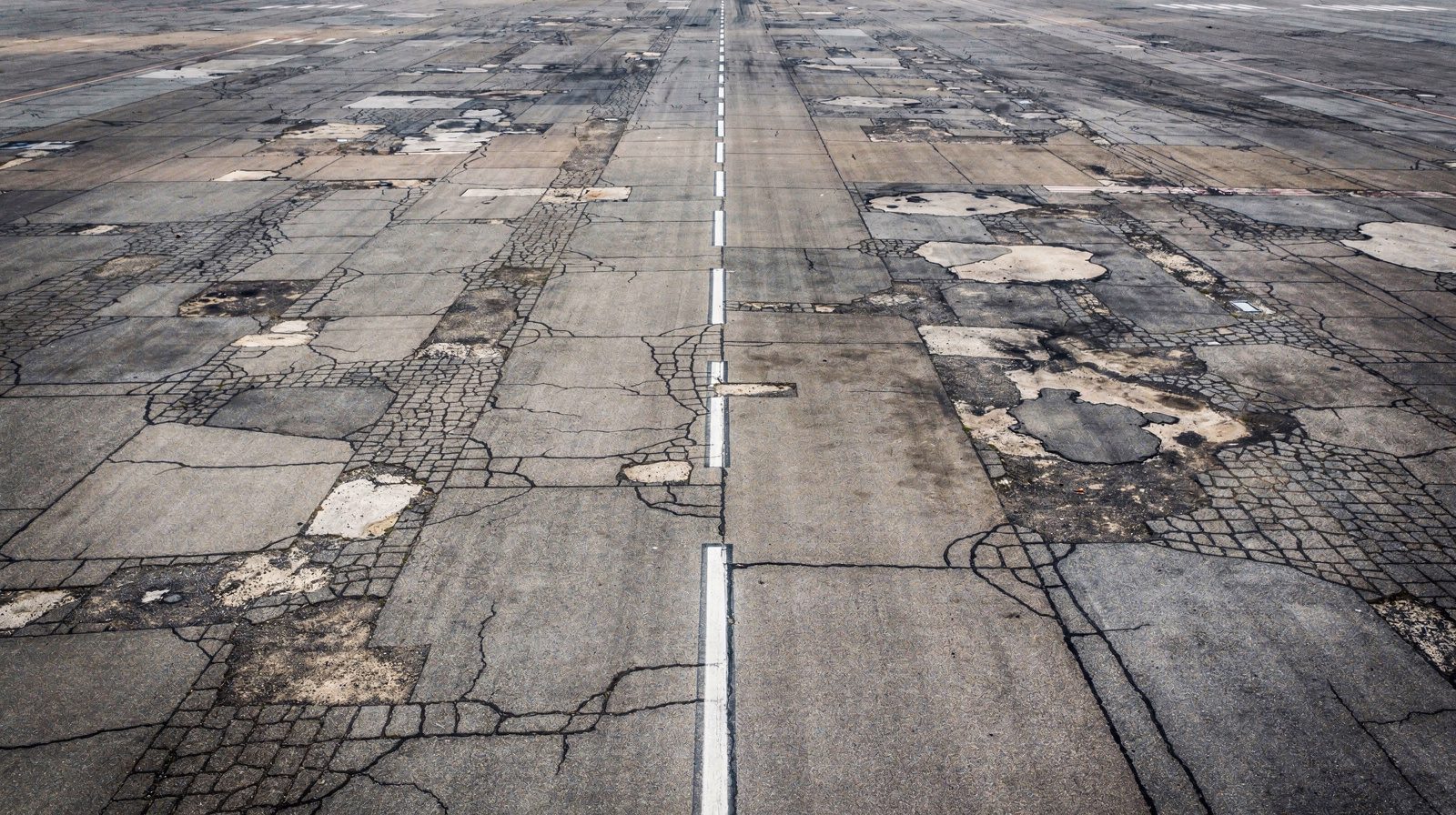
The surface at scan resolution. Raveling reads as texture loss and exposed aggregate long before it reads as a hole.
How the surface makes debris
The mechanism matters because it decides what to look for. Raveling is the binder in asphalt losing its grip on the aggregate as it oxidises. The surface goes from tight and black to open and grey, and then particles come away under tyre and jet blast. It starts as texture and ends as loose stone. Spalling at concrete joints is the slab edge breaking up, usually because the joint sealant failed and incompressible material got in, or because water got in and froze. It produces mortar first and fragments later. Corner breaks are a slab corner cracking off under load once the support beneath it has gone, and they produce the largest pieces.
All three are progressive. The material that comes off this week was loosening last year, and a survey that sees the texture change sees the debris before it exists. That is the argument for surveying the surface rather than only sweeping it. The mechanism is set out in more detail in from surface distress to foreign object damage . This page is about what to do with it.
How a source-control programme runs
The programme is a cycle, and the survey is one step in it. What changes is that every other step gets a map to work from.
From the FOD log to a sealed source
- 01
Read the FOD log by material and position
Classify each log entry by material class and record the collection position to the nearest section or taxiway segment. Plot the pavement-material entries for the last two seasons.
WhyThe log already says where the surface is shedding. Separating pavement material from everything else, and noting where it was collected, turns a compliance record into a first map of the sources.
Done whenThe plot shows clusters, and each cluster names a section.
If notIf the log has no positions, start recording them now and use the sweeper operator's knowledge as the interim map.
- 02
Survey the whole surface, with positions
Arrange a drone survey of the runway, taxiways and aprons as a pilot, with the section map agreed before the flight. The service is in active development and not yet offered. The platform already plans the flights and captures the imagery. Crack detection with ASTM D5340 coding is close to a first MVP, so shedding distress other than cracks is read from the imagery by an engineer.
WhyThe log finds where debris was collected, not where it came from. Jet blast and tyres move material, so the shedding distress is often upstream of the cluster. Only a whole-surface survey with positions finds the source rather than the destination.
Done whenEvery shedding distress is listed with a type, a severity and a surveyed position, and the FOD clusters can be traced upstream to named distresses.
If notStanding water, snow or contamination hide the surface. The capture is reflown, not rated through the obstruction.
- 03
Weight the list by traffic
Overlay the distress inventory on the traffic pattern: touchdown and rotation zones, holding positions, apron stands, high-speed exits. Rank shedding distresses by zone first and severity second.
WhySeverity alone ranks a shoulder crack above a touchdown-zone spall. FOD risk depends on what passes over the material and at what power.
Done whenThe top of the list is small, specific and in the places where engines are at power.
If notIf the traffic pattern is not documented, use the runway's declared distances and the taxi routes from the aerodrome manual as the first approximation.
- 04
Seal the top of the list
Hand the ranked list to the pavement engineer to choose the treatment per section. Record which distresses were treated, with their identifiers from the survey.
WhyCrack sealing, joint resealing and spall repair are cheap relative to resurfacing, and they stop the water and the movement that drive the shedding. Done early, they hold a surface for seasons.
Done whenEvery treated section carries a work order referencing the survey identifier of the distress it addressed.
If notIf a section is beyond sealing, it moves to the rehabilitation programme, and the sweeping route for that section is intensified until then.
- 05
Measure the change in the log and on the surface
Repeat the survey against the same section map and compare the imagery per section. Read the FOD log for the treated sections over the following season.
WhyThe programme is judged on whether the log gets quieter in the treated places and whether the surface stops shedding there. Both are measurable, and only if the survey repeats the same way.
Done whenThe side-by-side imagery shows treated distresses closed and no new shedding at those positions, and the log clusters have moved or gone.
If notA treated section that keeps shedding is a treatment choice to revisit, not a survey error. The retained imagery shows what the treatment did.
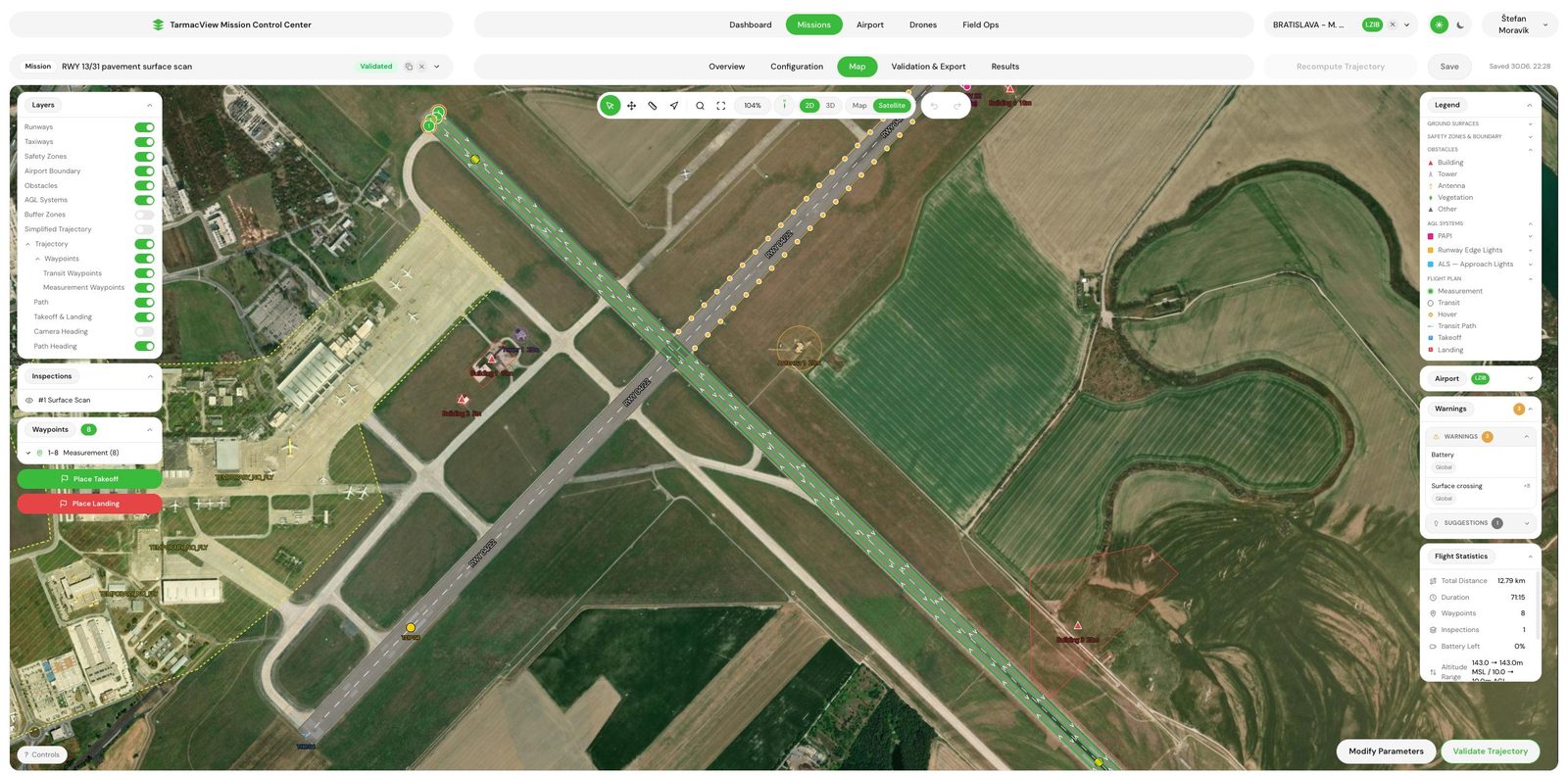
Full-width coverage in overlapping passes. The small spall that matters is the one a sampled survey misses.
Four ways to deal with pavement FOD, and what each one actually does
| Method | What it does | Evidence it leaves | Where it stops |
|---|---|---|---|
| Sweeping | Removes debris that has already come loose, on a schedule | The FOD log, if material and position are recorded | Says nothing about the source, and the supply continues |
| FOD walk and driven inspection | Finds loose material and obvious defects on the day, by eye | A checklist and a log entry | Samples rather than covers, sees debris not texture, produces no positions |
| Automated FOD detection | Finds debris on the surface between sweeps, in real time | Alert records with positions, which cluster usefully over time | Detects debris after it exists, but does not identify or reduce the source |
| Drone survey | Images the whole surface, keeps positioned imagery, repeats the same way | Retained, positioned imagery of each visit. Crack detection with ASTM D5340 coding is in development | Does not yet classify or rate distress, and leaves the treatment choice and the FOD removal as separate jobs |
| Walked PCI survey | A trained inspector rates sample units by the standard method | A formal condition index per section under ASTM D5340 | Samples rather than covers, and is silent on the units it did not walk |
Governance and the record
The FOD management guidance is clear that pavement condition is a FOD source and that the pavement programme and the FOD programme belong together. Most aerodromes keep them apart: one owned by airside operations, one by engineering, with a sweeping contract in between. The map is what joins them, and the survey is where the map comes from.
The record that matters in an audit or after an ingestion event is not the sweeping receipts. It is whether the aerodrome knew which sections were shedding, what it did about them, and when. A survey with positioned imagery, the engineer’s ranked list, work orders that reference survey identifiers, and a repeat survey that shows the change is that record. Each item is dated and each can be reconstructed from retained data.
Evidence and the honest limits
The strong claim on this page is that shedding distress is surface-visible and therefore surveyable from the air. Raveling reads as texture loss and exposed aggregate. Spalling reads as broken joint edges. Corner breaks read as displaced slab corners. All three are within what a drone camera at survey resolution resolves, and the runway surface scan captures the imagery in which they show.
The weaker claim is the link from distress to debris. The survey images the distress, and an engineer ranks it. It does not measure how much material a given spall releases per week, and it does not prove that a particular fragment in an engine came from a particular joint. The link is inference, supported by the log clustering and by the mechanism, and it is a strong inference rather than a measurement. A programme that wants a measured link can weigh the sweeper collections per section over a season, and the survey’s section map makes that possible.
The survey reports no condition index, and crack detection with D5340 coding is in development, close to a first MVP, and covers cracks only. Recognition of grass, patches and debris is also in development and short of training data. A formal ASTM D5340 survey is a different instrument. Where a funding programme names the standard, the walked survey is still the instrument, and it is silent on the sample units it did not cover, which is exactly where the small shedding spall lives.
Objections worth raising early
“We already sweep daily.” Then the log should say how much comes up per day, and whether it is falling. If it is not, the surface is producing material at least as fast as it is removed, and sweeping more often is paying for the symptom twice.
“Our FOD is from construction.” Possibly, and the log will say. Construction debris is varied and lands where the vehicles go. Pavement debris is aggregate and mortar and lands where the surface is breaking, repeatedly. The two sort easily once the log records material.
“We are resurfacing in three years.” Then the question is what happens in the touchdown zone in the meantime. A joint reseal and a handful of spall repairs bridge three years for a fraction of the sweeping cost, and the survey tells you which handful.
“A drone cannot see what an inspector sees.” Correct in one direction: an inspector on foot sees texture and hears hollow spots that a camera does not. Wrong in the other: an inspector covers sample units and a camera covers the surface, at one resolution, with positioned imagery, and repeats. The programme wants both.
Related tasks
If the immediate question is what the survey is and what it delivers, the pavement condition assessment is the service behind this page. If the question is what a scan actually resolves on a runway surface, what a drone scan sees sets out the resolution and its limits. If the question is the mechanism, the surface distress to foreign object damage post is the longer treatment. And if you want to talk about the development or early access at your field, get in touch .
Frequently Asked Questions
- How much runway FOD actually comes from the pavement?
- Enough that FOD management guidance treats pavement condition as a FOD source in its own right, and requires the pavement programme and the FOD programme to be linked. The exact share varies by aerodrome and by season, and nobody publishes a reliable number for it. What the FOD log at most aerodromes shows is telling on its own: once tools, hardware and wildlife are separated out, what is left is aggregate, mortar, sealant and fragments of the surface, and it clusters in the same places every time. That clustering is the tell that the source is the pavement rather than something passing over it.
- Which distress types shed material?
- Three families do most of it. Raveling and weathering of asphalt release aggregate particles as the binder oxidises and loses its grip. Joint spalling in concrete releases mortar and concrete fragments as the joint edge breaks up, often because incompressible material got into the joint or the sealant failed. Corner breaks release angular chunks, which are the largest and most dangerous class. Cracking of all kinds contributes fine material from the crack edges, and failed patches contribute whatever the patch was made of. All of these are surface-visible, which is why they can be seen in aerial imagery, and none of them is visible from a vehicle driving the centreline at night.
- Does an automated FOD detection system solve this?
- It solves a different problem well. A radar or optical detection system finds debris on the surface between sweeps, in real time, and that is exactly what a busy runway needs. It does not tell you why the same section keeps producing debris, and it does not reduce the supply. An aerodrome that installs detection without addressing the surface will see the alerts cluster in the same places, which is useful evidence but not a fix. Detection and source control are complementary, and the second is cheaper.
- Why is the FOD repair priority different from the condition-index priority?
- A condition index rates how far a section has deteriorated. FOD risk depends on where the material ends up and what passes over it. A small joint spall in the touchdown zone or at a runway holding position sits where engines are at high power and material gets picked up, so it outranks a long crack on a shoulder that no engine sees. The repair list for FOD purposes therefore weights each shedding distress by its location relative to the traffic, and positioned imagery is what makes that weighting possible.
- What does a drone survey add to a FOD walk?
- Coverage, position and a record. A FOD walk finds what is loose on the day, and its value is exactly that. It cannot see the surface texture that is about to release material, it samples rather than covers, and it produces no positions. An aerial survey images the whole surface at one resolution, keeps positioned imagery, and repeats the same way next time so two visits can be compared. The service is in active development and not yet offered. Crack detection with ASTM D5340 coding is close to a first MVP, and recognition of patches and debris is in development too. Raveling, spalling and the other shedding distress are not classified, so an engineer reads the imagery for those. The walk and the survey answer different questions and both belong in the programme.
- What should be sealed first?
- On FOD grounds, the shedding distress closest to where engines are at power: joint spalls and corner breaks in the touchdown and rotation zones and at holding positions, then raveling in the same zones, then everything else in order of severity. Crack sealing and joint resealing are cheap and stop water getting in, which is what accelerates spalling and edge raveling. A fog seal on early-oxidised asphalt holds the aggregate for a few more seasons. Which treatment fits which section is an engineering decision, and the survey gives that engineer the imagery rather than making the decision.
References
- faa-ac-150-5210-24
- AC 150/5210-24A, Airport Foreign Object Debris (FOD) Management Federal Aviation Administration
- icao-annex-14-v1
- Annex 14 to the Convention on International Civil Aviation, Volume I: Aerodrome Design and Operations International Civil Aviation Organization
- faa-ac-150-5380-6
- AC 150/5380-6, Guidelines and Procedures for Maintenance of Airport Pavements Federal Aviation Administration
- astm-d5340
- ASTM D5340, Standard Test Method for Airport Pavement Condition Index Surveys ASTM International