Runway Lighting Checks After Resurfacing and Works
How an aerodrome proves every runway light is back after resurfacing or a threshold move: position, colour and output checked unit by unit before reopening.
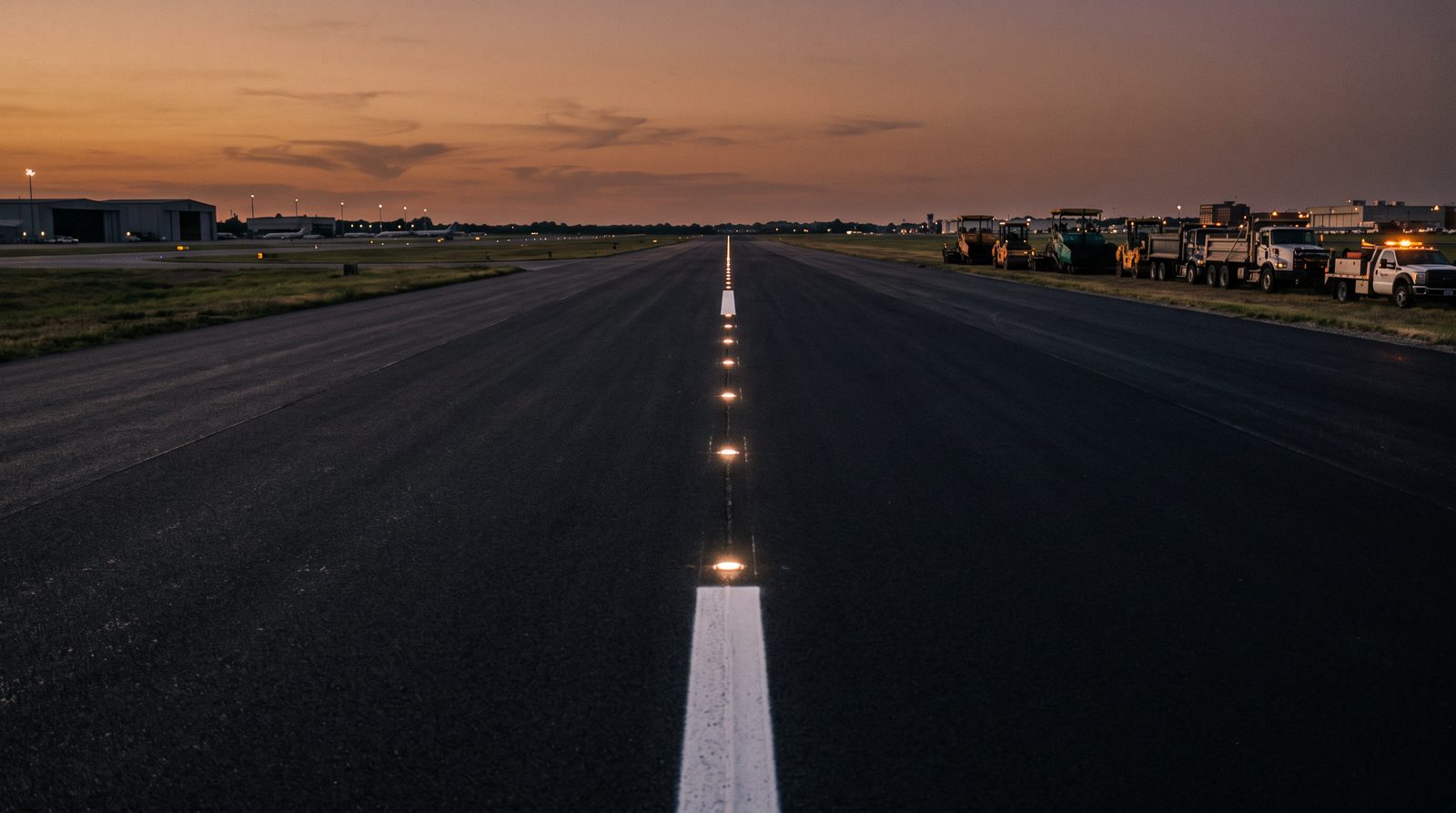
- 01 The contractor's handover shows that the circuits carry current. It does not show that each unit faces the right way, shows the right colour or sits at its new surveyed position.
- 02 A survey taken before the works start is what turns acceptance into a comparison with a known state rather than an argument about what used to be there.
- 03 A displaced threshold, a shortening or an extension changes where the green and red bars sit, which units show red and what the PAPI is set against, so the check starts from the new geometry.
- 04 Serviceability is judged per system under ADR.OPS.C.015, so the threshold bar, the end bar, the centre line and each edge row need their own count after the works.
On this page · 11 sections
Who runs into this
The works are planned for months and the lighting is accepted in an hour. That is the pattern this page is about, and it shows up in four kinds of project.
- Overnight resurfacing. The runway closes each night and reopens each morning. Inset units in the centre line, the touchdown zone and the threshold are lifted, their bases brought up to the new surface and the units reset, a section at a time. By the last night, most of the inset lighting has been out and back in, handled by several crews.
- Full rehabilitation. The pavement is rebuilt and the lighting is reinstalled with new cabling, new bases and often new LED units. Nothing on the field is the same fitting it was.
- Threshold displacement or shortening. The green bar moves, the edge lights between the runway end and the new threshold change what they show toward the approach, and the PAPI is set against a threshold that is no longer where it was.
- Extension. New units join the edge rows and the centre line, the end bar moves out, and the colour coding at the far end of the centre line has to move with it.
In every case the runway goes back into service on a date that was published long before the last unit was set. The contractor hands over a sheet that says the circuits test correctly. The aerodrome is the one that answers for the lighting the morning after.
Where this applies, and where it does not
This applies to an aerodrome where works have touched the runway lighting, whether that means lifting units, replacing them, moving them or adding to them. It applies to inset and elevated units alike, and to the threshold and runway end bars , the runway centre line and touchdown zone, the runway edge rows and the PAPI .
It does not apply to the electrical acceptance. Insulation resistance, series circuit continuity, transformer and regulator tests are ground tests done at the vault and on the circuit, and they belong in the contractor’s handover. It does not cover new obstacles under the approach after the works, which is the subject of the PAPI protection surface check . And it is not the yearly verification programme, which is covered under airfield lighting inspection . This page is about one moment: the runway is handed back, and somebody has to show the lighting came back with it.
What has to hold when the runway reopens
- Layout
- Every unit sits where the new as-built drawing puts it, with no unit left at an old position and no gap where a new one belongs.
- Presence
- Every unit on the drawing is installed and lit at each commanded intensity step.
- Colour
- Each unit shows the colour its position calls for, on each face, including the red sections that move when the threshold or the runway end moves.
- Output
- Units in a row are consistent with each other, so a unit reset off its axis or fitted with the wrong optic stands out from its neighbours.
- Bars
- The threshold and runway end bars sit at the surveyed threshold and end, with wing bars where fitted.
- Approach aids
- The PAPI is set against the threshold as it now is, and agrees with the ILS where there is one.
- Serviceability
- Each system meets its own limit under ADR.OPS.C.015 for the category the runway will operate in.
- Record
- A dated measurement per unit, with the defects listed by position and closed against a re-check.
What the aerodrome is trying to achieve
Three things, and they pull against each other at four in the morning.
Reopen on the published date
The reopening is in a NOTAM and the airlines have planned around it. A lighting check that needs the runway for hours after the works end is a check that will be skipped. The method has to fit inside the last closure or between the first movements, or it will not happen at all.
Accept the works on evidence
The contract usually ends with a handover. Once it is signed, a defect found later is harder to put back on the contractor and tends to become a maintenance cost. The aerodrome wants the defects listed, by unit and position, while the contractor is still on site and still under contract.
Start the next cycle from a known state
A rehabilitated runway is the best chance the aerodrome will get to record a clean baseline. Every unit is new or freshly set. A survey at handover gives the next yearly inspection something to compare against, instead of a first visit that cannot tell drift from a works defect.
What goes wrong after works
None of these failures is exotic. Each is what happens when many units are handled by several crews at night against a deadline. The list is a set of plausible failure modes from the mechanics of the work, not a statistic. Works-period lighting has caused real occurrences, for example at Perth in 2023, where after resealing the centre line lights were out of service, recessed edge lights were taken for centre line lights and aircraft lined up off the centre line.
- A unit reset at the wrong rotation or height. An in-pavement light is directional. Turned on its base, it throws its beam off the runway axis. Set low in the new surface, its beam is partly cut off by the pavement edge. From a vehicle it still looks lit. From the approach, and against its neighbours, it reads low.
- A unit left dark or missing. A connector not made up on the last night, a base covered by the new surface, a unit taken out and never returned. On a long centre line, one gap is easy to miss from a vehicle.
- Colour filters swapped. A white unit fitted where the coding calls for red, or a unidirectional unit fitted the wrong way round. Under ADR.OPS.C.015 a light with the wrong colour is unserviceable even though it is lit.
- A bar at the old position. After a displacement, the threshold lights are placed at the displaced threshold (CS ADR-DSN.M.680(b)(2)), and the edge units between the beginning of the runway and the displaced threshold show red toward the approach (M.675(c)(1)(i)). The specifications set no separate light colour rule for a temporary displacement during works, which is handled through marking (L.535(c)(4)) and the works AMC to ADR.OPS.B.070, with a 3.6 m transverse stripe. If any unit was left from the old layout, the runway shows two thresholds or none.
- Centre line coding counted from the old end. The colour coding over the last part of the centre line is measured from the runway end. Shorten or extend the runway and the red and alternating sections have to move with it.
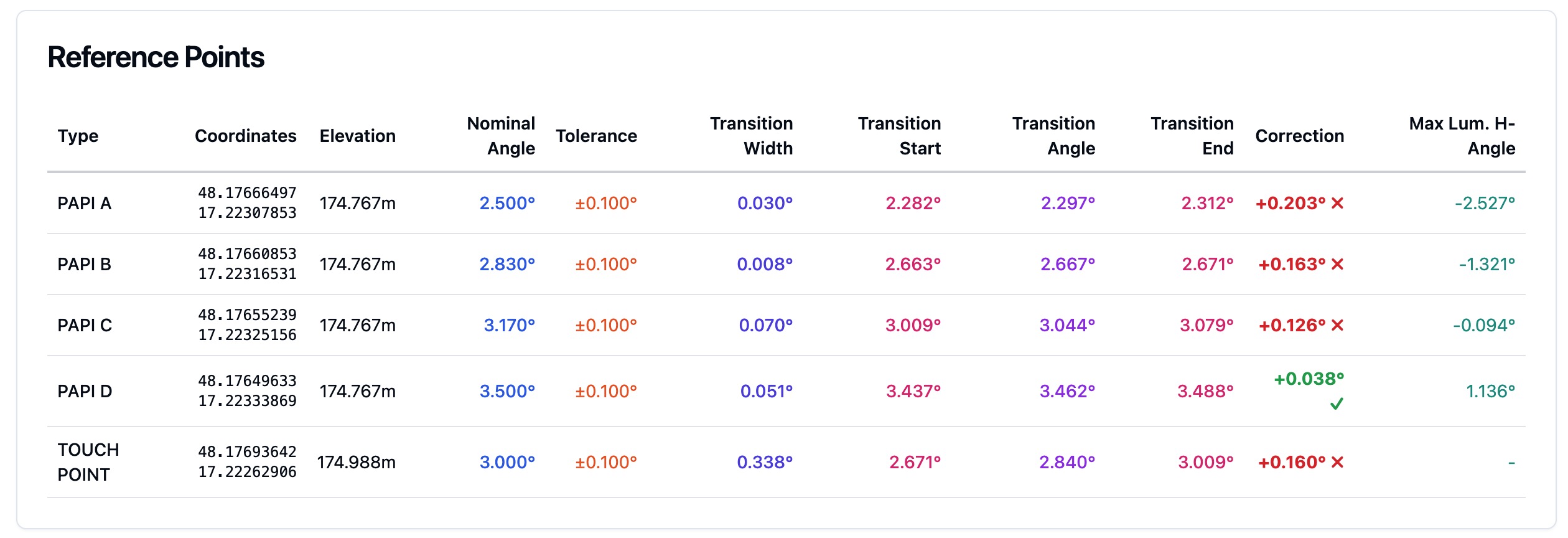
- A PAPI describing a threshold that moved. The units have not been touched, so they still pass a check against their old setting. The setting itself is now wrong for the new threshold. See the threshold crossing height for why this matters to the crew.
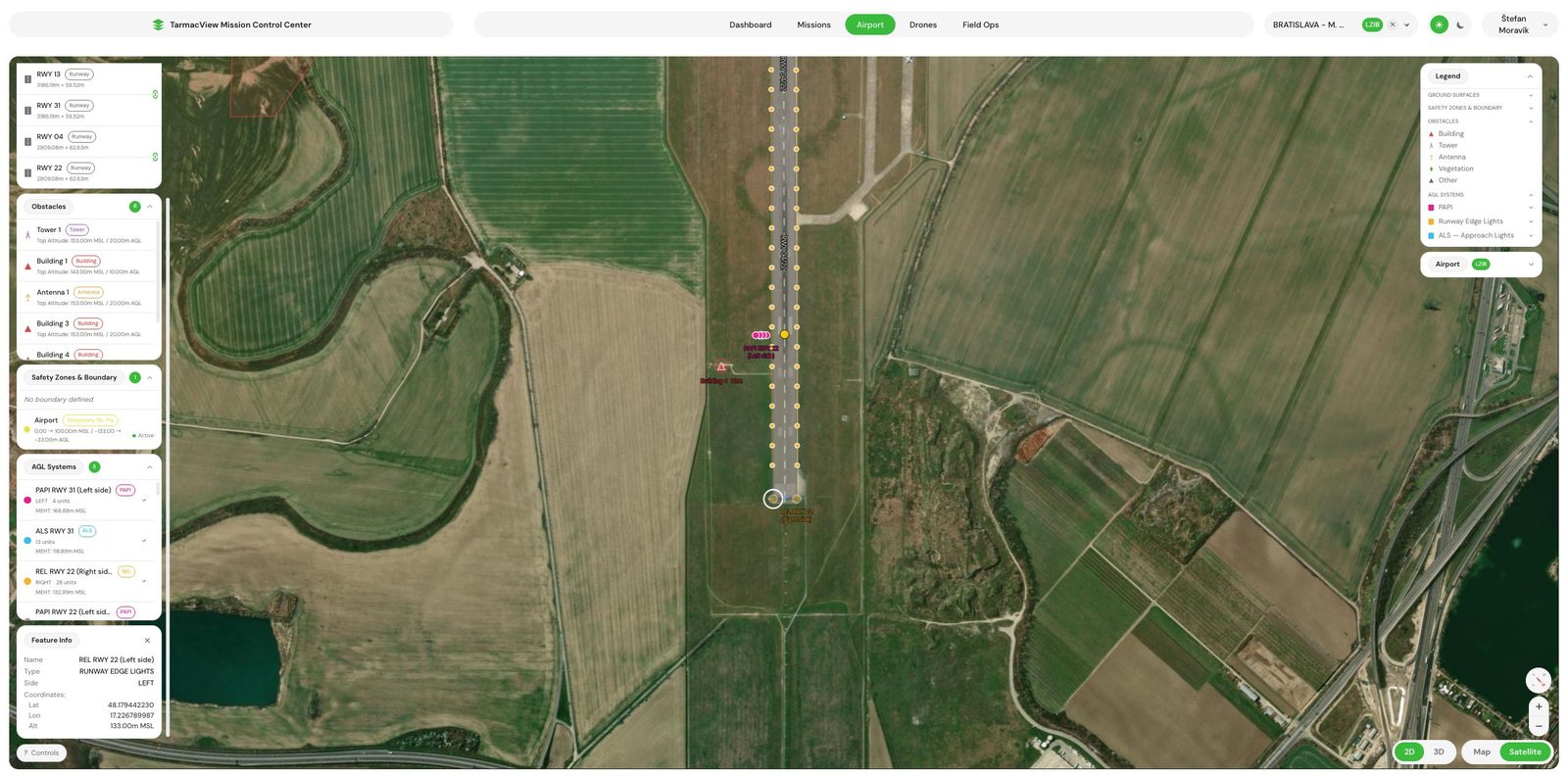
How the acceptance runs
Five steps, of which only the third falls on reopening night. The first two are planning work done while the works are being tendered.
Accepting the lighting after works
- 01
Survey the lighting before the works start
Fly every system the works will touch, at the intensity steps in use, and record each unit's state, colour, output against its row and surveyed position.
WhyOnce the contractor lifts the first unit, the old layout exists only on a drawing that may be years out of date. A measured before state is what lets the acceptance say that a unit's output dropped, not just that it is low.
Done whenA dated record per unit, including the units already dark or weak, so the contractor is not later asked to fix what was broken before they arrived.
If notIf the works have already started, survey the untouched sections now and treat the new as-built drawing as the reference for the rest.
- 02
Agree the acceptance list with the contractor
Write into the works contract which systems are accepted on a measured survey, against which drawing, which colour per position, what output spread along a row counts as a defect, and how quickly a listed unit is corrected.
WhyA defect list only works if both sides agreed in advance what counts as a defect. Without that, every finding becomes a negotiation after the handover.
Done whenThe contractor's handover and the aerodrome's acceptance refer to the same drawing and the same list of checks.
If notIf the contract is already signed, agree the list as a variation or a side letter before the last night of works rather than after.
- 03
Survey after the last night of works
Fly the threshold and end bars, the centre line and touchdown zone, the edge rows and the PAPI against the new as-built layout, at each commanded intensity step, with the lights switched on by the lighting control room.
WhyThis is the measurement the runway goes back into service on. Taken inside the final closure, it catches a defect before traffic sees it. Taken right after reopening, between movements, it still catches it under the contract.
Done whenEvery unit has a dated record against the new layout, and each system has its count against its own limit.
If notStanding water, fresh contamination or the contractor's plant can hide units. Those sections are reflown rather than rated through the obstruction.
- 04
List the defects by position for the contractor
Issue the defect list with each unit's position, what was found and what its position calls for, and report dark and missing units on the day of capture rather than holding them for the full record.
WhyA crew sent out at night with a count of dark units will look for them. A crew sent out with the positions will fix them.
Done whenThe contractor has a work list that names each fitting, and the aerodrome has the same list on file.
If notIf a finding is disputed, it is re-examined against the retained footage first. A unit is reflown only if the footage cannot settle it.
- 05
Re-check the corrected units
Fly only the corrected units and their neighbours with the same mission, and compare against the acceptance survey.
WhyA reset unit is a new unit again. The fix is not closed until it has been measured.
Done whenEvery defect on the list has a closing measurement dated after the correction, and the record becomes the baseline for the next yearly inspection.
If notA unit that still fails stays open on the list, and the operator decides with the contractor what happens next.
Ways to accept the lighting after works
| Method | What it proves | Evidence left behind | Where it stops |
|---|---|---|---|
| Contractor's handover sheet | The circuits are complete and insulated, the regulators deliver their steps, the units on the list were installed | Electrical test results and an installation list, signed by the party that did the work | Whether each unit faces the right way, shows the right colour and sits where the drawing puts it. It is also the contractor checking its own work |
| Night drive by the aerodrome | Which units are lit, and gross errors such as a bar in the wrong place or an obviously wrong colour | A list of outages, usually without positions or figures | Output against the row, beam direction seen from the approach, and any record a later dispute can be settled from |
| Ground photometric vehicle | Intensity in candela for the units it drives over, typically the centre line, touchdown zone and edge rows | Measured intensity per unit against the published minimum | Needs a booked occupancy of the runway, which is the scarcest thing on reopening night, and does not see the bars and the PAPI from the approach |
| Flight inspection | The PAPI angles and the approach and runway lighting as a crew sees them, flown on the approach without closing the runway | A flight inspection report on the system as a whole, alongside the radio aids where they are inspected on the same flight | A record of every inset unit by position, which is not what the aircraft is there to produce |
| Drone survey | Every unit lit or dark, its colour against its position, its output against its row and the commanded step, and its RTK position against the new layout | A dated record per unit with the source frames, and a defect list by position | Electrical tests, how far a unit stands proud of the surface, and absolute intensity in candela except on the edge rows, where the camera is characterised against a calibrated source |
Governance and the record
Three layers of rule meet at a works handover, and they say different things.
Works safety. Regulation (EU) 139/2014 covers aerodrome works safety in ADR.OPS.B.070, and its point (c)(5) requires the operator to have a procedure for establishing a worksite and returning it to operations. Under AMC1 ADR.OPS.B.070(c)(5), “Worksite return to operational use”, point (b)(2), the affected areas, including pavements, signs, lights, markings and FOD, are inspected for operational serviceability before they return to use. AMC1 ADR.OPS.B.070(c)(6)(c) adds a preliminary check after significant changes to marking or lighting. The rule puts the duty on the operator, not on the contractor. A handover sheet is evidence the operator can use. It does not move the duty.
Serviceability. ADR.OPS.C.015 sets the serviceability objectives that the reopened runway is judged against, system by system. A light counts as unserviceable when the average intensity of its main beam is below 50 % of the specified value, or when its filter is missing or damaged or its colour is wrong. For CAT I operations, 85 % of the approach, threshold, runway edge and runway end lights each have to be serviceable. For CAT II and III, the figures are 95 % for the runway centre line, threshold and runway edge lights, 90 % for the touchdown zone, 75 % for the runway end, and for the approach lights 95 % in the inner 450 m and 85 % beyond. For take-off with an RVR below 550 m, 95 % of the runway centre line lights. None of these is a single figure for the runway lighting, which is why the acceptance counts each system on its own.
Design. CS-ADR-DSN Issue 7 is what the reinstalled lighting has to meet: Chapter M for the lights themselves and Chapter U for their colours. ICAO Annex 14 Volume I sets out the same requirements internationally in its chapter on lights, and its maintenance chapter covers the upkeep of visual aids. A threshold displacement, shortening or extension is also a change to the aerodrome. Under ADR.OR.B.040(a), a change that affects the terms of the certificate, its certification basis or safety-critical aerodrome equipment, or that significantly affects elements of the management system, needs the competent authority’s prior approval, and under (c) the operator applies before the change and implements it only once approved. Under (d), other changes are handled through the procedure approved under ADR.AR.C.035(h). Which of these a given works package is falls to the operator’s change management, agreed with its authority.
In the United States, FAA AC 150/5370-2 covers operational safety on airports during construction, including the planning and coordination of works on an operating airport. It is guidance for US airports and useful reading elsewhere for the way it treats works as an operational activity rather than a contractor’s private site.
Whatever the framework, the auditor’s question after works is the same: show me that the lighting you reopened matched the layout you published. A signed handover and a NOTAM do not answer it. A dated per-unit record against the new as-built drawing does.
Evidence and the honest limits
The survey is good at the questions works raise, and it is worth being plain about the ones it does not answer.
What it answers well
Position and colour are its strongest outputs. Each unit’s position comes from RTK positioning and is set against the as-built layout, so a unit at an old position, a missing unit or a bar in the wrong place is reported where it is. Colour is read per unit and per face and set against what that position calls for. Output is measured against the unit’s neighbours and against the commanded dimming step, which is how a unit turned on its base or set too low shows up: it reads differently from the row it belongs to.
What it does not answer
The drone does not measure the height of an inset unit against the new surface, the torque on its bolts or anything below the pavement. It does not test the circuit, the regulator or the standby supply. Absolute intensity in candela is given for the edge rows, where the camera is characterised against a calibrated source before it flies. For the other systems the output is relative to the row and the step, which is what an acceptance against neighbours needs, and an absolute figure needs an anchor such as a calibrated photometer. The photometric measurement guide sets out where that anchor enters the chain.
Objections worth raising before you buy
“The contractor already tests the circuits.” It does, and that test is needed. A circuit test proves current flows through every transformer on the loop. It does not prove that the unit on the end of it faces down the runway, shows red where red belongs, or sits at the new threshold. Those are optical and positional facts, and they are what the crew sees.
“We reopen at 06:00, there is no time.” The survey does not need the runway to stay closed. It can be flown inside the last closure if the contractor’s plant and the tower allow, or between movements after reopening. What it needs is the lighting switched on at the steps being checked, and a slot in the tower’s plan. The record is what turns a defect found at 07:00 into a contractor’s work order rather than the aerodrome’s cost.
“It’s only a resurfacing, nothing moved.” Every inset unit was lifted and reset. That is the definition of moving it, in height and possibly in rotation, by however much the crew on that night got it wrong. The drawing did not change, which is exactly why a defect against it goes unnoticed.
“The flight inspection will catch it.” Flight inspection checks the PAPI and the approach and runway lighting as a crew sees them, and it is worth having after a threshold move. It judges the system from the approach. It is not built to hand the contractor a list of inset units by position, which is the form a works defect has to take to get fixed. The two are compared in drone survey versus flight inspection .
Related tasks
If the works moved the threshold, the threshold and runway end lights inspection scores each bar against its own limit at its new position, and the PAPI inspection checks the angles against the new threshold. If inset units were lifted, the runway centreline lights inspection covers the centre line and touchdown zone, and the runway edge lights inspection covers the rows on either side. If the works changed what sits under the approach, the PAPI protection surface check is the page for it. And once the runway is back in service, the airfield lighting inspection programme picks up from the acceptance record, with the shape of a visit on the pricing page .
Frequently Asked Questions
- When should the survey be flown, before or after reopening?
- Both sides of the works, if possible. The first survey is taken before the contractor lifts anything, so there is a measured layout of what was there. The acceptance survey is taken after the last night of works, either inside the closure if the contractor and the tower allow it, or between aircraft movements right after reopening. Before reopening is better, because a defect found then is fixed before traffic uses it. After reopening is still worth doing, because a defect found in the first days is a work order under the contract rather than a maintenance cost found later.
- Is the runway closed for the survey?
- No closure is booked for it. The passes are flown between aircraft movements in coordination with the tower, and the drone clears the strip when asked. If the works closure is still in force on the last night, the survey can be flown inside it where the contractor's vehicles and the tower allow. Either way the lights have to be switched on at the intensity steps being checked, which is a request to the lighting control room.
- Does moving the threshold change anything for the PAPI?
- Yes. The PAPI is sited and set against the threshold it serves, so a displaced threshold changes the height at which the on-slope signal crosses it, and with an ILS on the runway it changes the harmonisation as well. Either the PAPI is moved and re-set, or the aerodrome has to show why it did not need to be. The angle check is the PAPI inspection itself, flown against the new threshold. Whether a new obstacle sits under the approach after the works is a different question, answered by the protection surface check.
- What does a drone survey not check after works?
- Anything that is not light leaving the fitting. It does not measure how far an inset unit stands proud of the new surface, the bolt torque on its base, the condition of the cabling, insulation resistance, the regulator output on each step or the standby power switch-over. Those are ground tests, and the contractor's handover sheet and the aerodrome's electricians cover them. What the survey adds is the part nobody on the ground can see in one pass: every unit, from the air, with its colour, its output against its row and its position.
- We have no survey from before the works. Is the acceptance survey still useful?
- Yes, and it becomes the baseline. Without a before layout the acceptance survey is compared with the new as-built drawing instead of with the old field. That still finds missing units, dark units, wrong colours, units out of line with their row and bars that do not sit where the drawing puts them. What it cannot tell you is whether a unit's output dropped because of the works or was already low, because there is nothing earlier to set it against.
- Who fixes what the survey finds?
- The contractor, under the works contract, for anything the works touched. The survey lists each defect by unit and position, which is the form a contractor's crew needs to go to the right fitting at night. Once they have been back, the corrected units are flown again and the record is closed against them. TarmacView measures and reports. It does not adjust, replace or certify fittings, which keeps the measurement independent of the work it checks.
References
- easa-ear-aerodromes
- Easy Access Rules for Aerodromes (Regulation (EU) No 139/2014), including CS-ADR-DSN Issue 7 European Union Aviation Safety Agency
- eu-139-2014
- Commission Regulation (EU) No 139/2014 laying down requirements and administrative procedures related to aerodromes Publications Office of the European Union
- icao-annex-14-v1
- Annex 14 to the Convention on International Civil Aviation, Volume I: Aerodrome Design and Operations International Civil Aviation Organization
- faa-ac-150-5370-2
- AC 150/5370-2, Operational Safety on Airports During Construction Federal Aviation Administration
- atsb-ao-2023-027
- Investigation AO-2023-027, Perth Airport, 2023 Australian Transport Safety Bureau