What is a Lighting Schedule in Airport Operations?
Lighting Schedule – Plan for Lighting Operations in Airport Operations
What is a Lighting Schedule?
A Lighting Schedule in airport operations is a comprehensive, dynamic plan that dictates the precise timing, intensity, control logic, and operational conditions for every lighting system across an airport’s airside and landside environments. Far beyond a simple timetable, it is an adaptive, often software-driven management protocol that synchronizes lighting with variable flight activity, meteorological conditions, regulatory mandates, and sustainability objectives. Modern lighting schedules are embedded within wider Lighting Management Plans (LMP) or Airfield Lighting Operations Manuals, ensuring all stakeholders, air traffic control (ATC), maintenance, security, and environmental teams, work from a unified, compliant operational blueprint.
Lighting schedules govern:
- Runway and taxiway lighting
- Approach lighting systems (ALS)
- Apron, terminal, and landside lighting
- Obstruction lighting for hazards
- Maintenance and inspection cycles
The effectiveness of a lighting schedule directly impacts airport safety, operational efficiency, regulatory compliance, and environmental stewardship.
Purpose and Importance of a Lighting Schedule
The main objectives of a lighting schedule are:
- Safety: Ensures runways, taxiways, and approaches are illuminated precisely when required for takeoff, landing, and ground maneuvering, even under poor visibility or night operations.
- Regulatory Compliance: Meets stringent activation, deactivation, and intensity requirements set by authorities such as the FAA, ICAO, and local agencies.
- Efficiency: Matches lighting operations to actual airport activity, reducing or extinguishing lighting during periods of inactivity to save energy.
- Environmental Responsibility: Reduces light pollution, protects wildlife, and supports DarkSky compliance using adaptive dimming, shielding, and motion-activated controls.
- Maintenance Coordination: Integrates inspection and repair windows into operations, optimizing resource allocation and minimizing disruption.
In summary, an airport’s lighting schedule is a safety-critical, compliance-driven, and sustainability-focused operational tool.
Components of an Airport Lighting Schedule
A robust lighting schedule includes:
- System Identification: Details on each lighting system, type, location, and operational use (e.g., runway edge lights, taxiway centerline lights, ALS, apron floodlights, obstruction lights).
- Activation/Deactivation Times: Absolute (e.g., “30 min before sunset to 30 min after sunrise”) or event-driven (e.g., “when aircraft are taxiing”).
- Control Methods: Manual (by ATC), automated (via timers, sensors), or pilot-controlled (PCL).
- Intensity Settings: Adjusted for weather, operational need, and regulatory standards.
- Special Conditions: Procedures for construction, emergencies, equipment failures, or environmental incidents.
- Regulatory References: Citations of FAA, ICAO, and local codes.
- Maintenance Integration: Schedules for inspections, repairs, temporary lighting, and NOTAMs during outages.
Types of Lighting Systems Covered
Runway Lighting Systems
Runway lighting is critical for safe takeoff and landing:
- Edge lights define the runway width
- Centerline lights aid alignment in low visibility
- Threshold and end lights mark runway limits
- Touchdown zone lights help pilots gauge landing areas
Operational Guidelines:
Runway lights are typically on from 30 minutes before sunset to 30 minutes after sunrise, and always during low visibility (less than 3 miles) or low ceiling (below 1,000 feet AGL), as per ICAO and FAA standards. Intensities are adjustable for conditions.
Taxiway Lighting
Taxiway lighting guides aircraft between runways and aprons:
- Edge lights (blue)
- Centerline lights (green)
Activation:
Taxiway lights are generally on whenever runway lights are, or when aircraft taxi at night or in poor weather. Some airports use selective or pilot-controlled lighting to save energy.
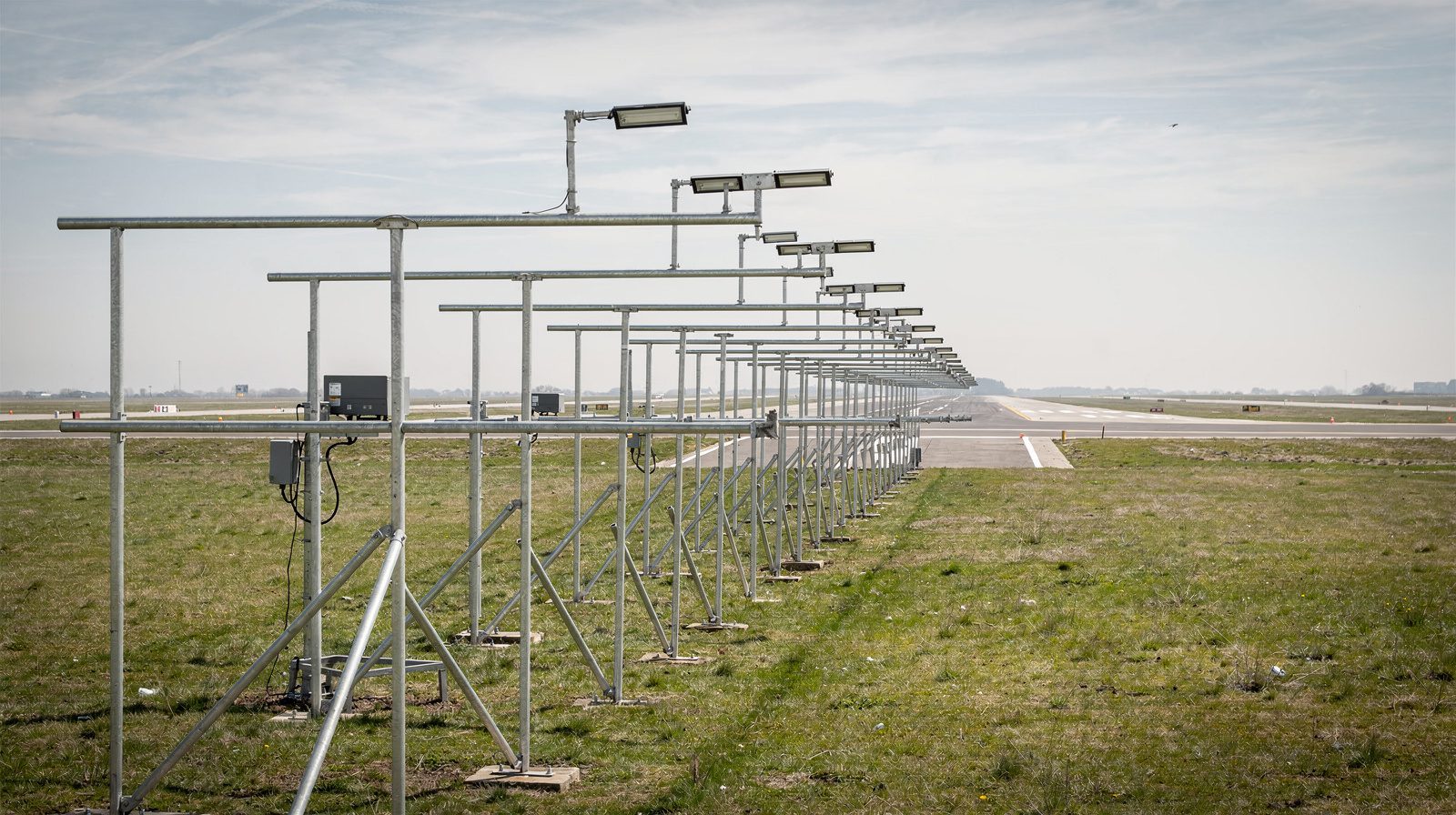
Approach Lighting Systems (ALS)
ALS provides critical visual cues during approach, especially in low visibility:
- Configurations vary by runway category (ICAO CAT I/II/III)
- Activation is linked to runway lights and instrument meteorological conditions (IMC)
ALS can be a significant source of light pollution, schedules often require dimming or shielding when not strictly necessary.
Obstruction Lighting
Marks hazards (towers, antennas, buildings, cranes, terrain) within the airport’s protected airspace:
- Operates sunset to sunrise, and during reduced visibility
- Includes low-intensity red beacons, medium/high-intensity strobes
Schedules require prompt maintenance and may include dimming or shielding for environmental compliance.
Apron, Terminal, and Landside Lighting
Ensures safety and security for ground personnel, passengers, and vehicles:
- Apron floodlights, terminal exteriors, parking lots, roads, walkways
- Activation based on operational demand, security protocols, and energy efficiency
Control systems use motion sensors, timers, and adaptive dimming to reduce unnecessary lighting.
Lighting Schedule Development: Methods and Inputs
Development involves:
- Operations Data: Flight schedules, historical patterns, special events
- Weather Data: Visibility, ceiling, and seasonal variations
- Regulatory Requirements: FAA, ICAO, and local codes
- Environmental & Community Input: Light pollution, wildlife, public feedback
Stakeholder engagement and advanced lighting control systems (LCMS) ensure the schedule is adaptive, compliant, and auditable.
Control Systems and Automation
Modern control systems automate lighting schedules based on:
- Time: Astronomical clocks calculate sunset/sunrise
- Sensors: Ambient light, occupancy, and weather
- Integration: ATC, flight schedules, and emergency systems
Manual override is retained for emergencies or special events. Pilot-Controlled Lighting (PCL) is used at low-traffic airports. All actions are logged for traceability.
Regulatory and Compliance Framework
- FAA Advisory Circular 150/5340-30J: US standard for airport visual aids
- ICAO Annex 14: International standard for aerodrome lighting
- Photometric Standards: Uniform illumination, correct color/intensity
- Environmental Codes: DarkSky, energy codes, wildlife protection
Non-compliance can result in fines, operational restrictions, or loss of certification.
Operational Use Cases and Examples
- Low-traffic airports: Pilot-controlled lighting to minimize energy use and light pollution
- High-traffic airports: Automated, integrated schedules with ATC and flight management
- Environmental compliance: Adaptive dimming and shielding, especially for landside lighting near sensitive areas
- Scenario-based use: Special schedules for snow removal, construction, or emergencies
Maintenance Scheduling and the Lighting Plan
Lighting schedules integrate:
- Routine inspections: Daily/weekly checks, photometric measurements
- Planned outages: Coordinated with low-traffic periods, NOTAMs issued
- Emergency repairs: Rapid response, temporary lighting procedures
- Seasonal adjustments: Additional inspections after severe weather
All maintenance is logged and coordinated with asset management systems.
Checklist: Lighting Schedule Implementation
- Inventory all lighting systems (type, location, operational role)
- Review all regulatory requirements (FAA, ICAO, local)
- Define activation/deactivation criteria for each system
- Specify control methods (manual, automated, PCL)
- Set intensity levels for various conditions
- Schedule maintenance and inspection intervals
- Document special procedures for emergencies, construction, or deviations
- Verify environmental compliance (DarkSky, local codes)
- Communicate and train all stakeholders
- Review and update the schedule annually or after significant changes
Key Terms and Definitions
- Airfield Lighting: Systems illuminating runways, taxiways, and approaches
- Landside Lighting: Lighting for terminals, parking, roads, and walkways
- Photometric Compliance: Meeting prescribed light intensity and uniformity
- Pilot-Controlled Lighting (PCL): Remote activation by pilots via radio
- Runway Status Light System (RWSL): Automated safety lights for runway occupancy
- Obstruction Lighting: Hazard marking for structures or terrain
- DarkSky Compliance: Minimizing unnecessary light for night sky preservation
- Lighting Management Plan (LMP): Comprehensive lighting policies and schedules
- NOTAM: Official notice of operational changes, including lighting outages
- ATC: Air Traffic Control, often responsible for lighting operations
- AIM: Aeronautical Information Manual for lighting-related guidance
Summary Table: Lighting Schedule in Airport Operations
| Element | Explanation |
|---|---|
| What is it? | Dynamic plan for operational timing, intensity, and control of airport lighting systems |
| Where used? | All airport zones: runway, taxiway, approach, apron, terminal, landside, obstructions |
| How is it used? | Via manual, automated, or pilot-controlled systems, integrates maintenance and environmental objectives |
| Why is it needed? | Ensures safety, regulatory compliance, efficiency, and environmental stewardship |
A well-designed lighting schedule is foundational to safe, compliant, and sustainable airport operations, balancing the needs of flight crews, regulatory authorities, and the surrounding community.
Frequently Asked Questions
- What is an airport lighting schedule?
- An airport lighting schedule is a regulated plan that defines when, how, and under what conditions various airport lighting systems, such as runways, taxiways, approaches, aprons, and obstructions, are activated, adjusted, and maintained. It ensures compliance with safety, regulatory, and environmental standards while optimizing energy use and operational efficiency.
- Why is a lighting schedule important for airports?
- A lighting schedule is critical for ensuring safe aircraft movements, regulatory compliance (with authorities like the FAA and ICAO), and efficient airport operations. It also helps minimize energy consumption and environmental impacts, such as light pollution and wildlife disturbance.
- How are airport lighting schedules developed?
- Lighting schedules are developed through collaboration among airport operations, safety, engineering, and environmental teams, using flight schedules, weather patterns, and regulatory requirements as inputs. Advanced lighting control systems and stakeholder engagement help create adaptive, compliant schedules.
- What types of lights are covered by a typical lighting schedule?
- A typical lighting schedule covers runway edge and centerline lights, threshold and touchdown zone lights, taxiway edge and centerline lights, approach lighting systems, apron floodlights, obstruction lights, terminal, and landside lighting.
- How do airports automate their lighting schedules?
- Many airports use lighting control and monitoring systems (LCMS) that automate activation based on time, weather, traffic, or sensor input. These systems can also be integrated with ATC consoles, flight schedules, and provide manual override for special situations.
This is a reference entry. TarmacView provides drone inspection services and doesn't sell the equipment or materials described in this glossary.