What is an aviation light?
An aviation light is a light used in aviation, either on the ground at an aerodrome or on an aircraft.
The term has no single definition in the EU or ICAO texts. Those texts define the ground group only. Aircraft certification rules and operating rules cover aircraft lights. Obstacle lights on masts and towers have their own chapter in Annex 14.
Aeronautical ground lights
EASA (the European Union Aviation Safety Agency) and ICAO (the International Civil Aviation Organization) use one definition. An aeronautical ground light is a light specially provided as an aid to air navigation. A light on an aircraft is not one. An aeronautical beacon is such a light. It is visible at all azimuths and marks a point on the surface of the earth. An aerodrome beacon marks the position of an aerodrome.
The EU specifications are in CS-ADR-DSN under Regulation (EU) No 139/2014. Chapter M covers the lights of the movement area, including:
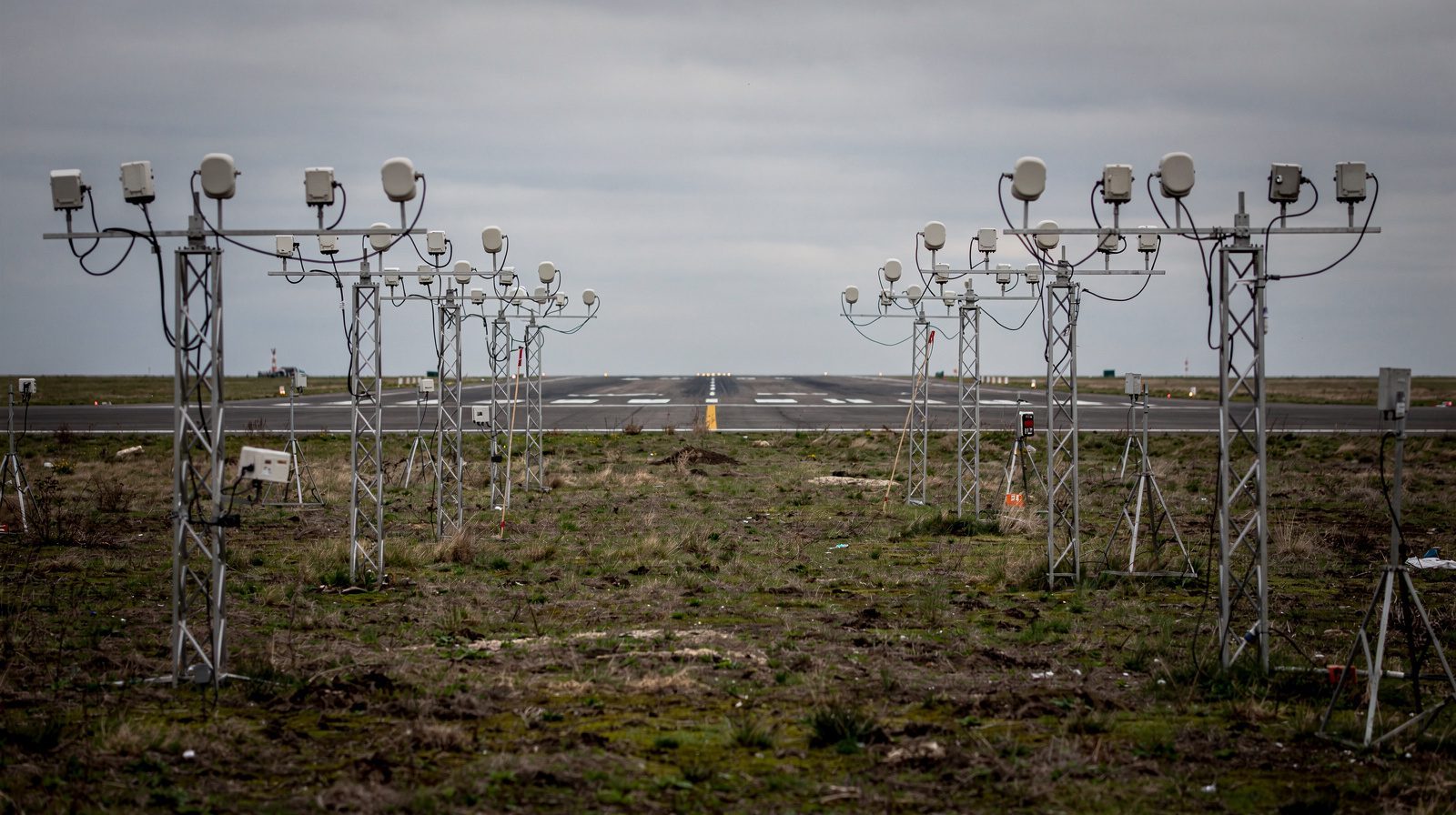
- the aerodrome beacon, approach lighting systems and the precision approach path indicator (PAPI)
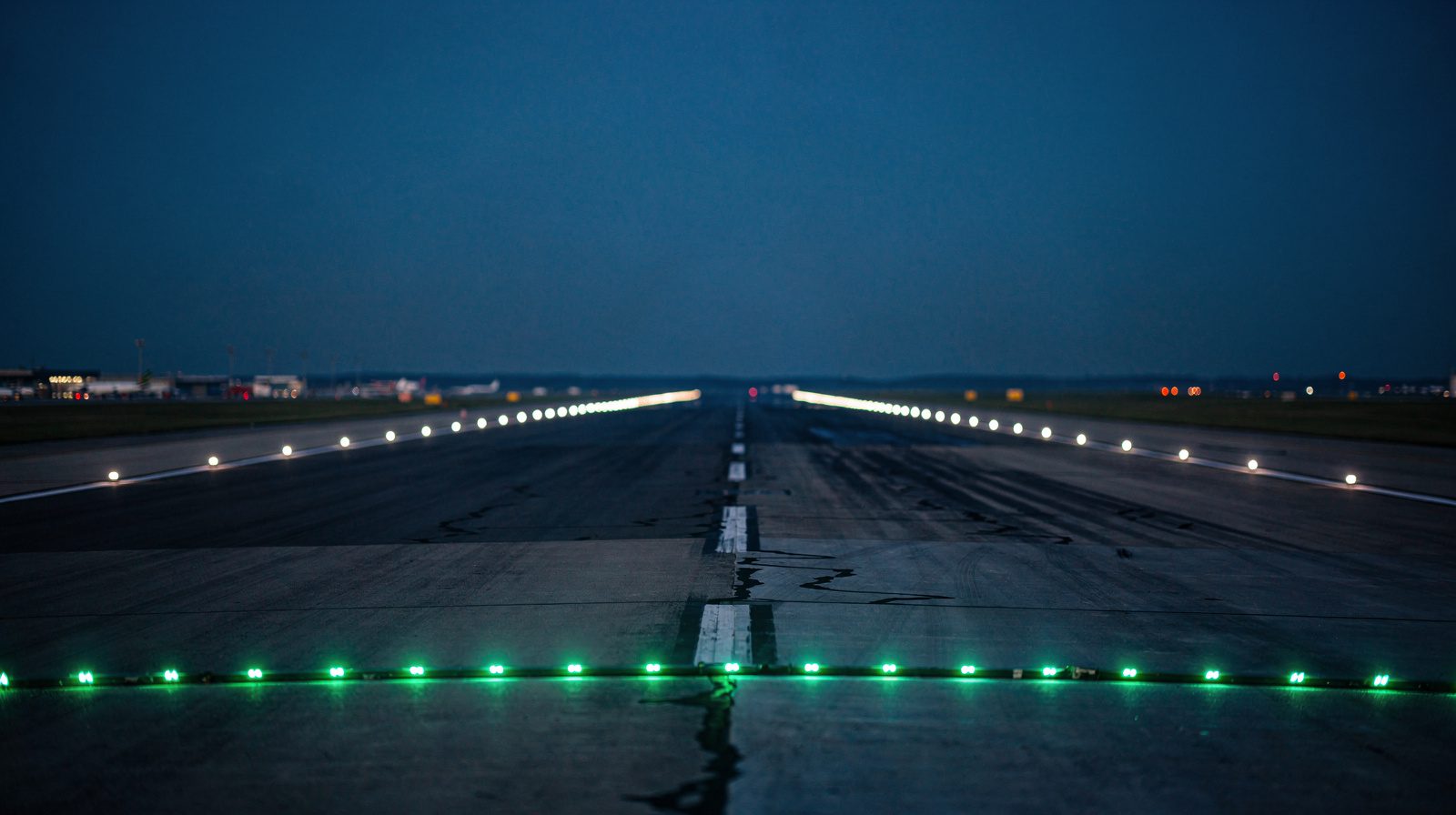
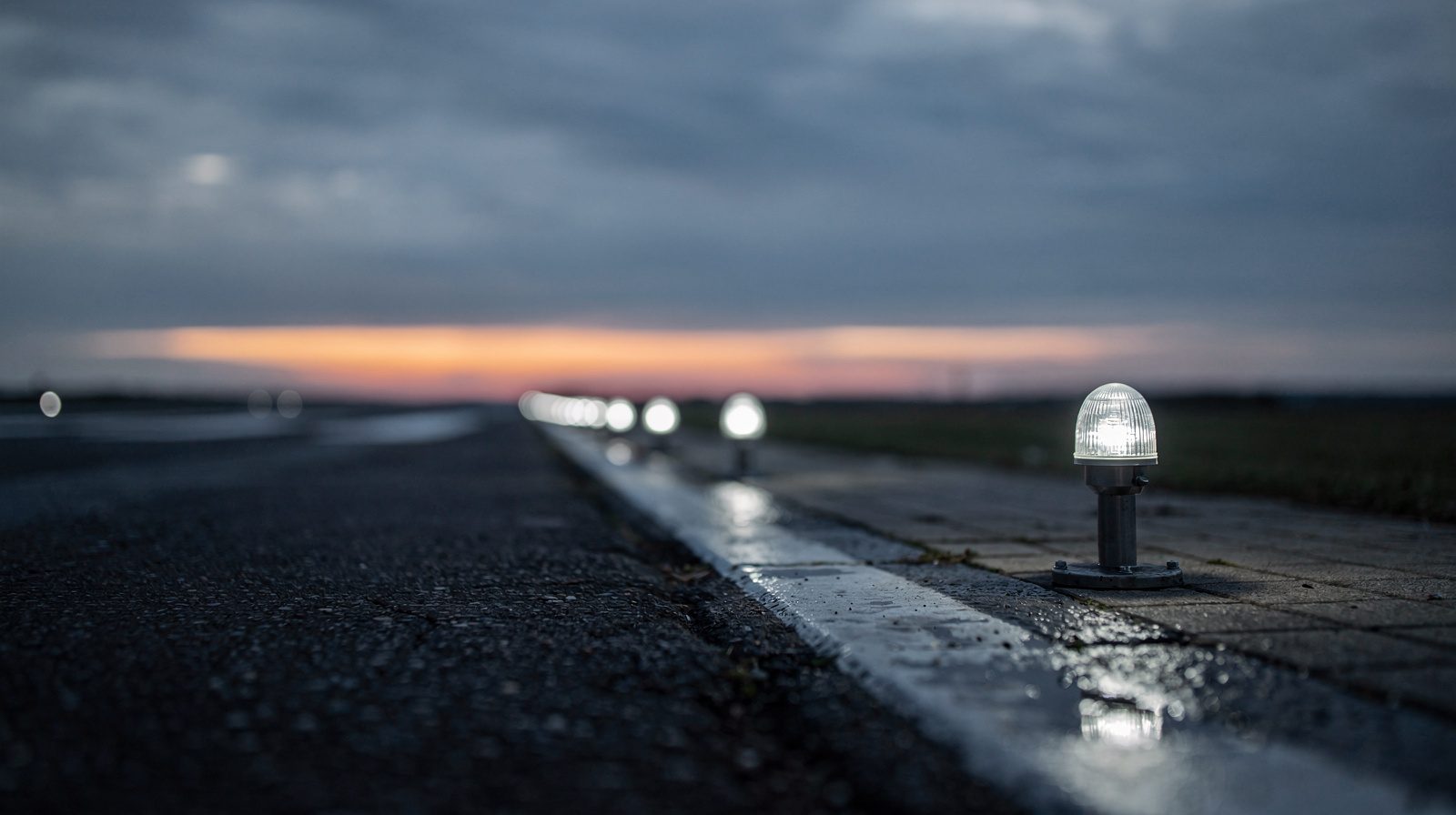
- runway edge, threshold, end, centre line and touchdown zone lights
- taxiway centre line and edge lights, and stop bars
- apron floodlighting
ICAO lists the same light types in Annex 14 Volume I, Chapter 5, section 5.3. The list also has circling guidance lights, rapid exit taxiway indicator lights, stopway lights, runway guard lights, no-entry bars and runway status lights. Obstacle lights are in Chapter Q of CS-ADR-DSN and in Chapter 6 of Annex 14.
Colours of airfield lights
Annex 14 sets the colour for each type of light. These are Standards (“shall”), and the yellow edge lights are an option (“may”). The table gives some of them.
| Light | Colour | Annex 14 |
|---|---|---|
| Aerodrome beacon | white flashes, or coloured flashes that alternate with white | 5.3.3.6 |
| Runway edge lights | variable white. Red between the runway start and a displaced threshold. Yellow may show on the last 600 m or one-third of the runway, whichever is less, seen from the take-off start | 5.3.9.7 |
| Runway threshold lights | green | 5.3.10.9 |
| Runway end lights | red | 5.3.11.4 |
| Runway centre line lights | variable white, then alternate red and variable white, then red toward the runway end | 5.3.12.7 |
| Taxiway centre line lights | green on a taxiway other than an exit taxiway | 5.3.17.6 |
| Taxiway edge lights | blue | 5.3.18.7 |
| Stop bar | red in the direction of approach | 5.3.20.5 |
On a runway shorter than 1 800 m the split between the white and the red centre line lights is different (5.3.12.7).
Annex 14 Appendix 1, section 2, gives the chromaticity limits of red, yellow, green, blue, white and variable white. Figure A1-1a is for filament-type lamps. Figure A1-1b is for solid state lighting. In the EU the colours are in CS ADR-DSN.U.930.
Construction and the aerodrome beacon
CS ADR-DSN.M.615 sets construction rules. Elevated runway, stopway and taxiway lights should be frangible. Lights set into a surface should withstand the wheels of an aircraft. At the contact with an aircraft tyre, they should not exceed 160 degrees Celsius in 10 minutes.
An aerodrome beacon is not on every aerodrome. CS ADR-DSN.M.620 asks for one at an aerodrome for night use under two conditions. Aircraft navigate mainly by visual means. Also, visibility is often reduced or the aerodrome is hard to find from the air. Annex 14 5.3.3.3 is wider. It asks for a beacon if any one of three conditions exists. The three are visual navigation, frequent reduced visibility and an aerodrome that is hard to find. Both texts place the beacon on or next to the aerodrome, in an area of low background lighting.
At a land aerodrome the beacon gives 20 to 30 flashes a minute. Any coloured flash is green (Annex 14, 5.3.3.6). In the United States, airport beacons flash 24 to 30 times a minute (AIM 2-1-9).
Obstacle lights
Obstacle lights are the aviation warning lights on masts, towers, wind turbines and other objects that endanger aircraft. Annex 14 6.2.1.1 says that obstacle lights show an object that must be lighted. They are low-, medium- or high-intensity lights, or a mix of them. 6.2.1.3 asks for enough lights to show the object from every angle in azimuth. A wind turbine that is an obstacle must be marked, lighted or both (6.2.4.1). Obstacle lights must not stand on elevated ground lights or signs in the movement area (6.1.1.2).
Annex 14 Table 6-1 sets the characteristics. A flash rate is in flashes a minute (fpm). The peak intensity is in candela (cd). N/A means that the type has no value for that background.
| Light type | Colour | Signal | Day peak (cd) | Twilight peak (cd) | Night peak (cd) |
|---|---|---|---|---|---|
| Low-intensity, Type A (fixed obstacle) | red | fixed | N/A | N/A | 10 |
| Low-intensity, Type B (fixed obstacle) | red | fixed | N/A | N/A | 32 |
| Low-intensity, Type C (mobile obstacle) | yellow or blue | flashing, 60 to 90 fpm | N/A | 40 | 40 |
| Low-intensity, Type D (follow-me vehicle) | yellow | flashing, 60 to 90 fpm | N/A | 200 | 200 |
| Low-intensity, Type E | red | flashing | N/A | N/A | 32 |
| Medium-intensity, Type A | white | flashing, 20 to 60 fpm | 20 000 | 20 000 | 2 000 |
| Medium-intensity, Type B | red | flashing, 20 to 60 fpm | N/A | N/A | 2 000 |
| Medium-intensity, Type C | red | fixed | N/A | N/A | 2 000 |
| High-intensity, Type A | white | flashing, 40 to 60 fpm | 200 000 | 20 000 | 2 000 |
| High-intensity, Type B | white | flashing, 40 to 60 fpm | 100 000 | 20 000 | 2 000 |
Day is a background above 500 cd/m2, twilight is 50 to 500 cd/m2 and night is below 50 cd/m2. See obstacle light for the placement rules.
The EU text is CS ADR-DSN.Q.840 and Q.846. They set which objects are lighted and how fixed objects are lit.
Lights on aircraft
Aircraft have position lights, anti-collision lights, landing lights and other lights. The United States rules for transport category aeroplanes give the colours. The forward position lights are red on the left and green on the right. The rear position light is white. An anti-collision light is aviation red or aviation white. Its effective flash frequency is 40 to 100 cycles a minute (14 CFR 25.1401). The landing light must give enough light for a night landing without objectionable glare for the pilot (14 CFR 25.1383).
From sunset to sunrise, 14 CFR 91.209(a) requires lighted position lights on an aircraft in operation. To park or move in a night flight operations area, or in dangerous proximity to it, an aircraft must meet one of three conditions. It is clearly illuminated, it shows lighted position lights, or it stands in an area that obstruction lights mark.
Paragraph (b) has no time limit. An aircraft with an anti-collision light system must operate with the anti-collision lights lit. The pilot-in-command may switch them off if operating conditions make that safer.
Other lights near an aerodrome
A non-aeronautical ground light near an aerodrome can endanger aircraft. Annex 14 5.3.1.1 says that such a light shall be extinguished, screened or modified so that the danger is gone. For laser emitters, Annex 14 recommends protected zones around aerodromes (5.3.1.2). It is a Recommended Practice, not a Standard.
Serviceability
The aerodrome operator must keep a maintenance programme for the individual lights and for the reliability of the lighting systems. The objective differs per system. There is no single figure. For a Category II or III precision approach runway, the objective is 95 percent working lights in each of four elements. The elements are the centre line lights, the threshold lights, the edge lights and the inner 450 m of the approach lighting system. The objective is 90 percent for the touchdown zone lights and 85 percent for the approach lights beyond 450 m. It is 75 percent for the runway end lights. On such a runway an unserviceable light must not stand next to another one, except in a barrette or crossbar. For a Category I runway, the objective is at least 85 percent in the approach, threshold, edge and end lights (ADR.OPS.C.015(b)).
Aviation lights and inspection
A drone flight along the aeronautical ground lights can record the intensity of each light relative to its neighbours, its colour and its position. TarmacView does this between aircraft movements for the lights of an aerodrome, such as PAPI, approach, runway and taxiway lights. The result shows which lights are weak or off, system by system.
Frequently Asked Questions
- What is the difference between an aviation light and an aeronautical ground light?
- An aeronautical ground light is one group of aviation lights. EASA and ICAO define it as any light specially provided as an aid to air navigation, other than a light displayed on an aircraft. Lights on aircraft form the other group. The term aviation light itself has no definition in these texts.
- What colours do airfield lights show?
- Annex 14 sets the colour per light type. Runway edge lights show variable white. Runway threshold lights show green. Runway end lights show red. Taxiway centre line lights show green. Taxiway edge lights show blue. Stop bars show red. Annex 14 Appendix 1 gives the chromaticity limits of each colour.
- What are aviation warning lights?
- Aviation warning lights are obstacle lights. They mark an object that is a hazard to aircraft, such as a mast or a wind turbine. Annex 14 Table 6-1 sets three intensity classes. Low-intensity Type A and Type B lights on fixed objects are red and steady. Medium-intensity lights are white or red. High-intensity lights are white and flash.
- Which colours do the position lights of an aeroplane show?
- The forward position lights show red on the left side and green on the right side. The rear position light shows white. This is the rule of 14 CFR 25.1385 for transport category aeroplanes in the United States. The EASA equivalent is not covered here. An anti-collision light shows aviation red or aviation white.
- Must every aeronautical ground light work?
- No, but ADR.OPS.C.015 asks the aerodrome operator to keep a maintenance programme with a serviceability objective per system. For a Category II or III precision approach runway, the objective is that at least 95 percent of the runway centre line lights work. For the runway end lights it is 75 percent. On such a runway an unserviceable light must not stand next to another one, except in a barrette or crossbar.
- Does every aerodrome need a beacon?
- No. ICAO Annex 14 5.3.3.3 requires an aerodrome beacon at an aerodrome for night use if one or more conditions exist. Aircraft navigate mainly by visual means. Reduced visibility is frequent. Or the aerodrome is hard to find from the air. EASA CS ADR-DSN.M.620 asks for one if aircraft navigate mainly by visual means and one of the other two conditions exists.
- How often does an aerodrome beacon flash?
- An aerodrome beacon gives 20 to 30 flashes a minute under Annex 14 5.3.3.6. It shows white flashes only, or coloured flashes that alternate with white. The coloured flashes are green at a land aerodrome and yellow at a water aerodrome. The FAA gives 24 to 30 flashes a minute for airport beacons.
References
- easa-ear-aerodromes
- Easy Access Rules for Aerodromes (Regulation (EU) No 139/2014), revision of March 2026, CS-ADR-DSN Issue 7 EASA
- easa-adr-ops-c-015
- ADR.OPS.C.015, Maintenance of visual aids and electrical systems (Delegated Regulation (EU) 2020/2148) EASA
- icao-annex-14-vol-i
- Annex 14 Volume I, Aerodrome Design and Operations, 9th edition (consolidated copy hosted by the Swiss FOCA) ICAO
- cfr-14-25-1383
- 14 CFR 25.1383, Landing lights eCFR
- cfr-14-25-1385
- 14 CFR 25.1385, Position light system installation eCFR
- cfr-14-25-1401
- 14 CFR 25.1401, Anticollision light system eCFR
- cfr-14-91-209
- 14 CFR 91.209, Aircraft lights eCFR
This is a reference entry. TarmacView provides drone inspection services and doesn't sell the equipment or materials described in this glossary.