PAPI Still Wrong After a Flight Check
A PAPI passed its flight check, or was re-aimed after it, and pilots still report it wrong. A drone check of each unit names the unit and transition at fault.
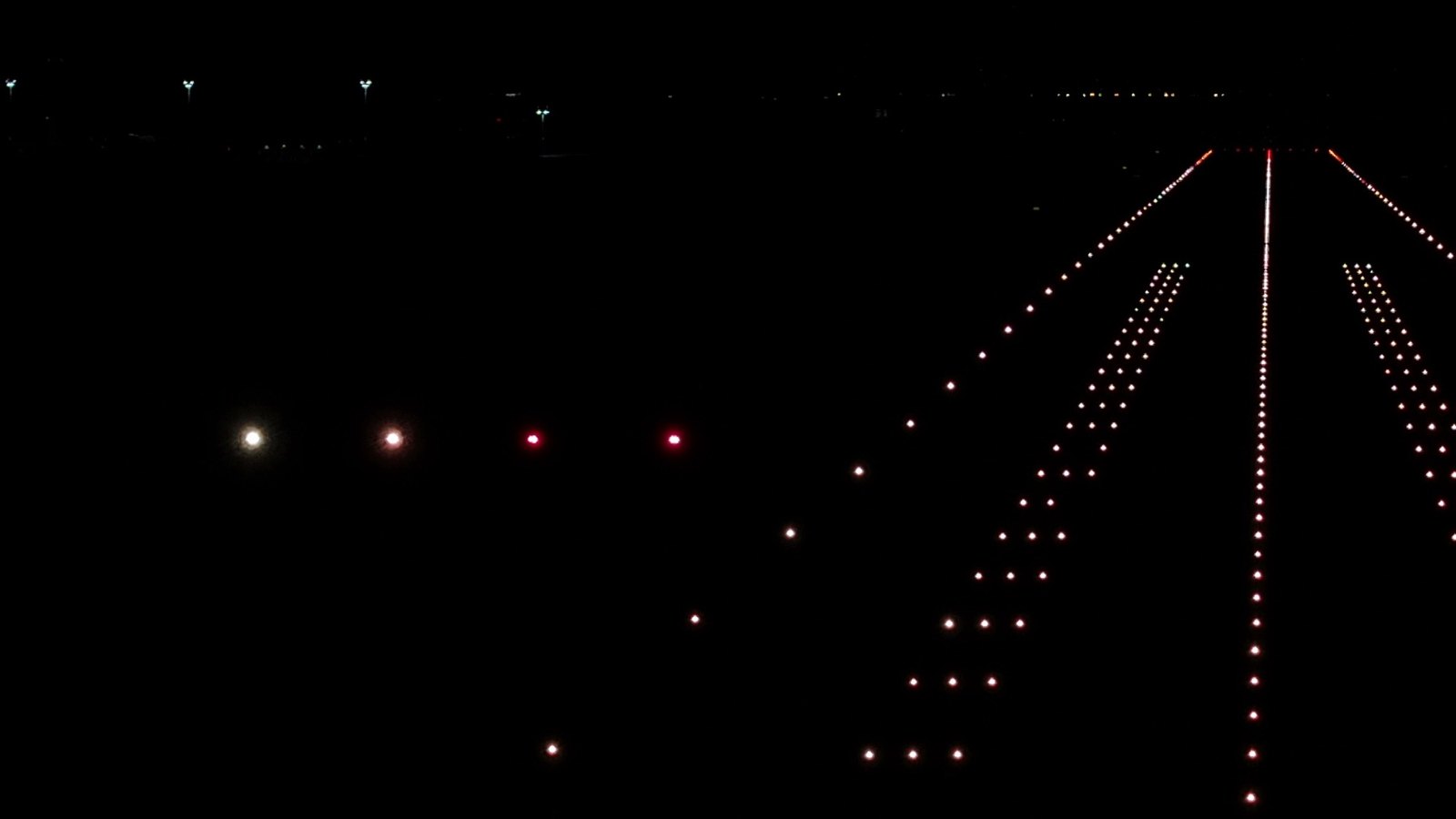
- 01 A flight check result and a pilot report can both be valid. They can describe the system and one unit, or the PAPI before and after an adjustment.
- 02 The United States flight inspection manual accepts an effective angle within 0.20 degrees. European acceptable means of compliance want unit errors above one minute of arc corrected.
- 03 A drone profile measures each unit's transition angle from the approach, so the finding names one unit, its direction and its size.
- 04 Flight inspection stays the authority's check and is not replaced. The drone measurement is an independent second opinion that sits beside it.
- 05 TarmacView measures and reports. The aerodrome's technician adjusts the unit, and the same profile flown again proves the correction.
On this page · 11 sections
Who runs into this
The flight inspection is done, and the report says the precision approach path indicator (PAPI ) is usable. Then a crew tells the tower the lights showed them low on a stable approach. The aerodrome now holds two statements that do not agree. It usually gets there in one of three ways.
- Passed, then reported. The calibration aircraft checked the PAPI on its scheduled visit and found it satisfactory. Pilot reports about the indication start, or continue, afterwards.
- Re-aimed, then reported. The flight inspection found a problem and the units were adjusted. Nobody has seen the adjusted PAPI from the approach since, and the reports begin after the repair.
- Reported by some crews only. One operator or one aircraft type complains and the others do not. The cause may be a unit, or it may be the eye height the PAPI was sited for.
The two main Slovak commercial airports called TarmacView in this position. A flight inspection by a calibration aircraft, and the repair that followed, left PAPI indications that pilots complained about. TarmacView came, measured the PAPI and gave the airports the results. Trenčín Airport and Žilina Airport have also asked for a second opinion on their PAPI. The Trenčín Airport case study shows that work on a PAPI reinstalled after the summer festivals.
The operator’s questions are narrow.
- Which unit is off.
- Which transition, and in which direction.
- By how much, in minutes of arc.
- What can be shown to the flight inspection provider and the authority.
Where this applies, and where it does not
This applies to a PAPI, or an abbreviated PAPI (APAPI), with a recent flight inspection result and a complaint that contradicts it. It applies with or without an instrument landing system (ILS ) on the runway.
It does not apply to a first suspicion with no flight check behind it. PAPI out of tolerance covers that case, from the first report to the closed finding. It does not apply to doubts about the ILS glide path. This check does not measure the ILS signal, which flight inspection verifies.
It is also not an argument against the flight check. The aircraft does check the PAPI, along with the approach lighting and the runway lighting. This page covers the case where its result and the crews’ view disagree, and someone independent has to measure.
What the second opinion has to establish
- Which unit
- The finding names one unit on a named wing bar. It does not describe the PAPI as a whole.
- Which transition
- Whether that unit changes from red to white above or below its set angle. That decides whether crews are led high or low.
- Size
- The difference between the measured and the set angle, in minutes of arc, against the limit in the maintenance programme.
- System angle
- The mean of the two middle units, set beside the angle the flight inspection reported for the system.
- Symmetry
- The spacing between neighbouring units, and the match between corresponding units where wing bars stand on both sides of the runway.
- ILS agreement
- Where the runway has an ILS, whether the visual slope still conforms as closely as possible with the glide path.
- What changed
- The date of the flight check, every adjustment since, and any frost, heavy rain, drought or mower contact in between.
- Cause
- Whether the box moved, the ground moved or the optics moved against the datum plate. This is found before anyone turns an adjuster.
- Evidence
- A dated angle per unit with the source frames, in a form the flight inspection provider and the authority can examine.
What the aerodrome is trying to achieve
Three things, in this order.
Reconcile two results
The flight inspection report and the pilot reports are both evidence. Neither has to be wrong. They can describe different things: the system as a whole and one unit, or the PAPI before an adjustment and after it. The operator needs a measurement detailed enough to show which.
Give the technician a target
“Re-aim the PAPI” is not an instruction. A technician needs a unit, a direction and a size in minutes of arc. With those, the technician goes to one box. Without them, the technician resets all four units and still cannot say which one the crews saw.
Go back with evidence
The operator will talk to the flight inspection provider and to the authority again. A dated angle per unit, with the frames behind it, is something both can examine. It does not replace their judgement. It gives them a unit-level record to judge.
Why the two results can differ
Four documented reasons follow, each with its source. The companion post, why a PAPI can pass a flight check and still look wrong to pilots , covers them in full.
- System and unit. The United States flight inspection manual is Federal Aviation Administration (FAA) Order 8200.1D. It takes the PAPI angle as the average of the two middle units, and its limit applies to that angle (7.3.b(2) and 7.5.b).
- Two sizes of limit. The same manual accepts an effective angle within 0.20 degrees, which is 12 minutes of arc. The European Union (EU) acceptable means of compliance ask for unit errors above one minute of arc to be corrected.
- Box and beam. A clinometer reads the box, not the beam. Doc 9157 Part 4 of the International Civil Aviation Organization (ICAO) says the optical axis may differ from the mechanical axis (8.3.32).
- Time. The EU guidance material names frost, heavy rain and drought as reasons for extra alignment checks. A unit can move after the aircraft has gone.
The 0.20 degree figure is from the United States manual. A flight inspection provider in Europe works to its own approved procedures, and its limit is the one to ask for.
How the second opinion runs
Five steps. The second and fourth are measurements, and the aerodrome’s people make the decisions in between.
From two conflicting results to one record
- 01
Put the existing evidence side by side
Collect the flight inspection report, every adjustment made since, and each pilot report with its runway end, time and intensity step. Pass them to the measuring team before the visit.
WhyThe flight inspection report, the technician's setting log and the pilot reports each describe the PAPI at a different moment. Their dates show what has changed between them.
Done whenThere is one timeline of the flight check, the adjustments and the reports, and the operator has decided whether the PAPI stays in service meanwhile.
If notIf the pilot reports are vague, measure every unit on that runway end. Do not guess which unit the crew meant.
- 02
Measure every unit's transition angle from the approach
Fly a vertical profile in front of the wing bar between aircraft movements, coordinated with the tower. The PAPI is on at the step being checked. The field laptop computes each angle offline, on site.
WhyThe crews' complaint is about what they saw from the approach. A measurement from the same side, unit by unit, tests the complaint in its own terms.
Done whenEvery unit has a measured transition angle and a difference from its set angle before the team leaves the field.
If notFog, low cloud or heavy rain at the wing bar hide the colour change. The profile is flown again in better conditions.
- 03
Compare the result with the flight inspection and the setting log
Set the mean of the two middle units beside the angle in the flight inspection report. Set each unit's angle beside the clinometer reading in the setting log.
WhyThe comparison shows which of the documented reasons applies. A sound system angle with one unit off is a different finding from four units that all moved.
Done whenThe operator can say whether the two results disagree, and if they do, at which unit and by how much.
If notIf every unit sits on its set angle, the PAPI is not the cause. Look at the eye height the system was sited for and at the conditions on the day of the report.
- 04
Correct the named unit and measure it again
The aerodrome's technician or contractor finds the cause and adjusts the named unit. The drone flies the same profile again at the same step.
WhyAn adjustment is not a fix until it has been seen from the approach. The second profile shows the change against the first.
Done whenEvery unit is within the programme's limit from the approach, and the pattern gives the intended on-slope signal.
If notIf the unit is still outside the limit, it goes back to the technician with the new figure. The PAPI status stays as the operator decided.
- 05
Take the record to the provider and the authority
File the flight inspection report, both drone measurements and the technician's adjustment together. Ask the authority whether a flight check is required before normal use.
WhyADR.OPS.C.015(g) requires records of maintenance activity. The EU acceptable means of compliance ask for special flight checks after major maintenance or changes.
Done whenThe flight inspection provider and the authority see one unit-level record with dates, and any notice to airmen (NOTAM) is closed through the operator's procedure.
If notIf the authority requires a flight check, the measurements go with the request. They do not replace it.

Measured transition angle per unit against its set angle. A second opinion names the unit, the direction and the size of the error.
Four ways to check a PAPI again after a flight check
| Method | What it shows | Evidence produced | Where it stops |
|---|---|---|---|
| Calling the flight inspection aircraft back | The PAPI as a crew sees it on the approach, with the approach and runway lighting, and its agreement with the ILS | A flight inspection report from the organisation the authority recognises | The slot depends on the flight inspection schedule. Flown in for the lights alone, the aircraft charges ferry both ways. It does not adjust anything |
| Clinometer or aiming device at the unit | Each box's setting angle against its datum, read by the aerodrome's technician | A setting angle and date per unit in the maintenance log | It reads the box, not the beam. Doc 9157 says the optical axis may differ from the mechanical axis |
| Independent ground check | The beam of one unit at a time, by theodolite survey, image analysis from a tripod or a checkboard | A transition angle per unit. Doc 9157 gives about 3 minutes of arc for the survey and better than 1 minute for image analysis | It works close to the unit, on the ground in front of the wing bar. Doc 9157 says it is not a calibration technique |
| Drone measurement from the approach | The transition angle of every unit as the approach sees it, and the spacing between units, flown between movements | A dated angle per unit with the source frames, known on site and reported afterwards | It does not adjust units, measure output in candela or verify the ILS. It does not replace a flight check where the authority requires one |
The fair reading of the table is that the methods answer different questions. Flight inspection is the authority’s check of the system. The clinometer sets the box. An independent ground check or a drone measurement shows where each beam goes. For how the drone and the aircraft divide the work across all visual aids, see drone survey versus flight inspection . The ground methods are described in how PAPI transition angles are verified .
Governance and the record
Five sets of text touch this case, and it helps to keep them apart.
The EU maintenance rule. The acceptable means of compliance to ADR.OPS.C.015(b) and (f) ask for alignment checks at defined intervals. Errors in excess of one minute of arc should be corrected. A flight check of the lighting, including the PAPI, should be made at least yearly. Special flight checks follow major maintenance or changes. The guidance material adds that the cause of a misalignment is found and corrected before the setting angles are adjusted.
After an adjustment. In the United Kingdom, Civil Aviation Publication (CAP) 168 says a clinometer is for a quick check. A unit adjusted with one must then be checked with a suitable instrument and flight checked as soon as possible (6.484 and 6.485). That is the gap in the second case on this page: the unit was adjusted, and nobody has seen it from the approach since.
The flight inspection manual. FAA Order 8200.1D says initial settings are determined by ground adjustments and verified by flight inspection. It asks the inspector to measure and report the angles of all four boxes. The tolerance in 7.5.b applies to the effective glide path angle. The manual applies in the United States.
The NOTAM rule. A notice to airmen (NOTAM ) follows the status of the PAPI. ADR.OPS.A.057(b) lists the withdrawal of, or significant changes to, visual aids. It names no error size. PAPI out of tolerance: what the rules say goes through each case.
The drone method. Doc 9157 Part 4 says an unmanned aircraft system may be used as an alternative method for measuring PAPI settings (8.3.43). It adds that the method may require special authorisation from the State (8.3.46). That is guidance on method, and it approves no particular drone. The regulatory acceptance guide sets out what each authority says.
Evidence and the honest limits
What it answers well
The transition angle is a geometry measurement. The drone’s position comes from real time kinematic (RTK ) positioning, and each unit’s position is surveyed. The angle is the elevation at which the unit’s colour changes from red to white, fitted across many frames. One profile covers every unit, so the result shows each unit and the pattern of all four together. The same profile flown after an adjustment gives a like-for-like comparison.
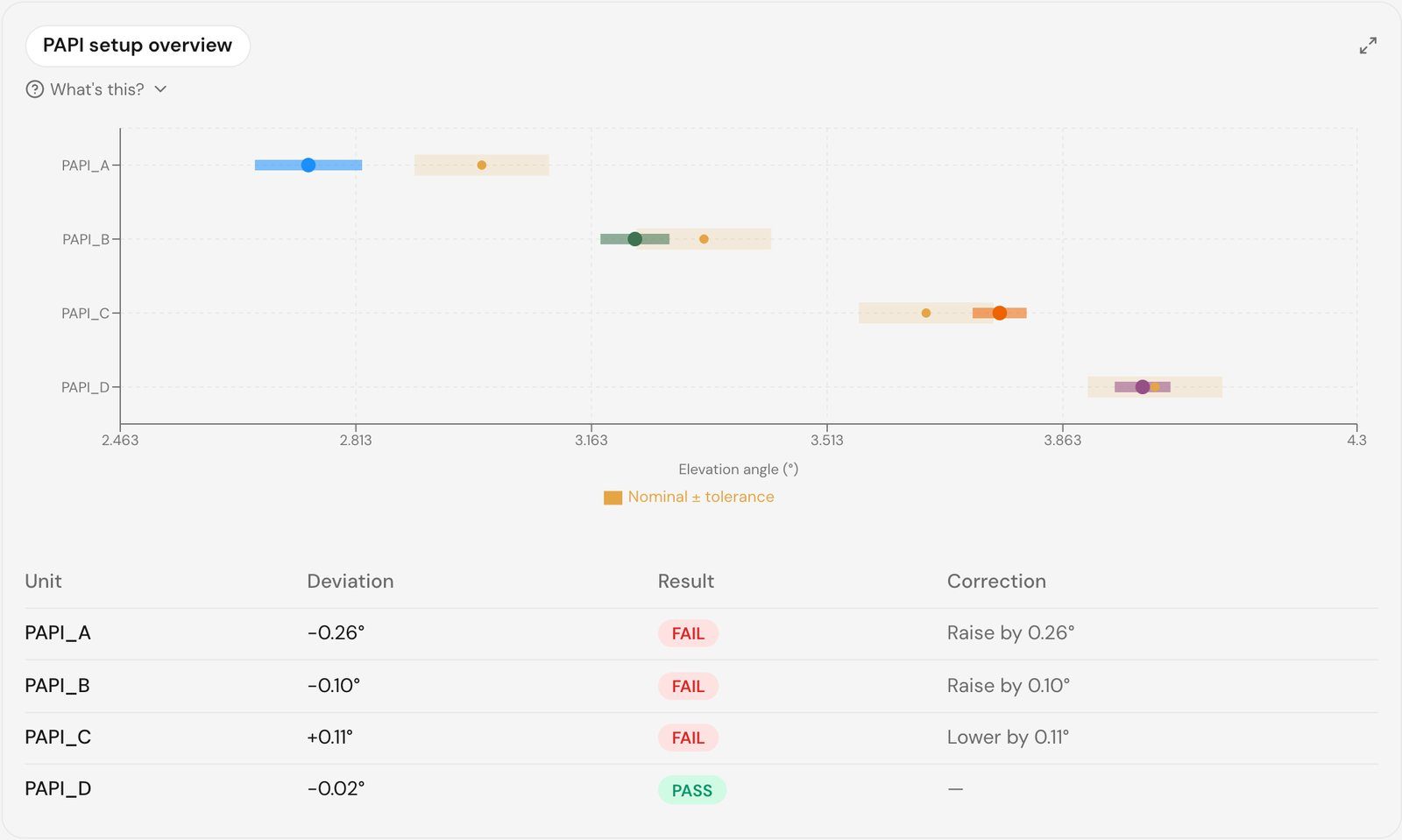
Transition angle per unit, fitted across the colour change. The same profile flown after the adjustment shows what the correction changed.
What it does not answer
- It does not adjust or certify. TarmacView measures and reports. The aerodrome’s technician or contractor adjusts the units.
- It does not measure light output in candela. Intensity is reported relative to the neighbouring units only.
- It does not verify the ILS. The ILS signal is verified by flight inspection.
- It does not replay one crew’s approach. It shows where each unit’s transition sits today, not what one pilot saw on one day.
- It does not stand in for a required flight check. Where the authority asks for one after a change, it is still flown.
Neither method closes the runway. The drone flies between movements, and the calibration aircraft flies approaches with the runway open.
Objections worth raising before you buy
“The flight check passed, so the PAPI is fine.” The flight check passed the system on the day it flew. Pilot reports after that date are new information. The EU acceptable means of compliance ask for unit errors above one minute of arc to be corrected, whatever the system result was.
“Calling the aircraft back is the proper answer.” Where the authority requires a flight check, it is. Where a calibration of the ILS or of a VHF omnidirectional range (VOR) is already scheduled, the aircraft verifies the lights for around 3,000 EUR. Flown in for the lights alone, it charges ferry both ways. Either way, the technician still needs to know which unit to correct before the aircraft returns. The PAPI calibration cost guide sets out the market. TarmacView’s check is quoted per aerodrome.
“A drone result that disagrees with the aircraft will not be accepted.” Ask the authority about the parameter, not the platform. Doc 9157 Part 4 names the unmanned aircraft method. The measurement is offered as evidence for the authority to assess, with the frames and positions behind each angle.
“We already re-aimed it with the clinometer.” Good, and the next correction will use it too. The clinometer shows the box is set. It cannot show a misalignment between the optics and the datum plate, and it cannot show what the crew sees.
Related tasks
The PAPI inspection is the service this page draws on, with everything measured per unit. PAPI out of tolerance covers the general case of a suspected unit, with or without a flight check. The Trenčín Airport case study follows a measurement, a contractor’s re-aiming and a re-check on a real PAPI. The companion post explains why a flight check and the crews’ view can differ . For how the drone and the aircraft divide the work, see drone survey versus flight inspection . To set the units precisely in the first place, see set your PAPI right the first time .
Frequently Asked Questions
- What are the alternatives to a flight inspection aircraft for checking a PAPI?
- ICAO Doc 9157 Part 4 describes several. The technician's clinometer checks each unit's setting angle at the box. A ground survey with a theodolite, image analysis from a tripod and a checkboard check the beam independently of the clinometer. Paragraph 8.3.43 adds an unmanned aircraft as an alternative method for measuring PAPI settings. The State decides whether any of them stands in for a flight check. TarmacView offers the unmanned aircraft method and measures every unit from the approach.
- How accurate is a drone PAPI check compared with an aircraft flight inspection?
- The two are judged against different limits, so one figure does not compare them. The United States flight inspection manual accepts an effective glide path angle within 0.20 degrees of the established angle. That angle is the average of the two middle units. A drone measurement reports the transition angle of each unit separately, from surveyed positions and many frames. Doc 9157 gives no accuracy figure for the unmanned method. The figure has to come from the provider's measurement uncertainty statement, so ask for it in writing.
- Can a PAPI pass a flight check and still be wrong for pilots?
- Yes, and without either side being mistaken. A flight inspection classifies the system as a pilot sees it on the approach. Maintenance rules judge each unit, and the EU acceptable means of compliance ask for errors above one minute of arc to be corrected. A unit can sit outside that limit while the system angle stays inside a wider one. A unit can also move, or be re-aimed, after the aircraft has left.
- Does the drone check replace the flight inspection?
- No. The EU acceptable means of compliance ask for a flight check of the lighting, including the PAPI, at least yearly. They also ask for special flight checks after major maintenance or changes. Flight inspection verifies the PAPI angles, the approach lighting and the runway lighting, and it checks the PAPI against the ILS. The drone check is an independent unit-level measurement that sits beside it. Neither method closes the runway.
- Do we need a NOTAM while the PAPI is checked again?
- A NOTAM follows the status of the PAPI, not the size of the error. ADR.OPS.A.057(b) lists the withdrawal of, or significant changes to, visual aids and the interruption of major lighting components. If the PAPI is switched off or withdrawn while it is checked, a NOTAM is originated. If it stays in service and a unit is corrected, the finding goes into the maintenance record. Your own procedure and your authority settle the cases in between.
- Who has asked TarmacView for a second opinion on a PAPI?
- The two main Slovak commercial airports called TarmacView after a flight inspection, and the repair that followed, left PAPI indications that pilots complained about. TarmacView measured the PAPI and gave the airports the results. Trenčín Airport and Žilina Airport have also asked for a second opinion. The measured values belong to each airport's maintenance record and are not published here.
- Is a drone check cheaper than calling the aircraft back?
- It depends on whether the aircraft is coming anyway. In Slovakia, Czechia and Hungary a flight calibration runs about 3,000 EUR per measurement flight hour. The lights of one bidirectional runway take about an hour. So the aircraft verifies them for around 3,000 EUR when an ILS or VOR calibration is already scheduled. Flown in for the lights alone, it also charges ferry both ways. TarmacView publishes no rate and quotes per aerodrome.
References
- easa-ear-aerodromes
- Easy Access Rules for Aerodromes (Regulation (EU) No 139/2014), including CS-ADR-DSN Issue 7 European Union Aviation Safety Agency
- faa-order-8200-1
- Order 8200.1D, United States Standard Flight Inspection Manual, with Change 1 Federal Aviation Administration
- icao-doc-9157-part-4
- Doc 9157, Aerodrome Design Manual, Part 4: Visual Aids, Fifth Edition, 2021 International Civil Aviation Organization
- faa-ac-150-5340-26c
- AC 150/5340-26C, Maintenance of Airport Visual Aid Facilities Federal Aviation Administration
- uk-caa-cap-168
- CAP 168, Licensing of Aerodromes, thirteenth edition (July 2025, version 13 re-issued 2 December 2025) UK Civil Aviation Authority
- cee-operator-rates
- Flight calibration rates and durations in the Slovak, Czech and Hungarian market Written exchange with a flight inspection operator active in the region
- expert-review-2026-09
- Review of the aircraft duration and scope Written review by an aeronautical ground aids measurement specialist