Why a PAPI Can Pass a Flight Check and Still Look Wrong to Pilots
Why a PAPI can pass a flight inspection and still look wrong to pilots. Seven sourced reasons, what the rules ask for next and how to settle it unit by unit.
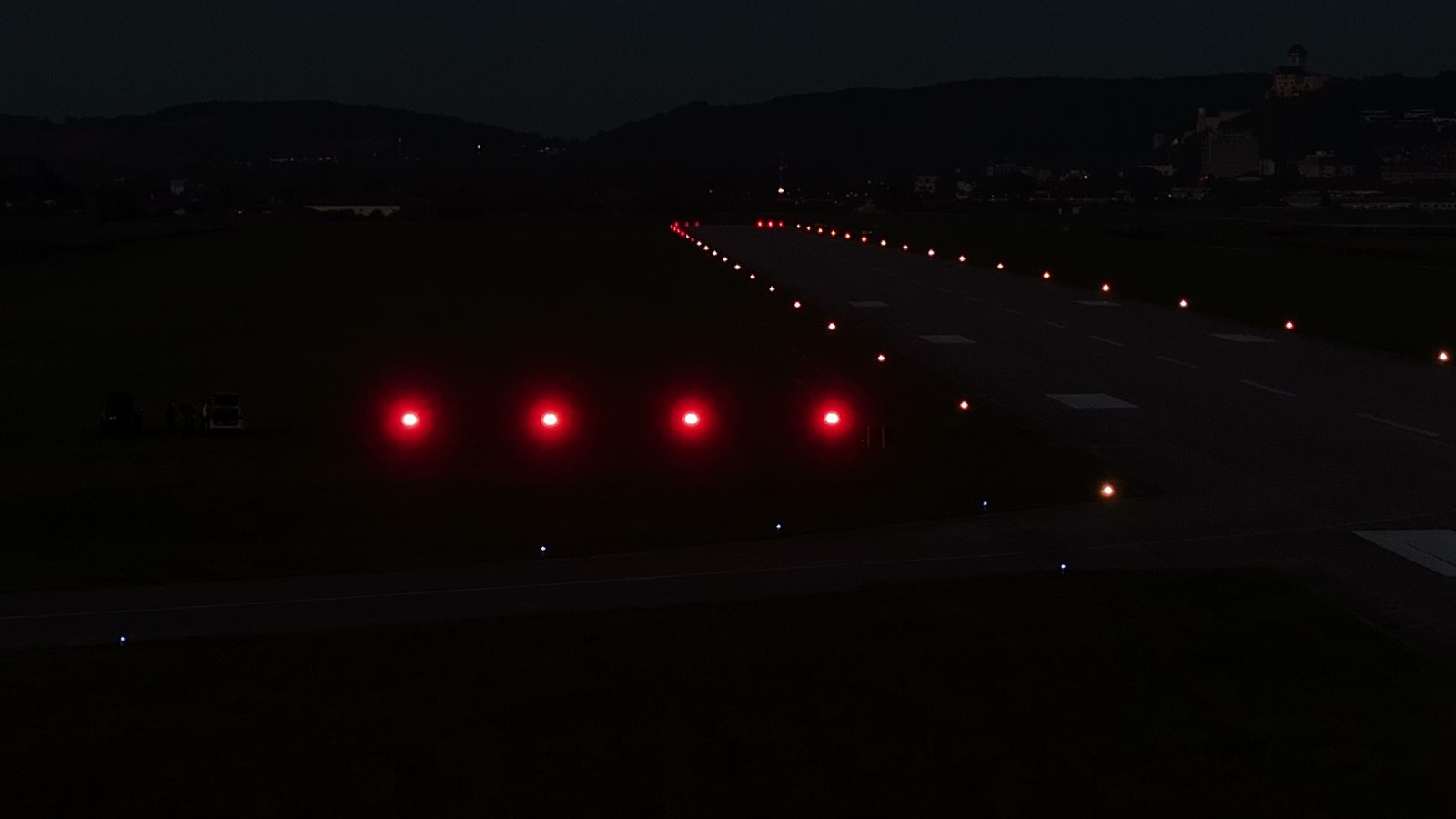 TRENČÍN · PAPI FROM OUR DRONE · ALL RED BELOW THE GLIDE PATH
A precision approach path indicator (PAPI ) can pass a flight inspection and still look wrong to pilots because the two judge different things. The aircraft classifies the system on its effective angle, on one day. Pilots see single units, later, from other eye heights and in other conditions. Both can be right.
Flight inspection does check the PAPI, and nothing below says otherwise. This post lists seven ways the two views can disagree, each from a named source. For the practical side, see PAPI still wrong after a flight check .
What does a flight inspection check on a PAPI?
Three public texts describe it.
- The European Union (EU) text. The acceptable means of compliance to ADR.OPS.C.015(b) and (f) ask for a flight check of the lighting, including the slope indicators, at least yearly. On precision approach runways, the guidance material adds the correct approach slope and compatibility with the non-visual aids.
- The guidance of the International Civil Aviation Organization (ICAO). Doc 9157 Part 4 says a new installation should be flight inspected for range, brilliancy control and setting angles. It adds compatibility with the precision instrument glide path. For the angles its words are “to ensure that there is no gross misalignment” (8.3.42).
- The United States manual. Order 8200.1D of the Federal Aviation Administration (FAA) lists seven checks at commissioning. They are light intensity, glide path angle, angular coverage, obstruction clearance, system identification and contrast, radio control, and coincidence with the electronic glide path (7.3.a).
The FAA manual sums up the purpose. Flight inspection checks “the overall appearance and usability of the system as viewed by the pilot on the approach” (7.3).
Why can the two views disagree?
| # | Reason | Source |
|---|---|---|
| 1 | The flight inspection result is a system angle | FAA Order 8200.1D, 7.3.b(2) and 7.5.b |
| 2 | The flight inspection limit and the unit aiming limit differ in size | FAA Order 8200.1D, 7.5.b. EU acceptable means of compliance |
| 3 | The angle rests on called colour changes | FAA Order 8200.1D, 7.3.b(2) |
| 4 | The box was reset and the beam was not seen again | Doc 9157 Part 4, 8.3.22 and 8.3.32 |
| 5 | The ground moves after the aircraft has gone | Doc 9157 Part 4, 8.3.20. EU guidance material |
| 6 | Pilots sit at different eye heights | Doc 9157 Part 4, 8.3.53 and 8.3.54. FAA Order 8200.1D, 7.3.b(7) |
| 7 | Conditions change what the eye sees | FAA Order 8200.1D, 7.4. Annex 14, 5.3.5.35 |
1. The flight inspection result is a system angle
The FAA manual defines the PAPI angle as an average. The effective on-path angle is “the average of the individual angles measured for two light boxes”. On a four-box system these are boxes 2 and 3 (7.3.b(2)). The tolerance in 7.5.b applies to that effective angle.
The manual also asks the inspector to measure and report the angles of all four boxes. Adjustments are made when the symmetry is unacceptable. The tolerances in 7.5 give no figure for a single box or for symmetry.
The consequence is arithmetic, not a statement from the manual. An average of two units does not move when one is high and the other is low by the same amount. The two outer units do not enter it. A pilot sees each of the four units change colour.
2. The two limits differ in size
Five texts set limits, and they limit different things. CAP 168 is Civil Aviation Publication 168 of the United Kingdom Civil Aviation Authority.
| Text | What it limits | Figure |
|---|---|---|
| FAA Order 8200.1D, 7.5.b(2) | Effective glide path angle found by flight inspection | Within 0.20 degrees of the established or desired angle |
| Doc 9157 Part 4, 8.3.42 | Setting angles at the flight inspection of a new installation | No figure. The check is for gross misalignment |
| Acceptable means of compliance to ADR.OPS.C.015(b) and (f) | Alignment errors found in ground checks | Errors in excess of 1 minute of arc should be corrected |
| CAP 168, 6.491 | Elevation setting error of one unit | Unserviceable above ±1 minute of arc |
| FAA Advisory Circular 150/5340-26C, Table A-7 | Vertical aiming of each unit | ±2 minutes initially, ±6 minutes in operation |
A limit of 0.20 degrees is 12 minutes of arc. At 1,000 m from the unit, 12 minutes is about 3.5 m of height, and 1 minute is about 0.3 m. That is our arithmetic, not a figure from the texts. A unit can therefore sit outside its aiming limit while the system angle stays inside the flight inspection limit.
The FAA manual expects ground settings and flight results to differ at times. If the effective angle is out of tolerance, the units may be adjusted beyond the ground maintenance tolerances to satisfy the flight inspection. Those settings then become the reference for later alignments (7.3).
3. The angle rests on called colour changes
The FAA manual describes how the angle is taken. In the level run method with a theodolite, the pilot calls each indication and the operator notes the angle. At least two runs are averaged at commissioning. In the on-path method the aircraft flies the colour change of one box. The box angle is the average of at least three colour changes in each direction.
The manual adds a warning. Unequal numbers of white-to-red and red-to-white calls skew the average towards the larger number (7.3.b(2)).
4. The box was reset and the beam was not seen again
A flight inspection finding is corrected on the ground, with a clinometer . Doc 9157 Part 4 names the limit of that tool. It measures aiming against the physical structure of the unit, not the projected beam. The optical axis may differ from the mechanical axis after damage in transport or a blow from snow blower exhaust (8.3.32). The manual says the cause of a misalignment is found and corrected before the setting angles are adjusted (8.3.22).
CAP 168 says a clinometer is for a quick check. A unit adjusted with one must then be checked with a suitable instrument and flight checked as soon as possible (6.484 and 6.485). The EU acceptable means of compliance ask for special flight checks after major maintenance or changes.
Until one of those checks is made, the flight inspection report describes the PAPI before the adjustment. Crews are looking at the PAPI after it.
5. The ground moves after the aircraft has gone
The EU acceptable means of compliance ask for a flight check at least yearly. The FAA manual has no periodic flight inspection requirement for these systems. Between flight checks, the angle is held by ground checks.
Doc 9157 Part 4 says units need checking more often where the ground is less stable, or where extreme weather may move the bases. It finds a monthly alignment check adequate in many circumstances (8.3.20). The EU guidance material names frost, heavy rain and drought. The FAA maintenance circular adds freezing, thawing, changes in soil moisture and contact with mowing equipment (5.7.1.2).
6. Pilots sit at different eye heights
A PAPI on a runway with an instrument landing system (ILS ) is sited for a range of aircraft. Annex 14 requires the visual slope to conform as closely as possible with the ILS glide path (5.3.5.37). Doc 9157 Part 4 says the result depends on the eye-to-antenna height of each aircraft type (8.3.53 and 8.3.54).
Its worked example shows the effect. Aircraft with a larger eye-to-antenna height tend to leave the on-slope sector from above. Aircraft with a smaller one tend to leave it from below. Widening the on-slope sector from 20 to 30 minutes of arc improves the agreement.
The FAA manual describes one siting where the two paths differ by design. A PAPI for Height Group 4 aircraft meets the runway 300 to 350 ft beyond the ILS point, which is about 91 to 107 m. The manual allows non-coincidence where it is published (7.3.b(7)). A crew can therefore see a PAPI that disagrees with the ILS while every unit sits on its angle.
7. Conditions change what the eye sees
The FAA manual says so in its analysis paragraph. “Many factors, such as snow, dust, precipitation, color of background, terrain, etc., affect the pilot’s color interpretation” (7.4). It adds that guidance may deteriorate as the pilot nears the threshold, because the light sources spread and the colours narrow. It also says the flight inspection should avoid bright sunlight where possible (7.3.b(1)).
Annex 14 treats deposits on the unit as a design matter. Condensation, snow, ice and dirt must not affect the contrast between red and white or the elevation of the transition (5.3.5.35). Doc 9157 Part 4 says heaters may be needed. Units with no means of warming the lenses need a brief warm-up at full intensity before use (8.3.19).
What do the rules say must happen?
None of the texts we read covers a flight inspection result and pilot reports that disagree. They do set duties that apply.
- Correct the unit. The EU acceptable means of compliance say errors in excess of one minute of arc should be corrected. The guidance material asks for the cause to be found first.
- Check again after the adjustment. The EU text asks for special flight checks after major maintenance or changes. CAP 168 asks for a flight check as soon as possible after a clinometer adjustment (6.485).
- Report the status. An EU operator reports matters of operational significance to the air traffic and aeronautical information services (ADR.OPS.B.015(a)).
- Decide on the notice to airmen (NOTAM ). ADR.OPS.A.057(b) ties it to the withdrawal of, or significant changes to, visual aids. Our post on what the rules say when a PAPI is out of tolerance covers each case.
- Keep the record. ADR.OPS.C.015(g) requires records of maintenance activity.
How do you settle it?
Settle it at the level the complaint is made, which is the single unit.
- Line up the dates. Put the flight inspection report, each adjustment since and each pilot report on one timeline.
- Measure each unit independently of the clinometer. Doc 9157 Part 4 asks for a ground check by an independent method (8.3.24). It describes a theodolite survey, image analysis, a checkboard and an unmanned aircraft method (8.3.43).
- Compare unit and system. Set the mean of the two middle units beside the angle in the flight inspection report. Then look at each unit against its set angle.
- Find the cause, correct and measure again. The second measurement uses the same method as the first, so the two compare directly.
- Take both records to the authority. Where a flight check is required after the change, it is still flown.
How accurate are the alternatives?
Doc 9157 Part 4 gives about 3 minutes of arc for the ground survey and better than 1 minute for image analysis (8.3.30 and 8.3.33). It gives no figure for the unmanned aircraft method. It says a real time kinematic base station is necessary for high dimensional precision (8.3.43). The accuracy figure for a drone measurement has to come from the provider’s own uncertainty statement. Ours puts the combined worst case at ±0.0072° and guarantees ±0.017°, which is 1 minute of arc. The budget is in how a drone measurement becomes evidence . Our post on how PAPI transition angles are verified describes each method.
What does calling the aircraft back cost?
It depends on whether the aircraft is coming anyway. In Slovakia, Czechia and Hungary a flight calibration runs about 3,000 EUR per measurement flight hour. The lights of one bidirectional runway take about an hour. Flown in for the lights alone, the aircraft also charges ferry both ways. Our guide to drone survey versus flight inspection compares the two in full.
Where TarmacView has done this
The two main Slovak commercial airports called TarmacView in this situation. A flight inspection by a calibration aircraft, and the repair that followed, left PAPI indications that pilots complained about. TarmacView came, measured the PAPI and gave the airports the results. Trenčín Airport and Žilina Airport have also asked for a second opinion. The Trenčín Airport case study follows one such measurement, the contractor’s re-aiming and the re-check.
TarmacView’s PAPI inspection reports a transition angle for every unit, seen from the approach. We do not adjust the units, and the measurement is an independent check beside the flight inspection. Whether an authority accepts it as verification is covered in our guide on regulatory acceptance .
What does this post not settle?
- European flight inspection limits. The 0.20 degree figure is from the United States manual. A European provider works to its own approved procedures, which we did not find in public.
- Your own case. The seven reasons are ways the two views can differ. Only a measurement shows which one applies at your aerodrome.
- National rules. Your Aeronautical Information Publication, the competent authority and your approved programme decide the interval, the limit and the NOTAM procedure.
For the precision of the check itself, see how precise is a PAPI flight check .
Frequently Asked Questions
- Can a PAPI pass a flight check and still look wrong to pilots?
- Yes. A flight inspection classifies the system, and FAA Order 8200.1D takes the PAPI angle as the average of the two middle units. Pilots see each unit change colour, later and from other eye heights. Both views can be right at once.
- What tolerance does a flight inspection apply to a PAPI?
- FAA Order 8200.1D requires the effective glide path angle within 0.20 degrees of the established angle, which is 12 minutes of arc. ICAO Doc 9157 says the setting angles are checked for gross misalignment. Neither is a unit aiming limit.
- Why would a drone and a flight inspection aircraft report different PAPI angles?
- They report different quantities. The FAA manual's result is an effective angle, averaged from two units and from called colour changes. A drone measurement gives one transition angle per unit. Doc 9157 gives no accuracy figure for the unmanned method, so ask the provider for its uncertainty statement.
- Is there an alternative to calling the flight inspection aircraft back?
- Doc 9157 Part 4 describes a theodolite ground survey, image analysis, a checkboard and an unmanned aircraft method. Each measures the beam independently of the clinometer. The State decides whether any of them replaces a flight check.
- Do pilot reports after a flight check mean a NOTAM is due?
- Not by themselves. ADR.OPS.A.057(b) ties the NOTAM to the withdrawal of, or a significant change to, a visual aid. A NOTAM is due if the PAPI is switched off or withdrawn while it is checked. No text we read sets an error size.
References
- faa-order-8200-1
- Order 8200.1D, United States Standard Flight Inspection Manual, with Change 1 Federal Aviation Administration
- easa-ear-aerodromes
- Easy Access Rules for Aerodromes (Regulation (EU) No 139/2014), including CS-ADR-DSN Issue 7, revision of March 2026 European Union Aviation Safety Agency
- icao-doc-9157-part-4
- Doc 9157, Aerodrome Design Manual, Part 4: Visual Aids, Fifth Edition, 2021 International Civil Aviation Organization
- icao-annex-14-v1
- Annex 14 to the Convention on International Civil Aviation, Volume I: Aerodrome Design and Operations, 9th edition, July 2022 International Civil Aviation Organization
- faa-ac-150-5340-26c
- AC 150/5340-26C, Maintenance of Airport Visual Aid Facilities Federal Aviation Administration
- uk-caa-cap-168
- CAP 168, Licensing of Aerodromes, thirteenth edition (July 2025, version 13 re-issued 2 December 2025) UK Civil Aviation Authority
- cee-operator-rates
- Flight calibration rates and durations in the Slovak, Czech and Hungarian market Written exchange with a flight inspection operator active in the region
- expert-review-2026-09
- Review of the aircraft duration and scope Written review by an aeronautical ground aids measurement specialist
Founded by flight-inspection veterans who spent decades measuring PAPI lights for aviation authorities across Europe.
Learn more
Related terms
03 TERMSCommissioning Flight Inspection
A commissioning flight inspection is the first flight check of a new or changed aid. When the FAA requires one for a PAPI, what is checked and how to prepare.
PAPI Approach Slope and Elevation Setting
The PAPI approach slope and elevation setting are the approach angle a PAPI shows and the angle of each unit. Setting angles for 3 degrees, tolerance, how they are measured, and drones.
Precision Approach Path Indicator (PAPI)
A precision approach path indicator (PAPI) is a row of lights beside a runway. What PAPI means, what the red and white pattern shows, unit angles, siting, the APAPI, the VASI, and the checks.
Further reading
03 ARTICLES
How Precise Is a PAPI Flight Check, and Can an Airport Do Better?
How precise a PAPI flight check is, why an aircraft cannot hover or fly several eye heights, and how a drone gives a value per unit for exact setting.
PAPI Commissioning Flight Check After an LED Retrofit
What a PAPI commissioning check involves after an LED retrofit: when the FAA requires a flight inspection, the seven checks, and what LED changes and…

How PAPI Transition Angles Are Verified in the Field
How to verify PAPI transition angles in the field: clinometer and ground checks, flight checks and drone measurement, with the ICAO, EASA and FAA…